

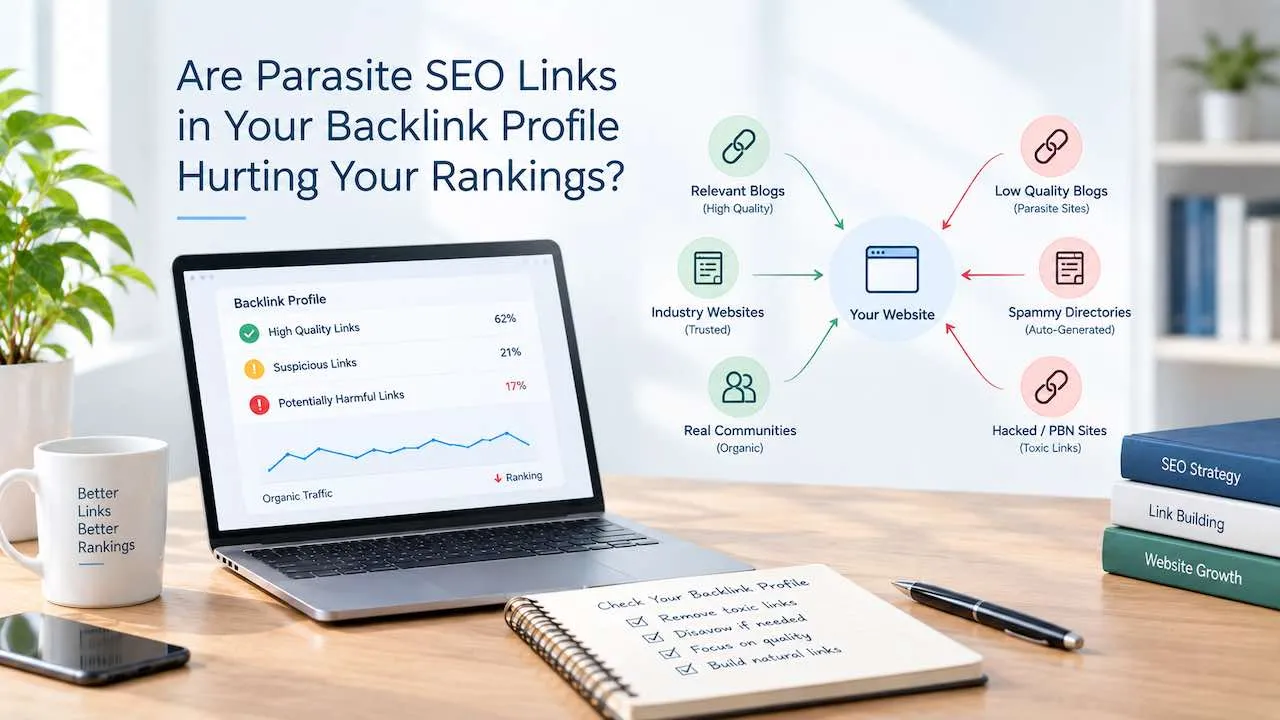
Parasite SEO links in your backlink profile can hurt your rankings in two ways. If Google’s spam detection flags the parasite host site, those links lose all equity. If your site receives a suspicious pattern of parasite links, Google may flag your domain. The reason is unnatural link building. The risk level depends on which scenario applies. This guide covers both scenarios. It draws on Google’s Site Reputation Abuse policy, SpamBrain AI updates through 2026, and real enforcement examples.
Google issued its Site Reputation Abuse policy in March 2024. Manual actions followed in mid-2024 against major parasite sections. Forbes Advisor, WSJ Buy Side, CNN Underscored, and Time Stamped were all affected. Sistrix documented millions of dollars in traffic-value losses across those domains in November 2024. The editorial oversight loophole closed the same month. Any link building strategy that used those parasite pages is now under active enforcement risk. If your backlink profile includes links from those sources, act carefully. Understand your actual exposure level before making any changes.
What Parasite SEO Links Look Like in a Backlink Profile
Parasite SEO links in a backlink profile appear as links from high-authority domains pointing to your site. They come from subfolders, subdomains, or sections of that domain. None of those sections are topically related to the main domain. A link from forbes.com/coupons/ pointing to a software review page is a textbook parasite SEO link. The domain authority is real. The topical relationship is manufactured. Google can detect both signals at once. The authority is real. The topical alignment is manufactured.
5 Types of Parasite SEO Link Sources
- News site coupon and deals sections: Subfolders like /deals/, /coupons/, /promo-codes/ on major publishers. Google issued the first wave of manual actions against these in mid-2024. Forbes Advisor and CNN Underscored were two of the largest cases documented by Sistrix
- User-generated content platforms: Medium articles, LinkedIn Pulse posts, Reddit submissions, Quora answers, and SlideShare presentations created by third parties to pass link equity. Google’s SpamBrain AI now identifies coordinated posting patterns across them
- Subdomain rental schemes: Rented subdomains on high-DA domains where a third-party publishes off-topic content targeting money keywords. These carry the parent domain’s authority with zero topical connection to it
- Press release and wire service spam: Links embedded in low-value press releases distributed across PRWeb, BusinessWire, or Globe Newswire, then picked up by auto-publishing aggregators at scale
- Translated or syndicated parasite content: Content scraped or translated into multiple languages and republished on high-DA regional media sites to multiply the link count from a single parasite campaign
Editorial Links vs High Authority Domain Abuse: Key Differences
| Signal | Parasite SEO Link | Legitimate Editorial Link |
|---|---|---|
| Topical relationship | None between host section and linked content | Strong relevance between host publication and your content |
| Host section origin | Subfolder or subdomain run by a third party, not the host editorial team | Published directly by the editorial team with original oversight |
| Anchor text pattern | Exact-match money keywords; over-optimized and repetitive across multiple links | Natural, varied anchors reflecting how an editor would reference the source |
| Link velocity | Multiple links placed simultaneously across many parasite domains in a campaign | Sporadic, organic link acquisition matching the natural publishing schedule |
| Google enforcement status | Active enforcement via manual actions and SpamBrain algorithmic scoring | Counted as a positive authority signal unless the host site is penalized |
How Google Spam Detection Identifies Parasite SEO Links
Google uses three systems to identify parasite SEO links at the host domain level. These are SpamBrain AI, section level independence scoring, and human quality raters. The detection process evaluates the link source first. Only then does it evaluate the destination. A link from a penalized parasite section carries zero equity. It passes nothing to your site. A link from an unpenalized parasite section may still carry equity today. It remains under active enforcement risk.
SpamBrain AI and Link Graph Anomaly Detection
SpamBrain is Google’s AI-based spam detection system. It evaluates link graphs for patterns that indicate coordinated or manipulative link building. SpamBrain flags a potential link scheme when dozens of high-DA sites link to the same domain. The flag triggers when similar anchor text patterns appear within a short timeframe. The August 2025 SpamBrain refresh strengthened detection of these coordinated patterns. Google confirmed the March 2026 refresh did NOT specifically target site reputation abuse. It was a general SpamBrain improvement.
SpamBrain evaluates both the host domain and the linked-to domain. A site receiving 40 parasite section links within six months generates a link graph anomaly. SpamBrain detects this across Forbes, CNN, and WSJ subfolder schemes. That signal alone does not guarantee a penalty. Combined with other spam signals, that anomaly increases manual action probability.
Section Level Independence Scoring
Google can evaluate subfolders and subdomains as independent content entities. This is section-level independence scoring. A /deals/ subfolder on a news site is assessed separately from the main editorial domain. Google applies a reduced trust score to a subfolder with no topical connection. The main site’s trust does not protect that section. Links from that section carry reduced or zero equity as a result. This explains why the November 2024 enforcement wave de-ranked entire parasite sections. Individual pages were not the only target. The whole section lost its independence-level trust score.
The November 2024 Oversight Loophole Closure
Before November 2024, some publishers used a human editorial review as a defense. They argued this protected their parasite sections from enforcement. Google’s enforcement update closed that defense permanently. The May 2024 Site Reputation Abuse policy made this clear. Editorial oversight does not override the fundamental question. That question is: does this section exist to benefit users, or to pass PageRank? Human editorial approval of off-topic monetization content fails that test. Forbes Advisor and Time Stamped both had human editorial oversight in place. Both still received manual actions under the November 2024 wave.
How Parasite SEO Links in Your Backlink Profile Actually Hurt You
The risk parasite SEO links pose depends on your role. You are either the host site or the link beneficiary. These are two different risk profiles with two different remediation paths. Understanding your role determines your next step. You may need a disavow strategy. Or you may only need to monitor your backlink profile for equity changes.
The Asymmetric Risk: Host Site vs Link Beneficiary
The host site that published parasite content carries the highest risk. Google’s manual actions and algorithmic enforcement target the publishing platform directly. The platform loses traffic, rankings, and domain trust. The link equity it passed to your site disappears at the same time.
Your site faces a lower but real risk as the link beneficiary. If your backlink profile shows a coordinated parasite link pattern, Google may flag your domain. Unnatural link building is the likely classification. This scenario triggers manual action review for the linked-to site. The threshold is pattern-based rather than individual-link-based. One parasite link from Forbes does not trigger a penalty alone. Thirty parasite links across five campaigns within four months is a concerning pattern. That pattern warrants manual action investigation.
Unnatural Link Profile Penalty Signals
Google’s spam team evaluates link profiles for patterns rather than individual links. These pattern signals increase your manual action risk as a link beneficiary:
- Multiple links from the same publisher’s parasite section pointing to the same page on your domain
- Exact-match commercial anchor text repeated across multiple parasite sources within a short timeframe
- Links from parasite sections across multiple unrelated verticals (finance, health, tech, travel) pointing to a single commercial page
- Temporal clustering: most parasite links acquired during a single campaign period rather than over time
- Links from parasite sections that have already received Google manual actions
HCU and Site Reputation Abuse Impact on Link Equity
The Helpful Content Update (HCU) and the Site Reputation Abuse policy work as separate but compounding enforcement mechanisms. The HCU reduces the ranking value of unhelpful content. Site reputation abuse enforcement removes PageRank transfer value from entire domain sections. When a parasite host site loses section-level trust, all its links lose equity instantly. This happens as soon as the site reputation abuse policy applies. Your rankings may drop for any keyword that depended on that link equity. This drop often appears in Search Console as an impression decline. No corresponding ranking change shows alongside it. Diagnosis requires backlink audit data, not just Search Console.
The Google core update recovery and link building guide covers how to identify these equity losses and replace them with links that carry stable authority signals not subject to site reputation abuse enforcement.
How to Identify Parasite SEO Links in Your Backlink Profile
Identify parasite SEO links using Search Console, Ahrefs, Semrush, or Majestic to audit your referring domains. Then cross-reference each domain against Google’s enforcement history. The audit runs in three stages. Export your full link profile first. Then filter for suspect domains. Then classify each suspect link by risk level.
Search Console Link Audit Method
Go to Google Search Console. Click Links in the left navigation. Click Export External Links. Download the full external links CSV. Open the file and filter the Linking Domains column for major publishers. Look for subfolders in the linking URL column that suggest parasite content. Common subfolder patterns to flag: /deals/, /coupons/, /sponsored/, /review/, /partner/, /contributor/, and /bestreviews/. Cross-reference each suspect domain against the confirmed mid-2024 and November 2024 manual action lists. Search Console shows link existence only. It does not show equity values. It only confirms link existence. Use a third-party tool for authority and trust scores.
Third Party Tool Analysis
- Ahrefs Backlink Audit: Filter referring domains by traffic. Parasite sections on penalized domains often show a dramatic traffic drop at a specific date. Cross-reference that date with Google update announcements. A November 2024 or mid-2024 traffic cliff on a referring domain is a strong signal the link lost equity
- Semrush Backlink Audit: Use the Toxicity Score filter. Score thresholds above 45 warrant manual review. Parasite section links often cluster in the 50 to 75 range. Do not disavow solely based on toxicity score. Use it as a triage tool to prioritize manual review
- Majestic: Check the Trust Flow versus Citation Flow ratio of each suspect referring domain. A high Citation Flow with a low Trust Flow (below 0.3 ratio) on the specific subfolder URL is a parasite SEO signal
Red Flags That Confirm Parasite SEO Links
| Red Flag | What It Indicates | Risk Level |
|---|---|---|
| Link URL contains /deals/, /coupons/, /sponsored/, /contributors/ | Third-party monetization subfolder running independently of editorial team | High: matches Google’s stated site reputation abuse criteria |
| Referring domain traffic dropped in November 2024 or mid-2024 | Domain received manual action during Google’s first enforcement wave | High: link equity from that domain is likely zero |
| Multiple links from same publisher pointing to same page | Pattern indicates coordinated parasite placement campaign | High: pattern-based penalty signal for your domain |
| Exact-match commercial anchor text across multiple parasite sources | Unnatural anchor text pattern consistent with paid link scheme | Medium-High: compounds risk when combined with other signals |
| Link from user-generated content platform with no editorial oversight | Platform hijacking via Medium, LinkedIn Pulse, Quora, or Reddit | Medium: SpamBrain detects coordinated UGC placement patterns |
| Link from subdomain not indexed in main domain sitemap | Rented subdomain scheme with no connection to host site’s editorial content | High: matches site reputation abuse and subdomain rental patterns |
Disavow Strategy for Parasite SEO Links
A parasite SEO disavow strategy should target patterns, not individual links. Disavowing every parasite-looking link removes real equity alongside spam equity. That mistake worsens rankings in the short term. The Google Disavow Tool sends a permanent signal to Google’s systems. Use it with a precise classification system. Never use it as a general cleanup sweep of suspicious URLs.
When to Disavow vs When to Leave Links Alone
Disavow parasite SEO links when three or more of these conditions apply. Check each condition before adding any URL to your disavow file:
- The referring domain received a confirmed Google manual action
- The linking subfolder or subdomain has zero topical relevance to your site
- You have a pattern of 10 or more parasite links across coordinated campaigns
- The link uses exact-match commercial anchor text
- Your Search Console data shows an impression drop correlated with the parasite domain’s enforcement date
Do not disavow when:
- A single parasite-style link exists with no pattern around it
- The linking domain has not been flagged for site reputation abuse
- The subfolder still passes traffic and has not suffered an enforcement drop
- Your rankings are stable and Search Console shows no manual action notification
How to Build a Disavow File for Parasite SEO Links
Export your full backlink list from Ahrefs or Semrush. Create a plain text file. Include the linking URL and your classification reason for each entry. Classify each link as URL-level or domain-level before adding it to the file. Use URL-level disavow for individual parasite pages on legitimate domains. Use domain-level disavow only when the entire domain operates as a spam network. Format the disavow file in plain text. Prefix domain-level entries with “domain:”. Use full URLs for URL-level entries. Add comments with the hash character to explain each disavow decision. This documentation protects you during any reconsideration request review.
Submitting and Tracking Your Disavow in Search Console
Submit your disavow file through Google Search Console at search.google.com/search-console/disavow-links. Google processes disavow files within days. Ranking recovery after a disavow submission takes 2 to 12 weeks. The exact timeline depends on how frequently Google re-crawls your site. After submission, track these four metrics to confirm the disavow is working:
- Manual action status in Search Console (Security and Manual Actions)
- Total referring domains count in Ahrefs or Semrush
- Organic impression count in Search Console Performance report
- Target keyword rankings for the pages that received the parasite links
Disavow strategy forms one part of a broader link building service that builds Google-safe editorial links alongside your cleanup work. Removing parasite SEO links without replacing them with quality authority links produces no net ranking improvement.
Recovering from Parasite SEO Link Profile Damage
Recovery from parasite SEO link profile damage follows two paths. The path depends on whether Google issued a manual action or applied an algorithmic penalty. Each requires a different response, different documentation, and a different timeline expectation. Applying the wrong recovery process delays results by weeks or months.
If You Have a Manual Action
Check Search Console under Security and Manual Actions first. A manual action notification specifies the reason. It will say Unnatural Links to Your Site or Site Reputation Abuse. If the action says Unnatural Links to Your Site, complete these steps first. Do not submit a reconsideration request until all steps are done:
- Export your full backlink profile from both Ahrefs and Search Console
- Attempt manual outreach to remove the worst parasite links using verified contact information
- Document every outreach attempt with email timestamps and replies received
- Build a disavow file covering all remaining parasite links that outreach could not remove
- Submit the disavow file through Search Console Disavow Tool
- Write a detailed reconsideration request. Describe every category of parasite links you found. Document every removal attempt and every disavow action taken. Confirm what changed in your link acquisition strategy going forward
Google typically responds to reconsideration requests within 2 to 4 weeks after submission. Some requests go through multiple review rounds before the action is lifted.
If You Have an Algorithmic Penalty
Algorithmic penalties from SpamBrain or the site reputation abuse enforcement wave leave no notification in Search Console. You identify them by correlating a traffic or ranking drop against a confirmed Google update date. Two dates matter most for parasite SEO link profile damage. These are the August 2025 SpamBrain refresh and the November 2024 site reputation abuse enforcement wave.
Algorithmic recovery requires three steps. Clean the link profile first. Then build replacement authority links. Then wait for Google’s next crawl cycle to re-evaluate your domain. Full recovery from a SpamBrain algorithmic signal takes one full Google update cycle. Core update recovery through link building explains how to rebuild link authority during that recovery window without creating new spam signals.
Site Reputation Abuse Enforcement Timeline
Understanding the enforcement timeline helps you correlate ranking drops to specific Google actions. It also helps you estimate your recovery window accurately.
| Date | Event | Impact on Parasite SEO Links |
|---|---|---|
| March 2024 | Google announces Site Reputation Abuse policy alongside March core update | Formal policy definition: third-party content on high-DA domains to manipulate rankings is spam |
| May 2024 | Site reputation abuse policy takes effect | Google begins identifying non-compliant sites; editorial oversight confirmed as insufficient defense |
| Mid-2024 | First wave of manual actions issued | Forbes Advisor, CNN Underscored, Time Stamped, WSJ Buy Side receive manual actions; millions in traffic value lost |
| November 2024 | Oversight loophole formally closed; second enforcement wave | Editorial review process no longer protects parasite sections; link equity from affected sections removed |
| August 2025 | SpamBrain refresh strengthens link graph anomaly detection | Coordinated parasite link patterns across multiple domains now detected algorithmically without manual review |
| November 2025 | EU Commission opens DMA proceedings regarding Google’s site reputation abuse enforcement | Enforcement policy under formal regulatory review; enforcement continues during proceedings |
| March 2026 | SpamBrain refresh confirms continued link graph enforcement | Google confirms this update did NOT specifically target site reputation abuse; SpamBrain general improvement |
FAQs: Parasite SEO Risks and Link Profile
These are the most common questions about parasite SEO link risk in backlink profiles.
Not always. Parasite SEO links hurt rankings in two specific scenarios. First: when the host site receives a Google manual action, links from that section lose all equity. Second: SpamBrain may identify a coordinated parasite link pattern pointing to your site. Google may then flag your domain. A single parasite link from an otherwise healthy site does not guarantee a penalty. The risk scales with the number, pattern, and enforcement status of the linking parasite pages.
Check Search Console under Security and Manual Actions first. A manual action notification will specify Unnatural Links to Your Site. If no manual action appears but rankings dropped, cross-reference your traffic decline date against Google update announcements. A drop correlated with November 2024 or August 2025 SpamBrain refresh dates is an algorithmic signal. It comes from parasite link pattern detection rather than a manual action.
No. Disavow only when three or more risk signals apply simultaneously. Three conditions trigger a disavow decision. The linking domain received a confirmed manual action. The anchor text is exact-match commercial. The links form a pattern across multiple campaigns. Disavowing isolated parasite links on otherwise healthy domains removes real equity and can worsen rankings. The disavow tool is a permanent signal. Use it precisely based on pattern analysis rather than as a general backlink cleanup tool.
Platform hijacking places links through user-generated content platforms. These include Medium, LinkedIn Pulse, Reddit, and Quora. No editorial oversight is involved. Site reputation abuse exploits a major publisher’s domain authority. It does this by publishing third-party content in an off-topic subfolder or subdomain. Both manipulate PageRank through borrowed authority signals. Both are addressed by Google’s Site Reputation Abuse policy and SpamBrain AI detection. Platform hijacking tends to produce lower-authority links. Site reputation abuse exploits DR 80 to 95 domains for far higher link equity manipulation.
Manual action recovery takes 2 to 4 weeks after a successful reconsideration request. Algorithmic recovery from SpamBrain signals takes one full Google update cycle. The clock starts when the disavow is submitted and replacement link building begins. That timeline ranges from 4 to 16 weeks. Replacing the equity lost from de-ranked parasite sections is the critical variable. Sites that only disavow without building replacement links rarely recover fully. One update cycle is not enough without new authority links.