

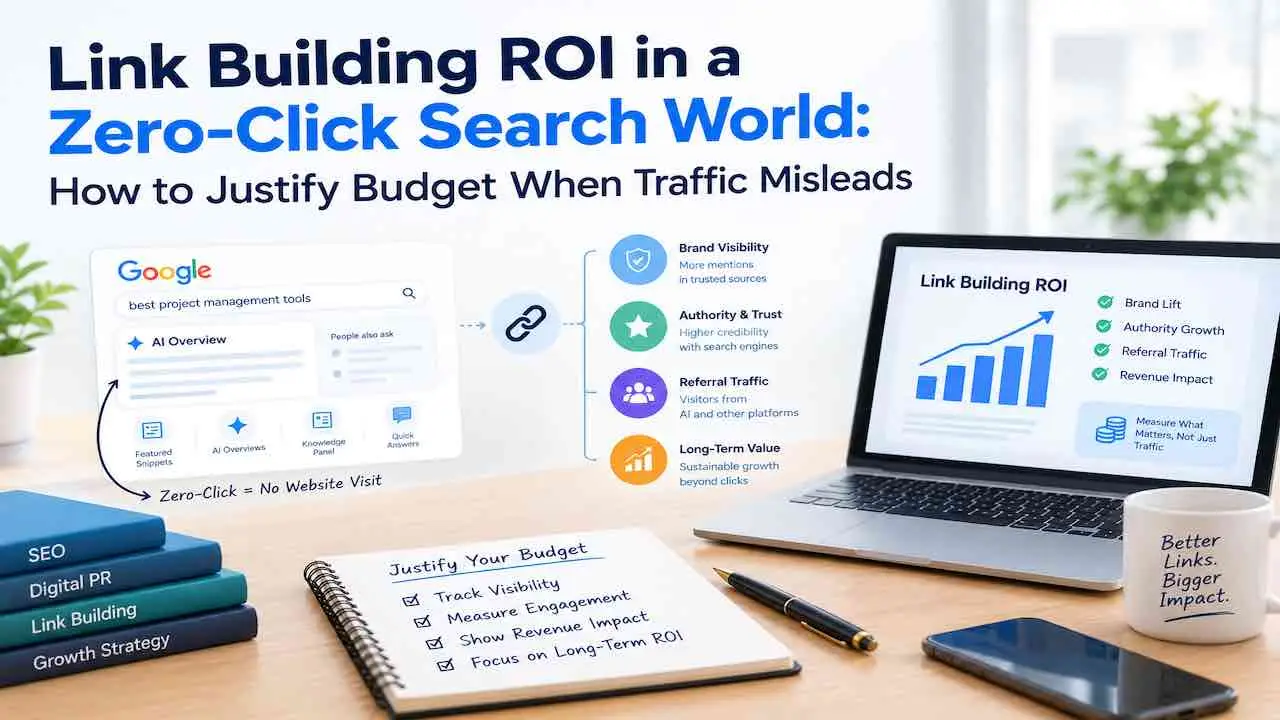
Link building ROI in a zero-click world requires six new metrics. These are brand search volume lift, organic share of voice, and AI citation rate. Referring domain growth, assisted conversions, and revenue correlation complete the set. Organic traffic sessions capture only 40% of Google searches. The other 60% resolve without a click. Traffic-based ROI reporting misses the full impact of every link you build.
78.1% of SEO professionals report positive ROI from link building, per Authority Hacker and editorial.link’s 2025 survey. Yet link building budgets get cut every year. The reason is measurement failure, not performance failure. This guide fixes that. It gives you exact metrics, three calculation methods, and an executive pitch framework that survives budget review.
Why Organic Traffic Misleads Link Building ROI in 2026
Organic traffic was always a proxy for link building ROI. In 2026, it has become a structurally incomplete proxy. The shift happened when AI Overviews, featured snippets, and SERPFeatures began answering queries without requiring a click. McKinsey’s 2025 research warns that 50% of brands will lose 50% of traffic. Adapting to AI-driven search is the required response. That traffic loss does not equal demand loss. It equals measurement failure.
The Zero-Click Search Numbers That Changed the ROI Equation
- 60% of all Google searches end without a click (SparkToro and Similarweb, 2026)
- On mobile devices, that figure rises to 77% (Creaeza, 2026)
- Pew Research confirmed users clicked on just 8% of searches with an AI Overview present
- Without AI Overviews, that click rate was 15%. AI Overviews nearly halved organic CTR
- First-position organic click-through rate dropped from 28% to 19% in 2025, a 32% decline
- Average CTR decline across positions 1 to 5 was 17.92% in 2025 versus 2024
- Gartner predicts traditional search volume will fall 25% in 2026 as users shift to AI
- Bain Research March 2025 found B2B software CTRs fell 30% specifically in that category
- Forrester confirmed 89% of B2B buyers use generative AI in at least one purchase stage
How SERPFeatures Accelerated the Click Collapse
SERPFeatures are SERP elements that answer queries without requiring a click. They include AI Overviews, featured snippets, People Also Ask boxes, Knowledge Panels, local packs, and shopping carousels. Each SERPFeature that resolves a query represents a session your link building influenced. Your attribution model never recorded it.
Aleyda Solis analyzed Similarweb SERP click distribution data from January 2025 to January 2026. In the headphones category, combined paid click share went from 16% to 36% in one year. Organic click share fell in parallel. Google’s Q3 2025 search ad revenue hit $56.6 billion. That is Google’s highest quarter ever. Zero-click behavior is not hurting Google. It is hurting organic traffic measurement. Zero-click search optimization strategy must account for this measurement shift.
The Billboard Effect: What Link Building Actually Produces Beyond Traffic
Similarweb put the measurement problem plainly in 2026: “The billboard does not send people to your website. You do not measure billboard ROI in clicks.” Link building has always produced brand awareness through indirect paths. Zero-click search did not break link building ROI. It revealed the flaw in measuring it through last-click traffic alone.
What a Single High Authority Link Actually Produces
When an authoritative publication links to your research, three things happen at the same time. First, your brand name enters the reader’s awareness through an editorial endorsement. No click is required. Second, your domain accumulates PageRank. That PageRank lifts your organic rankings across your full topic cluster. Third, Google’s entity recognition records a corroboration signal. That signal increases your AI Overview citation probability for related queries.
All three outcomes produce measurable downstream revenue. None of them appear as a direct organic traffic session from the citing page. Fire and Spark’s 2026 framework states this precisely: “Traffic is down. Demand isn’t. Your job is to prove it. Use revenue metrics, competitor benchmarks, and customer research.” That framework applies directly to link building ROI. Link building measurement for AI search closes that attribution gap. It tracks demand creation signals rather than demand capture clicks.
The 6 Metrics That Actually Measure Link Building ROI
Replace organic traffic sessions with these six metrics. Each one measures link building ROI accurately in a zero-click SERP environment. Each metric captures a downstream signal of the demand your link building creates. Also Each can be tracked using free or widely available tools. Each correlates with revenue in ways that organic traffic no longer does reliably.
Metric 1: Brand Search Volume Lift
Brand search volume lift measures growth in searches for your brand name and brand plus category terms. Les Binet’s marketing effectiveness research confirmed brand search volume strongly predicts future revenue. It is one of the best digital indicators available. When your link building earns coverage in authoritative publications, readers search your brand name directly. That branded query shows up in Search Console days or weeks later. No direct connection to the link appears.
Month-over-month branded query growth following a link building campaign is your most direct zero-click ROI signal. Filter Search Console Performance by queries containing your brand name. Track week-over-week impressions in the 2 to 4 weeks following each new high-authority link placement. Consistent branded query growth confirms link building drives brand discovery. Zero-click behavior makes that discovery invisible to standard traffic attribution.
Metric 2: Share of Search
Share of Search measures your brand’s search demand as a percentage of total category search demand. Divide your branded query volume by the combined volume of all named competitors. That ratio is your Share of Search. Use Google Trends relative comparison mode to do this without paid tools. Les Binet and LinkedIn B2B Institute research confirms Share of Search predicts market share. The time lag is 6 to 12 months. Brands that grow Share of Search grow revenue. Link building grows Share of Search by expanding brand visibility across authoritative editorial contexts.
Metric 3: Organic Share of Voice
Organic share of voice measures your domain’s percentage of total clicks and impressions across your target keywords. It compares you directly against all competitors. Tools including Semrush, Ahrefs, and Sistrix calculate this automatically. This is the single most reliable traffic-independent metric for measuring link building progress. Share of voice gains reflect sustained ranking improvements. Those improvements persist through SERPFeature volatility and compound into revenue over 6 to 12 months. Search Engine Land’s February 2026 analysis names “conversion-weighted visibility” as the next evolution of this metric. It weights click and impression data by the conversion probability of each keyword cluster.
Metric 4: Assisted Conversion and Dark Funnel Attribution
Assisted conversion tracking in GA4 measures conversions where organic appeared in the path. It captures this even when organic was not the last click. Configure GA4 to show data-driven attribution rather than last-click attribution. This single setting change typically increases organic’s measured revenue contribution by 20 to 40%.
Dark funnel attribution captures what GA4 cannot. B2B conversion paths regularly include zero-click SERP exposure, AI Overview reading, and podcast discovery. Only the final branded search appears in any analytics platform. Build one post-purchase survey question: “Where did you first encounter our brand before searching for us?” Track how many responses name a publication where you built a link. This is the most convincing single data point in any link building budget review.
Metric 5: Referring Domain Growth Rate
Referring domain growth rate measures the month-over-month increase in unique domains linking to your site. A healthy link building campaign adds 8 to 15 new referring domains per month for mid-market brands. Track this in Ahrefs or Semrush alongside the DR distribution of new referring domains. Share of authority takes this further. It measures your domain’s relative authority weight compared to competitors in the same topic space. This gives referring domain growth a competitive context that raw counts alone lack. Topical authority compounds across linked content clusters, lifting rankings across entire topic groups rather than individual pages.
Metric 6: AI Citation Rate
AI citation rate measures how often your domain appears in AI answers. It tracks Google AI Overviews, ChatGPT, Perplexity, Gemini, and Bing Copilot. An AI citation on a 60% zero-click query produces substantial brand exposure. It matches roughly 60% of a top-10 ranking’s reach with zero organic traffic. Track citation rate using Otterly.ai, Profound, or Semrush’s AI Toolkit. This converts invisible AI exposure into a quantifiable metric. Executives can then evaluate it against paid media CPM benchmarks. AI Overview citation optimization complements link building directly. Links build the domain authority that earns citations. Citations produce brand exposure that drives future branded searches.
How to Calculate Link Building ROI Without Traffic Data
Three calculation methods convert the six zero-click ROI metrics into revenue figures. Executives can then evaluate those figures against link building investment cost. Use all three in combination. This builds a multi-signal ROI case that does not collapse when any single metric shows volatility.
The Revenue Correlation Method
Map your referring domain count growth against revenue over an 18 to 24-month historical window. Calculate the Pearson correlation coefficient between the two data series. A coefficient above 0.7 confirms link building is a leading indicator of business results in your category. Present this correlation chart to executives. Mark the 6 to 12-month lag clearly. The lag represents the time for ranking improvements to convert into branded search growth, then into pipeline. This lag-adjusted revenue correlation is your strongest quantitative argument for sustained link building investment.
The Competitive Benchmark Method
Show the referring domain count of every competitor ranking above you for your core revenue keywords. Calculate the referring domain gap between your domain and the nearest competitor. Assign a cost per referring domain based on your current campaign cost. Project the timeline and investment required to close the gap. Present this as a market share capture investment rather than a traffic generation cost. This reframes the link building conversation from a traffic question to a market share question. The question becomes: “What will it cost to overtake Competitor X?”
The Branded Search to Pipeline Calculation
Take your average monthly branded search volume in Search Console. Apply your branded search-to-visit conversion rate (typically 60 to 80%). Apply your visit-to-lead rate and your lead-to-customer rate. Multiply by average customer lifetime value. This produces an estimated monthly revenue value for your branded search volume. When a link building campaign grows branded search volume by 15%, take action. Multiply that growth percentage against your branded search revenue estimate. The result is a quarterly revenue attribution figure for that campaign. B2B SaaS specifically achieves 702% ROI with a 7-month break-even. First Page Sage’s 2026 ROI analysis confirms this methodology. Goodfirms’ 2026 data cites 748% ROI for B2B SEO measured over the full attribution window.
The Executive Pitch Framework: Justify Link Building Budget in 2026
The executive pitch for link building budget requires three arguments. Each must survive direct challenge. Use revenue correlation, competitive displacement framing, and direct customer research. 59% of CMOs report insufficient budget to execute their strategy, per Gartner’s 2025 CMO Spend Survey. That budget pressure makes accurate ROI attribution more urgent than ever.
3 Arguments That Survive a Budget Review
Argument 1: Traffic is down. Demand isn’t. Present branded search volume growth alongside organic traffic decline. Include direct traffic growth over the past 12 months too. The divergence between declining sessions and growing branded demand reveals the attribution gap. Link building creates demand that GA4 redirects to other channels.
Argument 2: The competitive cost of stopping. Show the referring domain gap between your domain and competitors above you for your highest-revenue keywords. Calculate the cost to close that gap today versus in 18 months. 80.9% of SEOs expect link building costs to rise in the next 2 to 3 years. That is according to editorial.link’s 2025 industry report. The referring domain gap costs more to close each month you wait.
Argument 3: Customer research confirms editorial influence. Post-purchase survey data is the most convincing single argument in any budget review. It shows that 20 to 30% of customers first found your brand through editorial coverage. Creaeza’s 2026 analysis recommends this approach. It provides definitive proof when attribution data is incomplete. One quarter of survey implementation produces data no analytics platform can generate.
Stop Reporting These. Report These Instead.
| Stop Reporting | Report This Instead | Why It Survives Executive Scrutiny |
|---|---|---|
| Organic sessions per month | Branded search volume growth percentage and conversion-weighted visibility score | Branded search growth correlates directly with revenue and is not distorted by zero-click SERP behavior |
| Keyword rankings for individual queries | Organic share of voice versus named competitors across the target keyword set | Share of voice frames SEO as market share capture rather than a traffic generation activity |
| Organic traffic from linked pages only | Assisted conversion rate from organic across all paths in GA4 data-driven attribution | Assisted conversion shows organic’s role across the full buyer journey, not just last-click moments |
| Number of backlinks built per month | Referring domain growth rate and DR distribution versus named competitors | Framing the authority gap as competitive market share makes link building a business investment |
| Click-through rate on rank-tracked keywords | AI citation rate across target queries on Google AI Overviews, ChatGPT, and Perplexity | AI citation rate measures brand visibility in the channel now capturing 60% of all searches |
Tools to Measure Link Building ROI in a Zero-Click World
Every metric in the zero-click ROI framework has a free or widely available tool. None requires custom development. The stack below covers brand search monitoring through AI citation tracking and assisted conversion attribution.
| Metric | Primary Tool | Alternative | Cost |
|---|---|---|---|
| Brand search volume lift | Google Search Console (brand query filter) | Semrush Brand Monitoring | Free / Paid |
| Share of Search | Google Trends (relative comparison mode) | Semrush Market Explorer | Free / Paid |
| Organic share of voice | Semrush Organic Research (Share of Voice report) | Ahrefs Rank Tracker Share of Voice column | Paid |
| Assisted conversion attribution | GA4 Advertising workspace with data-driven attribution | Northbeam, Triple Whale | Free / Paid |
| Dark funnel attribution | Post-purchase survey via Typeform or Google Forms | Wynter, Hotjar post-conversion survey | Free / Paid |
| Referring domain growth | Ahrefs Site Explorer Referring Domains report | Semrush Backlink Analytics, Moz Link Explorer | Paid |
| AI citation rate | Otterly.ai or Profound Analytics | Semrush AI Toolkit, Peec.ai | Paid |
| Revenue correlation modeling | Google Looker Studio custom chart | Excel or Google Sheets regression analysis | Free |
Link Building ROI vs Paid Search in the Zero-Click Era
The correct comparison is not link building versus paid search in isolation. Compare the compounding return of link building authority against the linear cost of paid search. Google’s Q3 2025 search ad revenue hit $56.6 billion, its highest quarter ever. Zero-click behavior is not hurting Google. It is shifting clicks from organic to paid. That shift makes link building more important, not less.
| Factor | Link Building Investment | Paid Search Investment |
|---|---|---|
| Returns over time | Compounding: authority grows and sustains rankings after investment stops | Linear: traffic stops the day budget stops |
| Zero-click SERP exposure | Organic rankings produce impressions and SERPFeature appearances without CPC cost | Zero-click searches produce zero ad impressions unless a paid result appears above them |
| AI citation eligibility | Authoritative link profiles increase AI Overview citation probability at no ongoing cost per citation | Paid search produces no AI citation benefit regardless of spend level |
| Brand authority build | Each editorial link creates lasting brand mention corroboration that compounds entity recognition | Paid search creates no brand authority signal in Google’s organic ranking or entity systems |
| Long-term ROI | 748% ROI over full measurement window for B2B SEO (Goodfirms 2026) | Positive ROI requires continuous spend and stops compounding when budget pauses |
Common Link Building ROI Measurement Mistakes to Fix Now
Fixing these mistakes produces a more accurate link building ROI picture immediately. The link building strategy itself does not need to change. Most link building programs are undervalued internally because of how they are measured, not how they perform.
Mistake 1: Reporting Organic Revenue Through Last Click Attribution
Last-click attribution assigns all revenue credit to the final touchpoint before conversion. Organic search contributes at awareness and consideration stages. It loses credit to direct, branded, or email at the conversion stage. Switch GA4 to data-driven attribution in the Advertising workspace. This single setting change typically increases organic’s measured revenue contribution by 20 to 40%. Present data-driven attribution data in every link building ROI discussion going forward.
Mistake 2: Measuring Link Building Output in Sessions Alone
Sessions from link-boosted pages represent a fraction of link building value. The PageRank distributed through those links lifts your entire domain’s ranking potential. Track referring domain count and DR distribution growth alongside sessions. Present the full output of each link building campaign rather than just the traffic it directly generates.
Mistake 3: Showing Organic Traffic Decline Without Context
Never present organic traffic decline without context. Show the 60% zero-click growth figure alongside it. Without that context, executives interpret declining traffic as declining program effectiveness. Always present branded search volume growth and organic share of voice alongside organic sessions. Show that the measurement environment has changed, not the program’s output.
Mistake 4: No Purchase Survey to Capture Dark Funnel Attribution
Every month without a post-purchase survey is a month of dark funnel attribution evidence permanently lost. Buyers who found your brand through zero-click SERP exposure leave no digital trail. They often convert later through direct navigation. A single survey question at purchase confirmation captures what no analytics platform can. Brands using this survey regularly find that 20 to 35% of buyers first found them through editorial coverage. GA4 attributed that discovery elsewhere.
Mistake 5: Evaluating Link Building Budget Without Paid Search CPC Comparison
As organic click share falls, the CPC of branded and category paid search terms rises. Brands compensate for organic traffic loss by increasing paid spend. Calculate the paid search spend required to maintain equivalent traffic without link building authority. That difference is the net savings your organic authority generates annually. Include it in every link building ROI calculation. Most link building programs are undervalued. Excluding avoided paid search cost from the ROI calculation is why.
FAQs: Link Building ROI and Zero-Click Search
These are the top questions SEO teams ask during link building budget reviews. They come up most often in a zero-click search environment.
Yes. 78.1% of SEO professionals report positive ROI from link building, per Authority Hacker’s 2025 survey. Link building ROI shows in brand search volume lift, share of voice, and AI citation rate. It does not show in direct organic sessions. Traffic is down in many categories. Demand is not. Links build authority that lifts rankings. Rankings produce SERPFeature impressions. Those impressions drive branded searches and direct visits that GA4 attributes to other channels. The ROI exists. The attribution model misses it.
Use six revenue-correlated metrics: brand search volume lift, share of search, and organic share of voice. Also track assisted conversions in GA4, referring domain growth rate, and AI citation rate. Filter Search Console by brand queries. Track branded query growth in the weeks after each link placement. Map referring domain count against revenue over 18 to 24 months. Calculate the Pearson correlation coefficient. Add a post-purchase survey to capture dark funnel attribution. These six signals together give you a complete zero-click ROI picture that no single metric provides alone.
Use three arguments. First, branded search growth proves demand is rising despite traffic decline. Second, competitor referring domain gaps show the market share cost of stopping. Third, post-purchase survey data confirms editorial coverage as a primary buyer discovery channel. Present data-driven attribution from GA4 rather than last-click reports. Show organic share of voice growth alongside declining sessions. Calculate the paid search spend required to maintain equivalent traffic without organic authority. Include that avoided paid search cost as a line item in your link building ROI calculation.
Strong referring domain profiles increase AI Overview citation probability directly. 76% of AI Overview cited pages also rank in Google’s top 10 for that query. Ahrefs’ 2026 citation analysis confirmed this figure. Top-10 organic rankings require authoritative link profiles. Link building builds the domain authority that earns those rankings. Editorial links from authoritative publications also create corroboration signals. Google AI reads those signals as confirmation your brand is genuinely authoritative in a topic area. AI citation rate is now a trackable metric using Otterly.ai, Profound Analytics, or Peec.ai.
The revenue correlation method maps referring domain count growth against revenue. Use an 18 to 24-month window and calculate the Pearson correlation coefficient between the two data series. Pull monthly referring domain counts from Ahrefs or Semrush. Pull monthly revenue from your CRM or finance system. Plot both series in Google Looker Studio. Calculate the Pearson correlation coefficient. A result above 0.7 confirms link building is a revenue-leading indicator in your category. This gives you a statistically defensible ROI argument. It does not depend on click-based traffic metrics. Zero-click search has made those metrics unreliable.