

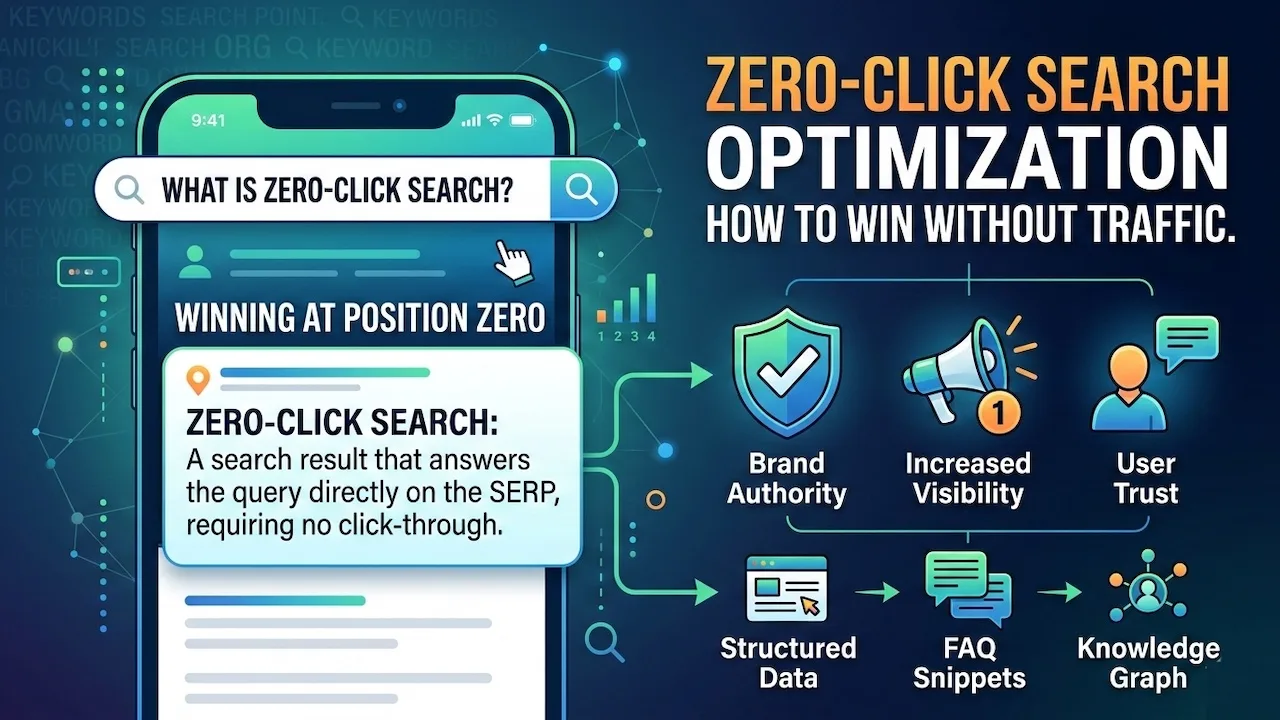
Zero-click search optimization is the practice of structuring content to win featured snippets, People Also Ask boxes, AI Overviews, knowledge panels, and other SERP features that answer user queries directly on the results page without requiring a click to your site. About 65% of Google searches now end without a single click to any website, according to SparkToro research. On mobile, that figure rises to approximately 77%. Ignoring zero-click optimization means ceding SERP real estate, brand visibility, and AI search citations to competitors who understand that position zero now matters more than position one for many query types.
If your rankings are holding steady but clicks are dropping, zero-click SERP features are almost certainly absorbing the traffic your organic position used to deliver. This guide covers every type of zero-click feature, the exact content structures that win each one, the schema markup required, how to measure zero-click SEO performance, and why brand authority without clicks still drives pipeline revenue through the implicit click flywheel.
Zero-Click Search Statistics: The Scale of the Problem
The scale of zero-click search has shifted from a niche SEO concern to the central challenge of modern search strategy. SparkToro and Rand Fishkin’s analysis found that approximately 65% of Google desktop searches and 77% of mobile searches end without a click to any external website. Google itself now receives approximately 8.5 billion searches per day. That means roughly 5.5 billion daily searches produce no website traffic at all. Google AI Overviews appear for approximately 80% of queries in active testing markets. Every AI Overview placement is a potential zero-click result that absorbs informational query traffic that previously flowed to organic results. SEO teams working only on traditional rankings are optimizing for the 35% of searches that still generate clicks while ignoring the 65% where brand visibility comes entirely from SERP features.
Why Zero-Click Searches Have Increased
Three changes to Google’s product drove the acceleration of zero-click search: the expansion of AI Overviews, the growth of People Also Ask cascades, and the proliferation of direct answer boxes for factual queries. Google AI Overviews synthesize multiple sources into a single answer block that appears before all organic results. People Also Ask boxes now appear on approximately 43% of all searches and cascade infinitely, each click loading 4 more questions. Direct answer boxes handle calculator queries, weather lookups, unit conversions, definition queries, sports scores, and time zone data without sending users anywhere. Featured snippets, which once represented the primary zero-click concern, now account for only a fraction of the total zero-click surface area that AI Overviews have created.
The Business Impact of Zero-Click Search
Zero-click search does not eliminate the business value of ranking for informational queries. It changes where that value appears in the customer journey. Brands featured in zero-click positions report a 20 to 30% increase in branded search volume over 6 to 12 months because users who see a brand cited in a featured snippet or AI Overview perform branded navigational searches later in the purchase cycle. This is the implicit click: a user reads your answer in a zero-click result, stores your brand name, and searches for it directly when ready to buy. Branded traffic converts at 2 to 5 times the rate of generic traffic. Zero-click optimization builds the top-of-funnel brand awareness that feeds those high-converting branded searches downstream.
Types of Zero-Click SERP Features
| SERP Feature | Query Types That Trigger It | Appearance Rate | Optimization Method |
|---|---|---|---|
| Featured Snippets | How-to, definition, comparison, list queries | ~12% of all searches | 40 to 60 word direct answer paragraphs, structured lists, and comparison tables |
| Google AI Overviews | Informational, research, how-to, and multi-step queries | ~80% in AI-enabled markets | EEAT signals, structured factual content, cited on authoritative sources |
| People Also Ask (PAA) | Question-format queries across all intents | ~43% of all searches | FAQ schema, direct one-sentence answers followed by supporting detail |
| Knowledge Panels | Branded navigational queries, entity searches | Brand and entity-specific | Organization schema, sameAs links, Wikipedia presence, Wikidata entity |
| Local Pack | Near-me, location-based, local service queries | ~29% of searches with local intent | Google Business Profile completeness, NAP consistency, LocalBusiness schema |
| Direct Answer Boxes | Factual, definitional, calculation, sports, weather | High for factual queries | Structured factual content, DefinedTerm schema, clear declarative sentences |
| Rich Snippets | Recipe, product, review, event, FAQ queries | Schema-dependent | Recipe, Product, Event, Review, FAQ structured data markup |
| Shopping Pack | Product purchase queries | ~28% of product searches | Google Merchant Center, Product schema with price and availability |
Should You Optimize for Zero-Click Search
The Case Against Zero-Click Optimization
The argument against zero-click optimization rests on a logical foundation: if users never click to your site, the traffic benefit of ranking is eliminated regardless of your SERP position. A featured snippet that answers a user’s question in full reduces the incentive to click through by 37% according to Ahrefs data on snippet click-through rates. Informational queries that produce zero-click results often belong to users with no immediate purchase intent. Optimizing specifically for featured snippets and PAA boxes in purely informational content categories can increase page-level investments with no measurable conversion return. This argument has merit for purely educational content that answers questions no serious buyer would ever pay to resolve.
The Business Case for Zero-Click Optimization
The business case for zero-click optimization is strongest for commercial, brand-adjacent, and consideration-stage queries where SERP visibility drives brand recognition that converts later. A buyer researching “what is the best link building strategy” and seeing Quick Digital cited in a featured snippet or AI Overview creates a brand association that survives the session. A user asking “how much does SEO cost” who sees your answer in a direct answer box remembers your brand when they request proposals. Zero-click optimization builds brand visibility at scale across informational queries, which compresses the brand discovery cycle. Users convert faster from brands they recognize, and zero-click SERP appearances are the fastest path to recognition at query volume.
The Brand Authority Flywheel
The brand authority flywheel connects zero-click search appearances to downstream branded conversions through four stages: zero-click impression, brand recall, branded search query, and high-intent conversion. A user sees your brand in a zero-click SERP feature for an informational query. They do not click. They recall your brand name when they later have a commercial need. They search your brand name directly. That branded search converts at 2 to 5 times the rate of a generic query click from the same original search. Measuring the full value of zero-click optimization requires tracking branded search volume growth alongside informational query SERP feature acquisition. Brands that appear consistently in zero-click positions for category-level informational queries see branded search volume grow 20 to 30% over 6 to 12 months of consistent SERP feature presence.
How to Optimize for Featured Snippets
Featured snippets appear above all organic results for approximately 12% of Google searches and currently drive 35% of all voice search answers, making them the highest-use single zero-click optimization target available. Featured snippets are pulled from pages that rank in the top 10 for a query, which means your page must already rank before snippet optimization produces results. Google pulls featured snippets from one of three content formats: paragraph snippets (40 to 60 word direct answers), list snippets (numbered or bulleted steps), and table snippets (comparison or structured data tables). Read our full featured snippet ranking guide for the complete content structure templates for each snippet type.
The 40 to 60 Word Direct Answer Format
Paragraph featured snippets consistently pull from content structured as a direct question immediately followed by a 40 to 60 word answer in the same paragraph, with no preamble, no “in this article we will cover,” and no lead-in before the answer starts. Write the target question as an H2 or H3 heading. Write the answer as the very first sentence of the paragraph below it, stating the complete answer before adding supporting context. Keep the answer paragraph between 40 and 60 words. Follow the answer paragraph with supporting detail in subsequent paragraphs. This structure gives Google a clearly bounded answer unit to extract without ambiguity. Pages following this format see snippet capture rates 2 to 3 times higher than pages burying their answers in long introductory paragraphs.
List and Table Snippet Optimization
List featured snippets pull from HTML ordered or unordered lists that answer a “steps to” or “types of” query, and table snippets pull from HTML comparison tables with clear column headers. For list snippets, use an H2 or H3 question heading, then place your list immediately below it with no intervening paragraph. Keep each list item to a single line. Use 5 to 9 items. Google caps list snippets at 8 visible items and adds a “More items” link. For table snippets, use proper HTML table markup with thead and th elements for column headers. Place the table immediately after the heading question. Tables comparing two or more options across the same attributes trigger table snippet selection more reliably than paragraph or list formats for comparison queries.
How to Optimize for People Also Ask Boxes
People Also Ask boxes appear on approximately 43% of all Google searches and cascade dynamically, meaning each expanded question loads 4 more related questions, creating near-infinite SERP real estate that compounds with every user interaction. A PAA placement is more durable than a featured snippet because the PAA box shows multiple sources across multiple questions rather than awarding a single winner. Appearing in PAA for 10 to 20 questions in your topic cluster produces more total zero-click impressions than a single featured snippet placement. Our complete People Also Ask optimization guide covers the full PAA cascade strategy, question research workflow, and answer format specifications for each question type.
PAA Question Research Strategy
The fastest method for finding PAA placement opportunities is to search your primary keywords and manually expand every PAA box to map the full question cascade, then cross-reference the questions against your existing content to identify which ones your pages already answer and which represent new content gaps. Use Ahrefs’ “Questions” filter in Keyword Explorer to surface PAA questions your competitors currently own. Use AlsoAsked.com to visualize the full question tree branching from any seed query. Export all questions and group them by topic cluster. Pages that answer a cluster of related questions perform better in PAA than pages that answer a single question, because Google’s PAA cascade logic surfaces related questions from the same source when a user continues expanding boxes.
PAA Answer Format and Schema
PAA answers are pulled from the same direct answer content format as featured snippets: a question heading, followed immediately by a 40 to 60 word direct answer paragraph, followed by supporting detail. Add FAQ schema markup to any page containing multiple Q&A sections to give Google a structured signal for extracting PAA answers. A page with 8 to 12 questions answered in this format with FAQ schema can capture PAA placements for multiple questions simultaneously. Add internal links within the supporting detail sections of each answer to connect related questions on the same page and signal content depth on the topic cluster. Read our conversational keywords and question-based queries guide for the full question research and content clustering approach.
How to Optimize for Google AI Overviews
Google AI Overviews (formerly Search Generative Experience) synthesize information from multiple authoritative sources into a single answer block appearing before all organic results for informational and research queries. AI Overviews cite sources in the summary panel, and those citations produce both zero-click brand exposure and a direct source link that users can click through. Appearing in AI Overview citations requires two things: sufficient EEAT authority signals for Google to classify your content as a trustworthy source, and content structured as clear, factual, directly answerable prose that AI systems can extract and synthesize accurately. Read our full Google AI Overviews optimization guide for the complete citation strategy.
Content Signals AI Overviews Prioritize
AI Overviews prioritize content from sources with established EEAT signals: demonstrated expertise in the topic area, author credentials, citations from recognized authorities, and a consistent publication history on the topic. Content that AI Overviews cite shares four structural characteristics: it starts with a direct answer to the query, it uses short declarative sentences under 17 words, it cites specific data points or examples rather than generalizing, and it avoids hedging language that introduces ambiguity. AI Overviews also prioritize content that appears in featured snippets and PAA boxes, meaning the same content structure that wins traditional zero-click features also performs well for AI Overview citation. Align your EEAT authority with our EEAT trust and authority guide before targeting AI Overview placements for competitive queries.
Schema Markup for AI Overview Eligibility
While schema markup does not guarantee AI Overview citations, it reduces parsing ambiguity and helps Google’s AI systems accurately extract and attribute facts from your content. Add FAQ schema to pages with multiple Q&A sections. Add HowTo schema to step-by-step instructional content. Add Article schema with author markup and datePublished to establish publication authority signals. Use speakable schema on answer paragraphs to signal that the content is designed for direct extraction. These markup signals tell Google’s systems which passages are most suitable for AI synthesis and citation. Read our full schema markup for AEO implementation guide for the complete code templates for each schema type relevant to zero-click optimization.
How to Optimize for Knowledge Panels
Knowledge panels appear for branded navigational queries and entity searches, occupying the entire right side of the SERP on desktop and pushing all other results below the fold, making them the most valuable single zero-click real estate for established brands. Knowledge panel eligibility requires that Google has confirmed your entity in the Knowledge Graph. Build this confirmation through Organization schema on your homepage with complete sameAs links to your LinkedIn, Facebook, YouTube, Crunchbase, and Twitter profiles, a Wikipedia entry or Wikidata entry for your brand, consistent NAP data across 50 or more authoritative directory citations, and sufficient branded search volume signaling that users actively seek your entity. Read our complete knowledge panel optimization guide for the full entity confirmation strategy.
Schema Markup for Zero-Click Features
| Schema Type | Zero-Click Feature It Targets | Required Properties | Content Type |
|---|---|---|---|
| FAQ | PAA boxes, AI Overviews, FAQ rich results | mainEntity, Question, acceptedAnswer, text | Pages with 2 or more Q&A sections |
| HowTo | Featured snippets, AI Overviews, rich results | name, step, HowToStep, text | Step-by-step instructional content |
| Article | AI Overviews, rich results | headline, author, datePublished, publisher | Blog posts, guides, editorial content |
| Organization | Knowledge panels, branded snippets | name, url, logo, sameAs, contactPoint | Homepage, About page |
| LocalBusiness | Local pack, knowledge panels, maps | name, address, telephone, openingHours, geo | Location pages, homepage for local businesses |
| Product | Shopping pack, product rich results | name, description, price, availability, image | Product and ecommerce pages |
| Speakable | Voice search zero-click, AI Overviews | cssSelector targeting answer paragraphs | Any page with direct answer paragraphs |
How to Measure Zero-Click SEO Performance
Traditional click-based metrics miss the full business value of zero-click optimization, so measuring it requires a 4-metric framework that captures SERP impression value alongside downstream brand conversion signals.
- Search impressions by query in Google Search Console: Filter by zero-click feature keywords in Search Console and track impressions over time. Rising impressions with flat clicks on featured snippet queries confirms you are winning SERP real estate without proportional click growth. This is the primary volume signal for zero-click reach.
- Featured snippet and PAA position tracking: Use Semrush’s SERP Features report or Ahrefs’ SERP Features filter to track how many of your target keywords produce featured snippet or PAA positions for your domain. Track this as “SERP feature owned” percentage of your total keyword set monthly.
- Branded search volume in Google Search Console: Filter queries by your brand name and track monthly impressions and clicks. Rising branded search volume in the 3 to 6 months following a zero-click optimization campaign confirms the implicit click flywheel is operating. This is the strongest revenue-adjacent signal of zero-click optimization value.
- AI citation rate in ChatGPT, Perplexity, and Google AI Overviews: Query your primary topic cluster questions in each AI search engine monthly. Track how often your brand is cited as a source. Rising AI citation rate confirms that the same content structure earning zero-click SERP features is also feeding AI search visibility, which is the primary growth frontier of zero-click optimization. See our Answer Engine Optimization guide for the full AI citation measurement framework.
Zero-Click Search Optimization Mistakes
Optimizing for Featured Snippets on Pages That Do Not Rank in the Top 10
Google only pulls featured snippets from pages ranking in positions 1 to 10 for the target query, which means zero-click optimization applied to pages ranking at position 15 or lower produces no SERP feature wins regardless of how well the content is structured. Run an Ahrefs or Semrush keyword report filtered to positions 5 to 20 for your site. These are your highest-value zero-click optimization targets. Pages already ranking in positions 5 to 10 for question-format queries are the most likely candidates for snippet elevation because they have established relevance but have not yet captured the featured snippet position from a competitor. Apply zero-click content formatting to these pages first before targeting pages that need significant ranking improvement to reach snippet eligibility range.
Writing for Snippets at the Expense of Conversion Content
The second most common zero-click optimization mistake is rewriting pages that convert well to match a snippet format, reducing their conversion effectiveness while winning SERP feature positions that deliver no direct revenue. Keep your highest-converting service pages and landing pages in their current format. Apply zero-click optimization to dedicated informational content, blog posts, FAQ pages, and resource guides that exist specifically to serve informational query intent. Create separate content assets for zero-click optimization that link to your conversion pages. This preserves conversion rates on commercial pages while building zero-click brand visibility and AI citation authority across your informational content cluster. Our semantic SEO and entity optimization guide covers how to structure your topical content cluster to serve both zero-click and conversion goals simultaneously.
Quick Digital · SEO Strategy Since 2014
Win the 65% of Searches That Never Click
Quick Digital builds zero-click search strategies that capture featured snippets, PAA positions, and AI Overview citations, turning SERP impressions into brand authority and downstream branded search conversions.
Stop losing SERP real estate to competitors who understand zero-click search.
Zero-Click Search Optimization: FAQs
Zero-click search is any Google search where the user finds their answer directly on the SERP without clicking through to any website. Approximately 65% of desktop searches and 77% of mobile searches end without a click. Google AI Overviews, featured snippets, PAA boxes, and direct answer boxes drive this volume.
Zero-click search reduces direct clicks on informational queries but builds brand awareness through SERP impressions that drive branded searches later. Brands appearing in zero-click positions report 20 to 30% branded search volume growth over 6 to 12 months. Branded traffic converts at 2 to 5 times the rate of generic traffic.
Write the target question as an H2 or H3 heading, then place a direct 40 to 60 word answer in the first paragraph immediately below it with no preamble. Google pulls paragraph snippets from clearly bounded answer units. Pages in positions 5 to 10 for question-format queries are the best snippet optimization candidates.
FAQ schema targets PAA boxes and AI Overviews. HowTo schema targets featured snippets. Organization schema targets knowledge panels. Speakable schema signals voice search and AI extraction eligibility. Each schema type reduces parsing ambiguity for Google’s AI systems and improves the likelihood of appearing in the specific zero-click features each markup targets.
Track 4 metrics: search impressions in Google Search Console, SERP feature positions in Ahrefs or Semrush, branded search volume growth, and AI citation rate in ChatGPT and Perplexity. Rising impressions with flat clicks confirms zero-click wins. Rising branded search volume confirms the implicit click flywheel is converting impressions into downstream revenue.