


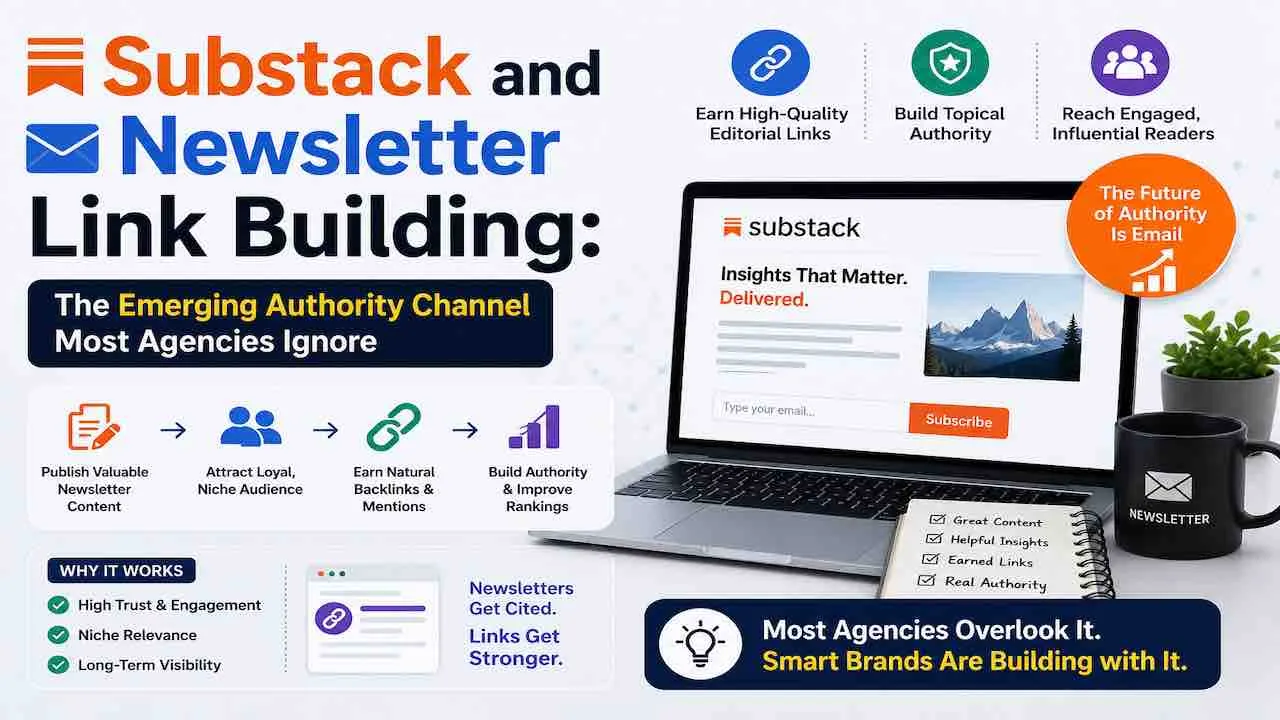
Every link published inside a Substack newsletter is automatically dofollow. It passes full link equity to your site without any nofollow tag, ugc attribute, or sponsored modifier. Reddit links are nofollow. Quora links are nofollow. Forum links are nofollow. A Substack is the exception most SEOs still file under social media and ignore. Substack has over 35 million active readers and a Domain Authority that rivals major publishing platforms. Substack newsletter link building gives you editorial, equity passing dofollow backlinks from niche audiences. Your competitors are not targeting these audiences yet. This guide covers every Substack link building play. These include earning links from other Substacks, running your own publication, and using Notes and Recommendations. They also include newsletter collaboration outreach and AI citation building.
Why Substack Links Are Different from Every Other Community Platform
Substack links pass full link equity because Substack was built as a publishing platform. It was not built as a social network. It never implemented the nofollow policy that community platforms use. This is a structural platform decision, not a temporary oversight. Every external link a Substack writer adds to their newsletter post is crawlable by Googlebot. It passes PageRank to the destination URL.
The table below compares link equity across major community platforms.
| Platform | Link Type | Passes PageRank? | SEO Value Level |
|---|---|---|---|
| Substack | Automatic dofollow on all links | Yes. Full link equity passes | High. DA equivalent to major publishing platforms |
| nofollow on all links | No direct PageRank transfer | Indirect via AI citation and referral traffic | |
| Quora | nofollow on all links | No direct PageRank transfer | Low for link equity, moderate for referral traffic |
| nofollow on all external links | No direct PageRank transfer | Brand entity signal only | |
| Beehiiv | dofollow on most external links | Yes, on indexed posts | Moderate. Growing platform, lower domain authority |
| Medium | nofollow on all links | No direct PageRank transfer | Brand mention signal, no link equity |
Substack’s dofollow status with genuine editorial content makes it one of the few community adjacent platforms. A single mention produces real ranking impact. This fits into the broader landscape of brand mentions vs backlinks and when each signal matters most.
The Two Distinct Substack Link Building Plays
A complete Substack newsletter link building strategy runs two distinct plays simultaneously. Play 1 is earning dofollow backlinks FROM other people’s Substacks pointing at your site. Play 2 is running your own Substack publication on a custom domain. Mixing these up produces a weaker result than running both plays deliberately.
- Play 1: Earning links from other Substacks. You target Substack writers in your niche and earn editorial mentions and dofollow links to your website or content. This is the link building play. It requires outreach, relationship building, and creating content worth citing. The links point from the Substack publication to your site.
- Play 2: Running your own Substack publication. You publish a newsletter under a custom domain. All authority built on your Substack accrues to your brand’s domain. You build topical authority, index more content, and earn backlinks to your Substack that ultimately strengthen your brand entity across Google’s Knowledge Graph.
Most brands attempt Play 2 without ever pursuing Play 1. Play 1 produces faster and more direct SEO results. Play 2 builds long term topical authority that compounds over 12 to 24 months. The strongest Substack link building strategies run both plays from day one.
Substack Subdomain vs Custom Domain: What Actually Builds Your SEO
A default Substack publication lives on the yourname.substack.com subdomain. A significant portion of the authority your newsletter builds accrues to Substack’s domain rather than yours. This is the most common mistake brands make when treating Substack as a link building asset. They publish quality content and earn citations. But the PageRank signals flow to substack.com, not to their brand domain.
A custom domain changes this entirely. When you connect a custom domain, all backlinks and brand mentions flow to your URL. Google Search Console becomes available for your domain. It gives you indexing control, keyword performance data, and crawl insights.
| Factor | Default Substack Subdomain | Custom Domain Substack |
|---|---|---|
| Authority flows to | Substack.com (shared domain authority) | Your brand domain exclusively |
| Google Search Console | Not available for subdomain | Full GSC access, sitemap submission, keyword data |
| Starting domain authority | High. Borrowed from Substack’s established domain | Lower initially if domain is new. Builds over time |
| Brand entity signal | Weak. Mentions point to Substack, not your brand | Strong. All mentions strengthen your brand entity |
| Backlink destination | Links point to yourname.substack.com | Links point to yournewsletter.com |
| Long term SEO value | Low. No asset if you leave Substack | High. Domain authority stays with your brand |
The recommendation is clear: connect a custom domain before investing in link building for your Substack. A new domain starts without borrowed authority. All future backlinks flow to your brand domain. This long term SEO equity far outweighs any short term boost from the substack.com subdomain.
How to Earn Dofollow Backlinks from Other Substacks
Earning dofollow backlinks from other Substacks is a deliberate outreach and relationship building process. The writers you want linking to you must know your content exists before they can cite it.
Finding Target Substacks for Link Building Outreach
Use these methods to build your outreach list of Substack writers in your niche.
- Substack’s native search and leaderboard: Search Substack.com for keywords in your niche. The leaderboard shows top newsletters by category. Sort by subscriber count to identify the highest authority Substacks in your topic.
- Google Search operator: Search site:substack.com “your niche topic” to find Substack posts that already cover your target topic. Writers who cover your topic regularly are far more likely to cite your content. General interest Substacks rarely produce relevant links.
- Ahrefs Content Explorer: Filter by platform for substack.com and search your target keyword. This shows which Substack posts rank in Google for your topic, giving you a list of writers who already produce SEO-visible newsletter content.
- Mutual subscriber overlap: Identify newsletters your target audience subscribes to by asking your existing subscribers directly. A newsletter your audience reads will send relevant referral traffic when it links to you.
The Outreach Strategy That Gets Mentioned in Newsletters
Newsletter outreach succeeds when you treat the writer’s publishing schedule and audience as the primary frame. Do not lead with your link building goal.
- Subscribe to the newsletter first and read at least 3 to 5 issues. Reference specific content from those issues in your outreach email. Generic pitches are deleted without reply.
- Pitch a specific data point, case study, or tool that adds value to the writer’s existing content. Frame the link as a resource their readers will appreciate, not as a promotional opportunity.
- Offer something in return: a reciprocal recommendation, exclusive data, or a guest post contribution. Newsletter writers respond to value, not link requests.
- Keep the initial email under 100 words. Newsletter writers are busy. A brief, specific pitch outperforms long introductory emails every time.
Substack Recommendations: The Built in Link Building Feature
The Substack Recommendations feature lets any Substack writer recommend other publications to their subscribers. Each recommendation creates an indexed, crawlable link on the recommending publication’s public page. This is a direct link building mechanism built into the platform. Most SEOs have not discovered it yet.
When a newsletter with 10,000 subscribers recommends your Substack, a link appears on their public page. The link is dofollow. The referring domain carries the authority of the recommending writer’s publication. It also triggers an automated email to all their subscribers, producing subscriber growth alongside the link signal.
- Ask writers in your niche to add you as a recommended publication in exchange for a reciprocal recommendation. This is a legitimate platform feature designed for exactly this purpose.
- Build a targeted list of newsletters with high subscriber counts in your topical area. A recommendation from a 50,000-subscriber newsletter produces far more authority than ten recommendations from newsletters with 500 subscribers.
- Substack rebuilt its recommendation algorithm in its most recent update around audience overlap signals. Recommendations from newsletters whose subscribers already overlap with your topic area produce the strongest subscriber growth and platform authority signals.
Substack Notes: The Discovery Layer for Newsletter Link Building
Substack Notes functions like a social stream for newsletter writers. Notes posts are indexed by Google. They are a fast to publish, SEO eligible content surface for link building.
The Notes feed is now discovery first. Most of what readers see comes from writers they do not yet follow. Restacks, which are reshares of a Note or post, now carry more algorithmic weight than ever. A Note that gets Restacked by several high subscriber writers in your niche reaches a new audience. It generates author mentions that build brand entity signals. It creates indexed pages with your brand name and content linked on the Substack platform.
- Publish Notes that reference and link to your best content. Keep Notes under 300 words. Start with a direct, specific observation or data point that makes writers want to Restack it.
- Engage with Notes from writers in your target outreach list. Commenting with specific, insightful additions builds recognition before your outreach email arrives. Writers are more likely to recommend and cite someone they already recognize from the Notes feed.
- Use Notes to share original data snippets. Data points that prompt newsletter writers to say “this is worth sharing with my audience” become organic link building opportunities without any direct outreach at all.
Guest Newsletter Contributions: The Newsletter Version of Guest Blogging
Guest newsletter contributions follow the same logic as guest blogging. They produce dofollow links inside email to web content that Substack indexes as public web pages.
A guest contribution inside another writer’s Substack newsletter creates three simultaneous signals. First, the published post contains a dofollow link back to your website. Second, the post is indexed as a web page under the host newsletter’s domain. Third, the email delivery drives referral traffic from a warm, engaged niche audience.
- Pitch a specific contributed piece, not a general “I’d love to write for you” email. Propose a complete, specific article title with a one sentence description of the value it adds for their readers.
- Include one contextual link back to your site within the contributed content plus an author bio link. Two links per contribution is standard. Requesting more reduces acceptance likelihood.
- Target newsletters where your contributed content fills a clear gap in their existing editorial calendar. Writers who publish weekly appreciate pre written, ready to publish contributions that reduce their workload.
- Follow up once, seven days after the initial pitch. Substack writers manage publication solo. Two or more follow ups damages any chance of a future relationship.
Newsletter Cross Promotion and Collaboration Link Building
Newsletter cross promotion is a mutual value exchange. Two writers in complementary niches each feature the other’s work. This creates dofollow links in both directions and grows subscriber bases for both parties. This is the fastest way to earn high authority newsletter links without a cold outreach pitch. Both parties receive immediate, measurable value.
- Link swap within editorial content: Both writers include a contextual reference to the other’s newsletter in their next issue. Each reference includes a dofollow link. The link appears within genuine editorial content, not a promotional section. Google treats editorial contextual links as the highest quality backlink type.
- Co authored issues: Two writers collaborate on a single newsletter issue that goes to both subscriber bases simultaneously. Each publication hosts the same content and links to the other. Both writers receive a dofollow link from the other’s publication page and exposure to a new audience.
- Data sharing partnerships: Two newsletters in complementary niches each publish their audience’s data and cross cite each other as the source. The resulting links are editorial citations of primary research, the highest value link type in any SEO strategy.
Substack Newsletter Link Building for AI Search Citations
Newsletters indexed on Substack are actively cited by Perplexity AI, Gemini, and Claude. AI training datasets treat newsletters as authoritative, expert written, niche specific content. They prioritize newsletters over generic blog content.
Perplexity AI actively surfaces Substack posts as citation sources for expert driven queries. The platform’s retrieval system treats indexed newsletter content as high authority editorial content. Newsletter content with original data earns AI citations at a higher rate than blog posts. See how backlinks for AI search citations and newsletter content build brand authority in AI engines together.
- Structure each newsletter post with a direct answer to the primary query in the first 100 words. AI extraction systems favor content that answers questions immediately, without long introductory sections.
- Include original statistics, proprietary data, or named expert quotes in every issue. AI engines prefer to cite primary sources over content that aggregates others’ data.
- Use clear H2 and H3 heading structure in Substack posts. Google and AI engines extract meaning from heading hierarchies. A post with clean heading structure earns AI citations at a higher rate than a wall of text with no structural hierarchy.
- Publish consistently. AI retrieval systems favor content freshness. A newsletter publishing 4 times per month signals active, maintained topical authority to both Google and AI engines indexing the platform.
Connecting Your Substack to Google Search Console
Connecting your Substack to Google Search Console and submitting a sitemap is the most important technical step. It ensures your newsletter posts get indexed and attributed correctly.
- Go to Google Search Console and add your Substack as a property. For a custom domain, use the Domain property option. For the default subdomain, use the URL prefix option with your yourname.substack.com address.
- Submit your Substack sitemap. The default sitemap URL is yourname.substack.com/sitemap.xml. Paste this into the Sitemap section of Google Search Console and submit. Google will begin crawling and indexing your newsletter posts systematically.
- Monitor the Index Coverage report weekly for the first month. Any indexing errors or excluded URLs indicate pages Google cannot crawl. Fix these before investing time in outreach for those specific posts.
- Track keyword performance for your newsletter posts in the Search Performance report. Rising impressions for your target keywords in Search Console confirm your newsletter content is building topical authority in Google’s index.
On Page SEO for Every Substack Post You Publish
Every Substack post has five on page SEO elements you control directly. These are: the post title, URL slug, subtitle, preview text, and body heading structure. Getting all five right determines whether your posts rank in Google.
- Post title: This becomes your H1 and your Google title tag simultaneously. Place your primary keyword in the first four words of every post title. A title like “Substack Newsletter Link Building: The Dofollow Strategy” signals clear topical relevance to Google from the first crawl.
- URL slug: Substack lets you customize the URL slug for every post before publishing. Change the auto generated slug to a keyword rich, human readable format. A slug like “substack link building strategy” performs better in both Google Search and Substack’s internal search than a slug that includes numbers or random characters.
- Subtitle: The subtitle appears in Google’s search snippet below the title. It functions as a meta description. Write a 120 to 160 character subtitle that includes your primary keyword and makes a direct promise about what the post delivers. Every post needs a unique, keyword relevant subtitle.
- Preview text: The preview text is what email subscribers see before opening your newsletter. It also appears in the Substack discovery feed. Use the preview text to state the primary benefit of the post in one sentence. Include one secondary keyword naturally. This is Substack’s version of a meta description for its own internal search surface.
- Body heading structure: Use H2 and H3 headings throughout every post body. Clear heading structure is what Google’s passage indexing and AI retrieval systems use to extract answer level citations from individual sections of your newsletter.
Substack’s Internal Discovery Algorithm: How It Decides Who Reads You
Substack’s internal discovery algorithm surfaces posts to readers who do not yet follow you through four signals. These are: engagement rate on recent posts, Restack velocity in the Notes feed, and Recommendations network strength. Subscriber growth rate in the past 30 days is the fourth signal. Building link authority through Substack requires optimizing for both Google and Substack’s own algorithm simultaneously.
- Engagement rate: Substack weights open rate and scroll depth as its primary quality signals. Posts with above average open rates get surfaced more widely in Substack search and category discovery feeds. A well structured post with a keyword rich subject line consistently outperforms a generic one in both open rate and Substack discovery ranking.
- Restack velocity: How quickly other writers Restack your Notes and posts signals topical relevance to Substack’s algorithm. A post Restacked by 5 writers within 48 hours of publishing gets surfaced to a far larger non subscriber audience than a post that earns the same 5 Restacks over 3 weeks. Publish time matters. Publish when your niche writers are active.
- Recommendations network strength: The number of active Recommendations pointing to your publication is a direct ranking factor in Substack’s internal discovery. Writers with 10 or more active Recommendations appear in Substack’s “Recommended for You” surfaces far more frequently than those with 2 to 3.
- Subscriber growth rate: Substack surfaces growing publications more aggressively than static ones. A publication that gains 50 new subscribers in 7 days ranks above a larger but static publication in Substack’s browse and category surfaces. Active link building and Recommendations outreach drive subscriber growth, which feeds the algorithm signal that drives more subscriber growth.
B2B Newsletter Link Building: The Substack Strategy for Business Audiences
B2B newsletter link building on Substack targets industry specific publications with decision maker audiences, and it requires a different outreach approach than general audience newsletters because B2B Substack writers prioritize data, research, and operational insights over general content.
- Target newsletters with industry specific audiences, not general ones: A contribution to a 3,000-subscriber newsletter whose readers are all marketing directors in SaaS companies produces better B2B link signals than a 50,000-subscriber general marketing newsletter. Specificity of audience determines the quality of referral traffic and the strength of the entity association the link creates.
- Lead with proprietary data: B2B newsletter writers cite data driven contributions more readily than opinion pieces. A guest contribution that presents original survey data, platform usage statistics, or industry benchmark analysis earns B2B newsletter links at a far higher rate than a contributed opinion essay. Original data is the strongest B2B link bait that exists in any channel.
- Use co research partnerships: Identify two to three newsletters covering adjacent B2B topics and propose a joint research project. Both publications publish the findings and cite each other as co sources. This creates dofollow editorial citations, email exposure to both subscriber bases, and a permanent indexed co research reference that earns ongoing citations. See how thought leadership link building applies the same co research logic across content formats.
- Pitch contributors who write about your tools or competitors: Search Substack for newsletter writers who already cover your category. Writers who mention competing tools but not yours are warm outreach targets. A specific pitch showing why your tool or service fills a gap they’ve already written about converts at a far higher rate than cold topic pitches.
AEO and GEO Optimization for Your Substack Content
Substack posts that earn AI search citations from Perplexity, Google AI Overviews, and ChatGPT Browse share four structural characteristics. Standard newsletter writing misses all four by default. Adding them multiplies your AI citation rate and Google ranking potential.
- Place a direct answer in the first 70 words of every post: AI extraction systems pull citations from the opening passage of indexed content. A Substack post that opens with a direct, factual, one sentence answer to the implied query in its title earns AI citations at a measurably higher rate than a post that opens with background context or an anecdotal introduction.
- Write each H2 section as an independently answerable unit: Google’s passage indexing scores each H2 section independently. AI retrieval systems do the same. Every H2 section in a Substack post should open with a direct answer to the heading, followed by supporting evidence, followed by a specific action or tool. This three part structure is extractable by both Google and AI engines as a discrete citation.
- Include at least one statistic with a named source every 150 to 200 words: AI engines like Perplexity specifically favor content that cites named, verifiable sources for every statistical claim. A Substack post that attributes every data point to a named study, report, or organization earns AI citations at a higher rate than a post that uses phrases like “research shows” without attribution.
- Use entity rich language throughout: Name specific tools, platforms, organizations, and people in every post. Entity mentions signal topical authority to both Google’s Knowledge Graph and AI training datasets. A post about newsletter link building that names Ahrefs, Semrush, Substack, Beehiiv, and Google Search Console earns stronger entity association signals than a post that refers generically to “SEO tools.”
Measuring Substack Newsletter Link Building Impact
Measure Substack newsletter link building impact through four metrics: dofollow backlinks from Substack domains in Ahrefs or Semrush, referral traffic from Substack in Google Analytics 4, newsletter keyword rankings in Google Search Console, and AI search citation frequency for newsletter related queries.
- Track new dofollow links from Substack domains: In Ahrefs or Semrush, filter your referring domains by substack.com. Monitor how many new Substack publications link to your site each month. Rising Substack referring domains confirm your outreach and collaboration strategy is working.
- UTM-tagged links in newsletter posts: Add UTM parameters to every link you publish inside your own newsletter (utm_source=newsletter, utm_medium=email, utm_campaign=issue name). This isolates newsletter referral traffic in GA4 and reveals which issues drive the most website sessions.
- Substack’s native analytics: Monitor views, opens, and subscriber referral sources inside Substack’s dashboard. A rising percentage of referrals from recommendations confirms your Recommendations outreach strategy is producing both links and subscriber growth.
- AI prompt testing: Search your target queries in Perplexity and Gemini monthly. Check whether your Substack posts appear as citation sources. Rising AI citation frequency from newsletter content confirms your AI optimized structure and content freshness signals are working.
Common Substack Newsletter Link Building Mistakes
These mistakes prevent Substack from producing meaningful link building results. They persist even when the newsletter is high quality and growing its subscriber base.
- Publishing on the default substack.com subdomain without a custom domain: All backlinks and brand mentions flow to Substack’s domain, not yours. Connect a custom domain before investing in link building outreach for your Substack.
- Treating Substack like a blog repost platform: Republishing the same content from your main blog on Substack creates duplicate content signals. Write original content for your newsletter. Unique content earns editorial citations that syndicated content cannot.
- Skipping Google Search Console setup: Without GSC, you cannot submit a sitemap, monitor indexing, or track keyword performance for your newsletter posts. Substack content cannot rank in Google unless it is indexed.
- Pitching Substack writers with generic link request emails: Newsletter writers delete generic link request pitches immediately. Every outreach message must reference specific issues, propose specific value, and show genuine familiarity with the writer’s audience.
- Ignoring the Recommendations feature: The Recommendations feature creates indexed, dofollow links on other publications’ pages and drives subscriber growth simultaneously. Not actively building a recommendations network means leaving both link signals and subscriber growth uncaptured.
- Not using Notes for brand visibility: Writers who never engage in the Notes feed are invisible to the writers they want to earn links from. Consistent Notes activity builds brand recognition. This makes outreach emails far more likely to receive a positive response.
Frequently Asked Questions: Substack Newsletter Link Building SEO
All Substack links are automatically dofollow. There is no nofollow tag, ugc attribute, or sponsored modifier on any external link in a Substack newsletter. Substack was built as a publishing platform, not a community network. It never implemented the nofollow policy that Reddit, Quora, and LinkedIn use. Every editorial mention passes full link equity to the destination URL.
Running a Substack newsletter on a custom domain builds topical authority, generates indexed content, and earns backlinks that strengthen your brand entity. A default subdomain builds authority for Substack’s domain, not yours. Connect a custom domain so all links flow to your brand’s domain.
Earn Substack links by subscribing to target newsletters and engaging genuinely with their content before pitching a specific resource that adds clear value to their readers. The Recommendations feature creates a formal mechanism for mutual links. Guest newsletter contributions create editorial dofollow links with full author bio placement.
Yes. Substack posts are indexed as public web pages. They can rank in Google Search when optimized with clear headings, original content, and inbound links. Connect your Substack to Google Search Console and submit a sitemap to accelerate indexing.
Substack newsletter link building shows measurable referral traffic within days of earning a citation in a high subscriber newsletter. Ranking improvements from Substack dofollow backlinks typically appear within 60 to 90 days. A Recommendations network takes 3 to 6 months to build. A custom domain Substack builds topical authority over 12 to 24 months.
Build Your Substack Newsletter Link Building Strategy with Quick Digital
Quick Digital • Digital Marketing Since 2014
Turn the Newsletter Channel Every Agency Ignores into Your Biggest Link Building Asset
Quick Digital builds Substack newsletter link building strategies that earn dofollow editorial backlinks from niche authority publications your competitors have not discovered yet. Outreach campaigns, recommendation network building, Notes strategy, guest newsletter placement, and AI citation optimization. 10+ years of digital marketing experience.
Build Your Newsletter Link Strategy →
Request a Free Quote
Newsletter Outreach • Recommendations Network • Guest Contributions • Notes Strategy • AI Citation Building