



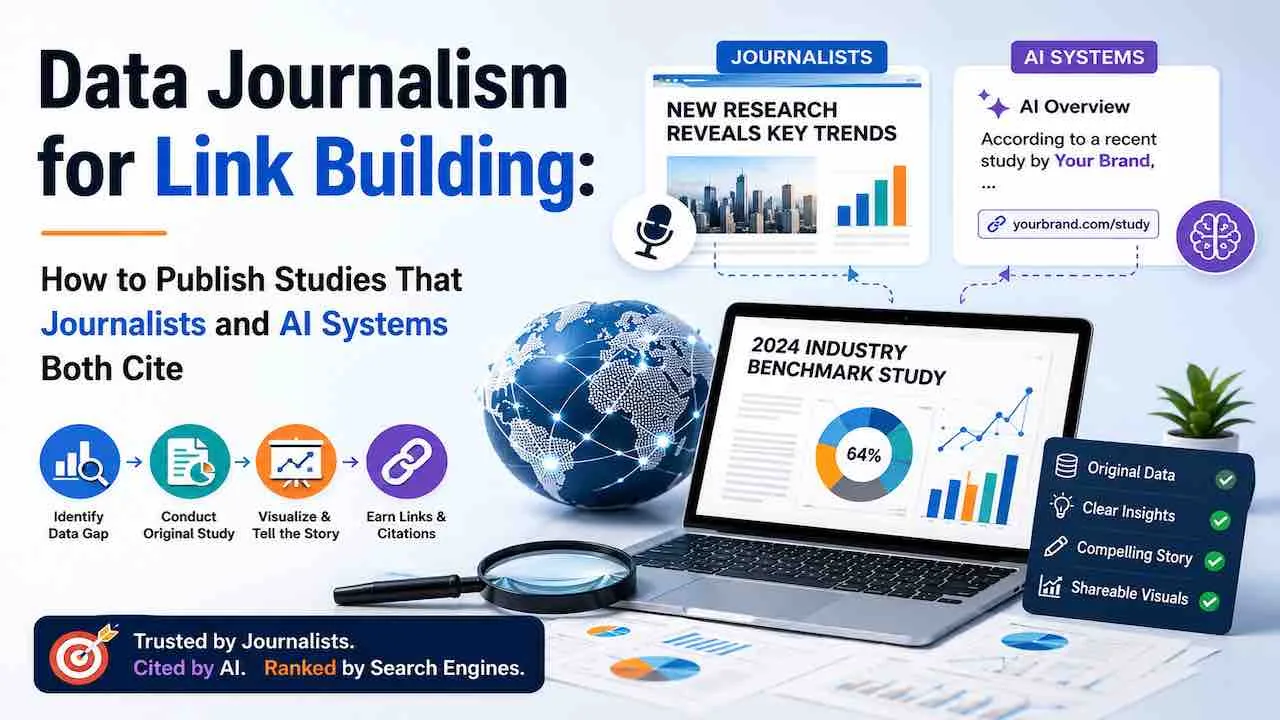
Data journalism link building earns editorial backlinks by giving journalists the primary source they need to write their story. When you publish original research, survey data, or an industry report that contains a statistic no other source holds, every publication that covers the story links back to you. That is the journalist citation mechanic in its simplest form: be the source not the asker, and dominate your niche with data that no competitor holds. Content that earns links passively, journalists come to you as the primary source, and authority through data are not aspirational outcomes in data journalism link building strategy. They are the documented result of publishing original data other sites must cite.
Standard link building outreach now converts at approximately 0.2%, down from 2% five years ago. Journalist pitches backed by proprietary data convert at 3 to 15 times that rate because the pitch is a genuine resource offer, not a link request. A survey of 1,300 high-authority publishers found that 88% write stories from pitches only a few times a month or less making the quality of what you pitch more important than any outreach volume strategy. Data-driven link building is how data journalism earns backlinks at a conversion rate traditional guest post outreach cannot match. Original data journalism delivers that quality. Data-driven PR campaigns that combine original research with targeted journalist outreach represent the highest-converting link building method available. Our full digital PR link building service covers data campaign production as a core delivery method.
What Is Data Journalism Link Building
Data journalism SEO and link building with data both refer to the practice where data journalism link building is of creating and publishing original research, survey data, industry reports, or statistic pages that journalists and AI engines cite as primary sources. It differs from standard content marketing because the asset is the data itself, not commentary on someone else’s data. A published study with proprietary findings cannot be replicated by a competitor. Every site that references the statistic must link back to the page where it lives.
Why Data Earns Links That Other Content Cannot
Original data is citable. An opinion piece earns no citation. A guide earns no citation. A statistic from your proprietary survey, confirmed by a named methodology and sample size, earns a citation every time a writer uses it. Original research earns 300% more backlinks on average than other content types, according to HubSpot research across content formats. The link comes as a byproduct of the citation, not as the result of a direct link request. This makes data journalism link building the closest thing in SEO to be cited by major publications without a cold email pipeline.
How This Differs From Standard Guest Post Link Building
Guest post link building places content on an existing publication and includes a link in the author bio or body. Data journalism link building earns links on your own domain from every publication that covers your research. The referring domain count compounds with each publication that picks up the story. A single data study can earn 20 to 300 referring domains from one release, whereas a guest post earns one link per placement. Statistical content link building at scale produces the most cost-efficient referring domain volume of any link building method over a 12-month horizon. See our full comparison in the link building service overview.
Two Types of Data Content That Earn Links
Data journalism for SEO operates through two distinct content models. Each earns links through a different mechanism, targets different publication types, and requires a different production process. The highest-performing data journalism link building programmes use both simultaneously.
Type 1: Original Research Studies
Original research link building uses data your organisation collects through surveys, proprietary datasets, or primary analysis. No other source holds these figures, which makes your publication the mandatory citation for any writer covering the topic. Survey data backlinks come from credible, citable survey data link building campaigns. Survey methodology for SEO determines whether journalists treat your data as publishable.
Data study link building through any methodology earns industry report SEO authority when the report becomes the go-to citation in its niche. Survey link building through SurveyMonkey or Typeform with a minimum sample of 500 respondents produces findings credible enough for trade publication coverage. A sample of 1,000 or more respondents reaches the threshold national newspapers require before citing research findings. Industry report link building through Industry report SEO authority and industry report link building results compound annually. Annual or quarterly publications earn recurring links as journalists update their stories with fresh data each cycle.
Type 2: Statistic Pages
Statistic pages aggregate the best existing statistics on a topic from multiple original sources and present them on one well-organised, well-sourced page. A page titled “47 Email Marketing Statistics for 2025” that correctly attributes each stat to its primary source earns links from every content writer who searches for email marketing statistics and finds your aggregation. The writer links to your statistic page as their secondary source rather than hunting down each original study individually. Statistic pages for link building through statistical link building is a core data journalism strategy that requires no original data collection. They earn links by becoming the most useful aggregation of data in their topic area. They require active updating when statistics become outdated, which keeps them relevant and re-linkable as new writers discover them.
How to Create a Data Study for Link Building
How to use data journalism for link building starts with finding a genuine data gap. Newsworthy data campaigns that produce newsworthy data study backlinks share one characteristic: they answer a specific question no existing published data answers. Original research link building strategy starts with finding that gap in your niche a question journalists and writers want to answer but cannot because no published statistic exists. That gap is where your study lives. A data study filling a real gap earns links because it answers a question every writer in your niche needs answered.
Finding the Right Research Angle
Search your target topic in Google News. Read the last 20 articles in your niche. Count how many cite the same 3 to 5 statistics from the same outdated reports. Those repeated citations show where the data gap is. A 2019 industry study being cited in 2025 articles tells you the market needs a current version. Your study fills that gap. Also search “[your niche] + statistics” and “[your niche] + survey” in Google. The searches that return no results from the past 12 months are your primary data journalism link building opportunity areas.
Survey Methodology and Sample Size
Original research for SEO and how to create data studies for backlinks both depend on methodology credibility above all else. Credible survey data link building requires these minimum standards for publication coverage:
- 500+ respondents minimum for trade and industry publication coverage
- 1,000+ respondents for national newspaper and broadcast media coverage
- Named methodology section on the research page explaining how respondents were recruited, screened, and surveyed
- Margin of error disclosed for any statistic presented as representative of a wider population
- Fieldwork date stated so journalists and AI engines can accurately cite the recency of the data
- Demographic breakdown available so journalists can filter findings by age, industry, or region for their specific audience
Alternative Data Sources That Cost Nothing
Original research does not always require primary survey collection. These free government and institutional datasets produce genuinely original analysis when combined with your industry expertise:
- ONS data (UK Office for National Statistics) labour market, consumer spending, housing
- Census data population demographics, employment, income
- Government data portals (data.gov.uk, data.gov) regulatory filings, planning applications, health records
- Google Trends search volume trend analysis as a proxy for consumer interest shifts
- Companies House filings financial data on publicly registered businesses in the UK
- Google Scholar for academic and peer-reviewed studies to cite alongside your own data, adding institutional credibility to the research page
- Exploding Topics trend identification for “why is X growing” story angles
How to pitch data to journalists effectively starts with having original data for media coverage no other source holds.
Data Licensing and Attribution Requirements
Using government and institutional data for data journalism link building requires correct attribution on the research page and in the press release. Incorrect attribution damages the credibility that makes research citable:
- ONS data is published under the Open Government Licence (OGL), which permits free use with attribution. Cite as: “Source: Office for National Statistics, [dataset name], [year].”
- Government data portals (data.gov.uk, data.gov) operate under OGL in the UK and Creative Commons attribution licences in the US. Check each dataset licence individually before publishing derived analysis.
- Census data is public domain in most jurisdictions. Cite the census year and issuing body to confirm it as a credible primary source.
- Companies House filings are public domain in the UK. Cite as: “Companies House, [year]” with the specific filing type referenced.
- Never misrepresent sample sizes or margins of error. A journalist who spots an inflated sample size will decline coverage and may write a correction that produces negative press rather than data journalism backlinks.
Original analysis of freely available government data that produces a new insight earns exactly the same press coverage and data journalism backlinks as a commissioned survey. The journalist cares about the finding, not the data collection method.
How to Structure the Research Findings Page
How to publish a data study for SEO determines whether the page earns both rankings and editorial links. The research page is where all backlinks land. Structure it as a standalone, evergreen data publication not a blog post. Include the headline finding in the H1, key statistics in a numbered or bulleted summary section near the top, a methodology section explaining sample and process, data visualisations for each major finding, a downloadable version of the full report, and a press contact or attribution note. Add FAQ schema markup below the findings covering the most common “what does this mean” questions around the headline statistic. This FAQ section feeds featured snippet and voice search eligibility alongside the link building function of the page.
How to Write a Press Release Journalists Open
Press release link building is the distribution layer of data journalism link building strategy. How to pitch data to journalists for links depends almost entirely on the press release headline. A press release for a data study earns journalist attention when the headline contains the specific statistic, not a vague claim about “new research.” A press release headline reading “New study reveals consumers are struggling with costs” earns no opens. A headline reading “1 in 3 UK households cut grocery spending by more than £50 per month in Q1, Quick Digital survey finds (n=1,200)” earns opens because the journalist can see the story, the credibility, and the usable statistic before clicking.
Press Release Structure for Data Journalism Link Building
- Headline: Specific statistic with sample size and date. Under 15 words. Never vague.
- First paragraph: The one finding that makes the journalist say “I need to cover this.” No background, no company history. Lead with the most surprising number.
- Second paragraph: Context explaining why the finding matters for the publication’s audience right now.
- Third paragraph: Two to three supporting statistics that build the full picture of the data story.
- Methodology note: Sample size, fieldwork dates, recruitment method. Minimum one sentence. Journalists will ask if you omit it.
- Expert quote: One named spokesperson from your organisation providing a ready-to-publish expert interpretation of the data. Not a marketing statement. A genuine data insight in the spokesperson’s voice.
- Press contact: A named person, direct email, and direct phone number. Not a generic press inbox.
Keep the total press release under 500 words. Journalists read press releases in under 60 seconds. If the story is not clear within the first two paragraphs, it gets deleted.
Journalist Outreach for Data Studies
Journalist outreach link building for data studies follows different rules from standard link outreach because how journalists use data determines what they need from a pitch. HARO alternative for data outreach programmes include Qwoted and Roxhill, both of which produce higher DR placements than the HARO email digest. Data journalism link building requires targeting journalists who already cover your topic, not broadcasting to a generic media list. A list of 20 specifically targeted journalists covering your exact beat produces more coverage from a single data study than a blast to 500 undifferentiated press contacts.
Building a Targeted Media List
Use Muck Rack to search journalists by beat, publication, and recent articles. Filter for journalists who have covered your topic in the past 90 days. Read their last 3 articles before pitching. Your pitch email should reference a specific article they wrote and explain why your data answers a question they raised in their coverage. This takes 10 minutes per journalist and produces response rates of 15 to 30%, compared to 0.5 to 2% for generic press releases. Our backlink outreach service builds and executes these targeted media lists for each data campaign.
HARO Alternatives for Data Outreach
After Connectively shut down in December 2024 and HARO relaunched under Featured.com in April 2025, the reactive journalist query platform landscape shifted. For data journalism link building specifically, these platforms produce the best results:
- Qwoted Over 70% of queries come from DR 80+ publications. When a journalist posts a query asking for data on your topic, responding with your proprietary study as the source earns both a citation link and an expert quote credit. The $99/month Pro tier removes pitch limits and enables first-response speed, which is critical on premium queries.
- Roxhill UK journalist database for proactive data outreach. Identify journalists by beat, review their recent articles, and pitch your data study directly before they post a query. Best for national UK press and trade publications where proactive outreach performs above reactive responses.
- HARO via Featured.com Free, high-volume, reactive. Effective for general consumer press and brand mention volume. Pitch data findings as expert commentary responses to relevant queries. AI-generated pitch flooding means authentic, specific, data-backed responses stand out clearly.
For data journalism link building, use Muck Rack for proactive targeted outreach to journalists who cover your topic, Qwoted for reactive premium query responses with your data as the citation source, and Roxhill for planned UK campaign outreach. See our full guide to digital PR link building for AI citations for how these platforms connect to AI citation acquisition.
How Data Journalism Earns AI Citations
Research data for AI citations carries the highest citation probability of any content type in data journalism for AI citations strategy. AEO (answer engine optimization) and GEO (generative engine optimization) both prioritise primary sources. AI engines cite original research and survey data above all other content types because primary sources are exactly what AI training and answer generation prioritise. Google AI Overviews, Perplexity AI, ChatGPT, and Gemini are all trained to answer questions with verifiable, attributable data. A statistic from a named study with a stated methodology and sample size is precisely the type of source AI engines cite when generating answers to “what percentage of X” and “how many Y” queries.
Why Original Data Gets Cited by AI Systems
AI systems are trained on web crawls that weight primary sources above secondary commentary. A statistic appearing on your research page as its original source earns a different signal from the same statistic republished on 50 other sites that cite you. The original source page carries the data provenance signal. This means every press coverage piece pointing back to your research page compounds its AI citation probability: the more editorial publications that cite your data, the more AI engines recognise your research page as the trusted primary source for that statistic.
How to Format Data for AI Citation
Format key statistics in your research publication to match the citation patterns AI engines can parse and attribute accurately. Use this structure for each headline finding:
Pattern: “[Specific finding with percentage or number], according to [Organisation] [Year] [Report Name] (n=[sample size]).”
Example: “47% of UK SMEs reduced their marketing budget in Q1, according to Quick Digital’s 2025 SME Marketing Report (n=1,043).”
This format contains every element AI engines need to cite the statistic accurately: the finding, the source organisation, the year, the report name, and the sample size confirming credibility. Statistics formatted this way appear in Google AI Overviews, Perplexity AI answers, and ChatGPT responses at a higher rate than unstructured data statements. This is the core of both generative engine optimization and answer engine optimization for data journalism content. See our full strategy for generative engine optimisation and Google AI Overviews optimisation.
Data Journalism Link Building Results: Documented Campaign Outcomes
These documented data journalism examples with backlinks and original data link building case study results confirm what industry report for link building and survey data link building campaign production deliver confirm what original research and industry report link building produces across different niche sizes and investment levels.
| Campaign Type | Industry | Referring Domains Earned | DR Range of Links | Campaign Duration |
|---|---|---|---|---|
| Annual industry report | B2B SaaS | 150 to 400 per annual release | DR 40 to DR 85 | 4 to 8 weeks of active coverage |
| Consumer survey (n=1,200) | Finance and retail | 80 to 250 per campaign | DR 50 to DR 90 | 3 to 6 weeks |
| Statistic page (aggregated) | Any niche | 30 to 120, compounding monthly | DR 30 to DR 70 | Ongoing passive accumulation |
| Government data analysis | Property and HR | 40 to 150 per release | DR 45 to DR 80 | 2 to 4 weeks |
| Research-backed PR campaign | Compliance tech (Case IQ) | 10 publications in one quarter | High-authority only | 18.26% organic traffic lift |
The Case IQ research-driven PR campaign increased their domain authority score from 58 to 68 and organic traffic from 25,898 to 30,625 in a single quarter. A B2B software company’s original research programme earned 15 media outlet coverages in launch week alone, moving from unknown to industry standard citation source within 12 months. These data journalism link building examples confirm that original research link building outperforms Ahrefs, Semrush, and BrightEdge all confirm this in their respective content performance research guest posting and niche editing on a per-campaign cost per referring domain basis for brands targeting DR 60+ link profiles.
How to Run a Data Journalism Link Building Campaign
This is the step-by-step sequence for a complete data journalism link building campaign from concept to live press coverage. Campaigns following this sequence consistently earn their first 15 to 30 referring domains within 6 weeks of data publication.
Step 1: Identify the Data Gap and Research Angle
Search your niche in Google News for the past 6 months. Find the statistics cited most often. Check each citation’s source date. Any statistic over 18 months old with no current replacement is your research angle. Confirm there is genuine journalist interest by searching Qwoted for recent queries on your topic. If journalists are actively requesting data on this subject, your study answers a real, live editorial need. Run the same search in Muck Rack to identify the specific journalists who have covered this topic recently.
Step 2: Collect the Data
For survey data link building: run the survey through SurveyMonkey or Typeform with a minimum of 500 respondents. For government data analysis: download the relevant dataset from ONS data, census data, or government data portals. And For industry report link building: combine your proprietary customer or platform data with published third-party figures to produce a composite analysis no individual source could produce alone. State the methodology clearly. State the sample size clearly. The methodology section is what separates a credible primary source from content any AI tool could write.
Step 3: Build the Research Publication Page
Create a standalone research page on your domain. Include the headline statistic in the H1. Add a key findings summary section with the 5 to 7 most citable statistics. Add data visualisations for each major finding. Write a methodology section. Add a downloadable full report option. Apply WebPage, Dataset, and FAQ schema markup. Internal link to this page from 3 or more existing content pieces on your site. Submit the URL to Google Search Console immediately. The research page is the asset all backlinks point to it must be indexable, fast, and mobile-optimised before any outreach begins.
When to Release a Data Study for Maximum Journalist Pickup
Timing a data study release determines how many journalists are available to cover it and whether the story angle feels relevant to their readers at that moment. These release timing principles consistently improve coverage volume per campaign:
- January and February perform best for annual trend data and “state of the industry” reports. Journalists writing end-of-year reviews and new-year trend pieces actively seek fresh statistics to anchor their coverage.
- Q1 consumer data (spending, sentiment, behaviour) earns maximum pickup because editors commission consumer trend stories in the first quarter ahead of spring editorial planning.
- Tie releases to upcoming industry events. A data study released 2 weeks before a major industry conference earns coverage from journalists already assigned to cover the event who need fresh data to anchor their preview stories.
- Avoid August and December. Senior journalists and editors take annual leave during these months. Press release open rates drop by 30 to 40% in August and December compared to March through June.
- Newsjacking with reactive data works regardless of season. If a news story breaks in your sector, releasing relevant data within 24 to 48 hours earns coverage at any time of year because it feeds a live story cycle.
When to Release a Data Study for Maximum Journalist Pickup
Timing a data study release determines how many journalists are available to cover it and whether the story angle feels relevant to their readers right now. These principles consistently improve coverage volume per campaign:
- January and February perform best for annual trend data and “state of the industry” reports. Journalists writing new-year trend pieces actively seek fresh statistics to anchor their coverage.
- Q1 consumer data earns maximum pickup because editors commission consumer trend stories in the first quarter ahead of spring editorial planning.
- Tie releases to upcoming industry events. A data study released 2 weeks before a major industry conference earns coverage from journalists already assigned to cover that event who need fresh data for their preview stories.
- Avoid August and December. Senior journalists and editors take annual leave during these months. Press release open rates drop 30 to 40% compared to March through June.
- Reactive newsjacking data works regardless of season. Releasing relevant data within 24 to 48 hours of a breaking news story in your sector earns coverage at any time of year because it feeds a live editorial cycle.
Step 4: Write and Distribute the Press Release
Write the press release following the structure from the section above. Keep it under 500 words. Lead with the most surprising statistic in the headline. Send exclusively to your top 10 targeted journalists first, not to a broadcast distribution list. Wait 48 hours for exclusive responses before sending to the wider list. PR Newswire distribution for broader reach makes sense after the exclusivity window closes. Document every journalist who responds, opens, or publishes coverage this list is your warm journalist relationship base for the next campaign.
Step 5: Respond to Journalist Queries With the Data as the Source
Monitor Qwoted and HARO daily for journalist queries touching your research topic. When a relevant query appears, respond with the specific statistic from your published study as the primary citation, plus a ready-to-publish expert quote interpreting the finding. Include the research page URL as the source link. How to earn editorial backlinks with data passively after launch comes from this reactive layer. This reactive outreach layer earns additional referring domains from journalists who missed the initial press release but independently need data on the same topic weeks or months later.
Step 6: Build a Statistic Page as a Secondary Asset
After your original research publication, create a statistic page aggregating the best existing data in your niche alongside your own findings. This statistic page earns its own passive data journalism backlinks from writers searching for statistics rather than stories. Update the statistic page quarterly as new data emerges. The combination of original research link building (your data as the citation) and statistic page link building (your aggregation as the reference) produces the highest total referring domain count per content investment of any data journalism link building programme.
Frequently Asked Questions About Data Journalism Link Building
A data study earns backlinks when it contains a specific, citable statistic that writers need to support a claim they are already making. A study that produces only general trends earns traffic but not citations. A study that produces a precise, named, attributable percentage or number earns citations because writers cannot make the same claim without linking to the source. Data journalism link building works at the statistic level, not the article level. The more specific, surprising, and contextually relevant your headline statistic, the more writers cite it and the more backlinks your research page earns passively from their articles over time.
A minimum of 500 respondents earns trade publication and industry blog coverage. A minimum of 1,000 respondents earns national newspaper and broadcast media coverage. Below 500, most journalists consider the sample size insufficient to represent meaningful population trends. The methodology section must state the sample size, recruitment method, and fieldwork dates. National newspapers typically require an accompanying expert quote and a named organisation behind the research before publishing. Survey link building at the 1,000+ respondent level with a named methodology earns the DR 70 to DR 90 press links that most link building campaigns cannot reach through any other method.
Original research produces your own data through surveys, proprietary datasets, or primary analysis. Statistic pages aggregate existing statistics from multiple primary sources onto one well-organised reference page. Original research earns citation links because you are the primary source. Statistic pages earn reference links because you provide the most convenient aggregation of secondary sources on a topic. Both earn data journalism backlinks but through different mechanisms. Original research link building produces higher-authority links from editorial and news publications. Statistic page link building produces higher volume links from content sites and resource pages. The strongest data journalism link building programmes use both simultaneously.
Original research earns AI citations because AI engines are trained to source answers from verifiable primary sources with named methodologies, stated sample sizes, and attributable dates. A statistic from your published survey formatted as “[Finding], [Organisation] [Year] (n=[sample])” contains every element Google AI Overviews, Perplexity AI, ChatGPT, and Gemini need to cite it accurately. The more editorial publications that link to and cite your research page, the stronger the entity authority signal your data carries. This is the same EEAT signal that drives organic ranking editorial validation of a primary source. See our EEAT and trust authority guide for how data journalism connects to your full trust signal strategy.
No. A data journalism link building campaign requires a research asset, a targeted media list, a well-structured press release, and a systematic outreach process. All four are producible in-house or with a specialist link building service. A HARO alternative like Qwoted provides access to premium journalist queries without a PR agency retainer. Muck Rack provides journalist targeting without a Cision subscription. The data collection itself through SurveyMonkey, Typeform, or government data sources like ONS data and census data requires no agency relationship. What a data journalism link building agency provides is the research angle validation, survey design, press release writing, media list building, and outreach execution that most in-house teams run slowly or inconsistently without dedicated resource.
Quick Digital designs and executes data journalism link building campaigns from research concept through press release to journalist outreach and AI citation tracking. Every campaign produces a research asset that earns links passively after the active outreach window closes. Request a free data campaign audit to see which research angle would earn the most press coverage in your niche and how data journalism link building fits alongside our full link building service.
Data Journalism Link Building
Get a Free Data Campaign Concept for Your Niche
We identify the data gap in your niche, validate the research angle against competitor citation patterns, and recommend the exact survey or data study concept most likely to earn 50 to 300 referring domains from editorial press.
No obligation. A real research angle recommendation with journalist demand data behind it.
Part of Quick Digital’s link building service · View packages · FAQs