


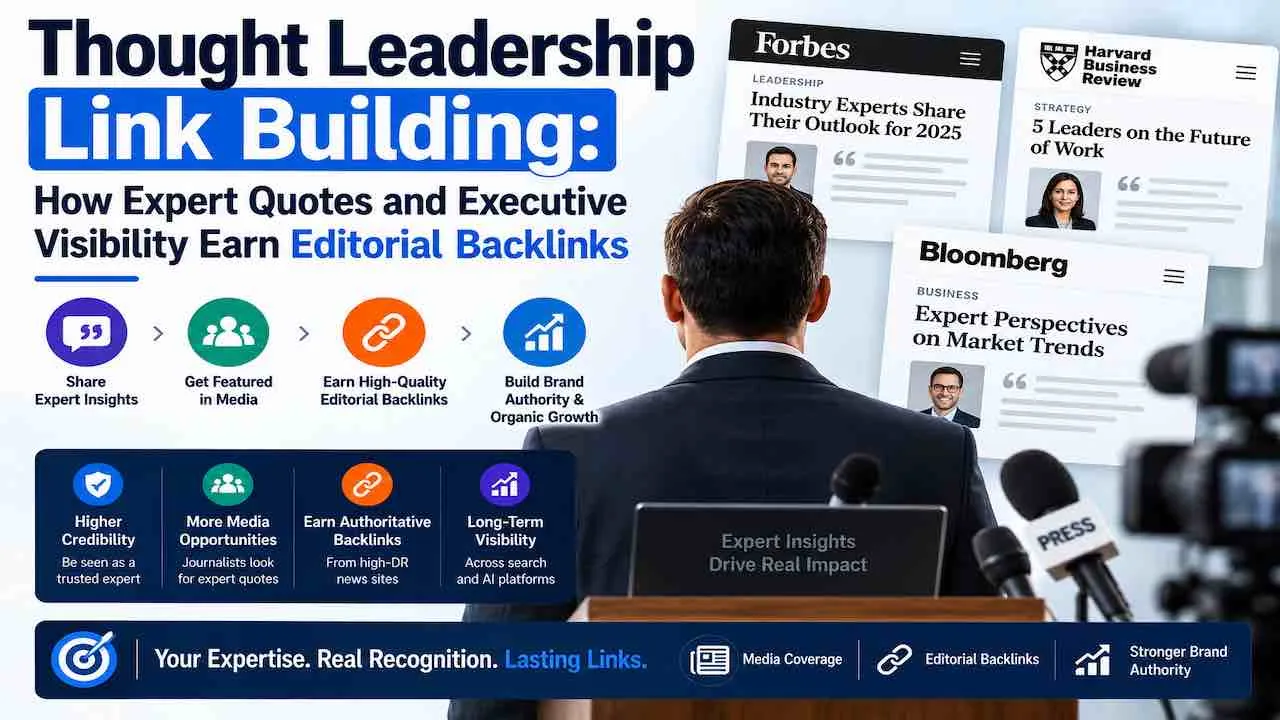
Thought leadership link building earns editorial backlinks by positioning founders and executives as credible industry sources. When journalists quote your CEO in a Forbes article, each instance generates a high authority editorial link. No outreach email can replicate it. Conference speaker listings and executive bylines work the same way. QuickDigital has built executive visibility programs for B2B companies, SaaS brands, and professional services firms since 2014. Our thought leadership SEO and executive PR SEO programs have earned editorial backlinks from DR 60 to 90+ publications. These span every major industry vertical. This guide covers the complete thought leadership link building strategy. It runs from EEAT foundation through expert quote acquisition, executive bylines, speaking engagement links, and personal brand SEO for founders.
If your link outreach is being ignored, thought leadership link building is the fix. It also applies when link building feels too salesy for your team. And it applies when your executives are invisible online while competitors get press coverage. It earns backlinks as a byproduct of genuine expert visibility. Backlinks without outreach are the defining characteristic of a mature thought leadership link building program. This is how thought leader brand authority turns into link equity.
Why Thought Leadership Link Building Outperforms Traditional Outreach
In a survey of 1,300 high authority publishers, 88% write stories from pitches a few times a month or less. Traditional link outreach competes in that tiny window. Link outreach ignored by editors and executives invisible online while competitors getting press coverage are symptoms of the same problem. No thought leader brand presence is generating organic media attention. Link building feels spammy precisely because it lacks thought leader brand authority behind it. Thought leadership link building bypasses it entirely. Journalists come to you. Editors invite your contribution. Podcast hosts request your appearance. Each instance generates editorial backlinks without a single cold outreach email.
| Factor | Traditional Link Outreach | Thought Leadership Link Building |
|---|---|---|
| Link acquisition method | Cold emails requesting link placement | Editorial citation of expert knowledge |
| Average link authority | DR 20 to 50 from niche blogs | DR 60 to 90+ from editorial publications |
| EEAT contribution | Minimal, link equity only | High, builds Expertise, Authoritativeness, and Trustworthiness signals simultaneously |
| Scalability | Requires constant outreach volume | Compounds as expert reputation grows |
| Brand signal benefit | Low, most links use generic anchor text | High, brand and personal name anchor text accumulates |
| AI search visibility | Minimal impact on AI citations | Strong, expert quotes appear in AI generated answers |
| Rejection risk | High, most cold pitches are ignored | Low, editors actively seek expert sources |
| Compound effect over time | Linear, requires ongoing effort | Exponential, reputation attracts unsolicited links |
Digital PR has emerged as the most powerful link building tactic in 2026. It is not really link building in the traditional sense. It is newsworthy content creation that earns genuine editorial coverage. Thought leader content and executive content marketing are the assets that generate this coverage at scale. Thought leadership link building is the individual expert version of digital PR. The asset is your executive’s knowledge and credibility, not a piece of content or a data study.
EEAT Link Building: The Foundation of Executive Authority
EEAT link building strategy connects Google’s quality assessment framework to your link acquisition strategy. It is the mechanism by which topical authority signals from editorial citations translate into measurable ranking improvements. Google evaluates every page using Experience, Expertise, Authoritativeness, and Trustworthiness signals. When your founder or executive is cited in authoritative publications, Google assigns EEAT credit to both. The individual and the domain they represent both receive the signal. This is EEAT link building in its most direct form.
How Google Rewards Expert Authority With Rankings
Google’s quality rater guidelines specifically evaluate author credibility on YMYL (Your Money Your Life) topics. An author with published bylines in Forbes, Harvard Business Review, or respected industry journals receives higher EEAT scores. An anonymous author with no credibility signals receives far lower scores. Those EEAT scores influence how Google ranks the content those authors write on your domain.
Executive visibility SEO works through this mechanism. Expert citation signals accumulate across Google’s entity systems. Every editorial placement, expert quote publication, and speaking engagement listing adds an EEAT signal. Each one names your executive and links to your domain. These signals accumulate across Google’s entity systems. They build author entity authority. This makes your team’s content rank faster and with less link support. Competitors without credible author entities cannot match this advantage.
Each editorial link from a DR 60+ publication that includes your executive’s name sends 3 signals simultaneously. It passes link equity to your domain. It adds an EEAT authority signal to your executive’s entity profile. And It trains LLMs to associate your expert with that topic area for AI search citation purposes.
Building Author Entity Authority for Link Acquisition
Author entity authority is the measurable recognition of your executive as a credible source in Google’s Knowledge Graph. Building it requires consistent naming and linking patterns across publications. Author entity authority separates an executive who earns links from one who remains invisible to Google’s entity recognition systems. Expert brand entity strength is the compound asset that grows with every editorial citation. Use the same full name format in every byline, expert quote credit, and speaker listing. Name consistency is the entity disambiguation requirement. It lets Google accurately accumulate all editorial citations into a single expert entity profile.
Link your author name to a consistent destination in every publication that allows author links. An About page or LinkedIn profile work well for this. The destination matters less than the consistency of the source page attribution. Over time, Google builds a robust entity profile for your executive. This profile functions as a credibility multiplier for everything they publish on your domain.
For the complete EEAT implementation strategy, see our EEAT trust and authority guide. It covers how EEAT connects directly to link building outcomes. See our personal brand link building and founder SEO guide for tactics using personal brand authority as the link acquisition asset.
Founder SEO: Personal Brand Link Building That Compounds
Founder SEO is the practice of building a founder or executive’s personal brand as a direct link acquisition channel. It differs from general thought leadership in one key way. Founder SEO treats the executive entity itself as an SEO asset. It has measurable authority, citation patterns, and Knowledge Graph presence. Personal brand SEO for link building turns the founder’s expertise into an engine. That engine drives editorial link acquisition automatically over time.
Optimizing Your Executive Entity in Google’s Knowledge Graph
Your executive needs a verified entity in Google’s systems before editorial links accumulate into measurable authority. Start with these entity anchors:
- Wikipedia page or Wikidata entry: The highest-weight entity anchor for any individual. Include verifiable facts: company founded, role, location, and notable accomplishments. Wikidata entries are achievable without Wikipedia notability requirements and provide direct Knowledge Graph data.
- Google Knowledge Panel: A Knowledge Panel for your executive confirms Google has resolved their entity with high confidence. It appears above organic results for branded searches. Build toward it through consistent citation volume across authoritative sources.
- LinkedIn profile completeness: LinkedIn profiles are indexed by Google and function as high authority entity anchors. A complete LinkedIn profile with consistent naming, current role, and linked website serves as a primary entity confirmation signal for executive entities.
- Crunchbase and AngelList presence: For startup founders and executives, Crunchbase profiles carry significant Knowledge Graph weight. These platforms feed directly into LLM training data for founder and company entities.
- Author pages on authoritative publications: Every publication where your executive contributes should carry a detailed author bio with consistent naming and a link to your domain. These author pages function as entity confirmation signals that aggregate executive link building credit.
Personal Brand SEO for Backlink Acquisition
Personal brand SEO for link building works through a predictable cycle. Your executive publishes original insights in one high authority publication. Journalists researching that topic find the byline. They request a quote or second byline. That quote appears in a second publication with a link. The cycle accelerates as the executive’s name becomes a recognized source in their subject area.
CEO personal brand development is not vanity. Personal brand backlinks from a well-established executive entity consistently outperform backlinks earned through cold outreach. They win on both authority and relevance. It is a systematic link acquisition channel. Executives with active public profiles generate 3 to 5 times more unsolicited editorial link opportunities than executives who are invisible online. Digital PR agency data tracking editorial pitch responses confirmed this ratio. The founder brand SEO investment compounds over 12 to 24 months. The result is a self-sustaining link acquisition system. Founder brand not ranking for a target keyword is fixable within this timeline. Founder link building strategy missing from the digital PR plan is the second gap. Personal brand authority signals absent from the domain is the third. All three resolve within 12 to 24 months of consistent effort.
For the step-by-step personal brand link building process, see our founder SEO and personal brand link building guide. It includes template author bios, entity anchoring sequences, and executive content calendars.
Expert Quotes: How to Get Cited in Media and Earn Editorial Links
An Expert quotes are the fastest path to editorial backlinks for executives without an established media profile. Expert quotes link building and how to get quoted in media for SEO are the same practice. Both apply the same journalist expert source strategy to earn editorial links. A journalist researching an article needs 3 to 5 expert sources. Your executive needs to be one of them. The link comes naturally as a citation credit. No link pitch required. No outreach campaign needed. The expert positioning SEO value is immediate and the link authority is consistently high.
HARO and Expert Source Platforms
A HARO (Help a Reporter Out) is the original expert source platform connecting journalists with subject matter experts. HARO link building generates media mentions SEO value through named editorial citations. No directory listing or guest post can match this signal quality. SourceBottle and ProfNet expand the journalist outreach reach beyond HARO’s coverage. It generates editorial links from major publications when your expert response is selected. HARO alternatives include SourceBottle, ProfNet, Qwoted, and Featured.com. Each platform sends journalist query notifications. Your executive responds to relevant queries with specific, data-backed expert commentary. Published responses earn editorial links with industry expert quotes credited to your executive.
Response quality determines selection rate. Generic responses are ignored. Specific responses with original data, counterintuitive insights, or practitioner experience consistently win publication. A 0.5% pitch acceptance rate is standard for cold outreach. Expert source response selection rates run 15 to 30% for high-quality responses to well-matched queries. The quality gap is the opportunity.
Set up HARO and expert source platform notifications filtered to your executive’s specific expertise categories. Respond within 2 hours of receiving a query. Journalists file stories on tight deadlines. Late responses are not considered regardless of quality. Speed is the first qualification. Quality is the second.
Building a Journalist Source Network
A journalist source network is the long term goal of expert quote strategy. When you have built rapport with a journalist, your pitches skip the slush pile. They already know your content is credible, your data is sound, and your executives give strong quotes. That trust translates directly into more coverage, more editorial links, and a stronger backlink profile over time.
Build the journalist source network systematically. Expert profile optimization across journalist-facing platforms is the foundation of this network. Follow the journalists who cover your industry on LinkedIn and X (Twitter). Engage with their published articles before pitching. Offer useful background data on stories they are researching without asking for a link. Provide exclusive data or early access to your original research. A journalist who receives genuine value from your executive twice will cite them on the third story. No request is needed.
Track journalist relationships in a simple CRM or spreadsheet. Log every interaction, every pitch sent, every article published that cited your executive. The journalist source network is a link building asset that appreciates over time. It is not a one-time tactic.
Writing Expert Quotes That Journalists Publish
Most expert quote responses are not published because they are too generic, too long, or too promotional. Journalists are looking for authoritative statements that make their article better, not vendor quotes that promote a product. Follow these guidelines for expert commentary that earns editorial placement:
- Lead with a specific, quotable claim. The first sentence must be the publishable quote. Journalists often use only the first sentence.
- Back the claim with a specific number, personal experience, or named case study. Vague claims are ignored. Specific claims are published.
- Keep responses under 150 words. Long responses signal that the expert cannot communicate concisely. Short, punchy responses signal media readiness.
- Never pitch your product or service in a HARO response. Journalists will disqualify you immediately. Focus on providing expert insight, not marketing copy.
- Offer a follow-up interview. Journalists who want more depth may upgrade your quote citation to a featured expert profile, which generates longer, more valuable editorial coverage.
Executive Bylines: Earning Editorial Links Through Contributed Content
Writing a bylined article for Forbes, Harvard Business Review, or a respected industry journal is not link manipulation. It is genuine thought leadership that happens to generate a high authority backlink. Executive bylines are the highest-value thought leadership link building tactic. Place them on publications with genuine editorial standards, engaged audiences, and domain ratings above 70.
Finding Byline Opportunities in Your Industry
Byline opportunities exist in three categories. Tier 1 publications such as Forbes, Entrepreneur, and Fast Company accept pitches from executives with established public profiles. These placements carry the highest authority but require significant editorial effort and established credibility. Tier 2 publications are industry-specific trade journals, association magazines, and vertical media sites. They serve your specific professional community. These placements carry strong topical relevance and generate targeted referral traffic alongside editorial links. Tier 3 publications are emerging newsletters, community platforms, and content-led blogs. They have growing audiences and real editorial standards.
Start with Tier 2 and Tier 3 publications. They accept first-time contributors. They also provide the published byline record that Tier 1 publications require before accepting pitches. Maintain a target publication list of 20 to 30 outlets in your niche ranked by audience quality. Develop a portfolio of pitch angles relevant to each publication’s editorial focus.
Pitching a cold guest contribution to a publication you have never engaged with is unlikely to succeed. High quality guest contributions to authoritative publications work best as part of a broader relationship-building strategy. Engage with the publication’s existing content. Reference their articles in your social posts. When you pitch, reference specific articles you found valuable. The relationship precedes the contribution.
The Byline Pitch Email Template That Gets Accepted
Use this structure for every byline pitch. Customize the topic angle and credential line for each publication. Keep the total pitch under 200 words.
Subject: Byline Pitch: [Specific Article Title] for [Publication Name]
Opening (1 sentence): State a specific, counterintuitive claim your article will make. This is the hook. It must challenge something the publication’s readers currently believe.
Article summary (2 to 3 sentences): Describe the main argument and the specific takeaway the reader gains. Support it with one piece of original data or proprietary insight from your experience.
Why this publication (1 sentence): Name a specific recent article from that publication. Explain how your piece extends or responds to it. This proves you read their content.
Credentials (2 sentences max): Name 2 publications where your bylines have appeared. Include your executive’s title, company, and the specific domain of expertise the article addresses.
CTA (1 sentence): Offer to send a full outline or first 300 words immediately. Make the next step zero-friction for the editor.
Pitch response rates run 15 to 30% for well-targeted pitches. Generic pitches receive under 2% response rates. The difference is specificity in the opening claim and the credential match to the publication’s existing editorial focus.
Byline Content Strategy for Maximum Link Value
Byline content strategy determines both acceptance rate and link value. Articles that include original research, proprietary data, or counterintuitive perspectives based on practitioner experience earn publication. Articles that restate common knowledge do not. Follow this structure for bylines that earn both editorial acceptance and maximum link authority:
- Lead with a specific claim that challenges conventional wisdom. Editors receive hundreds of pitches that state what everyone already knows. A specific challenge to accepted practice gets read.
- Support the claim with proprietary data or named case studies. Your company’s operational data is the asset that external researchers cannot replicate. Use it. Name the results. Quantify the outcomes.
- Include one contextual link to your domain where it genuinely adds value. Use one contextual link where it genuinely adds value. A link to additional research, a free tool, or a detailed case study satisfies editorial standards. A link to your homepage does not.
- Close with a specific, actionable recommendation. Editors want readers to finish articles with something they can do. Practical closing recommendations increase publication rates significantly.
For the complete executive byline placement process, see our expert bylines and domain authority link building guide. It covers outreach templates, pitch structures, and editorial link value measurement.
Speaking Engagements as a Link Building Channel
Speaking engagements for backlinks work through a straightforward mechanism. Conference websites list all speakers with bios and links to their company websites. Each conference listing is an editorial link from a domain that often carries authority above DR 50. Industry conferences in competitive sectors frequently have DR 60 to 80+ domains. Speaking engagement SEO value compounds across every conference where your executive appears.
How Conference Speaking Generates Editorial Backlinks
A single speaking engagement generates multiple editorial link opportunities. The conference website links to your domain in the speaker listing. Event recap articles published by media covering the conference mention your executive with a citation link. Attendees who write industry roundup posts reference speakers they found valuable. Organizers often invite speakers to contribute a byline to the conference publication or newsletter.
Industry conference speaking is the most overlooked thought leadership link building channel for executives in B2B sectors. Start with smaller, niche-specific industry events. Major conferences like Web Summit, SaaStr, or Dreamforce require an established speaking track record. Niche events actively seek subject matter experts. Apply to 10 to 15 relevant events per year. Expect 3 to 5 acceptances as a first-time speaker. Each acceptance generates 1 to 4 editorial links from the conference ecosystem.
Contributor articles and expert roundup link building citations intersect at the speaker bio page. How to build backlinks through thought leadership becomes clear when all these channels point to one expert entity destination. Prepare a speaker bio page on your own domain before applying. Conference organizers link to their speakers. Your speaker bio page becomes the landing destination for those links. Optimize it with your executive’s expertise focus, publication list, and past speaking credentials. This page accumulates link equity from every conference listing over time.
Podcast Guest Appearances for Link Building
Podcast guest link building is one of the highest ROI thought leadership link building tactics available. Every podcast episode generates a show notes page. This includes guest bios with links to the guest’s website. Top-tier industry podcasts with DR 60+ domains produce editorial links that match or exceed typical guest post link quality. The difference is that podcast links require expertise and communication skill, not writing ability.
Target podcasts covering your executive’s specific expertise area rather than general business podcasts. A focused industry podcast with 5,000 listeners in your exact target market generates more referral traffic. It produces more qualified editorial citations than a general entrepreneurship podcast with 50,000 general listeners. Topical relevance of the podcast domain multiplies the SEO value of the show notes link.
Prepare a one-page guest pitch document. Include your executive’s specific expertise claim and 3 potential episode topics with audience value statements. Add links to past media appearances as credibility proof. Send this to the podcast host or producer directly. Podcast booking rates for well-prepared pitches from genuine subject matter experts run 20 to 35%. For the complete podcast guest link building strategy, see our podcast guest link building guide.
The Thought Leadership Link Building Compound Effect
Thought leadership link building compounds in a way that traditional outreach cannot match. A single original research study published by your executive generates a cascade of editorial link opportunities. This compounding sequence is the core advantage of the strategy.
The compounding sequence works like this. Your executive publishes original research in a Tier 2 industry publication. The byline earns one editorial link. Journalists covering that publication find the research and cite it in 3 to 5 follow-on articles. Each citation adds an editorial link. A podcast host reading one of those articles invites your executive as a guest. The episode show notes add a link. A conference organizer reads the research and invites your executive to speak. The speaker listing adds a link. Other researchers in your industry cite the original research in their own articles. Each citation adds a link. One original study generates 8 to 20 editorial links across a 6 to 12 month window.
Your expertise is often the asset. Visibility grows when that expertise is packaged well. Packaging expertise well means producing original research, named frameworks, and specific data claims. Journalists, podcasters, and conference organizers can then reference, cite, and build on those assets. Expert citation in media and media mentions SEO value flow naturally from expert brand entities that produce citable assets. The packaging investment is a one-time effort. The editorial link returns compound indefinitely.
For how original research generates editorial link cascades, see our original research link building strategy guide.
LinkedIn as a Thought Leadership Link Building Platform
A LinkedIn thought leadership does not generate direct backlinks. LinkedIn posts are mostly nofollow. LinkedIn functions as a thought leadership link building platform through 3 indirect mechanisms. Each one produces editorial links at scale.
- Journalist identification: Journalists searching for expert sources frequently search LinkedIn before using HARO. An executive with a complete LinkedIn profile, consistent posting about their expertise, and engagement from industry peers appears in journalist searches. This generates unsolicited expert quote requests that turn into editorial links.
- Content amplification that attracts linkers: When your executive’s LinkedIn post reaches a journalist or editor in their network, they may assign a story based on the insight. The resulting article links to your domain as the source. LinkedIn becomes the distribution channel that places your executive’s insight in front of the people who control editorial links.
- Entity authority signaling: Google indexes LinkedIn profiles and company pages. An executive with a consistent publishing history on LinkedIn signals active thought leadership to Google’s entity systems. This LinkedIn link building SEO B2B signal strengthens the executive entity profile that accumulates link equity from all editorial sources simultaneously.
Post original expert insights on LinkedIn 3 to 4 times per week. LinkedIn thought leadership and anchor text brand building through personal name citations are long-term byproducts of consistent executive publishing. These compound gradually as the executive entity accumulates editorial authority. These should not be promotional content. They should be specific observations, data points from your operations, or counterintuitive claims from your practitioner experience. Track which posts generate journalist inquiries and direct messages from editors. Those topics are your highest-value byline and expert quote pitching opportunities. For the complete LinkedIn link building SEO B2B strategy, see our LinkedIn link building guide for B2B brands.
Measuring Thought Leadership Link Building ROI
Thought leadership link building ROI is measurable but requires different metrics than traditional link outreach. Track these 5 indicators monthly to demonstrate compound value growth over time.
- New referring domains from editorial sources: Filter your Ahrefs or SEMrush referring domain report by DR 50+ domains. Founder SEO link building and executive bylines for link building both appear in this report as high-value editorial link types. domains. Track monthly growth in high authority editorial links specifically. This separates thought leadership link value from general link acquisition.
- Executive name branded search volume: Track Google Search Console impressions for your executive’s name as a query. Rising impressions indicate growing expert recognition. This branded search growth is the leading indicator of compounding editorial link opportunities.
- Media mention volume: Track all publications that mention your executive’s name using Google Alerts. No media mentions in Google Alerts after 3 months of consistent thought leadership activity indicates a positioning problem, not a volume problem. and Ahrefs Content Explorer. Rising mention volume precedes rising link volume by 30 to 60 days. Monitor and convert unlinked mentions to links where possible.
- Author page authority growth: Track the DR and traffic of the author pages on publications where your executive contributes. Rising author page authority multiplies the link equity value of your byline links from those domains.
- EEAT signal accumulation: Run a quarterly audit of your executive’s named citations across authoritative sources. Count publications, citation volume, and average domain authority of citing sources. This EEAT audit tracks the authority signal accumulation that drives organic ranking improvements beyond direct link equity.
Cost and Time Investment Per Tactic
Every thought leadership link building tactic has a different cost and time profile. Use this table to plan your program based on available budget and team capacity. The monthly time estimates assume one executive participating actively across all channels.
| Tactic | Monthly Time Required | Cost to Outsource | Links Generated Per Month |
|---|---|---|---|
| HARO and expert source responses | 8 to 12 hours (3 to 5 responses per week) | $500 to $1,500/month | 2 to 6 editorial links |
| Executive byline articles | 6 to 10 hours (one article per month) | $800 to $2,500/month | 1 to 3 editorial links |
| Speaking engagement applications | 3 to 5 hours (applications and prep) | $300 to $800/month | 1 to 4 speaker listing links |
| Podcast guest appearances | 4 to 8 hours (prep and recording) | $500 to $1,200/month | 1 to 2 show notes links |
| LinkedIn thought leadership publishing | 3 to 5 hours (3 to 4 posts per week) | $400 to $1,000/month | Indirect (journalist outreach trigger) |
| Full managed program (all channels) | 20 to 40 hours (in-house team) | $3,000 to $8,000/month (agency) | 6 to 15 editorial links per month |
In-house programs require a dedicated marketing coordinator or PR manager at 20 to 25 hours per week. Agency-managed programs reduce internal time to 3 to 5 hours per month for executive participation in responses and reviews.
Common Thought Leadership Link Building Mistakes
These mistakes consistently undermine thought leadership link building programs across B2B companies, agencies, and SaaS brands. Avoiding them from the start saves 6 to 12 months of wasted effort.
- Pitching product features instead of expert insights. Journalists are not looking for product coverage. They are looking for credible expert perspectives that make their articles better. Executive quotes that mention specific product names or features are discarded. Expert quotes that provide specific practitioner insight are published. The distinction is the difference between a marketing message and a journalist source.
Tactical Mistakes That Undermine Link Value
- Targeting publications by domain rating instead of editorial relevance. A DR 80 publication in an unrelated niche generates a lower-value editorial link than a DR 55 publication that is the definitive journal in your exact industry. Topical relevance of the linking domain determines link value in Google’s context-aware link assessment. Pursue relevance first, authority second.
- Inconsistent executive naming across publications. Using “John Smith,” “J. Smith,” and “John E. Smith” interchangeably across publications fragments the entity authority accumulation that makes thought leadership link building compound over time. Pick one full name format and enforce it across every byline, speaker listing, and expert quote credit.
- Stopping after one publication cycle. A single byline article does not build a thought leadership link building program. The compounding effect requires at least 6 to 9 months of consistent activity across multiple channels. Most programs are abandoned at month 3, precisely when the initial results appear modest. The acceleration happens at months 9 to 12.
- No speaker bio page on your domain. Conference listings and podcast show notes link to your speaker bio page. Without a dedicated speaker bio page, these links point to generic pages that waste the referral authority. Build a speaker bio page that consolidates past speaking credentials, published bylines, and media appearances. It becomes the highest authority page on your domain over time.
For link building service options that incorporate thought leadership tactics, see our link building service. Also read our digital PR link building guide for AI citations. For outreach-based link building that complements the thought leadership approach, see our guest post outreach service.
Thought Leadership Link Building by QuickDigital
Build Editorial Backlinks Through Executive Visibility
QuickDigital builds thought leadership link building programs that position your founders and executives as recognized industry sources. Our programs generate DR 60+ editorial backlinks from expert quotes, bylines, and speaking engagements. Results are measurable within 90 days. Since 2014, we have built executive visibility programs that compound into self-sustaining link acquisition engines.
Get My Thought Leadership Link Strategy
Free strategy consultation. No obligation. Response within 24 hours.
Voice Search and Conversational Queries for Thought Leadership Link Building
A Voice search queries for thought leadership link building are conversational and specific. Voice queries follow conversational patterns about executives building backlinks and getting featured in industry publications. Users ask about the fastest ways to earn editorial links. Optimizing for these queries means short, direct answers. A voice assistant can read the answer in under 8 seconds.
The FAQ section of this guide uses H4 question headings followed by direct paragraph answers. This is the schema-compatible voice search structure that Google’s voice results draw from. Each FAQ answer leads with the direct response in the first sentence. This matches the voice search retrieval pattern for conversational queries about link building strategy.
For thought leadership link building, the top voice queries ask how to get backlinks through thought leadership. They also ask how experts build backlinks without outreach. Both are answered in the H2 headings and FAQ answers above. This structure serves traditional featured snippets and voice search results simultaneously. This structure serves both traditional search featured snippets and voice search result selection simultaneously.
Frequently Asked Questions
Build backlinks through thought leadership by responding to HARO and expert source platform queries. Contribute executive bylines to industry publications. Speak at conferences and appear as podcast guests. Thought leadership link building produces editorial links without cold outreach. Your executive becomes the source journalists and editors actively seek out.
Initial editorial links from HARO responses appear within 30 to 60 days. Byline-based links take 60 to 90 days from first pitch to publication. The compounding effect begins at 6 to 9 months. Full compound momentum is visible at 12 months when journalists cite your executive without any outreach at all.
Register on HARO, SourceBottle, Qwoted, and ProfNet. Respond to journalist queries within 2 hours with a specific, data-backed quote under 150 words. Expert quotes that get published are specific, counterintuitive, and grounded in practitioner experience. Generic quotes are never published. Never pitch your product in a media response.
Founder SEO link building treats the founder’s personal brand as a direct link acquisition channel. It combines entity optimization in Google’s Knowledge Graph, consistent byline publishing, and expert quote participation. Founder SEO link building compounds over 12 to 24 months. The result is a self-sustaining editorial link engine. It generates links without active outreach.
EEAT link building works by accumulating editorial citations that name your executive as a source in authoritative publications. Each citation adds Expertise, Authoritativeness, and Trustworthiness signals to the executive entity profile. Domains with 20 or more editorial citations from DR 50+ publications gain measurable EEAT authority. This improves rankings across the entire domain.