

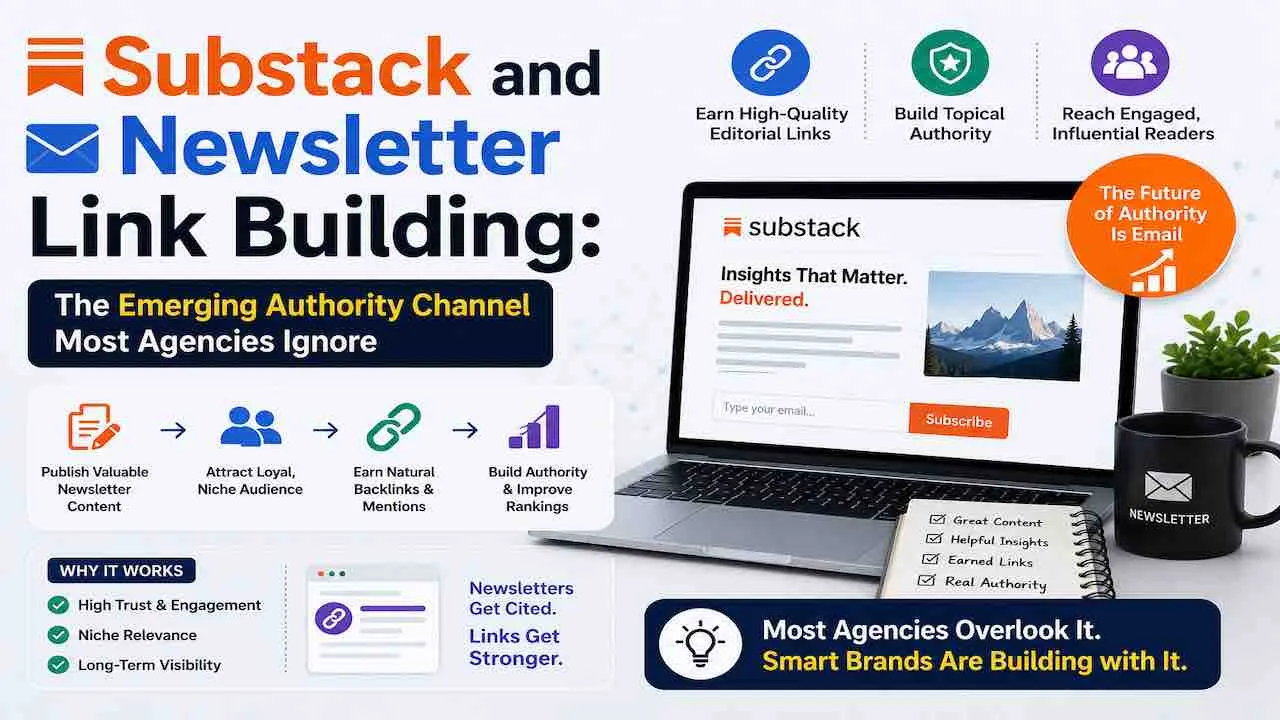
Substack newsletter link building works because Substack links are dofollow by default. Reddit, Quora, and LinkedIn attach nofollow or ugc attributes to all outbound links. Substack posts pass link equity directly to the pages they cite. Substack has over 35 million active readers, and its archive pages are indexed by Google. A single mention in a well read newsletter delivers referral traffic and a dofollow backlink. This guide covers every route to earning those links. It also covers Substack setup for SEO and measurement.
Why Substack Links Carry Real SEO Value
Substack links carry link equity because the platform does not apply nofollow attributes by default. This places Substack in a separate category from most user generated content platforms. The table below shows how Substack compares with other platforms most SEOs already use.
| Platform | Default Link Attribute | Archive Indexed by Google | SEO Link Value |
|---|---|---|---|
| Substack | Dofollow | Yes | High |
| Nofollow / ugc | Yes | Brand signal only | |
| Nofollow | Partial | Low | |
| Medium | Nofollow | Yes | Low |
| Quora | Nofollow / ugc | Yes | Brand signal only |
| Beehiiv | Dofollow on indexed posts | Yes | Moderate |
| Email only newsletters | Not crawlable | No | None for SEO |
One key caveat applies. Substack links are dofollow when the newsletter uses the default name.substack.com subdomain. Links from a custom domain Substack pass equity from that custom domain instead of substack.com. Both carry value. The distinction affects how you qualify link targets and where your own newsletter authority accumulates.
This is why most community link building guides overlook Substack entirely. They group it with nofollow social platforms. Substack belongs alongside editorial blogs and independent media, not community forums.
Two Distinct Plays in Substack Link Building
Substack link building splits into two strategies. Each has a different goal, timeline, and setup requirement.
- Earning links from other newsletters: get your content cited inside issues written by other Substack publishers. The link lives on their domain and points to yours.
- Running your own Substack as a link asset: build a newsletter on a custom domain. Each issue publishes dofollow links to your main site. The newsletter becomes a controlled link source you own.
Most sites benefit from both plays running at the same time. Earning links from other newsletters builds external authority. Your own newsletter builds a repeatable link stream and an audience that already trusts your brand.
Substack Subdomain vs Custom Domain for SEO
The domain you choose for your Substack directly affects the SEO value of every link it publishes. The table below covers the key differences.
| Factor | name.substack.com | Custom Domain |
|---|---|---|
| Link equity flows to | substack.com domain | Your brand domain |
| Google Search Console access | Limited (subdomain only) | Full property access |
| Brand entity signals | Split between Substack and brand | Consolidated to brand domain |
| Starting authority | High (borrows substack.com DA) | Starts from zero, builds over time |
| Long term SEO value | Low (dependent on Substack platform) | High (fully owned asset) |
A custom domain is the right choice when your newsletter runs more than 6 months. All backlinks earned by your newsletter then contribute to your brand domain’s authority. The subdomain option makes sense only for testing the channel before committing to a domain migration.
Finding Substack Newsletters Worth Targeting
Effective Substack link building starts with finding newsletters that cover your topic and publish web accessible archives. Email only newsletters are not crawlable by Google. A link in an email with no web archive version passes zero SEO value.
How to Build Your Target Newsletter List
- Substack native search: search by topic keyword at substack.com. Filter by subscriber count to find established publications in your niche.
- Google site operator: run
site:substack.com "your topic keyword"to find indexed posts that discuss your subject area. - Ahrefs or Semrush referring domains: filter your competitor’s referring domains by substack.com. This shows which newsletters already cite similar content.
- Substack Recommendations tab: open any relevant newsletter and check its Recommendations section. Recommended newsletters share a reader overlap with similar topics.
4 Signals That Qualify a Newsletter Before Outreach
- Publication frequency: publishers posting at least twice a month are more likely to respond.
- Archive indexation: paste a recent post URL into Google search with the site: operator. If it appears in results, the archive is indexed.
- Outbound link behavior: scan 2 to 3 recent posts. Writers who already link out to external sources are far more likely to link to yours.
- Audience engagement: check comments and Restacks on posts. Engaged readers increase the referral traffic value of any link earned.
Warm Outreach: Getting Cited in Other Newsletters
Cold link requests to newsletter writers fail at high rates. Writers receive pitches from people they have never engaged with, and they delete most of them. Warm outreach reverses this by building a genuine relationship before any ask.
The Warm Outreach Sequence
- Step 1: Subscribe and read 3 to 5 issues. Note the topics, writing style, and sources the writer already cites.
- Step 2: Engage on Substack Notes. Leave a substantive comment on a recent post. Add a specific point or question the writer can respond to. Generic praise is ignored.
- Step 3: Restack a post. A Restack signals that you promote their work without being asked.
- Step 4: Pitch after 1 to 2 weeks of engagement. Keep the pitch under 100 words. Name the specific piece you want them to link to. Explain why their readers benefit.
Pitch Format for Newsletter Writers
A pitch to a newsletter writer is not a link request email. It is a resource suggestion from a reader who already follows the publication.
Subject: Quick resource for your [topic] readers

Hi [Name],

I have been following your newsletter for a few weeks.
Your piece on [specific topic] was excellent.

I published a [data study / guide / tool] on [topic]
that your readers might find useful: [URL]

Key finding: [one sentence, specific stat or insight].

Happy to share the data if useful for a future issue.

[Your name]
Pitches under 80 words convert 3 to 4 times better than generic outreach. Referencing a specific recent piece is the key variable. Give something concrete: data, a complementary tool, or a counterpoint to something they already covered.
Unlinked Newsletter Mention Reclamation
Some newsletters reference brands, tools, or sites without hyperlinking them. Reclaiming these unlinked mentions is the highest ROI tactic in newsletter link building. The relationship already exists. The writer already trusts the brand enough to mention it. The ask is simply adding a link.
Unlinked brand mentions signal authority to search engines. Prioritize reclaiming them from newsletters with large, indexed audiences first. Mentions from high subscriber newsletters with indexed archives carry the most weight.
How to Find Unlinked Mentions
- Google Alerts: set up an alert for your brand name. Google emails new indexed mentions, including Substack posts that name you without linking.
- Ahrefs Mentions tool: filter by substack.com under the Mentions tab. This surfaces unlinked brand references in indexed posts.
- Google search operator: run
"your brand name" site:substack.com -site:yoursite.comto surface mentions not originating from your own domain.
Reclamation Outreach Template
Subject: Re: your mention of [Brand] in [Issue Name]

Hi [Name],

Thank you for mentioning [Brand] in your recent issue.

If useful, here is the direct link to the page you referenced:
[URL]

It might help your readers find it easily.

[Your name]
Reclamation emails convert at 20 to 40% with this format. Writers often update the live web version of the post within days.
Guest Writing for Newsletter Link Building
Guest issues are one of the most effective routes to editorial newsletter links. A guest post puts your name and 1 to 2 links in front of an engaged audience. The publisher endorses it by publishing it. The links appear inside content the publisher has endorsed by publishing it.
How to Pitch a Guest Newsletter Issue
- Propose a specific topic matching the newsletter’s existing content pillars. Do not send a generic guest post request.
- Show 1 to 2 examples of content you have published at a similar depth and style.
- Name the exact insight or data point you would feature. Writers accept pitches with a clear editorial angle.
- Limit your link placement to 2 contextual links within the body. More than 2 links reads as promotional and reduces acceptance rates.
The most successful guest post outreach for newsletters targets publications with 5,000 to 50,000 subscribers. Smaller newsletters have limited reach. Very large newsletters have high editorial bars and low response rates for unsolicited pitches.
Original Research as a Newsletter Link Magnet
Newsletter writers cite original data more than any other content type. A study with a specific finding gives writers something new they cannot find elsewhere. This is why original research link building generates disproportionate returns in the newsletter channel.
Data formats that earn newsletter citations consistently:
- Industry surveys: 50 to 200 respondents with a counterintuitive finding. A specific percentage from a named sample is more citable than a vague trend observation.
- Benchmark reports: aggregated performance data from a defined sample. Writers cite benchmark figures across multiple issues when the data stays relevant.
- Platform comparisons with real data: tested findings about tools or formats writers use regularly.
- Tracked metrics over time: a consistent dataset measured at regular intervals. Newsletter writers use longitudinal data to anchor trend observations with a credible source.
Publish the research as a standalone page on your main domain. This concentrates all earned backlinks on one URL with strong topical authority signals.
Substack Notes for Link Building and Brand Signals
Substack Notes is a social feed inside the platform. Notes posts are indexed by search engines and publish dofollow links to external pages. Publishing consistently in Notes builds co occurrence signals even when no traditional backlink is placed.
How to Use Notes for SEO
- Share research snippets: post the key stat or finding from your latest content. Include a link to the full piece on your main site.
- Restack other writers’ Notes: restacking is public and visible to the original writer. Restacking gets you on a writer’s radar fast. Do it before sending any outreach.
- Comment with substance: replies to popular Notes appear in the feed. A useful comment that references a relevant resource earns clicks. It signals your expertise in the niche.
Repeated mentions of your brand name alongside relevant topic terms build entity association signals. This applies even without a direct backlink. Notes act as a high frequency brand signal surface that compounds over time.
Substack Recommendations and Cross Posts
The Recommendations feature lets publishers recommend other publications to their subscribers. Each recommendation creates an indexed, crawlable dofollow link on the recommending publication’s public page. This is a direct link building mechanism built into the platform.
When a newsletter with 10,000 subscribers recommends your Substack, a link appears on their public page. It also triggers an automated email to all their subscribers, producing subscriber growth alongside the link signal.
Cross Posts for Editorial Links
A cross post publishes another writer’s full piece inside your newsletter, with commentary. Cross posts create reciprocal relationships. When you cross post someone’s work, they often return the gesture. Each cross post generates a public web post. It links to the original publication and any external resources mentioned in commentary.
Pairing cross posting with co research link building maximizes output. A joint data piece published across both newsletters earns links from both audiences at the same time.
Newsletter Link Building for AI Search Citations
AI search engines including Perplexity, ChatGPT, and Gemini pull answers from indexed web content. Newsletter archive pages appear in AI responses when they contain specific, factual content. A newsletter that cites your brand trains AI models to associate your brand with the relevant topic.
For maximum AI citation value, structure the content the link points to in a specific way. The guide on backlinks for AI search citations explains this difference in detail.
Newsletter Content That AI Cites Most
- Named entities: include brand names, people, and platform names. AI models use entity recognition to classify and cite content by topic.
- Declarative sentences with specific facts are more citable than opinion statements. For example: “X produces Y result under Z condition” anchors an AI citable claim.
- Self contained sections: each H2 section should answer one question completely. AI engines extract answers at the section level, not the full article level.
- Published author attribution: a named byline with a linked profile increases citation probability in AI responses.
The amplification effect compounds when newsletter mentions trigger downstream links from journalists and bloggers. One citation in a newsletter with 10,000 industry readers often generates 3 to 8 editorial backlinks. Those backlinks come from readers who cover the same topic.
This downstream link generation connects newsletter link building directly to digital PR link building. A newsletter with industry reach functions identically to a trade publication for amplification purposes.
Running Your Own Substack as a Controlled Link Asset
A Substack you publish yourself builds a link stream you control completely. Each issue links to your main site pages with the anchor text you choose. Unlike guest posts or outreach, this link source requires no negotiation or approval from a third party.
Setup for Maximum SEO Value
- Connect a custom domain. Links from your custom domain build your brand’s authority, not Substack’s.
- Submit the Substack sitemap to Google Search Console. The sitemap URL follows the pattern
yoursubstack.com/sitemap.xml. Verify the property as a domain property for full coverage. - Publish on a consistent schedule. Google rewards consistent publishing with more frequent crawls. Publish at minimum twice per month.
- Link to 1 to 2 specific pages on your main site per issue. Use descriptive anchor text. Avoid generic phrases like “our site” or “click here.”
- Build topic clusters. A pillar issue on a core topic builds topical authority. Support it with 4 to 6 serial issues that link back to it.
Common Mistakes in Substack Newsletter Link Building
- Treating Substack as a nofollow social platform: this single assumption causes most SEOs to skip the channel. Substack links are dofollow. Verify this by checking the anchor element in any Substack archive post with browser developer tools.
- Pursuing email only newsletter links: a link inside an email is not crawlable by Google. Target only newsletters that publish a web archive of every issue.
- Cold link request emails: pitching to a writer you have never engaged with converts below 2%. Warm engagement before outreach converts at 15 to 25%.
- No linkable asset: newsletter writers cite specific data, tools, or guides. A homepage or generic blog post gives them nothing specific to link to.
- Using the default Substack subdomain for your own newsletter: links from name.substack.com build Substack’s authority, not yours. A custom domain takes under 30 minutes to connect.
- Measuring only dofollow links misses the full picture. Unlinked mentions and downstream editorial links also contribute to SEO value. Tracking only direct backlinks understates the return on this channel.
- One time outreach: newsletter link building compounds over repeated interactions. A writer who cites you once will cite you again. Stay in their orbit through Notes, comments, and Recommendations.
Measuring Substack Newsletter Link Building Results
Newsletter link building produces results across 4 measurement areas. Track all 4 to see the full picture. A detailed framework for link building measurement in AI search covers newsletter citation tracking and AI visibility.
| Metric | Tool | What It Shows |
|---|---|---|
| New referring domains from Substack | Ahrefs, Semrush | Dofollow link equity earned |
| Referral traffic from newsletter sources | Google Analytics 4 with UTM tags | Qualified visitors, session quality, conversions |
| Brand mention volume | Google Alerts, Ahrefs Mentions | Linked and unlinked brand co occurrence growth |
| AI citation presence | Manual prompts in Perplexity, ChatGPT, Gemini | Whether AI answers cite your content for topic queries |
| Downstream editorial links | Ahrefs new backlinks report filtered by date | Links earned from journalists and bloggers who read newsletters |
Set a 90 day baseline before launch. Newsletter link results appear in Google within 2 to 4 weeks of the archive post going live. Referral traffic and AI citations often appear faster than traditional link equity improvements in rankings.
Substack Newsletter Link Building Monthly Action Plan
| Week | Action | Expected Output |
|---|---|---|
| Week 1 | Identify 10 target newsletters, subscribe, read 3 issues each | Qualified outreach list |
| Week 1 to 2 | Engage via Notes comments and Restacks on target publications | Visible presence before any pitch |
| Week 2 | Run unlinked mention audit, identify reclamation targets | Quick win backlink list |
| Week 2 to 3 | Send reclamation emails | 3 to 8 links per month at 20 to 40% conversion |
| Week 3 | Send warm outreach pitches to 10 target writers | 2 to 4 guest or citation placements |
| Week 4 | Publish your own Substack issue with 2 links to main site | Controlled dofollow links published |
| Monthly | Check new referring domains and downstream editorial links | ROI tracking report |
Frequently Asked Questions
Yes. Substack applies dofollow attributes to all outbound links in posts and Notes by default. This is different from Reddit, Medium, LinkedIn, and Quora, which all apply nofollow or ugc attributes. Verify this on any Substack archive post. Right click a link and check the anchor element in browser developer tools. No rel=”nofollow” attribute will appear.
Yes, when the link appears in a web archived issue that Google has indexed. Links inside emails are not crawlable and carry no SEO value. A link in an indexed Substack archive post passes equity from the substack.com domain. That domain carries high authority in most link analysis tools. Links from a custom domain Substack pass equity from that custom domain instead.
Earning links from other newsletters builds external authority pointing at your site from independent sources. Running your own Substack creates a controlled link stream you publish yourself. Both deliver dofollow links. Earned links carry more weight because they come from independent editorial decisions by other writers. Your own newsletter links are faster to produce and fully predictable.
Start by searching Substack for your topic keyword and filtering for active publications with regular web archives. Then check which newsletters already cite your competitors by searching their domains in Ahrefs. Writers who already link to similar content are your best link targets. Verify that the newsletter’s issues appear in Google search results before adding it to your outreach list.
Referral traffic from newsletter links appears within days of the issue going live. SEO ranking improvements from those links surface within 4 to 12 weeks. The timeline depends on Google crawl frequency. Downstream editorial links keep appearing for 3 to 6 months after the original mention.
Start Earning Dofollow Links From Newsletters
Substack is one of the few channels where editorial dofollow links are accessible. The cost and competition are far lower than traditional outreach. The channel rewards writers who provide real value and researchers who produce citable data.
Need newsletter links that actually pass link equity?
Quick Digital has built newsletter links through outreach, mention reclamation, and original research since 2014. The link building service includes newsletter and community channels alongside traditional editorial outreach.
Get a Free Newsletter Link Audit