
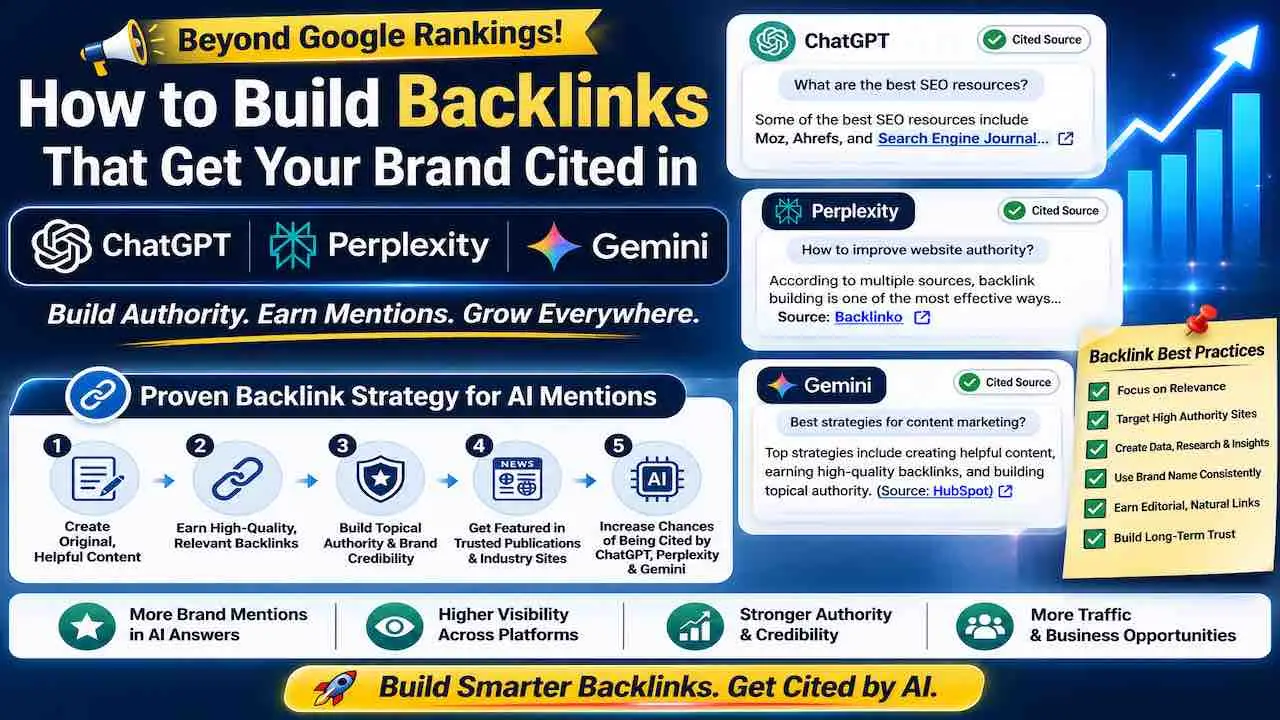
Backlinks for AI search citations work differently from traditional link building. AI engines cite brands based on brand mention frequency, editorial credibility, and entity authority signals. Link equity alone is not enough. Ahrefs analysis of 75,000 brands confirms brand mention frequency correlates with AI citation presence. That correlation is 3 times stronger than backlinks alone. Only 11% of domains are cited by both ChatGPT and Perplexity. This proves each platform requires its own citation strategy. This guide covers every link type, crawler access setting, platform tactic, and outreach approach. All major AI engines are covered.
How Backlinks Influence AI Search Citations
Backlinks influence AI search citations through two distinct mechanisms: training data authority and real time retrieval credibility. AI engines use backlinks as trust verification signals. They decide whether to cite a source based on those signals, not on ranking position alone.
Retrieval based AI engines like Perplexity and Bing Copilot check backlinks to confirm a source is trustworthy. This check happens before pulling content at query time. Training based AI engines like ChatGPT weigh brand mention frequency across the web. This weighting happens during model training cycles.
Your homepage accounts for only 4.5% of branded AI citations. Third party validation accounts for 74% of branded AI citations (Omniscient Digital, 23,387 citations study). This includes review sites, press coverage, industry directories, and community platforms. Build your AI citation link strategy around earning third party mentions first. Driving traffic to your own pages is secondary. Learn how LLM training data and AI indexing determines which sources AI engines pull citations from.
The 46x Citation Rate Gap You Must Understand
A study of 34,234 AI responses found a 46 times difference in brand citation rates. ChatGPT cited brands just 0.59% of the time. Perplexity sat at 13.05%, and Grok came in at 27%. This gap means a brand invisible in ChatGPT may be prominently featured in Perplexity, and vice versa. Optimizing for AI search as one unified category is the single biggest strategic mistake. Every major AI engine requires its own backlink strategy.
Research across 680 million citations found only 11% of domains cited by both ChatGPT and Perplexity. Google AI Overviews and Google AI Mode cite the same URLs only 13.7% of the time. They reach similar conclusions but use different sources. Build a separate backlink and mention strategy for each platform. Source types and outreach channels that drive ChatGPT citations differ fundamentally from those that drive Perplexity citations.
| AI Platform | Brand Citation Rate | Primary Citation Source | Key Backlink Target |
|---|---|---|---|
| Grok (xAI) | 27% of responses | X (Twitter), real time web | X presence, real time editorial coverage |
| Perplexity AI | 13.05% of responses | Real time web, Reddit, Google adjacent sources | Reddit, industry publications, review platforms |
| Claude (Anthropic) | Research backed content priority | Training data, multi source credibility | Academic citations, multi perspective coverage |
| ChatGPT (OpenAI) | 0.59% of responses | Training data, Bing retrieval | High authority publications, Wikipedia, Wikidata |
| Gemini (Google) | Google Search integrated | Google index, Knowledge Graph, GBP | Google indexed publications, sameAs entity links |
Allow AI Crawlers: The Foundation Step Most Brands Skip
Blocking AI crawlers in your robots.txt prevents AI engines from indexing your content. Every other backlink and brand mention strategy becomes worthless for AI citation building. Most brands either block AI crawlers accidentally or have no explicit policy. Both outcomes stop AI engines from citing your content, regardless of how many backlinks point to it.
Add explicit allow rules in your robots.txt for every major AI crawler. Missing even one means invisible content on that platform.
| AI Crawler | Platform It Serves | robots.txt Rule to Add |
|---|---|---|
| GPTBot | ChatGPT (training data) | User-agent: GPTBot / Allow: / |
| OAI-SearchBot | ChatGPT Search (real time) | User-agent: OAI-SearchBot / Allow: / |
| ClaudeBot | Claude (Anthropic) | User-agent: ClaudeBot / Allow: / |
| PerplexityBot | Perplexity AI | User-agent: PerplexityBot / Allow: / |
| Googlebot-Extended | Google AI Overviews and AI Mode | User-agent: Googlebot-Extended / Allow: / |
| FacebookBot | Meta AI | User-agent: FacebookBot / Allow: / |
Publish an llms.txt File for Direct AI Citation Guidance
An llms.txt file is a plain text file placed at yoursite.com/llms.txt. It tells AI engines which pages are most authoritative and citation worthy on your site. Think of it as the AI equivalent of robots.txt. It is a direct communication channel between your site and the AI systems indexing it.
Add your llms.txt file to your site root. Include links to your most important resource pages, data studies, FAQ content, and author pages. Keep the file updated whenever you publish new content that deserves AI citation priority. OpenAI specifically recommends allowing OAI SearchBot to crawl site content. This is required for content to be discoverable, cited, and linked inside ChatGPT Search responses. Fix robots.txt and publish llms.txt before any link building campaign. This is the correct order of operations. See how getting content cited by Claude AI works alongside these technical access foundations.
Multi Source Consensus Building: How AI Engines Decide to Cite
AI recommendation systems operate through multi source consensus building. When ChatGPT, Perplexity, or Gemini needs to recommend a solution, they cross reference multiple independent sources. They do not rely on just one authoritative page. If your product appears on 15 directories, 3 blog reviews, and your own site, all describing it consistently, AI engines have strong consensus. They cite with confidence. They cite with confidence. If you appear on 1 page only, AI engines hedge or skip you entirely.
Write a clear, concise brand description of 2 to 3 sentences. Use it as the base across all platforms. Adapt the tone for each platform but keep the core message and entity terminology consistent. Brand mention frequency correlates with AI citation presence at 3 times the strength of backlinks alone. Multi source consensus is the mechanism that explains why.
Backlinks for AI Citations vs Traditional Link Building
Traditional link building targets ranking positions. Backlinks for AI search citations target brand entity recognition inside AI generated answers. The same link can serve both goals. But platform priority and outreach strategy differ markedly.
| Factor | Traditional Link Building | Backlinks for AI Search Citations |
|---|---|---|
| Primary goal | Improve domain authority and ranking position | Get brand cited inside AI generated answers |
| Key strength signal | Domain Rating (DR) and Page Authority | Brand mention frequency and entity consistency |
| Best platform targets | High authority industry publications | Reddit, review sites, directories, press, YouTube |
| Homepage value | High. Homepage backlinks build domain authority | Low. Only 4.5% of AI citations point to homepages |
| Results timeline | 3 to 6 months for ranking movement | 6 to 18 months for consistent AI citation presence |
| robots.txt impact | Only affects Googlebot | Must allow GPTBot, OAI-SearchBot, ClaudeBot, PerplexityBot |
The Three Signals AI Engines Use for Brand Citations
AI engines weigh three categories of evidence when deciding whether to cite your brand. These are mentions, citations, and backlinks. No single signal wins alone. All three categories must grow together for consistent AI citation presence.
- Mentions are real world references to your brand name in natural language across web content, forums, podcasts, and social platforms. Mentions without backlinks still train AI engines to associate your brand with a topic. Brand mention frequency correlates with AI Overview presence at 3 times the strength of backlinks alone.
- Citations are structured source references: review profiles, directory listings, press coverage, expert roundups, and third party content that explicitly names your brand in a verifiable context. 57% of branded AI citations come from this category.
- Backlinks reinforce the trust signal. They tell retrieval based AI engines like Perplexity that your content is credible enough to pull at query time. Backlinks from authoritative platforms like Search Engine Land, Moz, and industry publications carry the most weight for AI citation trust verification.
Five Backlink Types That Drive AI Search Citations
These five backlink types consistently produce the highest AI search citation rates across ChatGPT, Perplexity, Gemini, and Claude based on current citation pattern research.
1. Editorial Placements in Industry Publications
Editorial placements in recognized industry publications build topical authority signals. AI engines use them to associate your brand with a subject area at training time. A brand regularly featured in Search Engine Journal or Forbes gets associated with those topics. AI training datasets make that association. One off mentions in unrelated areas do not produce the same effect.
Target publications that AI engines already cite as trusted sources. Test which publications appear in ChatGPT, Perplexity, and Gemini responses for your target topics. Pitch contributed articles, insights, and expert commentary consistently to those specific outlets. Repetition builds entity authority. AI rewards brands that consistently contribute insights across multiple platforms.
2. Data Driven Content That Earns Organic Citations
Original research, proprietary surveys, and unique datasets earn AI citations. AI engines prefer to cite the primary source of a statistic. They skip pages that repeat someone else’s statistic. Content with original statistics earns 30 to 40% higher AI visibility than aggregated data.
Publish an annual industry survey. Create a dataset around your niche. Run an original study with verifiable methodology. When other publications cite your data, AI engines treat your brand as an authoritative source. That signal applies across every AI engine. This is link building and AI citation building working simultaneously. One piece of content serves both goals.
3. Digital PR and Unlinked Brand Mention Campaigns
Unlinked brand mentions train AI engines as effectively as linked citations. AI systems process text meaning, not just link graphs. A brand mentioned 400 times across authoritative web content earns AI citation association. Whether those mentions carry a hyperlink does not matter.
Run digital PR campaigns targeting earned media coverage on news sites, industry blogs, and trade publications. Use Connectively (formerly HARO), Qwoted, and SourceBottle every day. Respond to journalist queries in your niche with specific, data backed expert commentary. Every press mention, even without a link, adds to the brand mention frequency signal. AI engines measure this signal directly. Track unlinked mentions using Brand24, Mention, or Ahrefs Content Explorer. Query your brand name in quotes minus your domain.
4. Expert Quotes and Named Source Citations
Expert quotes from named individuals earn AI citations. AI engines treat attributed quotes as verified entity evidence connecting your brand to a topic. Short, clear, factual quotes are what AI engines prefer. Vague or promotional statements get ignored.
Format expert quotes using this specific pattern. Include the full name, job title, company name, and a data backed factual statement. This gives AI engines three entity signals at once: person entity, organization entity, and topical authority context. Pitch expert quotes to journalists covering your industry. Use the same outreach platforms as your digital PR campaigns.
5. Reddit and Community Platform Citations
Reddit is the single largest citation source for Perplexity AI. It accounts for 21% of Google AI Overview citations. Community platform presence is non negotiable for backlinks targeting AI search citations. Perplexity actively surfaces Reddit threads, community discussions, and forum posts as source citations.
Build a genuine brand presence on Reddit subreddits relevant to your niche. Contribute expert answers and share original data. Focus on discussions where you want AI citation authority. AI engines detect promotional patterns and discount them. Authentic, helpful answers build community citation signals that drive Perplexity citations in particular.
Platform Specific Strategy: ChatGPT, Perplexity, Gemini, Claude, and Grok
Each AI engine uses a different citation mechanism. Building backlinks for AI search citations requires a platform specific strategy. Run a unified brand mention campaign alongside it.
| AI Platform | Primary Citation Source | Key Link Building Target | Backlink Priority |
|---|---|---|---|
| ChatGPT | Training data, Bing retrieval via OAI-SearchBot | High authority publications, Wikipedia, Wikidata | Brand mention frequency in training corpus |
| Perplexity AI | Real time web, Reddit, Google adjacent sources | Reddit, industry publications, review platforms | Freshness plus editorial trust signals |
| Gemini | Google search index, Knowledge Graph, GBP | Google indexed publications, sameAs entity links | PageRank adjacent signals plus Knowledge Graph links |
| Claude (Anthropic) | Training data accessed via ClaudeBot | Research backed content, multiple credible sources | Multi perspective analysis and academic citations |
| Grok (xAI) | X (Twitter), real time web data | X presence, real time commentary, trending coverage | Brand presence on X and real time editorial coverage |
| Bing Copilot | Bing index, Microsoft Graph | Bing indexed directories and news sites | Bing Webmaster authority signals |
Perplexity tracks Google’s top results closely. Getting cited in Perplexity requires presence in sources Google already ranks highly. ChatGPT barely tracks Google’s top 10. ChatGPT citations depend on brand mention frequency across the training corpus. This includes Reddit and long standing publications in your industry. For the full Perplexity citation strategy see the Perplexity AI optimization guide. For ChatGPT specific tactics see the complete guide to ranking in ChatGPT.
sameAs Entity Links: The Foundation for AI Brand Recognition
sameAs links in your Organization schema connect your brand entity to verified external profiles. They confirm your brand’s identity in AI knowledge graphs directly. Without sameAs entity links, AI engines cannot reliably resolve which brand your content belongs to. This reduces the value of every other backlink.
Add sameAs links in your schema pointing to your LinkedIn, Wikidata entry, Crunchbase profile, and Google Business Profile. Include Wikipedia if eligible. These are entity verification links. They tell AI engines your content comes from a verified, well connected entity. Every AI engine uses entity resolution before generating a citation. Fix your sameAs links before any link building campaign.
Create a Wikidata entry for your organization with complete entity data. Wikidata is one of Google’s primary Knowledge Graph sources. ChatGPT and Gemini reference it directly in their training data. Getting your brand into Wikidata is the most impactful single action for AI search citation visibility. See how E-E-A-T signals and entity authority work together for sustained AI citation rates.
Where AI Engines Find Brand Citations: Top Platform List
AI engines consistently pull citations from a specific set of platforms. Targeting these platforms directly is the fastest path to building backlinks for AI search citations.
| Platform Category | Examples | AI Engine Primary User | Citation Type |
|---|---|---|---|
| Industry publications | Search Engine Land, Moz, MarketingWeek, Forbes, HBR | ChatGPT, Gemini, Claude, Perplexity | Editorial placement, expert quote |
| Community platforms | Reddit, Quora, Stack Overflow, niche forums | Perplexity, AI Overviews, Grok | Brand mention, answer attribution |
| Review platforms | Trustpilot, G2, Clutch, Capterra, Yelp | ChatGPT, Perplexity, Gemini, Claude | Verified review citation, profile listing |
| Business directories | Crunchbase, LinkedIn, Wikidata, Companies House | ChatGPT, Gemini, Claude | Entity verification link (sameAs) |
| News and press | TechCrunch, Wired, industry trade press | ChatGPT, Perplexity, Gemini, Claude | Named brand mention, data citation |
| Social and X | X (Twitter), LinkedIn, YouTube | Grok, AI Overviews, Perplexity | Real time brand mention, authority signal |
| Academic and research | Google Scholar, ResearchGate, Semantic Scholar | Claude, ChatGPT, Gemini | Data source citation, methodology reference |
Link Building Outreach Strategy for AI Search Citations
The outreach strategy for backlinks targeting AI search citations prioritizes topical consistency and brand mention volume. Single high authority placements matter less than consistent coverage.
- Use Connectively, Qwoted, and SourceBottle every day. Respond to journalist queries in your niche with specific, data backed expert commentary. Every response that gets published adds a named entity citation connecting your brand to the topic.
- Pitch data driven contributed articles. Approach industry publications with original research or unique data angles. Editors accept data driven pitches more readily than opinion pieces. The resulting editorial link builds both traditional authority and AI citation signals.
- Build a brand mention monitoring system. Use Brand24 or Mention to find unlinked brand mentions across the web. Reach out to those publishers and request a link addition. Converting unlinked mentions to linked citations doubles the signal value for retrieval based AI engines like Perplexity.
- Claim and optimize every relevant review platform profile. Trustpilot, G2, Clutch, Capterra, and Yelp profiles appear in AI generated brand summaries. A verified profile with authentic reviews is a low effort, high impact source of AI citation signals that most brands underuse.
- Pursue podcast appearances and webinar citations. Podcast show notes and webinar summaries get indexed and cited by AI engines. Name your brand consistently in each appearance. Include your full brand name, your role, and a specific data point AI engines can extract as an entity citation.
Measuring AI Search Citation Impact from Link Building
Measure AI search citation impact by tracking brand recall across AI engines. Monitor AI referred traffic in Google Analytics 4 alongside traditional backlink metrics.
- Manual prompt testing: Build a spreadsheet of 20 to 50 queries where you want your brand cited. Test them monthly in ChatGPT, Perplexity, Gemini, Claude, Grok, and Bing Copilot. Track when and how your brand appears relative to competitors.
- AI referred traffic in GA4: Set up a custom segment filtering referral traffic from AI platforms. AI referred visitors convert at 14.2% versus 2.8% for standard organic traffic. Rising AI referral sessions confirm your citation building is working.
- Brand mention velocity: Track how frequently your brand name appears in new web content using Brand24 or Ahrefs Content Explorer. Rising mention velocity typically precedes AI citation increases by 60 to 90 days.
- Paid AI citation tracking tools: Otterly AI, Profound, AthenaHQ, and Peec AI run scheduled prompts against ChatGPT, Perplexity, Claude, and Gemini. They log which sources get cited for your target queries and track changes over time. Semrush added an AI Visibility tool that bundles AI citation tracking with traditional rank tracking in one report.
Common Link Building Mistakes That Block AI Search Citations
These mistakes prevent link building from translating into AI search citations, even when traditional SEO metrics improve as a result of the same links.
- Blocking AI crawlers in robots.txt: Accidentally blocking GPTBot, OAI-SearchBot, ClaudeBot, or PerplexityBot stops those AI engines from indexing your content. Check your robots.txt file first. Every blocked AI crawler is a platform where your backlinks produce zero citation value.
- No llms.txt file: Publishing an llms.txt file at your site root tells AI engines exactly which pages deserve citation priority. Skipping this leaves AI engines guessing which content is most authoritative on your site.
- Building links only to your homepage: Your homepage accounts for only 4.5% of branded AI citations. Build links to your most authoritative content pages, data studies, and resource pages instead.
- Ignoring brand mention frequency: Getting 3 high authority links but zero additional brand mentions gives AI engines almost no new entity signal. Brand mention frequency outperforms link count for AI citation generation.
- Skipping community platforms: Reddit is the single largest citation source for Perplexity. Ignoring Reddit and forum platforms means missing the primary citation channel for one of the three major AI search engines.
- Using generic anchor text: Branded anchor text and entity specific anchor text carry more entity authority than generic phrases. Use your brand name and entity specific context in every anchor text where possible.
- Missing review platform profiles: 57% of branded AI citations come from reviews and social proof. An unclaimed Trustpilot or G2 profile is a missed citation opportunity AI engines actively pull from for brand trust queries.
- Inconsistent entity naming: Using multiple brand name variations across platforms fragments entity recognition. AI engines cannot consolidate citations under one brand entity when the name varies. Use one exact format everywhere without exceptions.
Backlinks for AI Search Citations: Frequently Asked Questions
Backlinks improve AI search citation rates through training data authority and real time retrieval credibility. But brand mention frequency correlates with AI citation presence at 3 times the strength of backlinks alone (Ahrefs, 75,000 brands). Pair every link building campaign with a brand mention and digital PR campaign. This maximizes AI citation impact.
Reddit, review platforms like Trustpilot and G2, industry publications, and business directories produce the most AI search citations. Reddit is the single largest citation source for Perplexity. 57% of branded AI citations come from reviews, listicles, and press coverage. Focus outreach on third party platforms.
Building consistent AI citation visibility takes 6 to 18 months because AI engines update knowledge through crawling cycles and model retraining. Brands with strong domain authority see first citation appearances in 6 to 9 months. New brands need 12 to 18 months of consistent activity.
ChatGPT cited brands at 0.59% while Perplexity cited them at 13.05%, a 22 times difference that proves platform specific strategies are required. ChatGPT citations depend on training data brand mention frequency. For Perplexity, build Reddit presence and real time editorial coverage.
Yes. Blocking GPTBot, OAI-SearchBot, ClaudeBot, or PerplexityBot prevents those AI engines from indexing your content, making backlinks irrelevant for those specific platforms. Check your robots.txt immediately. Add explicit allow rules for every AI crawler. Publish an llms.txt file to tell AI engines which content deserves citation priority.
Build Your AI Search Citation Link Strategy with Quick Digital
Quick Digital • Digital Marketing Since 2014
Stop Being Invisible to ChatGPT, Perplexity, Gemini, and Claude
Quick Digital builds AI search citation strategies that place your brand inside ChatGPT, Perplexity, Gemini, and Claude responses. Editorial outreach, brand mention campaigns, entity authority building, robots.txt and llms.txt setup, and citation tracking from a team with over 10 years of digital marketing experience.
Build Backlinks for AI Search Citations →
Request a Free Quote
Editorial Outreach • Brand Mention Campaigns • Entity Authority Building • llms.txt Setup • AI Citation Tracking