


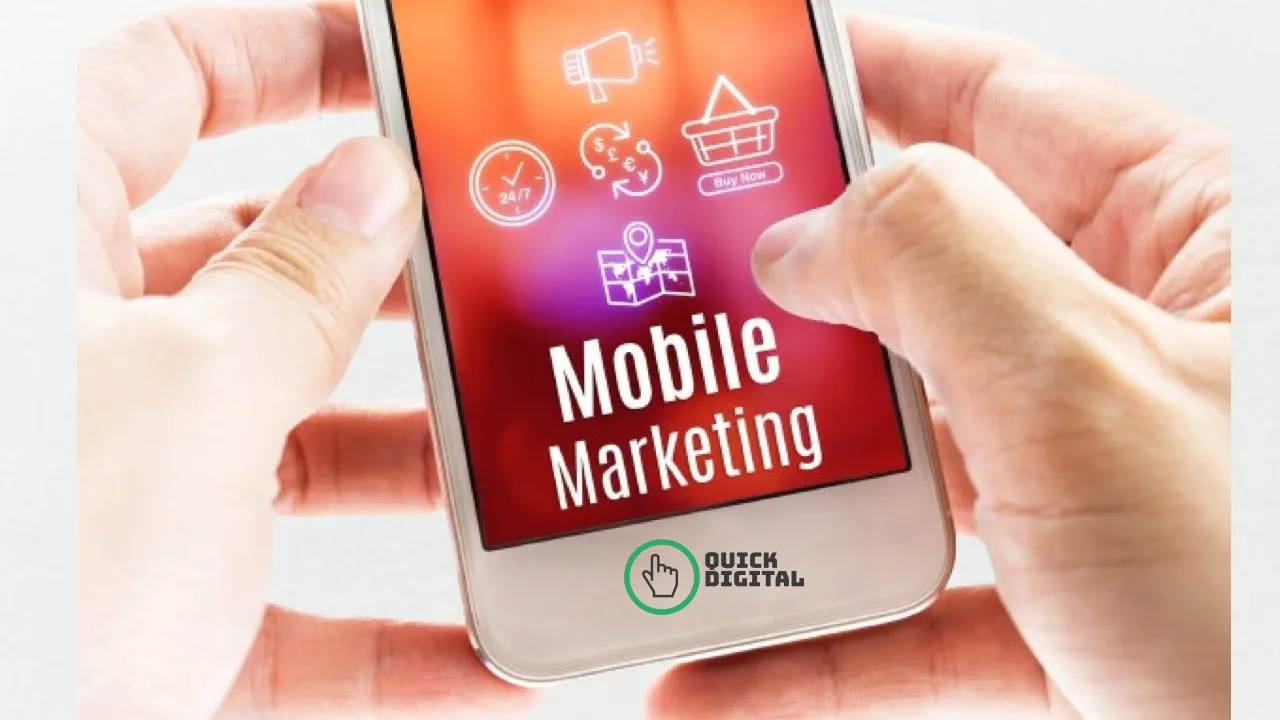
Mobile marketing is a multi-channel strategy that reaches customers on smartphones and tablets through SMS, push notifications, in-app ads, mobile SEO, and location-based targeting. Mobile devices account for 63.38% of all global web traffic per Statcounter data. Global mobile ad spend exceeds $430 billion per year per eMarketer. Brands that build a mobile first approach reach their audience where they already spend more than 5 hours every day.
Quick Digital has built mobile marketing strategies for businesses across industries since 2014. This guide covers every mobile marketing channel, every KPI, and every tactic your business needs to generate real results from smartphone users.
Mobile Marketing by the Numbers
The scale of mobile is impossible to ignore. Mobile now absorbs 74% of total global digital ad investment per eMarketer. The top 3 mobile ad platforms, Google, Meta, and TikTok, capture 67% of all mobile ad dollars. Over 6.8 billion people globally carry a smartphone. Users spend 90% of their mobile time inside apps and only 10% on the mobile web.
| Metric | Benchmark | Source |
|---|---|---|
| Global web traffic from mobile | 63.38% | Statcounter |
| Global mobile ad spend (annual) | $430 billion+ | eMarketer |
| SMS open rate (within 3 minutes) | 98% | Adjust |
| SMS conversion rate | 45% | Marketing LTB |
| Push notification CTR (Android / iOS) | 4.6% / 3.4% | Industry average |
| Daily time on mobile per user | 5+ hours | App Annie |
| Mobile time spent in apps vs mobile web | 90% apps / 10% web | The Trust Agency |
| Local mobile searches leading to a purchase | 28% | The Trust Agency |
Types of Mobile Marketing Channels
Each mobile marketing channel serves a different audience intent and campaign goal. Picking the right mix depends on your product, your budget, and how your target users behave on their phones.
| Channel | Best For | Avg. Conversion or CTR | Cost Level |
|---|---|---|---|
| SMS Marketing | Flash promotions, loyalty, cart recovery | 45% conversion rate | Low to Medium |
| Push Notifications | Re-engagement, real time alerts | 4.6% CTR (Android) | Low |
| Mobile SEO | Organic traffic, local intent queries | Varies by search intent | Low (time investment) |
| In-App Advertising | Brand awareness, app installs | $3.70 CPI (Android) | Medium to High |
| App Store Optimization (ASO) | Organic app downloads | Depends on category rank | Low |
| Geofencing | Foot traffic, location-triggered promos | 31% CTR (geo SMS) | Medium |
| Social Media Mobile Ads | Awareness, retargeting, social commerce | Varies by creative | Medium |
| Mobile Video Ads | Brand recall, product demos | Higher recall than static | Medium to High |
| QR Code Campaigns | Bridging offline to online | Up to 64% in-store scan rate | Very Low |
| Mobile Email Marketing | Nurture sequences, retention | Above 6% (vs SMS 45%) | Low |
SMS Marketing
SMS marketing delivers the highest raw performance of any owned mobile channel. Open rates exceed 98% within 3 minutes of delivery per Adjust benchmarks. Response rates average 45% compared to just 6% for email. Average SMS purchase conversion sits at 8.5%. Ecommerce brands running automated SMS flows report conversion rates of 12% to 18% per send.
How SMS Marketing Works
SMS marketing sends text messages to a subscriber list that has opted in. Permission is non-negotiable. In the US, brands must register through 10DLC (10 digit long code) before sending promotional texts at scale. Each standard SMS caps at 160 characters and can include a tracked link.
Pair SMS campaigns with remarketing campaigns to re-engage users who clicked but did not convert the first time.
SMS Campaign Types That Convert
The best performing SMS message types include:
- Abandoned cart reminders, which average a 21% click through rate per Marketing LTB data
- Geo-targeted promotions, which generate a 31% click through rate
- Loyalty reward messages, which produce a 29% click through rate
- Weekend promotional sends, which see 18% higher click through rates than weekday sends
- Discount code messages, which reach 40 to 60% redemption rates
SMS Compliance and 10DLC
US brands sending SMS at scale must register with the Campaign Registry through the 10DLC process. This reduces carrier filtering and protects sender reputation. GDPR and CCPA also require brands to obtain explicit consent before collecting mobile data for SMS or geofencing campaigns. Brands that build compliance infrastructure into SMS from day one capture stronger returns because the channel rewards diligence over volume.
Push Notifications
Push notifications are real time messages delivered to mobile users who have your app installed and have opted in. Android opt in rates reach 81% while iOS opt in rates sit at 51% per industry averages. Average click through rates are 4.6% on Android and 3.4% on iOS. Well timed, personalized push messages drive 3 to 5 times higher engagement than generic broadcast sends.
Push Notification Types
Push notifications fall into 4 main categories:
- Transactional alerts like order confirmations and shipping status updates
- Promotional pushes announcing new products, events, or time-limited deals
- Re-engagement messages for users who have not opened your app in 7 or more days
- Location-triggered notifications sent when a user enters a geofenced zone
Behavior Based Personalization in Push
Segmenting push audiences by in-app behavior rather than demographics alone changes results dramatically. Behavior based personalization can increase push notification reaction rates by up to 400% per industry benchmarks. Segmenting by last product viewed, purchase history, or session frequency lifts click through rates well above broadcast averages.
Push notifications work best alongside a strong conversion rate optimization strategy to turn notification taps into completed purchases or sign-ups.
Mobile SEO and Mobile First Indexing
Google uses mobile first indexing, meaning it crawls and ranks the mobile version of your site, not the desktop version. So if your site is slow or difficult on a smartphone, your rankings drop regardless of how polished your desktop version looks. Mobile SEO is not optional. It is the base requirement for any organic traffic strategy today.
Core Web Vitals on Mobile
Google’s Core Web Vitals measure 3 performance signals on mobile specifically:
- Largest Contentful Paint (LCP): how fast the main content loads, target under 2.5 seconds
- Interaction to Next Paint (INP): how fast your page responds to user input, target under 200 milliseconds
- Cumulative Layout Shift (CLS): how stable the layout is during loading, target under 0.1
Slow pages lose users immediately. Page load speed directly affects both mobile rankings and on-page conversion rates. Run Google Search Console and PageSpeed Insights regularly to track your mobile performance scores. Use the SEO checklist to audit your mobile site before launching any paid mobile campaign.
Mobile Local SEO
More than half of all mobile searches carry local intent. Searches like “dentist open now” or “restaurant near me” come almost entirely from smartphone users. 76% of people who search for something nearby on mobile visit a business within a day. 28% of those local mobile searches end in a purchase per Trust Agency data.
Ranking for local mobile searches requires accurate Google Business Profile data, consistent NAP (name, address, phone) citations across directories, and mobile-optimized landing pages. A well-managed Google Business Profile improves visibility in local pack results and Google Maps for all mobile searchers. Build your full local SEO signals to capture this high-intent traffic.
App Store Optimization
App Store Optimization (ASO) is the process of improving an app’s visibility in the Apple App Store and Google Play Store to drive organic downloads without paid spend. ASO works like search engine optimization but for app stores. The key ranking factors include the app title, keyword field, description, screenshots, star ratings, and review volume.
ASO vs Mobile SEO
Both ASO and mobile SEO target organic discovery. But the platforms differ. Mobile SEO drives traffic from Google and Bing to your website. ASO drives traffic from the App Store and Google Play to your app listing. Many brands need both running at the same time. Tools like AppTweak, Sensor Tower, and MobileAction help surface keyword opportunities inside both app stores. Brands building or scaling a mobile app should read our full app development overview before starting ASO work.
Location Based Mobile Marketing
Location-based marketing sends targeted messages and ads to users based on their physical location in real time. GPS, Wi-Fi, and cellular network data all power these campaigns. Brands using location signals see stronger engagement because the message matches exactly where the user is at that moment.
Geofencing Campaigns
Geofencing draws a virtual boundary around a specific location. That location can be your own store, a competitor’s address, an event venue, or an airport terminal. When a mobile device with location services enabled crosses that boundary, it triggers a push notification, SMS, or in-app message.
Geo-targeted SMS campaigns generate a 31% click through rate per Marketing LTB data. Small businesses using geofencing see 2 to 3 times better conversion rates than corporate competitors running the same technology. The advantage comes from local, personal messaging that feels relevant rather than generic.
Beacon Marketing
Beacons are small Bluetooth devices placed inside physical locations like retail stores, stadiums, or airports. When a user’s phone detects the beacon signal, it triggers a highly targeted in app message or promotion. Beacon-triggered messages carry higher conversion rates than standard push notifications because they reach users who are physically present inside the location and already in a buying mindset.
In App Advertising
In-app advertising places paid ads inside third-party mobile apps to reach users during active screen time. Since users spend 90% of their mobile time inside apps, in-app inventory reaches a far larger audience than mobile web banner ads. Average cost per install (CPI) benchmarks sit at $4.70 on iOS and $3.70 on Android across most categories.
In App Ad Formats and Benchmarks
The main in-app ad formats include:
- Banner ads placed at the top or bottom of the app screen at low cost
- Interstitial ads that appear as full-screen placements between content views
- Rewarded video ads that give users in-app rewards in exchange for watching a 15 to 30 second video
- Native ads styled to match the app’s content feed for less disruptive placement
- Playable ads that let users try a game or feature before downloading
Rewarded video drives the highest completion rates among all in-app formats. Users actively choose to watch. So the engagement is far stronger than forced impressions. Pair in-app ads with display advertising on mobile web properties to build frequency across both environments.
Mobile Social Media Marketing
Social media platforms generate most of their traffic from mobile apps, making mobile native creative the only real option for social ad campaigns. Vertical video, story formats, and short form clips perform best on mobile screens. Platforms like Instagram, Facebook, and TikTok optimize ad delivery specifically for in-app mobile consumption patterns.
Short Form Video on Mobile
Short form video under 60 seconds dominates mobile social feeds. TikTok, Instagram Reels, and YouTube Shorts all favor vertical, fast-paced content. Brands producing mobile native video see higher completion rates and lower cost per view than those repurposing landscape desktop videos for mobile.
Run Instagram marketing campaigns with Stories placements and Reels ads to reach users in their most engaged moments. For Facebook-first audiences, Facebook mobile ads with video creative in the in-feed placement produce stronger brand recall than static image ads.
Social Commerce on Mobile
Social commerce lets users complete a purchase without leaving the app. Instagram Shopping, TikTok Shop, and Pinterest Product Pins turn social browsing into a direct purchase path. Brands that reduce steps between discovery and checkout on mobile see measurably stronger conversion rates from social traffic compared to brands that redirect users to an external mobile site.
A full social media marketing strategy should integrate shoppable formats from the start.
QR Code Marketing
QR codes bridge offline advertising and online mobile experiences by letting smartphone users scan a code to reach a webpage, app listing, or payment screen instantly. Quick Response (QR) code scan activity grew 323% between recent years per Supercode data. Around 100 million US smartphone users scan QR codes monthly. 64% of shoppers have scanned a QR code inside a physical store, and 79% of those scanners say the scan made them more likely to buy per World Sync research.
Restaurants, retail stores, events, and out-of-home (OOH) advertising placements all use QR codes to move users from a physical touchpoint directly into a mobile purchasing or sign-up flow. QR codes also provide first-party tracking data outside of platforms like Google and Meta.
Mobile Commerce and Mobile Marketing
Mobile commerce (mCommerce) is the purchasing of goods and services through smartphones or tablets, and it represents the end goal of most mobile marketing campaigns. Andorid and Iphone Mobile accounts for 44.6% of total US eCommerce sales per eMarketer. Smartphones have a higher add-to-cart rate than desktop but a lower average completion rate, so reducing friction in the mobile checkout flow is the single highest-ROI optimization a mobile marketer can make.
Every 100 milliseconds of delay in app responsiveness costs conversions per DroidsOnRoids data. App experiences convert 3 times better than mobile web and drive 43% of repeat purchases. So investing in app performance alongside mobile web speed pays off across both channels.
Voice Search and Mobile Marketing
62% of American adults use voice search on at least one device, and voice queries come almost exclusively from mobile. Voice users ask full conversational questions rather than typing short keyword fragments. Queries like “which mobile marketing agency is best for small businesses” or “how do I set up SMS marketing for my store” are typical voice search patterns.
Ranking for voice queries means structuring content around question and answer format, targeting featured snippet positions, and building strong voice search optimization across your FAQ sections and how-to content. Your Answer Engine Optimization strategy should address the same conversational queries that voice users ask on mobile.
Mobile Email Marketing
Over 60% of all emails are opened on mobile devices. So mobile email design requires a fundamentally different approach than desktop layouts. Single column designs, font sizes of 14px or above, and tap-friendly CTA buttons at least 44px tall all improve mobile email performance. Subject lines under 35 characters display fully on most phone screens without truncation.
Use SMS as a follow-up channel for email subscribers who opened a message but did not click. This SMS-plus-email pairing lifts overall response rates across both channels by reaching users through a second, higher-engagement touchpoint at the right moment.
How to Build a Mobile Marketing Strategy
A mobile marketing strategy connects your business goals to the right channels, audiences, and messages. Follow these 7 steps to build one that produces measurable results.
- Define your audience persona. Map out who uses your product on mobile. Note their age, location, device type, app usage habits, and peak active hours. Survey existing customers or analyze your Google Analytics 4 mobile segment data to start.
- Set specific KPIs before you launch. Choose metrics like SMS click through rate, push notification CTR, app store ranking position, mobile bounce rate, or mobile conversion rate as your primary success measures.
- Audit your mobile site performance first. Run Google PageSpeed Insights and fix all Core Web Vitals failures. Use the SEO best practices for site architecture guide to set the right technical foundation before any paid mobile campaign.
- Start with 2 or 3 channels. Mobile SEO plus SMS marketing works for most businesses starting out. Add push notifications and geofencing after the first 2 channels prove ROI with at least 3 months of data.
- Create mobile-first content on every landing page. Write short paragraphs under 50 words. Use vertical images. Design CTAs for thumb taps, not mouse clicks. All landing page optimization must pass Google’s mobile usability test before any ad spend begins.
- Build A/B testing into every campaign from day 1. Test 2 versions of every SMS message, push notification subject, and ad creative simultaneously. Let data pick the winner after 500 to 1000 impressions before scaling the winner.
- Review analytics weekly and optimize. Kill underperforming segments. Scale what converts. Tie every channel back to your KPIs every 7 days. Use Google Analytics 4 or Firebase to track mobile-specific user journeys from first touch to conversion.
Mobile Marketing KPIs to Track
Every mobile marketing channel produces its own set of metrics. Tracking the right KPIs shows exactly where spend generates return and where to cut budget.
| KPI | Channel | What It Measures | Target Benchmark |
|---|---|---|---|
| SMS Open Rate | SMS | Messages read | 98% within 3 minutes |
| SMS Conversion Rate | SMS | Purchases per send | 8.5% average / 12-18% for flows |
| Push Notification CTR | Push | Taps on push alert | 4.6% Android / 3.4% iOS |
| Cost Per Install (CPI) | In-App Ads | Paid install cost | $3.70 Android / $4.70 iOS |
| App Retention Rate (Day 90) | App Marketing | Users still active at 90 days | 25% industry average |
| Mobile Bounce Rate | Mobile SEO | Single-page mobile sessions | Below 50% |
| Mobile Conversion Rate | All channels | Purchases, leads, sign-ups | Above your desktop baseline |
| Return on Ad Spend (ROAS) | Paid Mobile Ads | Revenue per ad dollar spent | Above 3x minimum |
| Geo-Targeted SMS CTR | Geofencing + SMS | Location-triggered clicks | 31% average |
Track your mobile bounce rate in Google Analytics to identify which mobile landing pages lose users fastest. Fix those pages before scaling ad spend on any channel.
Mobile Marketing Tools
The right tools reduce guesswork and speed up every phase of mobile marketing. Here are the most widely used platforms by channel function.
Analytics and Attribution Tools
- Google Analytics 4: tracks mobile web traffic, user behavior flows, and conversion events across all devices
- Firebase: Google’s mobile-specific analytics suite built for in-app measurement and crash reporting
- Adjust: mobile measurement partner (MMP) that attributes installs and in-app events accurately to the right campaigns
- AppsFlyer: deep-link attribution and user journey mapping for app marketing teams
SMS and Push Notification Platforms
- Braze: enterprise multi-channel mobile engagement platform with SMS, push, in-app, and email from one dashboard
- OneSignal: push notification and in-app messaging platform with a free tier for apps under 10,000 subscribers
- Klaviyo: SMS and email automation with strong integrations for Shopify and WooCommerce stores
- Attentive: SMS-first platform built specifically for direct-to-consumer brands
ASO and Mobile SEO Research Tools
- AppTweak: keyword research and competitor intelligence for App Store and Google Play rankings
- Sensor Tower: app store category rankings, download estimates, and competitive ad spend data
- MobileAction: ASO keyword tracking and app store ad intelligence
- Ahrefs and Semrush: mobile keyword research, site audits, and backlink analysis for mobile SEO campaigns
- Google Search Console: flags mobile usability errors and tracks your actual mobile search performance by page
Start with a set of free SEO tools to cover mobile site auditing before committing to a paid subscription. A curated small business SEO toolkit covers mobile SEO monitoring at zero cost.
Mobile Ad Platforms
- Google Ads: mobile search ads, app campaigns, and Performance Max campaigns across Google’s mobile inventory
- Meta Ads Manager: Facebook and Instagram mobile feed, Stories, and Reels placements with advanced audience targeting
- TikTok Ads: short form video in-feed and TopView placements targeting 18 to 34-year-old mobile users
- Apple Search Ads: targets users searching in the App Store directly for higher-intent installs
For fully managed paid mobile campaigns, PPC management from an experienced agency reduces wasted spend and improves ROAS from the first month.
Mobile Marketing for Small Businesses
Small businesses often outperform larger brands in mobile marketing results. They operate faster and communicate more personally. A local restaurant using geo-targeted SMS sees stronger click through rates than a national chain running the same campaign, because local messaging feels relevant and timely rather than generic.
Start with these 3 low-cost mobile marketing tactics:
- Set up and fully complete your Google Business Profile for local mobile search visibility
- Launch an SMS subscriber list with a 10% first-order discount incentive on your checkout page
- Publish short form vertical video content on Instagram Reels or TikTok showcasing your product in under 30 seconds
All 3 cost more time than money and can produce measurable results within 4 to 6 weeks. For AI-powered SEO and mobile search visibility, structured data and schema markup accelerate how fast AI search engines surface your business in mobile results.
Mobile Marketing and Content Strategy
Mobile marketing and content marketing intersect at every stage of the customer journey. Content created for mobile must be shorter, faster, and more visual than desktop content. Blog posts should use clear H2 and H3 subheadings for easy scanning on a 6-inch screen. Video content should be watchable with sound off. Infographics must be readable on a 375px wide viewport without pinching.
Brands that align content strategy with mobile user behavior see lower bounce rates and longer average session durations from mobile traffic. Read the full guide to SEO fundamentals to understand how mobile content and on-page optimization work together to build lasting organic traffic.
Mobile Marketing Mistakes to Avoid
Most failed mobile campaigns share the same avoidable errors. Stop these before they cost you budget and audience trust.
- Sending SMS without 10DLC registration triggers carrier filtering and legal risk under TCPA compliance rules
- Using landscape desktop video on mobile ad placements cuts completion rates by more than half compared to vertical creative
- Skipping mobile usability testing before launching paid campaigns means paying to send users to broken mobile experiences
- Tracking only clicks and installs while ignoring retention rates, revenue per user, and user lifetime value produces misleading success metrics
- Over-sending push notifications causes app uninstalls within 2 weeks of aggressive sending schedules
- Ignoring Core Web Vitals on mobile directly harms Google rankings regardless of content quality
- Treating mobile as a smaller version of desktop instead of designing every element specifically for thumb navigation and short attention spans
Mobile Marketing Services
Quick Digital has delivered mobile marketing strategy and execution for businesses across industries since 2014. Our team combines mobile SEO, SMS strategy, paid mobile ads, and mobile first content into campaigns built around measurable KPIs. We cover full-funnel digital marketing services from initial audit through to ongoing optimization for brands that want to grow from mobile traffic.
Get a free strategy assessment at quickdigital.org/free-a-quote.
Frequently Asked Questions
Mobile marketing covers SMS, push notifications, in-app advertising, mobile SEO, App Store Optimization (ASO), geofencing, mobile social media ads, QR code campaigns, mobile email, and mobile video ads.
Mobile marketing costs range from near zero for organic mobile SEO to thousands per month for paid in-app advertising campaigns. SMS typically costs $0.01 to $0.05 per message. In-app advertising averages $3.70 per install on Android and $4.70 on iOS. Push notification platforms start free for small subscriber bases and scale with volume. Geofencing platforms generally charge a setup fee plus CPM (cost per thousand impressions) on triggered messages.
SMS marketing produces an average 45% conversion rate and 8.5% purchase conversion per promotional send. Ecommerce brands running automated SMS sequences like abandoned cart and post-purchase flows report conversion rates of 12% to 18%. SMS response rates average 45% vs 6% for email.
Digital marketing covers all online channels including both desktop and mobile. Mobile marketing is the subset that specifically targets users on smartphones and tablets. Mobile marketing uses channels that only function on mobile devices such as SMS, push notifications, ASO, and geofencing. All mobile marketing is digital marketing, but not all digital marketing qualifies as mobile marketing.
SMS marketing produces the highest conversion rates of any mobile channel at 45% average and 8.5% per promotional send. Push notifications follow with a 4.6% CTR on Android. Geofencing campaigns deliver 31% click through rates on geo-targeted SMS sends. The best-performing channel for any specific business depends on whether that business has an app, an opted-in SMS list, or a physical location to anchor location-based campaigns around.