

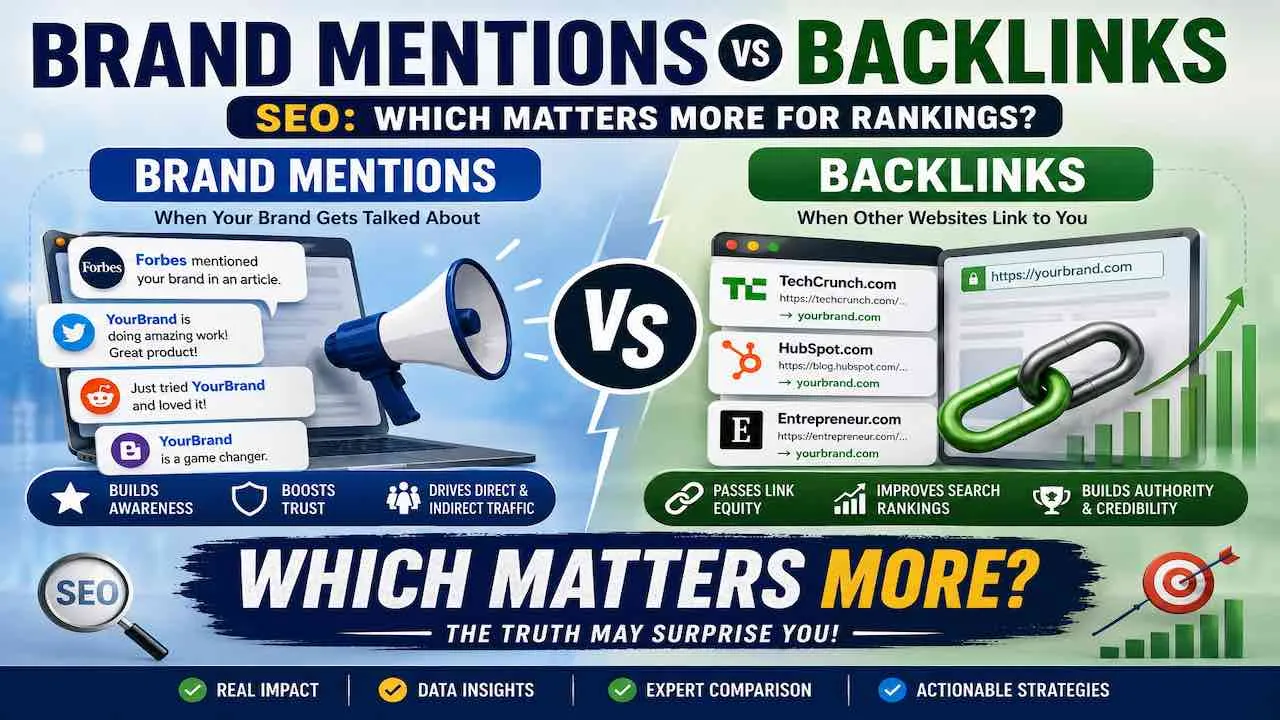
Backlinks pass link equity directly and remain the dominant off-page SEO signal for traditional Google rankings, while unlinked brand mentions build entity recognition, branded search volume, and AI search visibility without passing link equity. For competitive keyword rankings, pages with more backlinks win 94% of the time. For AI search citations in Google AI Overviews, ChatGPT, and Perplexity, brand mentions correlate 3 times more strongly than backlinks (r=0.664 vs r=0.218, Ahrefs, 75,000 brands). The strongest brand mentions SEO strategy earns editorial placements that deliver both from the same campaign.
If you are asking which is better for SEO brand mentions or backlinks, wasting time chasing backlinks from sites that ignore you, or wondering whether brand mentions without a link carry any real SEO impact, this guide gives you the complete answer. You will get Google’s actual position on implied links, what the Google API documentation revealed about brand signals, how Navboost uses branded search data, the full comparison table, a tier-by-tier breakdown of brand mention sources, how to measure brand mention SEO impact, and the exact strategy for your business stage.
Brand Mentions vs Backlinks: Core Definitions
Backlinks in SEO
A backlink is a hyperlink from one website pointing to your domain, and it passes link equity, also known as PageRank, from the referring domain to your linked page. Google confirmed backlinks as a top three ranking signal. The page ranking first in Google has 3.8 times more backlinks than pages in positions two through ten (Backlinko). Beyond link equity, backlinks carry anchor text signals that tell Google which keywords your page is relevant for. No other off page SEO signal replicates both link equity transfer and keyword-specific relevance in one action.
Unlinked Brand Mentions Defined
An unlinked brand mention is any reference to your brand name, product, or key personnel on an external page that does not include a clickable hyperlink to your domain. Examples include a journalist writing about Quick Digital without linking to quickdigital.org, a Reddit user recommending your product by name, or a podcast transcript naming your brand. Unlinked brand mentions do not pass link equity. But they do build co citation signals, co occurrence signals, entity recognition in Google’s Knowledge Graph, branded search volume, and EEAT trust signals. The SEO debate is about whether these indirect benefits match or rival what a direct backlink provides.
Implied Links and Google’s Patent
Google’s patent US 8,682,892 “Ranking Search Results” describes a system that counts both express links and implied links when determining ranking modifications, defining implied links, also called implicit links, as references to a target resource that is not a hyperlink. This patent became the foundation of the brand mentions vs backlinks debate in SEO. A closer reading by Search Engine Journal and others suggests the patent most likely refers to branded search queries as the implied links, not on-page text mentions. The practical distinction matters: the signal is the search behavior your brand mentions generate, not the mentions themselves. Both are still worth pursuing for different reasons.
Social Mentions vs Editorial Mentions
Not all brand mentions carry equal weight, and the distinction between social mentions and editorial mentions is the most commonly overlooked factor in brand mention SEO strategy. Editorial mentions appear in indexed web content such as news articles, blog posts, industry guides, and review sites. Google crawls and processes these. Social mentions on Twitter, LinkedIn, and Facebook are largely not indexed by Google and do not directly contribute to Knowledge Graph entity recognition or co citation signals. Social mentions build branded search volume indirectly, because brand awareness drives users to search your name. Direct SEO value flows from indexed editorial mentions on authoritative domains, not social posts.
Does Google Count Brand Mentions as Ranking Signals
Google’s Official Position
Google has not officially confirmed that unlinked web mentions on external pages directly influence rankings. John Mueller stated he does not think Google uses unlinked brand mentions the way the SEO community often assumes. Gary Illyes has referenced brand signals in conference talks without confirming on-page text mentions as a direct input. The most common SEO claim, that Google reads a brand name on a page and assigns it ranking value like a backlink, is not supported by any direct Google confirmation. What is confirmed: Google uses branded search queries as authority signals, and brand mentions generate branded search. The causal chain is real but indirect.
The Google API Documentation and Brand Signals
An internal Google API documentation leak revealed a ranking feature called SiteAuthority, described as a signal that measures the overall authority of a domain using a combination of link-based signals and brand-related engagement metrics. The documentation also referenced a concept called ClickSignals derived from branded navigational queries, meaning users searching your brand name directly. SEO researchers including Rand Fishkin and Mike King analyzed the leak and noted it supports the theory that brand signals function as an independent authority layer alongside traditional link signals. Google disputed the interpretation of some documentation but did not deny the existence of these signals. The leak strengthened the case for brand mention building as a legitimate SEO strategy, not a replacement for backlinks but a parallel authority-building mechanism.
Navboost and Branded Search Volume
Navboost is a Google system revealed in the Antitrust trial documentation that uses click signals, including branded navigational queries, to influence rankings at scale. When users repeatedly send a brand query by searching your brand name and click through, Navboost interprets that pattern as a quality and relevance signal. Brand mentions on authoritative sites drive users to search your brand name. Those branded searches feed Navboost with positive engagement signals. This is the mechanism by which brand mentions influence traditional SEO rankings without directly passing link equity. The brand mention generates the branded search query. The branded search query becomes the Navboost signal. The Navboost signal feeds rankings. Understanding this three-step chain explains why brand mention building produces measurable SEO lift even when no backlinks are involved.
What Bing Confirmed About Unlinked Mentions
Bing publicly confirmed at SMX West that it uses unlinked brand mentions as a ranking signal. Duane Forrester, formerly senior product manager at Bing, stated that Bing figures out context and sentiment around unlinked mentions and uses them to determine site authority. As the volume of trustworthy mentions grows, rankings improve. Bing’s confirmation demonstrates the technical capability exists and is actively used in production. Whether Google applies the same mechanism at the same weighting remains unconfirmed. However, Bing’s willingness to confirm it, combined with Google’s patent language and the Navboost documentation, creates a strong circumstantial case that some form of mention processing influences Google rankings as well.
Brand Mentions vs Backlinks: Direct SEO Comparison
| Factor | Backlinks | Unlinked Brand Mentions |
|---|---|---|
| Passes link equity | Yes, directly via PageRank | No link equity transferred |
| Traditional ranking impact | Direct, confirmed by Google | Indirect via Navboost and branded search |
| AI search visibility correlation | r = 0.218 (Ahrefs, 75,000 brands) | r = 0.664 (Ahrefs, 75,000 brands) |
| Google officially confirmed | Yes, top three ranking signal | No direct confirmation |
| Bing officially confirmed | Yes | Yes, confirmed at SMX West |
| Anchor text signals | Yes, reinforces keyword relevance | No anchor text signal |
| Builds branded search volume | Indirectly | Directly, drives navigational queries |
| Feeds Navboost signal | Indirectly through authority | Directly through branded search behavior |
| Contributes to EEAT | Yes, through domain authority | Yes, through entity recognition and trust |
| Reclamation opportunity | Not applicable | 15 to 40% outreach conversion rate |
| Cold outreach conversion | 3 to 8% | 15 to 40% (warm reclamation) |
| Affected by brand sentiment | No | Yes, negative mentions can signal low trust |
| Best for | Competitive keyword rankings | Entity authority and AI search citations |
How Brand Mentions Influence SEO Rankings
Entity Recognition and Knowledge Graph Authority
Unlinked brand mentions build entity recognition in Google’s Knowledge Graph, which affects how Google classifies your brand as a confirmed entity in its semantic database. When every entity mention of your brand across authoritative indexed publications, Google’s named entity recognition systems associate your brand entity with specific topics, industries, and geographic locations. This entity recognition influences how Google displays your brand in knowledge panels, People Also Ask boxes, and AI Overviews. Brands with stronger entity recognition rank more broadly for non-branded queries in their topic cluster. Our knowledge panel optimization guide covers how entity signals connect to specific SERP features.
Co-Citation and Co-Occurrence Signals
Co citation, also known as brand co citations and co citations, happens when two websites are mentioned together in the same content without either being linked, and it sends topical relevance signals that help Google classify your brand’s subject area. When a trusted source writes about your brand alongside recognized industry names, Google’s NLP systems read those co occurrence signals as semantic relevance indicators. Co citation and co occurrence signals build topical authority within your niche by telling Google your brand belongs in the same semantic cluster as established authorities. Our semantic SEO and entity optimization guide covers how these signals combine with structured data to strengthen topical authority for generative search engines.
Brand Sentiment and Context
Brand sentiment is the tone surrounding your brand name in a mention, and it influences how Bing processes unlinked mention signals and likely affects how Google’s quality systems evaluate brand authority. A negative brand mention on a high-authority site does not carry the same positive authority signal as a neutral or positive editorial mention. Bing’s Duane Forrester specifically referenced sentiment analysis when discussing how Bing uses unlinked mentions. Google’s Search Quality Rater Guidelines reference brand reputation signals when evaluating page quality, particularly for YMYL content. Building a strong volume of positive, neutral editorial brand mentions from authoritative sources builds the online reputation and brand sentiment profile that both traditional and AI-powered search engines reward with higher trust scores.
Brand Mentions and AI Search Visibility
For AI search, brand mentions outperform backlinks as the primary visibility driver by a factor of 3. Ahrefs analysis of 75,000 brands found web mentions correlate with AI Overview visibility at r=0.664, while backlinks correlate at r=0.218. Large language models like GPT-4, Gemini, and Claude learn brand associations from text during training, not from hyperlinks. A brand mentioned frequently and positively across trusted publications appears in AI-generated responses because the LLM has built a strong statistical association between that brand name and the relevant topic. About 85% of brand mentions in AI search citations come from sites the brand does not own or control. This makes earned editorial coverage the primary lever for AI citation authority. Read our Answer Engine Optimization (AEO) guide to align your brand mention building with AI search requirements.
How Backlinks Outperform Brand Mentions for Traditional Rankings
Link Equity and PageRank Drive Rankings
For competitive keyword rankings in traditional Google search, backlinks remain the dominant off page SEO signal with no equivalent replacement. Pages ranking first have 3.8 times more backlinks than pages in positions two through ten. No equivalent study has shown unlinked brand mentions producing the same ranking gap in traditional Google results. Backlinks pass link equity that raises the linked page’s authority across all queries it targets. Brand mentions influence entity understanding and Navboost signals through branded search volume, but they cannot replace the direct authority transfer that a backlink provides. If links getting harder to earn is a problem you recognise, the answer is better digital PR and content that earns links naturally, not brand mentions as a substitute.
Anchor Text and Keyword Relevance
Backlinks carry anchor text that directly reinforces keyword relevance for specific target pages, a function that brand mentions cannot replicate. When a trusted site links to your service page with anchor text like “local SEO services Ahmedabad,” that anchor text tells Google your page is relevant to that exact query. Brand mentions carry no anchor text signal. They cannot tell Google which specific page on your site is most relevant to which keyword. This makes backlinks non-negotiable for pages targeting competitive, specific transactional keywords where anchor text diversity and specificity directly determine ranking position above competitors with stronger domain authority.
When Backlinks Are Non-Negotiable
Three situations make backlinks non-negotiable regardless of how strong your brand mention profile is:
- New domains with no established authority need backlinks to build the initial trust level Google requires before ranking any page competitively. Brand mentions alone cannot generate the domain level authority a new site needs.
- Highly competitive verticals like legal, healthcare, finance, and SaaS where every top-ranking competitor has hundreds of high authority backlinks require link equity investment to compete. Brand mentions cannot close a 500-link authority gap.
- Transactional keyword pages targeting specific high-intent queries need the anchor text precision that only a contextual backlink provides to rank above competitors with stronger backlink profiles.
Types of Brand Mentions and Their SEO Value
Not all brand mentions carry equal SEO value, and investing time in low-tier mentions while ignoring high-tier opportunities wastes your brand mention building budget. Rank your target publications by tier before starting any outreach campaign.
| Tier | Source Types | SEO Value | AI Citation Value |
|---|---|---|---|
| Tier 1 | Forbes, Reuters, BBC, TechCrunch, industry-leading trade publications with DR 80+ | Highest. Strong Navboost signal, Knowledge Graph anchor, EEAT trust | Highest. LLMs weight these sources in training data |
| Tier 2 | Niche authority blogs, regional news, respected industry directories, podcast transcripts on major platforms | High. Builds topical authority and co citation within niche | Medium-high. Contributes to brand entity association |
| Tier 3 | Forums like Reddit and Quora, social media posts, low-DR blogs, user review sites | Low direct. Builds branded search volume through awareness | Low. Most social content is excluded from LLM training data |
| Negative mentions | Complaint forums, negative reviews, critical editorial coverage | Harmful. Negative brand sentiment in Bing ranking algorithm reduces site authority score | Harmful. Negative associations form in LLM training data |
Focus Tier 1 and Tier 2 mention acquisition first. Tier 3 mentions build awareness that generates Navboost signals but carry minimal direct SEO value. Monitoring and addressing negative mentions is as important as building positive ones, because negative brand sentiment in your mention profile actively lowers your authority score in Bing’s confirmed algorithm and likely in Google’s quality signals.
Brand Mention Reclamation: Converting Mentions into Links
Brand mention reclamation is the practice of finding existing unlinked brand mentions and asking the publisher to add a hyperlink, converting a brand authority signal into a backlink without requiring any new coverage. It is the fastest high-return link building activity available because the publisher already knows and named your brand. About 20% of digital PR placements arrive without a link on first publication, meaning a meaningful share of earned editorial coverage never converts to link equity unless someone proactively follows up.
How to Find Unlinked Brand Mentions
- Ahrefs Content Explorer: Search your brand name in quotation marks. Filter “One page per domain.” Export all results. Remove any that already link to your site.
- Semrush Brand Monitoring: Set up real-time alerts for your brand name, product names, and key executive names across indexed web content.
- Google Alerts: Free baseline monitoring. Set alerts for your brand name in quotes to catch new mentions as they are indexed by Google.
- Brand24 or Mention: Real-time brand mention monitoring across indexed web pages, news publications, and forums with sentiment analysis to identify both positive and negative brand mentions.
- Manual Google search: Search “your brand name” -site:yourdomain.com monthly and record new editorial placements that lack a link.
The Outreach Process That Converts
- Identify the author or editor of the specific article, not a generic contact form.
- Send a short, friendly email referencing the exact article title and the sentence where your brand appears.
- Explain that a hyperlink would help their readers find your site directly without needing to search.
- Suggest the exact URL and anchor text you want the link to point to.
- Follow up once after 5 to 7 days. Do not follow up more than twice on a single mention.
Reclamation ROI vs Cold Link Outreach
Brand mention reclamation converts at 15 to 40% versus 3 to 8% for cold link building outreach, making it 5 to 10 times more efficient per hour of outreach effort. The publisher context is entirely different. Cold link outreach asks a stranger to add a link to your content. Warm mention reclamation asks an existing reference to formalize a connection they already made. If your brand earns consistent press coverage, reclamation should be the first link building activity you invest in before spending budget on cold outreach campaigns. Our backlink outreach service includes systematic mention reclamation alongside new link prospecting for maximum return on off page SEO investment.
How to Build Brand Mentions Proactively
Digital PR Strategy for Brand Mentions
Digital PR is the most efficient proactive brand mention strategy because one placement in a Tier 1 publication generates more EEAT authority, Knowledge Graph reinforcement, branded search volume, and Navboost signal than dozens of Tier 3 forum mentions. Target relevant journalists and editors with original data, expert commentary, or newsjacking content tied to your brand. Reactive PR through platforms like HARO, Qwoted, and Connectively surfaces journalists actively requesting expert sources. A single confirmed expert quote in a high-authority industry publication delivers a brand mention with measurable SEO lift. Read our content marketing guide to understand how editorial content strategy feeds digital PR outcomes sustainably.
Content and Community Strategies
Original research and unique data are the most reliable content formats for earning unprompted Tier 1 and Tier 2 brand mentions, because journalists and analysts cite primary data sources by name without requiring outreach. Commission industry surveys, analyze proprietary data you hold, or produce original case studies using client results with permission. Community participation in niche forums, LinkedIn groups, and industry Slack communities builds Tier 3 brand mentions and branded search volume without direct outreach. Guest posting on relevant, indexed industry publications earns editorial brand mentions and typically includes an author bio link, combining both mention and backlink value in one piece of content. Our guest post outreach service targets publications that carry both an editorial brand mention and an attributed author backlink.
How to Measure Brand Mention SEO Impact
Measuring brand mention SEO impact requires tracking four specific metrics simultaneously, because the mechanism is indirect and a single metric will not show the full effect.
- Branded search volume in Google Search Console: Filter queries for your exact brand name and variations. Rising branded impressions and clicks signal that brand mentions are successfully generating Navboost-feeding search behavior from new audiences.
- Direct traffic in Google Analytics: Users who see a brand mention and navigate directly to your site without clicking a link contribute to direct traffic and branded search patterns that Navboost reads as engagement signals.
- Knowledge Graph entity score: Query the Google Knowledge Graph Search API for your brand name and track your resultScore over time. A rising score confirms entity recognition is strengthening as brand mentions accumulate.
- AI search citation rate: Manually search your brand name in ChatGPT, Perplexity AI, and Google AI Overviews quarterly. Track how often your brand appears in answers without you having triggered a branded query. Rising unprompted AI citation rates directly reflect growing brand mention authority across authoritative sources.
Common Brand Mention SEO Mistakes
Treating Brand Mentions as a Backlink Replacement
The most damaging mistake in brand mention SEO is treating unlinked mentions as a backlink replacement rather than a parallel signal, because this leads to underinvestment in link building while brand mention volume alone fails to close ranking gaps. If you are losing rankings to competitors with stronger backlink profiles, brand mentions will not recover them. Both signals serve different ranking mechanisms. Backlinks drive traditional ranking position. Brand mentions drive entity authority, AI citation visibility, and Navboost engagement signals. A brand with strong mentions but weak links will perform better in AI search. Brand mentions level the playing field for AI citation visibility in ways that traditional link building cannot replicate. A brand with strong links but weak mentions will rank well in traditional search but remain absent from AI-generated answers.
Chasing Low-Quality Mentions at Scale
Bulk mentions from low-authority, unindexed, or irrelevant sources produce no measurable SEO benefit and can generate negative brand sentiment at scale if the placement context is poor. Paying for brand mentions on low-quality blogs, sponsored forum posts, or thin directory sites wastes budget and risks associating your brand entity with low-quality content in Google’s quality evaluations. Focus on earning fewer, higher-authority editorial mentions from Tier 1 and Tier 2 sources rather than accumulating Tier 3 mentions at volume. Quality of brand mention source matters more than raw mention count for both EEAT signaling and AI training data influence.
The Right Strategy by Business Stage
| Business Stage | Primary Focus | Reason |
|---|---|---|
| New domain (0 to 12 months) | Backlinks first, brand mentions second | Need baseline domain authority before brand mentions produce measurable ranking lift |
| Growing brand (12 to 36 months) | Equal investment in both | Build link equity for traditional rankings while accumulating entity recognition for AI search |
| Established brand with link profile | Brand mentions and digital PR primary | Link equity is already strong. Marginal returns on new backlinks are lower than returns on AI citation building |
| Brand targeting AI search dominance | Brand mentions heavily weighted | AI visibility correlates 3x more with mentions than backlinks. LLMs learn from text, not link graphs |
| Brand in competitive YMYL niche | Both at maximum investment | EEAT requirements demand both domain authority through links and entity trust through editorial mentions |
For all business stages, earn editorial placements that deliver both a contextual backlink and a brand mention from the same piece of coverage. Digital PR targeting authoritative publications achieves both outcomes in one outreach effort. Read our brand SEO services page and our EEAT trust and authority guide to see how Quick Digital builds both signals through integrated off page SEO campaigns. Also read our Google AI Overviews optimization guide and Perplexity AI optimization guide to understand how brand mention authority translates into specific AI search placements across each platform.
Quick Digital · Off-Page SEO Since 2014
Build Brand Mentions and Backlinks That Move Rankings and AI Search Citations
Quick Digital builds editorial placements that deliver a contextual backlink and a brand mention from the same coverage, serving both your traditional rankings and your AI search citation visibility in one campaign.
Brand Mentions vs Backlinks SEO: FAQs
No. Unlinked brand mentions do not pass link equity. They influence SEO indirectly through branded search volume that feeds Google’s Navboost signal and through entity recognition in the Knowledge Graph. Bing has confirmed using unlinked mentions as a direct ranking signal. Google has not confirmed this officially.
Yes, but through indirect mechanisms rather than as a direct substitute for backlinks. Brand mentions build branded search volume that feeds Navboost, strengthen Knowledge Graph entity recognition, improve EEAT signals, and drive AI search citation visibility. Ahrefs found brand mentions correlate with AI Overview visibility at r=0.664 versus r=0.218 for backlinks.
Backlinks are better for traditional Google rankings. Brand mentions are better for AI search visibility. Pages ranking first have 3.8 times more backlinks than positions two through ten. But brand mentions correlate 3 times more strongly with AI Overview citations. Earning both from the same editorial placement maximizes return on every outreach effort.
Find unlinked mentions using Ahrefs Content Explorer, Semrush Brand Monitoring, or Google Alerts, then email the author asking them to add a hyperlink. Warm mention reclamation converts at 15 to 40%, versus 3 to 8% for cold outreach. Reference the exact article and suggest the specific URL and anchor text.
Yes. Brand mentions are the primary driver of AI search visibility, outperforming backlinks by a factor of 3. Large language models learn brand associations from text, not hyperlinks. Brands mentioned frequently across authoritative indexed sources appear in AI-generated responses. About 85% of brand citations in AI search come from external sites.