


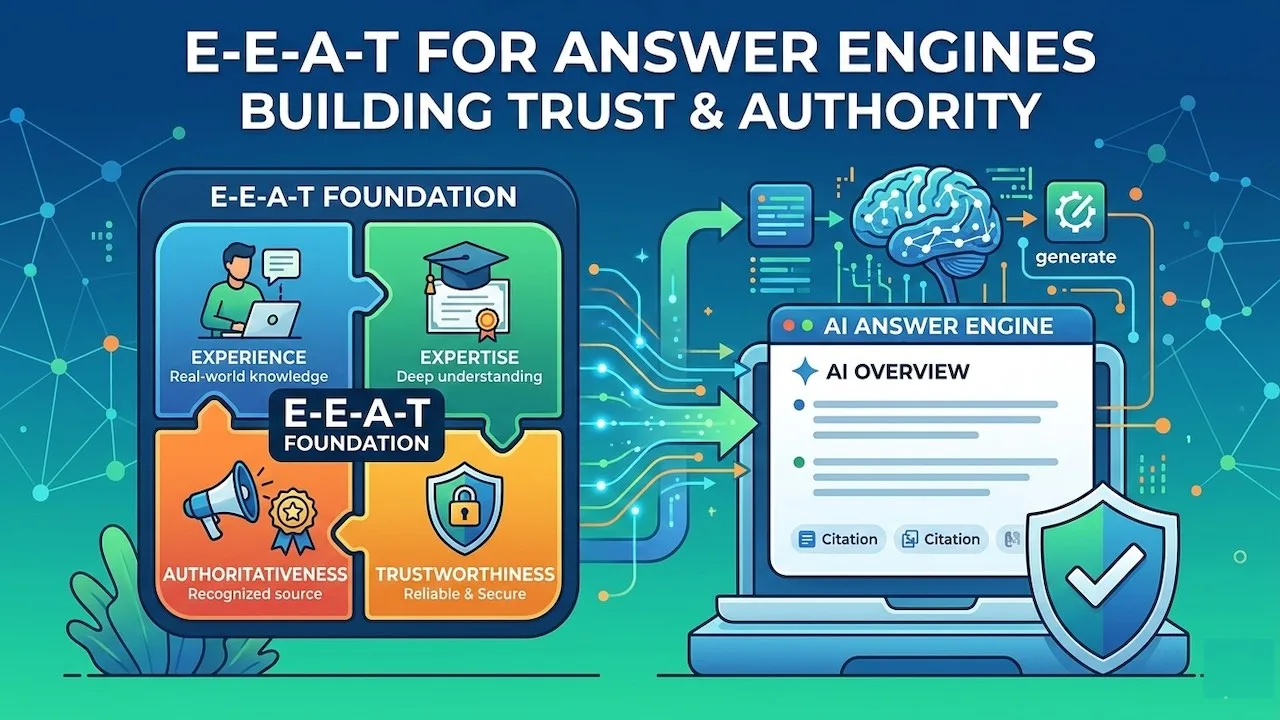
E-E-A-T for answer engines means applying the Experience, Expertise, Authoritativeness, and Trustworthiness signals that AI platforms verify before citing any source. Google AI Overviews, ChatGPT, Perplexity, Gemini, and Bing Copilot use E-E-A-T as a binary gatekeeping filter: content either passes the trust check and enters the citation pool, or it fails and stays invisible in AI generated answers entirely. Building citation-worthy content and establishing real citation worthiness requires verified trust and authority signals, not keyword density.
Answer engines now process over 1.5 billion queries daily. Each query triggers an automated E-E-A-T trust check before any source gets cited. According to Wellows analysis of 2,400 AI Overview citations, 96% go to sources with strong E-E-A-T signals. The remaining 4% is every other brand combined.
Traditional SEO built digital authority for search crawlers. E-E-A-T for answer engines builds citation worthiness for AI systems that read your entire digital footprint at the same time. The signals are different. The evaluation process is different. And the gap between brands that get cited and brands that never get ignored by answer engines widens every week.
Quick Digital has built digital authority strategies since 2014. This guide covers how each answer engine evaluates E-E-A-T trust signals, which authority actions produce the fastest citation frequency gains, and the specific mistakes that stop content from entering AI generated answers.
E-E-A-T as a Binary Gatekeeping Filter in AEO, GEO, and LLMO
Answer engines use E-E-A-T as a binary gatekeeping filter, not a ranking quality booster. In traditional SEO, a strong E-E-A-T score nudges a page up a few positions. In AEO (Answer Engine Optimisation), GEO (Generative Engine Optimisation), and LLMO (Large Language Model Optimisation), E-E-A-T decides whether content enters the citation pool at all. Pages ranked 6 through 10 with verified E-E-A-T get cited 2.3 times more often than rank-1 pages with weak content credibility signals, according to ZipTie research across 36 million AI Overviews.
The correlation between traditional domain authority and AI citation probability has dropped to r=0.18. Entity-based trust signals and verified author credentials now predict citation selection far more reliably than any backlink metric. E-E-A-T determines eligibility. GEO, AEO, and LLMO determine selection within the eligible pool. Without E-E-A-T compliance, no keyword strategy or technical fix puts your content inside AI generated answers.
Google’s SQRG (Search Quality Rater Guidelines) is the foundational document for understanding E-E-A-T in answer engine contexts. SQRG appears in Google’s evaluator training as the primary framework for assessing content credibility signals, topical authority, and brand authority. BERT and MUM, Google’s core language models, both use entity-based trust signals to assess source credibility before any content enters the AI Overview citation layer. When BERT and MUM encounter a page with no verified digital identity and no author credentials, that page exits the citation process at the first gate.
GEO and LLMO extend this E-E-A-T framework to non-Google platforms. ChatGPT, Perplexity, and Claude each apply their own version of the binary gatekeeping filter using SQRG-equivalent trust criteria. Stop losing AI citations to competitors by treating E-E-A-T as optional. It is the foundational requirement every other AEO, GEO, and LLMO tactic builds on top of.
E-E-A-T vs Traditional SEO: The Citation Pool vs The Ranking Ladder
| Dimension | Search Engine SEO | Answer Engine E-E-A-T |
|---|---|---|
| Trust function | Ranking quality booster | Binary gatekeeping filter: in or out |
| Primary check | Backlinks and domain authority | Digital identity and entity-based trust |
| Content evaluation | Keyword relevance and semantic coverage | Factual verifiability and content provenance |
| Author signals | Optional, rarely decisive | Mandatory: Person schema, credentials, bylines |
| Off site reputation | Backlink diversity | Wikidata, Knowledge Graph, media mentions, multi-source consensus |
| DA correlation | High (core driver) | Very Low (r=0.18) |
| Rank dependency | Higher rank means more visibility | E-E-A-T authority overrides rank position for citation selection |
The 4 E-E-A-T Pillars Mapped to Answer Engine Verification
Google’s SQRG states explicitly: Trustworthiness is the most important E-E-A-T pillar. Untrustworthy pages have low E-E-A-T regardless of how experienced, expert, or authoritative they may appear. Each pillar activates a separate verification layer inside every answer engine. Missing even one pillar reduces citation probability by 30 to 60% depending on the platform and content category.
| Pillar | What It Proves | How Answer Engines Verify It | Top Platforms |
|---|---|---|---|
| Experience | You have personally done what you write about | First hand practitioner insights, unique platform data, original observations absent from LLM training data | ChatGPT, Claude, Gemini |
| Expertise | Verified knowledge in the subject area | Author credentials, Person schema markup, consistent topic coverage history | Google AI Overviews, Gemini, Bing Copilot |
| Authoritativeness | Third parties recognise you as a leading source | Media mentions, Wikidata entries, Knowledge Graph entity cards, corroborated trust signals | All platforms, highest weight on ChatGPT and Perplexity |
| Trustworthiness | Accurate, transparent, verifiable content | Content provenance chains, HTTPS, primary source citations, consistent digital identity | All platforms, mandatory baseline gate |
Fan-out Queries: Why Single-Keyword Content Loses AI Citations
Answer engines do not process one query. They break every question into multiple fan-out sub-queries and retrieve information for each one separately before assembling the final answer. Pages that rank for both the main query and fan-out sub-queries account for 51% of all AI Overview citations, according to ZipTie analysis of 46 million citations. Pages that rank only for the main query account for under 20% of citations. Fan-out sub-query coverage gives pages a 161% higher citation probability than single-keyword optimised content.
Content scoped narrowly around one target keyword is at a serious disadvantage in AI citation systems. Fan-out queries pull from multiple angles of a topic simultaneously. A page targeting E-E-A-T for answer engines that also covers author schema, digital identity registration, content provenance, YMYL standards, entity confusion risks, and platform-specific trust signals captures the full fan-out sub-query set. A page covering only the core definition captures just the seed query and misses most citation opportunities entirely.
Fan-out sub-query coverage is also one of the strongest signals that builds topical authority in BERT and MUM evaluations. Topical authority proves to answer engines that your brand is the subject matter source of truth across an entire topic area, not just on one keyword. A semantic SEO and entity optimisation strategy built around topic clusters is the most reliable way to achieve full fan-out sub-query coverage.
How Each Answer Engine Evaluates E-E-A-T Trust and Authority
Each answer engine applies a slightly different trust weighting model for E-E-A-T signals. Understanding platform-specific criteria lets you focus on the authority actions that produce the fastest citation frequency gains on the platforms your audience uses most.
Google AI Overviews: SQRG-Based E-E-A-T Pre-Filter
Google AI Overviews apply E-E-A-T as a mandatory pre-filter using SQRG evaluation criteria before any content enters the citation pool. AI Overviews now appear on roughly 48% of tracked Google queries, up 58% year over year. Pages with verified authorship, Article schema markup, and topical authority demonstrated through content clusters get selected 3.2 times more often than anonymously authored pages. Google uses BERT and MUM language models to cross-reference entity-based trust signals against the Knowledge Graph during AI Overview generation.
Brands with verified Knowledge Panel entries show measurably higher citation rates than brands absent from the Knowledge Graph. Digital identity consistency between your website, Wikidata, and the Knowledge Graph is a direct input to Google’s entity-based trust evaluation. Build the specific trust architecture Google’s systems verify with the Google AI Overviews optimisation guide, and implement AEO-specific schema markup to deliver machine readable E-E-A-T signals directly to the citation selection layer.
ChatGPT: Referring Domain Authority and Digital Identity
ChatGPT uses RAG (Retrieval Augmented Generation) to pull current web content during query processing. Referring domain authority is the top ChatGPT E-E-A-T signal. Third party media mentions from recognised publishers such as Forbes, TechCrunch, and Search Engine Journal rank second. Brands with a consistent digital identity across Wikidata, Crunchbase, and the Knowledge Graph give ChatGPT the multi-source consensus it needs to cite their content confidently. Without that multi-source consensus, ChatGPT treats the brand as unverified and excludes it from citation selection.
Consistent entity-based trust signals across external databases build the digital authority layer ChatGPT uses for source verification. The guide on how to rank in ChatGPT covers the specific referring domain and entity-based authority signals that drive ChatGPT inclusion. LLM training data sources and AI indexing databases are the foundational layer where ChatGPT builds its brand authority models.
Claude AI: Content Provenance and Factual Verifiability
Claude applies strict content provenance and factual verifiability standards before selecting any citation source. Content that clearly documents where every fact comes from, citing peer-reviewed research or government data with direct source links, consistently outperforms content that makes equivalent claims without visible content provenance. Claude treats transparent content provenance as a direct proxy for E-E-A-T trustworthiness. The guide on getting content cited by Claude AI covers the content provenance and structured authority signals Claude specifically verifies.
Perplexity AI: Real Time Credibility Threshold Checks
Perplexity applies real time web retrieval during query processing. It actively checks a credibility threshold for every potential citation source before including it in any answer. Sources already cited in other AI Overviews gain a corroborated trust signal multiplier inside Perplexity’s algorithm. Freshness is mandatory for Perplexity: brands leading in Perplexity citation frequency update their content quarterly, according to Evergreen Media research. Content that fails Perplexity’s credibility threshold check gets excluded instantly, regardless of how well it ranks organically. The complete Perplexity AI optimisation strategy covers all real time credibility threshold requirements and quarterly freshness standards.
Gemini: Topical Authority Within Content Clusters
Gemini weights author attribution and topical authority within a linked content cluster more heavily than individual page signals alone. A brand with 15 interlinked articles on one topic shows 4.2 times higher Gemini citation rates than a brand publishing isolated standalone content on the same topic. Topical authority demonstrated through deeply linked content clusters is the single biggest Gemini citation driver beyond basic E-E-A-T trust compliance. The Gemini optimisation guide maps the topical authority cluster architecture Gemini uses for authority evaluation.
Bing Copilot: Microsoft Ecosystem Digital Identity
Bing Copilot mirrors many Google AI Overview LLMO signals but weights Microsoft ecosystem digital identity data more heavily. Consistent brand presence on LinkedIn, including accurate company pages and team member profiles with matching job titles, directly improves Bing Copilot citation frequency. According to Search Engine Journal, AI systems now prioritise first hand practitioner insights and verified authorship attributes when selecting answers, meaning experience and digital identity signals matter as much as content structure for Bing Copilot.
The 3-Layer E-E-A-T Trust Verification Answer Engines Apply
Every answer engine runs a 3-layer trust verification before selecting any citation source. Failing any single layer removes content from the citation pool entirely, regardless of content quality or search ranking. Fix each layer in sequence for the fastest path to citation eligibility.
Layer 1: Digital Identity and Entity-Based Trust
Entity-based trust is the first verification layer every answer engine applies. AI systems cross-reference your digital identity against the Google Knowledge Graph, Wikidata, Crunchbase, Bloomberg, and LinkedIn simultaneously at the moment of query processing. Brands without a consistent digital identity across these databases fail the entity-based trust check before their content quality is evaluated at all.
Entity confusion is the main risk at this layer. Entity confusion happens when inconsistent naming conventions across platforms cause answer engines to misidentify your brand or treat multiple profile versions as separate, fragmented entities. If your website describes you one way and your Wikidata entry uses a different name, entity confusion causes trust dilution across every platform at once. Trust dilution from entity confusion compounds over time because every new AI model trained on inconsistent data inherits the same fragmented brand identity.
Reputation bleed is a related Layer 1 risk. Reputation bleed happens when outdated or inaccurate third party content about your brand gets scraped by AI engines and presented as current fact inside generated answers. Monitor your brand across external sources using Brand24 or Google Alerts filtered to high authority domains. Request corrections from publishers promptly because reputation bleed from old content actively reduces digital identity trust scores in AI databases. The Knowledge Panel optimisation guide covers digital identity consistency steps that protect your brand from entity confusion, trust dilution, and reputation bleed.
Layer 2: Author Credibility and Content Provenance
Author credibility and content provenance form the second verification layer. Google’s Search Quality Rater Guidelines (SQRG) ask evaluators to confirm who created each piece of content, how their experience qualifies them for the subject, and why they produced it. Pages that cannot answer all 3 questions through visible author signals consistently fail SQRG evaluation and get excluded from AI Overview citations.
Content provenance means clearly showing where every factual claim originates. First hand practitioner insights, original case study data, and platform analytics that AI systems cannot find in existing LLM training data are the strongest content provenance signals available. Including first hand practitioner insights in your content differentiates it from AI generated summaries and dramatically raises citation probability across ChatGPT and Claude.
Person schema markup is the technical mechanism that makes author credibility machine readable. Person schema connects named authors to their published content, linking credentials, employer, job title, and social profiles into a single verifiable identity record that answer engines can process without interpreting natural language. The E-E-A-T trust and authority framework covers the complete author credentialing architecture needed to pass Layer 2 across every major answer engine.
Layer 3: Technical Trust Infrastructure
Technical trust is the baseline gate. No amount of author credentialing or digital identity work compensates for failed technical trust signals. Answer engines treat technical failures as immediate exclusion triggers across every content page on your domain. HTTPS with valid SSL, Core Web Vitals passing LCP under 2.5 seconds and CLS under 0.1, clear contact information in the footer, a transparent About page with named team members, and visible FTC-compliant disclosures for affiliates and sponsorships are all required baseline signals.
The gate order matters: Answer engines check digital identity and entity-based trust first, author credibility and content provenance second, and technical trust third. A brand that fixes only Layer 3 while ignoring entity confusion and digital identity still fails Layer 1 and never enters the citation pool. Fix layers in order for the fastest citation frequency gains.
How to Build E-E-A-T Authority for Answer Engines: 9-Step Framework
Learning how to build E-E-A-T authority for answer engines and how to get cited by AI answer engines requires addressing every citation gate systematically. These 9 steps cover each gate from digital identity registration through topical authority depth to structured data machine readability. Each step builds directly on the previous one.
- Step 1: Register a Verified Digital Identity Across External Databases
Create a Wikidata entry with consistent, verifiable brand attributes that match your website’s About page exactly. Submit your brand to Crunchbase and Bloomberg with identical descriptions. Register on Google Business Profile with accurate NAP (Name, Address, Phone) data. Register on 5 or more industry-specific directories using the same NAP data to build multi-source consensus around your digital identity. Without a verified digital identity across these databases, answer engines cannot confirm your brand as a trusted source of truth and will exclude it from the citation pool regardless of content quality.
- Step 2: Build Author Profiles with Person Schema Markup
Create a dedicated author profile page for every content contributor. Include credentials, professional history, portfolio links, a professional photo, and a verified LinkedIn link. Implement Person schema markup on every author profile page, connecting each author to all articles they publish across your site. Person schema is the technical bridge that makes your author credibility machine readable to BERT, MUM, and every major answer engine simultaneously. Use the same expert title consistently across your site, LinkedIn profile, and any press mentions to eliminate entity confusion caused by inconsistent role descriptions.
- Step 3: Claim and Optimise Your Google Knowledge Panel
Verify your Google Knowledge Panel through Google Search Console. Keep the panel description semantically aligned with your site About page to avoid creating entity confusion between your site content and your Knowledge Graph entry. Add accurate attributes including founding date, services offered, and current contact information. Knowledge Panel presence is a direct digital identity signal that reduces entity-based trust uncertainty for Google AI Overviews, Gemini, and Bing Copilot citation systems simultaneously.
- Step 4: Publish Original Research That Makes You the Source of Truth
Run primary surveys with at least 200 respondents. Analyse your own platform analytics and produce industry benchmarks competitors cannot replicate. Each original data point makes you the source of truth for that specific statistic inside the AI retrieval layer. Frame every data point as a standalone citable reference using the format: “[Brand Name] research found that…” Original data cited by other publications generates corroborated trust signals that multiply citation frequency across ChatGPT, Perplexity, and Google AI Overviews simultaneously because each platform independently discovers and validates the same source of truth data.
- Step 5: Build Digital PR for Media Authority and Corroborated Trust Signals
Earn mentions in authoritative publications through HARO (Help a Reporter Out) responses, expert commentary pitches, contributed articles, and podcast guest appearances. HARO alone generates media mentions across Forbes, TechCrunch, and dozens of vertical industry outlets simultaneously. Every media mention builds brand authority, creates a high authority backlink, reinforces digital identity across external databases, and generates corroborated trust signals that multiply citation frequency. Corroborated trust signals from multiple independent publications are the strongest E-E-A-T authority signal for ChatGPT and Perplexity citations. Our backlink outreach service and guest post outreach service build these editorial mentions from verified publishers at scale.
- Step 6: Deploy Schema Markup Across All Content Types
Add Article schema, FAQPage schema, HowTo schema, Organization schema, and Person schema to every content category on your site. Pages with structured data show a 73% higher citation rate in AI generated answers than unmarked pages with identical content. Article schema documents content provenance by timestamping publication and modification dates, which is critical for passing Perplexity’s real time credibility threshold check. Organization schema provides machine readable digital identity including your legal name, URL, logo, contact information, and founding date, feeding this data directly into entity recognition processes across all major answer engines and reducing entity confusion simultaneously. Validate every schema implementation through Google’s Rich Results Test before publishing. Follow the complete AEO schema markup implementation guide to cover every schema type correctly.
- Step 7: Build a 15-Article Topical Cluster with Fan-out Sub-query Coverage
Publish 15 or more deeply interlinked articles around each core subject area. Structure the cluster to cover the main query and all major fan-out sub-queries that answer engines use during citation assembly. Use MarketMuse and Surfer SEO to identify semantic coverage gaps against competing sources. Use InLinks to map entity relationships within your cluster and verify that topical authority signals are distributed across every article. And Use AirOps to monitor which fan-out sub-queries your cluster currently answers versus which ones competitors answer instead. Content covering main queries and fan-out sub-queries simultaneously shows 161% higher citation probability than single-keyword optimised content. Apply the semantic SEO and entity optimisation framework to fill every fan-out sub-query gap competitors currently fill instead of you.
- Step 8: Maintain Quarterly Freshness Updates with Visible Content Provenance
Update every published article quarterly to pass Perplexity’s real time credibility threshold check. Timestamp all content clearly. Add visible version notes at the top of every updated article documenting what changed and when. This makes content provenance transparent to both readers and AI systems. Cite primary sources in every factual section: peer-reviewed research, government databases, and official industry reports. AI systems increasingly verify claims against authoritative databases before citing. Content that fails real time content provenance verification gets dropped from Perplexity citation selection immediately, even for queries where it was previously cited regularly. Quarterly updates are the minimum frequency needed to maintain citation frequency across real time retrieval platforms.
- Step 9: Build Multi-Source Consensus Through Off-Site Trust Signals
AI models rely on multi-source consensus to determine what information is reliable enough to cite. When your website, HARO-generated media mentions, G2 reviews, Trustpilot ratings, Capterra listings, Bloomberg entries, and Wikidata attributes all confirm the same brand identity and expertise area, you reach the targeted trust status answer engines actively seek for citation selection. Maintain active profiles on G2, Trustpilot, and Capterra with genuine reviews and public team responses. Keep your LinkedIn company page updated with expert content and consistent team titles. Respond publicly to reviews on G2, Trustpilot, and Capterra to demonstrate brand accountability. Multi-source consensus is what converts strong E-E-A-T signals into the targeted trust status that produces consistent long-term citation frequency across all major answer engine platforms.
E-E-A-T Authority Signals Ranked by Answer Engine Citation Impact
| Authority Signal | Answer Engine Impact | SEO Impact | Time to Impact | Priority |
|---|---|---|---|---|
| Person schema with verified author credentials | Very High | High | 2 to 4 weeks | Critical |
| Media mentions via HARO and digital PR | Very High | High | 4 to 8 weeks | Critical |
| Wikidata and Knowledge Graph digital identity | High | Medium | 4 to 12 weeks | Critical |
| Article, FAQPage, HowTo, Organization schema | High (plus 73%) | Medium | 1 to 2 weeks | Critical |
| Topical cluster with fan-out sub-query coverage | High (161% multiplier) | Very High | 8 to 16 weeks | Critical |
| Original research creating source of truth data | High | Medium | 4 to 10 weeks | Critical |
| Quarterly freshness updates with content provenance | High (Perplexity critical) | Medium | Ongoing | Critical |
| G2, Trustpilot, Capterra multi-source consensus | Medium | Low | 4 to 12 weeks | High |
| HTTPS and Core Web Vitals (trust baseline) | Medium | Low | 1 to 2 weeks | High |
| Keyword density alone | None | Low | N/A | Not sufficient |
Answer-Worthy Content: Chunk-Level Retrieval and Passage-Level Extraction
Answer engines do not cite full pages. They cite individual passages extracted during chunk-level retrieval. Chunk-level retrieval means the AI splits your content into vector chunks and scores each chunk independently for relevance and citation worthiness. Passage-level extraction then pulls the highest-scoring chunks for inclusion in the generated answer. The optimal passage length for AI extraction is 150 to 300 words per section, matching the LLM vector chunk sizes used during RAG (Retrieval Augmented Generation) processing.
Answer-worthy content is content that AI systems can confidently extract, verify against content provenance signals, and cite without needing surrounding context. Content extractability, meaning how easily each section functions as a standalone answer unit, determines citation frequency far more than total word count. High content extractability requires every paragraph to open with a direct answer, not a preamble, so chunk-level retrieval scores each section at maximum relevance. Every paragraph must answer the heading question immediately in the first sentence, without setup or preamble. AI reads in chunks, not chapters. Structuring every section for chunk-level retrieval and passage-level extraction is the formatting standard that citation-worthy content follows across all major answer engine platforms.
Tools That Measure Content Extractability and Semantic Density
Use InLinks to map entity relationships within your content and identify entity-based gaps that reduce chunk-level retrieval scores. Use Surfer SEO and MarketMuse to measure semantic coverage of your content against top-ranked competitors. And Use AirOps to monitor which of your content chunks are actively getting extracted by answer engines and which are being ignored. Semantic density, meaning the natural integration of entity-based terms, synonyms, and related concepts throughout every section, proves topical authority to BERT and MUM without triggering keyword stuffing penalties. Content with 15 or more named entities per chunk shows 4.8 times higher answer engine citation selection probability than thin content with sparse entity references.
For voice search citation eligibility, add Speakable schema to key answer passages. Speakable schema marks specific content sections for voice playback extraction by Google Assistant and similar voice answer engines. Write 40 to 60 word direct answer blocks in natural spoken language for Speakable-marked sections. The complete voice search optimisation guide covers Speakable schema deployment alongside conversational keyword integration for voice answer engine citations. Apply zero-click search optimisation principles alongside chunk-level retrieval formatting to maximise both featured snippet and AI Overview citation frequency from the same content.
Schema Types That Build E-E-A-T Authority for Answer Engines
Structured data gives answer engines machine readable E-E-A-T signals they can process independently of natural language interpretation. Schema markup is the fastest single action to raise citation frequency, with measurable impact within 1 to 2 weeks of correct deployment. Pages with full schema coverage show 73% higher citation rates than unmarked pages with identical body content.
Person Schema
Person schema connects named authors to their published content across your entire site. Include full name, job title, credentials, employer, social profiles, and a link to the author bio page in every Person schema block. Answer engines use Person schema to verify the Who and Why behind every content piece without manually parsing author bios. Person schema is the single most impactful schema type for passing Google AI Overview and Gemini author credibility verification at the binary gatekeeping filter stage.
Article Schema with Content Provenance Timestamps
Article schema confirms content type, author identity, publication date, and last modification date to every answer engine. Date freshness is a live content provenance signal for Perplexity’s real time credibility threshold check. Every quarterly update needs the dateModified attribute updated immediately. Without a current dateModified value, Perplexity’s credibility threshold check treats your content as potentially stale and deprioritises it for citation selection.
FAQPage Schema
FAQPage schema formats question and answer pairs in a structure that answer engines extract directly for generated responses. Pages with FAQPage schema show 2.3 times higher appearance rates in AI generated answers compared to pages with identical content but no schema. Pair FAQPage schema with a PAA box domination strategy to maximise extraction across both featured snippets and AI Overviews from the same FAQ content.
Organization Schema for Digital Identity
Organization schema provides machine readable digital identity including your legal name, URL, logo, contact information, and founding date. This data feeds directly into entity recognition processes across every major answer engine and reduces entity confusion that causes trust dilution and lower citation frequency. Consistent Organization schema across every page on your site builds cumulative digital identity recognition that strengthens entity-based trust scores in AI knowledge bases over time.
HowTo Schema for Instructional Citations
HowTo schema formats step by step instructional content for direct answer engine extraction. Answer engines pull HowTo structured data for procedural queries, giving your steps a direct citation path in voice search responses and AI generated instructional answers.
Speakable Schema for Voice Answer Engine Citations
Speakable schema marks specific page sections as optimised for voice search playback. Add Speakable schema to definition blocks and direct answer passages across every published article. Speakable schema is the voice answer engine equivalent of FAQPage schema for text-based AI responses and completes full structured data coverage across both voice and text AI citation channels simultaneously.
E-E-A-T for YMYL Content: Strictest Answer Engine Standards
YMYL (Your Money or Your Life) content covering health, finance, legal matters, and safety decisions faces the strictest E-E-A-T evaluation from every answer engine. Failing E-E-A-T on YMYL content means complete exclusion from answer engine citations, not a partial ranking reduction. Google’s SQRG states that YMYL pages must demonstrate the highest levels of E-E-A-T because misinformation in these areas causes direct real-world harm to users.
Health and medical YMYL content requires authorship or peer review from credentialed healthcare professionals with visible qualifications and institutional affiliations above the content fold. Financial YMYL content needs disclosed author certifications like CFA or CFP and visible compliance disclaimers before the main body. Legal YMYL content requires attorney authorship or named expert review with bar admission information and jurisdiction disclosure. All YMYL categories must cite peer-reviewed sources, government databases such as CDC or NIH for health topics, or recognised professional body publications with direct links to original studies. Our healthcare SEO service applies these YMYL E-E-A-T standards to every published page and author profile for medical clients.
Measuring E-E-A-T Authority: Citation Frequency and Share of Voice in AI Responses
No single tool directly scores E-E-A-T. Tracking proxy signals across 5 measurement dimensions gives the most accurate view of your current citation frequency, share of voice in AI responses, and overall answer engine authority standing.
For citation frequency monitoring, track how often your brand appears in ChatGPT, Perplexity, and Gemini responses using the Semrush AI Visibility Toolkit, Profound AI citation tracker, or Brand24 for AI mention tracking. Profound tracks citation frequency across multiple answer engine platforms simultaneously and shows which specific content pieces are getting cited versus ignored. Semrush AI Visibility Toolkit provides share of voice in AI responses data that lets you compare your citation frequency against competitors for target topic clusters.
For digital identity tracking, search Google for your brand name to check Knowledge Panel display. Monitor Wikidata for entry accuracy, attribute completeness, and semantic alignment with your website About page. Any discrepancy between your Wikidata entry and your website creates entity confusion that reduces entity-based trust scores across all platforms. Brand24 and Google Alerts filtered to high authority domains track media mention velocity and help you spot reputation bleed from outdated third party content before it damages your digital identity trust scores.
According to Originality.ai citation analysis, only 38% of AI Overview citations now come from top-10 organic results, down from 76% just twelve months earlier. This shift confirms that E-E-A-T authority signals are rapidly replacing organic rank as the primary citation selection criterion. Brands monitoring share of voice in AI responses alongside organic search share of voice get the earliest signals of citation frequency shifts before they show up in organic traffic data. Use AirOps and Profound reports monthly to track both metrics and identify which E-E-A-T gaps are costing you citation frequency most urgently.
E-E-A-T Mistakes That Block Answer Engine Citations
These 8 failure patterns appear most often in answer engine citation audits. Each one operates as an independent binary gatekeeping trigger that removes content from the citation pool without any visible warning in organic search data.
Identity and Author Failures That Block Citations at Layer 1 and 2
Anonymous content authorship on expert topics creates an immediate E-E-A-T failure on Google AI Overviews and Gemini. Without a named author with visible credentials, the page fails SQRG’s author credibility check at Layer 2 before content quality is assessed.
Absent digital identity in external databases including Wikidata, Crunchbase, and the Knowledge Graph leaves answer engines with no entity-based trust record to verify your brand against. No digital identity entry means no entity-based trust, which means permanent exclusion from every citation pool that depends on Knowledge Graph verification.
Entity confusion from semantic drift causes trust dilution across all platforms simultaneously. When your website, LinkedIn, and Crunchbase use different brand descriptions, answer engines detect the inconsistency and reduce entity-based trust weighting across all your content.
Schema, Content, and Coverage Failures That Exclude You From the Citation Pool
Missing schema markup on articles, author profiles, and FAQ sections removes the machine readable trust layer answer engines use for passage-level extraction, content provenance verification, and digital identity confirmation during chunk-level retrieval.
Outdated statistics with no content provenance fail Perplexity’s real time credibility threshold check during query processing. Any claim without a verifiable primary source or a clear content provenance trail gets excluded instantly from Perplexity citation selection.
Thin topical coverage with 1 to 2 articles instead of a 15-article content cluster fails the fan-out sub-query coverage check. Without topical authority demonstrated across a full content cluster, answer engines treat your brand as a surface-level source rather than a source of truth and exclude it from multi-topic citation sets.
Operational Failures That Destroy Ongoing Citation Frequency
Generic About pages with no named team members, no credentials, and no verifiable company history fail the brand transparency check that all answer engines apply to source verification. Targeted trust status requires visible human accountability behind every published piece.
Skipping quarterly freshness updates causes content to fail Perplexity’s real time credibility threshold even for queries where it was previously cited regularly. Freshness is mandatory for ongoing citation frequency across real time retrieval platforms.
Stop losing AI citations to competitors by treating E-E-A-T as optional: Answer engines include content or exclude it. Every missing E-E-A-T signal is a binary exclusion trigger. Fix each layer completely before moving to the next because partial implementation rarely crosses the credibility threshold. Start with a signal-by-signal exclusion audit from the AEO authority strategy at Quick Digital to identify exactly which citation gates your content currently fails.
Future-Proof Your Brand: The E-E-A-T Citation Frequency Compound Effect
E-E-A-T authority for answer engines compounds over time in a way that keyword optimisation cannot replicate. Each AI citation your content earns increases branded search volume. Branded searches reinforce digital identity recognition and entity-based trust scores. Stronger entity-based trust generates more citations. The cycle accelerates automatically once initial credibility threshold levels are crossed across multiple platforms. This compound effect is how you future-proof your brand against AI search disruption and protect your brand from AI invisibility before competitors close the gap.
Why the Window to Build First-Mover E-E-A-T Authority Is Open Right Now
83% of surveyed users now prefer AI search over traditional Google, according to ZipTie research. Gartner projects a 25% decline in traditional search volume as AI chatbots absorb more query share. Only 38% of AI Overview citations now come from top-10 organic results, down from 76% twelve months ago, according to Originality.ai citation analysis. Every day without verified author schemas, Wikidata digital identity registrations, quarterly freshness updates, and deployed structured data markup is a day competitors secure their position as the trusted cited source in your niche. To secure your position first, start the 9-step framework today and track citation frequency gains monthly using Profound and Semrush AI Visibility Toolkit.
Build the Brand Trust Funnel That Compounds Citation Authority Over Time
Be the trusted source AI cites first. Brands starting E-E-A-T infrastructure now create a competitive moat that takes 6 to 24 months for competitors to replicate. The brand trust funnel built through corroborated trust signals compounds every quarter. The brand trust funnel accumulates strength across HARO-generated media mentions, G2 reviews, Trustpilot ratings, Capterra listings, Bloomberg entries, and Wikidata attributes becomes progressively harder to displace once it reaches the targeted trust level. Never get ignored by answer engines again by building the digital identity, content provenance, and multi-source consensus infrastructure that makes your brand the default citation choice.
For the complete integrated approach, the GEO authority strategy from Quick Digital covers entity registration, topical cluster architecture with fan-out sub-query coverage, structured data deployment, and ongoing citation frequency tracking across all major answer engines. Our AI SEO services extend E-E-A-T authority building into broader AI visibility across both search and generative AI platforms. Our content marketing service builds the topical authority clusters that establish citation-worthy brand authority across every answer engine. For local businesses, local AEO and near-me voice search optimisation applies E-E-A-T trust signals specifically to location-based answer engine citation queries.
Frequently Asked Questions: E-E-A-T for Answer Engines
To build E-E-A-T authority for answer engines and get cited by AI answer engines, implement 9 steps in this order: register a verified digital identity on Wikidata and Crunchbase, build verified author profiles with Person schema markup, claim your Google Knowledge Panel, publish original research that creates source of truth data, build a HARO-driven digital PR program for corroborated trust signals from Forbes and TechCrunch, deploy Article, FAQPage, HowTo, Organization schema, and Person schema across all content types, build a 15-article topical cluster with fan-out sub-query coverage using MarketMuse and Surfer SEO, maintain quarterly freshness updates with visible content provenance, and build multi-source consensus through G2, Trustpilot, and Capterra review profiles. Start with digital identity and Person schema because these are the first 2 citation gates answer engines check at the binary gatekeeping filter stage.
Answer engines apply E-E-A-T as a binary gatekeeping filter through a 3-layer verification process. Layer 1 checks digital identity and entity-based trust through Wikidata, Crunchbase, Bloomberg, and the Knowledge Graph. Layer 2 checks author credibility and content provenance through Person schema and visible byline credentials that satisfy SQRG evaluation criteria. And Layer 3 checks technical trust through HTTPS, contact transparency, and Core Web Vitals. Failing any layer removes content from the citation pool entirely. Pages that pass all 3 layers then compete for selection based on chunk-level retrieval scores, fan-out sub-query coverage, and multi-source consensus signals from G2, Trustpilot, Capterra, and media mentions.
Organic rank provides only a partial advantage. According to Originality.ai citation analysis, only 38% of AI Overview citations now come from the top-10 organic results, down from 76% twelve months ago. Pages ranked 6 through 10 with strong entity-based trust signals get cited 2.3 times more often than rank-1 pages with weak E-E-A-T infrastructure. Strong digital identity, corroborated trust signals from media mentions, fan-out sub-query coverage, and multi-source consensus from G2, Trustpilot, and Capterra override rank position for citation frequency across all major answer engine platforms.
Entity confusion happens when inconsistent naming conventions across platforms cause answer engines to treat multiple versions of your brand as separate fragmented entities with separate trust scores. Trust dilution from entity confusion means no single entity version reaches the credibility threshold needed for citation pool inclusion. Fix entity confusion by auditing every external database entry including Wikidata, Crunchbase, Bloomberg, G2, Trustpilot, Capterra, and LinkedIn, and enforcing one exact brand name and description across all touchpoints. Reputation bleed compounds entity confusion by adding outdated third party content to the fragmented entity picture. Monitor reputation bleed using Brand24 and Semrush mention tracking filtered to high authority domains, then request corrections from publishers to protect your digital identity consistency.
Five E-E-A-T signals raise citation frequency across all major answer engines at the same time. First, verified author credentials with Person schema satisfy SQRG author credibility requirements across Google AI Overviews, Gemini, ChatGPT, and Claude simultaneously. Second, consistent digital identity across Wikidata and the Knowledge Graph passes entity-based trust verification at Layer 1 for every platform. Third, Article and FAQPage schema make content provenance and question-answer pairs machine readable across all answer engines. Fourth, original research data creates source of truth citations that no competing source can replicate. Fifth, topical authority clusters with fan-out sub-query coverage achieve the 161% citation probability multiplier by matching how every answer engine assembles multi-angle answers. These 5 actions address the shared binary gatekeeping filter requirements across ChatGPT, Perplexity, Gemini, Bing Copilot, and Google AI Overviews in a single coordinated implementation effort.
Secure Your Position as the AI Preferred Source in Your Niche
Quick Digital has delivered E-E-A-T and AEO authority strategies since 2014. We build the digital identity infrastructure, content provenance chains, corroborated trust signals, and fan-out sub-query coverage that position your brand as the trusted cited source inside AI generated answers consistently across every major platform.