

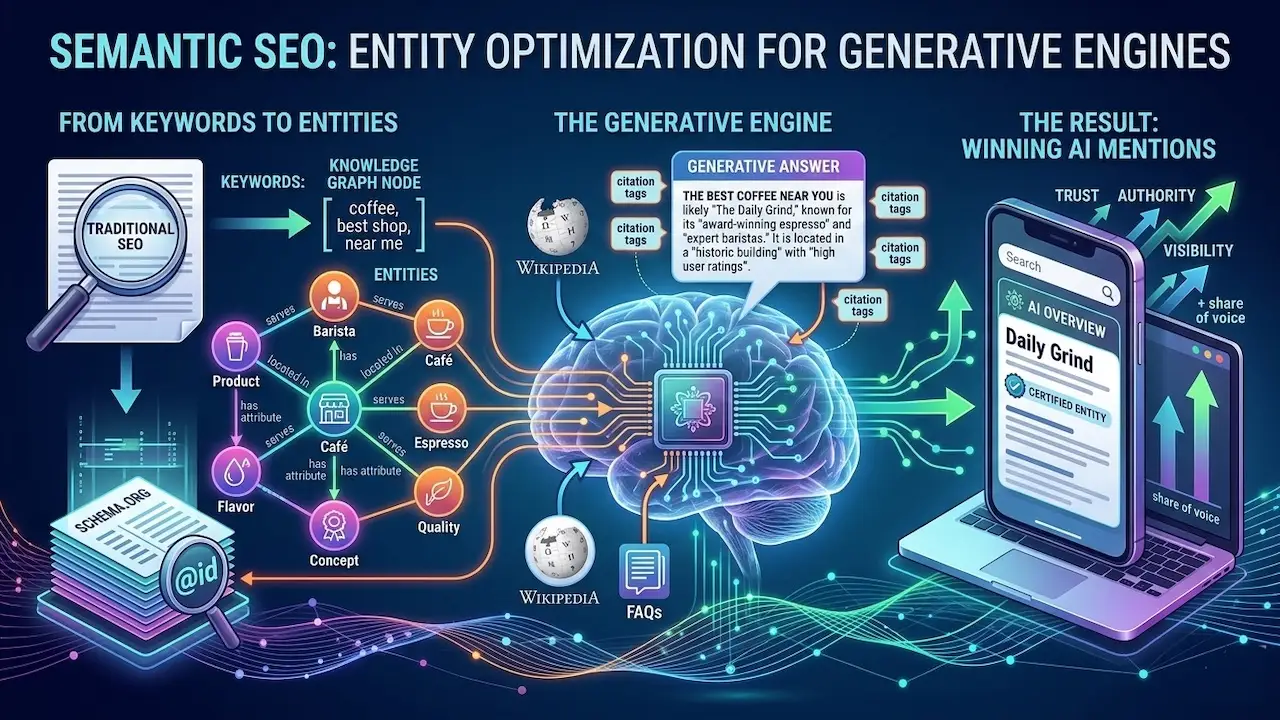
Semantic SEO is the practice of optimizing content for meaning, entities, and context rather than keyword frequency. It tells Google exactly what your page covers. It also tells AI engines like ChatGPT, Gemini, and Perplexity why your content is trustworthy. These engines then cite it as a trusted source. Pages built on semantic SEO rank for dozens of related queries at once. They appear in AI generated answers that keyword only pages never reach. This guide covers every component of semantic SEO. It includes entities, topic clusters, schema markup, and NLP signals. Follow the practical steps here today.
How Semantic SEO Differs from Traditional Keyword SEO
Traditional keyword SEO matches pages to queries by counting how often a word appears. Semantic SEO matches pages to queries by understanding what the word means. Google made this shift in 2012 with its Knowledge Graph update. It accelerated with Hummingbird, RankBrain, BERT, and MUM. Today, Google does not rank pages. It ranks entities and their relationships.
Here is the practical difference. A keyword SEO page targeting “running benefits” repeats that phrase. A semantic SEO page about running benefits also covers stamina, cardiovascular health, cortisol reduction, and running shoes. Those entities naturally co occur with the running concept. Google reads both pages and cites the second one. Google cites the second one because it covers the full entity, not just the keyword.
| Factor | Traditional Keyword SEO | Semantic SEO |
|---|---|---|
| Core signal | Keyword frequency and density | Entity meaning and relationships |
| Google algorithm | Exact match ranking logic | Hummingbird, BERT, RankBrain, MUM, NLP |
| Content coverage | One keyword per page | Full entity with all related concepts |
| Ranking scope | Targets one primary keyword | Ranks for dozens of semantically related queries |
| AI search visibility | No signal for AI citations | Recognized and cited by ChatGPT, Gemini, Perplexity |
| Trust signal | Backlinks and domain authority | Entity clarity, E-E-A-T, and Knowledge Graph presence |
The Entity Foundation of Semantic SEO
An entity is any clearly defined concept, person, place, brand, product, or idea. Google recognizes it and stores it inside its Knowledge Graph. Google’s Knowledge Graph holds over 8 billion entities and 800 billion facts connecting them. Every search query now maps to entities, not just words.
Your page must define its primary entity clearly. Then connect that entity to related entities through content, schema, and internal links. That network of connections is your entity relationship graph. AI engines like Gemini and Perplexity use it to decide whether your content is authoritative. Strong entity networks earn citations.
Quick Digital has applied semantic SEO and entity optimization for clients since 2014. The pattern is consistent. Pages that define their entity clearly rank broader. They earn AI citations faster than keyword repetition pages. See how knowledge panel optimization builds the entity authority that semantic SEO requires.
Named Entity Recognition and Salience Scores
Named Entity Recognition (NER) is how Google and AI engines identify entities inside your content. They categorize each one automatically. Every entity on your page receives a salience score from 0 to 1. A score near 1.0 means that entity dominates the page. Pages where your target entity scores highest appear in AI Overviews more often. AI generated answers favor them over diluted content.
Run Google’s Natural Language API on your page. Find the entity with the highest salience score. If it is not your intended topic entity, your semantic SEO has a focus problem. Fixing entity salience is more effective than adjusting keyword density. It directly affects how AI engines recall your content.
Semantic Keyword Research: Going Beyond Search Volume
Semantic keyword research maps the full ecosystem of terms, questions, and related concepts surrounding your target entity. The goal is finding every keyword that signals the same entity context to NLP systems. A page covering all of them ranks for all of them.
| Keyword Type | Example for “Semantic SEO” | Role in Semantic Content |
|---|---|---|
| Core entity keywords | semantic SEO, entity optimization, Knowledge Graph SEO | Anchors the page’s primary entity in NLP classification |
| LSI and semantic terms | entity salience, NLP SEO, semantic indexing, topical authority | Builds semantic co occurrence and entity depth signals |
| Long tail question keywords | how does semantic SEO work, how to build entity relationships for SEO | Matches voice queries and People Also Ask formats |
| Related concept keywords | topic clusters, pillar pages, semantic architecture, entity disambiguation | Expands entity coverage across the full concept space |
| Algorithm entity keywords | Google Hummingbird, BERT, RankBrain, MUM, Wikidata, Knowledge Graph | Activates co occurrence signals expected by NLP classifiers |
| Emotional intent keywords | brand not showing in AI search, invisible to Google, keyword SEO not working | Matches high intent users seeking urgent visibility solutions |
Semantic Keyword Research: Five Steps
- Start with your core entity. List every synonym, related concept, and sub entity connected to your main topic. Use SEMrush Topic Research or Ahrefs Content Gap to surface these.
- Extract People Also Ask data. Pull PAA boxes for your target keyword. Each question represents a sub entity your page should address. AlsoAsked automates this extraction.
- Group by semantic intent. Cluster keywords by entity context, not just search volume. Each cluster becomes a content section, not a separate page.
- Run a co occurrence audit. Feed your draft page into Google’s Natural Language API. Check which entities co occur with your target entity. Add any high salience related entities that your draft currently misses.
- Identify semantic gaps. Compare your content against top ranking pages. Find entity attributes they cover that yours does not. Those gaps reduce your topical authority score in NLP systems.
Topic Clusters and Semantic Architecture
Topic clusters are groups of interlinked content pages. Together they prove your site has deep authority on a subject. A pillar page covers the core entity at its highest level. Cluster pages cover every attribute, sub entity, process, and related concept. Together they create a semantic architecture that AI engines read as a coherent, authoritative knowledge source.
Without a topic cluster structure, your individual pages cover entity fragments. Google and AI engines treat fragments as low authority sources. They prefer pages that belong to a well connected semantic network. Every related concept should link back to a clearly defined core entity.
How to Build a Topic Cluster for Semantic SEO
- Map your entity hierarchy. Identify your core entity at the top. List every sub entity, attribute, and process that connects to it. Each item on that list becomes a cluster page target.
- Write the pillar page first. Cover your core entity completely. Answer the top 10 questions users ask about it. Link to each cluster page using entity specific anchor text, not generic phrases like “read more”.
- Build cluster pages with clear entity focus. Each cluster page must have one clear entity. Connect it back to the pillar page. Link to adjacent cluster pages only when entities share a direct relationship.
- Use breadcrumb navigation. BreadcrumbList schema reinforces your entity hierarchy for both crawlers and AI engines. Every cluster page must sit within 3 clicks of the pillar page.
- Audit for orphaned pages every 90 days. Orphaned cluster pages destroy the semantic network effect. Every cluster page needs a clear path back to the pillar entity.
Schema Markup for Semantic SEO
Schema markup is the machine readable layer that tells Google who you are. It also shows how your entity connects to other recognized entities. Generic schema from plugins creates shallow entity signals. Every property needs deliberate configuration, not auto generation.
Start with Organization schema on your homepage. Add sameAs links to your LinkedIn company page, Wikidata entry, and Crunchbase profile. These external links let AI engines verify your entity identity independently. Without them, AI engines cannot resolve your organization entity.
Add Article schema with a linked Person author object to every content page. Include about and mentions properties to connect your content to known entities. Update dateModified after every content change. AI engines use it as the freshness signal that determines whether your answer is still accurate. Read the schema markup implementation guide for every schema type that drives AI citations alongside traditional rankings.
Entity Disambiguation Through Schema
Entity disambiguation is the process by which Google determines which meaning a term refers to. It uses surrounding contextual signals to decide. If your brand name shares a term with an unrelated concept, disambiguation works against you. Your schema and content must make the correct entity context unmistakable.
Use the @id property in your Organization schema to give your entity a unique, persistent identifier. Connect your entity to its Wikidata QID. That connection provides a globally recognized disambiguation anchor. ChatGPT, Gemini, and Perplexity all reference Wikidata during entity resolution.
E-E-A-T as a Semantic Authority Signal
Google’s E-E-A-T framework functions as a measurable entity authority signal, not just a content quality guideline. Each dimension maps to entity attributes that AI engines evaluate. They use these signals when deciding which sources to cite. The E-E-A-T trust and authority framework explains how each dimension translates into specific technical signals.
- Experience: Attach content to real, named authors with verifiable professional histories. Link Person schema to LinkedIn profiles and published work. Experience is the newest E-E-A-T dimension. Most AI engines weight it heavily when deciding who to cite.
- Expertise: Write with technical precision. Include specific data points, named tools, and referenced methodologies. Generic advice gets filtered out of AI citation pools. It lacks the entity specificity NLP confidence scoring requires.
- Authoritativeness: Earn consistent mentions on external authority platforms. Each external citation reinforces your entity’s position in the knowledge graph. Industry publications, directories, and expert roundups all contribute.
- Trustworthiness: Maintain perfectly consistent entity information across all online touchpoints. Contradictory entity descriptions damage entity resolution and reduce AI recall accuracy.
Semantic Co occurrence: Teaching NLP Systems Your Entity Context
Semantic co occurrence is the pattern of which entities regularly appear near each other in text. It directly shapes how NLP systems classify and recall your content. When Google sees “semantic SEO” next to “entity salience” and “Knowledge Graph,” it builds a semantic cluster. That cluster links your content to the correct concept space.
Build semantic co occurrence intentionally. Use the full, official entity name in the first 100 words of every page. Reference related entities like partner organizations and tools by their full proper names. Replace pronouns with entity names repeatedly. This reinforces NER classification across the page.
The goal is aligning your content’s semantic embedding with users’ related query embeddings in vector space. When that alignment is strong, Google surfaces your page for every query in that entity context. It goes well beyond the exact keyword you targeted.
How to Write Content for Semantic SEO
Semantic SEO content writing starts with answering the page’s main question in the first 150 characters. Then build outward with entity context, structured evidence, and related concepts. AI engines skip long introductions that bury entity answers in prose.
Content Writing Rules for Semantic SEO
- Lead with the direct answer. State the core fact about your entity in the first one to two sentences. AI engines extract the first sentence under each heading most often.
- Write in active voice. Active voice makes meaning unambiguous for NLP parsers. Target over 90% active voice across every page.
- Use parallel structure in lists. Begin every list item with the same part of speech. This creates machine readable consistency that AI engines parse accurately.
- Bold only factual claims. Bold text signals importance to NLP systems. Use it on precise facts and direct answers only.
- Cover Who, What, Where, When, Why, and How. Address every natural language question format about your target entity. This matches how voice queries are phrased and how AI engines generate answers.
- Include specific numbers. Entity counts, percentage figures, time estimates, and named tools make content citable. Vague claims without supporting specifics get filtered out.
GEO Content Structure for AI Overview Eligibility
GEO content formatting aligns your semantic SEO writing with AI engine extraction patterns. Apply it to every page targeting AI Overviews.
- Opening answer block: Direct answer to the page’s main question within the first 150 characters.
- Entity context block: Two to three sentences explaining why this entity matters and how it connects to related concepts.
- Structured evidence block: A numbered list, comparison table, or step by step process to back the answer with specific, citable details.
- Named entity attribution: Reference the tools, organizations, frameworks, or people associated with the answer. This builds semantic co occurrence signals.
- FAQ block: End every key page with 3 to 5 entity specific questions with direct, factual answers. See how featured snippet optimization and FAQ structure work together for maximum SERP and AI visibility.
Semantic SEO Tools
These tools give you the entity analysis, semantic clustering, and NLP scoring data needed to build and measure a semantic SEO strategy.
| Tool | Primary Use for Semantic SEO | Key Feature |
|---|---|---|
| Google Natural Language API | Entity salience scoring and NER analysis | Assigns salience scores from 0 to 1 for every entity on your page |
| SEMrush Topic Research | Semantic cluster discovery | Groups keywords by topic and entity context, not just search volume |
| Ahrefs Content Gap | Entity coverage gap analysis | Finds sub entities competitors cover that your site currently misses |
| InLinks | Automated entity mapping and internal link analysis | NLP optimization scoring and semantic cluster visualization |
| Wikidata Query Service | Knowledge Graph entity relationship mapping | Maps entity relationships directly in Google’s knowledge source data |
| Surfer SEO or Clearscope | Semantic content scoring per page | Measures NLP term coverage and content semantic density |
| AlsoAsked | People Also Ask entity question extraction | Maps the full question ecosystem around any target entity |
| Schema App | Entity aware structured data management | Manages entity relationship connections across your full schema layer |
How to Measure Semantic SEO Performance
Measuring semantic SEO performance requires metrics beyond traditional keyword rankings and organic traffic. You need to measure how broadly your content ranks, how accurately AI engines describe your entity, and how your topical authority is growing over time.
- Query breadth: Count how many unique queries your target pages rank for in Google Search Console. Semantic SEO pages rank for 3 to 5 times more queries than keyword only pages.
- AI Overview appearance rate: Filter Search Console performance data by AI Overview triggering queries. Track how often your pages are cited as the source.
- Knowledge Panel presence and accuracy: A verified branded Knowledge Panel confirms Google has resolved your entity with confidence. Audit its attribute accuracy every month.
- Entity salience score: Run your key pages through Google’s Natural Language API monthly. Track whether your target entity’s salience score is rising or falling after content updates.
- LLM entity recall testing: Query ChatGPT, Gemini, Perplexity, and Bing Copilot with niche specific prompts monthly. Observe whether and how accurately your brand entity appears in responses.
- Behavioral metrics: Monitor time on page, scroll depth, and return visit rate. Rising engagement signals that your entity content matches what users actually need. It confirms content accuracy to search systems indirectly.
Common Semantic SEO Mistakes That Block Rankings
These exact patterns keep brands invisible in AI generated answers and prevent pages from ranking broadly, even when traditional SEO metrics look healthy.
- Keyword pages without entity structure: Pages optimized for keyword density but missing entity disambiguation, NER rich content, and relational context get filtered out of AI Overview candidate pools. Traditional ranking positions do not protect them.
- Inconsistent entity names: Using multiple name variations across platforms breaks entity resolution algorithms. Choose one official entity name. Apply it everywhere without variation.
- Missing sameAs connections: Without sameAs links connecting your schema entity to Wikidata, LinkedIn, and industry directories, AI engines cannot verify your identity from independent external sources.
- Orphaned cluster pages: Cluster pages covering sub entities without internal links back to the pillar page cannot be aggregated into a coherent semantic cluster. Every cluster page needs a clear path home.
- Anonymous content: Pages without a named, verifiable author entity receive lower E-E-A-T scores. AI engines weight human expertise attribution heavily in citation decisions.
- Generic schema from plugins: Auto built Article markup does not create specific entity connections that AI engines need. Review and manually configure every schema property.
- Pronoun overuse: Replacing entity names with “it” and “they” breaks NER classification. Repeat the entity name throughout the page to reinforce semantic signals.
- Topical coverage gaps: Pages that cover entity attributes but miss specific sub entity coverage create gaps. Competitors and AI summaries fill those gaps instead of your brand.
Semantic SEO and AI Search: How They Connect
Semantic SEO is the foundation that makes AI search visibility possible. Generative engines like Gemini, ChatGPT, and Perplexity use Retrieval Augmented Generation (RAG) to pull content from indexed sources. They extract entity relationships and synthesize answers. For your content to pass the RAG filter, it must pass three checks.
First, the entity must match the concept being queried with zero ambiguity. Second, the entity must cover all attributes the AI engine expects. These include name, function, relationships, and domain context. Third, the entity must be described consistently across your site, schema, and external sources. When all three conditions are met, your content gets recalled by generative engines. When even one is missing, your page stays invisible in AI answers.
Semantic SEO satisfies all three conditions at once. It ranks you in traditional SERPs. It positions you for AI citations too. Read about the full answer engine optimization strategy that builds on your semantic SEO foundation for maximum AI search visibility.
Frequently Asked Questions About Semantic SEO
Semantic SEO works by aligning your content with Google’s entity based ranking system, where pages are evaluated on meaning, entity clarity, and topical authority. Google uses Hummingbird, BERT, RankBrain, and MUM to understand entity relationships. Pages with high entity salience scores rank for dozens of related queries. Keyword only pages rank for one query.
Semantic SEO results typically appear within 60 to 90 days of implementing entity consistency across schema, content, and external sameAs sources. Initial signs include broader query coverage in Search Console and Knowledge Panel creation. LLM training data update cycles vary by platform.
Traditional keyword SEO optimizes a page to rank for one specific phrase. Semantic SEO optimizes content to rank for an entire entity concept and all related queries. Semantic SEO produces visibility in AI Overviews, Knowledge Panels, voice search answers, and LLM citations. Keyword SEO alone cannot achieve those outcomes. AI engines evaluate entity clarity and relationship depth.
Start by defining your core entity clearly on your homepage. Add Organization schema with sameAs links to LinkedIn and Wikidata. Then build one topic cluster around your most important service. Run Google’s Natural Language API on your pillar page to check entity salience. Then expand to cover every sub entity and related concept.
Semantic SEO is the foundation of voice search optimization because voice queries are natural language questions about entities. Voice queries run 3 to 5 times longer than typed queries. Every FAQ block and short direct answer section you write for semantic SEO is also optimized for voice search.
Build Your Semantic SEO Strategy with Quick Digital
Quick Digital • Digital Marketing Since 2014
Stop Losing Visibility to Competitors Who Use Semantic SEO
Quick Digital builds semantic SEO strategies that rank your content for entire entity concepts, not just one keyword at a time. Entity optimization, topic cluster architecture, schema markup, and AI search visibility from a team with over 10 years of search experience.
Build Your Semantic SEO Strategy →
Request a Free Quote
SEO Services • Entity Optimization • Topic Cluster Architecture • Schema Markup • AI Search Visibility