


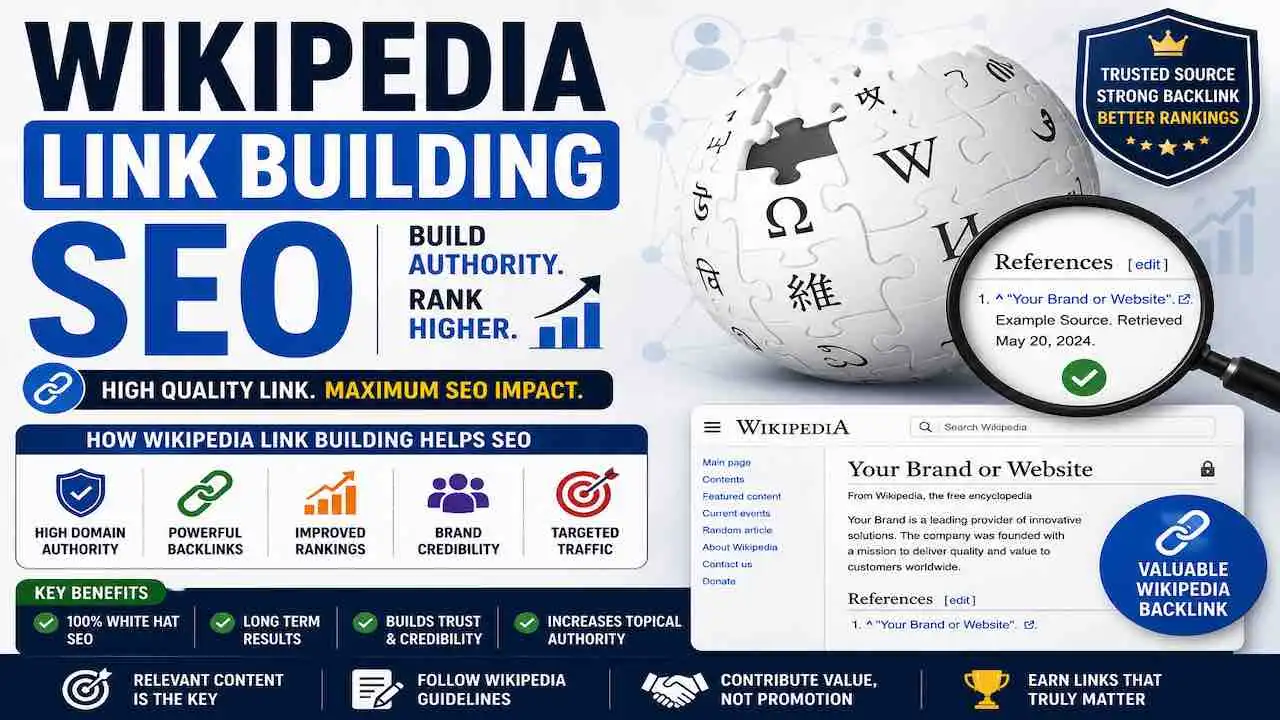
Wikipedia link building SEO works through 4 compounding mechanisms that raise your domain’s implicit authority ceiling: entity recognition in Google’s knowledge graph, secondary dofollow backlinks from journalists who use Wikipedia as a source, referral traffic from Wikipedia’s 130 billion annual pageviews, and the pagerankNS link signal confirmed in Google’s March algorithm leak. Wikipedia’s external links are nofollow. But 89 percent of SEO professionals in a 755-person Authority Hacker survey confirm nofollow links impact rankings. Google’s own leaked algorithm documentation confirms that Wikipedia-sourced links carry a separate trust signal called pagerankNS that applies specifically to editorially vetted, high-authority domains.
Wikipedia SEO is the practice of using Wikipedia for SEO to build brand entity authority, earn editorial citations, and raise your domain’s implicit ranking ceiling. The Wikipedia SEO value extends beyond nofollow link value through entity recognition, knowledge panel activation, and EEAT, also written as E-E-A-T (Expertise, Experience, Authoritativeness, Trustworthiness), trust signal reinforcement. Wikipedia external links deliver brand authority signals that no other nofollow citation can replicate.
This guide covers everything an end user needs to know about Wikipedia link building SEO: the authority ceiling concept, why Wikipedia backlinks work differently from all other nofollow links, the 6 Wikipedia link building methods ranked by difficulty and return, the exact Wikipedia notability criteria for brands, how to build editing reputation before adding any links, how to create a Wikipedia article that survives deletion, and what changes in your organic rankings after Wikipedia entry. Every section answers the question completely. No detail is withheld for a paid resource.
The Domain Authority Ceiling: What It Is and Why Wikipedia Breaks It
Domain authority stuck despite consistent link building? Authority bottleneck keeping competitors outranking you for terms your content should win? Brands not recognized by Google as verified real-world entities face a brand trust gap. A brand not recognized by Google in this way that missing from knowledge panel results makes visible every day. Unlocking higher rankings. Breaking through authority ceiling limitations requires entity recognition. breaking through the authority ceiling that creates the SEO plateau requires entity recognition that standard link building cannot provide. A domain authority ceiling is the implicit ranking cap Google applies to websites it has not yet recognized as verified real-world entities. Two sites can carry identical backlink profiles and Domain Authority scores. One ranks page one for competitive terms. The other plateaus between positions 8 and 15 regardless of content quality or new link acquisition. The difference is almost never backlinks. It is entity status.
Google does not rank websites as collections of pages. It ranks entities. An entity is a named, identifiable real-world thing: a brand, person, organization, or product. When Google can confirm your brand as a recognized entity with verifiable attributes, consistent cross-web mentions, and a position in its knowledge graph, your domain exits the anonymous website tier and enters the known-entity tier. Known entities rank differently. Their content gets preferential treatment in featured snippet selection, knowledge panel placement, and AI-generated answer citation.
Wikipedia sits at the top of Google’s entity verification hierarchy. Over 10 percent of Google knowledge graph entries are sourced directly from Wikipedia. A Wikipedia citation confirms your brand as notable and real. That confirmation breaks the authority ceiling that keeps most brands from reaching their true ranking potential regardless of how many backlinks they acquire.
Why Standard Link Building Cannot Break This Ceiling
Standard link building acquires domain authority through PageRank signals. It cannot acquire entity recognition. A brand can reach Domain Authority 60 through aggressive link building and still rank below a Domain Authority 45 competitor that has clear entity recognition through Wikipedia, knowledge panel presence, and consistent third-party brand mentions. The SEO plateau most established brands hit after 12 to 24 months of link building almost always traces to missing entity recognition rather than missing backlinks. Wikipedia link building SEO addresses the root cause of this plateau directly.
Why Wikipedia Backlinks Work: The pagerankNS Revelation
Google’s March algorithm documentation leak confirmed that Google evaluates links from high-trust editorially vetted sites through a separate signal called pagerankNS. The pagerankNS metric applies specifically to links that have passed editorial review on trusted domains. Wikipedia’s entire external link ecosystem is editorially reviewed. Every external link addition faces review by active Wikipedia editors. Links that violate Wikipedia’s external links policy get removed, often within hours. Links that survive are there because real human editors judged them appropriate.
This editorial vetting process is what separates Wikipedia’s nofollow links from all other nofollow links. A Wikipedia nofollow citation is not the same as a nofollow link from a social media profile or a forum comment. It carries an editorial endorsement from one of the most scrutinized editorial communities on the internet. Google tracks this difference through the pagerankNS signal confirmed in the algorithm leak.
The 4 Compounding Mechanisms of Wikipedia Link Building SEO
| Mechanism | Type | SEO Effect | Timeline |
|---|---|---|---|
| pagerankNS editorial trust signal | Direct ranking signal | Lifts trust threshold for the cited domain in Google’s ranking systems | 2 to 8 weeks after citation goes live |
| Entity recognition in knowledge graph | Entity authority | Confirms brand as real entity, activates knowledge panel, breaks authority ceiling | 4 to 12 weeks |
| Secondary dofollow backlinks | Indirect link building | Journalists and researchers find your source through Wikipedia and link directly | Ongoing from citation date |
| Referral traffic from 130B pageviews | Traffic and behavior signals | High-intent visitors with strong topical relevance send positive behavior signals | Immediate and ongoing |
Wikipedia brand mentions generate citation signals that build secondary citations across the web through co-citation. Brand entity recognition strengthens as more authoritative sources reference your brand alongside Wikipedia entries on your topic. Topical authority grows as brand credibility signals accumulate through consistent Wikipedia citation presence. Link juice from a Wikipedia nofollow citation does not flow as direct PageRank. But the tier-two links generated by journalists who cite Wikipedia as a source do. This secondary link building chain is what makes Wikipedia link building SEO produce more dofollow editorial backlinks over time than most outreach campaigns generate directly. The Wikipedia citation is the trigger. The tier-two dofollow backlinks from publications that cite Wikipedia as a source are the direct ranking benefit.
The Wikipedia to Wikidata to Knowledge Panel Pipeline
Every Wikipedia brand citation connects your domain to Google’s knowledge graph through a 3-step pipeline that no other link building method replicates. Understanding this pipeline shows exactly why Wikipedia link building SEO produces results that standard domain authority building cannot.
Step one: a Wikipedia editor creates or updates an article citing your brand or domain as a reliable source. Step two: Wikidata, Wikipedia’s machine-readable structured data layer, generates or updates a unique QID identifier for your brand entity. This QID carries structured attributes including founding date, headquarters, industry classification, CEO name, and official website URL in a format Google reads directly. Step three: Google ingests the Wikidata entity record and generates a knowledge panel for branded searches using the structured attributes as verified facts.
Knowledge graph integration through Wikipedia and Wikidata enables entity linking that connects your brand to topic clusters in Google’s index. Brand entity signals from this entity linking compound through Wikidata property records that Google reads directly. Entity consistency across Wikipedia, Wikidata, and your domain ensures these signals reinforce each other rather than creating conflicting entity records. The knowledge panel that appears on the right side of Google for branded queries does not require a manual claim or Google Business Profile submission when a Wikidata entity exists. Google generates it automatically from the Wikidata record. For brands without a Wikidata entity, that knowledge panel slot goes empty regardless of Domain Authority or search volume. Creating the Wikidata entity directly, without a full Wikipedia article, is the fastest path to knowledge panel activation. See the full knowledge panel optimization guide for step-by-step Wikidata entry creation.
What Entity Recognition Changes in Google’s Treatment of Your Domain
Brand entity disambiguation resolves ambiguous branded searches with confidence. Named entity recognition in Google’s systems links every mention of your brand name to one confirmed entity record. Entity salience, the measure of how prominently your brand features in topic-related documents, rises when Google’s co-occurrence signals consistently connect your brand name to relevant subject areas through Wikipedia citations. Entity-based search rewards entity salience with ranking authority across both branded and non-branded queries. The entity-based SEO guide covers how to strengthen entity recognition signals beyond Wikipedia through structured data and cross-web mention consistency.
6 Wikipedia Link Building Methods Ranked by Difficulty
Wikipedia page creation and Wikipedia article creation are the highest-commitment methods. How to create a Wikipedia page correctly requires completing lower-difficulty methods first to build editorial credibility. All 6 methods below contribute to Wikipedia link building SEO. Start with Method 1 and build upward.
Wikipedia link building SEO offers 6 distinct methods with different difficulty levels, editorial risk profiles, and return timelines. Start with the lowest-difficulty methods first. Build editorial reputation before attempting higher-difficulty methods. Every method requires genuine value contribution to a Wikipedia article. Links added without adding genuine encyclopedic value get removed immediately and may result in account bans.
Method 1: WikiGrabber Dead Link Replacement (Easiest)
The Wikipedia dead link strategy is the entry point for most successful Wikipedia link building campaigns. WikiGrabber is a free tool that crawls Wikipedia for dead external links and “citation needed” tags across articles related to any keyword you enter. It returns a formatted list of opportunities sorted by article traffic and link gap type. This is the highest-probability Wikipedia link building method for brands with published, reliable content that covers the same factual ground as a dead Wikipedia citation.
The process: enter your topic into WikiGrabber, identify articles with dead links pointing to content your published research replaces, verify your content meets Wikipedia’s reliable sources standard, then suggest the replacement through the article’s Talk page rather than editing directly. Talk page suggestions for dead link replacement get accepted at significantly higher rates than direct edits from new accounts with low edit counts.
Method 2: Citation Needed Tag Targeting
Wikipedia articles display “citation needed” tags next to unverified factual claims. These tags are explicit editorial requests for a reliable source. Finding “citation needed” tags in articles where your published content provides the required verification is the clearest Wikipedia link building opportunity available. Search Wikipedia directly with: site:en.wikipedia.org "citation needed" [your topic]. Each citation needed tag represents an editorial void your content can fill if it meets Wikipedia’s reliable sources standard.
Before adding any citation, verify 3 things: your content comes from a recognized reliable source or is itself published on a recognized platform, it directly supports the specific claim tagged as needing a citation, and it is not promotional in nature. Citations that do not directly support the tagged claim get removed by editors within hours of addition.
Method 3: Wikipedia Talk Page Suggestions
Every Wikipedia article has a Talk page where editors discuss changes, source quality, and article improvements. Contributing constructively to Talk page discussions builds editorial reputation and creates legitimate openings to suggest external link additions. To suggest a citation through a Talk page: explain why the specific content supports the specific claim in the article, provide the URL and author credentials, and note how the source meets Wikipedia’s reliable sources criteria.
Talk page suggestions succeed at higher rates than direct edits for accounts with fewer than 50 edits. Experienced Wikipedia editors monitor Talk pages actively and often implement well-reasoned suggestions from new contributors who have demonstrated good-faith editing elsewhere in Wikipedia. This method also protects your account from spam classification, which direct link additions without editorial conversation can trigger for new accounts.
Method 4: Getting Cited in Existing Articles Without a Brand Page
How to get cited on Wikipedia without a brand page and how to build Wikipedia citations in existing articles both follow the same core principle: contributing genuine encyclopedic value that improves a Wikipedia article’s factual coverage. Getting your brand mentioned in existing relevant Wikipedia articles without creating a standalone brand page requires one asset: published, citable research that improves a Wikipedia article’s factual coverage of a topic. Create original research, publish it in a recognized industry publication, and identify Wikipedia articles where that research supports or extends existing factual claims. The ideal scenario described by Wikipedia contributors themselves: an independent editor finds your published research while improving an article and adds it as a citation because it genuinely enhances the encyclopedia, not because you asked them to. Building this ideal scenario requires original research published in independent outlets, not press releases or self-published content.
Industry directory appearances in recognized lists create another citation path. Appearances in Fortune 500, FTSE indices, Gartner Magic Quadrant, and IDC market share reports are all citable on Wikipedia as independent third-party evidence of brand notability. These rankings are regularly cited in Wikipedia articles covering their respective industries. A brand listed in these rankings has a legitimate, editorially defensible citation path into industry-related Wikipedia articles.
Method 5: Wikipedia Article for Creation (AfC) Process
The Article for Creation (AfC) process is Wikipedia’s formal review system for new article submissions. Submitting through AfC rather than publishing directly gives your article access to Wikipedia editor review before publication. This significantly reduces the risk of immediate deletion for brands meeting notability criteria but new to Wikipedia’s editorial standards.
The AfC process requires: formatting your draft as a Wikipedia article with citations in Wikipedia’s citation template format, submitting it through the Wikipedia:Articles for Creation page, and waiting for an AfC reviewer to assess notability and formatting. Review timelines vary from days to months depending on reviewer availability. Accepted articles get published directly. Declined articles receive specific feedback on what additional sources or formatting changes are needed for acceptance. AfC decisions are not final. Multiple resubmissions with improved sourcing are standard practice.
Method 6: Direct Wikipedia Brand Page Creation (Hardest)
Creating a standalone Wikipedia page for your brand requires meeting notability criteria, building editorial reputation first, writing with complete NPOV compliance, and either submitting through AfC or publishing directly with full confidence your sourcing meets deletion review standards. This is the highest-risk, highest-reward Wikipedia link building method. A successful brand page delivers knowledge panel activation, entity recognition, and the full suite of Wikipedia link building SEO benefits. A failed page that gets deleted removes your brand from Wikipedia’s index with a deletion notice that makes future article creation more difficult.
Build at least 10 to 15 constructive edits on Wikipedia before attempting to create or significantly edit any article related to your brand. Wikipedia’s automated spam detection flags accounts with zero editing history that add external links in their first edits. The 10 to 15 edit threshold is the recognized minimum for establishing good-faith editing credentials. Fix spelling errors, update outdated facts, improve formatting on articles unrelated to your industry. Each edit counts toward the editorial credibility that protects your brand-related contributions from automatic rejection.
Wikipedia Notability Criteria for Brands
Wikipedia’s General Notability Guideline (GNG) requires significant coverage in reliable, independent, secondary sources. This requirement is absolute and non-negotiable. Brands that try to create Wikipedia pages before meeting this standard get deleted within hours. The sequence is not optional: build notability first, create the Wikipedia article second.
Acceptable Sources for Wikipedia Brand Citations
- National and regional newspapers with editorial standards: The Guardian, Financial Times, The Economic Times, regional business press. Articles must discuss your brand as a primary subject rather than a passing mention.
- Recognized industry publications with editorial oversight: TechCrunch, Forbes, Business Insider, Wired, and their vertical equivalents for your industry. Sponsored content, paid placements, and contributed articles from brand representatives do not qualify as independent sources.
- Industry ranking bodies: Fortune 500 rankings, Gartner Magic Quadrant appearances, IDC market share reports, and Clutch category listings are citable as third-party evidence of brand notability and scale.
- Academic journals and peer-reviewed research: Academic citations of your published research or brand as a subject of study carry significant notability weight for Wikipedia editors.
- Government sources: Company registrations, regulatory filings, court records, and government contracts are all citable as independently verifiable sources.
Unacceptable Sources Wikipedia Editors Will Reject
- Press releases: Not independent sources regardless of which outlet published them verbatim. Editors who identify press releases disguised as news coverage will remove the citation and flag the article for additional scrutiny.
- Self-published content: Your own website, blog, case studies, and whitepapers are primary sources by definition. They cannot establish notability no matter how detailed or well-researched.
- Interviews you arranged: Coverage resulting from proactive brand outreach where the brand controls the narrative is not considered independently sourced even when published by a reliable outlet.
- Sponsored content and paid placements: Any coverage where your brand paid for placement fails the independence test. Wikipedia editors are experienced at identifying sponsored content language patterns and remove it immediately.
- Social media and user-generated content: No social media source qualifies as a reliable independent source for Wikipedia purposes regardless of follower count or verified account status.
How Many Sources Is Enough
Wikipedia editors expect 3 to 5 strong independent secondary sources for a company article to survive deletion review. Each source must discuss your brand as a primary subject, not merely mention it among many others in a broader roundup. Coverage quality matters significantly more than volume. One in-depth investigative piece from a national newspaper carries more notability weight than 20 brief mentions in industry newsletters. Brands in digital marketing, cryptocurrency, financial services, and technology startups face stricter notability scrutiny due to historical Wikipedia spam campaigns from those industries. These sectors typically need 5 to 7 strong sources to pass deletion review reliably.
Building Wikipedia Editing Reputation Before Adding Brand Links
Building 10 to 15 constructive Wikipedia edits before adding any brand-related external links is the single most important practical step in any Wikipedia link building SEO strategy. SEOmator’s research confirms that accounts adding external links without prior editing history get flagged as spammers automatically. Flagged accounts face reversions of every edit and account bans that prevent future Wikipedia contributions entirely.
How to Build Wikipedia Editing Reputation Correctly
Create a free Wikipedia account with a neutral username. Do not use your brand name, company name, or any name that suggests commercial interest. Wikipedia’s conflict of interest (COI) policy requires disclosed COI for any edits related to your employer, clients, or financial interests. A username signaling commercial connection invites COI scrutiny from the start.
Begin editing articles completely unrelated to your industry. Fix spelling and grammatical errors. Add missing citations to factual claims you can verify from reliable sources. Improve article formatting and internal linking. Expand stub articles on topics you have genuine knowledge about. Each of these edits builds your account’s edit count, establishes your good-faith participation in Wikipedia’s editorial community, and reduces the likelihood that any brand-related contribution you make later gets automatically flagged for spam review.
After building your editing foundation, disclose any conflict of interest transparently when contributing to brand-related articles. Wikipedia’s COI policy allows disclosed COI editing in most cases. Undisclosed COI editing, when discovered, results in account suspension and article deletion. Transparent disclosure while contributing genuinely useful content is the compliant, sustainable approach to Wikipedia link building SEO for brand representatives and SEO agencies alike.
How to Create a Wikipedia Article That Survives Deletion
Wikipedia moderators patrol new articles actively. Wikipedia neutral point of view policy, known as NPOV, and Wikipedia conflict of interest (COI) guidelines are enforced by automated bots and human editors simultaneously. also Wikipedia articles about brands face deletion within hours when they read like marketing content. Every factual claim needs an independent reliable source as a footnote citation. Every sentence must pass the NPOV (Neutral Point of View) test: would a neutral journalist with no connection to the brand write it this way?
Wikipedia NPOV Writing Standard for Brand Articles
NPOV compliance requires specific rewrites that marketing professionals find counterintuitive. “Quick Digital is a leading digital marketing agency serving global brands” becomes “Quick Digital is a digital marketing agency.” The word “leading” is a promotional claim requiring an independent third-party source to verify. Without that source, it gets removed. “The company’s award-winning services” becomes “the company’s services.” No award citation, no award reference. Every factual claim requires a specific footnoted citation or it gets removed in the first editorial review.
Wikipedia brand articles typically cover: founding date and location, founders’ names, core business description, significant milestones cited by independent sources, notable products or services covered in independent press, and any relevant controversies handled factually with citations. Nothing beyond what independent sources confirm is appropriate for a Wikipedia article regardless of how factually true it is from the company’s own knowledge.
The Articles for Deletion (AfD) Process
Any Wikipedia editor can nominate any article for deletion through the Articles for Deletion (AfD) process. AfD nominations stay open for 7 days. During that period, any editor can weigh in with “keep,” “delete,” or “merge” recommendations. AfD outcomes are decided by editorial consensus, not vote counting. A well-reasoned “keep” argument citing specific reliable sources outweighs multiple “delete” votes from editors who did not review the sourcing carefully.
If your Wikipedia article receives an AfD nomination, respond immediately on the AfD discussion page. Provide the specific independent reliable sources that establish notability. Do not argue that the article is accurate or useful. Argue specifically that the brand meets Wikipedia’s General Notability Guideline through the sources provided. AfD discussions that include the brand representative disclosing COI and providing additional verifiable sources often result in “keep” outcomes when the underlying notability case is solid.
Wikipedia Link Building SEO Strategy: Building the Notability Foundation
Wikipedia notability building is an off-site SEO signals campaign that builds entity SEO authority through press mentions in editorially vetted publications. Industry rankings from bodies like Gartner, Fortune 500, and IDC provide the cleanest notability evidence because they meet Wikipedia editorial standards for independence and reliability. Wikipedia notability building is a digital PR and brand authority building campaign. The press coverage and citation building for SEO that Wikipedia requires creates independent value for your domain regardless of whether a Wikipedia article is ultimately created or survives. Every step toward Wikipedia notability simultaneously builds the E-E-A-T profile that Google’s quality assessment systems reward across all search features. See the full E-E-A-T and brand authority guide for how press coverage and third-party citations compound beyond Wikipedia to strengthen domain trust signals.
The Digital PR Foundation for Wikipedia Notability
Wikipedia reliable sources requirements guide every press mention you need. Target 5 to 7 pieces of genuine press coverage in publications Wikipedia editors recognize as reliable. Pitch original research data, proprietary survey results, or genuinely newsworthy brand stories. HARO (Help a Reporter Out) requests provide the most direct path to independent journalist coverage. Expert commentary in industry publications builds notability while also developing the off-site brand mentions that strengthen entity recognition across Google’s knowledge graph. Digital PR for SEO and Wikipedia link building strategy share identical source-building goals. Every press mention earned for Wikipedia notability also functions as a brand credibility signal in Google’s E-E-A-T evaluation systems.
Creating Wikipedia-Citable Content
The most reliable path to Wikipedia citations is creating original research that Wikipedia editors would naturally cite to support factual claims. Original survey data, industry benchmark reports, and independently verified statistics that fill gaps in existing Wikipedia articles represent the ideal citable content type. Publish this research in recognized industry publications or academic venues. Then identify Wikipedia articles where this research directly supports or extends existing factual claims. The best scenario for Wikipedia link building is an independent editor finding your published research while improving a Wikipedia article and adding it as a citation because it genuinely improves the encyclopedia. This organic citation scenario produces citations that survive indefinitely because no editor has grounds to remove them.
What Happens to Your SEO After Getting on Wikipedia
Wikipedia entry produces 5 measurable SEO changes that compound over 3 to 12 months. The knowledge panel is the fastest visible result. The competitive ranking improvement is the most strategically valuable long-term outcome.
| SEO Change | Timeline | What Drives It |
|---|---|---|
| Knowledge panel activation | 2 to 8 weeks after Wikidata entity creation | Google reads Wikidata QID and generates panel from entity attributes |
| Branded query disambiguation | 4 to 12 weeks after Wikipedia publication | Entity disambiguation connects all brand name mentions to one confirmed entity |
| Secondary dofollow backlink accumulation | Ongoing from citation date | Journalists and researchers find your source through Wikipedia and link directly |
| AI search citation eligibility | 3 to 6 months after entity recognition | Knowledge graph entity data feeds AI overview and LLM citation selection |
| Competitive ranking improvement | 6 to 12 months as authority ceiling rises | Entity authority compounds with existing backlink profile to lift non-branded rankings |
The AI search citation benefit now extends beyond traditional search. Large language models including GPT-4, Claude, Gemini, and LLaMA all include Wikipedia and Wikipedia-derived datasets like The Pile and Dolma in their pretraining corpora. A brand with a Wikipedia article enters LLM training data directly. A brand without one depends entirely on secondary coverage. The LLM training data and AI indexing guide covers how Wikipedia entity recognition feeds AI model training corpus inclusion and AI search citation selection simultaneously. Wikipedia link building SEO and Generative Engine Optimization (GEO) share the same entity foundation.
Common Wikipedia Link Building Mistakes That End Campaigns
Most Wikipedia link building SEO campaigns fail not because Wikipedia is inaccessible but because practitioners violate Wikipedia’s editorial policies in predictable ways. Each mistake below has ended more Wikipedia link building campaigns than the difficulty of the strategy itself.
- Adding links with zero edit history: Accounts adding external links in their first 1 to 5 edits get flagged automatically as spammers. Build 10 to 15 constructive edits on unrelated articles before adding any brand-related content.
- Submitting without meeting notability: Articles about brands with fewer than 3 strong independent secondary sources get deleted within hours. Build notability first. No exceptions.
- Using promotional language anywhere in the article: “The industry-leading,” “the award-winning,” and “the innovative” trigger immediate editor review. Every word must be verifiable from an independent source or it gets removed.
- Undisclosed conflict of interest editing: Editing Wikipedia articles about your employer, clients, or any brand you have a financial relationship with without disclosing that COI violates Wikipedia policy. Disclosure protects you. Non-disclosure results in bans that destroy every contribution you have made.
- Citing press releases as independent sources: Press releases published verbatim by media outlets are not independent regardless of who published them. Wikipedia editors identify press release language patterns and remove the citation.
- Abandoning the article after creation: Wikipedia articles about brands that go unmaintained face deletion nominations from editors enforcing quality standards. Assign ongoing maintenance responsibility before the article goes live.
- Using a VPN to add rejected links: Wikipedia IP-bans ranges associated with persistent spam editing. Using VPNs to circumvent bans results in the VPN IP range being banned, affecting every Wikipedia user on that VPN service.
Wikipedia Link Building SEO and Brand Authority: The Complete Picture
Wikipedia link building SEO solves a problem that standard link building cannot: the authority ceiling that prevents entity-unrecognized brands from ranking at their true potential. Wikipedia’s nofollow links carry the pagerankNS editorial trust signal. Wikipedia citations generate tier-two dofollow backlinks from journalists. Wikidata entity records activate knowledge panels. Wikipedia article inclusion in LLM pretraining data creates AI search citation eligibility. Every benefit compounds with the others over a 6 to 12 month window.
Quick Digital’s brand SEO services build this Wikipedia foundation through notability development, Wikidata entity creation, knowledge panel optimization, Wikipedia article strategy, and the off-site citation building that makes Wikipedia eligibility permanent. The broader link building service integrates Wikipedia citation strategy with digital PR, entity building, and AI search visibility into one coordinated brand authority program.
Frequently Asked Questions About Wikipedia Link Building SEO
Does Wikipedia Help SEO? Are Wikipedia Backlinks Worth It?
Does a Wikipedia page help domain authority? Does Wikipedia help SEO? Are Wikipedia backlinks worth it? Yes. Wikipedia’s nofollow links carry the pagerankNS editorial trust signal confirmed in Google’s March algorithm leak, generate secondary dofollow backlinks from journalists who use Wikipedia as a research source, and deliver entity recognition in Google’s knowledge graph. An Authority Hacker survey of 755 link builders found 89 percent believe nofollow links impact rankings. Research shows nearly identical ranking correlations between high-authority nofollow and standard dofollow links. The entity recognition mechanism alone justifies Wikipedia link building SEO for any brand investing in long-term search authority. Wikipedia domain authority of 100 makes its editorial endorsement one of the strongest trust signals available in organic search.
How to Get a Wikipedia Page and Meet Wikipedia Notability Requirements
How to get a Wikipedia page for your brand starts with meeting Wikipedia notability requirements before writing a single sentence. This is the most common mistake in Wikipedia link building SEO: attempting page creation before notability is established.
How Do I Get My Brand Cited on Wikipedia Without a Brand Page?
Use WikiGrabber to find dead links and citation needed tags in relevant Wikipedia articles, create original research that Wikipedia editors would cite to support factual claims, and contribute constructively to Talk page discussions where your content fills a genuine editorial gap. Build 10 to 15 edits on unrelated articles first. Getting cited in existing Wikipedia articles is faster, lower-risk, and often more valuable than creating a standalone brand page because existing articles carry established traffic and editorial credibility that new articles take years to build.
How Wikipedia Affects Google Rankings Through the Knowledge Graph
How Wikipedia affects Google rankings operates through the knowledge graph pipeline. Wikipedia and Google knowledge graph integration means Wikipedia citations carry entity-level ranking influence beyond what standard link metrics capture. The mechanism: Wikipedia citation confirms brand notability, Wikidata QID registers the entity, Google knowledge graph integration elevates the domain’s trust threshold across all ranking systems.
What Is the Wikipedia General Notability Guideline for Brands?
The General Notability Guideline (GNG) requires significant coverage in reliable, independent, secondary sources. For brands this means 3 to 5 news articles or industry publication pieces written by journalists with no affiliation to your brand. Press releases, sponsored content, company blogs, and social media posts do not count. Each source must discuss your brand as a primary subject. Brands in digital marketing, cryptocurrency, fintech, and technology startups typically need 5 to 7 strong sources due to stricter editorial scrutiny in those categories.
How Long Does Wikipedia’s SEO Impact Take to Appear?
Wikidata entity creation produces knowledge panel changes within 2 to 8 weeks. Wikipedia article publication produces branded query improvements within 4 to 12 weeks. Competitive ranking improvements from the raised authority ceiling take 6 to 12 months to compound fully. Perplexity AI and AI search citation effects appear within 3 to 6 months as AI systems process the updated entity and knowledge graph data. Track branded search performance, knowledge panel health, secondary backlink acquisition rate, and AI referral traffic as the 4 leading indicators of Wikipedia link building SEO momentum.
Is Wikipedia Link Building Worth the Effort?
Yes for brands that have hit an SEO plateau despite consistent link building and content investment. Wikipedia link building SEO targets the entity recognition gap that standard SEO cannot address. The effort required, 2 to 4 months of notability building, account reputation development, and article creation, produces benefits that compound for years without ongoing maintenance cost. The pagerankNS editorial trust signal, tier-two dofollow backlinks, knowledge panel activation, and AI citation eligibility all persist and grow after the initial investment. For brands where competitive terms remain out of reach despite strong Domain Authority, Wikipedia link building is the highest-leverage remaining lever available.
Quick Digital | Brand Authority Since 2014
Your Brand’s Authority Ceiling Is a Solvable Problem
Quick Digital builds the Wikipedia notability foundation, Wikidata entity records, knowledge panel presence, and off-site citation authority your brand needs to break through its current ranking ceiling and enter the known-entity tier.
Wikipedia citation strategy, digital PR for SEO, E-E-A-T building, and AI search visibility delivered as one coordinated brand SEO program.