


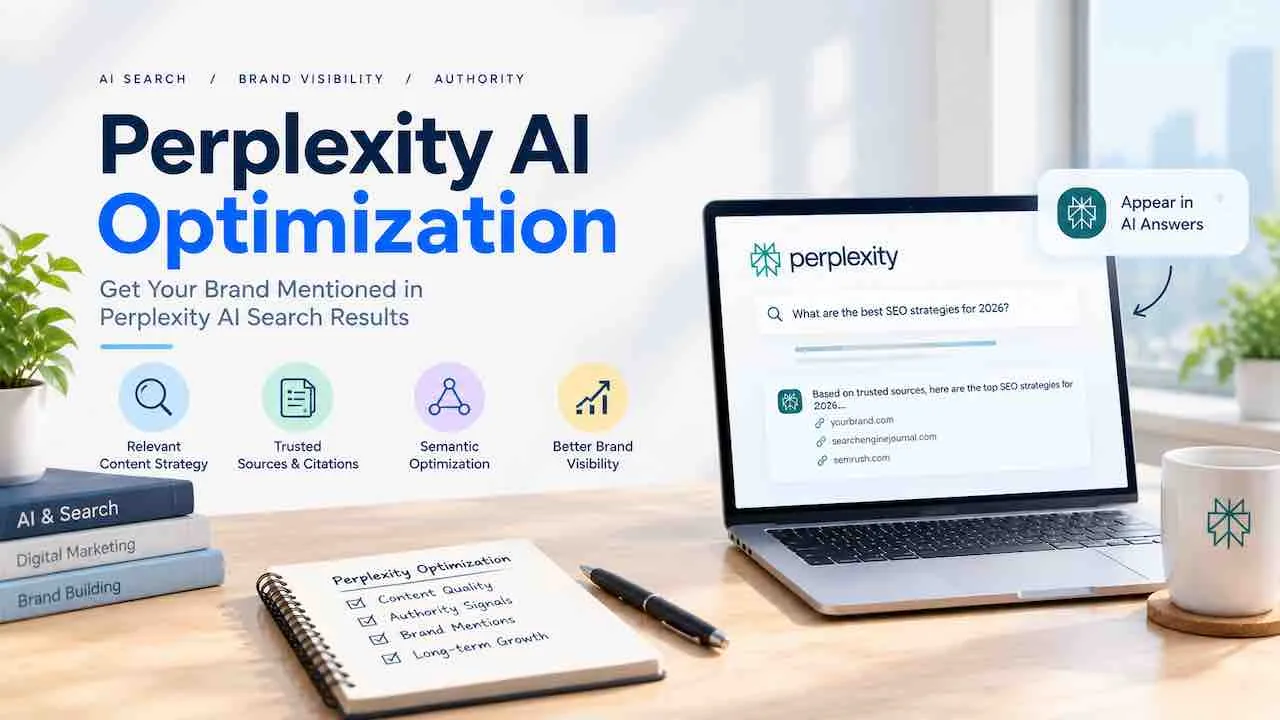
Perplexity AI optimization gets your content cited as a source in Perplexity AI answers. Perplexity SEO combines crawler access, answer-first structure, schema markup, and entity authority. Together these signals make your page citation-worthy. Perplexity processes over 780 million queries per month. That is the “Perplexity 780 million” benchmark marketers now target. It cites an average of 5.28 sources per answer. Each Perplexity AI referral traffic click converts up to 2x higher than standard organic traffic. QuickDigital has built generative engine optimization strategies since AI answer engines went mainstream.
How Perplexity AI Works: The RAG System Explained
Perplexity AI is a real-time answer engine, not a static search engine. Understanding Perplexity RAG is the foundation of every optimization decision. Perplexity RAG stands for Retrieval-Augmented Generation. The Perplexity RAG system fetches live web content for every query. It does not rely on training data like ChatGPT does. Perplexity is an answer engine, not a static search engine. That Perplexity answer engine distinction changes everything about how you optimize. Each query pulls 10 to 30 candidate pages from the web. A Perplexity reranker then scores and selects 5 to 10 of those pages as citations.
The Perplexity reranker weighs these signals:
- Entity relevance and topical match to the query
- Source authority from domain trust and citation history
- Perplexity freshness signals from dateModified and visible update timestamps
- Crawl accessibility for Perplexity bot specifically
- Answer-first structure placing the direct answer within the first 100 words
About 60% of Perplexity AI ranking overlaps with top Google organic results. Strong traditional SEO gives you a head start. Perplexity AI ranking then adds its own freshness and structure layer on top.
Perplexity Search Engine Query Modes
Perplexity search engine offers four query modes. Each mode cites sources differently.
| Mode | What It Prioritizes | Optimization Focus |
|---|---|---|
| Auto | Balanced recency and authority | Freshness plus domain trust |
| Pro Search | Deep research with multiple sources | Factual density and source credibility |
| Focus: Academic | Scholarly content and data | Citations, statistics, and methodology |
| Focus: Web | General web results | Crawlability and answer-first structure |
Perplexity AI Citation Ranking Factors
Perplexity AI ranking depends on six signals working together. A gap in any one signal reduces citation rate significantly. Perplexity AI visibility requires all six in place. Pages ranking in featured snippet positions on Google often get Perplexity citations too. People also ask boxes signal high-intent query patterns that Perplexity targets. Zero click search optimization matters here too. Content serving zero click needs also serves Perplexity answer extraction. See our zero click search optimization guide for the overlap strategy.
Perplexity Citation Frequency: 35% Weight
Perplexity citation frequency is the strongest single ranking factor at 35%. Pages cited repeatedly across different queries build a citation history. The reranker treats that history as a trust signal. Perplexity topic cluster strategy exploits this directly. A cluster of 8 to 12 interlinked guides generates more citation events than one long page. Each guide gets cited for its own specific queries. The cluster as a whole builds Perplexity domain authority faster.
Visual Citation Placement: 20% Weight
Visual citation placement measures how early your answer appears on the page. Perplexity direct answer extraction favors the first 100 words. A page burying its conclusion after 1,500 words loses citations. Pages that lead with answers win those citations instead. Each H2 section should also open with a one-sentence Perplexity direct answer. Perplexity often extracts answers section by section, not page by page.
Perplexity Domain Authority: 15% Weight
Perplexity domain authority combines backlink quality, brand mentions, and review platform presence. It also weighs historical Perplexity citation frequency for the domain. A high-authority domain gets new pages cited faster. Perplexity G2 and Capterra reviews create third-party entity signals that strengthen domain authority in Perplexity’s scoring model.
Perplexity Schema Markup: 10% Weight
Perplexity schema markup improves citation inclusion rate by 36%. Perplexity schema reads content type, authorship, publication date, and entity relationships. The most effective Perplexity schema types are Article, FAQPage, HowTo, Organization schema, and BreadcrumbList. Apply each only where it matches visible page content. See the complete schema markup implementation guide for AEO.
8 Perplexity AI Optimization Strategies That Win Citations
These 8 Perplexity AI content optimization strategies are sequenced by dependency. Fix technical access first. Then improve structure. Then add schema. Then build off-site authority.
1. Allow Perplexity Bot in robots.txt
Perplexity bot uses two crawlers. PerplexityBot handles standard indexing. Perplexity-User handles user-triggered page fetches. Both must be explicitly allowed. Many sites block Perplexity bot through WAF rules or CDN bot filters. These blocks happen silently. They leave no error in Google Search Console. Check your robots.txt file first. Then audit your Perplexity WAF and CDN bot management rules. Add Perplexity IP ranges to your allowlist. Slow page load speed also causes Perplexity bot to drop pages. Our page load speed guide covers the technical fixes that keep bots from timing out. A high bounce rate on your pages signals low content quality to Perplexity’s scoring model. See how bounce rate in Google Analytics connects to content quality signals.
Your robots.txt file must contain these Perplexity robots entries. A robots txt file missing both user agents is the single most common reason a site never gets cited:
- User-agent: PerplexityBot / Allow: /
- User-agent: Perplexity-User / Allow: /
Also check Perplexity JavaScript rendering. Content loaded via JavaScript after page render is invisible to Perplexity bot. Keep critical answers in Perplexity plain HTML. Unblocking Perplexity bot produced 12 new citations within 30 days in one documented case.
2. Structure Content with BLUF Formatting for Perplexity Direct Answers
BLUF formatting places the direct answer before all supporting context. BLUF stands for Bottom Line Up Front. Each page should answer its primary question within the first 100 words. Keep the opening answer to 2 to 3 sentences. Supporting evidence and detail follow after. This is the core of Perplexity AI content optimization.
Apply BLUF formatting to every H2 section as well. Open each section with one sentence that directly answers the heading. Perplexity extracts section answers independently. A well-structured section gets cited even when the full page doesn’t rank.
3. Implement Perplexity Schema Markup on All Key Pages
Perplexity schema works only when it matches visible content exactly. Apply FAQPage schema to visible FAQ sections only. Apply HowTo schema to sequential step-by-step content only. Apply Article schema to every long-form guide.
The most impactful Article schema properties for Perplexity AI ranking are:
- dateModified: signals Perplexity freshness to the reranker
- author.sameAs: links to author’s LinkedIn for EEAT entity verification
- citation: references external sources the article draws from
- publisher.logo: establishes brand entity recognition in Perplexity’s index
EEAT signals in schema (expertise, experience, authoritativeness, trustworthiness) also improve Perplexity AI ranking. Validate schema with Google’s Rich Results Test before publishing.
4. Run a Perplexity Content Refresh Every 30 to 90 Days
Perplexity content refresh is the fastest-impact strategy after technical access is fixed. Content freshness Perplexity weights heavily. Pages older than 30 days lose up to 40% of citation rate. Pages older than 90 days lose up to 65% of citation inclusion.
A Perplexity content refresh does not mean a full rewrite. Effective Perplexity refresh steps include:
- Updating statistics and data points to current figures
- Adding a visible “Perplexity last updated” timestamp and updating dateModified in schema
- Replacing outdated tool recommendations
- Adding new sections covering questions from recent PAA boxes
- Improving BLUF openers in sections that have lost Perplexity citation share
Priority pages should run a Perplexity refresh every 7 to 14 days. Secondary pages can follow a 30 to 45 day cycle. Content freshness Perplexity tier system downgrades pages that miss the rolling update window.
5. Build Perplexity Topic Clusters Around Core Entities
Perplexity entity optimization starts with topic cluster architecture. A Perplexity topic cluster of 8 to 12 interlinked pages outperforms a single comprehensive guide. Each page in the cluster gets cited for its own queries. The cluster collectively builds Perplexity domain authority for the topic entity.
A strong Perplexity topic cluster structure includes:
- 1 pillar page covering the broad topic with BLUF structure
- 4 to 6 supporting guides each covering one specific subtopic
- 2 to 3 Perplexity comparison table pages for research-intent queries
- 1 FAQ or glossary page targeting conversational queries and question-based queries
Use named-entity anchor text on all Perplexity internal links between cluster pages. See our semantic SEO and entity optimization guide for generative engines.
6. Optimize Content for Conversational Queries and Question-Based Queries
Perplexity users submit full natural language questions. Conversational queries like “how do I reduce SaaS churn” behave differently from keyword fragments. Use complete question forms as H2 and H3 headings. Include conversational queries and question-based queries as heading text and section openers. This matches what Perplexity users type and increases citation probability. See our framework for conversational keywords and question-based queries.
7. Build Off-Site Perplexity Brand Mention Authority
Perplexity brand mention signals account for roughly 25% of citation weighting. These signals come from outside your website. Perplexity Reddit citations are among the most powerful off-site signals. Subreddit discussions mentioning your brand or linking to your content create strong entity confirmation.
High-value platforms for Perplexity brand mentions:
- Perplexity Reddit: subreddit threads on your topic mentioning your brand
- Perplexity G2 and Capterra: product review pages establishing credibility
- Perplexity digital PR: placements in publications Perplexity already trusts
- Podcast transcripts: entity mentions across multiple domains simultaneously
Unlinked Perplexity brand mentions contribute to entity recognition without a direct backlink. Perplexity reads co-citation patterns. Your brand appearing near trusted entities improves your own authority score. See how unlinked brand mentions work as ranking signals.
8. Increase Perplexity Factual Density with Data and Named Sources
Perplexity factual density scoring ranks content with specific numbers higher than content with general claims. Every factual statement should carry a named source. Replace “studies show” with “a 2024 Gartner report found.” Include specific statistics, named tools, named organizations, and dated examples. Perplexity data extraction favors pages dense with verifiable facts.
Perplexity original research compounds this effect. A page citing your own survey creates a primary source. Other publications cite that source. Each citation adds Perplexity domain authority for your brand. Learn the original research strategy for citations and link building.
Perplexity AI vs Google SEO vs ChatGPT: Key Differences
Perplexity AI search optimization requires a different approach from Google SEO and ChatGPT optimization. Knowing where they diverge prevents wasted effort.
| Factor | Google SEO | Perplexity AI | ChatGPT |
|---|---|---|---|
| Data source | Indexed pages (historical) | Live web crawl per query | Training data (knowledge cutoff) |
| Freshness weight | Moderate | Very high | None (static) |
| Citation display | Blue links in SERP | Numbered citations in answer | Rarely cited |
| Schema impact | Rich snippets | Perplexity citation inclusion | No direct effect |
| Ranking signal | Backlinks, authority, content | Freshness, structure, crawlability | Training corpus presence |
| Traffic quality | Standard click-based organic | Perplexity AI referral traffic (2x conversion) | Minimal referral |
Perplexity ChatGPT differences matter for multi-platform strategies. ChatGPT optimization focuses on LLM SEO and LLM training data. LLM SEO requires structured knowledge sources and training corpus presence. Perplexity AI search optimization focuses on live crawlability and real-time freshness. Both matter. Run them as parallel tracks. See our full answer engine optimization guide for both.
Perplexity AI Visibility Tracking and Measurement
Perplexity AI visibility cannot be tracked with standard rank tracking tools. Perplexity does not publish a Search Console equivalent. Tracking requires GA4 referral data plus dedicated AI visibility tools.
GA4 Perplexity Referral Traffic Tracking
GA4 Perplexity tracking starts in your referral traffic report. Filter for the source domain perplexity.ai. This shows which pages receive Perplexity AI referral traffic clicks. Compare against Google Search Console impressions. Pages that rank traditionally but generate no Perplexity AI referral traffic have a structure or freshness gap. That gap is your optimization priority.
Perplexity AI Visibility Tools
- Otterly.ai: tracks Perplexity brand mention and citation events across AI engines
- Keyword.com: includes Perplexity AI visibility alongside traditional rank tracking. Keyword com supports AI search monitoring natively.
- xSeek: monitors 15+ AI bots and tracks Perplexity citation frequency patterns
- Semrush AI Toolkit: Perplexity brand mention monitoring across AI-generated content
Perplexity AI Marketing Metrics to Track Weekly
- Perplexity citation frequency: how often your URL appears as a source
- Perplexity brand mention rate: your brand named in answers without a URL
- Query coverage: how many target queries return your content as a citation
- Competitor citation overlap: which competitors appear for your target queries
- Perplexity AI referral traffic conversion rate: leads or revenue from perplexity.ai in GA4
Use our citation measurement framework for AI search to build a repeatable weekly tracking system.
8 Mistakes That Kill Perplexity AI Ranking
Most sites losing Perplexity citations make these 8 mistakes. Fix each before running any Perplexity AI optimization campaign.
- Blocking Perplexity bot: WAF and CDN bot filters block crawling silently with no Search Console warning
- Missing Perplexity direct answer: introductions spending 300 words on context before answering get skipped by the extraction layer
- Stale Perplexity dateModified: schema dateModified from 6 months ago signals low freshness even when the content is accurate
- Invalid Perplexity schema: FAQPage schema applied to non-visible FAQ content triggers a schema quality penalty
- No entity consistency: using different brand names across pages prevents Perplexity entity recognition
- Perplexity JavaScript rendering issues: body copy loaded via JavaScript after render is invisible to Perplexity bot
- Low Perplexity factual density: general advice with no statistics or named sources scores low on Perplexity’s factual scoring
- No off-site Perplexity brand mentions: a brand with zero Reddit presence and no Perplexity digital PR has weak entity authority regardless of on-page quality
30-60-90 Day Perplexity AI Optimization Plan
This Perplexity AI 2026 action plan sequences tasks by dependency. Technical access before content. Content before schema. Schema before off-site authority.
Days 1 to 30: Technical Fixes and Priority Page Rewrites
- Audit robots.txt for Perplexity bot allowances
- Add Perplexity IP allowlist entries in your WAF and CDN
- Verify Perplexity plain HTML rendering on 5 priority pages
- Rewrite opening paragraphs to answer the primary query within 100 words
- Add Perplexity dateModified to Article schema on all priority pages
- Set up GA4 Perplexity filter on perplexity.ai referral source
Days 30 to 60 Day Plan: Perplexity Schema Rollout and Topic Cluster Build
- Implement Perplexity FAQ schema on all visible FAQ sections
- Implement HowTo schema on all genuine step-by-step guides
- Audit entity gaps in your Perplexity topic cluster
- Strengthen Perplexity internal links with named-entity anchor text
- Begin Perplexity content refresh cycle for pages not updated in 30+ days
Days 60 to 90: Off-Site Authority and Perplexity AI Marketing
- Launch Perplexity digital PR targeting publications Perplexity already cites
- Build Perplexity Reddit presence in subreddits covering your core topics
- Request Perplexity G2 and Capterra reviews to create third-party entity signals
- Set a weekly Perplexity query test cadence using Perplexity directly
- Configure your Perplexity AI visibility tracking tool for monthly reporting
Perplexity AI Optimization for Content Types
Perplexity blog optimization, Perplexity service page optimization, and Perplexity landing page optimization each require different tactical adjustments.
Perplexity Blog Optimization
Perplexity blog posts benefit most from answer-first structure and Perplexity content refresh cadence. Each H2 section should open with a Perplexity direct answer sentence. Refresh priority blog posts every 14 days. Add new question sections from recent PAA boxes. Our content marketing framework covers production systems for freshness at scale.
Perplexity Service Page Optimization
Perplexity service pages get cited most for Perplexity comparison table queries. Structure service pages with a Perplexity direct answer paragraph at the top. Add a features table and Perplexity FAQ section with schema. Entity consistency across your service page, Google Business Profile, and third-party listings is the largest lever for Perplexity service page citations. Perplexity multi-source entity matching rewards brands with uniform details everywhere. See our landing page optimization guide for the conversion-citation balance.
Perplexity Local SEO Optimization
Perplexity local ranking combines web content, business profile data, and review signals. Perplexity local optimization requires these four actions:
- Keep Google Business Profile current as a Perplexity entity signal
- Build review volume on Yelp, Trustpilot, and Google for third-party entity confirmation
- Publish locally focused content naming the city and local entities related to the business
- Use Organization and LocalBusiness schema with complete address and sameAs properties
See our guide on local AEO and near-me voice search optimization for the full framework.
Perplexity AI and Google AI Overviews: Combined Strategy
Perplexity Google AI overlap is significant. Both systems weight entity authority, schema markup, content freshness, and answer-first structure. A page optimized for Perplexity citations is well-positioned for Perplexity Google AI Overview inclusion simultaneously.
The key difference: Perplexity Google AI Overviews weight EEAT signals more. EEAT (expertise, experience, authoritativeness, trustworthiness) signals in authorship and citations matter more for Google. Perplexity weights live freshness more. Run both optimizations as parallel tracks. Apply Google AI Overviews optimization alongside your Perplexity strategy. For Perplexity ChatGPT multi-platform visibility, use the GEO services framework. It covers LLM SEO on top of both the Perplexity and Google AI stacks.
Read our dedicated guide to how to rank in ChatGPT. It covers the LLM-specific citation strategy step by step.
FAQs: Perplexity AI Optimization
To rank in Perplexity AI, allow Perplexity bot in your robots.txt, place direct answers within the first 100 words, add Article and FAQPage schema with a current dateModified, and refresh pages every 30 to 90 days. Perplexity brand mentions on Reddit and review platforms further strengthen your Perplexity domain authority and citation frequency.
About 60% of Perplexity AI ranking overlaps with top Google organic results, but Perplexity SEO weights content freshness, crawlability, and BLUF structure more heavily. A page ranking on Google may miss Perplexity citations if it hasn’t run a Perplexity content refresh in 90 days or if Perplexity bot is blocked.
Fixing Perplexity bot access generates new citations within 30 days. BLUF content structure improvements show Perplexity AI visibility impact within 2 to 4 weeks. Perplexity digital PR and off-site authority campaigns take 60 to 90 days to influence Perplexity citation frequency measurably.
Perplexity schema types with the highest citation impact are Article with dateModified, FAQPage for visible Q&A sections, and HowTo for sequential step guides. Perplexity schema implementation increases AI summary inclusion by 36%. Each schema type must describe content that actually appears on the visible page.
Yes. Perplexity Reddit citations appear regularly for conversational and community-based queries. Building brand presence and expert contributions in relevant subreddits creates off-site Perplexity brand mentions. These signals support Perplexity domain authority even without a direct inbound link to your site.