


Integration partnership link building for SaaS works by listing your product on partner marketplaces. Zapier (DR 91) and HubSpot App Marketplace (DR 93) give you automatic dofollow backlinks. Your prospects already use these platforms to evaluate tools. Every integration you build is a free backlink from a domain. Most outreach campaigns cannot reach this authority level. Salesforce AppExchange, Slack App Directory, and Monday.com Marketplace are all DR 80 or above. All are topically aligned with your SaaS category by definition. All accept submissions through a public partner portal, not a sales conversation. This guide covers every major marketplace and how to get listed on each. It also covers how to optimize your integration page for maximum link equity and AI citation authority.
Why Integration Links Are the Highest ROI Backlinks in B2B SaaS
Integration partner directory links are the highest ROI backlinks available to B2B SaaS companies. They combine domain authority in the DR 80 to 93 range with topical relevance. No general publishing platform can match either quality. The cost is an integration your sales team already wants.
Every integration your product supports is a link opportunity. It lives on a platform your buyers already visit. Buyers check integration compatibility before purchasing. Your listing in Zapier or HubSpot’s App Marketplace is both a backlink and a sales touchpoint. No other link building tactic serves both SEO and pipeline simultaneously. Brand mentions on integration partner platforms correlate at 0.664 with AI visibility. Traditional backlinks correlate at just 0.218 (Otterly.ai research across 150 SaaS brands). Integration partner links strengthen your brand entity across both Google’s Knowledge Graph and AI training datasets.
The barrier to entry is lower than most SaaS marketing teams assume. Most major marketplaces accept submissions through the public developer portal, not through sales. Build a basic OAuth integration and submit through the developer console. Your listing goes live in 1 to 2 weeks. Your product may connect to three tools already. Without marketplace listings for each, you are leaving 3 to 5 free DR 90 plus links uncaptured. Link building for AI tools and SaaS startups pairs well with integration listings for compounding impact.
The Complete Marketplace Directory: Domain Rating and Submission Process
These 12 SaaS integration marketplaces are ranked by Domain Rating. The submission route and link type are included for each.
| Marketplace | Domain Rating | Link Type | Submission Route | Best For |
|---|---|---|---|---|
| HubSpot App Marketplace | DR 93 | Dofollow | HubSpot Developer Portal | CRM, marketing, sales, and customer success SaaS |
| Zapier | DR 91 | Dofollow | Zapier Developer Platform | Any SaaS with workflow automation use cases |
| Salesforce AppExchange | DR 88 | Dofollow | Salesforce Partner Community | Enterprise SaaS in sales, service, or marketing |
| Slack App Directory | DR 87 | Dofollow | Slack API Developer Dashboard | Productivity, communication, and workflow SaaS |
| Google Workspace Marketplace | DR 98 | Dofollow | Google Cloud Console | Productivity, document, and collaboration SaaS |
| Microsoft AppSource | DR 94 | Dofollow | Microsoft Partner Center | Enterprise SaaS integrating with Microsoft 365 or Azure |
| Monday.com Marketplace | DR 85 | Dofollow | Monday Developer Program | Project management and operations SaaS |
| Shopify App Store | DR 93 | Dofollow | Shopify Partners Dashboard | E-commerce and retail SaaS tools |
| Make (formerly Integromat) | DR 82 | Dofollow | Make Developer Submissions | Any SaaS with automation use cases |
| ClickUp App Center | DR 80 | Dofollow | ClickUp Developer Portal | Productivity and project management SaaS |
| Pipedrive Marketplace | DR 79 | Dofollow | Pipedrive Developer Hub | CRM and sales automation SaaS |
| Notion Integrations | DR 88 | Dofollow | Notion API Partners | Productivity, notes, and knowledge management SaaS |
Google Workspace Marketplace (DR 98) and Microsoft AppSource (DR 94) are the top two integration directories available. Most SaaS teams target Zapier and HubSpot first because the integration is technically simpler. Pursuing both requires deeper integration work. Both return the highest authority backlinks available to any SaaS company.
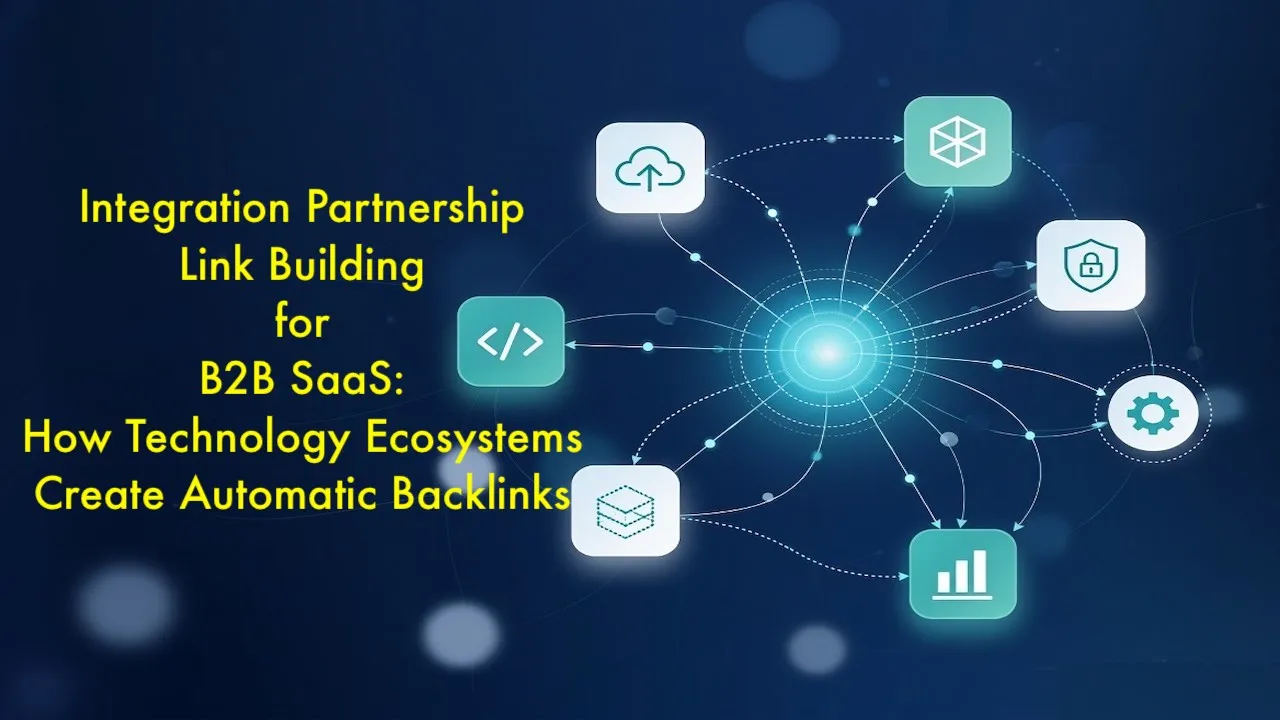
How Technology Ecosystem Link Building Actually Works
When your SaaS product gets listed on a partner marketplace, the marketplace creates a dedicated listing page. It links to your website from that page. This link is automatic, permanent, and dofollow. It comes from a domain your prospects visit to evaluate tools in your category.
The mechanism has three compounding layers. First, the marketplace listing page itself links to your site from a DR 80 plus domain. Second, Zapier, HubSpot, and Salesforce each maintain a dedicated page on your partner’s site. That page also links to you. Third, your own site gains a new strong referring domain every time you list a new integration. A SaaS product listed on all partner marketplaces can earn 40 to 60 high authority referring domains. This happens before publishing any link targeted content.
The topical relevance of each integration link is perfect by definition. A CRM SaaS listed on Salesforce AppExchange earns a link from within the Salesforce ecosystem. Every integration directory is explicitly in the B2B software category. No outreach tactic generates topically aligned links at this volume and authority level. The closest equivalent is building a link from every relevant site in your competitive niche simultaneously. The outreach cost is zero.
Your Own Integrations Page: The Link Magnet Most SaaS Companies Build Wrong
Every partner marketplace listing points to a page on your website. That destination page determines how much topical authority and link equity you capture from each integration listing. Most SaaS teams send all integration links to the homepage or a generic integrations overview page. This wastes the majority of the link value.
Build a dedicated integration page for every tool your product integrates with. The page for your Salesforce integration should exist at yoursite.com/integrations/salesforce. It should cover what the integration does, which workflows it enables, and which user problems it solves. A page structured this way captures topical authority signals from the Salesforce AppExchange link. It ranks for queries like yourproduct plus Salesforce integration. These queries attract buyers already evaluating tools.
Each individual integration page also becomes a link magnet. Users who write Salesforce integration tutorials and B2B journalists all link to well structured integration pages. They link far more readily than to a generic integrations overview. Build one dedicated page per integration and optimize it for the comparison stage query. Point your marketplace listing directly at that page. See how E-E-A-T authority signals compound when integration pages demonstrate genuine product depth.
Co branded Content with Integration Partners: The Link Multiplier
Co branded content with integration partners multiplies the link building value of each integration. It earns additional editorial backlinks from the partner’s blog and joint case study pages. Press coverage for both brands adds more.
- Joint blog posts: Write a how to guide with your integration partner showing how users combine both tools. The partner publishes it on their blog with a link to your site. You publish your version with a link to theirs. Two dofollow editorial links from a single content collaboration, each from a domain in the DR 80 plus range.
- Integration announcement posts: Every new integration deserves a dedicated announcement post on both company blogs. A “We now integrate with Zapier” post on your blog earns links from Zapier’s newsletter, partner directory pages, and users sharing the announcement. A parallel post on Zapier’s blog links back to your integration page.
- Co branded case studies: Document a real customer using both tools together. Both companies publish the case study and link to each other. These pages earn ongoing links from industry publications covering customer success stories.
- Joint webinars and events: A webinar co hosted with a DR 90 partner earns a landing page link from their site, links in their email promotions, and links from any coverage of the event in industry newsletters and blogs.
Partnership Announcement Link Building
Partnership announcements generate a second layer of integration links beyond the marketplace listing itself. Press coverage, partner blog posts, and industry newsletter mentions each add a new referring domain.
The standard partnership announcement generates three link types. First, the partner company typically publishes a blog post announcing the new integration. This post links to your product page from their domain. Second, most large integration platforms like HubSpot and Salesforce send email newsletters announcing new listings. Newsletter issues get archived as indexed web pages. Each carries a link to your listing. Third, B2B technology journalists actively cover new integration announcements for major platforms. A Zapier integration announcement placed with one industry publication can earn a DR 70 plus editorial link.
Use a structured press release format for every major integration launch. Include specific details about which workflows the integration enables. Name the customer problems it solves. Quote a named executive from each company. This format makes the announcement pickable as a standalone news story, not buried in a changelog.
The Minimum Integration Required for Marketplace Listing
Most SaaS companies overestimate the technical requirement for marketplace listings. They delay or skip integration link building as a result. The minimum viable integration for most major marketplaces is a basic OAuth connection. Add 3 to 5 trigger and action combinations and you meet most listing requirements.
| Marketplace | Minimum Integration Requirement | Development Time Estimate | Link Goes Live |
|---|---|---|---|
| Zapier | REST API plus 2 to 3 triggers and actions using Zapier CLI | 2 to 5 developer days | 1 to 2 weeks after submission |
| HubSpot App Marketplace | OAuth 2.0 authentication plus a functional app card or workflow action | 3 to 7 developer days | 2 to 4 weeks after review |
| Slack App Directory | Slack OAuth plus at least one slash command or event subscription | 2 to 4 developer days | 1 to 3 weeks after review |
| Google Workspace | Google OAuth plus verified domain and functional add on | 5 to 10 developer days plus domain verification | 2 to 6 weeks after verification |
| Make (formerly Integromat) | REST API plus module definitions in Make SDK | 3 to 6 developer days | 1 to 3 weeks after review |
| Salesforce AppExchange | Salesforce Connected App with OAuth plus security review | 5 to 15 developer days plus security review | 4 to 8 weeks due to security review |
Zapier is the fastest entry point. A developer with REST API experience can build a functional Zapier integration in 2 to 5 days. The Zapier Developer Platform documentation is clear. The review process is fast. The DR 91 link goes live within two weeks. Start with Zapier, Make, and Slack. These three marketplaces combined give you links from DR 82 to 91 domains. They have the fastest time to link in the integration ecosystem.
How Integration Partner Links Drive AI Search Citations
Integration partner listings on Zapier, HubSpot, and Salesforce now appear directly in AI generated answers. Users asking ChatGPT, Perplexity, and Gemini about tool comparisons see these listings as citation sources.
AI engines use marketplace listing data as structured entity signals. When your product is listed on Zapier’s integration directory, its entity data enters AI training datasets. Perplexity actively surfaces marketplace listing pages as citation sources for software evaluation queries. A user asking Perplexity about CRM tools that integrate with Zapier sees the Zapier integrations page as a source. Your listing on that page places you inside that citation surface.
The Otterly.ai research confirms this: brand mentions on integration partner platforms correlate at 0.664 with AI visibility. Building 10 integration listings creates 10 brand entity signals across 10 authoritative platforms simultaneously. No single link building tactic replicates this entity signal density at this speed. See how backlinks for AI search citations apply to the SaaS integration ecosystem.
Measuring Integration Partnership Link Building Results
Measure integration partnership link building through four metrics. Track four metrics. These are: new referring domains from Ahrefs, organic traffic to integration pages in GA4, trial signups from partner referral, and AI brand recall.
- New referring domains from marketplace sites: In Ahrefs, filter your referring domains report by source domain containing “zapier,” “hubspot,” “salesforce,” “slack,” or “google.” Track how many new marketplace domains link to your site each quarter. Each new marketplace listing should produce at least one new referring domain.
- Organic traffic to individual integration pages: Each integration page should earn organic traffic from comparison stage queries. Track organic sessions to yoursite.com/integrations/toolname pages in GA4. Pages earning fewer than 50 organic visits per month need better on page optimization or more partner links pointed at them.
- Trial signups from integration partner referral: Marketplace listings produce referral traffic from users already evaluating tools in your category. These visitors convert to trials at a higher rate than general organic visitors. Tag integration referral traffic with UTM parameters and track trial conversion rate separately in GA4.
- AI brand recall testing: Search “best [your category] tools that integrate with [Zapier/HubSpot/Salesforce]” in Perplexity, ChatGPT, and Gemini monthly. Track how often your product appears. Rising AI brand recall for integration queries confirms your marketplace listing and entity signal strategy is working.
Common Integration Link Building Mistakes
These mistakes prevent integration partnership link building from producing the backlink and revenue results it should deliver.
- Pointing all marketplace listings to the homepage: Every marketplace listing should point to a dedicated integration specific page on your site, not the homepage. A homepage link wastes the topical co occurrence signal that makes integration links so powerful.
- Skipping smaller platforms because of lower DR: Make at DR 82, Pipedrive Marketplace at DR 79, and ClickUp App Center at DR 80 are worth pursuing. Each adds a unique referring domain with strong topical relevance to your SaaS niche. Referring domain diversity matters. Do not stop at three or four platforms.
- Building integrations without co branded content: A marketplace listing gives you one link. A marketplace listing plus a co branded blog post plus a joint case study gives you three to five links from the same partnership. The co branded content layer is where most of the link multiplication happens.
- Delaying listing submission due to incomplete integration features: Most marketplaces do not require a fully featured integration. A basic trigger and action set is sufficient for Zapier listing. Submit the minimum viable integration and iterate after the link goes live.
- Missing the Salesforce AppExchange security review timeline: Salesforce requires a formal security review that takes 4 to 8 weeks beyond your development time. Plan 2 to 3 months from kickoff to live listing for Salesforce. Missing this timeline means missing the DR 88 link for an entire product quarter.
See how brand mentions vs backlinks and integration listing signals interact to determine which link types drive AI visibility.
Frequently Asked Questions: Integration Partnership Link Building SaaS
Yes. Zapier (DR 91), HubSpot (DR 93), Salesforce AppExchange (DR 88), and Slack (DR 87) all provide dofollow backlinks. These are editorial dofollow links, not paid placements. Marketplaces treat partner listings as editorial recommendations, not advertisements.
A SaaS product listed on 12 major marketplaces with co branded content can build 24 to 40 referring domains. Each marketplace listing gives one referring domain. Each co branded blog post or case study gives one to two more. All these domains fall in the DR 79 to 98 range.
The minimum Zapier listing requirement is a REST API plus 2 to 3 trigger and action combinations. The Zapier CLI platform handles the build. A developer with REST API experience can build this in 2 to 5 days. Submit the minimum viable integration and iterate after the DR 91 link goes live.
Yes. Integration partner listings on Zapier, HubSpot, and Salesforce appear as citation sources in Perplexity, ChatGPT, and Gemini. Brand mentions on integration partner platforms correlate at 0.664 with AI visibility. Traditional backlinks correlate at just 0.218.
Most SaaS companies see initial ranking improvements within 60 to 90 days. This requires 10 to 15 integration listing links and dedicated integration pages. Full organic traffic impact typically grows over 6 to 12 months. AI brand recall for integration related queries typically improves within 30 to 60 days after marketplace listing.
Build Your Integration Partnership Link Building Strategy with Quick Digital
Quick Digital • Digital Marketing Since 2014
Turn Every Integration Your SaaS Supports Into a DR 80+ Backlink
Quick Digital audits your existing integrations, identifies every marketplace listing opportunity, builds your dedicated integration pages, and manages co branded content outreach with every partner. DR 80 to 98 backlinks from Zapier, HubSpot, Salesforce, Google Workspace, and Microsoft AppSource without a single cold email.
Build SaaS Integration Backlinks →
Request a Free Quote
Integration Audit • Marketplace Submissions • Integration Pages • Co branded Content • AI Citation Building