

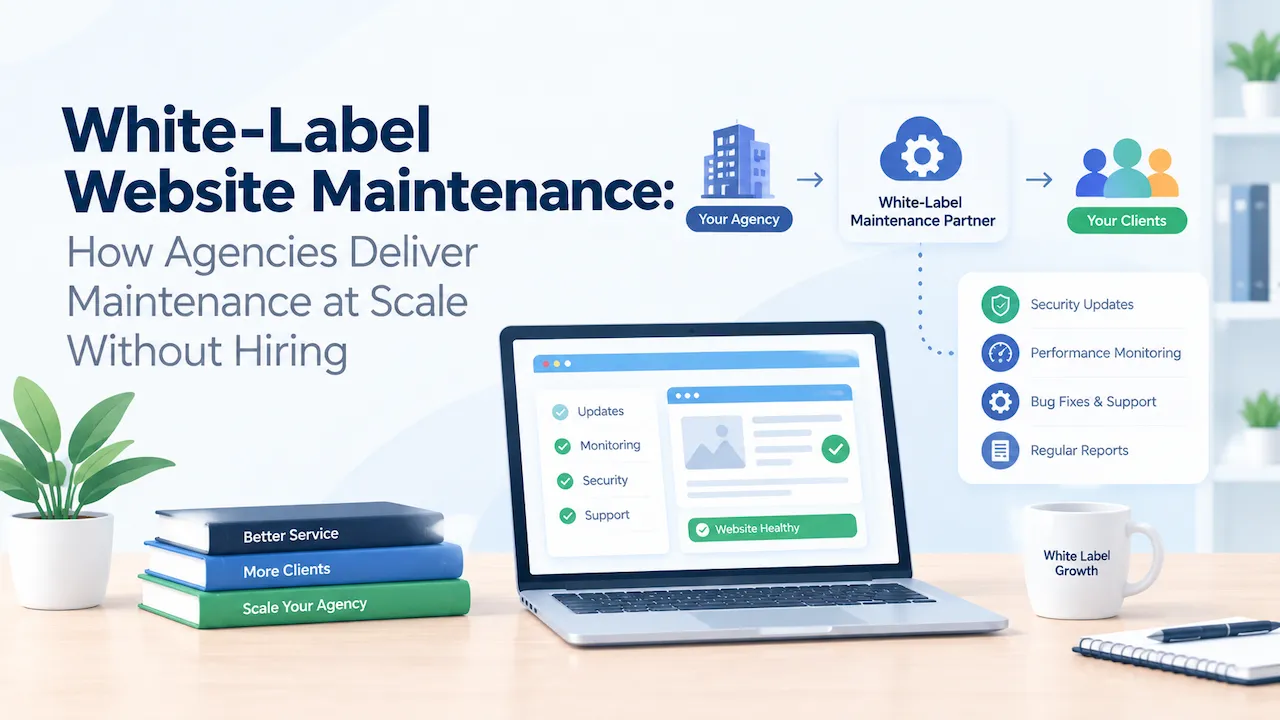
White-label website maintenance lets an agency sell branded WordPress care plans to clients. A specialist partner handles all the technical work under the agency’s name. The agency bills the client, controls the relationship, and keeps the margin. The partner never contacts the client. This model converts maintenance outsourcing into a recurring revenue line without adding a single technical hire.
Agencies managing 10 or more client sites know the problem. Updates, malware removal, backup restoration, and security hardening consume developer hours before any billable project work starts. Agencies that offer white-label website maintenance services earn the markup between wholesale and retail pricing. The partner absorbs the technical workload entirely. The agency also retains the client relationship long after the original project closes.
What White-Label Website Maintenance Actually Is
White-label website maintenance is a maintenance outsourcing model. A specialist partner delivers technical work under the agency’s brand. It is not managed WordPress hosting. It is not a reseller program that passes through a hosting cost.
Agencies searching for white label WordPress maintenance are looking for this same model. The CMS is almost always WordPress, so the tasks are WordPress-specific.
White-Label Maintenance vs. WordPress Care Plans
WordPress care plans are what agencies sell to clients. White-label maintenance is how agencies fulfil those care plans without doing the work in-house. The agency designs the care plan, sets the price, and owns the client relationship. The white-label partner handles plugin compatibility checks, security hardening, database optimization, and malware removal as the sub-contractor. They also manage backup restoration, uptime monitoring, and white label reporting.
White-Label Maintenance vs. Managed WordPress Hosting
Managed WordPress hosting covers server-level performance and security. White-label maintenance covers plugin updates, conflict resolution, Core Web Vitals, malware scans, and database cleanup. These are not the same. A hosting provider will not fix a broken WooCommerce checkout caused by a plugin conflict. A white-label maintenance partner will. Agencies should treat hosting and maintenance as separate line items in every client proposal.
How the White-Label Website Maintenance Model Works
The agency buys at wholesale and resells at retail. The partner delivers everything under the agency’s brand. The client sees the agency’s name on every report, email, and support ticket. The partner signs an NDA and acts as an invisible sub-contractor.
The standard white-label website maintenance workflow runs across 5 stages:
- Agency onboarding: Agency signs a partner agreement, establishes NDA terms, and defines branded report templates and email domains
- Client site handoff: Agency provides site credentials through a secure credential vault, not email
- Monthly maintenance cycle: Partner runs updates on a staging environment, applies to production after QA, completes security scan, backup, and performance check
- White-label reporting: Partner generates a branded monthly report under the agency’s logo and sends from the agency’s domain or delivers to the agency for distribution
- Ticket and support handling: Client support requests route to the agency’s white-label support portal; partner resolves under the agency’s brand
The workflow repeats monthly. At scale, the agency manages the billing and client relationships. The partner manages the technical execution. Revenue stacking happens when each new client site added increases margin with no proportional cost increase.
Who Uses White-Label Website Maintenance
4 agency types use white-label website maintenance most: full-service agencies, freelancers scaling up, design studios without developers, and SEO agencies reducing client churn.
| Agency Type | Core Problem Solved | Typical Portfolio Size |
|---|---|---|
| Small full-service agency (2 to 10 staff) | Developer time lost to updates and tickets | 15 to 80 client sites |
| Freelance developer growing to agency | No capacity for nights and weekends support | 5 to 30 client sites |
| Design or marketing studio | No technical staff for post-launch maintenance | 10 to 50 client sites |
| SEO or PPC agency | High client churn after project completion | 10 to 100 client sites |
Agencies with fewer than 5 sites manage updates with a tool like ManageWP or MainWP at low cost. White-label outsourcing typically breaks even at 8 to 12 sites. Above that, the client lifetime value of a maintenance retainer far exceeds the margin lost by outsourcing.
The Margin Math: Care Plan Pricing and Markup Strategy
Most agencies apply a markup strategy of 80 to 150 percent on wholesale partner costs. That becomes predictable monthly retainer revenue. Understanding website maintenance cost at the wholesale level is the starting point for setting retail care plan prices. Plans presented at project handoff achieve attach rates of 40 to 70 percent. Plans pitched weeks after handoff convert far less.
| Care Plan Type | Wholesale Cost per Site | Agency Retail Price | Monthly Gross Margin |
|---|---|---|---|
| Basic (WordPress, brochure site) | $60 to $100 | $150 to $200 | $50 to $140 |
| Growth (WordPress, content site) | $100 to $250 | $250 to $500 | $100 to $350 |
| WooCommerce or LMS | $250 to $500 | $500 to $1,200 | $200 to $900 |
| Enterprise or high-traffic | $500 to $1,000 | $1,000 to $2,500 | $400 to $1,800 |
An agency with 30 Growth-tier clients paying $350 per month earns $10,500 monthly before partner costs. At $150 wholesale per site, the gross margin is $6,000 per month. Zero developer hours are attached to that revenue.
Pricing below 80 percent markup erodes profitability fast. A $120 retail price on a $100 wholesale plan leaves $20 per site per month. That does not cover account management or a single client email exchange. Price care plans as a professional service, not a pass-through cost.
What a White-Label Website Maintenance Plan Must Include
Any care plan worth reselling covers 8 core monthly tasks plus emergency response and white-label reporting. Agencies unsure about scope can review what website maintenance includes before setting care plan boundaries. Anything less leaves the agency exposed to client complaints the partner will not resolve.
Monthly Core Tasks Every Care Plan Needs
- WordPress core, plugin, and theme updates with plugin compatibility checks before pushing to production
- Staging environment testing on a full copy of the site before any update goes live
- Security scan and malware removal using file integrity monitoring and blacklist checks
- Security hardening review covering login protection, brute force blocking, and firewall rules
- Offsite backup and restoration test confirming the backup ran and can restore cleanly
- Uptime monitoring with alerting under 5-minute intervals and incident documentation
- Database optimization removing expired transients, post revisions, orphaned data, and spam comments
- Performance check covering Core Web Vitals: LCP, INP, and CLS against baseline
White-Label Reporting: What a Branded Report Covers
A strong branded monthly report includes 6 sections:
- Updates applied: plugin name, version before, version after, staging test result
- Security scan: files checked, threats found, threats resolved, firewall status
- Backup log: date, file size, storage location, last restore test
- Uptime: percentage, incidents, resolution time
- Performance: Core Web Vitals scores, load time, before/after comparison
- Next month: scheduled updates, known plugin vulnerabilities, recommended work
The white-label dashboard and report carry only the agency’s logo and contact details. Route all client tickets through a branded white label support desk. Never use the partner’s own ticketing system.
Git Version Control and Automated Deployments
Premium care plans include Git version control and automated deployments. Every change is committed to a repository before it touches the live site. This gives the agency a full audit trail for every update.
White-Label Execution: What Invisible Actually Means
True white-label execution means the partner’s name never appears anywhere the client can see. A report footer or ticket signature that reveals the partner’s brand loses client trust immediately.
Ask any prospective partner these 5 questions before signing:
- Does your company name appear in any report, email, ticket, or plugin the client can see?
- Do you send support emails from your domain, or can you use the agency’s branded email and domain?
- Do your maintenance plugins leave any admin-panel trace visible to site owners?
- Do you sign a mutual NDA covering client identity, your sub-contractor role, and post-termination non-solicitation?
- If the agency terminates the contract, do you contact clients to pursue a direct relationship?
Question 5 is the one most agencies skip. Any partner that contacts the agency’s clients after exit is not a true white-label partner. Exit terms must confirm that client relationships, credentials, and data belong to the agency.
SLA Reality: What 24/7 Support Actually Means
Most white-label providers offer 24/7 uptime monitoring. Human emergency response often runs 24/5 or business-hours-only at lower tiers. Knowing this prevents overselling a support promise the agency cannot deliver.
| Support Level | What It Typically Covers | When It Applies |
|---|---|---|
| 24/7 monitoring | Automated alerts for downtime and security events | All plans |
| 24/5 human response | A technician responds to tickets Monday to Friday | Standard tiers |
| Emergency weekend response | Technician responds to critical outages on weekends | Premium or enterprise tiers only |
| True 24/7 human response | Guaranteed engineer response any time, any day | High-cost enterprise plans |
Agencies managing WooCommerce or membership sites need emergency weekend response. The full scope of WooCommerce website maintenance explains why checkout and payment monitoring cannot wait until Monday. Ask the partner for the SLA in writing, not as a marketing bullet on a pricing page.
Onboarding Process: How to Start with a White-Label Partner
Most white-label website maintenance partners complete agency onboarding in 24 to 72 hours. The process covers 5 steps.
Step 1: Sign the Partner Agreement and NDA
The agreement defines the service scope, SLA, white-label terms, exit conditions, and NDA obligations. Review all exit clauses before signing. Confirm the partner cannot contact your clients after termination.
Step 2: Set Up Branded Assets
Provide the partner with the agency’s logo, brand colours, email domain, and report template preferences. The partner configures the white label dashboard, report headers, and email addresses before any site goes live.
Step 3: Credential Handoff via Vault
Share all site credentials through a secure credential vault like 1Password Teams or LastPass. Never use email or spreadsheets. Create a dedicated WordPress administrator account for the partner rather than sharing the primary owner login. Enable two-factor authentication on all partner-access accounts.
Step 4: Pilot with 3 to 5 Sites
Start the agency reseller relationship with 3 to 5 high-overhead sites. These are the sites that currently consume the most developer time. Run the first monthly cycle and review the white label reporting output. Confirm branded delivery quality before rolling out to the full portfolio.
Step 5: Expand and Negotiate Volume Pricing
Once the pilot confirms quality, move the remaining portfolio. Volume pricing from most partners activates at 10 to 25 sites. Negotiate discounts in writing at the contract stage. A 15 to 20 percent volume discount at 25 sites meaningfully improves margin at scale.
Credential and Data Security in White-Label Partnerships
Handing site admin credentials to a sub-contractor requires a formal access management policy. Skipping this step risks data exposure, WordPress vulnerability exploitation, and liability when a partner breach occurs.
- Password manager or credential vault: Share credentials through 1Password Teams or LastPass, never email or spreadsheets
- Limited-access accounts: Create a dedicated administrator account for the partner, not the primary site owner login
- Two-factor authentication: Require 2FA on all admin accounts including the partner-access account
- Credential revocation on exit: The agreement must require the partner to delete all credentials and access tokens within 48 hours of termination
Ask the partner about their internal credential storage policy. Any partner storing passwords in plain text or spreadsheets is a security risk.
Vendor Vetting Checklist for White-Label Website Maintenance
Evaluate a white-label maintenance partner across 6 dimensions before signing any agreement. A website maintenance checklist confirms every deliverable is in scope.
1. Update Testing and Plugin Compatibility Process
Does the partner test plugin compatibility and theme updates on a staging environment before deploying to production? Do they use visual regression testing or manual QA? Can they roll back a failed update the same day using Git or WP Rollback?
2. White-Label Depth and Branded Reporting
Do all client-facing assets carry the agency’s brand: reports, emails, white-label dashboard, ticket portal, and admin notices? Is the partner’s name absent from every client touchpoint? Can the agency customise the white-label reporting template with its own colours, messaging, and domain?
3. Security and Malware Removal Capability
Does the partner run active malware removal, not just detection? Do they include security hardening, brute force protection, and Web Application Firewall management? Can they handle a post-hack recovery and restore from backup on the same day?
4. Response Time and SLA in Writing
What is the written emergency response SLA? Is weekend coverage included at the purchased plan level? Has the partner provided documented uptime statistics and incident response records for existing clients?
5. Pricing, Volume Discounts, and Exit Terms
Are wholesale prices fixed per site, or do they change with volume? Are there setup fees, exit fees, or minimum commitments? Does the partner offer reseller program volume discounts at 10, 25, and 50 sites? Do exit terms confirm the agency owns the client relationship and all data?
6. Automated Deployments and Git Workflow
Does the partner use Git version control for all changes? Do they support automated deployments from staging to production? Can they provide access to the change log on request for any site?
How to Build WordPress Care Plans for Agency Clients
3-tier WordPress care plans convert more existing clients than a single flat-rate plan. The specifics of WordPress website maintenance set the foundation for what each tier must cover. PHP version compatibility and plugin conflict resolution are the most common WordPress-specific tasks in any care plan. Tiered pricing lets each client self-select by site complexity and budget. WooCommerce and high-traffic clients naturally move into higher-margin tiers.
Sample 3-Tier Agency Care Plan Package
| Care Plan Name | Best For | What’s Included | Retail Price Range |
|---|---|---|---|
| Essential | Brochure and portfolio sites | Updates, security scan, backups, uptime monitoring, branded monthly report | $150 to $200/month |
| Growth | Content sites and lead-gen sites | Everything in Essential plus database optimization, performance check, 2 edit hours, priority response | $300 to $500/month |
| Commerce | WooCommerce and LMS sites | Everything in Growth plus payment gateway testing, checkout monitoring, Git version control, 4 edit hours, emergency weekend response | $600 to $1,200/month |
Include edit hours in every tier. A client on a plan with zero edit hours will send content change requests immediately. Edit hours set a clear scope and reduce scope creep. They also make the care plan feel tangible beyond automated tasks.
How to Pitch Maintenance to Existing Clients
Existing clients convert to care plans at higher rates than new prospects. The relationship and site access already exist. The pitch works best when framed around protection and client lifetime value, not cost. Agencies that add SEO services alongside maintenance see the highest client lifetime value per retainer.
Post-Launch Pitch
After delivering a new site, present maintenance as the natural next step. The site is now an asset. Like any asset, it needs upkeep to stay secure and performing. Quote the care plan in the same invoice as the site launch. Attach rates of 40 to 70 percent are common when maintenance is presented at handoff.
Incident-Based Pitch
A hacked site, a failed plugin update, or a slow-load complaint is the strongest conversion moment. The client already experienced the pain. Present maintenance as the prevention. Monthly malware removal scans, staged updates, and backup restoration capability stop the next incident before it starts.
Quarterly Audit Pitch
During any client check-in, present a site health audit. Cover uptime, page speed, WordPress vulnerability count in installed plugins, and last backup date. A site with 3 outdated plugins and no recent backup restoration test sells its own care plan. The data does the work.
Scaling White-Label Website Maintenance Beyond 50 Sites
Managing more than 50 clients requires a ticket system, a renewal workflow, and a dedicated partner contact. Managing a maintenance portfolio through email and spreadsheets takes more admin time than the margin justifies.
At 20 or more clients, set up these 3 systems:
- White-label support portal: Use Freshdesk, Help Scout, or a white-label ticketing system from the partner. Route all client requests through one inbox, never personal email.
- Renewal automation: Use automated billing software for monthly retainer charges, failed payment retries, and renewal notices. Manual invoicing at 50 sites is not sustainable.
- White-label reporting distribution: Schedule monthly report delivery through a CRM or the partner’s branded reporting tool. A missed monthly report is the most common reason clients question a care plan’s value.
When White-Label Website Maintenance Is Not the Right Model
Maintenance outsourcing adds cost and a partner dependency that does not always make sense. Three situations where in-house or tool-based management beats outsourcing:
- Under 5 client sites: A ManageWP or MainWP licence handles bulk updates, backups, and uptime monitoring for under $20 per month. A white-label partner at $100+ per site is not cost-effective at this portfolio size.
- Highly customised enterprise sites: Sites with proprietary frameworks, custom APIs, or complex CI/CD pipelines need a developer who knows the build. A generic white-label partner creates more risk than value here.
- Agencies with a dedicated in-house developer: If a developer already handles updates, tickets, and monitoring as part of their role, adding a white-label partner creates duplication without reducing workload.
White-Label Website Maintenance vs. In-House vs. DIY Tools
| Approach | Monthly Cost (20 sites) | Staff Required | Best For |
|---|---|---|---|
| White-label partner | $2,000 to $5,000 wholesale | 0 technical staff | Agencies wanting recurring revenue without hiring |
| In-house developer | $5,000 to $10,000/month salary equivalent | 1 full-time or part-time developer | Agencies with complex custom builds or high volume |
| DIY tools (ManageWP, MainWP) | $20 to $60/month for tools | Someone on staff to run updates | Agencies with under 10 simple sites and technical capability |
The white-label model wins when the agency values time over margin control. An in-house developer gives more control and handles custom work. But it adds payroll, benefits, and management overhead. DIY tools need staff with WordPress knowledge for plugin conflicts and security incidents.
Between 10 and 100 client sites, white-label website maintenance delivers the best return on time invested. The goal is to turn maintenance into a revenue line. It should generate recurring income, not consume unpaid support hours.
Frequently Asked Questions
No, if the partner uses true white-label execution. Reports, emails, and tickets carry only the agency’s brand. The partner signs an NDA. Confirm the partner’s name appears nowhere in client materials.
Apply a markup of at least 80 to 100 percent over wholesale cost. A $150 wholesale plan should retail at $300 or more. Use tiered care plan pricing by site type to earn more on WooCommerce and enterprise clients.
Your clients stay with you, not the partner. Exit terms must state that credentials, data, and relationships belong to the agency. A reputable partner deletes all access within 48 hours of termination.
The breakeven for white-label website maintenance is 8 to 12 sites. Below that, ManageWP handles updates at lower cost. Above 12 sites, a white-label partner generates more margin per hour than in-house handling.
Quality plans include malware removal and security hardening. Malware removal covers file scanning and post-hack cleanup. Security hardening covers brute force protection and firewall rules. Confirm both are in scope, not sold as add-ons.
White-Label Website Maintenance for Your Agency Clients
Quick Digital delivers white-label website maintenance to agency partners across WordPress, WooCommerce, and custom CMS builds. Every plan includes staged updates, branded monthly reports, malware removal, database optimization, backup verification, and a dedicated partner contact. Your agency name stays on every deliverable.
View Maintenance Plans Get a Partner Quote