

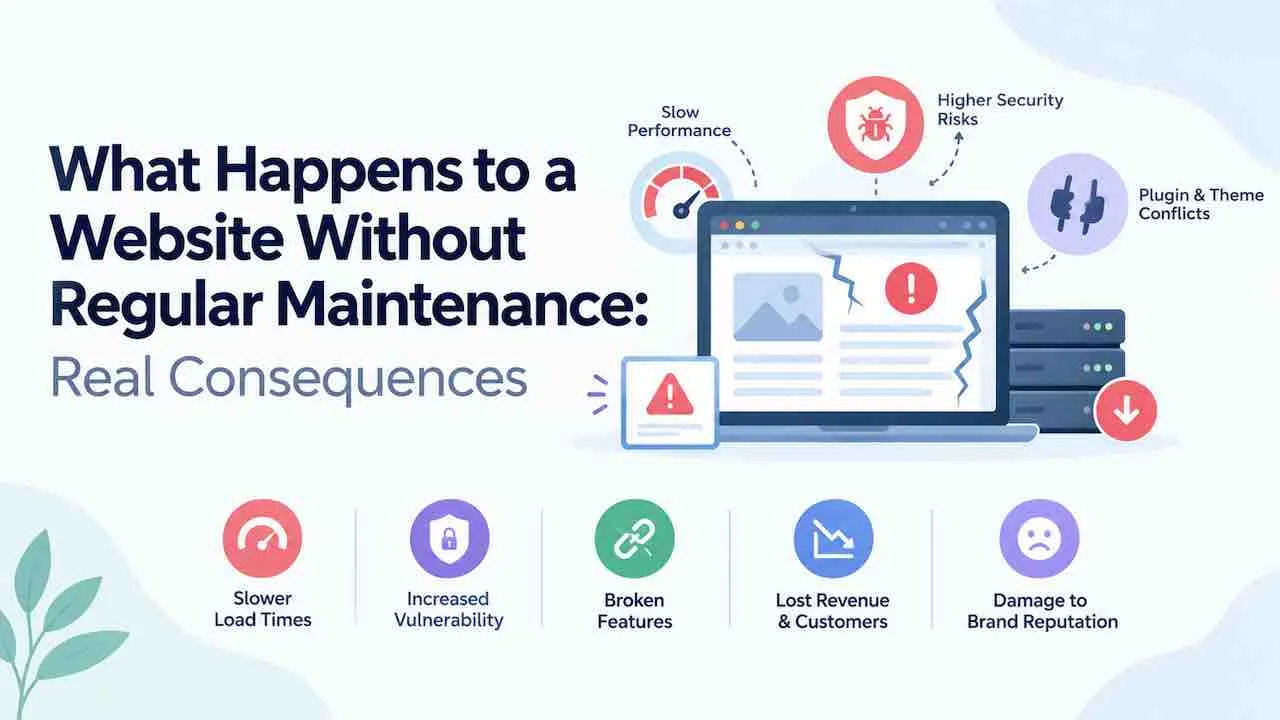
A website without regular maintenance degrades in six ways: security vulnerabilities open within weeks of skipped updates, search rankings drop as Core Web Vitals decline, page speed regresses silently, broken links and 404 errors accumulate, SSL certificates expire and block visitors, and content becomes outdated enough to lose customer trust. Most website owners notice the damage only after a customer reports it or rankings fall.
Website maintenance consequences are not a single event. They compound. Each skipped security patch, expired certificate, and unaddressed 404 error adds to website technical debt. The pile grows with each passing week. The consequences of not maintaining a website follow a predictable sequence. This guide covers each consequence in the order it typically appears. It shows what the visitor experience looks like at each stage. It also compares recovery costs to prevention.
What Visitors Actually See on a Neglected Website
Before considering the technical consequences, consider the customer perspective. A visitor arriving at an unmaintained website encounters problems that destroy trust immediately. Images fail to load because file paths changed and nobody updated the references. Contact forms submit successfully but deliver nothing because the email plugin stopped working after a core update. Phone numbers and addresses are months out of date. A copyright notice frozen at a previous year signals abandonment. Pricing information no longer reflects reality. The visitor draws one conclusion: this business is not looking after itself. They leave and do not come back.
This visitor experience damage is the most commonly overlooked effect of website neglect. Security and SEO consequences are invisible to visitors. Outdated content, broken forms, and stale information are not. Eighty-eight percent of online consumers are less likely to return after a bad website experience. A neglected website delivers that bad experience on every visit, to every potential customer, continuously. No amount of advertising spend overcomes a first impression built on visible website abandonment.
Security Breaks Down First
Security is the first technical casualty of website neglect. Website security vulnerabilities on an unmaintained site are publicly documented. Website security without maintenance means running that vulnerable software indefinitely. Automated bots scan the internet continuously for known vulnerabilities. Outdated WordPress installations, outdated plugins, and expired SSL certificates all appear in those scans. Outdated website risks include far more than visual degradation. Plugin vulnerabilities account for the majority of WordPress security breaches. WordPress without updates is the most commonly targeted CMS configuration on the internet.
Security patches exist because vulnerabilities are found and published regularly. An unpatched WordPress plugin sits in a public vulnerability database. Any bot running a vulnerability scan finds it within hours of the exploit being listed. Website hacking without updates is not a theoretical risk. It is a near-certainty over a meaningful time horizon. More than 30,000 websites are compromised daily. Most are not large targets. They are ordinary business websites running outdated software that nobody updated.
What Attackers Do With an Unpatched Website
- Spam injection: Hidden links to external spam sites are inserted inside your pages. This destroys domain authority and search rankings without any visible warning to the site owner.
- Malware distribution: Your website becomes a delivery vehicle for malware targeting your visitors. Google detects this and displays a warning before the page loads.
- Credential harvesting: Login forms are cloned to collect usernames and passwords from your customers directly.
- Server resource abuse: Your hosting server is used for cryptocurrency mining or sending mass spam emails, which degrades performance and can trigger hosting account suspension.
- Data theft: Customer data stored in your database is extracted. GDPR and data protection regulations impose significant penalties for data breaches caused by preventable security failures.
Search Engine Rankings Drop Without Warning
The SEO impact of unmaintained website configurations is consistent and measurable across every CMS platform. Google does not warn you before your rankings drop. A Google penalty from spam injection or a manual action removes a site from search results overnight. Losing Google rankings from neglect is more gradual, but equally damaging over time. Core Web Vitals scores fall as outdated code accumulates. Crawl errors increase as broken links and missing pages go unfixed. The result is a gradual decline in organic visibility. It can take months to notice and years to reverse.
Website Neglect Decay Timeline by SEO Consequence
| Time Without Maintenance | What Breaks | SEO Consequence |
|---|---|---|
| 0 to 30 days | Minor plugin incompatibilities, small speed regressions | Minimal – Core Web Vitals scores begin to slip |
| 1 to 3 months | Outdated PHP version, broken internal links, expired CDN cache rules | Crawl errors increase, some pages drop positions |
| 3 to 6 months | Unpatched security vulnerabilities, SSL approaching expiry, plugin conflicts | Google flags site quality signals, traffic declines visibly |
| 6 to 12 months | Malware risk escalates, 404 errors accumulate, content becomes stale | Rankings drop across multiple keywords, bounce rate rises sharply |
| 12 months or more | Potential blacklisting, severe technical debt, structural errors | Domain authority erodes, full technical audit required before recovery |
A full technical SEO foundation is only effective when the underlying site is maintained. Technical SEO optimisation on a neglected website is ineffective. The ranking work cannot hold without the maintenance foundation beneath it.
Technical Compatibility Breaks Over Time
Hosting environments, PHP versions, browsers, and third-party services all change on their own schedules. A website that worked correctly when it was built will break as the surrounding environment evolves. Hosting providers upgrade PHP versions to maintain security. An outdated PHP version running old code produces errors, blank pages, or broken functionality. Browser vendors update how they handle JavaScript. Outdated scripts that worked in previous browser versions stop executing correctly in current versions. Visitors on modern browsers see broken page elements. The website owner, typically on the same browser and device combination they always use, notices nothing.
Third-party integrations present the highest-impact compatibility failure risk. Payment gateways update their API requirements and deprecate old versions. A checkout page can fail silently the day a payment gateway API version is retired. Booking systems, live chat widgets, and email marketing integrations all follow their own update cycles. Without maintenance monitoring, these failures go undetected. A customer usually discovers the problem first. Revenue is lost before anyone knows the integration broke.
Website Speed Degrades and Traffic Follows
A one-second delay in page load time reduces conversions by up to 7%. It also increases page load speed problems compound over time. Website performance degradation is gradual and invisible to the site owner. Plugins accumulate database bloat. New content is added without image optimisation. Caching rules expire. Hosting environments fall further behind modern performance standards. Website speed without maintenance worsens on every metric Google PageSpeed measures. A site that previously loaded in 2 seconds may now load in 4 seconds. No deliberate change is required for this regression to occur.
Google’s Core Web Vitals are a direct ranking factor. Largest Contentful Paint, Cumulative Layout Shift, and Interaction to Next Paint all degrade on unmaintained websites. Outdated page builders inject unused CSS and JavaScript. Images lack modern formats. Server response times increase as unoptimised queries accumulate. These regressions are only visible to Google. Google acts on them quietly by reducing the site’s search position over time.
Broken Links and 404 Errors Destroy Trust
Every broken link on your website is a trust signal pointing in the wrong direction. Website owners add pages, delete pages, and restructure content over time. Without maintenance, no one manages the resulting 404 errors. Internal links break. External sites that linked to your content send visitors to error pages. Google’s crawler hits those errors and logs them as crawl waste. It then reduces the priority assigned to your site. Users who land on a 404 page leave immediately.
A website with 200 pages can accumulate dozens of broken internal links within six months. Normal editorial activity produces this level of link churn. Each broken link is a lost conversion opportunity. It is also a wasted backlink and a negative signal in Google’s quality evaluation. A website architecture that follows SEO best practices requires regular link auditing. This maintains the structural integrity that search engines reward.
SSL Certificate Expiry Kills Conversions Instantly
When an SSL certificate expires, every major browser shows a full-screen warning. Visitors see this before they can access the site. The warning tells the visitor that the site is not secure. It advises them not to proceed. Most visitors leave immediately. Business reputation damage from SSL expiry warnings is real and immediate. Trust destroyed by a browser security warning is difficult to rebuild. SSL certificates require renewal on a schedule, typically every 12 to 24 months. Without maintenance monitoring, the expiry date passes unnoticed until a visitor or Google Search Console flags it.
SSL expiry also removes the HTTPS status that Google uses as a basic ranking signal. A site that drops from HTTPS to HTTP loses a direct ranking factor simultaneously. Organic traffic lost during the expiry period does not return automatically once the certificate is renewed. Recovering the ranking signal requires SSL renewal, HTTPS redirect verification, and a recrawl request. The process takes time while potential customers see security warnings.
Legal and Compliance Risks from Website Neglect
A website without maintenance accumulates legal and compliance exposure that most business owners do not consider until a problem arises. Cookie consent notices become non-compliant as regulations evolve. Privacy policies that were accurate when written become inaccurate as data practices change. GDPR and regional data protection laws impose significant penalties for non-compliance. An outdated privacy policy on a site with new analytics tools represents real legal exposure.
Accessibility requirements are also subject to change. WCAG standards evolve, and websites that met requirements when built may no longer meet current standards. In regulated industries, an unmaintained website can create liability exposure independently of any security incident. Routine maintenance includes a compliance review. It catches these issues before they attract regulatory attention.
The Real Cost of Recovery vs Prevention
Emergency recovery after a hack, a major technical failure, or a Google penalty costs significantly more than preventive maintenance. Website downtime without maintenance monitoring can go undetected for hours or days. Revenue lost from unplanned downtime exceeds monthly maintenance costs within a single incident. Losing customers to competitors during downtime is an irreversible consequence.
Recovery Cost vs Prevention: What the Numbers Show
| Problem from Neglect | Typical Recovery Cost | Prevention |
|---|---|---|
| Malware removal, site restoration from website backup | $500 to $3,000 | Included in monthly maintenance |
| Google blacklist removal and reconsideration | $1,000 to $5,000 plus lost revenue | Prevented by security updates |
| SSL expiry recovery and trust rebuilding | $200 to $800 plus conversion losses | Automated renewal monitoring |
| Core Web Vitals technical audit and repair | $800 to $2,500 | Prevented by ongoing performance checks |
| Broken link and 404 audit and repair | $300 to $1,200 | Included in monthly maintenance |
| Payment gateway integration failure recovery | $500 to $2,000 plus transaction losses | Detected immediately by uptime monitoring |
A website maintained for $150 to $300 per month avoids a costly rebuild. Without maintenance, a $10,000 to $25,000 rebuild becomes necessary within three years. Without maintenance, that rebuild becomes necessary. The hidden cost of website neglect is not only the emergency recovery fee. It is the compounded loss of rankings, leads, and revenue during the decline period. E-E-A-T trust signals that took years to build can be destroyed by months of neglect. Managed website maintenance services address every one of these risk categories before they become emergencies.
How Website Neglect Compounds Over Time
Website decay follows a compounding pattern. The effects of neglecting your website are interconnected failures that accelerate each other. One unpatched plugin creates one vulnerability. That vulnerability gets exploited and injects spam. The spam injection reduces domain authority. The domain authority drop reduces organic traffic. Less traffic means fewer conversions. Meanwhile, skipped updates mean each new update becomes harder to apply safely.
Businesses that delay maintenance consistently face a point of no return. The site requires a full rebuild rather than an update. Website abandonment is the end state of this process. The rebuild resets all the domain authority, backlinks, and ranking history the old site accumulated. Website failure rarely announces itself. It builds quietly until the cost to recover exceeds the cost to rebuild from scratch.
Stop Website Neglect Before It Costs You Rankings and Revenue
Quick Digital’s managed website maintenance services handle security updates, performance monitoring, broken link audits, SSL renewal, compatibility testing, and backup management on a defined monthly schedule. Your site stays protected, fast, and ranking.
View Maintenance PlansFrequently Asked Questions: Website Without Maintenance
A website without updates accumulates security vulnerabilities, speed degradation, broken links, and plugin conflicts. Hackers exploit unpatched software within days of a vulnerability being published. Core Web Vitals decline and crawl errors accumulate, causing search rankings to drop gradually then sharply. Content becomes outdated, forms break, and third-party integrations fail. Recovery costs significantly more than ongoing maintenance would have.
Security vulnerabilities begin accumulating immediately after updates are skipped. Visible visitor-facing problems,
broken forms, outdated content, stale information appear within 1 to 3 months. SEO ranking drops typically appear within 3 to 6 months. SSL certificates expire on their renewal schedule, often 12 to 24 months. Third-party integration failures can occur at any point when a connected service updates its API without notice.
Yes. Website maintenance directly affects search rankings through Core Web Vitals scores, crawl error rates, SSL status, page speed, and internal link integrity. A site that scores poorly across these signals loses rankings to maintained competitors. Regular maintenance keeps all these signals healthy and prevents the gradual ranking erosion that unmaintained websites consistently experience.