

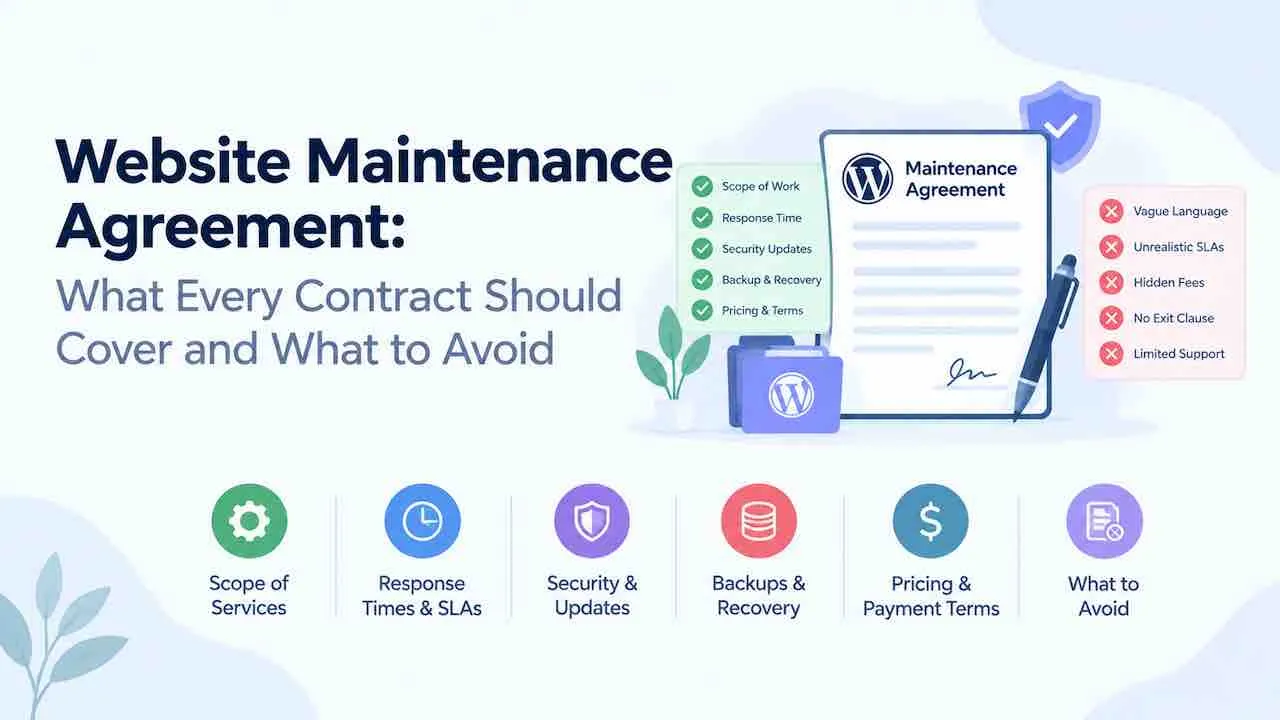
A website maintenance agreement is a written contract between a business and a web maintenance provider that defines the scope of work, response times, uptime guarantees, payment terms, domain and hosting ownership, intellectual property transfer, termination rights, data retention policy, force majeure terms, and indemnification obligations for ongoing website upkeep services. Without a signed agreement, you have no recourse when your provider goes dark, no contractual obligation protecting who owns your files and hosting, and no defined timeline for when a site outage gets fixed. A properly written website maintenance service contract protects your website data, your business continuity, and your budget across every scenario a handshake deal fails to cover.
This guide covers the 15 clauses every website maintenance agreement must include, sample language for the 3 highest-risk terms, the difference between a care plan agreement, an SLA, and a maintenance retainer, how freelancer and agency contracts differ, the 6 red flags to reject, and a 7-point review checklist for any agreement you have been handed before signing.
Why a Website Maintenance Agreement Matters
What Happens Without a Written Agreement
Without a signed website maintenance agreement, four specific failure modes become unenforceable problems with no contractual remedy. First, scope creep: without a written scope of work, providers bill for work you assumed was included and refuse work you assumed was covered. Second, data loss: without a backup clause, no contractual obligation exists to restore your site after a failed update or breach. Third, website hostage risk: without an IP and access clause, some providers retain your login credentials and files as a negotiating tool when payment disputes arise. Fourth, abandoned service: without a termination clause defining penalties and obligations, providers can stop responding with no consequences.
Read our guide on what website maintenance includes to understand the full scope of tasks a proper agreement should enumerate before you evaluate any contract.
Freelancer, Agency, and Managed Service: Contract Differences
The type of provider you hire determines which contractual protections are most critical because each provider type carries a different risk profile and a different accountability structure. A freelancer contract needs the strongest IP ownership, file delivery, and continuity clauses because a single individual represents your entire support chain. If they disappear, become unavailable, or pass away, you have no recourse without explicit succession or file delivery terms. An agency contract needs the strongest scope definition and SLA clauses because agencies are more likely to bill for scope creep and assign junior staff to ongoing work. A managed service provider contract needs the strongest uptime guarantee, SLA tiers, security responsibility, and data protection clauses because these providers typically host and control your full technology stack, making their contractual obligations more technically consequential. Apply the relevant emphasis in your next web maintenance contract based on who you are actually contracting with.
The 15 Essential Clauses Every Website Maintenance Agreement Must Include
1. Scope of Work Definition
The scope of work clause is the most important section of any website maintenance contract because it defines exactly what is included, what is excluded, and what triggers a separate change request. A strong scope definition lists specific maintenance deliverables: monthly plugin updates, theme updates, security scanning, broken link checks, uptime monitoring, performance checks, SSL certificate management, and content edits up to a defined monthly hour limit. It also explicitly names exclusions: new page builds, redesigns, SEO campaigns, and third-party integrations. Read our website maintenance checklist to understand the full scope a provider should be covering under a standard monthly agreement.
Sample scope language: “Provider will perform the following monthly services: (a) CMS core, plugin, and theme updates with pre-update staging backup; (b) malware scanning and removal up to [X] hours per incident; (c) uptime monitoring with alert thresholds at 99.9%; (d) content edits up to [X] hours per month; (e) monthly performance report. Services not listed above require a separate written change request and are billed at the hourly rate defined in Schedule A.”
2. Domain and Hosting Ownership
Domain and hosting ownership is the single clause most commonly missing from website care plan agreements, and its absence is the primary cause of the “agency holding your website hostage” situation that businesses report after ending maintenance relationships. The agreement must state who holds the domain registrar account, who controls the hosting control panel, who pays the hosting invoice, and what happens to each at termination. The safest arrangement is client ownership of both domain and hosting accounts with the provider added as a technical user, not an account owner. If the provider hosts your site on their infrastructure, the agreement must require them to provide a full cPanel or equivalent export and database dump within 10 business days of termination, at no additional charge.
3. Intellectual Property and Code Ownership
The intellectual property clause must explicitly state that the client owns all website files, code, content, databases, themes, and custom development created or maintained under the agreement, with no conditions attached to file delivery. This clause prevents providers from withholding files as negotiating tools in payment disputes. The agreement must require delivery of all source code, database exports, and media files within a defined period after termination.
Sample IP language: “All website files, databases, custom code, themes, plugins, and media assets created or maintained under this agreement are the exclusive property of Client. Provider agrees to deliver complete copies of all files and databases to Client within 10 business days of agreement termination, regardless of any outstanding billing disputes. Provider retains no license, lien, or right of retention over any website assets upon termination.”
4. Response Time and Service Level Agreement
The response time clause defines how quickly the provider must acknowledge a support request, begin working on it, and resolve it, categorized by severity level. A properly written website maintenance SLA separates requests into at least three tiers:
| Severity Level | Definition | Response Time | Resolution Time |
|---|---|---|---|
| Critical | Site down, data breach, payment system failure | 1 to 4 hours | 24 hours |
| High | Broken form, checkout error, security warning | 4 to 8 hours | 48 hours |
| Standard | Content update, minor bug, cosmetic fix | 1 to 2 business days | 5 business days |
Any agreement using phrases like “prompt support” or “best efforts” without specific hour targets has no enforceable service standard. Reject it and request tiered response windows before signing.
5. Uptime Guarantee
The uptime guarantee clause defines the minimum availability percentage the provider commits to, how it is measured, and the remedies available when that threshold is not met. Standard guarantees in professional website maintenance service contracts run at 99.9%, allowing approximately 8.7 hours of total downtime per year. The clause must specify whether it covers the hosting environment, the application layer, or both, plus the monitoring tool used to generate uptime data. See our website uptime monitoring guide for the tools and thresholds that define reliable uptime measurement and the credit structures providers typically offer when guarantees are breached.
6. Backup and Data Retention Policy
The backup clause must define frequency, storage location, retention period, restoration timeline, and your right to request a backup copy at any time, because vague backup language produces no real protection when you need a restoration. A minimum standard is daily full-site backups retained for 30 days in an offsite location separate from your primary hosting environment. The data retention policy section should specify how long your data is stored if you terminate the agreement and when it is permanently deleted, in compliance with applicable data protection regulations. See our website backup strategy guide for the full backup architecture your agreement should reflect. Any agreement that mentions backups without naming frequency, retention, and storage location is not a backup commitment.
7. Payment Terms, Pricing, and Rate Change Policy
The payment terms clause defines the fee, billing date, payment method, late fee structure, service suspension trigger, and how and when pricing increases are communicated. The agreement should specify whether the fee is fixed for the contract term or subject to annual increases, the maximum increase percentage, and the minimum advance notice required before any increase takes effect. For fixed-price vs hourly maintenance contracts: fixed-price retainer agreements work best for predictable, recurring task sets. Hourly-rate agreements work better for variable, ad-hoc support needs. A hybrid structure with a fixed monthly retainer for standard tasks and an agreed hourly rate for change requests beyond the retainer scope is the most common professional arrangement. Read our website maintenance cost guide for typical pricing benchmarks by provider type and service scope.
8. Change Request Process
The change request clause defines the process for requesting work outside the agreed scope, how it is quoted and approved, and what constitutes a billable change vs a scope-included maintenance task. The change request process requires written approval before any out-of-scope work begins, a written estimate with a fixed price or hourly rate, and a log of all approved requests. Emergency change requests must have an expedited approval path for situations where waiting for standard approval would extend site downtime unacceptably.
9. Access and Credentials Management
The access clause defines which credentials the provider holds, how they are stored, the procedure for changes during the agreement, and the mandatory transfer process at termination. The provider must use a secure credential management system such as 1Password or Bitwarden and must never store passwords in plain text or personal email. The clause should prohibit undisclosed provider-controlled user accounts on your systems. At termination, all credentials must be transferred and all provider accounts removed. Clients must retain independent access to all systems at all times, not depend solely on the provider for CMS or hosting access.
10. Security Responsibilities
The security clause defines which party owns each layer of website security, the frequency of security scans, breach notification timelines, and the liability allocation when a breach occurs. The provider typically owns: core software and plugin updates, scheduled malware scanning, SSL certificate renewal, and firewall management. The client typically owns: account credential hygiene and third-party integrations they manage independently. The breach notification timeline must be explicit: within how many hours must the provider notify you of a confirmed breach? Four hours is standard for critical incidents in professional web maintenance contract terms. See our website security maintenance guide for the full list of security tasks a provider should own contractually.
11. Termination and Exit Clause
The termination clause defines the notice period, obligations of both parties during the notice period, any early termination fee, and the complete file and credential transfer timeline.
Sample termination language: “Either party may terminate this agreement with 30 days written notice. Upon termination, Provider will: (a) continue providing services through the notice period; (b) deliver all website files, database exports, and credentials to Client within 10 business days of the termination date; (c) remove all Provider user accounts from Client systems. Early termination by Client within an annual contract term triggers a fee equal to [X] remaining months at the monthly rate. Early termination for material breach requires 5 days notice and written documentation of the breach.”
12. Force Majeure
The force majeure clause suspends a party’s contractual obligations when performance is prevented by events outside their reasonable control, including natural disasters, power outages, cyberattacks on third-party infrastructure, or government-imposed restrictions. A proper force majeure clause defines the qualifying events, requires prompt written notification when a force majeure event begins, limits the suspension period before either party can terminate, and excludes events that the affected party could have mitigated with reasonable planning. Without a force majeure clause, a provider whose data center goes offline could be in breach of contract for failing to meet uptime guarantees caused by events entirely outside their control.
13. Indemnification
The indemnification clause defines which party protects the other from third-party claims arising from performance of the agreement, and in what circumstances. The provider should indemnify the client against claims arising from the provider’s own negligence, errors, or misconduct in performing maintenance services. The client should indemnify the provider against claims arising from client-supplied content, the client’s own actions on the site, or third-party products the client directed the provider to install. Mutual indemnification clauses that balance responsibility between both parties are standard in professional web maintenance contracts. One-sided indemnification language that places all risk on one party is a red flag requiring negotiation.
14. Liability Limitation
The liability limitation clause caps the maximum financial exposure of the provider in the event of service failures, data loss, or security breaches, typically set at 3 to 12 months of fees paid. This clause is standard in professional service contracts and protects providers from unlimited liability claims. Clients should negotiate the cap to a minimum of 12 months of fees for breach of the backup, security, or data protection clauses. The clause should explicitly state that gross negligence, fraud, and intentional misconduct are excluded from the cap and remain fully liable regardless of the limitation language.
15. Data Protection and Compliance
The data protection clause defines the provider’s obligations regarding any personal data accessed during maintenance work, their compliance with GDPR, CCPA, or other applicable regulations, and their breach notification obligations. If your website collects personal data, your maintenance provider processes that data as a data processor. The data retention policy must define what data the provider accesses, how it is handled, what security measures apply, how long it is retained after termination, and the provider’s timeline for notifying you if personal data is compromised. This clause is non-negotiable for any website collecting user data under applicable privacy law.
Website Care Plan Agreement vs SLA vs Maintenance Retainer
Three distinct documents govern a complete web maintenance relationship, and most disputes arise from conflating them or treating a single document as sufficient for all three purposes.
| Document | Primary Purpose | What It Governs | When You Need It |
|---|---|---|---|
| Website Maintenance Agreement | Master contract for the full service relationship | Scope, ownership, IP, termination, liability, data protection, force majeure, indemnification | Before any maintenance work begins |
| Service Level Agreement (SLA) | Performance standards for uptime and response | Uptime percentage, response tiers, remedies for breach, performance benchmarks | As appendix to the maintenance agreement |
| Website Care Plan / Maintenance Retainer | Financial arrangement for pre-purchased monthly services | Monthly fee, included task list, rate for additional hours, rollover policy | When recurring task volume justifies a pre-purchased monthly structure |
A website care plan agreement is a commonly used term for a combined document that merges the retainer pricing and task list into the main agreement, without separating them into distinct documents. A separate SLA appendix for uptime and response time commitments provides better contractual clarity. Missing any one of these three components leaves a gap in protection for the area it governs.
Monthly vs Annual Website Maintenance Agreements
| Factor | Monthly Agreement | Annual Agreement |
|---|---|---|
| Cost per month | Higher, typically 15 to 25% above annual rate | Lower, discount for 12-month commitment |
| Exit flexibility | 30-day notice, no early termination penalty | Early termination fee applies for remaining months |
| Price lock | Rate can change with 30-day notice | Rate locked for full contract term |
| Best for | New provider relationships, unstable or changing sites | Established provider track record, stable sites with predictable needs |
| Auto-renewal risk | Lower, 30-day commitment limit | Higher, 12-month commitment on renewal |
Start new provider relationships on a monthly agreement for 3 to 6 months before committing annually. This creates a performance track record before locking in a year of fees.
6 Red Flags in Website Maintenance Contracts to Reject
- No defined response times: Phrases like “prompt support” or “best efforts response” without specific hour-based SLA tiers have no enforceable standard. Reject and request tiered response windows by severity category.
- Ambiguous domain, hosting, or file ownership: Any clause that omits domain registrar ownership, conditions file delivery on payment of disputed invoices, or grants the provider a lien over your website assets is a hostage clause. Require clean unconditional ownership and delivery language.
- Auto-renewal without advance notice: Contracts that auto-renew for a full annual term without a notification requirement trap clients into another 12 months of billing without consent. Require a minimum 30-day advance notice before auto-renewal takes effect.
- Unlimited or undefined scope language: Phrases like “all necessary maintenance” or “general website support” without an itemized deliverable list give the provider unlimited discretion. Require a named scope list with explicit exclusions.
- No backup clause or vague backup terms: “We perform regular backups” without naming frequency, retention period, and storage location is not a backup commitment. Require specific backup terms or add them as a signed addendum before work begins.
- No monthly reporting obligation: Paying for maintenance that does nothing is undetectable without a reporting requirement. A written monthly activity report is a minimum deliverable. Require it explicitly in the contract or accept that you are paying for undocumented activity.
How to Review a Website Maintenance Agreement You Have Been Handed
Before signing any website maintenance contract, work through this 7-point review checklist to identify missing clauses and unacceptable terms before they become disputes.
- Scope of work: List every named deliverable. If fewer than 5 specific tasks are named, the scope is too vague. If a domain and hosting ownership clause is absent, add it as a condition of signing.
- Response time SLA: Confirm specific hour targets exist for at least 3 severity tiers. If “best efforts” language appears without hour targets, request an SLA appendix.
- IP and file ownership: Confirm the words “client owns” or equivalent appear for all website assets without conditions attached to file delivery at termination.
- Termination clause: Confirm the notice period, any early termination fee amount, the file delivery timeline, and whether file delivery is conditional on payment of disputed amounts.
- Backup clause: Confirm that frequency, retention period, and offsite storage location are all specified. “Regular backups” without these three specifics is not a contractual obligation.
- Auto-renewal: If the contract auto-renews, confirm a minimum 30-day advance written notice requirement exists. If absent, request an amendment before signing.
- Force majeure, indemnification, and liability cap: Confirm all three exist. A contract missing any of these three clauses has gaps in its risk allocation framework that become disputes when service failures occur.
Use DocuSign, PandaDoc, or HelloSign to execute your signed agreement with a timestamped audit trail. A signed PDF sent by email creates ambiguity about version and acceptance date. Electronically signed agreements with a documented audit trail are enforceable in most jurisdictions and eliminate version disputes entirely.
Website Maintenance Agreement Template: What to Include
A complete website maintenance agreement template should follow this structure to cover all 15 essential clauses in a logical order that mirrors how real-world disputes arise.
- Parties and Effective Date: Full legal names, addresses, and the date the agreement takes effect
- Schedule A: Scope of Work : itemized task list with monthly hour limit and explicit exclusion list
- Schedule B: Pricing and Payment Terms : monthly fee, billing date, late fee, service suspension trigger
- Appendix 1: Service Level Agreement : uptime percentage, response tier table, remedies and credit structure
- Section 3: Domain, Hosting, and IP Ownership : who holds each account, delivery obligations at termination
- Section 4: Access and Credentials : storage requirements, disclosure obligations, transfer process
- Section 5: Backup and Data Retention Policy : frequency, retention period, storage location, restoration timeline
- Section 6: Security Responsibilities : provider obligations, client obligations, breach notification timeline
- Section 7: Change Request Process : request format, approval requirement, emergency escalation path
- Section 8: Termination and Exit : notice period, early termination fee, file delivery obligations
- Section 9: Force Majeure : qualifying events, notification requirement, suspension period limit
- Section 10: Indemnification : mutual indemnification scope for each party
- Section 11: Liability Limitation : cap amount, excluded events, negotiation notes
- Section 12: Data Protection : data processor obligations, applicable regulations, breach notification
- Signatures: Authorized representative for each party with date
This structure covers every risk area that generates disputes in real website maintenance relationships. Use it as your checklist when evaluating a web maintenance contract template provided by any agency or freelancer.
What Quick Digital Includes in Every Website Maintenance Service Contract
Every Quick Digital website maintenance service contract includes all 15 essential clauses in plain language, not legal jargon, so clients understand exactly what they are agreeing to before they sign.
Our agreements specify tiered response times by severity, commit to 99.9% uptime with monitoring data shared directly with clients through our uptime monitoring dashboard, include daily backups retained for 30 days in offsite storage, and state clean IP ownership with no file delivery conditions at termination. Domain and hosting accounts remain under client control at all times. Our standard monthly rolling agreement requires 30-day notice for cancellation with no penalty. Annual agreements include a rate-lock guarantee for the full term. Every contract includes a monthly written activity report covering every task performed. We use DocuSign for all contract executions to provide a clear timestamped audit trail.
If you want to review our standard agreement terms before getting a quote, request a free quote and we will send the full contract for your review before any commitment is made.
Quick Digital · Website Maintenance Since 2014
Get a Website Maintenance Contract You Can Actually Understand
Quick Digital’s website maintenance service contracts cover all 15 essential clauses in plain language: 99.9% uptime guarantees, daily backups, tiered SLA response times, clean IP ownership, and client-controlled domain and hosting at all times.
Review our full contract before committing. No hard sell, no surprises.
Website Maintenance Agreement: FAQs
A website maintenance agreement must include scope of work, domain and hosting ownership, response time SLA, uptime guarantee, backup policy, payment terms, IP ownership, access management, security responsibilities, change request process, termination clause, force majeure, and indemnification. The scope, IP ownership, and termination clauses carry the highest dispute risk.
The client must own all website files, code, content, and databases under any properly written website maintenance agreement. The agreement must state unconditional client ownership with no conditions on file delivery at termination. All files, credentials, and database exports must be delivered within 10 business days of termination.
A fair website maintenance SLA defines critical issue response within 1 to 4 hours and high-priority issue response within 4 to 8 hours. Any agreement without tiered response times provides no enforceable service standard. Best efforts language without hour targets is not a service level agreement.
The six biggest red flags are: no defined response times, ambiguous domain or file ownership, auto-renewal without advance notice, unlimited scope language, missing backup terms, and no monthly reporting obligation. Any contract conditioning file delivery on disputed invoices is a website hostage clause and should be rejected.
A website care plan agreement merges the retainer pricing, task list, and service terms into a single document rather than separating them into a master contract plus SLA appendix. Both describe the same contractual relationship. Care plan agreements suit smaller agencies. A formal agreement with a separate SLA appendix suits higher-value website support.