
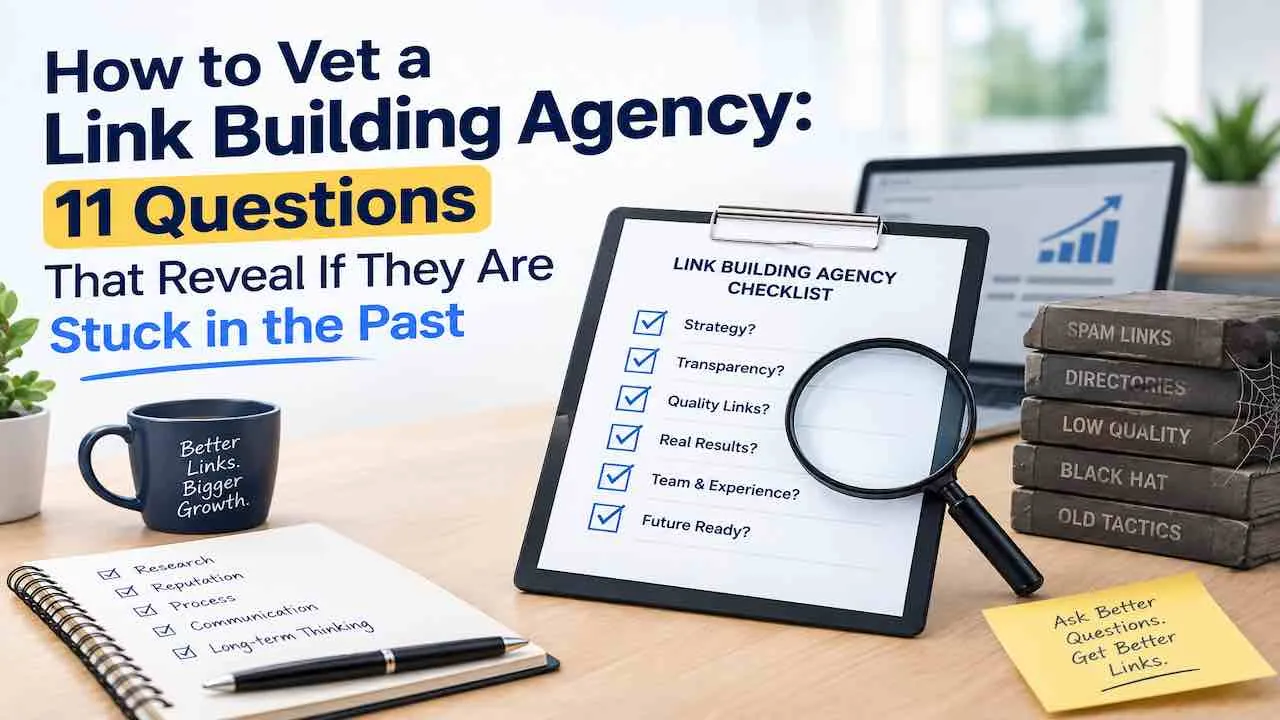
Choosing the right link building agency requires asking the questions most buyers never think to ask. The wrong agency does not just waste your link building budget. It puts your domain at risk of a Google manual action with no guaranteed recovery timeline. This guide gives you the 11 exact questions that separate a trustworthy link building agency from one selling an outdated playbook.
Google algorithm updates targeting link manipulation have intensified every quarter since 2024. Google penalty risk link building represents the most serious financial risk in any SEO programme. Legitimate white-hat placements cost $500 to $1,000 or more per link. Any agency offering volume at $100 to $300 per link almost certainly delivers grey-hat or black-hat inventory that collapses under spam enforcement.
Don’t waste link building budget on an agency that cannot answer these questions. How to choose the right link building agency and how to evaluate link building agency options both start with the 11 questions below. Link building agency selection using this framework takes one call. The 11 questions below separate a trustworthy agency from one selling an outdated playbook. This guide also covers vetting link building services, link building agency comparison across providers, and the link quality checklist to use before signing anything. Part of Quick Digital’s full link building service.
Legitimate white-hat link placements currently cost $500 to $1,000 or more per link from credible editorial sources. Any agency offering volume at $100 to $300 per link is almost certainly delivering grey-hat or black-hat inventory that may perform initially but collapses under Google’s spam updates. Google’s March 2024 Core and Spam Update deindexed thousands of sites that had been selling guest posts for years and enforcement has intensified each quarter since. Vetting link building services before you sign protects both your domain and your AI search visibility.
Why Standard Link Building Agency Questions Do Not Go Far Enough
Most buyers ask if an agency does “white hat link building.” Every agency says yes. The real question is what specifically they exclude because an agency that can clearly articulate what it will not do tells you far more than one that only lists what it will.
Link building now serves two separate functions: Google’s ranking algorithm and AI model training data. An agency stuck in the past optimises for domain rating and link volume. A modern agency optimises for editorial authority, brand entity signals, and placement transparency because these are the signals that feed both traditional ranking and AI citation visibility across Google AI Overviews, featured snippet selection, voice search answers, Perplexity AI, ChatGPT, and Gemini.
Link building agency vetting today must cover methodology, transparency, risk management, reporting quality, and the agency’s understanding of how link building connects to GEO and AEO visibility. The 11 questions below cover all five. They are the definitive link building agency questions to ask and the complete framework for what to ask before hiring a link building agency. Use them before signing any link building agency agreement. They work whether you are evaluating a first agency or replacing one after a Google penalty. Our full link building service overview shows how we answer each of these ourselves.
11 Questions That Reveal If a Link Building Agency Is Stuck in the Past
These are the best questions to ask a link building agency before committing budget. For each question, note not just the answer but the confidence and specificity with which they answer. Vague, defensive, or marketing-heavy responses to these questions are as revealing as the content of the answer itself.
Question 1: Can You Show Me the Exact Sites Before You Publish Any Links?
Placement transparency is the single most important criterion for how to evaluate a link building agency. A transparent agency shows you the specific URL, the domain rating, the organic traffic on the linking page, and the existing content context before any link goes live. You have the right to approve or reject individual placements before publication.
If an agency says their publisher list is “proprietary” or that they cannot share site URLs before publication, they are hiding something. Their sites are either low-quality blogs they own, part of a paid link network they cannot publicly associate with, or simply not vetted to the standard they claim. Link building agency transparency at the pre-publication stage is non-negotiable for white hat guarantee compliance.
Question 2: What Happens If a Placed Link Is Removed After Publication?
A link removal or conversion to nofollow after placement represents lost budget and lost domain authority. Ask exactly what the agency does when this happens. A responsible agency monitors every placed link with Ahrefs alerts, notifies you within a defined period of any removal, and replaces it with a comparable or better placement at no additional cost.
If the answer is “we don’t control what publishers do after publication,” the agency is not managing your link profile they are completing a transaction and moving on. Link building agency accountability extends beyond the placement date. A link that disappears 60 days after publication earned you nothing. Agency vetting must cover the post-placement monitoring and replacement policy before you sign.
Question 3: Do You Use Private Blog Networks, Link Farms, or Paid Link Networks?
The answer must be an immediate, unambiguous “no” followed by a clear explanation of what they use instead. Private blog networks (PBNs) are networks of sites controlled by a single entity specifically to pass link equity to client sites. Google’s spam policies explicitly prohibit these. A site receiving PBN links is vulnerable to a manual action that can remove it from Google search results entirely.
Link farms, guest post farms, and tiered link building carry the same risk. The distinction between grey hat SEO and black hat SEO is almost meaningless in practice both put your domain at risk. Agencies that acknowledge they used PBNs “in the past but not anymore” require particularly careful scrutiny. Spammy links placed two years ago may still be in your backlink profile feeding a penalty risk.
Question 4: How Do You Define Link Quality Beyond Domain Rating?
Domain rating is one data point, not a quality guarantee. Domain authority (Moz) and domain rating (Ahrefs) are the most commonly cited metrics. Neither alone defines white hat SEO link quality. A DR 70 site with zero organic traffic and 50 outbound links on every page is a worse link than a DR 45 niche publication with 8,000 monthly readers and editorial standards. Link quality metrics that matter in 2025 extend well beyond domain rating to include the organic traffic of the specific linking page, the topical relevance of the content, the number of outbound links on the page, and the editorial standards of the publication.
Asking about domain rating vetting specifically tests whether the agency is using Ahrefs or Semrush data intelligently or simply chasing a number. An agency whose quality definition begins and ends with DR is operating on a 2015 methodology. Domain authority as a standalone metric was already being gamed six years ago. The best link building agency evaluation looks at traffic, relevance, and editorial independence simultaneously.
Question 5: What Is Your Track Record With Google Manual Actions on Client Domains?
Any agency doing high-volume link building at scale will occasionally encounter issues. The relevant question is not whether any client has ever received a manual action it is whether the agency can discuss this honestly and explain exactly how they handled it. Protect your domain from penalties by asking for their recovery process, their communication protocol when issues arise, and specific examples of how they resolved penalty situations.
Agency track record link building history should include honest disclosure of both successes and challenges. An agency that claims no client has ever had any issue under their management is either too small to have a meaningful track record or is not being honest. Agency track record in link building should include both the successes and the challenges. A transparent agency can walk you through a Google penalty situation, what caused it, and what they did to recover it. This is one of the most revealing questions to ask before hiring a link building agency.
Question 6: How Do You Manage Anchor Text Distribution Across a Campaign?
Anchor text manipulation is one of the fastest ways to earn a Google penalty. An over-optimised anchor text profile too many exact-match keywords in backlink anchor text is a clear spam signal that Google’s algorithm and manual reviewers both flag. Ask the agency to explain how they balance branded anchors, naked URL anchors, generic anchors, and partial-match anchors across a campaign.
A sophisticated agency manages your anchor text distribution actively, checking your existing profile in Ahrefs before any new links are placed and deliberately varying anchor text to maintain a natural link profile pattern. An agency that says anchor text “doesn’t matter as much as it used to” or that they “keep it natural” without being able to specify their approach is not managing your risk carefully.
Question 7: Can I See a Sample Reporting Dashboard From a Current Client?
Link building agency reporting quality reveals their professionalism and accountability more clearly than any sales conversation. A good report shows each placed link with the live URL, the domain rating of the linking domain, the organic traffic on the linking page, the anchor text used, and the date the link went live. You should be able to verify every link in Google Search Console or Ahrefs independently.
A bad report shows a total link count, a list of referring domains without page-level data, or a graph of domain authority over time. If an agency cannot share a sample report from a client with permission, they either do not have sophisticated reporting or have nothing worth showing. Asking for a sample report is one of the most efficient ways to verify link building agency quality before committing budget.
Question 8: What Specific Methods Do You Use and What Specifically Don’t You Do?
The “what we don’t do” answer is as revealing as the methods list. A trustworthy agency can immediately list specific exclusions: no PBNs, no sitewide links, no automated outreach spam, no guest post farms, no tiered link building, no sponsored content sold as editorial. If the agency cannot clearly and immediately articulate what it will not do, it is likely doing some of it.
Ask what makes a good link building agency specifically exclude these methods, not just that they do. An agency that cannot explain why PBNs risk your domain or why tiered link building triggers spam signals has not thought through its own methodology carefully. How to find a trustworthy link building agency involves testing their reasoning, not just their answer.
Question 9: How Do Your Link Building Methods Support AI Citation and GEO Visibility?
An agency that has never heard of generative engine optimization or has no answer to this question is operating with a 2022 understanding of how links build authority. Links now serve two functions simultaneously: Google’s ranking algorithm and AI model training data. Agencies building only for traditional rankings are ignoring the growing share of search queries answered by Google AI Overviews, Perplexity AI, ChatGPT, and Gemini.
The best link building agencies understand that editorial links from high-DR publications, brand mentions, and earned media coverage all feed AI citation probability alongside traditional ranking signals. Ask specifically how their methods build entity authority and EEAT signals for AEO (answer engine optimization) and GEO (generative engine optimization). If the answer is blank or generic, the agency is stuck in the past. See our guide to generative engine optimisation for the full AI visibility framework.
Question 10: What Exactly Does Your White Hat Guarantee Cover?
“We do white hat link building” is a marketing phrase, not a guarantee. Ask for the specific written exclusions the white hat guarantee covers. A real white hat link building guarantee specifies: no private blog networks, no paid link networks, no link farms, no automated outreach spam, no cloaked links, and a replacement commitment if any placed link is removed or discovered to violate Google’s guidelines.
Ask whether the guarantee is written into the contract. Agency track record in link building is your best predictor of Google penalty risk for link building under their management. An agency confident in their methods puts the white hat guarantee in writing without hesitation. An agency that offers a verbal guarantee but says it “doesn’t typically go in the contract” is giving you marketing reassurance, not a contractual commitment. Link building agency criteria for a trustworthy partner include written documentation of exactly what their guarantee covers and what it excludes.
Question 11: Who Owns the Publisher Relationships and What Happens When We Stop Working With You?
The links placed during your engagement should remain in your backlink profile permanently, regardless of whether you continue with the agency. If an agency owns the publishing sites or maintains exclusive relationships that result in link removal when the contract ends, you do not own the backlinks you are renting them. Link building agency accountability extends to what happens after the contract closes.
Ask specifically whether any placed links sit on sites the agency owns, operates, or has exclusive arrangements with. Ask whether all placed links will still appear in Ahrefs and Google Search Console after your contract ends. A credible agency has no hesitation answering both questions affirmatively. The agency building links on sites they control is one of the most common and damaging agency red flags link building and it is a critical part of how to choose a link building agency rather than a link rental scheme.
Agency Red Flags in Link Building: How to Spot a Bad Agency Before You Sign
How to spot a bad link building agency, understanding agency red flags in link building, and recognising link building agency red flags to avoid all determine how to tell if a link building agency is good without needing to sign a contract first. These are the signals that should end the conversation, regardless of how compelling the agency’s pitch or case studies appear. How to avoid bad link building agencies starts with recognising these patterns before you sign anything.
Disqualifying Red Flags
- They quote you before asking about your goals, target pages, or current backlink profile. An agency that quotes without diagnosing is selling a product, not a solution. A link building agency evaluation must start with understanding your situation, not their pricing.
- They guarantee a specific number of links within a specific timeframe. Legitimate outreach-based link building cannot be guaranteed by volume. Only agencies using paid networks or PBNs can guarantee link counts because they control the placement sites.
- Their pricing is below $150 per link for claimed DR 50+ placements. Legitimate white-hat placements from real editorial publications with organic traffic cost $500 to $1,000 or more. Below-market pricing signals link farms, low-traffic placeholder sites, or grey-hat inventory.
- They will not share the exact URLs of sites they use before publication. This is placement transparency link building agencies owe every client. Refusal means they have something to hide.
- Their reporting only shows domain authority or total link count without page-level traffic data, anchor text used, or live URLs you can verify independently.
- They have no named client case studies and no verifiable references. An agency with a genuine track record can name clients (with permission) and link to or describe specific campaign outcomes. Vague testimonials without specifics are a red flag.
- They describe their publisher network as “proprietary” and refuse to share domain examples. Proprietary network is the language agencies use to hide that their sites exist solely to sell links, which is exactly the type of scheme Google’s spam policies target.
What Good Placement Transparency Looks Like in Practice
Placement transparency means you see every link before it goes live and can verify every live link independently after publication. A transparent agency provides a placement brief for each pending link showing the destination URL, the anchor text planned, the domain rating of the host site, the organic traffic of the specific page where the link will sit, and the article title or context.
After publication, you receive a live link report with all the same data plus the confirmed live URL. You can paste every URL into Google Search Console and confirm the link in your backlink data. You can pull the referring domain in Ahrefs and verify that the organic traffic figures match what the agency quoted. Link building agency transparency is measurable and verifiable not a matter of trust.
Our backlink outreach service shows the exact placement reporting format we use with clients, including pre-publication approval workflow and live link verification. Compare this to any agency you are evaluating to assess whether their transparency standard matches.
The Link Quality Checklist Before Signing Any Agency
Run every prospective link building agency through this link quality checklist before committing any budget. How to choose a link building agency and what to look for in a link building agency map directly to these ten criteria.
Ten-Point Agency Vetting Checklist
| Criterion | What to Verify | How to Check |
|---|---|---|
| Pre-publication site transparency | They share exact URLs before links go live | Request 3 sample placement briefs |
| Page-level organic traffic | Linking pages have real organic traffic, not just DR | Check shared URLs in Ahrefs or Semrush |
| Editorial independence | Publisher sites are not owned or controlled by the agency | Check WHOIS on shared domain samples |
| PBN and link farm exclusion | Written exclusion in the contract, not verbal assurance | Request the contract language covering this |
| Anchor text management | They audit your existing profile before placing new links | Ask them to describe their anchor text process |
| Link monitoring and replacement | They monitor placements and replace removed links | Ask for the written replacement policy |
| Reporting quality | Reports include live URLs, traffic data, and anchor text | Request a sample report from a current client |
| Post-contract link survival | Links remain in your profile if you end the engagement | Confirm in writing: no links on agency-owned sites |
| Google penalty track record | Agency can discuss penalty situations honestly | Ask directly: has any client received a manual action under your management? |
| AI citation and GEO alignment | Methods build entity authority and AI citation signals | Ask how their links feed Perplexity AI, ChatGPT, and Google AI Overviews |
How to choose a link building agency comes down to one principle: finding a trustworthy link building agency that answers every item in this table confidently and specifically not one that deflects, qualifies, or changes the subject. This table gives you the link building agency evaluation criteria and link building agency checklist questions to use in every initial call and request written confirmation on the items that matter most before you sign. Compare agencies on our link building packages page to see how transparent reporting and placement disclosure should look.
How to Verify Link Building Agency Quality: A Link Building Agency Review and Comparison Framework
Link building agency due diligence does not end with the sales call. These are the specific verification steps to run independently as part of how to verify link building agency quality before signing any agreement.
Pull Their Existing Client Links in Ahrefs
A link building agency review of current client results is the most direct verification available. The most direct answer to how to choose a link building agency is to inspect their existing work before you commit. Ask the agency for two or three current clients who have given permission to discuss their work. Pull each client’s backlink profile in Ahrefs Site Explorer. Look at the referring domains added in the last 6 months. Check the organic traffic of the linking domains and the specific pages. If the majority of new referring domains show no organic traffic, you are looking at a link farm or PBN network in action, regardless of what the agency told you in the sales call.
Check for Self-Owned Publisher Sites
Take 5 example URLs the agency shares as sample placements. Run each domain through a WHOIS lookup and compare the registration details. An agency running a proprietary network of publisher sites will often have overlapping registration data, hosting providers, or contact emails across multiple domains. This is how to verify link building agency quality independently before you discover their network through a Google penalty rather than due diligence.
Search Google Search Console for Past Clients
Ask the agency whether any former or current clients have received Google manual actions under their management. Search the agency name plus “manual action,” “penalty,” or “deindexed” in Google and industry forums. An agency with a pattern of causing Google penalties will have left a discussion trail. Link building agency red flags often surface in SEO community discussions on forums where clients share experiences after the fact. Our guide to in-house vs agency link building covers the verification process in detail.
Frequently Asked Questions About How to Choose a Link Building Agency
Placement transparency is the single most important factor in how to choose a link building agency, and the first criterion in any link building agency comparison. An agency that shows you the exact URLs, page-level traffic, and anchor text before any link goes live gives you the ability to verify every claim they make about link quality. An agency that refuses to share this information before publication is hiding something about the quality of their publisher network. Every other criterion reporting quality, white hat guarantee, penalty track record becomes meaningless without the ability to independently verify the sites your budget is buying access to.
Three signals reveal PBN usage without requiring the agency to admit it. First, pull sample placement URLs in Ahrefs and check whether the linking domains have organic traffic. PBN sites typically have no real organic search traffic only the domain rating transferred from expired domain backlinks. Second, run WHOIS lookups on multiple sample domains. Overlapping registration details, hosting providers, or nameservers across multiple sample sites indicate agency ownership. Third, check Google Search Console for manual action history on your domain if you have used an agency before. Google’s spam policies flag PBN link patterns specifically.
A complete link building agency report contains the live URL of every placed link, the domain rating of the linking domain, the organic traffic of the specific linking page, the anchor text used, the publication date, and the article title or context. Every item on the report should be independently verifiable in Google Search Console and Ahrefs. If a report contains only domain names, total link counts, or domain authority scores without page-level data and live URLs, the agency is not providing placement transparency. Request a sample report before signing any agency agreement.
Legitimate white-hat link placements from real editorial publications with organic traffic cost between $500 and $1,000 or more per link. Any agency offering high-DR placements at $100 to $300 per link is almost certainly delivering grey-hat or black-hat inventory paid link networks, link farms, or low-traffic placeholder sites with high DR but no real audience. Link building agency pricing below market rates always signals black hat link building risks. Cheap links not only fail to build authority effectively but actively risk your domain through Google’s spam update enforcement. Avoid getting burned by a bad agency by treating suspiciously low pricing as an immediate disqualifying signal rather than a negotiating advantage.
Links from genuine editorial publications build the entity authority and brand mention signals that AI engines use to select citation sources. Google AI Overviews, featured snippet selection, voice search answers, Perplexity AI, ChatGPT, and Gemini all weight editorial independence and institutional trust when deciding which brands to surface in generated answers. An agency building links on PBNs, link farms, or low-traffic guest post sites earns no AI citation benefit because these sources are not inside AI training datasets as trusted editorial voices. The best link building agency evaluation includes specifically asking how their methods build AI citation visibility and walking away from any agency that has no answer. Our AI SEO services page covers the full framework.
Quick Digital’s link building service shows placement URLs before publication, provides page-level traffic data on every referring domain, uses no PBNs or paid link networks, monitors every placed link with Ahrefs alerts, and replaces any removed link within 30 days. Request a free link profile audit to see how your current backlink profile measures against these standards and where your domain’s link quality gaps are. Find an agency you can trust by using this framework before any budget commitment. Peace of mind link building starts with knowing exactly what you are buying before a single link goes live.
Agency Vetting
Get a Free Backlink Profile Audit Before You Hire Anyone
We audit your current backlink profile for PBN signals, low-traffic referring domains, over-optimised anchor text, and manual action risk then show you exactly what a clean, transparent link building programme should look like.
No obligation. A real audit with specific findings you can act on immediately.
Link building service ·
View packages ·
Pricing guide ·
FAQs