




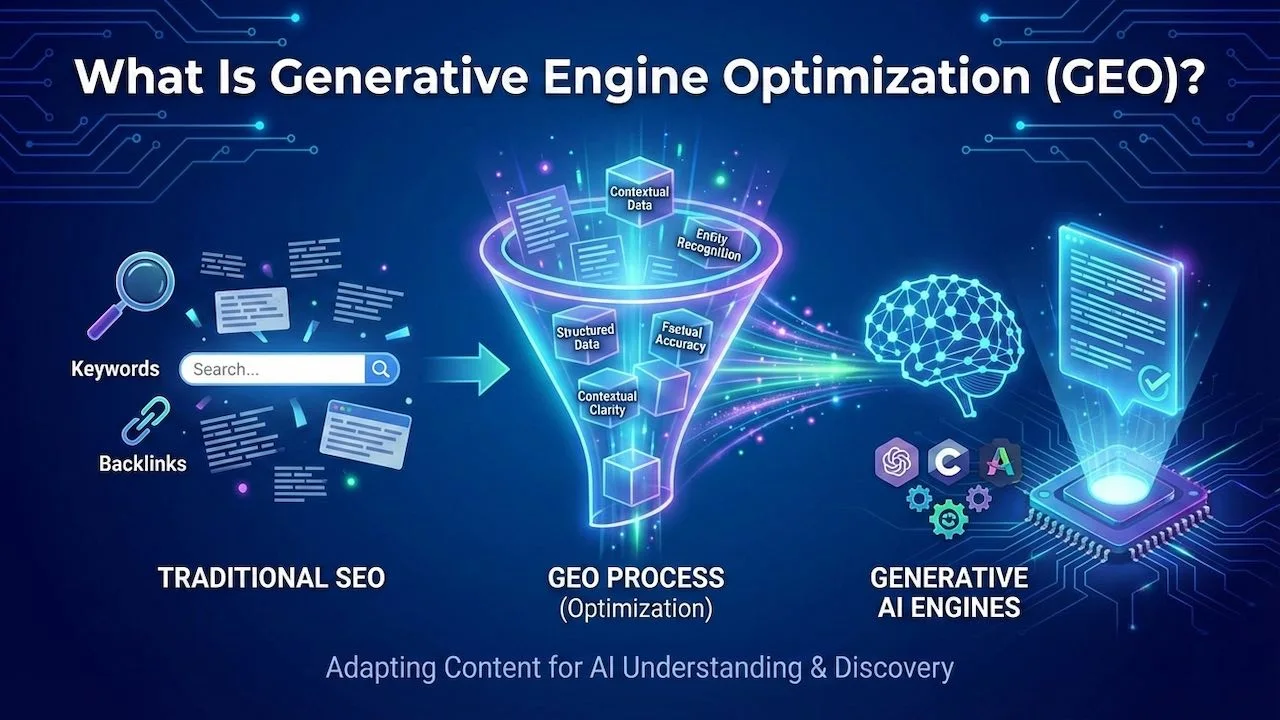
Generative Engine Optimization (GEO) is the practice of structuring content and building brand authority so AI platforms like ChatGPT, Perplexity, Google AI Overviews, Gemini, and Claude cite your brand inside their generated answers. GEO shifts your goal from appearing in a ranked list to becoming the trusted source the AI quotes directly to its users.
These generative engine optimization examples make the concept concrete. A user asks ChatGPT which project management tool suits a remote team. ChatGPT does not show 10 blue links. It reads trusted sources, synthesizes the information, and writes a single reply. It names the brands it found most credible. Your brand either appears in that reply or it does not. Generative engine optimization determines which side of that divide your brand sits on.
Brands missing from AI answers lose visibility at the exact moment users are making decisions. They are invisible to AI, losing visibility to AI search, and falling behind in AI search without realising it. Brand citations in AI and brand visibility in AI are now the metrics that matter. Companies that future-proof their content strategy get ahead of competitors. They optimise for AI citation before their niche fills with early movers. That is the problem GEO solves.
What Is Generative Engine Optimization (GEO)?
Generative Engine Optimization, commonly called GEO, makes your content retrievable, credible, and citable by large language models (LLMs). These include ChatGPT, Google Gemini, Anthropic Claude, Perplexity AI, and Microsoft Bing Copilot. The term was formally introduced in research published by Princeton University, Georgia Tech, and IIT Delhi. Related fields include Answer Engine Optimization (AEO), LLM optimization (LLMO), Generative Search Optimization (GSO), and AI search optimization (AIO). Related fields include Answer Engine Optimization (AEO), LLM optimization (LLMO), Generative Search Optimization (GSO), and AI search optimization (AIO). All four describe the same core goal: AI citation optimization. Generative AI optimization and AI search engine optimization are two more terms for the same discipline. The common aim is getting your brand cited inside AI-generated answers. GEO optimization explained simply: be the source AI quotes.
What is GEO in digital marketing? In GEO digital marketing, success no longer means ranking number one in a list of blue links. Success means appearing as a named source inside the paragraph an AI platform writes in response to a user’s question. That is GEO marketing in practice. It is a fundamental shift in what visibility means, and it is happening right now across every industry and every niche.
What Does GEO Stand For in Marketing?
GEO stands for Generative Engine Optimization in marketing. It refers to optimizing content for generative AI search engines rather than for traditional keyword-based search engines. Some practitioners use the terms LLMO (Large Language Model Optimization), GSO (Generative Search Optimization), or AIO (AI Search Optimization) interchangeably with GEO. All four describe large language model optimization for the purpose of appearing in AI-generated responses across platforms like ChatGPT, Gemini, Perplexity, and Claude.
Why GEO Matters Right Now
AI search adoption is accelerating faster than any previous search shift. Perplexity processes over 780 million queries monthly. ChatGPT handles 2.5 billion prompts per day. AI-referred website sessions grew 527% in a recent five-month window, according to Previsible’s AI Traffic Report. Brands not optimizing for generative AI search right now are already losing visibility without realizing it.
The opportunity gap is wide and still open. 47% of brands have no GEO strategy at all. Like domain authority before it, AI citation authority accumulates over time. Brands that start building GEO authority today have a meaningful early mover advantage over competitors still focused only on traditional rankings.
The Princeton University GEO research, published alongside Georgia Tech and IIT Delhi, confirms the scale of the opportunity. GEO-optimized content achieves 30 to 115% higher visibility in AI-generated responses. That figure comes from the Princeton University GEO research comparing optimised versus unoptimised content. The three highest-impact GEO techniques are: definition first sentence patterns, which deliver a 2.1x citation rate improvement. Sourced statistics in content boost AI citation rates by up to 40% per passage. Credentialed expert quotations drive up to 115% higher citation rates in certain categories.
How Generative Engine Optimization Works
GEO works by making your content easy for AI systems to retrieve, score highly, and reproduce inside a generated answer. Most generative search engines run on a process called Retrieval-Augmented Generation, also written as retrieval augmented generation or RAG. Understanding each step shows where GEO optimization creates its biggest impact.
How generative AI engines process queries and select sources to cite. Each step shows where GEO optimization creates its biggest advantage.
- Step 1: Semantic Query Processing Using NLP
The AI platform converts the user question into a concept using natural language processing (NLP) and machine learning. Google applies BERT and MUM to understand full intent behind a query. A question like “best CRM for small teams” retrieves content covering workflows, pricing, integrations, and user experience, even if those exact words are absent. GEO content uses semantic intent matching to align at the concept level, not just the keyword level.
- Step 2: Document Retrieval and Machine Learning Scoring
The AI searches an indexed knowledge base for documents matched to the query. Machine learning models score each retrieved document on four signals: relevance, authority, recency, and structural quality. GEO-optimized content scores higher across all four dimensions. It moves into the candidate source pool ahead of content with keyword density but weak structure. This is where GEO creates its most direct competitive advantage.
- Step 3: Information Synthesis and Response Generation
The AI reads three to ten top-scoring documents and generates a coherent reply. It does not copy text. It understands concepts and rewrites them in natural language. Pages with structured answer blocks of 40 to 60 words, clean heading structure, and sourced statistics give the AI pre-packaged, trustworthy content. The AI integrates this content cleanly into its response. This is the content extractability principle in action. Citable, standalone sentences earn more citations than long unstructured passages.
- Step 4: Source Attribution and AI Citation
The platform adds inline citations pointing to the sources it drew from. This AI citation is the GEO equivalent of a number-one ranking. Users see your brand name, absorb your authority, and often search directly for you later. Wikipedia citations account for 47.9% of ChatGPT source mentions for factual queries. This confirms that authoritative, structured, entity-rich content earns the most citations across AI platforms.
Generative Engine Optimization vs SEO vs AEO: Key Differences
GEO vs SEO vs AEO is one of the most searched comparisons in AI marketing. GEO, Answer Engine Optimization (AEO), and traditional SEO target different discovery surfaces and use different success metrics. All three work together. None replaces the others. GEO adds an AI-specific layer on top of a strong SEO and AEO foundation.
| Factor | SEO | AEO | GEO |
|---|---|---|---|
| Primary Goal | Rank high in search results | Appear in featured snippets and voice answers | Get cited inside AI-generated responses |
| Target Platform | Google, Bing, Yandex | Google Featured Snippets, Alexa, Siri | ChatGPT, Perplexity, Gemini, Claude, Copilot, Google AI Overviews |
| Success Metric | Rankings, clicks, organic traffic | Snippet appearances, voice query answers | Citation rate, AI share of voice, brand mentions in LLM outputs |
| Core Ranking Signal | Backlinks, keyword relevance, page experience | Concise direct answers, structured data | E-E-A-T, entity clarity, semantic depth, AI trust signals |
| User Journey | User clicks through to your website | User gets answer without clicking | User reads AI answer that cites your brand as the source |
| Content Format | Keyword-optimised long-form pages | Q&A blocks, bullet lists, schema data | Definition first blocks, sourced statistics, expert quotes, FAQ schema |
| Time to First Result | 3 to 6 months | 4 to 8 weeks | Initial citations in 2 to 4 weeks for optimised pages |
A critical insight: 76.1% of AI Overview citations already rank in Google’s top 10. Strong technical SEO creates the same authority and accessibility foundation that AI retrieval systems rely on. GEO adds AI-specific layers on top of that base: entity-based optimization, content extractability, and a structured citation strategy.
6 GEO Ranking Factors That Drive AI Citations
AI systems do not rank pages. They retrieve and cite them. Six primary citation signals determine which content gets selected. These signals determine your AI brand visibility across ChatGPT, Perplexity, and Google AI Overviews.
1. E-E-A-T and AI Trust Signals
Experience, Expertise, Authoritativeness, and Trustworthiness are the most durable citation signals in generative engine optimization. AI systems surface content with transparent author bios, accurate external citations, named contributors with credentials, and a history of factually correct information. Content with strong E-E-A-T signals consistently appears in AI-generated results. Content without them gets bypassed entirely, even when it ranks well in traditional search. AI trust signals are not assumed. They must be demonstrated through specific, verifiable signals on the page.
2. Definition First Content Structure and Content Extractability
Each major section must open with a direct, concise answer of 40 to 60 words. This citation block is the text AI systems extract when synthesizing responses. Definition first sentence patterns produce a 2.1x citation rate improvement. That is the highest single-technique gain in the Princeton research. Generic preambles and passive voice lead-ins get bypassed entirely. Write the definition or answer first. Add the explanation after. AI platforms select content that can be lifted cleanly into a generated answer without ambiguity. This is the content extractability principle and it is the most actionable GEO tactic available.
3. Semantic Depth, Topical Authority, and Intent Matching
AI platforms use RAG and machine learning to perform concept matching, not keyword matching. A page covering every subtopic around a theme scores higher than a shallow page repeating the same phrase. Topical authority building through interconnected content signals credibility to AI retrieval systems. That is why semantic SEO for generative engines forms the foundation of every effective GEO strategy. Fluency and readability improvements alone deliver a 10 to 20% visibility boost. Well-written content earns more citations than technically dense or poorly structured pages.
4. Verifiable Statistics, Expert Quotations, and AI Fact Verification
Adding specific, sourced statistics directly boosts AI citation rates by up to 40% per passage. Expert quotations from credentialed individuals drive up to 115% higher citation rates in certain categories. AI platforms perform active AI fact verification before selecting sources. Replace every vague claim with attributed, specific data. Replace vague claims with specifics. Write “email marketing generates $42 for every $1 spent, according to Litmus” instead of “email marketing has strong ROI.” Every assertion should connect to a named source, a specific number, or a traceable study.
5. Schema Markup, Technical Accessibility, and Content Freshness
Schema markup tells AI crawlers exactly what your content means. Pages using FAQPage schema, Article schema, HowTo schema, and Organization schema show 30 to 40% higher AI visibility than unstructured pages. AI bots including GPTBot, ClaudeBot, PerplexityBot, and Google-Extended must be allowed in your robots.txt file. Block them and you are invisible to those platforms entirely. Content freshness also matters. AI platforms weight recently updated, accurate content over stale pages. Learn how to implement schema markup for AEO and GEO to build the structured data layer AI systems rely on. See the full guide on LLM training data and AI indexing for technical crawlability requirements.
6. Off-Site Entity Authority and Citation Strategy
Your website alone is not your strongest GEO asset. AI platforms use named entity recognition (NER) to categorize brands, people, and concepts across the web. They weight third-party sources more heavily than brand-owned content. Your own website is not your strongest GEO asset.
A strong citation strategy includes credible mentions in industry publications and digital PR coverage. Keep brand data consistent across Wikipedia, Crunchbase, LinkedIn, and Google Business Profile. Every unlinked brand mention in a credible publication acts as a brand signal that LLMs interpret as proof of authority. Read how knowledge panel optimization strengthens your entity presence inside AI systems. Community platform AI citations captured 52.5% of all AI citations across ChatGPT, Perplexity, and Google AI Overviews. That figure comes from OtterlyAI’s analysis of one million citations. Reddit and Quora are the dominant sources. Off-site entity authority is not optional in GEO. It is where more than half of all AI citations originate.
Which AI Platforms Does GEO Target?
A complete generative engine optimization strategy addresses each AI platform directly. ChatGPT optimization, Perplexity AI optimization, Gemini optimization, Claude AI optimization, and Bing Copilot optimization each require a slightly different approach. Brands appearing consistently across all platforms build AI share of voice that compounds over time.
| AI Platform | What It Favors | GEO Priority Action |
|---|---|---|
| ChatGPT | Bing web index, GPTBot access, schema-rich content, entity signals | Allow GPTBot in robots.txt, strong Bing SEO, definition first blocks. See the full guide on how to get cited by ChatGPT and how to rank in ChatGPT. |
| Perplexity AI | Live web crawl, sourced accurate content, credible external citations | Sourced statistics, allow PerplexityBot, fresh content updated every 60 to 90 days |
| Google AI Overviews | Top-10 Google rankings, FAQ schema, E-E-A-T signals, structured headings | Strong technical SEO foundation first, then GEO layers. See the complete guide on how to appear in Google AI Overviews: Google AI Overviews optimization. |
| Gemini | Google ecosystem trust, Knowledge Graph entity recognition, E-E-A-T | Google Business Profile, Search Console optimization, Organization schema |
| Claude AI | Authoritative well-structured content, clear topical expertise, entity signals | Allow ClaudeBot, entity optimization, answer first content structure |
| Bing Copilot | Bing index coverage, Core Web Vitals, structured data, fast crawlability | Bing Webmaster Tools verification, structured data, fast load times |
Generative Engine Optimization Checklist: How to Rank in Generative AI Search
Start with your five highest-traffic pages and apply GEO improvements before building anything new. This section explains how to do generative engine optimization from scratch. It is a generative engine optimization for beginners checklist that covers the highest-impact actions first. Most GEO wins come from restructuring existing content, not creating new pages.
| Action | What to Do | Impact |
|---|---|---|
| Allow AI crawlers | Open robots.txt and explicitly allow GPTBot, ClaudeBot, PerplexityBot, and Google-Extended | Immediate: blocks removed |
| Add definition first blocks | Write a 40 to 60 word direct answer at the top of each major section. That is a 2.1x citation rate improvement | High: up to 2.1x citations |
| Add sourced statistics | Replace every unattributed claim with a specific statistic and named source to pass AI fact verification | High: up to 40% boost |
| Add FAQPage schema | Mark up 5 to 8 Q&A pairs per page using FAQPage schema for conversational search and voice visibility | High: 30 to 40% AI visibility boost |
| Include expert quotations | Add attributed quotes from credentialed experts, up to 115% higher citation rates per the Princeton research | High in certain categories |
| Build topical authority clusters | Create interlinked pillar content covering every subtopic in your niche to signal semantic depth to AI retrieval systems | Medium: compounds over time |
| Build entity presence | Keep brand data consistent on LinkedIn, Crunchbase, Wikipedia, Reddit, Quora, and Google Business Profile | Medium: knowledge graph optimization |
| Track AI citations monthly | Run 20 to 30 target queries in ChatGPT, Perplexity, and Gemini monthly using Semrush AI Toolkit or Profound | Ongoing: measure your GEO progress |
GEO Mistakes That Block AI Citations
Blocking AI Crawlers in robots.txt
Many sites block GPTBot, ClaudeBot, and PerplexityBot by default. AI platforms cannot cite content they cannot access. Open your robots.txt file and explicitly allow every AI bot. This single fix is often the fastest path from invisible in AI search to being cited. It takes under five minutes and has immediate impact on every platform trying to read your content.
Writing for Keywords Instead of Semantic Intent
Repeating a keyword phrase 20 times does not help generative AI SEO at all. RAG systems use semantic intent matching, not keyword proximity. A page covering its topic with depth, sourced data, expert quotes, and supporting entities stands out in AI-generated results. It outperforms keyword-dense but meaning-thin pages every time. Competitors getting cited in AI are the ones covering topics with genuine depth, not keyword density.
Missing Verifiable Statistics and Expert Quotes
Vague authority statements carry zero weight with AI systems. AI platforms perform active fact verification before selecting sources. Every assertion your content makes should connect to a named source, a specific number, or a traceable study. Content that cannot be verified gets left out of generated answers entirely, regardless of how well it ranks in traditional search. This is one of the most overlooked differences between traditional SEO and GEO.
Ignoring Off-Site Community Platform Presence
Community platform AI citations account for 52.5% of all AI citations across ChatGPT, Perplexity, and Google AI Overviews. Brands that optimize only their own website miss the largest single source of AI citation volume. Genuine expertise shared in community discussions surfaces in AI responses consistently. This is one of the most underused generative engine optimization strategies for brands of any size.
Treating GEO as Separate from SEO
Strong technical SEO, clean site architecture, solid backlinks, and good semantic SEO strategy form the exact foundation AI retrieval systems rely on. 76.1% of Google AI Overview citations already rank in Google’s top 10. Separating GEO from SEO creates gaps in both channels. The brands staying ahead in AI search execute strong SEO first and then add GEO-specific layers on top. Start with your SEO foundation before adding GEO-specific fixes.
How to Measure GEO Performance
AI share of voice is the primary GEO success metric. It measures how often your brand appears in AI-generated answers for target queries compared to competitors. Track it alongside citation frequency, brand sentiment in AI outputs, and downstream branded search traffic as downstream indicators.
Run 20 to 30 target queries manually in ChatGPT, Perplexity, and Gemini each month. Note how often your brand appears as a ChatGPT citation or Perplexity search result versus competitors. Record changes month over month. Automated tools for GEO measurement at scale include Semrush AI Visibility Toolkit, Profound Agent Analytics, and OtterlyAI. Free starting points include Google Rich Results Test for schema validation and Google Search Console for technical audits.
Run a full GEO audit on your top ten pages every 90 days. GEO performance improves fastest when treated as a recurring process, not a one-time fix. Also monitor answer engine optimization performance as a companion metric to GEO. They share enough infrastructure that improvements in one consistently improve the other.
FAQ About GEO
Generative Engine Optimization (GEO) is the practice of structuring content so AI platforms like ChatGPT, Perplexity, Google AI Overviews, Gemini, and Claude cite your brand inside their generated answers. GEO shifts your goal from ranking in a list of blue links to becoming the source the AI quotes directly. It combines semantic SEO, entity-based optimization, structured content, schema markup, and digital PR into one AI-focused visibility strategy.
SEO optimizes content for rankings and clicks in traditional search engines. GEO optimizes content to be cited inside AI-generated answers. SEO measures success with keyword positions and organic traffic. GEO measures success with citation rate, AI share of voice, and how accurately AI platforms describe your brand.
GEO works through a four-step process called Retrieval-Augmented Generation (RAG). First, the AI converts the query into a concept using NLP. Second, machine learning scores retrieved documents on relevance, authority, recency, and structural quality. Third, the AI synthesizes a response from the top-scoring sources. Fourth, it adds inline citations to the brands it used.
Initial AI citations can appear within 2 to 4 weeks of optimizing high-priority pages. This is particularly true after adding definition first blocks, FAQPage schema, expert quotations, and allowing AI crawlers.
Yes. GEO favors content quality and topical authority over domain size or budget. Research shows 47% of brands have no GEO strategy at all, creating a major early mover advantage in every niche. Basic GEO tactics like definition first blocks, FAQPage schema, expert quotations, and allowing AI crawlers require time investment, not large budgets.
Digital Marketing Since 2014
Ready to Get Your Brand Cited by AI?
QuickDigital builds AI search visibility for brands across ChatGPT, Perplexity, Google AI Overviews, Gemini, and Claude. Our GEO service covers content architecture, entity-based optimization, schema implementation, expert citation strategy, and full AI share of voice tracking.
47% of brands have no GEO strategy yet. Citation authority compounds over time. Start now while competition for AI citation is still low in your niche.