


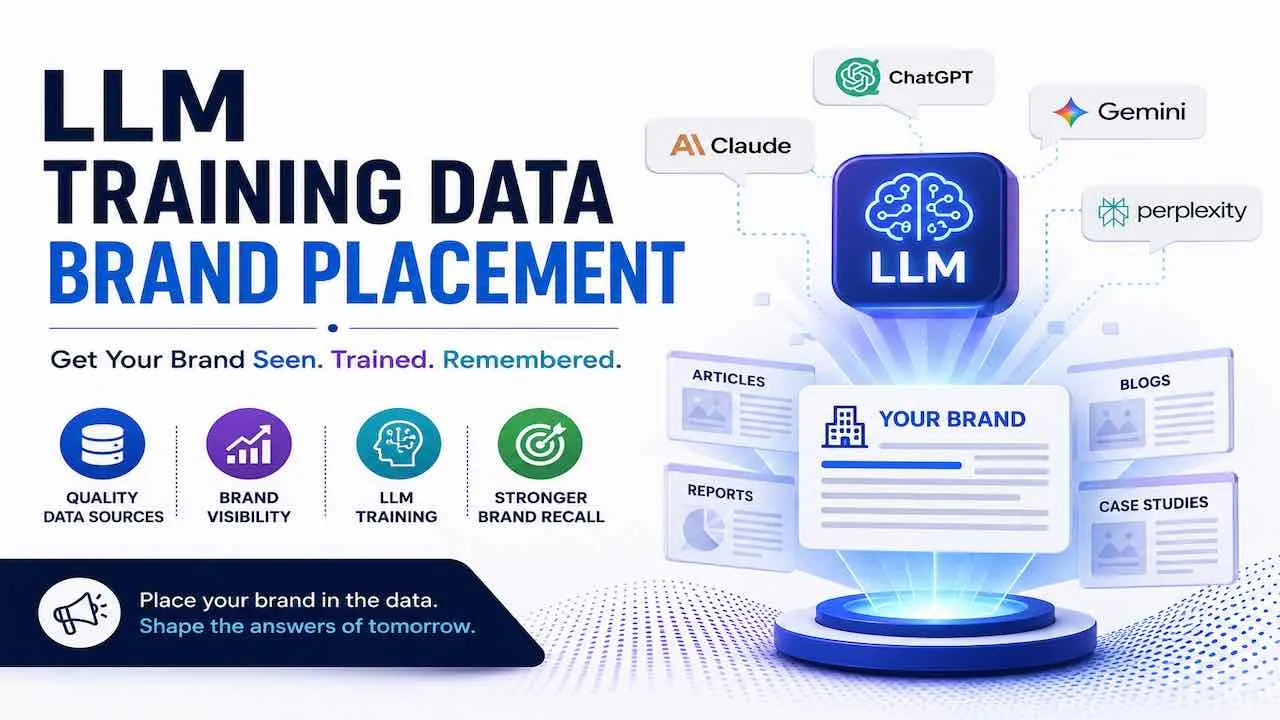
LLM training data brand placement also called AI training data brand visibility is the practice of strategically publishing content across platforms that feed large language model training corpora so AI models develop neural associations between your brand entity and specific topics, problems, and industries. When ChatGPT, Claude, or Gemini responds to a query in your category, it draws primarily from parametric memory: knowledge baked into its weights during pretraining. If your brand did not appear in the training corpus that built those weights, the model has zero knowledge of your existence. This guide covers how LLMs actually absorb brand information, which platforms feed AI training hubs directly, and the specific content formats that pass the quality filters discarding 90% of raw web data before it reaches any LLM pretraining dataset.
Business owners searching “how to get your brand in LLM training data,” “how to plant brand in AI knowledge bases,” or “how to make AI know your brand” all face the same challenge: AI models have no parametric knowledge of most brands. Being invisible to AI search engines means competitors who seeded their brands into the training corpus earlier get recommended by default. Whether you need to know how to get brand mentioned in AI training data, how to get brand into AI corpus, or build strategic content placement for AI brand visibility, this guide provides platform-specific steps backed by LLM corpus research.
QuickDigital has tracked AI brand visibility for clients across multiple industries since 2014. Every tactic in this guide is based on current research into LLM corpus composition, platform indexing behaviour, and brand seeding strategy outcomes. See the full technical breakdown on LLM training data and AI indexing for how the data pipeline works before executing any brand seeding strategy.
How LLMs Actually Learn About Your Brand
AI models learn about brands through two completely separate mechanisms, and confusing them is the most common strategic mistake in AI brand visibility planning. Understanding both mechanisms determines which content you create, where you publish it, and what results you can expect from each approach.
Parametric Memory: The Permanent Brand Knowledge Layer
Understanding how LLMs learn about brands begins with parametric memory: knowledge encoded directly into model weights during LLM pretraining, and it represents approximately 60% of how ChatGPT answers queries with no live web lookup triggered at all (Weply research). This is the AI equivalent of long-term memory. A brand embedded in parametric memory gets recommended instantly, in milliseconds, with no retrieval latency and no dependence on whether your current website is crawlable. It is the most durable form of AI brand visibility because it persists across sessions, survives algorithm changes, and requires no ongoing paid promotion to maintain.
Parametric memory forms through co-occurrence signals. When your brand name consistently appears alongside specific topics, product categories, and use cases across the LLM corpus during training, the model builds a neural brand association between your entity and those topics. Brand memory, brand entity embedding, and brand association in AI all flow from this parametric memory brand layer during pretraining and persist independently of real-time retrieval. The strength of that association depends on frequency, source diversity, and content quality across the LLM corpus, not just on how many times your brand appears on your own website.
RAG Citations: The Real-Time Retrieval Layer
Retrieval-Augmented Generation (RAG) is a separate mechanism that lets AI systems like Perplexity AI and ChatGPT Browse access current web content at query time, independent of their training data. RAG citations are what most GEO guides currently focus on. They matter for timely topics, pricing, product updates, and recent news. But RAG citations require your content to be crawlable and indexed at the moment of the query. Unlike RAG-based passage retrieval, which requires your page to be live and crawlable at query time, parametric brand placement works even when your site is down, blocked, or not yet published.
Fine-tuning data and RLHF (Reinforcement Learning from Human Feedback) also shape how models respond to brand queries, making brand seeding across high-quality platforms relevant to both the pretraining and post-training brand visibility layers. Build both layers. Prioritise parametric placement first because it creates the brand foundation that makes RAG citations more credible when they do occur.
The LLM Training Corpus: Where Brand Data Actually Comes From
Most major LLMs draw their pretraining data from a small set of core sources, and brand seeding strategy works by maximising presence across those sources specifically. Natural language processing and entity recognition AI systems process this corpus to build semantic fingerprints and entity salience scores for every named entity in the data. Brands that appear across Common Crawl, The Pile, the C4 dataset (Colossal Clean Crawled Corpus), Hugging Face datasets, and Wikipedia build strong knowledge graph entity records that persist in model weights. Brands absent from these sources have no entity salience and no knowledge graph presence inside the model.
| Training Data Source | Estimated Contribution to Major LLMs | Brand Placement Method | Update Frequency |
|---|---|---|---|
| Common Crawl web archive | Primary source for most major LLMs | Your crawlable website, guest posts, press coverage | Crawled monthly; used in training snapshots |
| Wikipedia | Approximately 22% of major AI training data | Wikipedia entity page, cited references | Continuously updated; high trust weighting |
| Reddit (pushshift archive) | Significant share of conversational training data | Subreddit discussions, AMA participation | Historical archive used; new licensing agreements active |
| Stack Overflow and Quora | Q&A sites referenced in ~22% of GPT-3 training data | Expert answers mentioning brand use cases | Archived in The Pile, C4, and similar datasets |
| GitHub repositories | Primary source for technical and coding LLMs | Repositories, documentation, README files | Indexed continuously; used in coding model training |
| Substack and Medium | High-authority publishing platforms in Common Crawl | Newsletters, thought leadership articles | Crawled and indexed; editorial quality signal |
| Most-cited domain for B2B professional queries (Profound) | Company page, LinkedIn articles, founder profiles | Indexed via Common Crawl; high professional authority | |
| News and licensed content | Reuters, Bloomberg, AP feed fact-checked entity data | Press releases, media coverage, journalist pitching | Licensed partnerships with OpenAI, Google, Anthropic |
Why AI Models Currently Do Not Know Your Brand
The primary reason AI models have no knowledge of most brands is not missing content but failing the quality filtering that removes 90% or more of raw web data before it reaches any LLM pretraining dataset. If AI doesn’t know my brand or ChatGPT never mentions my brand despite strong SEO rankings, the cause is almost always training data filtering, not content quality. AI training corpus optimization and training data optimization for brands both require passing these filters first.
An LLM brand mention strategy that generates AI model brand recognition starts with understanding what those filters discard. Brand mentions in AI-generated responses only happen when those mentions exist in training data that survived filtering. OpenAI’s GPT models reportedly discard over 90% of raw Common Crawl data using quality heuristics, duplicate detection, and safety filters. A brand that publishes generic, thin, or repetitive content across platforms fails these filters and never enters the training corpus regardless of how frequently it publishes.
The Filtering Problem and How Brand Content Gets Excluded
AI training data curation uses several filters simultaneously. Content behind login walls, in PDFs without proper metadata, on recently launched domains, or on pages with low content-to-advertising ratios gets excluded before training begins. Duplicate content across multiple pages of the same site triggers deduplication that removes all but one version. Content too similar to other indexed pages fails semantic diversity checks. Generic brand descriptions that read like press releases rather than genuine expert contribution score low on quality heuristics. Passing these filters requires content that demonstrates genuine topical authority, factual specificity, and source diversity. This is why brand seeding in AI models requires a platform-by-platform content strategy rather than mass posting. See how semantic SEO and entity optimisation for generative engines builds the content depth that passes these filters.
Platform-by-Platform LLM Training Data Brand Placement Strategy
Effective LLM seeding, or AI knowledge base brand seeding, requires publishing distinct, high-quality content on each AI training hub using the format that each platform contributes to the training corpus, not generic cross-posting of the same content everywhere. Each platform feeds different sections of the LLM training dataset and rewards different content characteristics. A brand seeding strategy for AI models that treats all platforms identically wastes effort. Execute a brand seeding strategy for AI based on what each platform contributes to the LLM corpus specifically.
Reddit Strategy for AI Brand Visibility: Conversational Corpus Brand Seeding
Reddit is one of the largest sources of conversational LLM training data and OpenAI, Google, and Anthropic have all signed active licensing agreements with Reddit to access updated data beyond the historical pushshift archive. This makes Reddit the most important platform for brand seeding in AI models for conversational and recommendation queries. When a user asks ChatGPT “which is the best tool for X,” the model’s answer draws heavily on Reddit discussion patterns from its training data. A brand that appears consistently in those discussions, in a helpful and contextually relevant way, builds the co-occurrence signals that shape AI recommendations.
Reddit Brand Seeding Strategy
- Identify 5 to 10 subreddits where your target audience discusses problems your brand solves
- Build genuine account history in each subreddit with 80% non-promotional helpful contributions before any brand mentions
- Contribute detailed, specific answers to questions where your brand is genuinely the best answer. Mention your brand name, what it does, and what specific problem it solves in a single direct sentence.
- Post original research, data, or case studies from your brand as original content, not repurposed website copy
- Use Ask Me Anything (AMA) sessions in relevant subreddits where your founder or subject matter expert answers questions under your brand name
- Target r/entrepreneurship, r/smallbusiness, r/digitalmarketing, r/SEO, and category-specific subreddits aligned with your industry
Substack for LLM Brand Training: Newsletter Corpus Brand Inclusion
Substack is ideal for LLM training data brand placement because its editorial format, verified author profiles, and topical depth add authority signals that AI training filters reward over generic blog posts. A Substack newsletters are indexed via Common Crawl and appear in training datasets because their content structure, consistent authorship, and subscriber engagement signals all pass quality heuristics that generic content fails. AI training corpus curation treats Substack articles as high-quality editorial content closer to published journalism than to standard blog posts.
Substack Brand Seeding Strategy
- Publish a Substack newsletter under your brand name covering one specific topic your target customers research actively
- Mention your brand in every issue in a factual, declarative format: “At [Brand Name], we solve X by doing Y”
- Publish at minimum twice per month to build the consistent publishing history that quality filters use as an authority signal
- Cross-reference your Substack from your main website, LinkedIn company page, and Crunchbase profile to build entity linking between all brand touchpoints
- Include original data, case studies, or research in each newsletter. AI training corpus curation explicitly rewards original data over opinion content.
GitHub for AI Brand Recognition: Technical Corpus Brand Placement
GitHub repositories are a primary training source for technical LLMs and feed coding-specific model training datasets including GitHub Copilot, Code Llama, and sections of GPT-4 and Claude, making them the most direct LLM training data brand placement channel for technical and developer-focused brands. A GitHub repository that carries your brand name in its README, documentation, and description builds brand entity recognition in every technical AI system that uses GitHub corpus data for training.
GitHub Brand Seeding Strategy
- Create repositories that showcase your brand’s expertise: tutorials, tool integrations, example implementations, and open datasets
- Write comprehensive README files that include your brand name, what your brand does, and links to your main domain
- Name repositories using your brand name: brandname-toolkit, brandname-examples, brandname-api-wrapper
- Publish technical documentation that references your brand in headings and as the author of specific approaches or methodologies
- Contribute to popular open source repositories in your niche with pull requests and issues that include your brand in the contributor profile
LinkedIn for AI Training Data Brand Placement: Professional Corpus Strategy
LinkedIn is the most-cited domain for professional and B2B queries across all six major AI platforms according to Profound research, making it the highest-priority AI training hub for B2B brands seeking parametric memory placement. A LinkedIn content appears in Common Crawl archives, is indexed at high frequency, and carries professional credibility signals that AI training filters weight strongly for business-related queries. Both company pages and individual founder or executive profiles contribute to LLM corpus brand placement independently.
LinkedIn Brand Seeding Strategy
- Complete every field on your LinkedIn company page: About section, tagline, specialties, location, website URL, and company size
- Publish LinkedIn Articles (not just posts) under your company page and founder profiles monthly. Articles are indexed more reliably than short-form posts in Common Crawl.
- Write LinkedIn Articles that include your brand name in the headline, opening paragraph, and naturally throughout the body at a rate of 3 to 5 mentions per 800-word article
- Have your founder publish a long-form LinkedIn Article on a topic your brand owns expertise in at minimum once per month
- Add your brand and its primary use cases to the Skills and Endorsements sections of all employee profiles to build distributed co-occurrence signals across multiple LinkedIn entity records
See the complete strategy for ranking your brand in ChatGPT to extend your LinkedIn and platform-specific efforts into direct AI recommendation optimisation.
Wikipedia, Stack Overflow, Quora, and AI Training Hubs
Wikipedia contributes approximately 22% of training data for most major AI models and remains the single highest-trust source for entity recognition, brand facts, and foundational brand knowledge in LLM parametric memory. A Wikipedia page for your brand is not optional for serious LLM training data brand placement. It is the highest-priority single action because Wikipedia content is included in virtually every major LLM training dataset with the highest trust weighting of any source type.
- Wikipedia: Create or contribute to a Wikipedia page for your brand using verifiable third-party sources as citations. Every factual claim must link to an independent source. Wikipedia policies prohibit promotional language but allow factual brand documentation with proper citations.
- Stack Overflow: Publish detailed expert answers to technical questions where your brand’s product or methodology is directly relevant. Your contributor profile should link to your main domain and list your company affiliation explicitly.
- Quora: Answer specific questions in your industry with detailed responses that include your brand name as the entity providing the answer. Quora’s Q&A format aligns directly with how LLMs retrieve and present information, giving your answers a structural advantage in the AI training corpus.
- Crunchbase and G2: Complete profiles on Crunchbase, G2, Capterra, and Trustpilot give AI training datasets structured business entity data they use for brand fact verification and citation attribution.
Content Formats That Pass AI Training Data Quality Filters
Listicles are the single most-cited content format in AI search results, accounting for 21.9% of all citations across AI Mode, ChatGPT, and Perplexity combined, making them the highest-priority format for LLM training data brand placement at scale. AI training corpus curation rewards content that answers specific questions with structured, factual responses. Certain formats score consistently higher on the quality heuristics that determine what enters the LLM corpus and what gets discarded.
Highest-Performing Formats for LLM Corpus Brand Inclusion
- Listicles with brand inclusion: “10 tools for X” or “best Y solutions” format that naturally includes your brand among verified alternatives. This mirrors how AI models construct recommendation answers from training data. Listicles in your niche that mention your brand build co-occurrence signals between your brand entity and your category.
- Original research and data reports: AI training data curation explicitly rewards original data over opinion content. Publishing an annual industry survey, benchmark report, or proprietary dataset under your brand name creates training-ready content that scores high on quality heuristics across all platforms.
- Comparison and versus content: “Brand A vs Brand B” format is heavily used by AI models when answering competitive queries. Publishing honest, factual comparison content that includes your brand on both sides of the comparison builds brand entity recognition in competitive training data signals.
- FAQ and Q&A content: Content structured as explicit question-answer pairs mirrors the format LLMs use to retrieve and present information, making it structurally compatible with AI training data extraction patterns.
- Case studies with specific metrics: Quantified outcomes attributed to your brand build factual co-occurrence signals between your brand name and verifiable results that AI fact-checking filters trust more than unverifiable claims.
Brand Seeding Content Quality Standards That Pass Training Data Filters
Brand content that passes AI training data quality filters shares four characteristics: factual specificity, source attribution, genuine topical depth, and entity consistency across platforms. Content that fails any one of these four standards risks being discarded in the preprocessing stage that removes 90% of raw web data before it reaches LLM pretraining. Apply these standards consistently across every platform in your brand seeding strategy. Read how E-E-A-T trust and authority principles apply directly to the quality standards AI training filters use when evaluating content for inclusion.
The 4 Quality Standards for Training Data Inclusion
- Factual specificity over vague claims: “QuickDigital increased organic traffic by 340% for client X in 6 months” passes quality filters. “QuickDigital delivers great results” does not. Training filters use specificity as a signal of genuine content versus promotional filler.
- Source attribution for all claims: Content that cites named sources, links to verifiable data, and attributes claims to specific studies or research scores far higher on quality heuristics than unsourced assertions. LLM training data curation inherited this standard from Wikipedia’s editorial policies.
- Genuine topical depth of 800 words or more: Thin content under 400 words fails depth filters across most major training dataset preprocessing pipelines. Content over 800 words with structured headings, factual claims, and entity references consistently passes quality scoring thresholds.
- Brand entity consistency across all platforms: Your brand name must appear identically across every platform: Reddit profile, Substack newsletter header, GitHub organisation name, LinkedIn company page, Wikipedia entry, and Crunchbase profile. Brand disambiguation in AI knowledge bases depends on entity consistency. Inconsistent naming creates separate entity records that dilute your brand’s co-occurrence signal strength.
The Trust Gap: Why Third-Party Sources Outweigh Your Own Content in AI Training Data
Understanding how AI models learn about your brand from third-party sources rather than from your own website is the single most important mindset shift in LLM training data brand placement strategy. Most brands invest 90% of their content effort on owned channels and 10% on third-party. The AI training corpus rewards the inverse.
The most common LLM training data brand placement mistake is publishing content only on your own domain. AirOps research found that 85% of brand mentions in AI-generated answers came from third-party pages, not owned domains. AI engines treat your “About Us” page and your own blog posts as low-trust sources for brand facts. They treat independent reviews, industry publications, forum discussions, and editorial mentions as high-trust sources. This is the trust gap: the gap between what your brand says about itself and what external sources say about it. Building LLM training data brand placement exclusively through owned content leaves 85% of the available brand authority on the table.
Citation Provenance: How AI Models Choose Which Sources to Trust
Citation provenance is the specific source URL an AI model uses to generate a brand claim, and understanding it reveals which third-party sources are shaping what AI models currently say about your brand and your competitors. When Perplexity says “Brand X is known for Y,” that statement traces back to a specific cited page: a review site, an industry comparison article, a forum thread, or a news piece. That cited page is your acquisition target. Competitors appearing consistently in AI recommendations are not ranking higher on their own websites. They are appearing consistently on the third-party sources AI models have learned to trust. Use these platforms to build the external validation layer that closes the trust gap:
Third-Party Sources That Close the Trust Gap Most Effectively
- G2 and Capterra: Software review platforms are among the most-cited third-party sources for SaaS and B2B brand recommendations across ChatGPT, Perplexity, and Gemini. A complete, actively managed G2 profile with 25 or more verified reviews generates the kind of semantically rich, user-generated content that passes AI training data quality filters at high rates because it contains the exact natural language phrases buyers use when asking AI assistants for recommendations.
- Trustpilot: For consumer and service brands, Trustpilot reviews appear in Common Crawl archives and carry high trust weighting in AI training data due to their verified review structure and independent editorial standing.
- Industry publications and analyst reports: A single brand mention in a Forbes, TechCrunch, or niche industry publication generates a citation provenance record that AI models weight far above 10 mentions on your own blog. Digital PR that secures mentions in these sources is the highest-ROI third-party validation activity for closing the trust gap.
- Displacement strategy: When AI models describe your brand inaccurately or with outdated information, the fastest fix is not requesting content removal. It is generating high-quality positive content on authoritative external sources that creates new citation provenance records and displaces stale information through volume and source authority.
How to Monitor Your Brand’s LLM Visibility and Share of Model
LLM brand monitoring is the systematic process of querying AI engines with buyer-intent prompts to measure how often your brand appears, how accurately it is described, and which third-party sources are driving your AI visibility. Approximately 65% of cited sources change within two weeks across major AI platforms, making one-time audits meaningless. The mention-citation gap, when AI names your brand without linking to your content as a cited source, is another metric worth tracking because it signals brand awareness without the full citation authority benefit.
Ongoing weekly monitoring is the only approach that produces actionable data. Share of model the percentage of relevant AI responses that mention your brand versus competitors is the primary visibility score for LLM training data brand placement. If you want to know how to get brand recognized by ChatGPT, this monitoring process is how you measure whether your seeding efforts are working and which gaps remain.
Building Your Prompt Set for AI Brand Monitoring
Effective brand prompt testing requires building a structured prompt set based on how real buyers query AI engines, not how SEOs write keyword lists. Buyers ask natural language questions like “which tool should I use for X” and “what are the best alternatives to Y,” not “best brand in category.” Build your prompt set across four types:
- Category intent prompts: “What are the best tools for [your use case]?” and “Which companies specialise in [your service type]?” These test your brand’s inclusion in AI shortlists for your category.
- Comparison prompts: “Compare [your brand] vs [competitor]” and “What are the pros and cons of [your brand]?” These test accuracy and sentiment of how AI models describe your brand.
- Buyer intent prompts: “I need a [product/service] that does X, Y, Z. What do you recommend?” These test whether your brand appears when buyers describe needs your product solves.
- Competitor displacement prompts: “What are alternatives to [competitor]?” These reveal which source ecosystems are validating competitors you should target for coverage acquisition.
Competitor Citation Analysis: Finding Your Source Acquisition Targets
Competitor citation analysis identifies which third-party sources consistently validate your competitors in AI responses so you can acquire coverage on those exact sources. When ChatGPT recommends a competitor instead of your brand, the useful question is not “why them?” in the abstract. It is “which source ecosystems keep validating them?” Run your competitor displacement prompts across ChatGPT, Perplexity, Gemini, and Claude. Document every cited or implied source behind competitor recommendations. Any high-authority third-party site that appears consistently for two or more competitors but not for your brand is your highest-priority citation acquisition target.
LLM Brand Monitoring Tools and Tracking Setup
Manual prompt testing is the starting point for LLM brand monitoring, but scaling to consistent measurement requires dedicated monitoring platforms that extract citation provenance, track share of model over time, and identify source-level gaps automatically. The leading LLM brand monitoring tools include AirOps (citation extraction and topical coverage tracking), Profound (share of model tracking across six major AI platforms), Otterly.AI (multi-platform brand mention monitoring), SearchAtlas (LLM-SERP overlap analysis), PromptEden (coverage across ChatGPT, Perplexity, Gemini, Claude, and GitHub Copilot), and Amadora.ai (citation source identification for PR targeting).
Each tool measures a different facet of brand authority in AI knowledge bases, from share of model to citation provenance to visibility score trends. For teams starting without a dedicated tool, use a tracking spreadsheet with these columns: prompt text, AI platform tested, brand mentioned (yes or no), sentiment (positive, neutral, or negative), accuracy issues noted, competitors mentioned, and citation sources identified. Run your full prompt set weekly for the first month. Adjust monitoring cadence based on how frequently your share of model shifts. Build your knowledge panel presence alongside LLM monitoring to strengthen entity consistency across both AI search and traditional search systems simultaneously.
LLM Training Data Brand Placement Timeline
Parametric Memory vs RAG Citation: The Two Timing Tracks
LLM training data brand placement operates on a different timeline from traditional SEO or even RAG-based AI citation because parametric memory only updates when AI providers retrain or fine-tune their models, which happens on cycles of 6 to 18 months for most major LLMs. Brand content published today enters Common Crawl and other data sources relatively quickly. But that content only reaches the parametric layer of model knowledge during the next pretraining or fine-tuning cycle. Understanding these two timing tracks is the foundation of any realistic LLM training data brand placement plan.
Platform Brand Seeding Timeline by Source
| LLM Training Data Brand Placement Activity | Timeline to RAG Citation Visibility | Timeline to Parametric Memory |
|---|---|---|
| IndexNow URL submission after any new content published | Hours to days via Bing, Yandex, and participating AI engines | Accelerates crawl discovery; does not affect LLM parametric training directly |
| Reddit posts and subreddit contributions | 2 to 4 weeks via Perplexity and ChatGPT Browse | Next Reddit API licensing data update (6 to 12 months) |
| Substack newsletter publication | 2 to 6 weeks via Common Crawl indexing | Next model pretraining snapshot (6 to 18 months) |
| GitHub repository creation | 1 to 4 weeks via GitHub’s own AI integrations | Next coding model training run (varies by provider) |
| LinkedIn Articles published | 1 to 3 weeks via Common Crawl and direct LinkedIn indexing | Next model pretraining snapshot (6 to 18 months) |
| Wikipedia entry created or updated | 1 to 2 weeks via Perplexity and Google AI Overviews | Highest priority in next training snapshot (3 to 6 months) |
| Press coverage and media mentions | Days via real-time news APIs in ChatGPT and Perplexity | Next model snapshot including news corpus (6 to 12 months) |
Why Starting Brand Seeding Now Matters for Future AI Model Training
Start LLM training data brand placement now rather than waiting for the optimal moment. Content entering the AI training corpus today shapes what models know about your brand in the next training cycle. The compounding effect of consistent, multi-platform brand seeding over 12 to 18 months creates parametric memory depth that a single burst of activity cannot replicate. Explore our Generative Engine Optimization (GEO) guide to build the full AI visibility strategy that supports LLM training data brand placement at every layer.
Quick Digital • AI Visibility Since 2014
AI Does Not Know Your Brand. Let’s Fix That.
Quick Digital builds LLM training data brand placement strategies across Reddit, Substack, GitHub, LinkedIn, Wikipedia, and licensed AI training hubs. We audit your current parametric memory presence, identify which platforms need brand seeding work, and execute the content strategy that plants your brand in AI knowledge bases for the next training cycle.
Frequently Asked Questions About LLM Training Data Brand Placement
LLMs learn about brands through co-occurrence signals in their pretraining corpus. When your brand appears across Reddit, Wikipedia, GitHub, and LinkedIn in the training dataset, the model builds neural brand associations that persist independently of real-time retrieval.
Wikipedia contributes approximately 22% of major LLM training data with the highest trust weighting for brand facts. Reddit is primary for conversational training. LinkedIn is most-cited for B2B queries across all six AI platforms. GitHub feeds technical model training. Substack and Stack Overflow appear in Common Crawl archives.
RAG-based citation visibility appears in Perplexity and ChatGPT Browse within 2 to 6 weeks. Parametric memory inclusion requires the next LLM pretraining cycle, typically every 6 to 18 months. Wikipedia reaches parametric memory fastest due to high priority in training data curation.
AI models learn from training corpora, not your live website directly. If your brand fails quality filtering, which removes 90%+ of raw web data, or if your brand has not appeared consistently across Reddit, Wikipedia, LinkedIn, and other high-trust sources in the training corpus, the model has no parametric knowledge of your brand regardless of your website quality or SEO rankings.
Listicles account for 21.9% of all AI citations across AI Mode, ChatGPT, and Perplexity. Original research with specific data passes quality filters best. FAQ content mirrors how LLMs retrieve answers. All formats improve with factual specificity, named sources, and 800 or more words.