


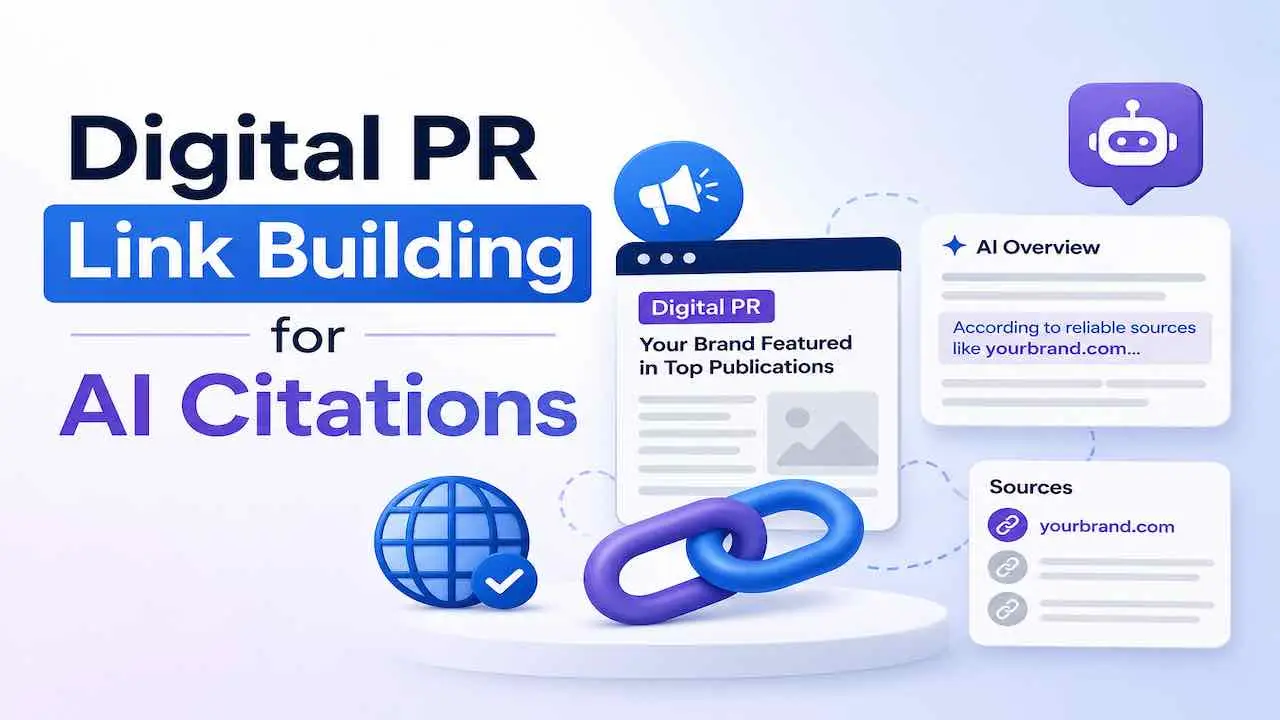
AI engines do not cite pages because they rank well in Google. They cite pages because they are trusted sources and earned media backlinks from real editorial publications are the strongest trust signal AI engines recognise. Digital PR link building for AI citations builds exactly that: press coverage from DR 60 to DR 90 publications that Google AI Overviews, Perplexity AI, ChatGPT Search, Gemini, and Bing Copilot already use as pre-approved reference sources.
BrightEdge research confirms only 17% of AI Overview citations come from pages in the organic top 10. The remaining 83% come from earned media authority, brand mention patterns, and editorial press links that standard SEO link building alone does not build. Brands missing from AI-generated answers, invisible in AI search, and watching competitors cited by AI while their own organic traffic declining from zero-click results share the same root gap: no earned media authority signal.
This guide covers how AI engines choose citations, which journalist outreach platforms earn the highest-authority press links, how to write pitches that beat AI-generated responses, what content types earn AI citation backlinks, and how to track AI citation appearances across all four major AI engines.
What AI Citations Are and Why Standard SEO Cannot Earn Them
An AI citation is when Google AI Overviews, Perplexity AI, ChatGPT Search, or Gemini includes your website as a named source in a generated answer. This is distinct from ranking in organic results. A page can rank at position 1 and never appear in AI-generated answers for the same query. AI citation link building targets a separate authority signal that most SEO programmes have not yet addressed.
The distinction matters because AI-generated answers now appear above organic results for millions of queries. A brand not appearing in AI answers loses visibility to a competitor that does, even if the excluded brand ranks higher in traditional organic search. Brand not appearing in AI Overviews, brand invisible in AI search, and missing from AI answer pools are three compounding problems that one digital PR AI citations strategy addresses simultaneously.
How the AI Citation Signal Differs From the SEO Ranking Signal
SEO rankings depend primarily on keyword optimisation, on-page quality, technical health, and backlink volume. AI citation selection adds three signals SEO rarely addresses directly:
- Entity recognition in Google’s Knowledge Graph so your brand exists as a named entity associated with specific topics
- Earned media authority from editorial press coverage confirming independent publications have cited your brand as a credible source
- Brand mention patterns across high-DR publications creating consistent named mentions across multiple trusted sources, with or without backlinks
Editorial links AI search engines cite come from independent editorial publications, not negotiated blog placements. A brand holding 500 guest post links from DR 25 blogs can rank well while completely absent from AI-generated answers. Digital PR for AI visibility targets exactly this gap. Adding earned media AI citations from Qwoted, HARO, and Roxhill journalist outreach builds the second layer that converts organic visibility into AI search visibility. See our full guide on backlinks for AI search citations and link building for Google AI Overviews.
| Signal | SEO Ranking Impact | AI Citation Impact |
|---|---|---|
| Keyword optimisation | High | Low |
| Backlink volume (DR 20 to 40) | High | Low |
| Earned media from DR 60 to 90 press | Moderate | Very high |
| Brand mentions without backlinks | Low | High |
| DR 80 links from national press | High | Very high |
| Expert commentary in media | Low | Very high |
| Knowledge Graph entity presence | Moderate | Very high |
Why AI Engines Trust Earned Media Links Over All Other Source Types
AI engines are trained on the same signals humans use to assess credibility: who published the information, who cited it, and how independently it was verified. Editorial independence removes manipulation signals. PR backlinks AI engines recognise as highest-authority are editorially independent placements from publications with genuine audiences, not negotiated placements where value was exchanged.
The Four Mechanisms Behind AI Citation Trust
Understanding these four mechanisms explains why digital PR link building for AI citations produces compounding visibility effects that standard backlink acquisition cannot match:
- Editorial independence removes manipulation signals. AI models recognise paid and negotiated placements. Earned media backlinks carry no manipulation signal because the editor chose to include them without incentive. This editorial authority AI search engines weight is the clearest trust signal available.
- DR 80 links feed AI citation probability directly. National publications with DR 80 or above are inside AI training data as pre-approved sources. A link from them associates your brand with content those pre-approved editorial sites considered credible. DR80 links AI citations depend on carry this pre-qualification into every AI engine simultaneously.
- Brand mentions build entity nodes in the Knowledge Graph. Every time a DR 60+ publication names your brand in editorial context, it adds a structured signal to your entity profile. Google’s Knowledge Graph uses these entity signals AI citations rely on to associate your brand with specific topics. AI engines surface your brand when queries fall within those topic associations.
- Earned media is inside LLM training data. Large language models train on web crawls that weight editorial news sources and reference sites far more heavily than blog content or guest posts. Press coverage from these publications puts your brand into the base knowledge of AI models before any query is asked. LLM training data weighting is why digital PR link building for AI citations produces results other off-page tactics cannot replicate.
Muck Rack research confirms earned media accounts for 84% of all AI Overview, Perplexity AI, and ChatGPT Search citations. Paid and advertorial content accounts for 0.3%. The trust signals AI engines weight most align exactly with Google’s EEAT signals: the editorial authority AI search engines weight most is earned, independent, and verifiable. EEAT AI citations depend on exactly this editorial independence. See how this connects to your full EEAT and trust authority strategy.
Ahrefs research across 75,000 brands found brand mentions are 3 times more predictive of AI visibility than backlink counts alone. Media coverage AI search engines use as citation source pools comes almost entirely from independent editorial publications. Earned media AI visibility and earned media AI citations both compound over time as the entity footprint builds across multiple trusted publications.
Connectively, Qwoted, and Roxhill: Journalist Outreach Platforms for AI Citation Link Building
The journalist outreach platform landscape changed sharply in late 2024 and early 2025. Understanding what each platform is now, who uses it, which publications it connects to, and what it costs determines which combination earns the highest-authority press coverage AI citations for your niche.
HARO, Relaunched Under Featured.com
HARO was originally owned by Cision under the Connectively brand name. Connectively shut down permanently on December 9, 2024. Featured.com acquired the HARO brand and relaunched it in April 2025 as a free platform funded by newsletter sponsorships. It operates on the same daily digest model as the original HARO.
The relaunched HARO sends three daily digest emails across broad topic categories. The free model has attracted high pitch volume and journalist inboxes now receive a high proportion of AI-generated responses, which experienced editors identify and ignore immediately. This creates a specific opportunity: authentic, specific, ready-to-publish expert responses stand out clearly against the AI-generated noise. HARO works best for brand mention volume and consistent journalist relationship development across general news and consumer press.
- Cost: Free
- Query volume: High, broad topic coverage
- Publication DR range: Mixed, DR 30 to DR 80+
- Primary AI citation value: Brand mention volume, consumer press coverage
- Main limitation: Heavy AI pitch competition reduces response-to-placement conversion rate
Qwoted
Qwoted is the recommended primary platform for digital PR link building AI citations work. It operates as a verified journalist-to-expert network where all journalists and sources are authenticated before participating. After Connectively shut down in December 2024, Qwoted captured the majority of high-quality journalist queries from premium publications.
Over 70% of Qwoted queries originate from DR 80+ publications. This makes it the single highest-use reactive platform for earning the press coverage AI citations require. Verified participation eliminates the AI-generated pitch flooding that affects HARO. Qwoted also includes a proactive expert search feature where journalists find your profile without a posted query, generating inbound placement requests at no additional effort.
- Cost: $99 per month Pro tier, removes pitch limits
- Query volume: Lower than HARO, far higher quality
- Publication DR range: 70%+ of queries from DR 80+ outlets
- Primary AI citation value: High-authority media links from publications inside AI training data
- Best for: DR 80+ media link acquisition and AI brand visibility building
Roxhill
Roxhill is a UK-focused journalist database and real-time media monitoring platform for proactive outreach campaigns. Unlike HARO and Qwoted, which are reactive platforms where journalists post queries and brands respond, Roxhill lets your team identify journalists, research their beat and recent coverage, and pitch them directly before any query is posted anywhere.
This proactive model works best for planned data-driven PR campaigns and newsjacking. Roxhill’s real-time media monitoring alerts your team when a breaking story appears in your industry, enabling same-day journalist pitches before reactive platforms even list the opportunity. For UK press coverage links at DR 60 to DR 85, Roxhill is the most targeted proactive outreach tool available for digital PR strategy for AI visibility.
- Cost: Enterprise pricing, contact Roxhill directly for a quote
- Coverage focus: UK publications, national press, trade media
- Primary AI citation value: Planned editorial campaigns targeting specific high-DR publications
- Best for: UK brands, planned digital PR strategy for AI visibility, newsjacking
Platform Budget Summary
| Platform | Monthly Cost | Query Type | Avg. Publication DR | AI Citation Value |
|---|---|---|---|---|
| HARO via Featured.com | Free | Reactive | Mixed, DR 30 to 85 | Medium |
| Qwoted Pro | $99 per month | Reactive and inbound | 70%+ of queries DR 80+ | Very high |
| Roxhill | Enterprise rate | Proactive | DR 60 to 85 UK press | High |
How to Write Pitches That Beat AI-Generated Responses
The biggest obstacle in journalist outreach in 2025 is AI-generated pitch flooding. Journalists on HARO and Qwoted receive hundreds of responses per popular query, most produced by AI tools that generate generic expert-sounding answers. Experienced editors identify these within seconds and move on. Winning pitches share six specific characteristics that AI-generated content cannot replicate:
- A ready-to-publish quote in the first sentence. Open with the quote the journalist can paste into their article immediately. Format: “First name, job title at Company, says: [quote].” Not a pitch about your company. Not background. The quote first.
- A concrete statistic, data point, or named example. AI generates plausible-sounding generalities. A specific number, a named client outcome, or a real-world example immediately signals a human with genuine experience wrote this. This is what journalist outreach AI citations campaigns must prioritise.
- A named, credentialled spokesperson. Include full name, job title, company name, and relevant years of experience or credential. Journalists need someone accountable to quote. Anonymous or vague expert attribution gets deleted without reply.
- Direct relevance to the journalist’s exact question. Read the query carefully. Address their specific angle, not a general topic tangentially related to it. Off-topic responses are filtered without reply.
- Under 200 words total. Keep the entire response including the quote under 200 words. Cision research confirms journalists prefer pitches under 200 words. Long responses signal the sender did not respect the journalist’s time.
- A response within 60 minutes on Qwoted. First relevant response from a qualified source consistently wins placement priority. Speed is a direct competitive advantage on Qwoted because competition for each query is from fewer, better sources than on HARO.
Five Content Types That Earn AI Citation Backlinks
Not all digital PR content earns AI citations equally. These five content formats generate the editorial press coverage that journalists publish and AI engines cite as authoritative sources. Newsworthy content link building and newsworthy content for AI citations both depend on matching the right format to the right outreach channel.
Proprietary Data Studies
Original data your business holds exclusively generates the most AI citation backlinks per campaign. Journalists at national publications and trade media cite data studies because they are primary sources with no freely available alternative. AI engines pull these citations because the data appears across multiple publications as a verified original source. Typical yield: 15 to 80 unique referring domains per published study. Pitch exclusively to your top 3 target publications first, then release broadly to wider outreach. Earned media backlinks for AI search come overwhelmingly from this content type at the premium DR tier.
Expert Commentary via Qwoted and HARO
Specific, credentialled expert responses to journalist queries on Qwoted and HARO earn expert attribution links from news publications. These build the entity association AI engines use to identify authoritative sources for specific topic areas. Typical yield: 3 to 15 placements per month with a consistent daily response programme. Each placement adds to the entity authority signal that drives press coverage AI citations accumulation over time.
Reactive Newsjacking
Immediate expert responses to breaking industry news before journalist query platforms post requests. Roxhill’s real-time monitoring enables same-day pitches directly to journalists covering breaking stories. These reactive placements appear in news articles with fresh citation dates. Typical yield: 2 to 10 placements per news cycle. Google AI overview citation earned media from breaking news coverage carries a timeliness signal that boosts citation probability for current queries.
Annual Index Reports
Original annual reports and industry index pieces that publications cover and subsequently cite as a reference benchmark. Once an annual report establishes itself as the sector reference point, it earns citations from journalists covering the annual release and from other publications referencing it throughout the year. AI engines favour these because they are consistent, date-stamped, and verifiable primary sources. Typical yield: 20 to 100+ referring domains over 12 months.
Linkable Tools and Data Resources
Free calculators, interactive datasets, and reference tools that journalists link to as resources for their readers. These earn earned media backlinks for AI search passively after initial outreach because editors return to reliable tools as reference points in future articles. Typical yield: Compounding growth over time, without active outreach after initial launch. AI engines treat stable, authoritative reference assets with above-average citation probability because they appear consistently across multiple trusted publication contexts.
DR 80 Links and AI Citation Probability
DR 80 links AI citation probability depends on are not just about domain rating. These publications are inside AI training data as pre-approved sources. A link from a DR 80+ national publication tells the AI model that your brand is associated with content that an independent, trusted editorial team considered worth referencing.
DR 80 links AI citation impact is exponentially higher than DR 30 guest post links. A site with 10 DR 80+ press links consistently earns more AI citations than a site with 200 DR 25 guest post links from non-editorial sources. AI trust signals are weighted toward quality and editorial independence, not volume. Understanding how AI engines choose citations traces directly to this quality-over-volume mechanism.
Qwoted’s 70%+ DR 80+ query concentration makes it the most targeted platform for building this exact press coverage. Responding to 10 Qwoted queries per month with high-quality expert commentary and converting 2 to 3 into live placements produces more AI citation impact than 20 lower-tier guest post placements from the same period.
Nofollow DR 80+ links also contribute to AI citation probability. Many national publications use nofollow attributes on outbound links. For traditional SEO, these pass no PageRank. For AI citation signals, editorial context matters more than link attribute. A nofollow mention in a national publication carries entity and brand authority signals that feed AI citation probability regardless of follow status. Our digital PR link building service includes link reclamation outreach to convert nofollow coverage to dofollow links wherever editorial policy allows.
How Press Coverage Builds Entity Signals for AI Citations
Google’s Knowledge Graph treats your brand as an entity with defined attributes, relationships, and associated topics. AI engines use this entity profile when deciding whether your brand is a credible citation source for a given query. Press coverage from editorial publications builds that entity profile at scale more efficiently than any other off-page strategy.
Entity signals AI citations rely on are built when high-DR publications name your brand consistently in editorial context. Each editorial mention contributes to the entity node connecting your brand to specific industry topics. Brand mentions AI citations count include both linked and unlinked editorial coverage because AI models train on text content from those publications, not just their link graphs.
Earned media AI citations accumulate from these mention patterns and drive earned media AI visibility across all four major AI engines simultaneously. Press coverage for AI search visibility builds the entity presence that puts your brand into AI answer pools for relevant queries. Media coverage AI search decisions trace directly back to this entity profile in Google’s Knowledge Graph. Each new Qwoted, HARO, or Roxhill placement strengthens a different facet of that entity node.
Brands appearing consistently in 40 or more editorial articles across DR 60+ publications become recognised by AI engines as trusted information sources for queries in those topic areas. Brand mentions AI citations and entity signals AI citations both compound over time. This is why digital PR AI citations strategy produces long-term AI search visibility that cannot be replicated by any volume of standard guest post or niche edit link building.
How to Track AI Citation Appearances
Tracking AI citation appearances requires a different approach from tracking SEO rankings because AI-generated answers change dynamically and vary by query phrasing. These are the four tracking methods that produce reliable, actionable data for a digital PR link building AI citations programme:
Manual Query Testing Across All Four AI Engines
Run your 15 most important target queries monthly in Google AI Overviews, Perplexity AI, ChatGPT Search, and Gemini. Each query where a competitor appears but you do not is a gap your digital PR link building AI citations programme must close. Record which brands appear as named citation sources in the generated answers. Track whether your brand appears and which query types trigger your citation. Compare results month on month after each digital PR campaign cycle. This is the most direct measure of how digital PR earns AI citations for your brand.
Semrush AI Toolkit
Semrush now tracks AI Overview appearances for target keywords across your monitored keyword set. The AI Toolkit shows which queries trigger AI-generated answers and which sources are cited in those answers. Use this alongside manual testing to scale tracking across more keywords than manual testing alone covers. AI brand visibility improvements from digital PR campaigns become visible in Semrush AI Toolkit data within 6 to 8 weeks of earned media placements going live.
Ahrefs Brand Mention Monitoring
Use Ahrefs Alerts to monitor brand mentions across newly indexed content. Track when high-DR publications name your brand in editorial context, with or without a backlink. Each new editorial mention from a DR 60+ source is a potential entity signal addition. Log these alongside your Qwoted, HARO, and Roxhill placement reports to build a complete earned media authority timeline showing how AI link building strategy compounds over time.
Perplexity AI for Competitive Citation Research
Run competitor brand names in Perplexity AI for your most important industry queries. Perplexity displays its source citations visibly for each answer. This reveals which publications and domains Perplexity trusts as citation sources in your niche, which directly informs which outlets to target in your Roxhill and Qwoted outreach campaigns. Perplexity AI citation digital PR strategy starts with knowing which sources Perplexity already trusts in your sector.
Step-by-Step Digital PR Strategy for AI Citations
This is the practical workflow for building earned media authority that feeds AI citation visibility across Google AI Overviews, Perplexity AI, ChatGPT Search, and Gemini. How to get cited in AI search starts with understanding where you currently stand against the competitors who already appear in those answers.
- Step 1: Audit Your AI Citation Gap
Run your 10 most important target queries in all four AI engines. Record which competitor brands appear as cited sources. Pull their backlink profiles in Ahrefs and count how many DR 60+ press links they hold compared to yours. Run the same queries in Perplexity AI and note which publications appear as sources. This gap between their earned media profile and yours defines your AI link building strategy and the volume of digital PR link building for AI citations activity needed to compete.
- Step 2: Set Up Qwoted Pro and HARO Daily Monitoring
Create verified profiles on Qwoted Pro ($99/month) and HARO (free via Featured.com). Set topic filters to your exact industry categories. Assign a team member to check both platforms daily and respond within 60 minutes of any relevant query. On Qwoted, this speed advantage increases placement probability in each cycle because competition per query is from fewer, better sources. On HARO, speed is less important than response quality and authenticity against AI-generated pitches.
- Step 3: Add Roxhill for Proactive UK and Trade Press Outreach
Digital PR link building for AI visibility through Roxhill requires a targeted list of 20 to 30 UK journalists and trade publication editors in Roxhill who cover your industry regularly. Review their last 5 articles to understand their current angle. Pitch proactively when your data or expert commentary aligns with their beat. Use Roxhill’s real-time monitoring for same-day newsjacking pitches on breaking stories before reactive platforms list the opportunity. Journalist outreach AI citations from proactive Roxhill campaigns target specific high-DR outlets that Qwoted and HARO may not consistently surface.
- Step 4: Commission One Data Study Per Quarter
Produce a proprietary data study in your industry each quarter. Survey customers, analyse internal data, or partner with a research firm to produce original findings journalists cannot source elsewhere. Pitch the study exclusively to your top 3 target publications first, then release broadly to wider outreach. One strong quarterly data study consistently outperforms 12 months of reactive journalist responses alone in total earned media backlinks for AI citation building. Data-driven PR at this level earns the press coverage AI citations that HARO and Qwoted alone cannot produce at scale.
- Step 5: Track AI Citations and Iterate Monthly
Run target queries monthly in all four AI engines. Track Semrush AI Toolkit appearances for monitored keywords. Monitor Ahrefs for new DR 60+ brand mentions. The correlation between earned media placements from Qwoted, HARO, and Roxhill outreach and subsequent AI citation appearances typically becomes visible within 2 to 4 months. ChatGPT citation digital PR results and Perplexity AI citation digital PR appearances both trace the same pattern: consistent earned media activity at DR 60+ level drives citation probability across all AI engines simultaneously.
Frequently Asked Questions About Digital PR Link Building for AI Citations
Digital PR link building for Google AI Overviews builds the earned media authority that Google uses as a primary citation source selection signal. BrightEdge research shows only 17% of AI Overview citations come from top-10 organic ranking pages. The other 83% come from editorially independent coverage in publications Google recognises as trusted. When your brand earns press links from DR 60+ publications through journalist outreach on Qwoted, HARO, and Roxhill, it accumulates the entity trust signals Google’s AI models use to decide which sources appear in generated answers. See our full guide on Google AI Overviews optimisation.
Qwoted focuses on quality over volume, with over 70% of its journalist queries coming from DR 80+ publications. HARO (relaunched under Featured.com in 2025) is free and high-volume but heavily affected by AI-generated pitch flooding. For digital PR link building AI citations, Qwoted Pro at $99 per month produces higher-authority placements from publications inside AI training data as pre-approved citation sources. Use both: Qwoted for premium DR 80+ target placements and HARO for brand citation volume and consumer press coverage.
Yes. Brand mentions in editorial content from high-authority publications contribute to AI citation visibility even without a backlink. AI models train on text content from trusted publications, not just their link graphs. A brand named consistently as a credible expert source in DR 70+ editorial articles builds entity authority in Google’s Knowledge Graph regardless of link attribute. Ahrefs research across 75,000 brands found brand mentions are 3 times more predictive of AI visibility than backlink counts alone. Earned media AI citations and earned media AI visibility both benefit from unlinked editorial mentions at the DR 60+ level.
Most brands see AI citation appearances within 2 to 4 months of consistent digital PR activity targeting DR 60+ publications. Brands starting from zero earned media presence typically need 8 to 12 placements from DR 60+ publications before consistent AI citation appearances begin. Qwoted placements in DR 80+ outlets accelerate this timeline compared to lower-DR consumer press placements. Track with Semrush AI Toolkit and manual query testing in all four AI engines to see correlation within 3 months of programme activity starting.
Standard link building optimises for Google’s PageRank algorithm through referring domain volume and anchor text strategy. Digital PR link building for AI citations optimises for entity authority, brand mention patterns, and editorial trust signals that AI engines use to select citation sources. AEO (answer engine optimization) and GEO (generative engine optimization) both depend on the earned media and entity signals that digital PR builds. Featured snippet eligibility and voice search answer sourcing follow the same authority signals as AI citations. and entity signals that digital PR builds. A site with 500 guest post links may rank well while being absent from AI-generated answers. See our full generative engine optimisation guide for how earned media feeds AI visibility directly.
Our digital PR link building service runs journalist outreach campaigns on Qwoted, HARO, and Roxhill alongside data-driven PR content creation and link reclamation outreach. Every campaign targets the DR 60 to DR 90 publication tier that feeds both traditional Google rankings and AI engine citation probability simultaneously.
Build Your AI Citation Authority
Get a Free Digital PR and AI Citation Audit
We audit your current AI citation presence across Google AI Overviews, Perplexity AI, and ChatGPT Search, identify your earned media gap against competitors, and build a digital PR campaign plan targeting the publications that feed your industry AI answers.
No pitch. No obligation. A real audit showing exactly where you stand and what earned media activity closes the gap.
Part of Quick Digital’s full link building service ·
Digital PR service ·
AI Overviews guide ·
FAQs