

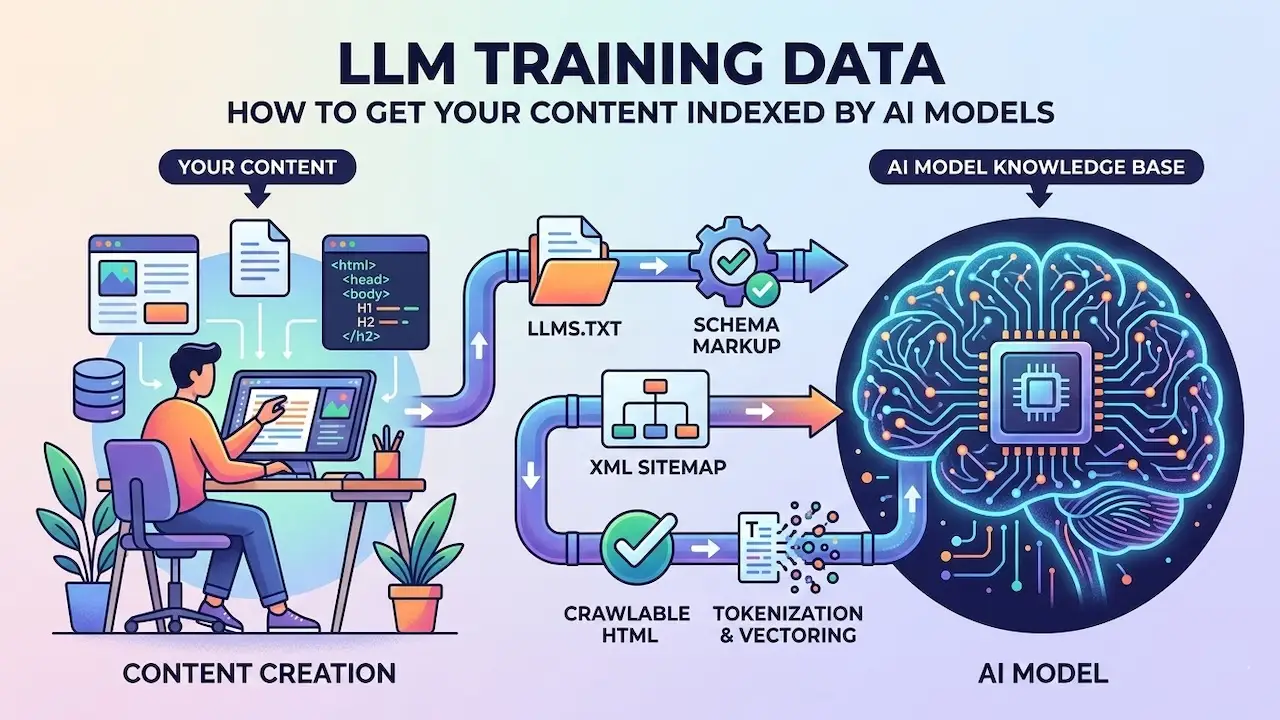
LLM training data is the large language model dataset AI systems process during pretraining to learn language, facts, and reasoning. To get your content into it, allow AI bots in robots.txt, add an llms.txt file, fix JavaScript rendering, and build citations on authority platforms. Also submit to Bing Webmaster Tools, implement structured data markup, and publish original content that passes corpus filtering.
AI is replacing a measurable share of organic search traffic. Brands left out of AI answers share one common failure. Their content never entered the LLM training data pipeline at all. Competitors appearing in ChatGPT and Perplexity AI responses did not get there by accident. They fixed their crawlability, built their AI citation authority, and published citation-friendly content on trusted platforms.
Since 2014, Quick Digital’s AI SEO team has helped brands fix these exact barriers. This guide gives you the exact same 7-step framework. It shows how to get content into LLM training data pipelines and live AI retrieval systems at the same time so you get found in AI search across every major platform.
What LLM Training Data Actually Is
LLM training data is the raw AI training corpus that neural network training processes consume before any user query occurs. This machine learning training data spans trillions of tokens collected from training data sources across the public web, academic papers, books, code repositories, and curated collections. Latent semantic relationships between concepts are baked into the text corpus during this collection phase. AI data collection happens through web crawlers, then passes through multiple corpus filtering stages before models ever train on it.
Your content affects AI answers through 2 separate paths. The first is static pretraining, where LLM training data shapes what models know long term. The second is live retrieval, called RAG or retrieval-augmented generation, where AI tools pull your pages at query time. Both paths require separate optimization actions. Most brands optimize for neither, which is the root cause of being invisible to AI and missing AI traffic entirely.
Two AI Indexing Pipelines Compared
Each pipeline runs on different rules and responds to different signals. Understanding both is the starting point for any serious LLM training data and AI content indexing strategy.
| Factor | Pre-Training Pipeline | RAG Retrieval Pipeline |
|---|---|---|
| Purpose | Shapes model knowledge long term | Answers live user queries in real time |
| Data Source | Common Crawl, large language model datasets | Bing index, Google index |
| Time to Visibility | Months, depends on next training run | Days to weeks via IndexNow submission |
| Optimized By | Open AI bots, original content, authority citations | Bing ranking, schema markup, page speed |
| Serves Platforms | GPT-4, Claude 3, Gemini, LLaMA, Mistral | Perplexity, Copilot, ChatGPT Browse |
The Training Datasets That Power Major AI Models
AI developers build LLM training data corpora from named, curated large language model datasets. Knowing which training data sources feed which models tells you exactly where to place content for maximum AI content indexing potential.
| Dataset | Primary Source | Models Trained On It |
|---|---|---|
| Common Crawl | Public web, monthly crawl cycle | GPT-4, Claude 3, LLaMA, Gemini, Mistral |
| C4 (Colossal Clean Crawled Corpus) | Filtered Common Crawl | T5, PaLM, Flan model family |
| The Pile | GitHub, PubMed, arXiv, Stack Exchange | GPT-NeoX, EleutherAI models |
| Dolma | Common Crawl, Wikipedia, GitHub, Reddit | OLMo model series by Allen AI |
| RedPajama | Open LLaMA reproduction corpus | Community LLMs worldwide |
| Wikipedia | Curated encyclopedic articles | Every major LLM corpus without exception |
Meta’s LLaMA models drew approximately 67 percent of their machine learning training data from Common Crawl. Your content enters every model that draws from Common Crawl as long as CCBot can access your pages. A Wikipedia citation naming your brand carries outsized weight across every large language model dataset at once.
How Transformers Turn Your Content Into AI Knowledge
Transformer-based language models use attention mechanisms to process the LLM training data corpus during pretraining. Raw text goes through tokenization first. Byte pair encoding breaks content into subword units called tokens. Models assign numerical values to tokens and store meaning relationships as vector embeddings inside an embedding space.
Content with clear semantic chunking produces stronger word embeddings. Natural language processing and sentence transformers then calculate cosine similarity and semantic similarity between concepts. These embedding scores determine how retrievable your content is at query time. Passage-level clarity directly affects citability inside AI-generated answers.
After pretraining, models go through supervised fine-tuning using instruction-following datasets. Then RLHF, or reinforcement learning from human feedback, aligns outputs with human preferences. Chain-of-thought fine-tuning and knowledge distillation happen in later stages. Your content influences pretraining. The fine-tuning and instruction tuning stages use separate curated data after that point.
Why Your Content Is Invisible to AI Models Right Now
Most sites have at least one technical barrier that blocks AI crawlers and kills content visibility in AI entirely. Fixing the wrong problem first wastes months. Identify the actual blocker before touching content quality or writing any new pages.
The 3 Tier AI Crawler Structure You Must Understand
AI companies now operate 3 separate crawlers for 3 separate jobs. Confusing them means blocking the wrong bot and losing the wrong type of AI visibility without gaining any protection over your content.
| Tier | Purpose | OpenAI Bot | Anthropic Bot | Perplexity Bot |
|---|---|---|---|---|
| Training | Feeds LLM training data corpus | GPTBot | ClaudeBot | CCBot |
| Search Index | Powers live AI search answers | OAI-SearchBot | Claude-SearchBot | PerplexityBot |
| User Retrieval | Handles real-time user requests | ChatGPT-User | Claude-User | Perplexity-User |
Blocking ClaudeBot stops pretraining data collection. It does not stop Claude-SearchBot or Claude-User from accessing your site. Blocking the wrong bot tier removes AI visibility without achieving your intended goal. Plan each robots.txt directive with this 3 tier structure in mind.
Anthropic confirmed all 3 of its bots honor robots.txt directives. OpenAI notes ChatGPT-User may not follow robots.txt on user-initiated fetches. Perplexity bots were documented bypassing robots.txt using rotating IP addresses on at least one confirmed occasion. Monitor your server access logs regularly to confirm actual bot behavior on your domain.
JavaScript Rendering Silently Blocks AI Crawlers
GPTBot does not execute JavaScript. It processes only static HTML on the first bot request. React, Vue, and Angular apps relying on client side rendering deliver an empty HTML shell to GPTBot and CCBot. The crawlability problem runs silent, meaning no error appears in Google Search Console while your AI content indexing fails completely.
A page that renders perfectly in your browser but serves an empty shell to GPTBot never enters Common Crawl’s large language model dataset. This is the most common cause of missing AI traffic on sites with strong Google rankings and good domain authority. Fix rendering before reviewing content quality at all.
Content Gating and Paywalls Block AI Crawlers Too
Hard paywalls that block crawler access remove AI Overview eligibility entirely. A Rutgers and Wharton study found that major publishers blocking LLM crawlers lose approximately 23 percent of their weekly traffic as AI answers replace traditional search clicks. Open access content dominates AI citation slots. Paywalled pages are structurally excluded from every generative AI feature across platforms.
Review your gated content strategy with AI crawlability in mind. Gated content AI crawlers cannot access simply does not exist inside any training corpus or retrieval pool. Publishers who grant AI bot access through flexible sampling while still requiring registration for human readers keep their AI search visibility intact. Content gating that blocks GPTBot, ClaudeBot, and PerplexityBot cuts every LLM training data and RAG retrieval path at once.
Near Duplicate Content Triggers MinHash Deduplication
MinHash deduplication collapses near-duplicate pages before training begins. Corpus filtering also removes pages with low stop word density, high symbol-to-word ratios, and low n-gram diversity. A rephrased version of a competitor article still carries high vector similarity. Deduplication filters treat it as a duplicate instance and remove it from the machine learning training data corpus. Only original content survives with its own vector embedding and citation potential.
7 Steps to Get Your Content Into LLM Training Data
Apply these steps in sequence. Each one removes a blocker that stops the next from working effectively. Start with crawlability. Then build authority signals. Content quality improvements come last, not first.
Step 1. Update robots.txt for the 3 Tier AI Crawler System
Many sites block AI bots through legacy wildcard rules written years ago. Open your robots.txt file today. Add explicit allow rules for every named AI crawler across all 3 tiers to restore full AI crawlability and content visibility in AI search.
User-agent: GPTBot
Allow: /

User-agent: OAI-SearchBot
Allow: /

User-agent: ChatGPT-User
Allow: /

User-agent: ClaudeBot
Allow: /

User-agent: Claude-SearchBot
Allow: /

User-agent: Claude-User
Allow: /

User-agent: Google-Extended
Allow: /

User-agent: PerplexityBot
Allow: /

User-agent: CCBot
Allow: /

User-agent: Meta-ExternalAgent
Allow: /
Know before you allow: Bytespider from ByteDance is now the 4th largest AI crawler by traffic volume. Meta-ExternalAgent extracts content at scale but returns zero referral traffic to publishers. Make a deliberate decision about these bots based on your content monetization goals before writing any allow rule.
Review your server access logs 14 days after this update. Look for visits from GPTBot, ClaudeBot, Claude-SearchBot, CCBot, and PerplexityBot. No bot visits after 30 days means a deeper technical block exists at the CDN or firewall level, not just in robots.txt.
Step 2. Build Your llms.txt File
Jeremy Howard of Answer.AI introduced the llms.txt standard as a Markdown navigation file for AI tools. Place it at yourdomain.com/llms.txt. It guides AI crawlers to your most important pages and tells them what your site covers and which content to attribute to your brand for AI citation authority.
Set accurate expectations: As of early this year, no major AI company including OpenAI, Google, Anthropic, or Meta has publicly confirmed they use llms.txt in production retrieval systems. Google’s John Mueller confirmed Google Search does not read it. GPTBot fetches it occasionally. Build one as infrastructure for the agentic web. AI developer tools like Cursor and GitHub Copilot actively use it for real-time document retrieval today, not as an immediate LLM training data lever.
# Quick Digital | GEO and AI Visibility Services

> We help brands get cited in ChatGPT, Gemini, Claude, and Perplexity.

## Key Pages
- [GEO Services](/generative-engine-optimization-services/)
- [LLM Training Data Guide](/llm-training-data-ai-indexing/)
- [AEO Services](/aeo-answer-engine-optimization-services/)
- [AI SEO Services](/ai-seo-services/)

## Topics Covered
- LLM SEO, GEO, AEO, LLMO, voice search optimization
- AI model indexing for ChatGPT, Perplexity, Claude, Gemini, Copilot
Also build an llms-full.txt file with complete page content in one Markdown document. AI models with longer context windows use this version for deep content ingestion across your full site.
Step 3. Submit to Bing and Activate IndexNow
Bing is the primary RAG source for every major non-Google AI platform. Perplexity AI uses Bing. Microsoft Copilot uses Bing. ChatGPT Browse pulls from Bing via OpenAI’s web plugin. A page absent from Bing’s index is invisible to all 3 platforms at once and completely cut off from their AI answer engines.
Register your site in Bing Webmaster Tools today. Submit your XML sitemap directly inside the tool. Sites registered in Bing Webmaster Tools get AI citations 3 to 4 weeks faster than sites relying on organic crawling alone.
Activate IndexNow after submitting your sitemap. IndexNow pings Bing within hours of each new page you publish. WordPress users activate it through Rank Math or Yoast SEO with no custom code needed. Faster Bing indexing directly reduces missing AI traffic from Copilot, Perplexity AI, and ChatGPT Browse at once.
Also Submit to Google Search Console
Google AI Overviews pull only from Google’s own index. Submit your sitemap in Google Search Console separately. Strong Google ranking is the baseline requirement for Google AI Overview citations. Use the URL Inspection tool to request indexing for priority pages immediately after publishing.
Step 4. Fix JavaScript Rendering for AI Crawlers
AI crawlers cannot read content that appears only after client side JavaScript runs. Fix this with one of these 3 approaches:
- Server side rendering (SSR): Your server generates complete HTML before sending it to the crawler. Every bot receives a fully rendered page on the first request without running any scripts.
- Static site generation (SSG): Pre-build pages as static HTML files. Any crawler reads them immediately with zero code execution required on arrival.
- Prerender.io or similar tools: Intercept AI bot requests and serve pre-rendered static HTML without changing your existing front-end architecture at all.
Test AI crawlability by disabling JavaScript in your browser. If core content disappears from the page, AI crawlers receive an empty shell. Your content never reaches any LLM training data pipeline or RAG retrieval pool in that state.
Step 5. Implement JSON-LD Structured Data Markup
Structured data markup turns human-readable pages into machine-readable signals that help RAG systems identify and rank content for AI citations. JSON-LD is the preferred format across every major AI platform. Research documented a 29.6 percent RAG retrieval accuracy improvement for JSON-LD-marked content over plain HTML in standard retrieval pipelines. This directly improves citability and content discoverability across AI answer engines.
| Schema Type | Apply To | AI Indexing Benefit |
|---|---|---|
| Article | All blog posts and guides | Signals content type, author, and freshness date to RAG systems |
| FAQPage | Every FAQ section on every page | Creates citation-ready Q and A pairs under 40 words each |
| HowTo | All step-by-step guides and tutorials | Helps AI systems reconstruct ordered process flows accurately |
| Organization | Homepage and About page | Establishes brand entity with name, URL, and logo for knowledge graph |
FAQPage schema with answers under 40 words creates the clearest AI citation signals. These same answers trigger voice search extraction by Google Assistant, Siri, and Alexa. One schema implementation improves Google AI Overview presence, voice search citations, and People Also Ask appearances from a single content investment.
Important nuance from research: A study tracking 1,885 pages found that adding JSON-LD to pages already recognized by AI did not significantly increase citation rates on its own. Schema markup works best as one layer in a broader strategy that also includes content quality, entity SEO, Bing ranking, and original content that passes MinHash deduplication.
Step 6. Build LLM Seeding and Digital PR for AI Citations
LLM seeding is the most direct way to get brand cited in AI and get content into LLM training data at the source level. The strategy focuses on placing content and brand mentions in AI on platforms that feed LLM training datasets directly. To get cited in Perplexity AI, ChatGPT, and Gemini through seeding, you need citations on platforms these models already trust in their corpus filtering pipelines. Wikipedia, GitHub, Stack Overflow, Medium, Reddit, and PR Newswire carry pre-verified authority status in corpus filtering pipelines. Content cited on them enters training data at a higher rate than content on your own domain alone. This builds brand familiarity inside AI models at the pretraining level, creating a long-term AI citation authority advantage.
- Publish original research and cite your domain as the primary source in every piece for AI data collection to pick up.
- Contribute factual content to relevant Wikipedia articles with your site as a reference link.
- Release technical documentation or open-source tools on GitHub with permissive licenses.
- Earn brand mentions in AI-cited press coverage through digital PR for AI visibility on trusted publications.
- Answer expert questions on Stack Overflow and Quora with links back to your detailed guides.
Each action places your brand inside training data sources that survive domain-level quality filters during pretraining data collection. These citations also survive MinHash deduplication because they appear on domains that pre-pass every corpus filtering stage automatically. Consistent brand mentions on authoritative platforms also build your knowledge panel and strengthen knowledge graph associations that AI systems draw from when generating answers.
Build E-E-A-T Signals Alongside Platform Citations
LLM quality filters assess domain trust through expertise, experience, authoritativeness, and trustworthiness signals. Add author bio pages with verifiable credentials. Link to primary sources throughout your content. Display your organization registration details clearly. Publish case studies with measurable outcomes and real client data that readers can verify independently.
These E-E-A-T improvements strengthen both the pretraining pipeline and RAG retrieval ranking from a single content investment. They matter equally for Google Search, Bing, and AI platform quality assessments across every major model.
Step 7. Publish Original Content That Beats Corpus Filtering
Publish proprietary survey data, original research, or unique case studies with real measurable outcomes. Give each piece a perspective not available anywhere else on the web. Each original piece becomes an independent source in the pretraining corpus. It gets its own vector embedding, its own co-occurrence patterns, and its own citation potential inside AI-generated answers. This is what makes content truly citation-friendly for both machine learning SEO and generative AI search.
This content approach produces compounding AI visibility over time. It builds topical authority, semantic density, and semantic SEO coverage that no algorithm update removes. It is the foundation of a future-proof content strategy for AI search that outlasts any single platform’s ranking criteria or LLM training data refresh schedule.
Content freshness also matters for RAG retrieval systems. Perplexity AI and Google AI Overviews both use a query fan-out process that prioritizes current sources. Update your evergreen pages on a regular cadence. Surface update dates visibly. This signals recency to both traditional search and AI retrieval layers at once.
Voice search formatting tip: Format FAQ answers as complete sentences between 20 and 40 words. Answers in this length read naturally when spoken aloud. Google Assistant, Siri, and Alexa extract passages in this range for spoken responses. This applies especially to local and near me voice search queries where brevity and accuracy matter most.
Content Format That LLMs Extract and Cite
LLMs extract information at the passage-level through semantic chunking. They pull individual sentences and short sections that directly answer specific queries. Your format determines how cleanly those passages extract. Poor format means AI systems skip your content even when crawlability is perfect and content freshness is current.
Page Structure for Maximum AI Content Discoverability
Each structural choice below directly affects how often AI models cite your passages. Apply all 6 to make your pages citation-friendly sources that AI prefers over any competitor covering the same topic.
- Put a direct factual answer in the first 300 characters of every page, before any background context or narrative.
- Write H2 headings as natural language questions to match conversational search and optimize content for LLM training data retrieval pipelines.
- Keep one idea per paragraph at 2 to 3 sentences maximum so extraction tools isolate each point cleanly without mixing concepts.
- Use numbered steps for any process with a sequence so AI models reconstruct ordered flows accurately when generating answers.
- Add FAQ sections with schema-tagged answers under 40 words each to trigger AI Overview, featured snippets, and People Also Ask citations from one content investment.
- Place subheadings at least every 300 words to support AI content discoverability and human readability together.
Entity SEO and Semantic Relevance That Prove Topical Authority
AI models understand topics through named entity recognition and natural language processing, not keyword matching. Content that references the full entity framework of a topic signals topical authority to both LLMs and traditional semantic SEO algorithms at once. LLMs use co-occurrence patterns and keyword co-occurrence signals to build semantic relevance maps. When your brand consistently appears near topical entities in the LLM training data corpus, models associate your domain with that subject area during pretraining itself.
For LLM training data as a topic, relevant entities span 6 categories. AI organizations like OpenAI, Anthropic, Google DeepMind, Meta AI, Mistral AI, Allen AI, and Hugging Face form the first. Training datasets like Common Crawl, C4, The Pile, Dolma, and RedPajama form the second. Training processes like RLHF, supervised fine-tuning, instruction tuning, and transformer architecture form the third. Retrieval tools like LlamaIndex, Pinecone, Weaviate, and Chroma form the fourth. AI answer platforms like ChatGPT, Perplexity AI, Gemini, Claude, and Microsoft Copilot form the fifth. Visibility tools like Indexly, Rankio, and Otterly.ai form the sixth.
| Entity Category | Examples to Include Naturally |
|---|---|
| AI Organizations | OpenAI, Anthropic, Google DeepMind, Meta AI, Mistral AI, Allen AI, Hugging Face |
| Large Language Model Datasets | Common Crawl, C4, The Pile, Dolma, RedPajama, Wikipedia |
| Training and NLP Processes | RLHF, supervised fine-tuning, tokenization, byte pair encoding, transformer, BERT, sentence transformers |
| Retrieval Tools | LlamaIndex, Pinecone, Weaviate, Chroma, RAG pipelines, embedding space |
| AI Answer Platforms | ChatGPT, Perplexity AI, Gemini, Claude, Microsoft Copilot |
| Visibility and Tracking Tools | Indexly, Rankio, Otterly.ai, Bing Webmaster Tools, Google Search Console |
Referencing these entities naturally within factual context demonstrates deep domain knowledge. AI corpus filtering rewards this with higher machine learning training data inclusion rates. Entity SEO and semantic SEO signals from this coverage also improve rankings across Google, Bing, and AI retrieval platforms together. One investment in entity-rich content improves LLM visibility, machine learning SEO performance, and traditional search rankings at once.
Writing Style That Passes AI Quality Filters
- Keep sentences under 17 words for the majority of body content to pass readability scoring in corpus filtering pipelines.
- Write in active voice in over 91 percent of sentences throughout every published page and guide.
- Use plain language that a non-specialist reads and understands on the first pass through conversational search phrasing.
- Include specific numbers, named tools, and named organizations throughout as concrete entity SEO signals.
- Maintain consistent terminology across all pages so entity disambiguation tools link every mention to your brand correctly.
GEO, AEO, and LLMO: Three AI Visibility Disciplines
Three disciplines now work alongside traditional machine learning SEO for full AI pipeline coverage. Each targets a different part of the AI answer pipeline. Dropping any one creates a gap that competitors fill within weeks. All 4 together represent a complete AI content strategy for getting found in AI search.
| Discipline | Focus Area | Primary Outcome |
|---|---|---|
| GEO (Generative Engine Optimization) | Brand citations inside AI-generated answers | Brand appears in ChatGPT, Perplexity AI, Gemini, Claude responses |
| AEO (Answer Engine Optimization) | Structuring content as direct factual answers | Appears in zero-click AI answers, voice search, People Also Ask |
| LLMO | Entering LLM pretraining corpora directly | Shapes model knowledge long term through knowledge graph enrichment |
| SEO | Organic ranking through machine learning SEO signals | Feeds RAG retrieval through Bing and Google index positions |
SEO feeds RAG retrieval through Bing and Google ranking. Generative engine optimization builds citation presence inside AI-generated answers. Answer engine optimization structures content for direct passage-level extraction as a spoken or displayed fact. LLMO gets content into the training corpus through tokenization, byte pair encoding, and vector embeddings during pretraining.
Brands applying all 4 disciplines consistently appear in ChatGPT search results and Perplexity AI citations. They also appear in Gemini answers and Claude AI responses alongside traditional organic rankings. Also monitor your zero-click search performance and conversational search keyword coverage as direct AI visibility indicators.
How to Track AI Indexing Activity on Your Site
No single dashboard shows AI content indexing status the way Google Search Console shows Google indexing. Run 4 tracking methods in parallel to identify where missing AI traffic and LLM visibility gaps originate.
- Server access log analysis:
Filter logs for GPTBot, ClaudeBot, Claude-SearchBot, CCBot, Google-Extended, OAI-SearchBot, and PerplexityBot. Regular bot visits confirm active crawlability. No visits after 30 days signals a technical block at the CDN or firewall level that robots.txt alone cannot fix.
- Bing Webmaster Tools indexing reports:
Bing shows which pages are indexed, crawled, and flagged for errors. A page absent from Bing is invisible to ChatGPT Browse, Copilot, and Perplexity AI at once. Audit your most important pages weekly and use IndexNow to push new content immediately.
- Manual AI platform testing:
Ask ChatGPT, Claude, Perplexity AI, and Gemini direct questions about topics your content covers. Note which sources each platform cites. If competitors appearing consistently and your site does not, start with crawlability and Bing indexing steps before reviewing content strategy for AI.
- Dedicated LLM visibility tools:
Indexly, Rankio, and Otterly.ai track AI citations and bot activity across major LLM platforms. They surface which pages AI tools reference, where your brand mentions in AI appear, and which competitors get cited over your domain across ChatGPT, Perplexity AI, Claude, and Gemini.
Bing indexing gaps are the most overlooked cause of missing AI traffic for brands working on LLM training data visibility. Many rank page 1 on Google yet receive zero AI citations from ChatGPT Browse, Perplexity AI, and Copilot. Also monitor your People Also Ask appearances as indirect indicators of AI answer engine citation health.
Frequently Asked Questions About LLM Training Data
LLM training data comes from Common Crawl, Wikipedia, GitHub, arXiv, PubMed, Reddit, and Stack Overflow as primary training data sources. These raw sources pass through corpus filtering including MinHash deduplication, perplexity scoring, stop word density checks, and symbol-to-word ratio heuristics before training begins. Curated large language model datasets like C4, Dolma, RedPajama, and The Pile train specific model families after this filtering removes low-quality and near-duplicate content from the raw machine learning training data corpus.
Allow GPTBot and OAI-SearchBot in your robots.txt file to restore crawlability. Rank on Bing because ChatGPT Browse pulls results from Bing’s index. Add FAQPage schema with answers under 40 words. Publish original content that passes MinHash deduplication as an independent source. Submit your sitemap to Bing Webmaster Tools and activate IndexNow to speed up Bing indexing. Also run an LLM seeding strategy to get brand mentions on authoritative platforms that feed AI training data directly.
Blocking GPTBot removes OpenAI’s ability to collect your content for LLM training data permanently for that crawl period. But GPTBot handles only pretraining data collection, not live search. Blocking OAI-SearchBot removes you from live ChatGPT Search results. Block each bot tier deliberately based on your specific content goals. Blanket blocking of all AI crawlers costs you both LLM training data inclusion and live RAG retrieval citation at once.
Google ranking and AI content indexing follow different criteria across entirely separate pipelines. AI models prioritize structured data markup, entity SEO, semantic relevance, original content that passes corpus filtering, and Bing index presence for RAG retrieval. Sites ranking page 1 on Google still fail LLM training data quality filters. JavaScript rendering issues, blocked AI bots, content gating, near-duplicate content, or absence from Bing’s index are the 4 root causes of missing AI traffic despite strong organic rankings.
Yes, build one, but set accurate expectations about its immediate impact on AI citations and LLM visibility. As of early this year, major AI providers have not publicly confirmed they use llms.txt in production retrieval systems. Google’s John Mueller confirmed Google Search does not read it. Build one as infrastructure for the agentic web. AI developer tools like Cursor and GitHub Copilot actively use it for real-time document retrieval today. Treat it as long-term infrastructure, not an immediate LLM training data or AI citation strategy lever.