

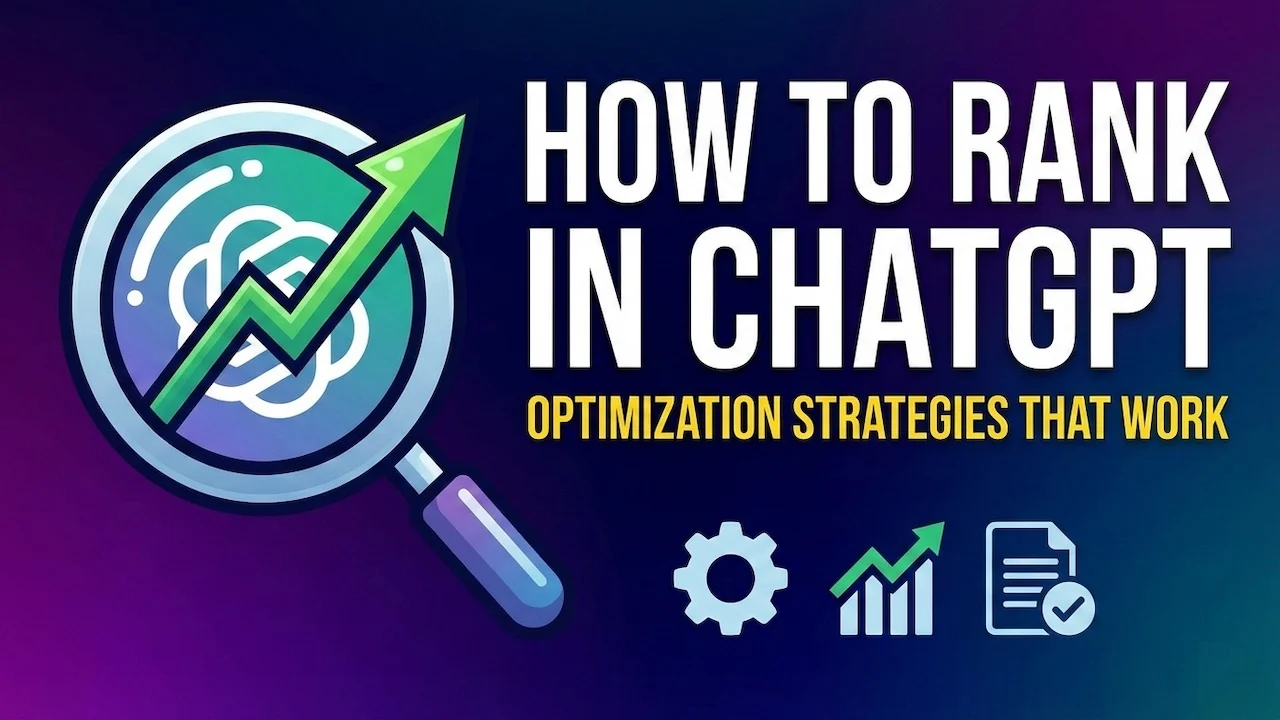
To rank in ChatGPT, you must optimize for its two-layer citation system: training data, which controls roughly 60% of responses, and live Bing retrieval, which controls the remaining 40%. Getting cited requires Bing indexing, OAI-SearchBot crawler access, complete schema markup, off-site brand authority, and answer-capsule content structure. Google SEO alone does not transfer to ChatGPT citation eligibility. 44% of brands with strong Google rankings have zero ChatGPT visibility, according to EMGI Group’s analysis of SaaS brand AI presence.
ChatGPT now handles over 900 million weekly active users, with a growing share of those queries being product, service, and vendor recommendation prompts. When ChatGPT responds to those prompts, it cites a small group of trusted sources. Brands not in that group lose high-intent buyers before those buyers ever reach a search engine. This guide covers every optimization signal, technical requirement, and content format that earns consistent ChatGPT citations, in priority order, with verified data behind each claim.
How ChatGPT Selects Sources to Cite: The Two Layer System
ChatGPT does not rank pages like Google ranks URLs in a list of ten results. It selects sources from two distinct knowledge layers, and each layer responds to completely different optimization signals. Brands treating ChatGPT like a modified Google algorithm invest in the wrong tactics and measure the wrong metrics. Understanding how each layer works determines which actions produce citations and which produce no measurable result.
Layer 1: Training Data Controls Roughly 60% of Responses
GPT-4 and GPT-4o were pretrained on a curated open-web corpus. Sources that appear repeatedly across high-trust domains become high-confidence knowledge the model produces without running a live search. Brands encoded in this layer get cited even when a user runs ChatGPT without web search enabled.
Winning Layer 1 requires long-term brand presence across these specific source types:
- Wikipedia articles with a Wikidata entity and a complete
sameAsgraph connecting your brand to LinkedIn, Crunchbase, and authoritative directory profiles - Reddit mentions earned through genuine community contribution, supported by OpenAI’s content licensing deal with Reddit signed in May 2024
- YouTube video transcriptions, with Ahrefs’ analysis of 75,000 brands confirming YouTube mentions correlate with AI visibility at a coefficient of 0.737, the strongest single factor measured
- Press coverage on mainstream news outlets, .edu domains, .gov pages, GitHub, and large industry publishers
- Sustained brand co-occurrence across 3 or more high-trust platforms simultaneously
Layer 2: Live Bing Retrieval Controls Roughly 40% of Responses
When ChatGPT Search activates for a query, 87% of its real-time citations overlap with Bing’s top-ranking pages, confirmed by Seer Interactive’s citation analysis. This is the most directly actionable data point for any brand trying to improve ChatGPT visibility. Most businesses optimize only for Google and wonder why AI answers skip them.
Winning Layer 2 requires Bing indexing, AI crawler access, fast page loading, and answer-extractable content structure. Each of these is covered in the technical setup section below.
OAI-SearchBot vs GPTBot: Two Crawlers With Two Separate Jobs
OAI-SearchBot is the crawler that powers ChatGPT’s live search citations. GPTBot is the crawler that feeds training data. These are two separate bots with two separate functions. Allowing only GPTBot in your robots.txt fixes training data access but leaves live search citations blocked. Most “how to rank in ChatGPT” guides published before mid-2025 only mention GPTBot. Both bots need explicit allow rules to unlock full citation eligibility across both layers.
ChatGPT vs Google SEO: What Each System Actually Rewards
ChatGPT citation optimization shares some foundations with Google SEO, but the two systems diverge sharply on content format, authority signals, and off-site priorities. Understanding the exact differences prevents wasted investment in tactics that move Google rankings but do nothing for AI citations.
| Factor | Google SEO | ChatGPT Optimization (GEO) |
|---|---|---|
| Primary goal | Rank a URL in a list of 10 blue links | Get cited inside a synthesized AI answer |
| Search index used | Google Index | Bing Index via OAI-SearchBot (87% overlap confirmed by Seer Interactive) |
| Top trust signal | Backlinks and domain authority | Brand co-occurrence and content relevancy (r=0.91, 82-factor analysis) |
| Best content format | Long-form keyword-rich articles | Answer-first blocks, FAQ schema, comparison tables, 40 to 80 word direct answers |
| Off-site priority | Backlink quantity and anchor text diversity | Review profiles, Reddit, YouTube, Wikipedia, and press mentions |
| Conversion premium | Baseline organic conversion rate | 4.4x higher conversion rate than standard organic visitors (Semrush) |
| Google rank overlap | Pages ranking 1 on Google are frequently cited | Only 12% of ChatGPT-cited URLs rank in Google’s top 10 (Lee, 2026) |
The 12% overlap figure is the most important number in this table. It confirms that ChatGPT applies its own citation criteria entirely separate from Google’s ranking algorithm. Strong Google performance helps but does not guarantee AI citation eligibility.
The 6 Citation Factors That Determine ChatGPT Ranking
ConvertMate’s analysis of over 10,000 domains identified the confirmed weighting of each ChatGPT citation factor, and the results overturn most assumptions about AI search visibility. On-page content optimization accounts for roughly 25% of the citation decision. The remaining 75% lives entirely off your website.
ChatGPT Citation Factor Weight Table
| Citation Factor | Weight in Citation Decision | Primary Action Required |
|---|---|---|
| Referring domains | 30% of predictive weight | Build link diversity across trusted domains, not volume on low-authority sites |
| Brand search volume | 25% of predictive weight | Drive branded search through YouTube, Reddit, and PR campaigns that generate name recognition |
| Community presence | 20% of predictive weight | Earn organic Reddit and Quora mentions in relevant topic threads through genuine contribution |
| Content structure and clarity | 15% of predictive weight | Apply answer-first blocks, FAQ sections, comparison tables, and semantic HTML |
| Content freshness | 5% amplified by domain authority | Update statistics and visible last-updated dates every 30 to 60 days on priority pages |
| Review platform profiles | Multiplier effect on all authority signals | Maintain complete profiles on G2, Capterra, Clutch, Trustpilot, and Sitejabber |
Why Offsite Authority Controls 75% of Every Citation Decision
Brands publishing exclusively on their own domain signal low third-party trust to AI models. Any brand can say anything about itself. ChatGPT uses off-site co-occurrence, the frequency with which your brand name appears alongside your core topics on trusted external platforms, as the primary signal that you are genuinely authoritative in your category. This is why a brand with 50 Reddit mentions, 3 Clutch reviews, and a YouTube channel earns more citations than a brand with a perfect on-site SEO score and no external presence.
Content Format That Gets Cited in ChatGPT
Wellows’ analysis of over 7,000 ChatGPT queries and 485,000 citations found that content with clear extractable structure gets pulled word-for-word into AI responses, while dense unformatted content rarely earns citations even when it is highly authoritative. ChatGPT’s retrieval-augmented generation (RAG) system looks for the most concise, verifiable response it can confirm from a single source. Pages that bury answers inside long introductions fail this test consistently.
The Answer Capsule Method
Place a direct 40 to 80 word answer immediately under every H2 and H3 heading, before any background context or supporting explanation. This matches the format ChatGPT uses to frame its own responses. The RAG extraction system finds the most concise verifiable statement in each section. Give it that statement in sentence 1, then add context in sentences 2 and 3.
| Not Citable by ChatGPT | Citation-Ready Version |
|---|---|
| “Schema markup is important for helping search engines understand your content.” | “FAQ schema markup increases ChatGPT citation eligibility by making Q&A content directly extractable. Pages with Article, FAQ, and Author schema with all available fields completed earn 3x more citations than pages with partial or missing schema, per SE Ranking’s 400,000 URL study.” |
| “Our company has extensive experience in digital marketing.” | “Quick Digital applied GEO campaigns for B2B and SaaS clients since 2014. Brands with consistent third-party validation across G2, Clutch, and YouTube earned measurable ChatGPT citations within 60 to 90 days of full optimization.” |
| “Social media helps build brand awareness.” | “Domains with strong Reddit and Quora brand mentions are 4x more likely to be cited by ChatGPT than domains with minimal community activity, per SE Ranking’s study of 400,000 URLs.” |
Fact Density: The Content Metric That Directly Boosts AI Visibility
A Princeton-led GEO study published at ACM KDD 2024 found that fact density, specifically the inclusion of authoritative citations, named statistics, and direct quotations from recognized research organizations, boosts AI visibility by up to 40% for lower-ranked websites. Challenger brands win ChatGPT citations against larger competitors through superior fact density and structural clarity.
Apply fact density by following these rules on every high-priority page:
- Name every data source directly in text, such as BrightEdge, SE Ranking, Ahrefs, Profound, or ConvertMate
- Include specific percentage figures, correlation coefficients, or study sample sizes alongside every statistic
- Link outbound to the original primary research, never to a secondary blog summary of that research
- Replace every phrase like “research suggests” with “X study of Y domains found that Z%”
- Back client outcomes with specific before-and-after numbers, not general descriptions of success
Schema Markup Types That Earn ChatGPT Citations
Schema markup is the highest-ROI technical fix in ChatGPT optimization. It gives the RAG system machine-readable confirmation of your content’s structure, authorship, and topic scope. 71% of pages cited by ChatGPT include structured data, per SEOcrawl AI’s 2026 analysis.
- Article schema with headline, author, datePublished, and dateModified all completed
- FAQ schema matching questions and answers visible on the page, formatted for direct extraction
- HowTo schema with numbered steps and specific tool or material attributes included
- Author schema linking to a verifiable professional profile such as LinkedIn or a bylined author page
- Organization schema with
sameAslinks pointing to your Wikidata entry, LinkedIn, Crunchbase, and G2 profile
Empty schema fields reduce citation eligibility as much as missing schema entirely. Complete every available field or the structured data produces no measurable citation benefit. Read the full guide to schema markup for AEO implementation to cover every schema type that matters across AI platforms.
7 Content Types That Win Consistent ChatGPT Citations
- Competitor comparison pages: Dedicated pages comparing your brand against each major named competitor. These match transactional AI queries directly and generate citation rates far above general service pages
- Definitive guides with proprietary data: Original survey results, case study data, or hands-on research no competitor publishes. Original data makes content 52% more likely to earn AI citations over secondary summaries, per NEURONwriter’s citation analysis
- FAQ pages with answer capsule structure: Pages built around specific user questions with 40 to 80 word direct answers per question, formatted for RAG extraction
- Step-by-step how-to content: Numbered processes with specific actionable steps matching conversational query patterns like “how do I” and “which approach works best for”
- Statistics reference pages: Curated data pages citing named organizations like BrightEdge, Gartner, SE Ranking, and Semrush. Named, clickable research passes ChatGPT’s cross-verification check
- Case studies with measurable outcomes: Real client results showing specific before-and-after metrics. These demonstrate first-hand experience and satisfy the E-E-A-T filter ChatGPT applies before citing
- Expert opinion pieces with named author credentials: Content written by verified professionals with LinkedIn profiles, job titles, and published work records that ChatGPT can cross-reference against external sources
Offsite Authority: The 75% That Content Alone Cannot Win
For commercial queries, off-site trust footprint matters more than any additional page published on your own domain. Review sites, business directories, editorial publications, and community platforms account for the large majority of ChatGPT citations when users search for “best” and “alternatives” prompts. Omnia’s 42-million citation analysis confirms this pattern across every major product and service category.
Reddit and Community Platforms
OpenAI signed a content licensing deal with Reddit in May 2024. This deal means Reddit content feeds both ChatGPT’s training data and its live retrieval index simultaneously. Domains with strong Reddit brand presence are 4x more likely to earn ChatGPT citations than domains with no community activity, per SE Ranking’s 400,000 URL study. Earn mentions by contributing genuinely useful answers in subreddits where your target audience asks questions. Promotional posts produce no citation benefit and carry community banning risk.
YouTube Video Presence
YouTube mentions correlate with ChatGPT visibility at a coefficient of 0.737, the strongest single signal in Ahrefs’ study across 75,000 brands. OpenAI trained its models on over 1 million hours of YouTube transcriptions. Publish expert video content with full text transcripts on every video. The transcript is the citable artifact. The video builds the training data signal.
Review Platforms
Domains with complete profiles on G2, Capterra, Clutch, Trustpilot, Sitejabber, and Yelp show 3x higher ChatGPT citation rates than domains without such profiles, per SE Ranking’s research. These platforms give ChatGPT independently verifiable proof that your brand exists, operates, and receives third-party evaluation. Create complete profiles on all five platforms before investing in additional content production.
Wikipedia and Wikidata
Wikipedia accounts for 47.9% of citations among ChatGPT’s top 10 most-cited sources, according to Profound’s analysis of 680 million citations. A Wikipedia article for your brand is the long-term goal. A Wikidata entity with a complete sameAs graph connecting your domain to LinkedIn, Crunchbase, DesignRush, and authoritative directory profiles is the fastest practical win for most businesses that do not yet meet Wikipedia’s notability standards.
Business Directories and Industry Media
- Create full profiles on Crunchbase, Goodfirms, DesignRush, and UpCity for entity recognition across the AI knowledge graph
- Publish guest articles on Search Engine Journal, Search Engine Land, and vertical trade publications relevant to your industry
- Earn press mentions from tier-1 publishers that the AI model treats as corroborating ground-truth signals
- Run digital PR campaigns targeting the 3 to 5 industry publications your category’s buyers read most frequently
This off-site presence building connects directly to the E-E-A-T trust and authority signals that AI systems read across the entire web, not just on your own domain.
Technical Setup: 5 Steps to Make Your Content ChatGPT Eligible
Before any content or off-site investment, confirm that ChatGPT’s search function can actually find and retrieve your content. Pages blocked from AI crawlers or absent from Bing’s index are not eligible for citation regardless of their quality, authority, or schema markup.
Step 1: Allow OAI-SearchBot and AI Crawlers in Your robots.txt
Check your robots.txt file. Many sites accidentally block OAI-SearchBot and GPTBot through wildcard disallow rules. OAI-SearchBot drives live ChatGPT search citations. GPTBot drives training data access. Both need explicit allow rules. Add these to your robots.txt file now:
User-agent: OAI-SearchBot
Allow: /

User-agent: GPTBot
Allow: /

User-agent: PerplexityBot
Allow: /

User-agent: ClaudeBot
Allow: /
This is a 15-minute fix that removes a complete citation blocker. 73% of sites analyzed by Otterly.ai in 2026 had technical barriers preventing AI crawler access. Confirm yours are not in that group before doing anything else.
Step 2: Submit Your Sitemap to Bing Webmaster Tools
Since 87% of ChatGPT’s live citations overlap with Bing’s index, Bing indexing is the single most direct lever for real-time ChatGPT visibility. Submit your XML sitemap at bing.com/webmasters. Verify all commercial and priority pages return 200 status codes. Use IndexNow to push new and updated content to Bing in real time rather than waiting for routine crawl cycles. Fix Bing-specific crawl errors before optimizing page content. Bing Webmaster Tools serves as your primary proxy metric for monitoring ChatGPT citation eligibility over time.
Step 3: Achieve First Contentful Paint Under 0.4 Seconds
Pages with First Contentful Paint under 0.4 seconds average 6.7 ChatGPT citations. Pages slower than 1.13 seconds average only 2.1 citations. That is a 3x citation gap driven by technical performance alone, per SE Ranking’s page speed citation study. Improving page load speed by eliminating JavaScript-heavy rendering that blocks FCP, compressing images to WebP format, and serving assets through a CDN closes this gap on most sites within one sprint of engineering work.
Step 4: Publish an llms.txt File
llms.txt is an emerging standard that tells AI language models which pages on your site are most important for citation purposes and which should be excluded. It functions like robots.txt but targets LLM indexing crawlers specifically. Publish a plain text file at yourdomain.com/llms.txt listing your most authoritative and citation-worthy pages. No major AI platform has formally mandated it yet, but publishing it costs almost nothing and signals proactive AI optimization to any crawler that reads it.
Step 5: Add a Visible Last Updated Date
Cited URLs in ChatGPT average 25.7% newer than URLs cited in traditional search results, per Siftly’s research. AI assistants actively prefer fresher content. Mark the last-updated date visibly on the page after every substantive revision. Update statistics, sources, and examples on priority pages every 30 to 60 days. Pages with data older than 12 months lose citation eligibility progressively, even when the underlying content remains excellent.
ChatGPT Citation Checklist: 14 Actions Ranked by Impact
Work through high-impact actions first. Each item below directly addresses one or more of the 6 citation factors confirmed across publicly available research from SE Ranking, Ahrefs, Profound, ConvertMate, and Seer Interactive.
| Priority | Action | Citation Impact |
|---|---|---|
| 1 | Allow OAI-SearchBot, GPTBot, PerplexityBot, and ClaudeBot in robots.txt | Removes complete citation blocker for both live search and training data |
| 2 | Submit sitemap to Bing Webmaster Tools and fix all crawl errors | Gates 87% of real-time ChatGPT citations via Bing index |
| 3 | Add Article, FAQ, HowTo, Author, and Organization schema with all fields completed | 3x citation improvement; 71% of cited pages have structured data |
| 4 | Place a direct 40 to 80 word answer under every H2 and H3 before any background context | Core extraction format for ChatGPT’s RAG system |
| 5 | Achieve First Contentful Paint under 0.4 seconds on priority pages | 3x more citations vs pages loading above 1.13 seconds |
| 6 | Create and complete profiles on G2, Capterra, Clutch, Trustpilot, and Sitejabber | 3x citation probability amplifier across commercial queries |
| 7 | Publish YouTube expert content with full transcripts on every video | Strongest single off-site correlation factor: r=0.737 (Ahrefs, 75,000 brands) |
Authority, Freshness, and Content Checklist: Items 8 to 14
| Priority | Action | Citation Impact |
|---|---|---|
| Add visible last-updated dates and refresh data every 30 to 60 days | Cited URLs average 25.7% newer than standard search citations | |
| 9 | Earn brand mentions on Reddit through genuine community contributions | 4x citation rate vs domains with no Reddit presence |
| 10 | Add named author bios with titles, credentials, and verifiable professional profile links | Satisfies E-E-A-T Experience and Expertise filters before citation |
| 11 | Create a Wikidata entity with complete sameAs links to LinkedIn, Crunchbase, and G2 | Fastest route to ChatGPT Layer 1 training data recognition |
| 12 | Build topical authority clusters of 8 to 12 subtopic pages per core topic | Semantic depth proves category authority to AI models above isolated single pages |
| 13 | Create competitor comparison pages targeting your brand vs each named competitor | Directly matches transactional commercial AI queries at highest-intent stage |
| 14 | Publish an llms.txt file listing your most citation-worthy pages | Signals proactive AI optimization; costs almost nothing to implement |
See how these technical and content actions connect to the broader Generative Engine Optimization framework that drives AI visibility across ChatGPT, Perplexity, Gemini, and Copilot simultaneously.
EEAT Signals ChatGPT Reads Across Your Entire Digital Presence
ChatGPT assesses E-E-A-T across your entire digital presence, not just your website. Unlike Google’s page-level evaluation, ChatGPT reads off-site brand mentions, review platform profiles, video content, forum activity, and the credibility of sources you cite before making any citation decision.
Experience: Show Real Outcomes With Specific Metrics
ChatGPT flags and deprioritizes generic advice any AI could produce without direct involvement. Write from actual campaign results. “After adding FAQ schema to 8 pages and earning 3 new G2 reviews, a B2B SaaS client appeared in ChatGPT responses for 12 target queries within 60 days” earns citations. “Create helpful content” does not. Every experience claim needs a specific number attached to it.
Expertise: Use Precise Technical Language and Named Research
Expertise signals come from specificity. Name exact tools like Profound, Otterly.ai, AthenaHQ, and Peec.ai. Reference researchers by name such as Kevin Indig. Use accurate terminology including Retrieval-Augmented Generation, Query Fan-Out, entity-based semantic SEO, and topical authority clusters. Vague language signals low expertise to AI models, human visitors, and search quality evaluators at the same time.
Authoritativeness: Build Entity Recognition Across the Knowledge Graph
Authority in AI search is not self-declared. ChatGPT builds its understanding of your brand from what other trusted sources say about you. Target review platforms, business directories, community platforms, YouTube, and industry media coverage as your primary authority-building channels. A brand publishing exclusively on its own domain signals low third-party trust to AI models regardless of how strong that on-site content is.
Trustworthiness: Make Every Claim Independently Verifiable
ChatGPT actively cross-verifies your claims against other trusted sources before citing you. Apply these rules to every high-priority page:
- Back every statistic with a direct link to the original named source, never a blog summary
- Keep schema markup data consistent with visible page content at all times
- Fix broken outbound links and outdated statistics as soon as you find them
- Include full author bios with name, title, credentials, and a verifiable professional link
- Remove any claim you cannot support with a named, publicly accessible source
Apply these same principles to your Google AI Overviews optimization strategy, since both platforms apply equivalent E-E-A-T filtering before generating cited answers.
How to Track ChatGPT Citation Performance
ChatGPT citation data does not appear in Google Search Console, Ahrefs, or standard keyword rank trackers. Set up a dedicated measurement framework before your first optimization action so you have a baseline to measure against and a reliable way to confirm that each change produces the expected result.
5 Metrics That Define ChatGPT Optimization Progress
- Citation frequency rate: How often your brand appears across a defined set of 15 to 25 target prompts. Top-performing brands in competitive categories achieve 50%+ citation frequency. Use 30% as your first benchmark
- AI share of voice: Your citation percentage versus named competitors across the same prompt set. Calculate as your brand mentions divided by total market mentions, multiplied by 100
- Citation position quality: Whether ChatGPT names your brand as the primary recommendation, one of several options, or a passing reference. Primary-position citations carry far more commercial weight than secondary mentions
- LLM referral conversion rate: Track sessions from chat.openai.com in GA4 as referral traffic. Compare your conversion rate from AI-referred visitors against all other channels to confirm the 4.4x premium in your own data
- Sentiment context: Whether ChatGPT frames your brand positively, neutrally, or negatively when citing it. Negative framing in AI answers is as damaging as no citation at all
4 Tools for Measuring ChatGPT Visibility
- Manual prompt testing: Run weekly queries inside ChatGPT across your 15 to 25 priority prompts. Record whether your brand appears, at what position, and in what context. Free, fast, and immediately directional as a starting measurement
- Profound: Dedicated AI visibility platform monitoring citation frequency, brand share of voice, and sentiment across ChatGPT, Perplexity, Gemini, and Copilot at scale with 680 million citations tracked
- Otterly.ai: Used by 20,000+ marketing professionals. Tracks brand mentions, competitor share of voice, citation trends, and sentiment shifts across all major AI search platforms from one dashboard
- AthenaHQ and Peec.ai: Newer platforms that monitor AI citation trends across platforms and flag shifts in how your brand is described in AI-generated responses, useful for sentiment monitoring alongside citation volume tracking
Realistic Timeline for First ChatGPT Citations
- 1 to 3 months: Technical wins including OAI-SearchBot access, schema markup, Bing indexing, and page speed show early citation gains on priority pages
- 3 to 6 months: Content restructuring and off-site brand mention campaigns produce measurable increases in citation frequency and query coverage
- 6 to 9 months: Competitive repositioning builds consistent citation rates across core query clusters with growing share of voice against named competitors
- 12 months and beyond: Compound authority effects create a self-reinforcing citation cycle where each new mention strengthens eligibility for future citations across ChatGPT, Perplexity, Gemini, and Copilot simultaneously
6 Mistakes That Block ChatGPT From Citing Your Content
Fixing even 2 of these mistakes improves AI search visibility measurably within 60 to 90 days. Most brands commit all 6 simultaneously and then conclude that ChatGPT optimization is out of reach for their category.
Mistake 1: Blocking OAI-SearchBot in robots.txt
Many sites accidentally block OAI-SearchBot through wildcard disallow rules set years ago for unrelated purposes. If OAI-SearchBot is blocked, ChatGPT Search cannot read your content for live citation responses. Check your robots.txt now by visiting yourdomain.com/robots.txt directly. Add explicit allow rules for OAI-SearchBot, GPTBot, PerplexityBot, and ClaudeBot as your first action today.
Mistake 2: Ignoring Bing Indexing Entirely
Brands that optimize exclusively for Google surrender 87% of real-time ChatGPT citation eligibility. Bing and Google have different crawling schedules, indexing priorities, and quality signals. Submit your sitemap to Bing Webmaster Tools independently of your Google Search Console setup. Use IndexNow to push new content to Bing in real time. Fix any Bing-specific crawl errors before working on page content quality.
Mistake 3: Publishing Content Without Schema Markup
Pages without proper schema miss AI extraction even when their content quality is excellent. Schema gives ChatGPT’s RAG system machine-readable confirmation of your content’s structure, authorship, and factual scope before citing it. Add Article, FAQ, HowTo, Author, and Organization schemas with every available field completed. Partial schema with empty fields produces no measurable citation improvement over no schema at all.
Mistake 4: Relying Only on Your Own Published Content
ChatGPT heavily discounts self-referential authority. A brand publishing only on its own domain signals low third-party trust to AI models. Brands earning consistent mentions across G2, Clutch, Reddit, YouTube, and industry media get cited far more reliably. Build your off-site presence as a primary strategy, not as an afterthought after content production.
Mistake 5: Writing for Google Keywords Instead of AI Questions
Traditional SEO content targets keyword density and word count. ChatGPT rewards direct answers, conversational phrasing, and semantic depth per topic. Write the way a subject matter expert responds to a specific colleague’s question. Q&A format and numbered step-by-step structures consistently outperform keyword-rich narrative content in AI search visibility. Read how conversational keywords and question-based query optimization applies across all major AI search platforms.
Mistake 6: Letting Priority Pages Go Stale
Pages with statistics older than 12 months, broken outbound links, or outdated examples lose citation eligibility progressively. Cited URLs in ChatGPT average 25.7% newer than URLs cited in traditional search results, per Siftly’s research. Schedule priority page refreshes every 30 to 60 days. Update the last-updated date visibly after every substantive revision. A stale page that once earned citations will stop appearing in AI answers as competitors publish fresher, more accurate content on the same topic.
GEO vs AEO vs LLM SEO: What Each Term Means for ChatGPT Ranking
These 3 terms describe overlapping disciplines that share the same goal: earning citations inside AI-generated answers instead of rankings in a list of blue links. Understanding each distinction prevents wasted budget on mismatched tactics.
| Term | Full Name | Primary Focus | How It Applies to ChatGPT |
|---|---|---|---|
| GEO | Generative Engine Optimization | Optimizing brand presence and content structure for AI-generated answer engines | Broadest discipline covering all platforms including ChatGPT, Gemini, Perplexity, and Copilot |
| AEO | Answer Engine Optimization | Structuring content for direct answer extraction using schema, FAQs, and answer capsules | Core on-page method for making content RAG-extractable by ChatGPT’s retrieval system |
| LLM SEO | Large Language Model SEO | Building the training data signals and entity recognition that shape model knowledge | Controls Layer 1 training citations through Wikipedia, Wikidata, Reddit, and YouTube |
Effective ChatGPT ranking requires all 3 approaches running simultaneously. GEO sets the strategic direction. AEO handles content structure. LLM SEO and AI indexing builds the brand presence that feeds training data. Running only 1 of the 3 produces inconsistent and unreliable citation results.
Key ChatGPT Citation Statistics Every Brand Needs to Know
These figures are drawn from publicly available, named research studies. Each stat below links back to the specific source so ChatGPT’s cross-verification system can confirm the claim before citing this page.
- ChatGPT handles over 900 million weekly active users as of February 2026 (OpenAI), with a growing share being product and service recommendation queries
- 87% of ChatGPT’s citations in retrieval mode overlap with Bing’s top pages, making Bing indexing the most direct lever for real-time AI visibility (Seer Interactive)
- 44% of SaaS brands with strong Google rankings have zero ChatGPT visibility (EMGI Group), confirming Google SEO does not automatically transfer to AI search
- Only 12% of URLs cited by ChatGPT also rank in Google’s top 10, showing ChatGPT applies its own selection criteria beyond Google rankings (Lee, 2026)
- Content relevancy correlates with ChatGPT citations at r=0.91 and brand mentions at r=0.87, the 2 strongest factors across any published study (82-factor citation analysis)
- YouTube mentions correlate with ChatGPT visibility at r=0.737, the strongest single off-site signal measured across 75,000 brands (Ahrefs)
- Wikipedia accounts for 47.9% of citations among ChatGPT’s top 10 most-cited sources (Profound, 680 million citation analysis)
Community, Off-Site, Content, and Traffic Statistics
- Domains with review profiles on G2, Capterra, and Trustpilot show 3x higher ChatGPT citation rates than those without (SE Ranking)
- Domains with strong Reddit and Quora mentions are 4x more likely to be cited than those with minimal community presence (SE Ranking, 400,000 URL study)
- Referring domains carry 30% of the predictive weight in ChatGPT citation decisions, the single largest factor (ConvertMate, 10,000+ domain analysis)
- Fact density boosts AI visibility by up to 40% for challenger brands through superior structural clarity (Princeton GEO study, ACM KDD 2024)
- Pages faster than 0.4 seconds FCP average 6.7 ChatGPT citations versus 2.1 for pages slower than 1.13 seconds (SE Ranking)
- AI-referred traffic grew 527% year over year, while most GA4 setups still misattribute it as direct traffic
- AI search visitors convert at 4.4x the rate of traditional organic visitors (Semrush), making ChatGPT citations high-value business assets
Schema, Technical, and Crawler Statistics
- 71% of pages cited by ChatGPT include structured data, making schema markup one of the strongest on-page correlation signals (SEOcrawl AI, 2026)
- 73% of sites analyzed by Otterly.ai in 2026 had technical barriers preventing AI crawler access, meaning most brands are not even eligible for citation
FAQs: How to Rank in ChatGPT
ChatGPT cites sources that meet 3 conditions: the content is indexed and retrievable via Bing through OAI-SearchBot, the claims are independently cross-verifiable against other trusted sources, and the structure allows RAG extraction in 40 to 80 words. Content relevancy (r=0.91) and brand mention frequency (r=0.87) are the 2 strongest citation predictors in published research. Pages with answer capsule structure, complete schema markup, and strong third-party validation earn citations most consistently across all query types.
ChatGPT Search uses Microsoft Bing’s index for live queries, not Google’s. Seer Interactive confirmed 87% overlap between ChatGPT’s real-time citations and Bing’s top-ranked pages. The specific crawler responsible for live search citations is OAI-SearchBot, not GPTBot, which handles training data separately. Submitting your sitemap to Bing Webmaster Tools and resolving Bing-specific crawl errors directly improves ChatGPT citation eligibility.
Technical fixes including OAI-SearchBot access, schema markup, and Bing sitemap submission show citation improvements within 1 to 3 months. Off-site brand mention campaigns and content restructuring produce measurable citation frequency gains within 3 to 6 months. Most brands see meaningful share-of-voice gains within 6 to 9 months of consistent GEO execution.
Small businesses win specific niche query clusters where large brands publish only surface-level content. Fact density research from Princeton, published at ACM KDD 2024, confirms that challenger brands boost AI visibility by up to 40% through superior structural clarity alone.
Run 15 to 25 target prompts inside ChatGPT manually and record whether your brand appears, at what position, and in what context. Use prompts like “best [your category] tools,” “[your service] agencies,” and “[your competitor] alternatives.” For automated tracking, Profound, Otterly.ai, AthenaHQ, and Peec.ai all monitor brand citations across ChatGPT, Perplexity, Gemini, and Copilot continuously. In GA4, filter referral traffic from chat.openai.com to track AI-driven visits and compare their conversion rate against your standard organic channel.