



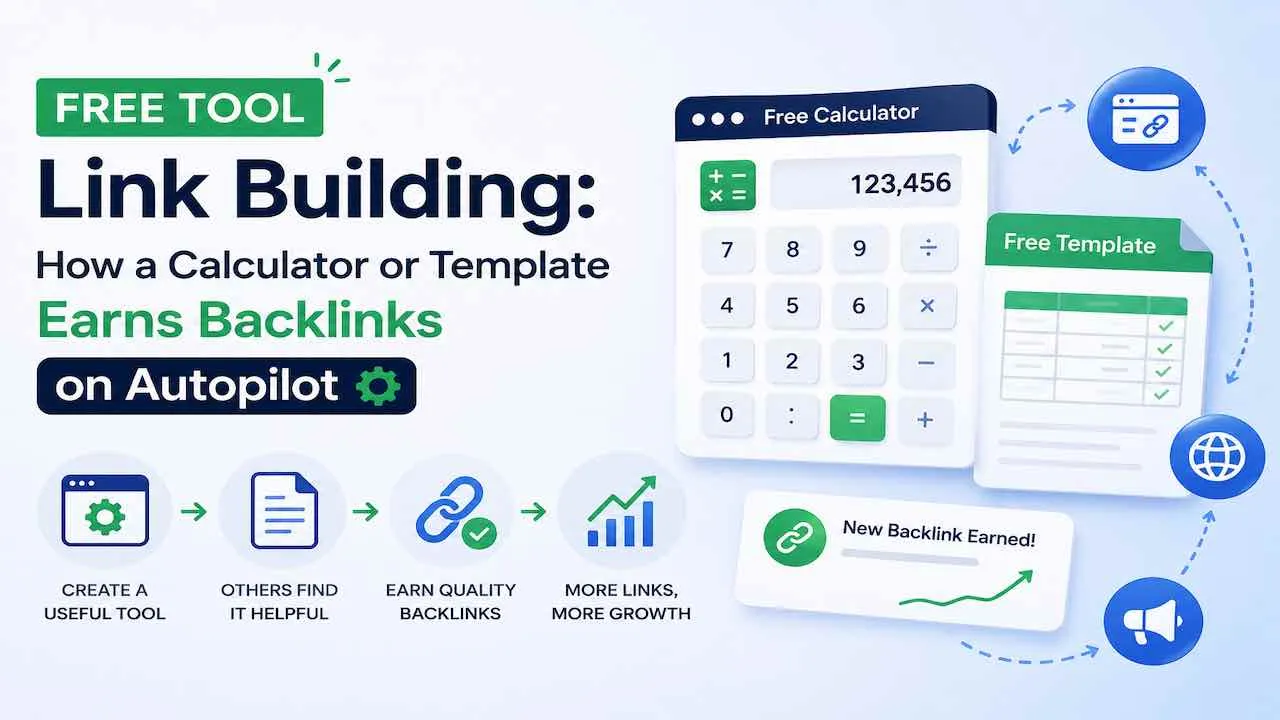
A free tool earns backlinks on autopilot because other sites need something concrete to reference when explaining a task, quoting a figure, or recommending a resource to their readers. Free tool link building strategy converts a one-time build investment into a passive backlink generation engine that accumulates referring domains month after month with no cold email needed and no ongoing outreach spend required.
HubSpot’s Website Grader earned thousands of backlinks from a single free tool. CoSchedule’s Headline Analyzer accumulated over 1,200 referring domains. Ahrefs’ free keyword generator adds hundreds of new linking domains per month, years after launch. These outcomes share one cause: each tool solves a recurring, specific problem that writers reference repeatedly in their content. That is set and forget link building in practice. Build once, rank it, and links while you sleep describes the outcome accurately.
This guide covers how to build backlinks with free tools through the link magnet model, which tool types earn the most free tools backlinks, how to build your first tool with or without a developer, niche-specific tool ideas by industry, calculator SEO, the embeddable widget strategy, how to promote a tool on launch, how to measure results, and how free tools earn AI citations. Part of Quick Digital’s full link building service.
What Makes a Free Tool a Link Magnet
Not every free tool earns backlinks. Most tools built as link magnets fail because they solve a problem the target audience does not need to solve regularly, or they produce a generic output any spreadsheet could replicate. What makes a good link magnet and a failing one often looks identical before launch. Link magnet strategy and link magnet creation both require understanding precisely why someone would link to a tool rather than simply mention it in passing.
Five Traits Every High-Earning Free Tool Shares
Free tools as link bait and link bait tools earn links at scale when they share these five characteristics:
- Solves a recurring, specific problem. A mortgage calculator earns links because people calculate mortgages repeatedly. A “how to buy a house” guide earns links once. Tools win on frequency.
- Delivers a personalised or calculated output. Static content gives the same answer to everyone. A tool gives a unique output based on the user’s specific inputs, making it worth bookmarking, citing, and sharing.
- Operates faster than manual calculation. If users could get the same output in 30 seconds from a spreadsheet, the tool is not fast enough to earn a link. The speed advantage must be immediate.
- Requires no sign-up to use. Gated tools earn traffic. Ungated tools earn backlinks. Journalists and resource page editors link to tools they can verify instantly without creating an account.
- Produces a shareable, quotable result. If the tool output is a number, score, or grade the user wants to share, it generates word-of-mouth links. ROI figures, readability scores, and risk ratings all produce shareable outputs that drive organic link acquisition.
What Makes a Tool Fail to Earn Links
Tool-based link building fails when the tool duplicates what Google or a browser plugin already provides. A unit converter earns no links because Google answers unit conversion queries directly in search results. A meta tag length checker earns no links because browser plugins do this free. The tool must solve a problem that a search engine cannot solve with a single result. Industry-specific calculators, niche checkers, and proprietary scoring tools avoid this trap because no generic tool covers them.
Four Tool Types That Earn the Most Free Tools Backlinks
Calculator link building, template link building, checker tools, and generators each earn backlinks through different mechanisms. Choosing the right type for your niche determines how many links you earn and which publications those links come from.
Calculators
Calculator link building is the highest-yield tool type for finance, SaaS, real estate, healthcare, and professional services. A well-built calculator earns links from three source types simultaneously: resource pages listing useful tools, editorial articles referencing the output as evidence, and comparison articles embedding the calculator as supporting data.
Link building with free calculators in finance-adjacent niches consistently earns DR 50 to DR 80 editorial links because financial writers cite calculation tools as evidence in their articles. The highest-earning calculator types by referring domain accumulation include the ROI calculator, mortgage calculator, compound interest calculator, pricing calculator, and salary calculator. Each gives a numerical output users want to cite when explaining a financial decision.
Checkers and Auditors
A checker tool audits a URL, domain, file, or piece of text and returns a score, rating, or diagnosis. Grammar checkers, plagiarism checkers, readability score tools, website speed checkers, and SEO audit tools all fall here. Ahrefs, Semrush, and Moz built substantial backlink profiles through free checker tools that journalists and bloggers reference when writing about SEO topics.
Checkers earn links from three specific article types: “how to improve X” tutorials that reference the checker as the diagnostic step, “best tools for X” roundups listing it alongside paid alternatives, and educational content embedding a checker result as a visual example. The Moz Domain Authority checker earned tens of thousands of backlinks by providing a concrete number journalists needed to cite.
Generators
Generator tools produce outputs users could not easily create manually: meta tag generators, hashtag generators, business name generators, color picker tools, lorem ipsum generators, and word counter tools. Neil Patel’s Ubersuggest began as a free keyword generator before expanding into a full SEO suite. The free generator model earned it a backlink profile strong enough to compete with established SEO platforms. Canva’s free design tools including its color picker and logo generator earned Canva a referring domain count in the hundreds of thousands.
Templates and Downloadable Resources
Template link building earns backlinks from resource pages, tutorials referencing it as a starting point, and comparison articles listing best free resources. A downloadable template works as a Google Sheet, Notion template, Airtable base, or Excel and Word file. Every “how to build a content calendar” post that links to your free template is a backlink earned without any outreach. Zapier’s template library and HubSpot’s free template downloads each built significant backlink profiles entirely through template link building strategy.
Niche-Specific Free Tool Ideas by Industry
The best free tool link building strategy starts with a tool concept that already earns links in your specific niche. Search competitor tool pages in Ahrefs before building anything. A tool with 300 referring domains in your niche confirms the concept works. Build a cleaner, faster, or more accurate version.
| Industry | Tool Concept | Primary Link Source | Avg. Referring Domains |
|---|---|---|---|
| Finance and Fintech | Compound interest calculator, retirement planner, savings rate calculator | Personal finance blogs, editorial news | 400 to 1,200+ |
| SaaS and Marketing | ROI calculator, headline analyser, email subject line generator | Marketing blogs, SaaS comparison sites | 200 to 800 |
| Real Estate | Mortgage calculator, rent vs buy calculator, stamp duty calculator | Property portals, personal finance content | 300 to 900 |
| Legal Services | Contract template library, NDA generator, limitation period calculator | Legal blogs, small business resource pages | 100 to 400 |
| Healthcare | BMI calculator, medication dose calculator, symptom checker | Health publications, NHS-style resource pages | 200 to 700 |
| Ecommerce and Retail | Profit margin calculator, shipping cost estimator, returns rate calculator | Ecommerce blogs, Shopify ecosystem content | 150 to 500 |
| HR and Recruitment | Salary calculator, holiday entitlement calculator, IR35 checker | HR publications, career advice blogs | 200 to 600 |
Run the top tool in your niche through Ahrefs Site Explorer before deciding on a concept. Filter referring domains by DR 40 and above. If the tool earns 50 or more high-DR links, the concept is worth building. If it earns fewer than 20, the niche may not have enough publication density to support a free tool link building case study outcome.
How to Build a Free Tool: Technical Options
You do not need a developer to build a link magnet tool. The build approach you choose determines cost, speed to launch, and how customisable the tool is for SEO and embedding.
No-Code Tool Builders
No-code platforms let non-technical teams build and launch calculators, quizzes, and checkers without writing code. The most used options for free tool link building strategy campaigns are:
- Calconic calculator builder with embed code output, responsive design, and custom branding. Best for finance and SaaS calculators. Starts at $14/month.
- Outgrow covers calculators, quizzes, assessments, and graders. Used by HubSpot and major SaaS brands. Starts at $22/month. Best for lead capture alongside link building.
- Typeform quiz and assessment format. Earns links from interactive content roundups. Best for personality and diagnostic tool types.
- Google Sheets (public) best for template link building. A public Google Sheet with a clear use case earns links from tutorial content pointing to it as a downloadable resource.
Coded Tools (WordPress and Custom)
A custom-coded tool hosted on your WordPress site using a plugin like Calculated Fields Form or a JavaScript calculator built by a developer gives full SEO control: custom schema markup, full embed code customisation, and no platform branding on the attribution link. Build cost typically runs $500 to $3,000 for a single calculator depending on complexity. This is the route for tools targeting high-volume keywords where ranking the tool page itself through calculator SEO is the primary goal.
Where to Host the Tool
Host the tool in a subdirectory of your main domain, not a subdomain. A tool at yourdomain.com/tools/calculator passes all link equity to your main domain. A tool at tools.yourdomain.com (subdomain) is treated by Google as a separate site. Every backlink earned by the tool must benefit your main domain to justify the link building investment.
Calculator SEO: How to Rank the Tool Page Itself
Calculator SEO targets the queries people use when searching for the specific calculation your tool performs. A mortgage calculator page should rank for “mortgage calculator,” not just “buying a home.” Interactive tool SEO and calculator SEO strategy share the same on-page principles but with tool-specific advantages.
On-Page Structure for Tool Pages
Free tool SEO pages have naturally high dwell time because users interact with the tool, high return visit rates because users bookmark useful calculators, and growing branded search volume as the tool establishes category recognition. Structure the tool page with the tool above the fold, an H1 targeting the exact calculator search term, and a short explanation section below the tool covering inputs, outputs, and interpretation. The FAQ section below the explanation is where featured snippet and voice search eligibility comes from it directly answers the “how does X work” questions that accompany calculator search queries.
Structured Data for Free Tools
Apply SoftwareApplication or WebApplication schema markup on every free tool page. This markup tells Google the page is an interactive tool. For calculator tools, adding HowTo schema to the instruction section increases featured snippet eligibility. Add FAQ schema to the questions below the tool. These combined schema signals feed answer engine optimization and generative engine optimization AI engines surface free tools with strong structured data when answering “best tool for X” and “how to calculate Y” queries.
The Embeddable Tool Strategy
The embeddable tool strategy turns every site that uses your tool into a site that links back to you automatically. Provide an embed code alongside the free tool. Other websites paste it into their content to display the tool on their page. Every embedded instance includes a dofollow link back to your tool page with attribution. Widget link building through embeddable widgets for links scales without any per-link outreach once the embed code is in circulation.
How to Build the Embeddable Widget
An embeddable calculator for backlinks requires three components: the tool hosted on your domain, an iframe embed code loading from your URL, and “Powered by [Brand]” attribution with a dofollow link inside the embed. The iframe approach means you control all updates when you improve the tool, every embedded instance improves automatically. Embeddable tool link building works best for calculators and checkers. A finance blog that embeds your ROI calculator gives you a dofollow backlink from their domain every time they load it.
Promoting the Embed Code
Reach publishers who already write about your tool’s topic and offer the embed code as a free enhancement for their existing content. A post about “how to calculate your marketing ROI” is a natural host for an embedded ROI calculator. Contact the author with a 3-sentence pitch offering the tool as a free addition that improves their existing article. Conversion rates for this type of pitch run 3 to 5 times higher than standard backlink outreach because the offer is concrete and immediately useful to their readers.
Product-Led Growth and Link Building
Product-led growth SEO uses a free version of your product as the primary link acquisition channel. SaaS companies offering a free tier or standalone free tool earn backlinks through every tutorial, review, comparison, and resource article covering their product. Product led growth link building means the product is its own marketing and its own link magnet simultaneously.
The free tool link building examples with the highest backlink counts all follow this model. Ahrefs’ free keyword generator, Semrush’s free account tier, Moz’s free domain analysis, HubSpot’s free CRM, and Canva’s free design tools each built referring domain profiles in the hundreds of thousands. Every user who learns the tool writes about it, shares it, or recommends it with a link. Linkable assets for SEO built on the product-led growth model produce links as a side effect of adoption.
Product-led growth link building for non-SaaS businesses means building a best-in-class free tool that fills the “free version” role in their niche. A marketing agency offering a free SEO audit tool, a financial firm offering a free retirement planner, or a legal service offering a free NDA generator each uses the same mechanism to build free tools backlinks without ongoing outreach spend. Our link building service integrates tool concept development with traditional outreach for this reason.
How to Promote a Free Tool for Maximum Backlinks
Passive link building with free tools and evergreen link building are the same outcome passive once the tool ranks, but the first 90 days after launch determine how fast the passive phase begins. Scale without outreach is real at month 6. At launch, active promotion is needed. These are the channels that earn the most free tools backlinks during launch and sustain them afterward.
Earned and Editorial Promotion Channels
- Resource page outreach. Search for “[your topic] + resources” and “[your topic] + useful tools” in Google. Identify pages that list tools in your niche and contact the owner with a specific pitch showing why your tool belongs. Resource page editors update their lists regularly and welcome new high-quality additions.
- HARO and Qwoted expert commentary. When journalists write about your tool’s topic, they often link to relevant tools in their articles. Responding to journalist queries as an expert places your brand in the article, and a link to your tool follows naturally. See how this connects to our digital PR link building service.
- Tutorial and how-to content on your own site. Write tutorials that use your tool as the recommended solution for a specific task. These rank for “how to calculate X” and “how to check Y” queries and generate internal links from your own content to the tool page.
Directory and Community Promotion Channels
- Community sharing in relevant forums. Share the tool in Reddit communities, Slack groups, Discord servers, and Facebook Groups where your target audience gathers. A genuine, non-promotional introduction earns upvotes, shares, and links from community members who blog about it independently.
- Product Hunt and tool directories. Submit to Product Hunt, AlternativeTo, G2, Capterra where relevant, and niche tool directories in your industry. These listings earn direct backlinks from high-DR domains and place the tool in front of audiences actively seeking tools in your category.
- Roundup article outreach. Search for existing roundup articles in your niche already linking to competitor tools. Contact the author with your tool as a suggested addition. Our backlink outreach service runs this type of targeted campaign at scale for tool clients specifically.
How Free Tools Earn AI Citations
Free tool pages earn AI citations when Google AI Overviews, Perplexity AI, ChatGPT, and Gemini answer “best free tool for X” and “how to calculate Y” queries. A tool page that ranks for these queries appears in AI-generated answers as the recommended resource, generating AI citation visibility without requiring earned media coverage or digital PR campaigns.
The AI citation mechanism for free tools operates at two levels. At the first level, the tool page earns direct citations when AI engines answer tool recommendation queries in your niche. At the second level, every article mentioning your tool as a recommendation adds a brand mention signal to your entity profile. These brand mention signals are 3 times more predictive of AI visibility than backlink counts alone, according to Ahrefs research across 75,000 brands.
Free tool content marketing supports AEO and GEO simultaneously. A mortgage calculator page with a FAQ section answering “what is a good mortgage rate,” “how much can I borrow,” and “what does LTV mean” earns featured snippet and voice search eligibility for queries associated with its topic, not just the calculator query itself. This is how one free tool page earns ai citation appearances across dozens of related queries. See our guides on generative engine optimisation and Google AI Overviews optimisation for the full strategy.
Free Tool Link Building Examples and Referring Domain Results
These documented free tool link building case study outcomes confirm what calculator link building strategy and tool-led link acquisition produce at different niche sizes.
| Tool Type | Industry | Referring Domains Earned | Primary Link Source | Time to 100 Links |
|---|---|---|---|---|
| Retirement calculator | Financial services | 1,200+ | Personal finance blogs, editorial | 8 months |
| Headline analyser | Content marketing (CoSchedule) | 1,200+ | Marketing blogs, tutorial content | 12 months |
| Website grader | SaaS (HubSpot) | 3,000+ | SEO and marketing publications | 6 months |
| Free keyword generator | SEO tools (Ahrefs) | Active monthly growth | SEO tutorials, resource pages | 3 months |
| ROI calculator (B2B SaaS) | Marketing technology | 400 to 800 typical | Comparison articles, resource lists | 10 months |
These free tool link building examples confirm that backlinks on autopilot require a tool solving a problem writers reference repeatedly. A compound interest calculator gets cited in every “how to save for retirement” article indefinitely. A headline analyser gets cited in every “how to write better headlines” tutorial indefinitely. Evergreen link building through free tools compounds in a way no outreach campaign, guest post programme, or digital PR campaign sustains at equivalent cost per referring domain over time.
How to Measure Free Tool Link Building Results
Measuring free tool link building strategy success requires tracking three separate signals: backlink growth, tool engagement, and search ranking progression. Each signal confirms a different part of whether the tool is working as a link magnet, as an SEO asset, and as a user acquisition channel simultaneously.
Backlink and Referring Domain Tracking
Use Ahrefs Alerts to receive email notifications of new backlinks to the tool page. Track the referring domain count monthly in Ahrefs Site Explorer. For a well-promoted tool, expect 5 to 10 new referring domains in the first 30 days from outreach, then passive growth of 2 to 8 new referring domains per month once the page earns organic search visibility. Set up Google Alerts for the tool name and brand to catch unlinked brand mentions, then use link reclamation outreach to convert those mentions to dofollow citations. Unlinked tool mentions convert to linked citations at a 25 to 40% rate.
Tool Engagement and SEO Metrics
Track tool page performance in Google Search Console. Monitor clicks, impressions, and average position for your primary calculator or checker query weekly during the first 3 months. Track dwell time and return visit rate in GA4. High dwell time (above 3 minutes) and a return visit rate above 20% both confirm the tool is genuinely useful, which predicts sustained passive link building. Use Semrush Position Tracking to monitor keyword rankings for the exact tool search term and for the FAQ-related queries around it.
Step-by-Step: Build Your First Link Magnet Tool
This is the practical build sequence for a free tool link building strategy from concept to first 50 backlinks. Follow these steps in order. Skipping concept validation is the most common reason tool campaigns fail to earn links at meaningful scale.
- Step 1: Validate the Concept With Competitor Research
Search your niche for existing calculators, checkers, and generators. Pull their backlink profiles in Ahrefs and count referring domains above DR 40. A tool with 200 or more high-DR backlinks confirms the concept earns links in your space. The link magnet tool strategy at this stage is to build a better version: cleaner interface, more accurate outputs, additional input variables, or faster loading time. How to create a link magnet tool starts with knowing which concepts already earn links.
- Step 2: Build It Ungated, Fast, and on Your Main Domain
Build the tool with no sign-up requirement. Results must load in under 2 seconds. Use Calconic or Outgrow for a no-code build. Use a WordPress plugin like Calculated Fields Form or a custom JavaScript calculator for full SEO control. Host it at yourdomain.com/tools/[tool-name], not on a subdomain. The tool-based link building investment only benefits your main domain if it is hosted in a subdirectory. Add the embed code option from day one.
- Step 3: Apply Calculator SEO and Structured Data
Write the tool page H1 targeting the exact search query. Add WebApplication schema markup. Add FAQ schema to the questions below the tool. and Add HowTo schema to the instruction section. Submit the tool URL to Google Search Console for indexing immediately after launch. Internal link to the tool page from 3 or more existing posts on your site. These internal links are the fastest way to pass initial authority to the new tool page before external backlinks accumulate.
- Step 4: Launch With Free Resource Link Building Strategy Outreach
Build a list of 50 resource pages and roundup articles already linking to similar tools in your niche. Contact each with a 3-sentence pitch. Target 20 of these with the embed code specifically. Aim for 10 to 15 placements from the initial 50 contacts. Submit to Product Hunt and 3 to 5 relevant tool directories on launch day. Our guest post outreach service and backlink outreach service both include tool promotion as a core delivery option.
- Step 5: Monitor, Reclaim, and Expand
Check Ahrefs weekly for new referring domains and unlinked brand mentions. Send link reclamation emails for every unlinked tool mention found through Google Alerts or Semrush Brand Monitoring. After the first tool earns 100 backlinks, build a second tool targeting a related query cluster. Two tools on one domain compound authority faster than one tool alone and confirm how to build links with free tools as a sustainable, scalable programme. How to use free tools to get backlinks at scale requires a library of tools, not a single asset.
Frequently Asked Questions About Free Tool Link Building Strategy
Calculators earn the most backlinks per tool, followed by checkers, generators, and templates. Calculators produce numerical outputs writers cite as evidence. Checkers earn links from tutorial content using the result as a visual example. Generators earn links from roundup articles listing free tools by category. Templates earn links from resource pages and educational content. Linkable asset link building through calculators outperforms all other tool types in passive link earning rate because demand for financial and industry calculations is permanent and evergreen.
Most free tool link building strategies earn their first 10 backlinks within 4 to 8 weeks of launch with active initial promotion. Organic link accumulation begins between month 3 and month 6 once the tool page earns search visibility for its target query. The highest-earning tools in documented free tool link building examples reached 100 referring domains within 6 to 12 months of launch. After 12 months, a well-ranked free tool page earns 5 to 20 new referring domains per month with no additional outreach investment required.
Yes. The embed code attribution link is a standard dofollow anchor link from the embedding site to your tool page. When a finance blog embeds your mortgage calculator using the provided iframe, the “Powered by [Brand]” link inside the embed code is a live dofollow backlink from their domain to yours. Embeddable calculator for backlinks strategy scales because the embed code handles attribution automatically. Every site that embeds the tool gives you a backlink without you needing to ask, follow up, or maintain any ongoing relationship with the linking site.
Yes. Free tool pages earn AI citations through direct citation for “best tool for X” queries and through brand mention signals that build entity authority across AI training data. Google AI Overviews and Perplexity AI both surface specific free tools in response to “how to calculate X” and “best free checker for Y” queries. A tool page with FAQ structured data, strong backlinks, and a well-optimised tool description earns AEO and GEO visibility simultaneously. This makes free tool link building one of the few strategies building traditional SEO authority and answer engine optimization visibility from a single asset.
A link magnet is any asset built specifically to attract backlinks, while a linkable asset is any content with enough standalone value to earn links organically. All link magnet tools are linkable assets, but not all linkable assets are interactive tools. Free resource link building through tools outperforms static linkable assets like guides and infographic-based content in passive link earning rate because tools stay relevant without updates. Guides and statistics-based content become outdated and lose links as newer data replaces them. A compound interest calculator built in 2015 still earns links today. A statistics post published in 2015 lost most of its links by 2018 when the data became stale.
Quick Digital builds free tool concepts, writes the technical brief, handles tool promotion outreach, and integrates free tool link building strategy into full link building service campaigns. Request a free audit to see which tool type earns the most backlinks in your niche and how a free tool link building strategy fits alongside niche edit link building and guest post outreach.
Free Tool Link Building
Get a Free Tool Concept Audit for Your Niche
We research your niche for proven tool types, audit competitor free tools by referring domain count, and recommend the exact calculator or template concept most likely to earn 100 to 500 backlinks in your industry.
No obligation. A real tool concept recommendation with competitor backlink data behind it.
Part of Quick Digital’s link building service · View packages · FAQs