


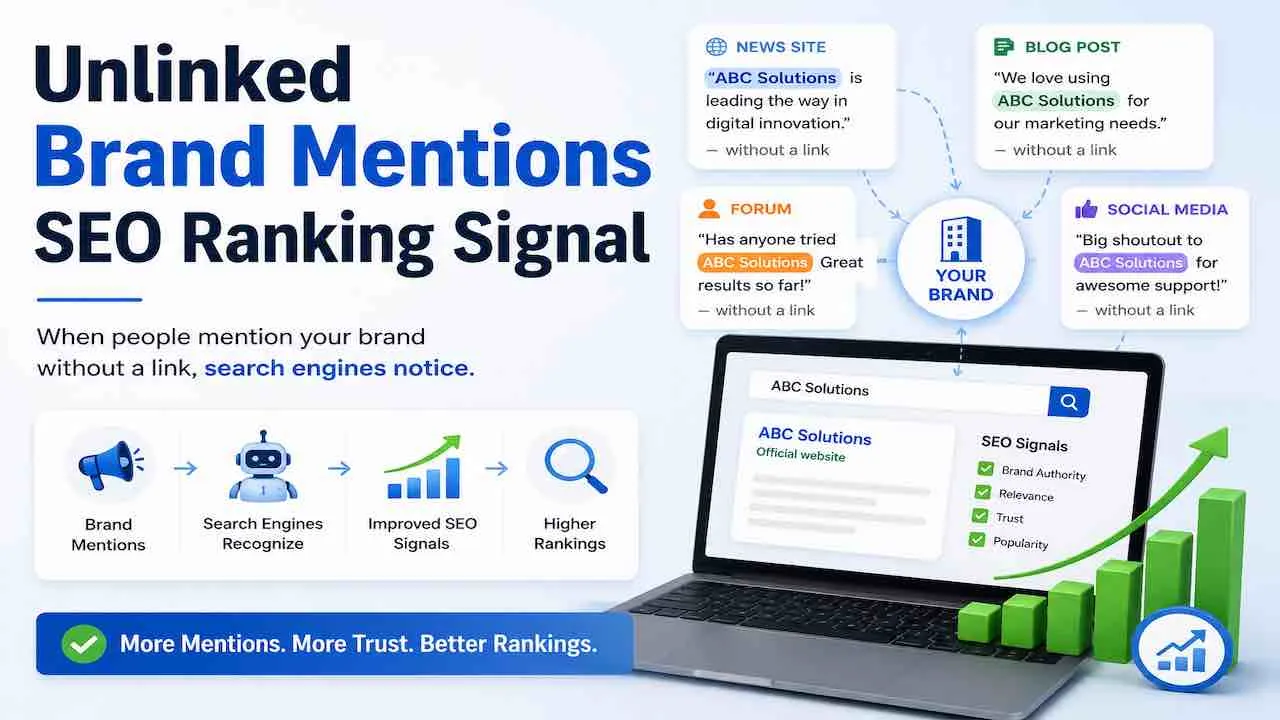
Unlinked brand mentions are references to your company name in published content without a hyperlink. As a traditional SEO ranking signal, they work through entity recognition, branded search volume, and EEAT authority assessment. Link equity plays no role. As an AI search citation signal, unlinked brand mentions are a direct mechanism. Large language models learn brand associations from text patterns, not link graphs. A brand mentioned consistently across authoritative, indexed publications gets cited in ChatGPT, Perplexity, and Google AI Overviews. No backlink is required.
You are probably here because link building is too expensive for your budget. That phrase, “link building too expensive,” reflects a real constraint for most brands. Or you have no backlinks but want to rank in AI search. Either way, this guide applies to your situation. Or you cannot afford link building at the scale your competitors use. Or you want to appear in AI answers without months of outreach. All three problems have the same solution. All three problems have the same solution. Understanding unlinked brand mentions as an SEO ranking signal is the fastest path to brand authority on a budget. Consistency is the requirement.
QuickDigital has tracked brand entity signals for clients across B2B, SaaS, and eCommerce sectors since 2014. This guide explains the exact mechanism and corrects the most common patent misinterpretation in the industry. It also gives you 7 specific tactics that move the needle in traditional search and AI search.
The Problem: Your Brand Is Invisible in AI Search Without Backlinks
Most brands start their SEO journey focused on backlinks. They spend months on outreach, guest posting, and digital PR to build link equity. Then they notice their brand does not appear in ChatGPT answers, Perplexity results, or Google AI Overviews. This happens even for branded queries. Meanwhile, brands with far fewer backlinks get cited regularly in AI generated answers about their industry.
The reason is a fundamental misunderstanding of how AI search systems work. AI engines do not rank results using the same link graph that Google’s PageRank uses. They retrieve and cite content based on entity cooccurrence patterns and entity association signals across authoritative sources. A brand that cannot afford link building but builds consistent unlinked mentions will outperform a heavily-linked brand in AI search. This holds true every time.
Small business brand visibility and brand authority without backlinks are entirely achievable through this mechanism. Building brand authority on a budget is the core use case for unlinked brand mention strategy. Getting cited without link building is not a workaround. It is the primary mechanism AI search systems use to surface brands in generated answers.
Unlinked Brand Mentions as an SEO Ranking Signal: The Complete Explanation
The SEO community has debated whether unlinked brand mentions help SEO for over a decade. Most content either overclaims or dismisses them entirely. The accurate answer is more nuanced and more useful than either extreme position.
The Difference Between Linked and Unlinked Citations
A linked citation passes PageRank, anchor text signals, and referral traffic to your domain. An unlinked brand citation carries no link equity. It cannot boost your PageRank or Domain Authority score directly. What it does build is entity recognition, entity association signals, and brand prominence signals. These feed into Google’s Knowledge Graph and into LLM training data simultaneously.
Unlinked citation value is not zero. Unlinked mentions ranking as a signal accumulates across dozens or hundreds of publications over months. It is different from link value, and it operates on a different timeline. Brand citation signals accumulate across dozens or hundreds of publications over months. The compound effect of consistent unlinked brand mentions produces measurable branded search volume growth. Knowledge Panel creation follows as well. It also produces AI search citation rates that link building alone cannot replicate. Building brand authority without backlinks through entity-rich content separates brands visible in AI search from those that are not.
Brand signal diversity matters as much as brand signal volume. A brand mentioned in news articles, review platforms, community forums, and analyst reports sends stronger entity signals. Being mentioned in only one channel weakens those signals significantly. Link free brand authority is built through this multi-channel mention diversity, not through any single source type.
Brand Co-occurrence SEO Strategy
Brand co-occurrence is the pattern of which entities appear alongside your company name in published content. Implied links SEO theory and brand co-occurrence strategy point to the same mechanism. That mechanism is entity association through contextual proximity. When your brand name appears alongside established industry authorities and trusted platforms, Google builds an entity proximity association. That association links your brand to those known entities in the Knowledge Graph. This is brand co-occurrence as an SEO strategy.
Brand co-occurrence SEO strategy means targeting publications where your brand appears alongside entities you want to be associated with. To rank for CRM software queries, get your brand mentioned alongside Salesforce, HubSpot, and Microsoft Dynamics. Target comparison articles, analyst reports, and community discussions for these mentions. The entity association signals from that co-occurrence strengthen your topical authority without requiring a single hyperlink.
Mention signals ranking is the aggregate effect of all unlinked brand mentions on your entity authority. No single mention moves the needle significantly. Fifty consistently-placed mentions across the right sources produce measurable results in 60 to 120 days.
Brand Signal Diversity and Why It Matters
Google’s quality evaluation systems assess brand prominence across multiple signal types. A brand with 100 backlinks from low-authority blogs but zero mention signals from news publications sends much weaker entity signals. A brand with 20 backlinks and consistent EEAT brand signals across diverse sources outperforms it. Brand signal diversity is the multiplier that amplifies every other SEO tactic you apply.
The brand mentions vs backlinks analysis shows how these two signal types complement each other in modern SEO strategy. They do not compete. For brands that cannot afford link building at scale, brand mention signal diversity produces faster measurable results. Chasing DA-matched backlink opportunities takes longer.
Google Patent US 8,682,892 and Implied Links: The Real Explanation
Google filed patent US 8,682,892, titled “Ranking Search Results.” That patent describes a system counting both express links and implied links. Both are ranking signals. This generated widespread excitement in the SEO industry. Many concluded that Google counts unlinked brand mentions the same way it counts backlinks. That interpretation is incorrect.
How Google Uses Implied Links
A careful reading of the patent reveals that “implied links” refers to branded search queries and navigational queries. It does not refer to text mentions on web pages. The patent describes a ranking system that uses branded search behavior as a reference signal. Google’s John Mueller addressed this directly. He said Google does not use plain text mentions for PageRank or link graph signals. He acknowledged a plain mention can be sometimes useful in other ways.
Those “other ways” are significant. Google patent implied links do feed into entity recognition systems even when they do not pass PageRank. The implied link as Google uses it contributes to brand entity recognition, not to link equity transfer. Unlinked mentions Google ranking factor is real. It operates through the Knowledge Graph and entity systems, not through PageRank.
How Google uses implied links specifically involves NLP brand extraction, entity salience scoring, and entity cooccurrence mapping. Every brand mention Google crawls contributes to a brand entity profile. This profile shapes Knowledge Panel creation, EEAT assessments, and AI Overview citation selection.
Google Hummingbird and Entity-Based Ranking
Google launched Hummingbird in 2013 to shift its core algorithm from keyword matching to entity-based ranking. Before Hummingbird, Google matched search queries to pages by counting keyword occurrences. After Hummingbird, Google matched queries to entities and their semantic relationships. This shift is why unlinked brand mentions as an SEO ranking signal became meaningful. Google Hummingbird made entity recognition a primary ranking mechanism. Brand mentions in text are the raw material that entity recognition systems process.
Entity-based ranking means a brand consistently mentioned in the right topic contexts builds topical authority. Link equity accumulation alone cannot achieve the same outcome. The Hummingbird era marked the beginning of brand co-occurrence as a valid and measurable SEO signal.
Why Unlinked Brand Mentions Drive AI Search Citations Directly
For AI search, unlinked brand mentions are not an indirect signal. They are the primary training and retrieval signal determining whether your brand appears in AI generated answers. This is the critical distinction that most SEO guides miss entirely.
Brand Mentions in AI Generated Answers
Large language models learn brand associations from text patterns in training data, not from link graphs. A brand mentioned frequently and positively across authoritative sources builds statistical associations. These determine how the model responds to queries about that brand’s topic area. Brand mentions in AI generated answers come from brands that built mention presence in the right sources. The training data sources are the key variable.
Getting cited by ChatGPT without link building is not just possible. It is the default mechanism. ChatGPT’s training data includes Wikipedia, Wikidata, major news publications, G2, Capterra, Reddit, and Quora. A brand consistently mentioned across these sources without a single backlink enters ChatGPT’s entity knowledge about that industry. Getting cited without link building requires mention presence in these specific training data sources.
AI Overviews Brand Citation Without Backlinks
Google AI Overviews uses Retrieval Augmented Generation (RAG) to pull passages from indexed sources at query time. The RAG pipeline selects passages based on entity cooccurrence patterns and entity clarity signals. AI Overviews brand citation without backlinks happens when your brand name appears in indexed passages. The surrounding entity context must match the query’s topic.
How to appear in AI search without backlinks comes down to one mechanism. That mechanism is entity cooccurrence in indexed, authoritative content. Your brand name must appear alongside the entities AI engines expect in answers about your industry. No link is required. Entity proximity is the selection criterion.
How to Appear in AI Search Without Backlinks
Brand not appearing in AI answers is almost always an entity signal problem, not a link problem. Brands invisible in AI search typically have brand mentions confined to their own website and social profiles. Third-party mentions on authoritative platforms are missing. The fix is systematic mention building across the sources AI systems draw from.
Brand invisible in AI search also occurs when brand mentions lack entity context. A passing reference to your company name in an unrelated article adds almost no entity signal. A mention that places your brand alongside specific industry entities adds strong entity association signals. These signals feed into both Google’s Knowledge Graph and LLM training data.
Our generative engine optimization guide covers structuring content that RAG systems select and cite. Our LLM training data and AI indexing guide explains which sources AI systems draw from during training. It also covers which mentions carry the most weight in that process.
NLP Entity Extraction, Entity Salience, and Knowledge Graph Signals
The mechanism connecting unlinked brand mentions to SEO and AI search visibility runs through three NLP systems. These are named entity recognition, entity salience scoring, and Knowledge Graph entity mapping. NLP entity extraction is the process that makes every unlinked mention a measurable brand signal.
Named Entity Recognition and Entity Salience Score
Named entity recognition (NER) is how Google and LLMs identify and categorize real-world objects in text. These include brands, people, locations, concepts, and organizations. Every page Google crawls goes through NLP brand extraction. Brand mentions in any content are identified and extracted. They are attributed to their corresponding entity profile in the Knowledge Graph.
Entity salience score determines how prominently a given entity features in a piece of content. Scores range from 0 to 1. A score near 1.0 means your brand entity dominates the content. Pages where your brand achieves high entity salience scores contribute stronger brand entity recognition signals. A passing mention on a page sends far weaker signals.
Run Google’s Natural Language API on any page that mentions your brand. This NLP brand extraction audit shows your entity salience score for that specific page. It tells you whether the mention sends a strong or weak entity signal. Target publications and content formats that consistently produce high-salience entity extraction for your brand name.
Entity Disambiguation, Semantic Neighborhood, and Entity Gravity
Entity disambiguation is how NLP systems determine which of multiple possible meanings a brand name refers to. A company named “Apex” competes with dozens of other entities using the same name. Entity disambiguation uses surrounding contextual entities to determine which Apex is being discussed. This is why entity cooccurrence context matters so much. Placing your brand name alongside industry-specific entities helps disambiguation systems correctly identify your specific entity.
Semantic neighborhood is the cluster of entities that consistently appear alongside your brand in indexed content. Semantic cooccurrence patterns within that neighborhood determine your topical authority associations. A Semantic brand signals emerge from this consistent contextual proximity across multiple authoritative sources. Expanding your semantic neighborhood means earning mentions in content about the topics you want to own. Each new mention in a relevant context strengthens the knowledge graph node associated with your brand entity. This strengthens topical authority signals directly. A brand whose semantic neighborhood includes the most authoritative entities in its category receives the strongest topical authority associations. Both Google and LLMs draw from these. Both Google and LLMs draw on these associations.
Entity gravity measures how strongly your brand entity pulls related queries toward your entity profile. Knowledge graph brand entity strength is the technical name for this property in Google’s systems. High entity gravity means Google resolves more queries to your brand entity with high confidence. Low entity gravity means Google shows lower confidence when associating your brand with specific topics. Building entity gravity requires consistent brand co-occurrence signals across high-authority sources over time. There are no shortcuts. Brand entity recognition grows linearly with the volume and authority of brand mentions across authoritative sources.
NAP Citations and Entity Association Signals
NAP citations are structured brand mentions that include your Name, Address, and Phone number. They appear in consistent format across business directories, review platforms, and citation databases. NAP citations are a foundational form of unlinked brand mention for local and service-area businesses. Each NAP citation adds an entity association signal. Google uses these signals to confirm your brand as a real, verified business entity.
NAP consistency across all citations is the critical requirement. A single name variation, such as “My Company” versus “My Company LLC,” creates entity disambiguation conflicts. These conflicts reduce Google’s confidence in your brand entity. Audit every existing citation for name consistency before building new ones. Our schema markup implementation guide covers connecting your on-site entity signals to your NAP citation network.
Brand Mentions vs Backlinks: The Complete Comparison
The “brand mentions vs backlinks” question is the wrong framing. The right framing is understanding what each signal type does and when each is more valuable. Use both strategically. Does Google use brand mentions for ranking? Yes, through entity systems. Does Google use backlinks for ranking? Yes, through PageRank. Both signals exist in the same algorithm. Neither replaces the other.
| Factor | Backlinks | Unlinked Brand Mentions |
|---|---|---|
| Primary signal type | PageRank and link equity transfer | Entity recognition and brand authority signals |
| Impact on traditional SEO | Direct ranking boost for target keywords | Indirect boost via branded search volume and entity authority |
| Impact on AI search | Minimal, AI systems ignore link graphs | Direct, AI systems train on text patterns not links |
| Cost to acquire | High, requires significant outreach time and budget | Low, accessible through PR, community, and content tactics |
| Timeline to results | 2 to 4 months for PageRank to be recognized | 60 to 120 days for entity signal accumulation |
| Small business suitability | Difficult without dedicated budget or team | Achievable through editorial mentions and community presence |
| Compounding effect | Strong with high authority domains | Strong with consistent cross-platform mention diversity |
| Risk of penalty | High if unnatural link patterns are detected | None, organic brand mentions carry no penalty risk |
| Knowledge Graph impact | Indirect, through anchor text and domain authority | Direct, through NLP entity extraction from every crawled mention |
| EEAT contribution | Moderate, contributes to domain authority signals | High, directly builds Authoritativeness and Trustworthiness signals |
See our resource on brand mentions vs backlinks in SEO for a deeper analysis. Brands combining both signals outperform those relying on either alone.
7 Tactics to Generate Unlinked Brand Mentions at Scale
These tactics target the sources producing the highest-quality entity signals for Google’s Knowledge Graph and LLM training data. Prioritize by source authority and topical relevance. Whether you get a link is secondary. What matters is whether the mention places your brand in the right entity context.
Tactics 1 to 4: Media, Reviews, Communities, and PR
Tactics 1 and 2: Earned Media and Review Platforms
- Pitch data-driven insights to industry journalists. Journalists cite brands that supply original data, statistics, or research findings. They rarely add links in news articles. They consistently name the source. Press mention SEO value comes from the brand name association in high-authority indexed publications, not from the link. PR SEO without links is the standard practice at major media outlets. A naming mention in TechCrunch or Forbes trains more AI models than ten backlinks from small blogs. This is press mention SEO in its most powerful form.
- Build your presence on software review platforms. G2, Capterra, and Trustpilot carry massive weight in LLM training sets. Brands like HubSpot, Ahrefs, and SEMrush increased Knowledge Panel visibility significantly after building structured review profiles on these platforms. Actively building your presence on these platforms generates structured, authoritative brand mentions. AI systems treat these as high-confidence entity confirmations. Social media brand mentions on LinkedIn also contribute to professional brand entity signals, particularly for B2B brands seeking AI citation in business-category queries.
a Tactics 3 and 4: Roundups and Community Discussions
- Participate in industry roundups and awards programs. Roundup articles that list the best tools, agencies, or services in a category generate high-salience entity mentions for every brand named. Submit your company to relevant awards programs, best-of lists, and curated directories in your sector. These roundups are frequently crawled, frequently updated, and heavily weighted in both Google and LLM training data. Getting cited without link building from these roundups is the default, not the exception.
- Get your brand discussed in forum and community discussions. Reddit, Quora, Stack Overflow, and industry-specific forums are heavily weighted sources in LLM training data. When community members recommend or discuss your brand by name in these forums, the mentions enter AI training pipelines directly. Brand invisible in AI search often means invisible in these community discussions. Build a brand reputation in your community so members cite you organically. Answer questions authentically. Do not post promotional content. Social media brand mentions in community contexts carry stronger entity signals than branded posts on your own profiles.
Tactics 5 to 7: Research, Wikipedia, and Analyst Coverage
- Create data, tools, or frameworks that practitioners reference. Original research, free calculators, and named frameworks generate brand co-occurrence SEO strategy results every time a practitioner references them in their own content. Name your framework with your brand name included. A practitioner who writes “we used the QuickDigital entity audit framework” in their blog post generates a brand mention that trains models even without linking to your site. Brand mentions without links from practitioners are among the most topically relevant entity signals available because they come from domain experts discussing your brand in its exact topic context.
- Establish a Wikidata entry and Wikipedia presence. Wikidata and Wikipedia are the single most heavily weighted sources in LLM training data across all major AI systems. A Wikidata entry for your brand creates a persistent entity anchor that all AI models draw from. This single action does more for AI search brand citation than dozens of backlinks from regular blogs. Brand mentions in AI generated answers frequently trace back to Wikidata entity associations, even when the AI system does not explicitly cite Wikipedia. Wikipedia link building strategy and Wikidata entity building are the highest-ROI tactics for AI search brand visibility, particularly for brands building brand authority on a budget.
- Get named in analyst reports and buyer guides. Gartner, Forrester, IDC, and vertical-specific analyst firms produce content that is cited in AI-generated answers at disproportionately high rates. Being named in an analyst report without a link is worth more for AI search brand visibility than dozens of regular backlinks. Unlinked mentions Google ranking factor is strongest when those mentions come from analyst-grade authoritative sources. Submit your products for analyst evaluation, participate in industry surveys, and contribute data to research reports in your sector.
EEAT Brand Signals and the Quality Rater Guidelines Connection
Google’s Search Quality Rater Guidelines reference brand prominence and reputation as components of EEAT assessment. EEAT brand signals are the subset of your brand’s online presence that quality raters evaluate. Google’s automated systems use these to determine Experience, Expertise, Authoritativeness, and Trustworthiness. Unlinked brand mentions directly build 3 of the 4 EEAT dimensions.
- Authoritativeness: A brand mentioned consistently in authoritative publications demonstrates authoritativeness to both quality raters and automated systems. Unlinked mentions in Forbes, TechCrunch, industry journals, and analyst reports signal that authoritative sources recognize your brand as a credible reference in your domain.
- Trustworthiness: NAP consistent citations across authoritative directories, consistent brand name formatting across all sources, and positive brand mentions in review platforms build Trustworthiness signals. These are all unlinked brand mention signals that directly contribute to Trust in the EEAT framework.
- Expertise: Brand mentions in technical discussions, practitioner forums, and subject-matter expert content signal that experts in your field recognize your brand as knowledgeable. Community brand mentions from domain practitioners contribute more to Expertise signals than media coverage from general journalists.
For the complete EEAT implementation framework, see our EEAT trust and authority guide. It covers every brand entity signal connection. For AI-specific EEAT considerations, see our semantic SEO entity optimization guide.
Brand Mention Source Quality: Ranking Sources by Signal Weight
Not all unlinked brand mentions carry equal signal weight. The source authority, topical relevance, and surrounding entity context determine how much each mention contributes to your entity profile. This table ranks source types by their combined Google entity signal and AI search citation weight.
| Source Type | Google Entity Signal | AI Search Citation Weight | Examples |
|---|---|---|---|
| Wikipedia and Wikidata | Highest | Highest | Wikipedia articles, Wikidata entity entries |
| Major news and media | Very high | Very high | Forbes, TechCrunch, BBC, Reuters, major trade press |
| Review and comparison platforms | High | Very high | G2, Capterra, Clutch, Trustpilot, GetApp |
| Analyst reports | High | Very high | Gartner, Forrester, IDC, niche research firms |
| NAP citations and directories | High for local, medium for general | Medium | Google Business Profile, Apple Maps, BBB, Yelp |
| Community and forum discussions | Medium | High | Reddit, Quora, Stack Overflow, Hacker News |
| Social media brand mentions | Low to medium | Low | Twitter/X, LinkedIn posts, Facebook mentions |
| Generic directories | Low | Very low | Generic business listing sites with no editorial process |
How to Track Unlinked Brand Mentions
Most brands have unlinked mentions they have never found. Auditing existing mentions reveals which publications already see you as a credible reference. It also surfaces conversion opportunities. A simple outreach email can turn an existing mention into a backlink when link equity matters.
- Google Alerts: Free, real-time alerts for any new mention of your brand name across indexed web content. Set up alerts for your exact brand name, common misspellings, and key executive names. This is the minimum monitoring setup every brand should have active.
- Ahrefs Content Explorer: Search your brand name in Ahrefs Content Explorer and filter for pages that do not link to your domain. This surfaces high-authority unlinked mentions at scale. Export sorted by domain rating for prioritized outreach.
- SEMrush Brand Monitoring: SEMrush’s brand monitoring tool tracks mentions across web, news, and social channels. It flags unlinked mentions separately and shows the source authority score for each mention.
- Brand24 or Mention: Real-time brand mention monitoring tools that track mentions across news, blogs, forums, and social media. Both tools filter by sentiment and show reach estimates for each source.
Measuring Brand Mention SEO and AI Search Impact
5 Monthly Metrics to Track
- Branded search volume: Track branded search query impressions in Google Search Console monthly. Rising branded search impressions indicate more people are searching for your brand name directly. This is the clearest measurable proxy for unlinked mention impact on branded query signals.
- Knowledge Panel presence and accuracy: A branded Knowledge Panel confirms Google has resolved your brand as a verified entity. Audit its attributes monthly. Accuracy improvement over time indicates entity cooccurrence signals are strengthening your entity profile in the Knowledge Graph. Our Knowledge Panel optimization guide covers how to accelerate Knowledge Panel creation through mention signal accumulation.
- AI Overview appearance rate: Filter Google Search Console by AI Overview-triggering queries containing your brand name. Rising impression counts indicate your brand entity is being pulled into AI generated answers at higher frequency.
- LLM brand recall testing: Query ChatGPT, Perplexity, and Gemini monthly with prompts like “recommend the best tools for” followed by your category. Track whether and how accurately your brand appears in those AI generated answers. This directly measures whether your brand mentions in AI generated answers are growing over time.
- Unlinked mention volume by source tier: Track the number of new unlinked mentions per month segmented by source authority. Rising mention volume in tier 1 and tier 2 sources is the leading indicator of entity signal accumulation before ranking changes become visible in Google Search Console.
For guidance on AI-generated answer citations, read our Google AI Overviews optimization guide. Also read our guide to ranking your brand in ChatGPT. For Perplexity-specific brand citation strategy, see our Perplexity AI optimization guide.
When to Convert Unlinked Mentions Into Backlinks
Brand mentions without backlinks ranking is a real outcome. But when you can convert a high-authority unlinked mention into a backlink, do it. When an unlinked mention becomes a linked citation, it sends both entity signals and link equity. Both signals fire simultaneously.
Prioritize conversion outreach based on 3 criteria. Look for source domain authority above 50 and topical relevance to your core keywords. The mention context must be positive and specific. A mention in a high-authority editorial piece describing your brand accurately is worth outreach time. A passing reference in a low-quality aggregator is not. Conversion rates for well-targeted outreach run 15 to 25%. Our backlink outreach service handles this at scale. It suits brands converting their mention profile into a structured link program. For digital PR that generates both brand mentions and links, see our digital PR and link building guide.
Brand Entity Services by QuickDigital
Build the Brand Entity Signals That Get You Cited in AI Search
QuickDigital builds brand entity strategies that generate unlinked brand mentions across high-authority sources. We strengthen your Knowledge Graph presence. We get your brand cited in ChatGPT, Perplexity, and Google AI Overviews. Since 2014, we have helped brands build entity authority that compounds over time.
Get My Free Brand Entity Audit
Free brand entity audit. No obligation. Response within 24 hours.
Frequently Asked Questions
Unlinked brand mentions do not pass link equity or PageRank. They build entity recognition in the Knowledge Graph. They drive branded search volume and strengthen EEAT brand signals. These indirect effects produce measurable ranking improvements for branded queries. Consistent mention accumulation over 60 to 120 days drives visible results.
Google patent US 8,682,892 describes implied links as branded search queries and navigational behavior. Text mentions on web pages are not what the patent describes. Unlinked mentions Google ranking factor works through NLP brand extraction and entity cooccurrence mapping. The result is entity authority growth, not link equity transfer.
Build consistent brand mentions across Wikipedia, Wikidata, G2, Capterra, Reddit, major news publications, and analyst reports. Brand mentions in AI generated answers come from brands with consistent entity-rich mentions across authoritative third-party sources. No backlink is required for AI retrieval. Entity cooccurrence in indexed content is the selection criterion.
Five free channels work without link building. Pitch original data to industry journalists. Build profiles on G2 and Clutch. Participate authentically in Reddit and Quora. Submit to analyst surveys and award programs. Create named frameworks that practitioners reference. These channels generate brand co-occurrence SEO strategy results at zero link building cost.
Google uses brand mentions for ranking through entity recognition systems, not PageRank. Brand mentions without backlinks ranking as an SEO signal operates through the Knowledge Graph, EEAT brand signals, and branded search volume generation. The effect is real and measurable over 60 to 120 days. It operates through different mechanisms than traditional link building.