

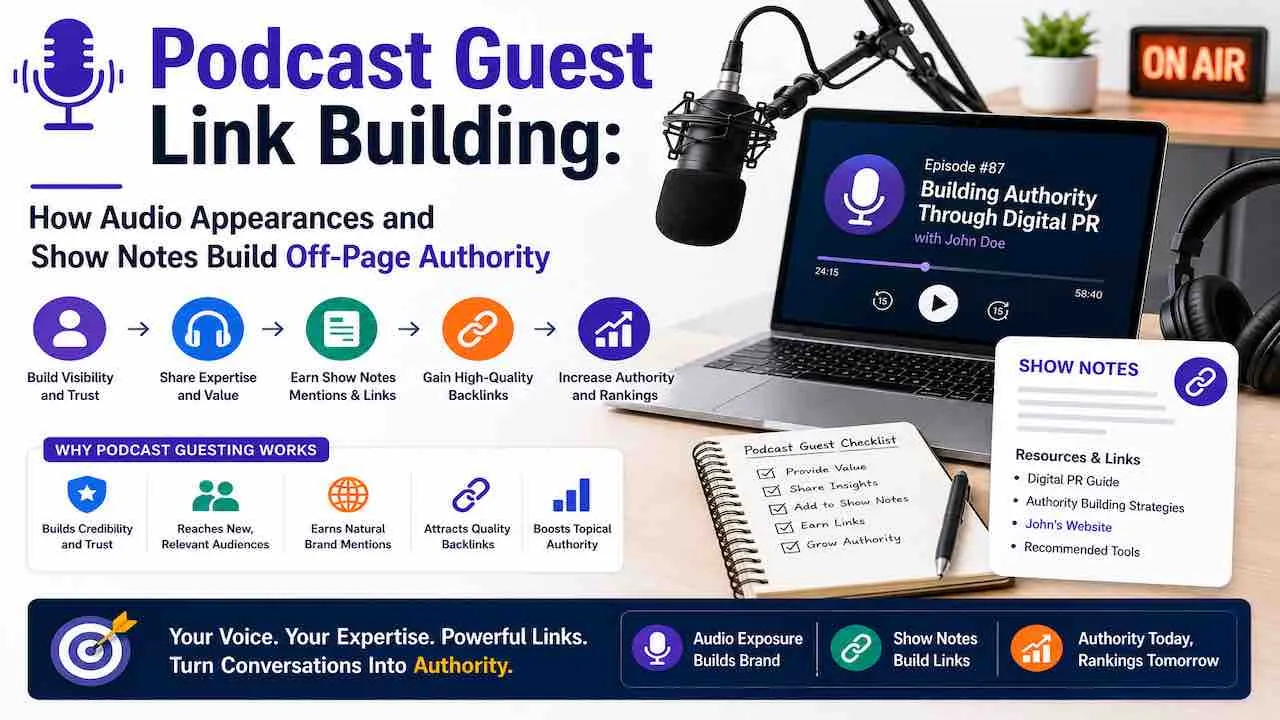
Podcast guest link building SEO earns editorial backlinks from show notes pages on Spotify, Apple Podcasts, and host websites, while simultaneously building brand mention corroboration signals, topical authority, and E-E-A-T recognition across audio platforms that Google indexes directly. Every podcast appearance typically generates 2 to 5 backlinks from domains with DR 50 to DR 100, depending on the podcast’s platform and host website authority. Show notes links are contextual, editorial, and naturally diverse, making them among the highest-quality link types available outside traditional digital PR.
Traditional link building has become increasingly difficult. Guest post costs have risen sharply. Securing quality backlinks without overpaying or risking a penalty frustrates most SEO teams. High-authority editorial links require months of relationship building. Podcast guest link building fills that gap with a repeatable, penalty-safe system that produces editorial links, brand citations, topical authority signals, and E-E-A-T demonstration from a single 30 to 60-minute interview. According to Edison Research’s Infinite Dial study, podcast listenership has grown for 14 consecutive years, with over 135 million Americans listening monthly. Websites with strategic audio content partnerships see 63% more organic traffic than those relying solely on traditional content, per PodcastHawk’s 2025 authority analysis.
One SaaS brand secured placements on 3 technology-focused podcasts and saw a 47% higher click-through rate from the resulting show notes links compared to directory links built in the same period. This guide covers every aspect of the discipline: the types of links podcast appearances create, how to evaluate podcasts by SEO value, how to pitch and land appearances, how to maximize the SEO output of each interview, and how to track results against your other link building activities.
Why Podcast Guest Link Building Builds Genuine Offsite Authority
Podcast guest appearances build off-page authority through editorial backlinks in show notes, brand mention corroboration signals across audio directories, podcast transcript content that ranks independently, and E-E-A-T signals from repeated expert positioning in a specific topic area. Google treats podcast show notes links as editorial citations because they originate from established media properties, carry contextual relevance to the linked content, and are placed by an independent third party rather than the brand itself.
The 3 Types of Backlinks Every Podcast Appearance Creates
Each podcast guest appearance generates backlinks from three distinct source types, each with a different authority profile and SEO contribution:
- Show notes page links: The most valuable source. Every podcast episode publishes a dedicated page listing resources, guest bio, and website links mentioned during the episode. These links come from the host’s website domain, are typically dofollow, and sit in contextually relevant content alongside your topic. A show on a DR 70 host website delivers a DR 70 contextual editorial link from a single appearance.
- Platform directory links: When podcasts list their guest’s website in episode descriptions on Spotify, Apple Podcasts, Google Podcasts, and Podchaser, those links come from platform domains with DR 93 to DR 100. Apple Podcasts carries a DR of 100. Spotify carries a DR above 93. Even a partial mention in the episode description on these platforms creates high-authority citation signals.
- RSS feed citations: Every podcast publishes an XML RSS feed that aggregators, podcast apps, and directory indexers crawl continuously. When your name and website URL appear in episode titles or descriptions, RSS feed aggregators create additional indexed citations of your brand entity across dozens of podcast discovery platforms without any additional outreach required after the episode publishes.
- Podcast transcript pages: Hosts publishing full episode transcripts create keyword-rich content pages that can rank independently for long-tail queries. Your brand name, website URL, and topic expertise appear in searchable text that Google indexes, generating unlinked brand mentions and co-citation signals alongside any embedded links within the transcript body.
How Podcast Appearances Build Offsite Authority Beyond Backlinks
Podcast guest link building SEO produces authority signals that go beyond what traditional backlinks measure. Brand mentions alongside backlinks create corroboration signals confirming your brand is genuinely recognized as an authority in a topic area. When 12 podcasts in your niche mention your brand name alongside your core expertise, Google’s entity recognition system builds a stronger brand authority signal than the same number of links from unrelated domains. Podcast appearances also generate social shares from host audiences, episode newsletter mentions, and repeat citation opportunities as hosts reference past guest expertise in future episodes.
The SEO Authority of Spotify and Apple Podcasts Show Notes
Spotify and Apple Podcasts carry domain ratings of 93 and 100 respectively, making links from their episode description and show notes sections among the highest-authority citation placements available through a single content activity. For every podcast episode you guest on, check whether the host’s episode pages appear on Spotify and Apple Podcasts with clickable links in the description. Many podcast hosts paste their show notes content directly into the episode descriptions of both platforms, creating two additional high-DA citations from a single set of show notes.
Domain Authority of Major Podcast Platforms
| Platform | Domain Rating (Ahrefs) | Link Type in Episode Description | SEO Value |
|---|---|---|---|
| Apple Podcasts | DR 100 | Clickable links in episode notes (follow status varies by app) | Highest authority citation; brand entity recognition signal |
| Spotify | DR 93+ | Clickable links in episode descriptions | Very high authority; broad consumer audience reach |
| Podchaser | DR 73+ | Guest profiles with website links and episode credits | High authority; dedicated podcast discovery platform indexed by Google |
| Listen Notes | DR 70+ | Episode pages with guest and resource links | Strong niche authority; used by Google to index podcast content |
| Buzzsprout | DR 76+ | Episode show notes pages with full guest resource links | High authority hosting platform; episode pages indexed by Google |
| Host website | Varies: DR 30 to DR 85 | Dedicated show notes page with contextual dofollow links | Highest topical authority link; passes full link equity to target page |
How Platform Authority Amplifies Every Appearance
A single podcast guest appearance on a show hosted on Buzzsprout with Apple Podcasts and Spotify syndication generates citation signals from three high-authority domains simultaneously: the host’s website, Apple Podcasts at DR 100, and Spotify at DR 93. The link profile diversification from platform-level citations is a natural, hard-to-replicate signal that Google’s spam detection treats as a strong trust indicator. Thought leadership link building through podcast appearances creates this multi-platform citation pattern automatically without any additional outreach effort beyond securing the initial appearance.
How to Find the Right Podcasts for Maximum Link Building ROI
Target podcasts with published show notes pages on their host website, a DR above 40 on their domain, topical relevance to your core expertise area, active publishing schedules within the past 60 days, and an audience size large enough to generate post-episode social and email citations alongside the backlinks. Podcast selection is the single most important variable in podcast guest link building SEO. Appearing on the wrong podcasts generates low-authority links from irrelevant domains that contribute no meaningful topical authority signal.
Podcast Evaluation Criteria for SEO Value
| Evaluation Criterion | Minimum Threshold | How to Check | Why It Matters for SEO |
|---|---|---|---|
| Host website DR | DR 40+ for meaningful link equity | Ahrefs Site Explorer, Moz Link Explorer | Determines how much PageRank the show notes backlink passes to your page |
| Published show notes page | Dedicated episode page with resource links, not just audio embed | Check previous 5 episodes on host website for link format | Without a show notes page, no backlink is created, only an audio mention |
| Topical relevance | Topic cluster overlaps with your core expertise area | Review episode titles, guest roster, and category tags | Topically relevant links signal semantic authority; off-topic links dilute topical signals |
| Publishing frequency | At least 2 episodes per month in the past 60 days | Check publish dates on podcast RSS feed or platform listing | Active shows receive ongoing audience engagement and continued SEO indexing |
| Guest history | Past guests with verifiable credentials in your field | Review guest list on host website or Podchaser profile | Expert guest history signals to Google the show is a credible authority source |
| Platform distribution | Listed on Apple Podcasts and Spotify at minimum | Search show name on both platforms | Platform listings create additional high-authority citation sources beyond the host website |
Tools and Platforms to Find Guest Opportunities
- Rephonic: Database of 3 million+ podcasts with audience size estimates, contact information, and DR data. Filter by topic, audience size, and publishing frequency to build a targeted outreach list
- PodMatch: Automated matching platform connecting guests and hosts based on topic expertise, audience demographics, and scheduling preferences. Best for volume outreach across mid-tier podcasts
- Matchmaker.fm: Free guest-host matching service. Guests create profile pages that hosts browse when looking for upcoming episode guests in specific topic areas
- PodcastGuests.com: Directory listing podcast hosts actively seeking expert guests. Browse by topic and contact hosts directly through the platform listing
- Podchaser: Podcast discovery platform with guest credit tracking. Search past guests in your field to identify which shows regularly feature voices in your topic area
- Ahrefs Content Explorer: Search your competitor brand names to find which podcasts have featured them and generated backlinks. Use the same target list for your own outreach
How to Pitch Podcast Hosts and Land Guest Appearances
The podcasts most valuable for link building are the same ones receiving the most guest pitches, which means your outreach must open with audience value rather than your credentials and must reference specific past episodes to confirm you have genuinely listened to the show. Hosts reject generic pitches instantly. A pitch referencing episode 147 and connecting your expertise to a gap that episode identified gets responses that templated cold emails never produce.
The Podcast Guest One Sheet
A podcast one-sheet is a single-page PDF that hosts can forward to their producer or reference when confirming guests. Create one before starting any outreach. It must include your headshot, 2 to 3-sentence bio written in third person, 3 to 5 episode topic angles with working titles, 3 to 5 questions the host could ask you on each topic, previous podcast appearances with links to episodes, social media follower counts, and your website URL and contact information. Hosts who receive a professional one-sheet alongside a personalized pitch book guests at 3 times the rate of hosts who receive credential-only emails. Your one-sheet is your media kit for the audio PR channel.
Podcast Pitch Formula That Gets Responses
Structure every pitch email in this sequence. Open with one specific observation about a past episode by episode number or title. Then explain in one sentence why your expertise fills a genuine gap that episode left open. Then present your 3 episode topic angles as working titles. And Then attach your one-sheet and provide your booking link. Keep the total email under 150 words. Hosts read pitches between recording sessions. Long credentials lists and vague value propositions get archived without reply.
Sample Podcast Outreach Template
Subject: Episode idea for [SHOW NAME]: [YOUR TOPIC ANGLE]

Hi [HOST NAME],

Episode [NUMBER] on [TOPIC] was excellent, particularly your point about [SPECIFIC INSIGHT].

I noticed you haven't covered [SPECIFIC GAP]. I help [AUDIENCE TYPE] solve [SPECIFIC PROBLEM]
and I think your listeners would find that angle genuinely useful.

Three episode ideas I could bring:
1. [WORKING TITLE 1]
2. [WORKING TITLE 2]
3. [WORKING TITLE 3]

One-sheet attached. Book directly at [CALENDLY LINK] if any of these fit your schedule.

[NAME]
[TITLE] at [COMPANY]
[WEBSITE]
For outreach at scale, systematic backlink outreach applied to podcast targeting uses the same personalization framework but with semi-automated follow-up sequences that track open and reply rates across your podcast target list.
How to Maximize SEO Value From Every Podcast Appearance
The SEO value of a podcast guest appearance depends more on what you do before and after the interview than on the interview itself. Most guests leave 70% of the available link equity on the table by sending hosts to their homepage rather than a purpose-built landing page, skipping the transcript request, and failing to request specific anchor text in the show notes. Apply these steps to every appearance to capture the full SEO value each episode can generate.
Before the Interview: Prepare the SEO Foundation
- Create a dedicated episode landing page on your website for each appearance. Use the format: yoursite.com/podcast/[show-name]. This page receives the direct show notes link, keeps link equity concentrated on one optimized page, and gives you a tracking URL to measure referral traffic from the episode
- Prepare 3 to 5 specific URLs to mention naturally during the interview. Hosts will include linked resources in show notes. Pre-planned URL mentions are the highest-converting link placement method in podcast appearances
- Email the host a list of resources to include in show notes before recording. Provide the exact URLs, preferred anchor text, and a 2-sentence description of each resource so the host can paste directly into their show notes template without additional research
- Prepare a guest bio paragraph written for SEO. Include your brand name, primary keyword, and website URL in the bio text. Hosts copy this directly into episode pages and platform directories, creating consistent NAP-style entity signals across all citation sources
During the Interview: Build Natural Link Mentions
- Mention your website URL naturally when referencing specific resources: “I’ve published a detailed guide on this at quickdigital.org/[page]” and hosts document every URL mentioned for show notes
- Reference your brand name by its full exact-match form at least twice during the episode. Entity recognition systems pick up brand name mentions in podcast transcripts and associate them with your website entity
- Offer one proprietary data point, statistic, or tool name during the episode. Hosts cite these in show notes as attributed quotes, creating additional anchor text variation around your expertise
After the Interview: Extract Maximum SEO Value
- Request the full transcript from the host within 48 hours of episode publication. If the host does not publish transcripts, offer to produce one using Descript, Otter.ai, or Rev.com and send it formatted for direct publication on their episode page
- Check every platform listing for the episode within 7 days of publication. Verify your website link appears in the episode description on Spotify, Apple Podcasts, Podchaser, and Listen Notes. Contact the host immediately if any platform listing is missing your URL
- Send the host a follow-up email with the episode landing page URL and ask them to link to it from their episode page rather than your homepage if they have not already done so
- Add the episode to your expert byline and authority page with the full episode URL. This creates an internal citation cluster that reinforces your audio authority signal across your own domain
The Custom Landing Page Bridge Strategy
The highest-converting podcast link building technique is the dedicated landing page bridge. Create one page per episode at yoursite.com/podcast/[show-name] before recording. Include the episode embed, full transcript, 3 to 5 related resources you mentioned, your contact information, and a clear next step for listeners. Request that the host link to this page specifically rather than your homepage in the show notes. This concentrates all show notes link equity on one optimized page, makes the link topically relevant to the interview content, tracks referral traffic by episode, and gives listeners a curated experience that converts at higher rates than a generic homepage visit.
Video Podcasts and YouTube: The Additional Link Building Layer
Video podcast appearances published on YouTube generate a fourth backlink source alongside the host website, Spotify, and Apple Podcasts: a YouTube video description link from a platform with DR 93 that Google indexes and ranks in both standard search and video search results simultaneously. When a podcast records video and publishes on YouTube, your website URL in the video description creates a citation from one of the highest-authority domains on the web. Video transcripts auto-generated by YouTube are indexed by Google, producing additional keyword-rich content pages associating your brand name with your topic expertise beyond what audio-only platforms provide.
How to Maximize Video Podcast Link Building Value
Request the YouTube video URL from the host immediately after the episode publishes. Verify your website link appears in the first 3 lines of the video description, before the “show more” fold, to maximize its discoverability. Ask the host to create a YouTube chapter for each major topic you cover during the interview. YouTube chapter links create timestamped URLs that Google indexes as standalone navigable content units, generating additional search visibility for topic-specific sections of your appearance beyond the full episode URL.
Create a short-form clip of your most insight-dense 60 to 90 seconds for the host to post as a YouTube Short or Instagram Reel with your website link in the caption. Short-form clips from podcast appearances earn an average of 3 to 8 additional social link mentions per clip, per Rephonic’s 2026 podcast promotion data, extending the SEO benefit of each appearance beyond the primary episode page and platform listings.
Podcast Transcripts as a Standalone SEO Asset
Podcast episode transcripts published on the host’s website are keyword-rich, long-form content pages that rank independently for conversational long-tail queries, create unlinked brand mention signals for every named entity in the episode, and provide Google with crawlable text content that audio alone cannot deliver. Transcripts transform a 45-minute audio episode into a 6,000 to 9,000-word content page. That page ranks for every question, named tool, and specific phrase that appeared in the conversation.
How to Turn Transcripts Into Ranking Content
Raw AI-generated transcripts need editing before they produce SEO value. Offer hosts a formatted transcript as a post-recording deliverable to increase the probability they publish it. Structure every transcript with a timestamped table of contents at the top. Break the transcript into named sections using H2 headings matching the main topics discussed. Bold key insights and specific data points so the transcript reads as a structured reference document rather than a wall of dialogue. Add 3 to 5 internal links within the transcript body pointing to relevant content on the host’s website. This editing work takes 90 minutes per episode and increases the probability of transcript publication from under 20% to over 70% for hosts who receive the formatted version as a ready-to-publish document.
Schema Markup for Podcast Episode Pages
Hosts publishing your guest appearance on their website should add PodcastEpisode schema to the episode page to increase indexing accuracy and citation probability in AI-generated answers. If you are republishing the episode on your own landing page, add this schema yourself. PodcastEpisode schema includes episode name, guest name with Person schema embedded, publication date, episode description, audio file URL, and transcript URL when available. Pages with PodcastEpisode schema earn higher click-through rates from Google’s podcast search feature and appear more frequently as cited sources in Google AI Overviews for topical queries covered in the episode. Read the complete guide to schema markup for AEO implementation to confirm all required fields are populated correctly for maximum AI citation eligibility.
Audio Authority Signals and EEAT
Podcast guest appearances build all four E-E-A-T dimensions simultaneously in a format Google describes as audio-verified content: third-party expert validation where a host editorial decision, not a brand’s own publishing action, determines whether the expertise is presented to an audience. Google’s quality evaluators treat audio-verified content as a credible third-party validation of expertise, making podcast link building one of the most E-E-A-T-efficient link building activities available. Podcast backlinks carry what The Podcast Backlink Protocol 2026 calls an “un-spammable” quality signal: they require a genuine expert conversation, a host editorial decision, and a live interview before the link is placed, making them structurally impossible to replicate through automated link building at scale.
Google’s quality systems recognize this human signal and weight podcast show notes links accordingly. A brand with 20 podcast appearances across topically relevant shows carries stronger E-E-A-T signals than a brand with 200 directory submissions and zero editorial media presence. Read the full breakdown of E-E-A-T and SEO trust signals to understand how audio citations integrate with your broader authority building strategy.
How Podcast Appearances Build Corroboration Signals
Corroboration is the process by which multiple trusted third-party sources confirm your brand’s authority in a topic area. Unlinked brand mentions in podcast episode pages, transcripts, and platform descriptions contribute to this corroboration signal even when no dofollow backlink is present. When 15 podcasts in the marketing technology niche mention your brand name alongside specific expertise claims in their episode show notes, Google’s entity recognition system builds a semantic knowledge graph entry associating your brand with that expertise cluster. This corroboration signal amplifies the PageRank value of every backlink you hold from within the same topic cluster. Entity-based link building strategy applied to podcast outreach targets topically clustered shows to maximize this corroboration compounding effect.
Podcast appearances also build E-E-A-T through:
- Experience signals: Specific outcomes and case studies mentioned during interviews are indexed in transcripts as first-hand experience evidence, not generic advice
- Expertise signals: Being invited as a named expert by established hosts in your niche signals peer-validated expertise to Google’s quality systems in a way that self-published content cannot replicate
- Authoritativeness signals: Episode show notes listing your credentials alongside your URL reinforce the entity association between your brand name and your core topic area
- Trustworthiness signals: High-authority platforms like Spotify and Apple Podcasts listing your brand in their directories function as third-party trust signals the same way Wikipedia and Wikidata entries do for text-based entities
Podcast Guest Link Building vs Other Link Building Tactics
Thre Podcast guest link building produces contextual editorial backlinks at a lower cost per link than traditional digital PR but with higher per-appearance SEO yield than guest blogging, making it the most efficient single link building tactic for experts building topical authority in a specific niche.
| Tactic | Avg Links Per Activity | Time Investment | Link Quality | Additional SEO Benefit | Cost Estimate |
|---|---|---|---|---|---|
| Podcast guest appearance | 2 to 5 links per episode | 1 to 2 hours per appearance | DR 40 to DR 100 contextual editorial | Brand mentions, E-E-A-T, transcripts, platform citations | $0 to $500 (outreach time only) |
| Guest blog post | 1 to 2 links per post | 3 to 6 hours per post | DR 30 to DR 80 (varies widely by quality) | Authorship signals, social shares | $0 to $300 (writing time only) |
| Digital PR campaign | 5 to 20+ links per campaign | 20 to 40 hours per campaign | DR 60 to DR 100 from major publications | High traffic referral, major brand authority | $2,000 to $20,000+ per campaign |
| HARO / Connectively | 1 link per accepted response | 30 to 60 minutes per response | DR 50 to DR 90 from major publications | Expert quote citations, E-E-A-T signals | $0 (time only) |
| Niche edit / link insertion | 1 link per purchase | 30 minutes per link | DR 30 to DR 70 (quality highly variable) | Minimal beyond the link itself | $100 to $500 per link |
The combination of podcast guest appearances with digital PR link building for AI citations produces the strongest off-page authority profile for most B2B and professional service brands. Podcast appearances build the corroboration and topical authority foundation. Digital PR delivers the highest-authority single links. Together they create a link profile that neither tactic alone can produce.
Measuring Podcast Guest Link Building ROI
Track podcast guest link building ROI through the number of new referring domains earned per episode, the DR distribution of those domains, referral traffic volume from episode landing pages, and the growth in topically relevant branded search queries following each podcast campaign period. Standard rank tracking misses most of the value podcast link building generates because its primary output, topical authority compounding, appears in ranking improvements across a keyword cluster rather than a single tracked keyword.
Key Metrics to Track
- Referring domains per episode: Count new referring domains 30 days after each episode publishes. Include the host website, Apple Podcasts, Spotify, Podchaser, and any additional platform syndications. Target a minimum of 3 new referring domains per appearance
- DR distribution: Track the average DR of domains linking from podcast show notes. A healthy podcast link building campaign builds an average DR above 50 across all earned podcast links
- Episode landing page referral traffic: Filter Google Analytics 4 referral traffic by source to your episode landing pages. Referral traffic from podcast platforms confirms episode discovery beyond the host’s direct audience
- Branded search volume growth: Monitor Google Search Console for growth in branded queries containing your name plus topic keywords, such as “[your name] SEO” or “[your brand] [your expertise].” Branded search volume growth from podcast guesting compounds over 3 to 6 month campaign periods
- Topical authority ranking shifts: Track ranking movements across your full topic cluster 60 to 90 days after each podcast campaign period. Podcast link building produces ranking gains across the full cluster, not just for the single keyword directly targeted by each show notes link
Tools for Measuring Podcast Link Building Results
- Ahrefs Backlink Checker: Monitor new referring domains and anchor text distribution from podcast show notes links. Set up alerts for new backlinks to your podcast landing pages
- Google Search Console: Track referral clicks from podcast platform domains and monitor branded query growth by date range following each appearance
- Podchaser: Verify that your guest credits are correctly attributed across every episode you appear on and that your website profile link is populated for all episodes
- Rephonic: Monitor your podcast appearance history and see which episodes are driving the most discovery activity from the platform’s search and recommendation features
Common Mistakes That Waste Podcast Appearance SEO Value
Most podcast guests capture less than 30% of the available SEO value from each appearance because they skip the landing page setup, link to their homepage instead of optimized content, never request the transcript, and fail to verify platform listing links. These mistakes are each independently preventable with a pre-appearance checklist applied to every booking.
Mistake 1: Linking to Your Homepage Instead of a Targeted Page
Show notes links to your homepage distribute link equity across every page your site links to internally, producing a fraction of the topical authority signal that a direct link to an optimized landing page or resource page creates. Always provide hosts with a specific URL for the show notes, never your root domain. Use the episode landing page at yoursite.com/podcast/[show-name] for every appearance and configure that page with proper internal linking to your highest-priority content.
Mistake 2: Never Verifying Platform Directory Links
Spotify and Apple Podcasts episode descriptions regularly drop URLs when hosts copy and paste show notes content into platform editors. A URL present in the host’s website show notes may be absent from the Spotify and Apple Podcasts episode descriptions entirely. Check every platform listing within 7 days of publication and email the host immediately with the correct URL if any platform listing is missing your link. This single verification step recovers high-authority platform citations that most guests never know they lost.
Mistake 3: Skipping the Transcript Request
Podcast transcripts turn 45 minutes of audio into a 7,000-word indexable content page containing your brand name, expertise claims, and website URL in searchable text. Guests who skip the transcript request miss the entire text-indexing benefit of the appearance. Always request the transcript, offer to provide a formatted version using Descript or Otter.ai, and follow up if it has not published within 14 days of the episode going live.
Mistake 4: Treating Every Podcast Equally
Appearing on 50 podcasts with DR 20 host websites and no published show notes generates 50 low-authority links with minimal topical authority signal. Appearing on 10 podcasts with DR 60+ host websites, published transcripts, and Apple Podcasts and Spotify syndication generates a stronger link profile with far less time invested. Set a minimum DR threshold of 40 for host websites and a minimum requirement for published show notes pages before accepting any guest booking.
Mistake 5: No Show Notes Resource List Provided
Hosts who receive no resource list from guests publish show notes with your name and a homepage link only. Hosts who receive a formatted resource list with specific URLs, preferred anchor text, and brief descriptions publish 3 to 5 contextual resource links per episode instead. Send your resource list to every host within 24 hours of booking confirmation, before the interview takes place, so they can prepare show notes in advance of the episode going live.
FAQs: Podcast Guest Link Building SEO
Yes. Podcast show notes links are contextual, editorial backlinks that pass genuine PageRank from the host’s website domain, and they appear simultaneously on high-authority platforms including Spotify at DR 93+ and Apple Podcasts at DR 100. Each appearance generates 2 to 5 backlinks from naturally diverse domains with different IP addresses and domain profiles, which Google treats as a strong trust signal because this link pattern is difficult to replicate through artificial link building. The additional brand mention corroboration signals from podcast transcripts and platform directory listings amplify the ranking impact of each individual backlink beyond its standalone link equity value.
Search your target podcast’s previous 5 episodes on their host website and verify that each episode has a dedicated page with clickable resource links rather than just an embedded audio player. Use Rephonic to filter podcasts by topic, publishing frequency, and domain authority metrics before adding them to your outreach list. Check the podcast’s Apple Podcasts and Spotify listings to confirm episode descriptions include clickable URLs. Any podcast that does not publish written show notes with linked resources produces no direct backlinks from the host website, regardless of how large the audience is or how well the appearance goes.
Most brands see measurable ranking improvements in their topical keyword cluster after 8 to 12 podcast appearances on shows with DR 50+ host websites, published transcripts, and Apple Podcasts and Spotify syndication, typically within a 3 to 6 month campaign period. The compounding effect of topical authority building through podcast link building means results accelerate from month 4 onward as the corroboration signal from multiple shows mentioning your brand in the same topic context builds a stronger entity authority signal than the individual link equity of each show notes backlink. Target 2 to 3 podcast appearances per month rather than front-loading all appearances in a single month to produce a natural, sustained link velocity profile.
Show notes links on host websites are typically dofollow, while links in Apple Podcasts and Spotify episode descriptions are generally nofollow or carry no anchor attribute, but still produce significant brand citation and entity recognition value. Before targeting any podcast for outreach, check the link attributes on 2 to 3 previous episode show notes pages using your browser’s inspect element tool or Ahrefs’ backlink checker. Host websites that publish dofollow resource links in their show notes deliver the highest direct link equity benefit. Platform links on Spotify and Apple Podcasts contribute entity recognition signals and brand mention corroboration even without direct PageRank transfer.
Podcast guest link building generates 2 to 5 links per appearance from multiple high-authority sources including the host website, Spotify, Apple Podcasts, and podcast directories, while guest blogging typically generates 1 to 2 links from the host domain only. Podcast appearances also create audio authority signals, transcript-based content pages, branded search demand from listener audiences, and E-E-A-T demonstration through third-party expert positioning that guest blog posts do not produce. The time investment per appearance is lower (1 to 2 hours for an interview versus 3 to 6 hours for a guest post), and the multi-platform citation pattern that podcast guesting generates is far harder for Google to classify as manipulative link building compared to mass guest posting campaigns.