



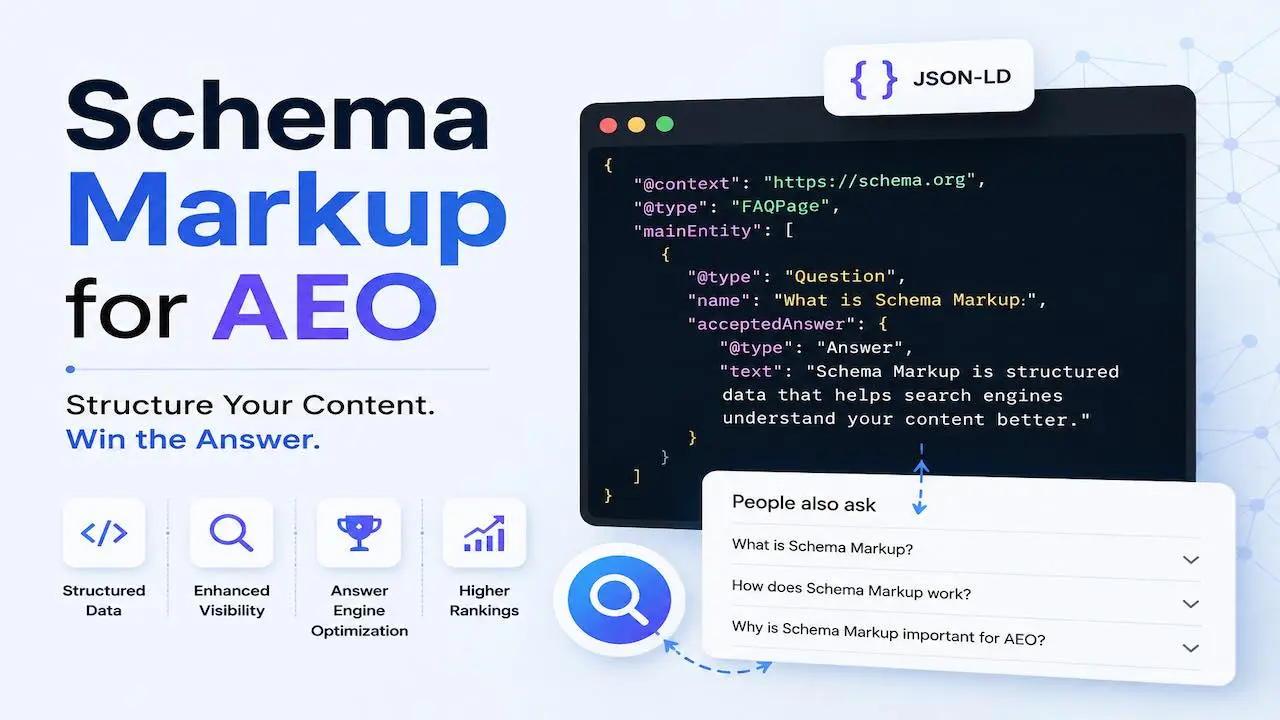
Schema markup for AEO is answer engine optimization schema: structured data you add to your page HTML so AI engines can extract, attribute, and cite your answers without guessing at meaning, authorship, or entity relationships. Pages with attribute-rich schema earn a 61.7% AI citation rate in independent research. But here is the finding most schema guides skip: generic, minimally populated schema earns only a 41.6% citation rate, which is lower than having no schema at all (59.8%). Adding incomplete schema actively hurts your AI citation rate. This guide covers which JSON-LD for AEO types drive the highest citation rates, the schema markup for AI citations that drives AI grounding decisions, and the 10 mistakes that block AI citations even when your markup validates correctly.
The right AEO schema implementation gives AI engines three signals they cannot extract reliably from unstructured text: what your content covers, who created it, and how it connects to verified knowledge graph entities. This is the core difference between structured data for AI search and structured data for traditional SEO. Quick Digital has applied AI citation schema strategies since 2014. Every implementation in this guide comes from real client sites. If you want schema implementation handled end to end, read about our AEO answer engine optimization services.
How Schema Markup for AEO Works
Schema markup for AEO gives AI engines three signals they cannot reliably extract from unstructured text: what your content covers, who created it, and how it connects to verified entities in the knowledge graph. AI systems process indexed representations of your content, not the live page the way humans read it. They assemble answers from those representations at query time. Pages with clean JSON-LD schema give the AI a pre-labelled semantic fingerprint it trusts. Crawlable structured data written using the Schema.org structured data vocabulary is the machine-readable layer that enables entity attribution, entity graph principle connections, and AI grounding across ChatGPT, Perplexity, Google AI Overviews, and Bing Copilot. Pages without schema force the AI to infer all three signals from text patterns alone, which introduces uncertainty that reduces citation probability.
Schema Markup for AEO vs Schema Markup for Traditional SEO
Schema markup for traditional SEO targets Google rich results in search pages. AEO Schema markup for targets the machine-readable signals AI engines use for entity disambiguation, AI grounding, and citation attribution across ChatGPT, Perplexity, Google AI Overviews, and Bing Copilot. The schema types and Schema.org vocabulary are the same. The priority order and required properties are completely different. AEO schema prioritises entity clarity, authorship verification, and linked external identifiers. Traditional SEO schema prioritises rich snippet eligibility. A page can lose all FAQ rich results and still earn maximum AEO citations from the same FAQPage schema.
AI Crawler Access: The Prerequisite Most Sites Miss
Schema markup for AEO only works if AI crawlers can access your pages, and many sites block the exact user agents that AI engines use to index content. Review your robots.txt for AI crawlers — this robots.txt for AI crawlers check is the most common prerequisite site owners miss:
- GPTBot: OpenAI’s crawler used by ChatGPT Browse and ChatGPT responses
- ClaudeBot: Anthropic’s crawler used by Claude AI systems
- PerplexityBot: Perplexity AI’s crawler for real-time web search answers
- CCBot: Common Crawl bot whose indexed data feeds multiple LLM training sets
- Googlebot-Extended: Google’s dedicated AI content crawler for AI Overviews
If any of these appear in a Disallow block on your robots.txt, those AI platforms cannot read your pages. Your schema markup does nothing for them. Fix this before implementing any structured data. AI citation rates on crawlable pages consistently outperform schema alone on blocked pages by a factor that makes crawl access a higher priority than schema type selection.
FAQPage Schema for AI Citations: The Highest-Impact AEO Signal
FAQPage schema is the single most impactful schema type for AEO because it structures your content as standalone question-answer pairs that AI engines extract and cite directly, without reformulating your text. Each FAQ answer inside your JSON-LD is a pre-packaged AI citation. FAQPage schema carries a 3.2 times higher AI Overview appearance probability than pages without it, and only 10.5% of AI-cited pages currently use FAQPage or QAPage schema. That gap is the competitive opening available right now.
FAQPage Rich Results vs FAQPage AEO Value
Google deprecated FAQPage visual rich results from standard search for most sites, but FAQPage schema remains fully effective for AEO across ChatGPT, Perplexity, Google AI Overviews, and Bing Copilot. The deprecation of accordion results in Google Search does not affect how AI engines use the same markup for answer extraction. Keep FAQPage schema on every page containing genuine Q&A content. The rich result is gone for most sites. The AI citation value is unchanged. Base your FAQ questions on People Also Ask data to target the exact questions AI engines are already answering for your topic.
FAQPage Schema Rules That Directly Affect Citation Rate
- Keep every answer between 40 and 60 words. AI systems favour this extraction window.
- Start every answer with the core fact, not a qualifier. Answers beginning with “It depends” earn near-zero citations.
- Name specific entities, tools, and platforms in every answer. Vague answers fail entity verification.
- Use 6 to 10 questions per FAQPage block. Fewer than 6 underutilises the signal. More than 10 dilutes entity salience.
- Both the question and the answer must be visible in rendered HTML. Hidden accordion answers may fail AI crawlers.
<script type="application/ld+json">
{
  "@context": "https://schema.org",
  "@type": "FAQPage",
  "mainEntity": [
    {
      "@type": "Question",
      "name": "How does schema markup improve AEO?",
      "acceptedAnswer": {
        "@type": "Answer",
        "text": "Schema markup for AEO gives AI engines machine-readable signals about your content's meaning, authorship, and entity connections. Pages with attribute-rich schema earn a 61.7% AI citation rate. Generic or minimally populated schema earns only 41.6%, which is lower than having no schema at all."
      }
    },
    {
      "@type": "Question",
      "name": "Which schema type has the highest AEO citation rate?",
      "acceptedAnswer": {
        "@type": "Answer",
        "text": "FAQPage schema has the highest AEO citation impact, carrying a 3.2 times higher Google AI Overview appearance probability than pages without it. Organization schema appears in 82% of AI Mode citations. Combining FAQPage, Article, and Organization in @graph format produces 1.8 times more citations than Article schema alone."
      }
    }
  ]
}
</script>
Organization Schema for AEO: The Entity Foundation
Organization schema for AEO is the entity foundation every other schema type references, and it appears in 82% of AI Mode citations because it gives AI systems the verified entity record they need to attribute your content to your brand. Without it, AI engines cite your content without entity attribution linking that citation to your brand in the knowledge graph. The most critical property is the sameAs property: include at least five external profile URLs so AI systems confirm your entity across independent sources. The sameAs property is how AI engines perform entity disambiguation across Wikipedia, LinkedIn, Crunchbase, and industry directories. See how knowledge panel optimisation connects directly to Organization schema for full entity authority.
Required Organization Schema Properties for AEO
| Property | Status for AEO | What AI Engines Use It For |
|---|---|---|
@id | Required | Stable entity identifier for linking across your @graph |
name | Required | Brand name as AI engines reference it in citations |
url | Required | Canonical brand URL for knowledge graph anchoring |
sameAs | Required for AEO | Cross-platform entity disambiguation across independent sources |
foundingDate | Recommended | Brand trust and authority longevity signal |
knowsAbout | Recommended | Topic cluster declaration so AI engines know your expertise areas |
contactPoint | Recommended | Legitimacy and reachability signal |
<script type="application/ld+json">
{
  "@context": "https://schema.org",
  "@type": "Organization",
  "@id": "https://quickdigital.org/#organization",
  "name": "Quick Digital",
  "url": "https://quickdigital.org",
  "foundingDate": "2014",
  "description": "Quick Digital is a digital marketing agency founded in 2014, specialising in AEO, structured data optimisation, and AI search visibility.",
  "knowsAbout": [
    "Answer Engine Optimization",
    "Schema Markup for AEO",
    "Generative Engine Optimization",
    "Structured Data",
    "AI Search Visibility"
  ],
  "sameAs": [
    "https://www.linkedin.com/company/quickdigital",
    "https://www.crunchbase.com/organization/quickdigital",
    "https://www.facebook.com/quickdigital",
    "https://twitter.com/quickdigital",
    "https://www.youtube.com/@quickdigital"
  ],
  "contactPoint": {
    "@type": "ContactPoint",
    "contactType": "customer support",
    "url": "https://quickdigital.org/contacts/"
  }
}
</script>
Article Schema with Person Authorship: The AEO E-E-A-T Triad
Article schema combined with a linked Person object and your Organization schema forms the AEO E-E-A-T triad: the three-schema combination that provides machine-readable proof of expertise, authorship, and brand authority that AI engines use to select cited sources. Person author schema appears in 38% of AI Mode citations. Article schema without a named author provides almost none of this signal. The Person object needs a stable @id pointing to a dedicated author page that shows job title and organisational affiliation. This connects directly to how E-E-A-T trust and authority signals map to your schema strategy.
dateModified: The Content Freshness Signal AI Engines Check
Pages with a visible dateModified timestamp in their Article schema receive 1.8 times more AI citations than pages without one, because AI engines treat this property as the direct signal for whether your answer is still accurate. Update dateModified every time you change content. Do not update it without changing content. Google’s structured data policies and the schema markup for AEO principle both require that schema reflects visible content truthfully. A stale dateModified actively reduces your citation rate for queries where freshness matters, including pricing, tools, platforms, and feature comparisons.
<script type="application/ld+json">
{
  "@context": "https://schema.org",
  "@type": "Article",
  "@id": "https://quickdigital.org/schema-markup-for-aeo-implementation/#article",
  "headline": "Schema Markup for AEO: Implementation Guide",
  "description": "How to implement FAQPage, Organization, and Article schema for AEO and AI search citation rates.",
  "author": {
    "@type": "Person",
    "@id": "https://quickdigital.org/about-company/#author",
    "name": "Quick Digital Team",
    "jobTitle": "AEO and Structured Data Specialist",
    "worksFor": {
      "@type": "Organization",
      "@id": "https://quickdigital.org/#organization"
    }
  },
  "publisher": {
    "@type": "Organization",
    "@id": "https://quickdigital.org/#organization"
  },
  "about": [
    { "@type": "Thing", "name": "Schema Markup" },
    { "@type": "Thing", "name": "Answer Engine Optimization" },
    { "@type": "Thing", "name": "JSON-LD" },
    { "@type": "Thing", "name": "Entity Graph" }
  ],
  "dateModified": "2026-08-10"
}
</script>
HowTo Schema for AI Search: Step-Based Answer Citations
HowTo schema tells AI engines your content delivers procedural instructions, making it eligible for voice summaries, step-based AI answer presentations, and featured snippet positions for process-based queries. AI engines frequently generate step-by-step responses. HowTo markup gives them pre-structured steps to extract directly without reformulating your content. The required properties are name and step. Add description, tool, supply, and totalTime to increase eligibility for expanded AI presentations.
Critical HowTo Schema Rule for AEO
Every step must appear visibly in the rendered HTML body. Never place steps only inside the JSON-LD block. AI engines verify that schema-declared content matches the content actually visible on the page. Schema that describes content users cannot see violates Google’s structured data policies and triggers manual action risk. This rule applies to all schema types, not just HowTo. AI grounding requires that schema and visible content tell the same story.
Triple Schema Stacking with @graph Format
Triple schema stacking combines FAQPage, Article, and Organization schema inside a single JSON-LD @graph block, producing 1.8 times more AI citations than Article schema alone, because AI engines treat the connected @graph as one internally consistent entity graph rather than three isolated signals. Most sites implement schema as separate script tags with no @id linking between them. The @graph format changes this by connecting all schema objects through shared entity references. AI engines see one structured, machine-readable content map rather than disconnected signals. Apply triple schema stacking on your highest-value pages: service pages, pillar content, and question-intent pages.
@graph Format: How to Connect Schema Types
<script type="application/ld+json">
{
  "@context": "https://schema.org",
  "@graph": [
    {
      "@type": "Article",
      "@id": "https://quickdigital.org/schema-markup-for-aeo-implementation/#article",
      "headline": "Schema Markup for AEO: Implementation Guide",
      "author": { "@id": "https://quickdigital.org/about-company/#author" },
      "publisher": { "@id": "https://quickdigital.org/#organization" },
      "dateModified": "2026-08-10"
    },
    {
      "@type": "FAQPage",
      "@id": "https://quickdigital.org/schema-markup-for-aeo-implementation/#faq",
      "mainEntity": [
        {
          "@type": "Question",
          "name": "Does schema markup directly improve AI citation rates?",
          "acceptedAnswer": {
            "@type": "Answer",
            "text": "Attribute-rich schema earns a 61.7% AI citation rate in independent research. Generic schema earns 41.6%, which is lower than no schema at all at 59.8%. Schema markup for AEO works when it is complete, accurate, and mirrors your visible page content exactly."
          }
        }
      ]
    },
    {
      "@type": "Organization",
      "@id": "https://quickdigital.org/#organization",
      "name": "Quick Digital",
      "url": "https://quickdigital.org",
      "foundingDate": "2014"
    }
  ]
}
</script>
The Three-Layer Schema Architecture for AEO
Build schema across three connected layers to create the entity graph that AI engines navigate with confidence rather than isolated page-level scripts that AI systems cannot traverse. This three-layer schema architecture is what separates a schema strategy from a schema checklist.
- Layer 1: Sitewide identity. Place Organization and WebSite schema on your homepage. This defines who you are at the root level of your entity graph. Every other schema block across your site references this @id.
- Layer 2: Page context. Add BreadcrumbList and Article or WebPage schema to every key page. Reference your Layer 1 Organization @id in every publisher field to maintain entity coherence.
- Layer 3: Content type. Apply FAQPage, HowTo, Product, or Service schema at the content block level. This is where AI engines extract the specific answers they cite. Use @graph format to connect Layer 3 markup to Layer 1 and Layer 2 entities through shared @id references.
Service and Product Schema for Commercial Page AEO
Service Schema: Entity Clarity for Commercial Queries
A Service schema ties your Organization entity directly to the specific solutions AI systems match to service-based queries, so when a user asks ChatGPT which agencies provide AEO services, your brand appears as a verified match rather than an inference. Without Service schema, that match fails consistently. Pair Service schema with FAQPage schema on the same page to create the strongest AEO signal for commercial intent. Service schema tells AI engines what you provide. FAQPage schema answers the questions buyers ask before deciding. Together, they position your page as both a trusted entity and a direct answer source for the same query.
Product Schema: Attribute-Rich Markup for AI Shopping Assistants
Generic Product schema with only a name and price earns near-zero AI citation rates. Attribute-rich Product schema that includes aggregateRating, brand, positiveNotes, and negativeNotes earns the 61.7% citation rate found in independent research because it mirrors how AI shopping assistants construct comparison answers. Add positiveNotes and negativeNotes as ItemList objects inside your Product schema. AI systems building comparison answers look for these explicit declarations. Brands that define pros and cons in structured data appear in AI-generated comparisons more reliably than brands using generic markup. Connect Product schema to your Organization @id through the brand property to maintain entity coherence across your structured data architecture.
Schema Markup Mistakes That Block AI Citations: All 10 Explained
Valid schema can still fail AEO when it creates entity confusion, semantic noise, or trust failures that AI engines treat as reasons to skip your content. These 10 mistakes appear consistently across sites with low AI citation rates despite correct schema implementation.
Content and Visibility Mistakes
- Marking up hidden content: Every question, answer, and step inside your JSON-LD must be visible in rendered HTML. Google treats hidden schema as manipulative and can remove all rich results from your domain with a manual action. AI systems use the same visibility check.
- Generic schema types: Using WebPage or Thing where FAQPage or Product applies gives AI engines no useful signal. Use the most specific Schema.org type that accurately describes your content.
- Generic FAQ answers starting with “It depends”: Every answer needs a direct declarative opening and at least one named entity. Vague answers provide nothing for AI systems to extract and cite.
- Duplicate schema blocks: Two FAQPage script tags on one page create conflicting entity signals. Merge them into one block or use @graph format.
Entity Graph Mistakes
- Missing sameAs on Organization schema: Without external profile links, AI systems cite your content without attributing it to your brand in the knowledge graph. The citation happens. The entity authority build does not.
- Missing @id values: Without stable @id values on Organization, Person, and Article objects, AI systems treat each schema block as isolated information with no entity relationships to traverse.
- Orphaned entities: An Organization or Person object with no connection to any Article or Service schema on your site is an orphaned entity. AI systems cannot traverse or trust it as an authority signal.
- Stale dateModified: An outdated dateModified property actively reduces citation probability for freshness-sensitive queries. Update it with every genuine content change.
Technical and Crawl Mistakes
- Blocking AI crawlers in robots.txt: Disallowing GPTBot, ClaudeBot, PerplexityBot, or CCBot prevents those platforms from indexing your content entirely. Schema markup does nothing for crawlers that never reach your pages.
- JavaScript-rendered schema: Some AI crawlers skip JavaScript during indexing. Place your JSON-LD in a static script tag inside the HTML head, not in a JavaScript-generated block. Verify that your schema appears in the raw HTML source before relying on it for AEO.
Schema Markup for AEO: Platform-Specific Citation Signals
Different AI platforms use schema markup differently, and knowing which signals matter most on each platform lets you prioritise implementation for your primary traffic sources first. The foundational schema types: Organization, Article, and FAQPage, satisfy all major platforms. Platform-specific differences affect secondary priorities.
| AI Platform | Primary Schema Signal | Key AEO Property | Optimisation Priority |
|---|---|---|---|
| Google AI Overviews (schema markup for Google AI Overviews) | FAQPage, Organization, Article | dateModified freshness, sameAs links | Entity clarity and content freshness |
| ChatGPT (schema markup for ChatGPT citations) | Article with named author, Organization | dateModified recency, Person @id | E-E-A-T authorship signals strongest here |
| Perplexity AI (schema markup for Perplexity AI) | FAQPage, HowTo | Entity sameAs verification | Direct answer format markup priority |
| Bing Copilot | Organization, Service | IndexNow submission speed | IndexNow plus Organization sameAs |
| Google Gemini | Organization, Article | Structured entity graph coherence | Knowledge graph entity strength |
Read the detailed guide on Google AI Overviews optimisation to see how schema markup affects AI Overview citations across the full AI search visibility strategy. Schema is the machine-readable layer. Content structure, entity density, and E-E-A-T authority are what make the schema worth extracting.
AEO Schema Implementation: Priority Order and Validation
Build schema in priority order and validate each type before moving to the next, because incomplete schema of any type actively hurts your AEO citation rate compared to having no schema in that category at all.
Week 1: Organization and Article Schema
Start with Organization schema on your homepage with all sameAs links before touching any other schema type. Your entity identity in the knowledge graph is the anchor every other schema block references. Without a verified organisation entity, AI systems cannot attribute your content citations to your brand. Simultaneously add Article schema with a named Person author and current dateModified to every editorial page. No “by the team” author. No missing dateModified. These two schema types form the AEO E-E-A-T triad foundation on which everything else builds.
Week 2: FAQPage Schema on Top Traffic Pages
Identify your 10 highest-traffic question-intent pages and add 6 to 10 FAQ pairs per page using answer-first formatting and the inverted pyramid structure. Write answers that start with the core fact in the first sentence. Keep every answer between 40 and 60 words. Fill gaps that competitors avoid to create unique citation slots AI engines fill with your content rather than a competitor’s. Use @graph format to connect FAQPage markup to your already-live Article and Organization @id values.
Validation Tools: Use Both Before Publishing
| Tool | Purpose | When to Use |
|---|---|---|
| Google Rich Results Test | Google eligibility and error detection | Before every page publish |
| Schema Markup Validator | Full Schema.org compliance check | After every new schema type added |
| Google Search Console (Enhancements) | Sitewide schema error monitoring | Weekly review |
| Screaming Frog SEO Spider | Bulk schema extraction and gap analysis | After site migrations and updates |
Treat sameAs warnings on Organisation schema as errors for AEO purposes. A warning there means your entity graph has a gap AI systems will recognise and flag as low entity coherence. After validating, submit every updated URL through IndexNow to notify Bing, Yandex, and participating AI engines immediately rather than waiting for the next crawl cycle. Read the complete guide to answer engine optimisation to see how schema fits inside a full AEO strategy covering content structure, entity density, and voice search readiness.
Schema Markup for AEO and Zero-Click Search
Schema markup for AEO operates in a zero-click search environment where your content gets cited inside AI-generated answers and users may never visit your site from a traditional search result. AI answer surfaces like Google AI Overviews, ChatGPT, and Perplexity deliver complete answers directly. Traditional click traffic to cited pages is declining for informational queries. Schema markup adapts your visibility strategy to this reality. Your brand appears inside the AI answer. Your entity gets attributed. And Your topical authority schema signals build across AI knowledge graphs even when users never click through.
Over time, that entity authority built through consistent, attribute-rich schema compounds into higher citation rates for commercial and transactional queries where users do click through and convert. Brands that act on schema markup for AEO today gain entity authority that takes competitors months to replicate. This is the compounding return that makes structured data a long-term AI search visibility investment rather than a one-time technical fix. See how schema contributes to the broader answer engine optimisation framework and connects to Google AI Overviews optimisation for full AI search coverage.
Quick Digital • Digital Marketing Since 2014
Your Schema Is Validating But Your Citations Are Not Coming
Quick Digital builds schema markup systems that turn your pages into AI-cited sources. Full JSON-LD implementation, entity graph setup, AI crawler access audit, and citation rate monitoring from a team with 10-plus years of structured data experience.
Frequently Asked Questions About Schema Markup for AEO
Attribute-rich schema earns a 61.7% AI citation rate. Generic schema earns 41.6%, lower than no schema at all (59.8%). Schema markup for AEO only improves citations when it is complete, accurate, and mirrors your visible content exactly. Adding incomplete schema actively hurts your AEO citation rate.
FAQPage schema has the highest AEO impact, carrying a 3.2 times higher Google AI Overview appearance probability than pages without it. Organization schema appears in 82% of AI Mode citations. Combining FAQPage, Article, and Organization in @graph format produces 1.8 times more citations than Article schema alone.
FAQPage schema remains fully effective for AEO after Google deprecated accordion rich results for most sites. ChatGPT, Perplexity, Google AI Overviews, and Bing Copilot all use FAQPage markup to extract and cite answers directly. The rich result in Google Search is gone for most sites. The AI citation value is unchanged.
Allow 4 to 8 weeks after schema implementation before drawing conclusions about AEO citation impact. Established sites with strong entity signals see early AI citation wins within 6 weeks. New domains typically see meaningful AEO results after 12 to 18 months of consistent structured data investment.
Schema markup improves citation probability for ChatGPT and Perplexity by making your content machine-readable during their indexing processes. Pages with attribute-rich schema earn a 61.7% citation rate across AI platforms. First confirm GPTBot and PerplexityBot are allowed in your robots.txt. Schema on a blocked page does nothing for those platforms.