

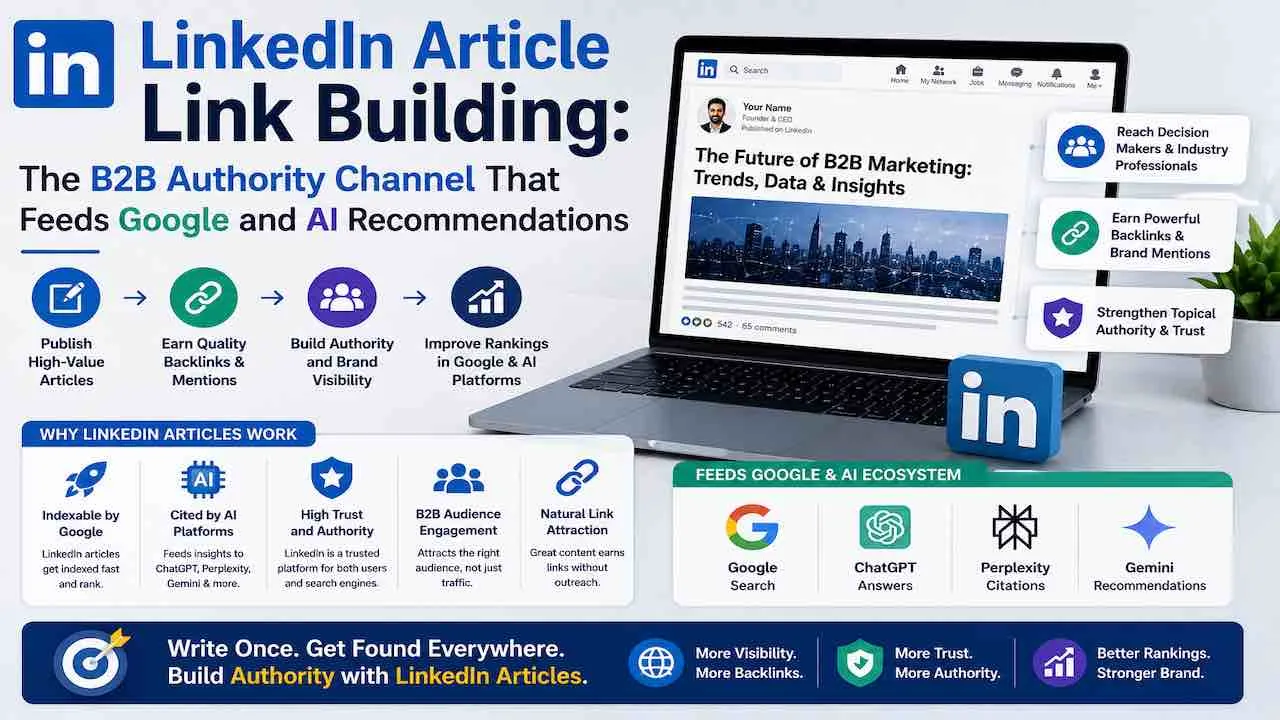
Most B2B brands treat LinkedIn as a social distribution platform and overlook its LinkedIn backlinks, LinkedIn domain authority, and LinkedIn indexing benefits entirely. The brands winning AI recommendations treat it as a search and citation engine. LinkedIn articles indexed by Google appear in traditional search results alongside blog posts. The same articles feed ChatGPT, Perplexity, Gemini, and Google AI Overviews because LinkedIn’s decades-old domain authority gives every piece of native content a trust advantage that a brand-new company website cannot replicate. Does LinkedIn help with SEO? Emphatically yes, across Google rankings, AI citations, and secondary editorial backlinks simultaneously. How to use LinkedIn for link building is the question this guide answers with specific tactics, not general advice. This guide covers the exact B2B link building strategy that turns LinkedIn publishing into Google rankings, secondary editorial backlinks, and AI citations before your competitors understand what they are missing.
Does LinkedIn Count as a Backlink for B2B SEO?
LinkedIn links are nofollow, meaning PageRank does not flow directly from LinkedIn to your domain through any standard hyperlink on the platform. This is the answer most LinkedIn SEO guides stop at. The complete answer is far more useful for B2B link building strategy. LinkedIn link building generates three distinct SEO benefits that do not require a dofollow link to produce measurable domain authority growth.
The 3 Real SEO Benefits LinkedIn Delivers Without Dofollow Links
- Google-indexed authority content at LinkedIn’s domain authority level: When a LinkedIn article ranks on Google for a B2B keyword, that ranking draws traffic from searchers who never visit LinkedIn at all. If the article is well-written, a percentage of those visitors cite it in their own content, creating genuine editorial backlinks to your LinkedIn article. Those links then flow through LinkedIn’s domain authority and amplify the article’s ranking further, generating more exposure and more secondary backlinks. This is how LinkedIn articles build backlinks: ranked articles attract Google searchers who cite the content, generating editorial dofollow links from external publishers. This is the secondary backlink mechanism that makes LinkedIn link building for B2B different from ordinary social media posting.
- AI citation authority that competes with top publishers: Google AI Overviews, ChatGPT, Perplexity, and Gemini evaluate source credibility before citing any content. LinkedIn’s domain authority combined with named professional authorship satisfies the trust verification criteria AI engines apply. LinkedIn articles cited in ChatGPT responses appear alongside Forbes, Harvard Business Review, and Search Engine Journal as trusted B2B sources. Your LinkedIn article competes at that tier without requiring the editorial relationship those publications demand.
- E-E-A-T authoritativeness signals that feed Google domain authority: Every named LinkedIn article you publish is an expert authorship signal that Google reads alongside your website’s content. This is the same mechanism that expert bylines build domain authority through, except LinkedIn is an open publishing platform available to any professional without an editorial pitch process.
How LinkedIn Articles Get Indexed by Google
Google indexes LinkedIn articles, LinkedIn newsletters, LinkedIn profiles, and LinkedIn company pages. Google does not index regular LinkedIn posts. This distinction determines your entire LinkedIn link building for B2B content strategy. Time and effort invested in regular posts builds LinkedIn feed reach only. Time invested in LinkedIn articles builds both LinkedIn reach and Google search visibility simultaneously.
| LinkedIn Content Type | Google Indexes? | AI Cites? | Has Unique URL? | B2B Link Value |
|---|---|---|---|---|
| LinkedIn Articles (500 to 2,000 words) | Yes, within 24 to 48 hours | Yes, drives 50 to 66% of LinkedIn AI citations | Yes, permanent unique URL | Very High |
| LinkedIn Newsletters | Yes, each edition indexed separately | Yes, growing citation rate | Yes, unique URL per edition | High |
| LinkedIn Company Pages | Yes, page and updates | Yes, for brand entity queries | Yes | High for brand signals |
| LinkedIn Profiles | Yes, public profiles | Yes, for person entity queries | Yes, custom URL available | High for E-E-A-T |
| Regular LinkedIn Posts | No consistent indexing | Rarely | No permalink | Low for SEO |
Optimizing LinkedIn Articles for Google and AI Indexing
LinkedIn articles SEO and LinkedIn article optimization follow the same rules as traditional blog post SEO. Treat every LinkedIn article like a Google-optimized blog post. LinkedIn for link building starts with this content-first foundation. Place your primary B2B keyword in the article title, the first 150 words of the article body, and at least one H2 subheading within the article. LinkedIn article URLs are permanent and canonical.
Google treats them as independent indexed pages with LinkedIn’s full domain authority behind them. Your LinkedIn publishing strategy should target 500 to 2,000 words per article. LinkedIn content marketing at this length drives the highest LinkedIn organic reach and AI citation rates simultaneously. Write 500 to 2,000 words per article. Articles in this range receive the highest share of LinkedIn AI citations according to GEORaiser research. Link back to a relevant resource on your website from within the article body. Even though the link is nofollow, it drives referral traffic from both LinkedIn readers and Google searchers who find the article.
The AI Citation Data That Changes B2B LinkedIn Strategy
LinkedIn ranked second among every domain cited by AI across all platforms, ahead of Wikipedia, YouTube, and every major news publisher, in Semrush analysis of 325,000 AI prompts. On average, 11 percent of AI responses reference a LinkedIn URL. For B2B brands, this is the most important LinkedIn SEO data available. Bing Copilot, which runs on the same retrieval model as ChatGPT Search, shows comparable LinkedIn citation rates for B2B professional queries. LinkedIn for AI recommendations is not a future strategy. It is the current default for B2B brand authority LinkedIn and LinkedIn AI Overview citations across every major AI platform right now. LinkedIn articles and newsletters are not just social content. They are the B2B authority channel that feeds AI recommendations directly.
AI Platform Citation Rates for LinkedIn Content
| AI Platform | LinkedIn Citation Rate | Primary Content Type Cited |
|---|---|---|
| ChatGPT Search | 14.3% of responses | LinkedIn articles and professional profiles |
| Google AI Mode | 13.5% of responses | LinkedIn articles, company pages, newsletters |
| Perplexity | 5.3% of responses | LinkedIn articles with structured, direct answers |
| All platforms average | 11% of responses | LinkedIn articles drive 50 to 66% of total LinkedIn AI citations |
For B2B SaaS companies targeting decision-maker queries in ChatGPT and Perplexity, this data confirms LinkedIn as the most efficient GEO (Generative Engine Optimization) and AEO (Answer Engine Optimization) channel available. A LinkedIn article answering a B2B decision-maker query has a higher probability of AI citation than the same article published on a lower-authority company blog. Digital PR and AI citation building strategies that ignore LinkedIn are missing the platform where AI engines most reliably find B2B professional authority content.
The 5-Stage LinkedIn Link Building Strategy for B2B
A LinkedIn SEO strategy for B2B and a broader B2B SEO strategy both rest on the same foundation: consistent named expert publishing on indexed platforms. Executing LinkedIn link building for B2B SEO requires five synchronized stages working together. Each stage builds on the previous one. Skipping stages produces partial results. Running all five stages builds a compounding B2B authority channel that generates Google rankings, secondary editorial backlinks, and AI recommendations simultaneously.
Stage 1: Executive Profile Authority Foundation
Individual executive and founder profiles are the highest-return assets for professional link building on LinkedIn. LinkedIn profile authority, built through consistent named expert publishing, is the engine of professional authority building that converts a standard profile into a B2B citation source. LinkedIn data confirms personal profiles carry stronger subject matter authority signals for AI citation than company pages because they are tied to specific expertise, roles, and professional context. Set every executive profile to public visibility.
Complete every profile field. Add a keyword-rich headline covering the executive’s primary expertise area in the first 60 characters. This is the highest-weight field in LinkedIn’s internal search algorithm. Link each profile to the company website using the website field. Add LinkedIn custom URLs using the person’s full name to match Google Knowledge Graph entity patterns. Implement Person schema and author schema markup on your website linking to each executive’s LinkedIn profile to complete the bidirectional entity recognition connection Google’s Knowledge Graph uses for professional authority verification.
Stage 2: LinkedIn Article Publishing Strategy
Publish one LinkedIn article per month per key executive at minimum. Two articles per month compounds faster. LinkedIn articles in the 500 to 2,000 word range drive 50 to 66% of LinkedIn’s AI citations. Write each article around one specific B2B decision-maker question. Answer that question directly in the first paragraph, within 40 to 60 words, to maximize AI extraction probability. Use H2 and H3 subheadings inside LinkedIn articles exactly as you would on a blog post.
Google’s crawler reads LinkedIn article heading structure the same way it reads blog post structure. Include one internal link to a relevant resource on your company website from within the article body. This creates a referral traffic path from Google searchers who find the LinkedIn article and want to read more. Over time, LinkedIn articles that rank on Google for B2B keywords generate editorial backlinks from other writers and publishers who cite the article as a source.
Stage 3: LinkedIn Newsletter as an Indexed SEO Channel
LinkedIn newsletters have separate URLs for each edition, and Google indexes every edition independently. A LinkedIn newsletter with 10 editions produces 10 individually indexed pages, each competing for its own keyword in Google search. LinkedIn newsletter for SEO combines subscriber engagement with Google indexing and AI citation in a single content format that most B2B brands do not yet use strategically. Name the newsletter with your primary B2B category keyword. Use consistent formatting: a question-based headline, a direct answer in the opening paragraph, and 3 to 5 structured sections. This structure matches the format AI engines extract for citation. Each edition should link back to a relevant resource on your website, building referral traffic and creating the cross-platform entity signal pattern that feeds Google Knowledge Panel recognition for your brand entity.
Stage 4: LinkedIn Company Page as B2B Brand Signal Engine
LinkedIn company pages contribute B2B brand signals that Google uses for entity recognition and E-E-A-T evaluation. A fully completed company page with a keyword-rich About section, consistent NAP (Name, Address, Phone) data matching your website, and regular content updates tells Google’s Knowledge Graph the same brand information your website About page does. LinkedIn company page SEO requires naming the page with your exact registered brand name, adding industry-specific keywords in the tagline and About section, linking directly to your website from the company website field, and posting at least 2 to 3 times per week to demonstrate active brand presence. Company pages appear in Google branded search results. An optimized LinkedIn company page appearing in branded SERPs reinforces brand entity signals that strengthen domain authority evaluations across your entire site.
Stage 5: Converting LinkedIn Readers Into Backlink Sources
LinkedIn articles that rank on Google attract two distinct audiences: LinkedIn members who find the content in their feed, and Google searchers who find the ranked article in search results. The Google searcher audience contains the editorial backlink sources you want. These are bloggers, journalists, content strategists, and researchers looking for data, frameworks, and perspectives to cite in their own work. Include original data, proprietary frameworks, or unique perspectives in every LinkedIn article specifically to give these visitors something worth citing. LinkedIn thought leadership content that includes a specific statistic, a named framework, or a counterintuitive insight earns editorial backlinks from other publishers without any outreach required. Thought leadership content on LinkedIn is the format that converts readers into citation sources. This is the B2B link building without outreach mechanism that makes thought leadership link building through LinkedIn compound over time without ongoing promotion effort.
How LinkedIn Feeds E-E-A-T Signals and Google’s Knowledge Graph
Google’s Search Quality Rater Guidelines define authoritativeness as recognition from other credible sources in the same field. LinkedIn is one of those credible sources. When Google’s crawler processes a LinkedIn profile showing an executive with 15 years of verified employment history in a field, connections to known industry entities, and a publication record of articles on a specific subject, it builds an entity model for that person that feeds the Knowledge Graph. This entity model strengthens the E-E-A-T evaluation of every page on their company website covering the same subject area.
The bidirectional linking pattern between LinkedIn and your website is the technical mechanism that connects LinkedIn authority to Google domain authority. Link from your website About page to executive LinkedIn profiles. Link from LinkedIn profiles back to your website. And Link from LinkedIn articles to specific resource pages on your website. Each cross-reference reinforces the entity relationship between your brand domain and the LinkedIn professional authority records Google already trusts. E-E-A-T trust and authority building through LinkedIn requires this bidirectional entity consistency across every professional profile, every article, and every company page update. Wikidata entries for executives with substantial LinkedIn publishing histories further reinforce Google Knowledge Graph recognition across AI platforms simultaneously.
LinkedIn vs Guest Posts for B2B Link Building
B2B link building decisions require understanding what each channel produces and at what cost. LinkedIn link building and guest post link building both build domain authority but through different mechanisms and timelines.
| Dimension | LinkedIn Link Building | Guest Post Link Building |
|---|---|---|
| Cost per placement | Zero direct cost, time only | Outreach time plus placement fees at many sites |
| Link attribute | Nofollow from LinkedIn, but secondary editorial links are dofollow | Often dofollow from the host site directly |
| E-E-A-T impact | High: named professional authorship on DA 99 domain | Varies by host site quality |
| AI citation probability | Very High: LinkedIn cited in 11% of all AI responses | Depends entirely on host site domain trust |
| Google indexing speed | 24 to 48 hours | Varies by host site crawl frequency |
| Ongoing effort | Content creation only, no relationship maintenance | Requires ongoing outreach and relationship building |
| B2B brand signals | Very High: professional context, industry peers, company verification | Low unless publication is industry-specific |
LinkedIn and guest posts work better together than in isolation. A guest post in Search Engine Journal or Forbes combined with a LinkedIn article on the same topic creates a multi-platform authority signal that AI engines and Google both read as consistent expert presence across trusted sources. Brand mentions and backlinks together build the corroborated trust signal that no single channel achieves alone.
How to Track LinkedIn Link Building Results for B2B SEO
Tracking LinkedIn link building SEO B2B results requires monitoring five metrics across three platforms. Most B2B teams track LinkedIn engagement only. The SEO and AI citation metrics are where the link building ROI lives.
- Google Search Console impressions for LinkedIn article URLs:
Add your LinkedIn profile domain to Search Console using the URL prefix property. Track impressions and clicks for your LinkedIn article URLs in organic search. This confirms which articles are ranking on Google and for which queries.
- Ahrefs or Semrush referring domain growth on LinkedIn article URLs:
Check backlinks pointing to your LinkedIn articles monthly. When a LinkedIn article earns editorial backlinks from other publishers, Ahrefs or Semrush captures these as referring domain growth. This is your passive B2B link building metric.
- LinkedIn analytics search appearances:
LinkedIn’s analytics dashboard shows how many times your profile appeared in LinkedIn search results for specific keywords. Growth in this metric confirms LinkedIn’s internal search algorithm is recognizing your professional authority signals.
- AI citation monitoring via Semrush AI Visibility Toolkit or Profound:
Track how often your LinkedIn articles or profile appear in ChatGPT, Perplexity, and Google AI Overviews responses for your B2B target queries. This is your LinkedIn GEO performance metric.
- Website referral traffic from LinkedIn:
In Google Analytics 4, segment traffic by referral source and track LinkedIn article referral traffic separately from LinkedIn profile traffic. LinkedIn articles that rank on Google generate referral traffic from both sources simultaneously.
LinkedIn Link Building Mistakes B2B Brands Consistently Make
- Publishing regular posts instead of articles: Regular LinkedIn posts do not receive consistent Google indexing and rarely earn AI citations. Every hour spent writing posts for feed engagement is an hour not building Google-indexed content with permanent URLs and AI citation probability.
- Setting profiles to connections-only visibility: Google cannot index private LinkedIn content. Every executive profile set to connections-only visibility is invisible to Google’s crawler and excluded from AI citation pools. Set all professional profiles to public visibility before publishing any B2B content.
Technical and Consistency Mistakes That Reduce LinkedIn SEO Value
- Missing the bidirectional website link: A LinkedIn article that does not link back to your website breaks the entity recognition chain between LinkedIn authority and website domain authority. Every article needs one contextual link to a relevant page on your company website.
- Inconsistent professional branding across profiles and company page: If executive profiles use different job titles than the company website About page, Google’s Knowledge Graph builds a fragmented brand entity record. Consistent professional branding across every LinkedIn asset and every website page is the B2B brand signal consistency that feeds strong entity recognition.
- Ignoring LinkedIn newsletters as an indexed SEO channel: LinkedIn newsletter for SEO is the most underused B2B link building format available. Each newsletter edition is individually indexed by Google, individually citable by AI engines, and subscribable by B2B decision makers actively seeking expertise in your field.
- Publishing once and expecting compound results: LinkedIn AI citation probability increases with publishing frequency and topical consistency. A single LinkedIn article does not build professional authority. LinkedIn content for domain authority requires consistency. A consistent content cadence of 1 to 2 articles per month on a specific B2B topic builds the topical authority signal that Google and AI engines reward with increasing visibility over 6 to 12 months.
Build the LinkedIn Authority That Gets Your Brand Cited by AI
Quick Digital builds LinkedIn link building strategies for B2B brands that generate Google-indexed articles, secondary editorial backlinks, and AI citations across ChatGPT, Perplexity, and Google AI Overviews. Get AI to recommend your brand to B2B buyers by publishing where AI engines already look. Stop being invisible to B2B buyers who search for your expertise in AI engines. Be the go-to expert AI cites first by publishing consistently on LinkedIn. Earn backlinks while you publish by creating citation-worthy frameworks and original data. Get mentioned in AI-generated answers without a PR budget. Be cited by ChatGPT, Perplexity, and Google AI before competitors realize LinkedIn is the channel where it happens. Dominate your niche with LinkedIn authority by building a consistent 12-month publication record that no competitor can replicate quickly. Build B2B authority without expensive outreach by making LinkedIn your primary professional publishing platform. Get a LinkedIn SEO audit and B2B authority strategy built for the AI search era.
Get Your LinkedIn Link Building StrategyFrequently Asked Questions: LinkedIn Link Building SEO B2B
LinkedIn Articles, Indexing, and AI Citations
LinkedIn links are nofollow, meaning PageRank does not flow directly from LinkedIn to your domain through any standard hyperlink. However, LinkedIn articles indexed by Google generate secondary editorial backlinks when other publishers cite them as sources. A LinkedIn article that ranks in Google for a B2B keyword earns genuine dofollow backlinks with real link equity from other writers who reference its content. These secondary links show as new referring domains in Ahrefs Domain Rating reports. The anchor text other publishers use when citing LinkedIn articles contributes topical relevance signals alongside raw link equity. This secondary backlink mechanism is the primary B2B link building value LinkedIn delivers, alongside E-E-A-T authoritativeness signals and AI citation probability that operate independently of link attribute.
LinkedIn ranked second among all domains cited by AI across ChatGPT Search, Google AI Mode, and Perplexity, appearing in 11 percent of all AI responses on average according to Semrush analysis of 325,000 AI prompts. ChatGPT Search specifically cites LinkedIn in 14.3 percent of responses. LinkedIn articles drive 50 to 66 percent of LinkedIn’s total AI citations. AI engines favor LinkedIn because its domain authority, professional identity verification, and named expert authorship satisfy the trust criteria these systems apply before citing any source. Publishing original, structured LinkedIn articles on B2B topics puts your brand in the citation pool that competes with Wikipedia, Forbes, and Harvard Business Review for AI-generated answers.
LinkedIn Articles vs Posts, Timelines, and Profile Strategy
Google indexes LinkedIn articles, LinkedIn newsletters, LinkedIn profiles, and LinkedIn company pages consistently. Google does not consistently index regular LinkedIn posts. LinkedIn articles (formerly called LinkedIn Pulse articles) have permanent unique URLs that appear in Google search results as independent indexed pages. LinkedIn Pulse evolved into the current LinkedIn articles format and the SEO principles remain identical. Regular posts have no permalink and do not appear in Google search. For B2B link building SEO purposes, LinkedIn articles are the only post format that builds Google visibility, earns secondary editorial backlinks from Google searchers who cite the content, and contributes to AI citation probability. Write regular posts for LinkedIn feed engagement only. Invest in LinkedIn articles for every SEO and link building objective.
LinkedIn Timeline, Profiles and Compound Authority
LinkedIn articles get indexed by Google within 24 to 48 hours of publication. Initial AI citation appearances for LinkedIn articles with strong structural optimization and specific B2B expertise signals begin within 4 to 8 weeks. Measurable Google search ranking growth for B2B keywords through LinkedIn articles typically appears within 2 to 4 months of consistent publishing. Secondary editorial backlinks from ranked LinkedIn articles accumulate over 3 to 6 months as Google searchers find and cite the content. The full compound effect, including Knowledge Graph entity recognition and consistent AI citation appearances across ChatGPT, Perplexity, and Google AI Overviews, develops over 6 to 12 months of consistent LinkedIn article publishing at 1 to 2 articles per month.
Both serve different roles in LinkedIn link building for B2B SEO and should be developed simultaneously. Personal executive profiles generate stronger subject matter authority signals for AI citations because they are tied to specific professional expertise, verified employment history, and named authorship. LinkedIn data confirms personal profiles carry more AI citation weight than company pages for professional knowledge queries. Company pages contribute B2B brand signals: Google entity recognition, branded search SERP presence, and consistent NAP data reinforcing domain authority evaluations. The most effective B2B LinkedIn link building strategy uses executive profiles as the primary article publishing and AI citation channel while maintaining the company page as a brand entity anchor that Google and AI engines read for organizational context and credibility.