


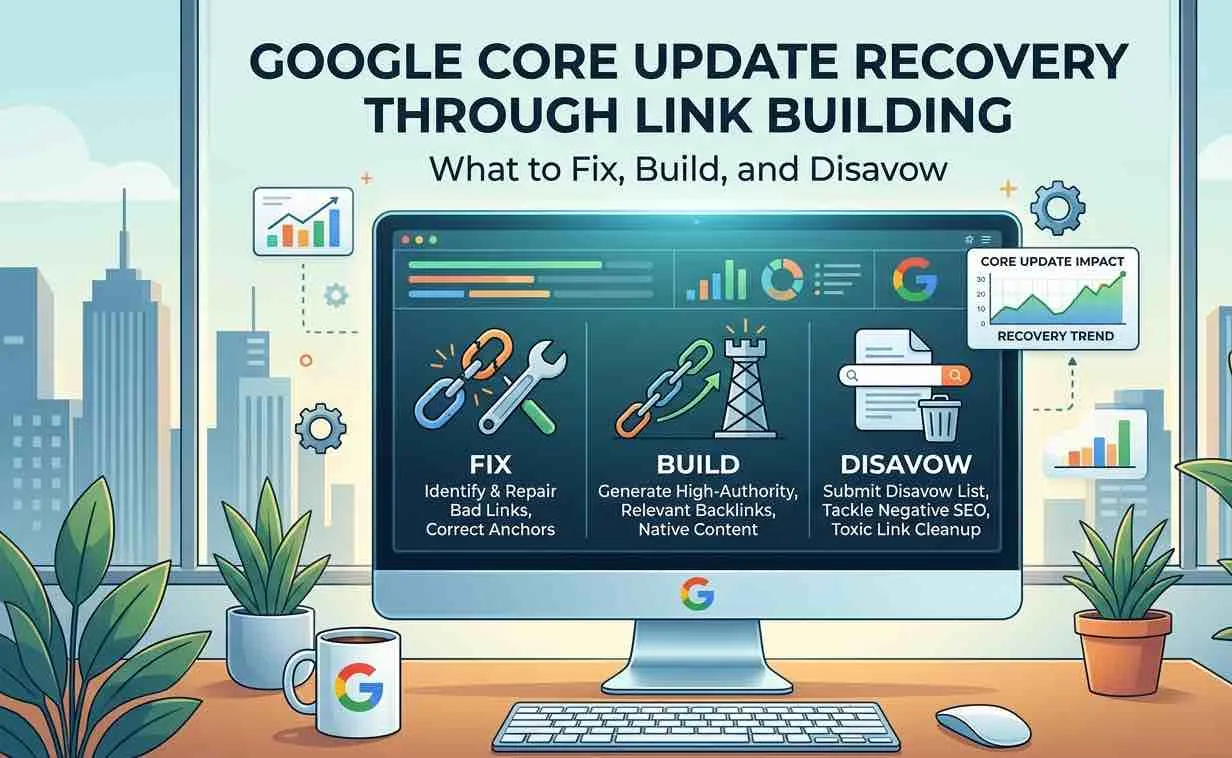
Google core update recovery through link building requires three separate actions. First, audit your link profile to identify genuinely toxic links. Second, disavow only links you paid for or acquired through prohibited schemes. Third, build high authority editorial links to affected pages to strengthen relevance and EEAT signals. Core updates primarily reassess content quality and topical authority, not link profiles. However, building quality editorial links to underperforming pages accelerates recovery. They signal expertise and trust during Google’s next reassessment cycle. QuickDigital has managed link profiles for recovery campaigns since 2014 across B2B, eCommerce, healthcare, and SaaS sectors.
Traffic dropped after Google update? Site hit by Google update with organic traffic crashed? Google update destroyed rankings for thousands of sites. If you cannot recover from Google update, this guide is for you. Google helpful content update recovery and google core update recovery link building start the same way. Core update link analysis is always step one. This guide covers the exact diagnosis, disavow, and link building sequence. It aligns with how Google’s core algorithm reassesses sites. Link building strategy after Google core update must account for how the next reassessment cycle works. Can link building help recover from Google core update? Yes, specifically by closing the authority gap. If traffic dropped after a spam update, the link profile audit steps below apply more directly. They address link profile problems specifically rather than content quality gaps.
The Honest Answer: When Link Building Helps Core Update Recovery
Google’s John Mueller stated this clearly: core updates are primarily about relevance signals, not spammy links. Removing a batch of poor quality links will not solve most core update problems. What link building DOES fix is the authority gap between your content and the pages outranking you. Building authoritative editorial links to your problem pages signals to Google that credible sources endorse that content. Toxic backlinks do not cause most core update drops. Toxic link removal alone will not recover core update traffic losses. This directly supports the EEAT signals that core updates evaluate most heavily.
The March 2026 core update affected 40 to 60% of websites. Affiliate sites were hit hardest at 71%. The May 2026 core update ran from 21 May to 2 June. The June 2026 spam update ran 24 to 26 June. Each type of update requires a different primary response. Getting the diagnosis right first saves months of misdirected effort. Google update destroyed rankings for many sites in 2026. The correct diagnosis determines whether you need core update recovery SEO, penalty recovery SEO, or both.
Core Update vs Spam Update: Different Problems, Different Fixes
| Factor | Google Core Update | Google Spam Update |
|---|---|---|
| Primary target | Content quality, EEAT, topical authority, relevance | Link schemes, AI-generated spam, site reputation abuse, scaled content abuse |
| Link profile impact | Indirect: low authority relative to competitors causes ranking drop | Direct: manipulative links trigger algorithmic or manual demotion |
| Disavow urgency | Low unless you have paid links or a manual action confirmed | High for confirmed manipulative link schemes |
| Primary fix | Improve content quality, EEAT, and build editorial links to problem pages | Remove or disavow manipulative links, fix policy violations |
| Recovery timeline | 3 to 6 months, confirmed at the next core update | 4 to 12 weeks after link cleanup and reconsideration request |
| Google Search Console signal | Traffic drop on core update date, no manual action notice | Manual action notice in Search Console, or algorithmic spam filter |
| Link building role | Accelerates recovery by closing the authority gap with competitors | Pause new link building until toxic links are cleaned up |
HCU Recovery Link Building Strategy and the Helpful Content Update
The Helpful Content Update is no longer a separate event. Since March 2024, the helpful content classifier runs continuously inside Google’s core ranking algorithm. There is no next HCU to wait for. Google grades your whole site continuously, not just individual pages. If most of your content is thin or without genuine experience, your stronger pages get held back. Weaker pages drag down stronger ones. HCU recovery link building strategy and core update recovery now follow the same playbook. How to recover from helpful content update is answered the same way as core update recovery. For the link building component, the signal needed is the same. Build editorial links to pages that demonstrate genuine expertise and first-hand experience.
Step 1: Diagnose Your Link Profile in Google Search Console
Before building a single new link or submitting a disavow file, run a full link profile analysis. This link profile analysis is the foundation of every core update recovery SEO campaign. Backlink profile repair and link profile cleanup begin here. Not with the disavow tool. An aggressive disavow of links that were helping you is one of the most damaging recovery mistakes. Identify the actual problem before acting on it.
4 Metrics to Check First in Google Search Console
- Manual Actions report: Go to Security and Manual Actions in Google Search Console. Check the Manual Actions report first. If you see no manual action, your core update drop is algorithmic. Algorithmic penalty drops do not respond to manual penalty recovery fixes. Do not treat an algorithmic drop as a link penalty. Google algorithm update recovery for algorithmic drops requires content quality improvement. Not link disavows. Disavowing links will not fix an algorithmic quality reassessment.
- Top linked pages: Go to Links in Google Search Console. Check which pages receive the most external links. If your affected pages have significantly fewer external links than the competitor pages now outranking them, this is your link gap. This gap is what link building during recovery addresses.
- Top linking sites: Review the domains linking to your site. Look for patterns in your link profile. This link toxicity assessment identifies referring domain quality gaps. These separate your link profile from competitors. Competitor link analysis uses the same process applied to the pages currently outranking you. Common signals include links from the same low-quality network, exact-match anchor text repetition, and links from unrelated industries. These patterns indicate a link profile problem that predates the core update. A link neighborhood dominated by spam reduces domain trust metrics. It also reduces topical authority signals across your entire domain.
- Anchor text distribution: Check your anchor text in the Google Search Console Links report. Natural link profile patterns have 40 to 60% branded anchor text. Natural link profile analysis and natural link profile patterns begin here., 20 to 30% generic anchors, and under 5% exact-match keyword anchors. Exact-match anchor text above 15% is an unnatural signal worth addressing.
Spam Score Thresholds That Signal Problems
Google does not publish spam scores. Third-party tools like Moz, Ahrefs, and Majestic calculate their own toxicity signals. Use these as diagnostic indicators, not as definitive proof of a link penalty problem.
| Tool Metric | Threshold | Action Required |
|---|---|---|
| Moz Spam Score | 1 to 30%: low risk. Keep all. | No action needed. These links are fine. |
| Moz Spam Score | 31 to 60%: medium risk. Review each. | Investigate source. Disavow only if you paid for the link. |
| Moz Spam Score | 61 to 100%: high risk. Audit carefully. | Check for paid link patterns or link scheme participation before disavowing. |
| Ahrefs DR of linking domain | DR below 10 with exact-match anchor | Review for link scheme participation. Disavow if paid. |
| Majestic Trust Flow | TF below 10, Citation Flow above 30 | High manipulation signal. Review and disavow if part of a paid scheme. |
Moz spam score and spam score threshold values are indicators, not proof. High spam score alone does not justify disavowing a link. Google ignores most low-quality links automatically. The dangerous links are those you paid for or acquired through schemes that violate Google’s policies. For link profile patterns that carry algorithmic risk, see our guide on parasite SEO risks and link profile red flags.
Step 2: Disavow, Ignore, or Reclaim: The Decision Framework
The disavow file is not a recovery tool for core update drops. Google recommends using it only for links you paid for. It also applies to links acquired through means that violate Google’s link policies. Aggressive disavowing removes links that were helping you and extends your recovery timeline.
The Correct Disavow Use Case
Disavow a link only when all three conditions are true:
- You know you paid for the link, participated in the link exchange, or used a private blog network
- You cannot get the link removed by contacting the webmaster directly
- The link is either causing a manual action or is part of a pattern you are actively cleaning up before a reconsideration request
For core update recovery: do not submit a speculative disavow without evidence that links caused your traffic drop. If your Manual Actions report is clear, your problem is content quality and authority gaps. It is not toxic links. Fix the content first. Fix the content. Build editorial links to the affected pages. Wait for the next core update reassessment.
Disavow File Format and Submission
If your audit confirms paid links or a manual action related to link schemes, create the disavow file in plain text format. The disavow tool is not a core update recovery tool. It is a manual penalty recovery tool. Use it only when confirmed. Disavow file after core update submission without a manual action is a common mistake. Google accepts two formats:
- Full URL:
https://example.com/specific-page— disavows one specific link - Domain:
domain:example.com— disavows all links from that domain - Use the domain format when a whole network of links from one domain is toxic, not just a single page
- Add
#comment lines above each group explaining why those links are being disavowed - Submit the file at
search.google.com/search-console/disavow-links
Links to Ignore vs Links Worth Reclaiming
Not every low-quality link is worth disavowing. Some are worth reclaiming as higher-quality references. Link reclamation and toxic link removal are different processes. Toxic link removal after Google update means eliminating links you paid for. Toxic link removal after Google update targets confirmed paid or scheme links only. Link reclamation means converting existing mentions into higher-quality editorial links. A link that mentions your brand but uses a nofollow tag is worth a reclamation outreach attempt. Try this before disavowing. Our brand mentions vs backlinks guide covers the difference between link types and when each serves your recovery.
Step 3: Fix Your Anchor Text Distribution Before Building New Links
Building new links into an unnatural anchor text profile makes the problem worse, not better. Fix the existing distribution pattern first, then build new links using the correct anchor text ratios.
Correcting Unnatural Anchor Text Distribution
An exact-match anchor text ratio above 10 to 15% is an unnatural signal. You cannot remove anchor text from links you did not pay for. What you can do is dilute the exact-match ratio. Build new links with branded, generic, and partial-match anchor text. This is the link profile fix strategy for sites where over-optimized anchor text contributed to the algorithmic penalty. Target these ratios when building recovery links:
- Branded anchor text (your company name): 40 to 60% of all new links
- Generic anchor text (click here, read more, this resource): 15 to 25%
- Partial-match anchor text (natural phrase containing your keyword): 15 to 25%
- Exact-match anchor text: keep total across all links under 5%
- Naked URL anchors (your domain URL as anchor): 5 to 10%
Link Velocity Normalization During Recovery
Link velocity is the rate at which your domain acquires new links over time. Also Link velocity patterns that show sudden spikes or unnatural bursts trigger algorithmic scrutiny. During core update recovery, maintain steady link velocity patterns at all times. Link velocity patterns that normalize over time are a positive signal. Sudden spikes in link acquisition signal unnatural patterns to Google. During core update recovery, build new links at a consistent, moderate pace. Aim for 5 to 15 new quality links per month for small to medium sites. Avoid campaigns that deliver 50 to 100 links in a 30-day burst. Consistent monthly acquisition sends natural link velocity signals. This supports recovery rather than flagging new manipulation patterns.
Domain authority stagnation during recovery is a separate problem. If your domain authority has stayed flat while competitors grow, read our domain authority link building analysis. It covers fixes that unblock authority growth during recovery.
Step 4: Link Building Strategy After Google Core Update
Link building strategy after Google core update focuses on building high authority editorial links to affected pages. This directly accelerates core update recovery. Can link building help recover from Google core update? This is the specific mechanism that answers yes. How to fix link profile after Google update? This step is the answer for authority gaps identified in Step 1. These links serve two functions simultaneously. They close the authority gap between your content and the pages that outranked you. They also send EEAT signals that strengthen Google’s assessment of your content during its next reassessment cycle.
Link Types That Signal Quality to Google During Recovery
Not all links help recovery equally. The following link types send the strongest quality signals during a core update recovery period:
- Editorial mentions in authoritative industry publications: This is how to recover from Google core update through editorial link acquisition. Core update link analysis shows this is the link type with the highest recovery impact. A link from a DR 60+ industry journal or news publication to your affected page sends both authority and topical relevance signals. These are the highest-value recovery links available.
- Expert roundup citations: Being quoted as an expert source in roundup articles on authoritative domains generates branded anchor text links that strengthen EEAT signals for the individual and the domain.
- Original research citations: Publishing original data studies that other sites cite generates natural editorial links with diverse anchor text. These are particularly effective for EEAT recovery. See our original research link building strategy guide.
- Digital PR mentions: Earning coverage in news publications through genuine newsworthiness generates high authority editorial links that Google treats as strong credibility signals. Our digital PR link building guide covers this approach in detail.
- Niche-relevant guest bylines: Guest posting on authoritative publications in your niche generates contextual links from topically relevant domains. Guest posting during link building during Google penalty recovery should focus exclusively on genuine editorial guest posts, not paid placements.
During recovery, prioritize links that are topically relevant to the affected pages. A link from a DR 55 niche publication in your exact industry carries more recovery value. A DR 70 general blog with no topical connection carries far less during recovery.
How Many Links to Build During Recovery and at What Pace
Recovery does not require a large volume of links. It requires consistent improvement in link quality relative to the pages that outranked you. Run a competitor link gap analysis before setting your recovery link building targets. Use Ahrefs or SEMrush to compare your referring domains against the top 3 pages now outranking you. Your monthly target should close that gap within 3 to 4 months. Avoid creating an unnatural velocity spike in the process.
For our managed recovery link building programs, see our backlink outreach service and link building service pages. Both include competitor link gap analysis as the first step in every recovery engagement.
Google Core Update Recovery Timeline
How long to recover from Google core update is the most common question site owners ask after a traffic drop. A Google core update recovery checklist should track five milestones. These are: update type diagnosis, link profile audit, content quality fixes, editorial link building, and next core update confirmation.
Recovery from a core update takes 3 to 6 months. It is confirmed at the next core update, not before. Google now runs core updates on a roughly quarterly cadence. If you implement fixes after a core update, the next reassessment opportunity is 55 to 93 days away. Flat traffic between core updates is not evidence that your fixes failed. Google has not re-evaluated your site yet.
| Month | Actions to Complete | Expected Outcome |
|---|---|---|
| Month 1 | Confirm update type. Run Google Search Console audit. Check Manual Actions report. Identify top affected pages. Do not disavow speculatively. | Clear diagnosis of whether this is a content quality problem, authority gap, or link scheme issue. |
| Month 1 to 2 | Fix content quality on affected pages. Improve EEAT signals. Start competitive link gap analysis. Begin acquiring 5 to 10 editorial links per month to affected pages. | Content improvements indexed. First editorial links indexed. No ranking movement yet (normal). |
| Month 2 to 3 | Submit disavow file if paid links confirmed. Continue editorial link building. Build 5 to 15 new quality links per month. Fix anchor text distribution. | Link profile stabilization. Google crawls improved pages. Still awaiting next core update for reassessment. |
| Month 3 to 4 | Publish original research or data study targeting affected topic clusters. Pursue digital PR coverage. Build 10 to 15 editorial links per month. | Possible partial ranking recovery for secondary terms. First EEAT signals visible in Search Console impressions data. |
| Month 4 to 6 | Next core update confirmation. Continue link building at consistent pace. Monitor Google Search Console for impression and click growth on affected pages. | Ranking recovery confirmation or identification of remaining gaps. Most sites see 40 to 70% traffic recovery at this milestone. |
Recovery Tools: Google Search Console, Ahrefs, SEMrush, and Majestic
Each tool serves a different function in the core update recovery link audit. Use all four tools in sequence for a complete picture.
- Google Search Console (free): The only tool with direct Google data. Check the Manual Actions report, Performance report, and Links report. Compare performance before and after the confirmed update date. Download your top linking sites and anchor text data for analysis.
- Ahrefs: Use for competitor link gap analysis. Compare your referring domain count and domain rating to the pages outranking you. Identify which link types and domains your competitors have that you do not. This gap defines your recovery link building targets.
- SEMrush: Use for toxicity scoring and anchor text distribution analysis. The Backlink Audit tool flags potentially toxic links with a toxicity score. Cross-reference high-toxicity links against your Manual Actions report before taking any action.
- Majestic: Use Trust Flow and Citation Flow ratio analysis. A Citation Flow significantly higher than Trust Flow indicates a manipulated link profile. It was built for manipulation rather than genuine editorial acquisition. This ratio is an additional data point, not a standalone decision criterion.
Recovery Mistakes That Extend the Timeline
Google quality rater guidelines define the human evaluation framework that core algorithm updates are calibrated against. Matching google quality rater guidelines standards in your content is the long-term recovery foundation. These mistakes consistently add 3 to 6 months to core update recovery timelines. Avoiding them from the moment you confirm an update hit is the fastest path to pre-update rankings.
- Submitting a speculative disavow file without evidence. Disavowing links that were helping you removes authority from your affected pages. Google ignores most low-quality links automatically. Removing good links disguised as low-quality ones sets back recovery by months.
- Reacting during the rollout period. Core update rollouts take 1 to 2 weeks. Ranking volatility during this period does not reflect the final assessment. Wait for the rollout to complete and then let data stabilize for 7 days before drawing conclusions or making changes. Sites that can’t recover from Google update progress often conclude this too early. They act during volatility before the rollout is complete.
- Treating a core update drop as a manual penalty. A core update drop and a manual penalty require completely different fixes. A manual penalty requires a disavow file and a reconsideration request. A core update drop requires content quality improvement and authority gap closure through link building.
Avoid These Specific Link Building Behaviors During Recovery
- Building low quality links during recovery. Links from private blog networks, paid link farms, or low-DR irrelevant sites during a recovery period can trigger spam update action on top of the existing core update impact. Only build editorial links from genuine, topically relevant, high-authority sources during recovery.
- Expecting recovery before the next core update. Core update recovery is confirmed at the next core update, not through incremental daily ranking changes. If your fixes are correct, you will see improvement at the next major core update. Traffic between updates may stay flat. That is normal, not a failure signal. The feeling that you cannot recover from Google update at this stage is premature. The next core update is the only event that can confirm recovery.
For risky versus safe link building approaches during recovery, see our EEAT trust and authority guide. It covers the specific trust signals Google evaluates most heavily after a core update.
Google Core Update Recovery by QuickDigital
Fix Your Link Profile and Build the Editorial Links That Drive Core Update Recovery
QuickDigital runs full link profile audits, disavow file preparation, and editorial link building campaigns. These serve sites recovering from Google core updates and spam updates. Our audits include core web vitals assessment alongside link profile review. Core web vitals are part of Google’s holistic site quality evaluation. Every engagement starts with a Google Search Console diagnosis, not a generic checklist. Since 2014, we have managed recovery campaigns across B2B, eCommerce, healthcare, and SaaS sectors.
Get My Core Update Recovery Audit
Free link profile audit. No obligation. Response within 24 hours.
Frequently Asked Questions
Yes, through authority building, not bad link removal. Building high authority editorial links to your affected pages accelerates core update recovery. It closes the authority gap with the pages that outranked you. Core updates reassess EEAT and topical authority signals. Editorial links from credible sources directly strengthen both signals before Google’s next reassessment cycle.
Only if you have a confirmed manual action in Google Search Console. Also only if you paid for links violating Google’s policies. Do not submit a speculative disavow file after a core update. Google ignores most low-quality links automatically. Disavowing links you did not pay for removes authority and extends your recovery timeline.
Core update recovery takes 3 to 6 months and confirms at the next core update. Google runs core updates roughly every 55 to 93 days. Flat traffic between core updates is normal, not a failure signal. Recovery timing is controlled by Google’s update schedule.
Check the Manual Actions report first. If no manual action exists, your link profile is not the primary problem. Build new links with branded and generic anchor text to correct anchor text distribution. Build 5 to 15 editorial links per month to affected pages. Disavow only confirmed paid links or links from prohibited link schemes.
The Helpful Content Update became part of Google’s core algorithm in March 2024. Improve content quality on affected pages. Build editorial links to pages demonstrating genuine first-hand experience. HCU recovery confirms at the next core update, 55 to 93 days after fixes are complete.