



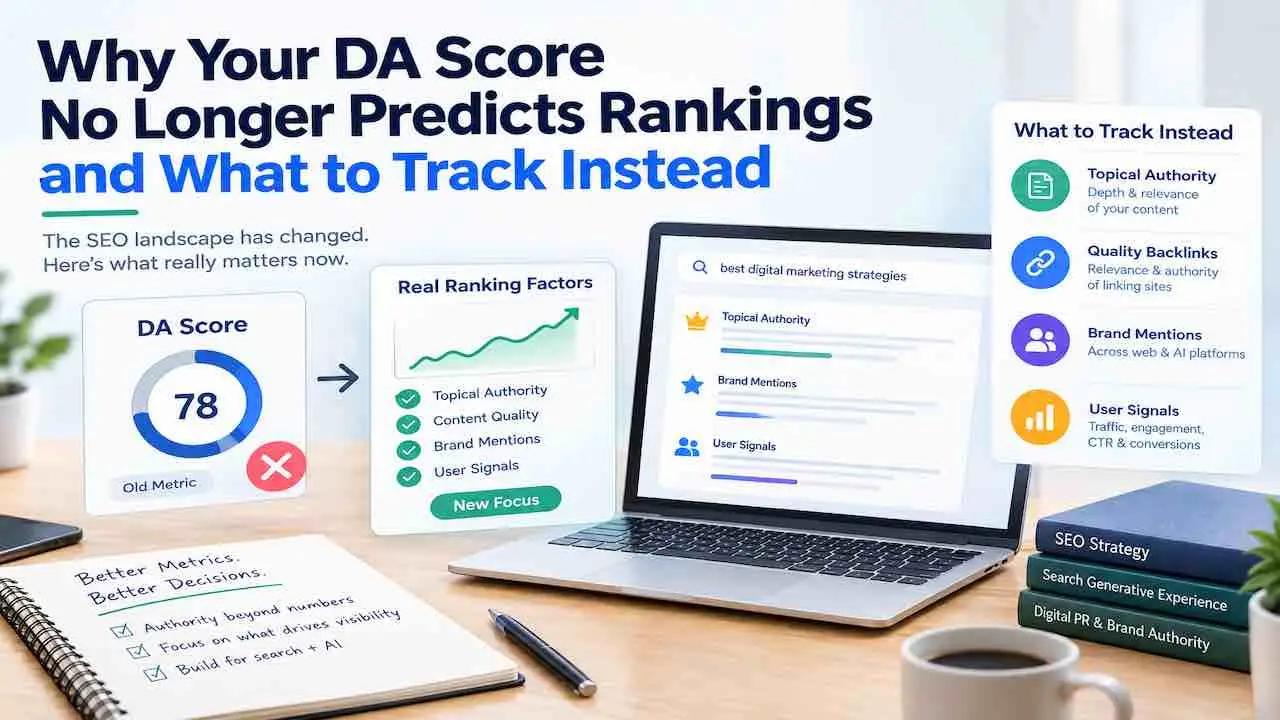
Domain authority failing link building results is a pattern every SEO encounters. A high DA link goes live, and rankings do not move. Moz DA and Ahrefs DR are third party metrics. Neither is a Google ranking factor. Both can be inflated for as little as $15. This guide covers what DA actually measures and why it fails link building campaigns. It also covers seven metrics that actually predict ranking improvements.
What Moz DA and Ahrefs DR Actually Measure
Moz Domain Authority (DA) is a machine learning score. It predicts how likely a domain is to rank. It is trained on link based signals including linking root domains, total link counts, and spam patterns. Ahrefs Domain Rating (DR) is a simpler link graph score. It measures the strength of a site’s backlink profile based on referring domains and their authority.
Neither metric sees what Google sees. DA does not measure content quality, topical authority, user engagement, Core Web Vitals, or organic traffic. DR deliberately excludes traffic, spam signals, domain age, and every non link variable. Ahrefs is transparent about this limitation in its documentation.
Both scores run on a logarithmic scale from 0 to 100. Most agencies skip this detail entirely. Moving from DA 20 to DA 30 is easier than moving from DA 70 to DA 80. This is the logarithmic scale effect. A site with DA 60 and one with DA 62 are not equivalent, despite their apparent proximity. The difference is exponentially larger than the two point gap suggests. Applying a simple “DA 50 minimum” filter treats these scores as linear, which they are not.
Why Domain Authority Is Failing Link Building Results
Domain authority fails link building results because it measures link volume and pattern. It ignores link quality, topical relevance, and the signals Google uses to assess trustworthiness.
The $15 DA Inflation Problem
DA and DR can both be artificially inflated. Industry research confirms both scores can be manipulated for as little as $15. Bulk link purchases from private blog networks or link farms achieve this. A site can reach DR 60 with zero genuine organic traffic. It accumulates hundreds of low quality referring domains from networks built to inflate these metrics. When you filter link prospects by DR 50+, you filter by a purchasable number. It does not reflect genuine authority.
The High DA, Zero Traffic Problem
Rhino Rank documented the pattern precisely. “DR 62, marked as strong. Traffic check: almost nothing ranking.” This is the DA trap at its most expensive. This is the DA trap at its most expensive. A high DA score with no organic traffic means the site influenced a third party score only. Google does not trust it. A link from it will not transfer a meaningful ranking signal. Traffic data exposes this gap immediately. DA does not.
The Logarithmic Scale Deception
Agencies report “DR increased from 45 to 52” as evidence of link building progress. On a logarithmic scale, this tells you almost nothing about ranking improvement. A site can gain 50 referring domains from irrelevant directories and jump 7 DR points. Rankings do not move because the links carry no topical relevance or traffic based trust signal. DA and DR measure what the score model sees. They do not measure what Google rewards.
Specific Situations Where DA Score Misleads Link Buyers
These are the four specific link scenarios where DA score produces the most misleading purchase decisions.
| DA/DR Situation | What DA Sees | What Google Sees | Actual Link Value |
|---|---|---|---|
| DR 65, 0 organic traffic | Strong backlink profile, worth targeting | No traffic, no real audience, no trust signal | Near zero. Site has links but no ranking credibility |
| DA 55, PBN inflated links | Solid authority score, above average | Unnatural link patterns, potential penalty risk | Negative. Links from penalized networks harm your profile |
| DA 45, wrong niche | Moderate authority, acceptable target | Zero topical relevance, mismatched entity signals | Minimal. Topically irrelevant links produce weak signals |
| DA 30, high traffic, perfect niche match | Below minimum, reject | Active audience, topical authority, trusted by users | High. Traffic and relevance outweigh low DA score |
Why Google Does Not Use Domain Authority
Google does not use Moz DA, Ahrefs DR, or any third party metric as a ranking factor. It has confirmed this multiple times. Google uses its own internal version of PageRank. It is not publicly visible and stopped being published entirely.
Every third party authority metric is an estimate of what PageRank might look like. Each tool builds it from its own web crawl with its own data gaps and scoring formulas. Moz and Ahrefs do not crawl the same links Google crawls. They do not crawl at the same speed or depth. They apply their own proprietary formulas to their own data.
The practical implication is direct. A DA 15 site ranking on page one for competitive keywords passes more real ranking signal. A DA 70 site that ranks for nothing passes less. Google measures the ranking performance of the linking domain. Your link building tool measures its own data model. These are not the same thing. See how E-E-A-T authority signals work in Google’s actual quality assessment compared to third party metrics.
The Seven Metrics That Actually Predict Link Building Results
Replace DA based link qualification with these seven metrics. Each one correlates with real ranking signals rather than third party link graph estimates.
1. Organic Traffic of the Linking Domain
Organic traffic is the single most reliable indicator of whether a site carries ranking trust. A site that ranks for real queries has passed Google’s quality filters already. Check organic traffic in Ahrefs Site Explorer or Semrush Domain Overview before accepting any link. A site with 10,000 monthly organic visitors from genuine keyword rankings carries ranking signal. No DA score can replicate it. A site with 200 monthly organic visitors from one branded keyword does not carry that signal. This is true regardless of its DR score. Set a minimum organic traffic threshold for every link prospect. 1,000 to 5,000 monthly organic visitors is a practical starting point.
2. Ahrefs Traffic Value (Organic Traffic Value)
Ahrefs Traffic Value estimates what a site’s organic traffic would cost if purchased through Google Ads. It is a stronger link quality indicator than Domain Rating. It combines traffic volume, keyword competitiveness, and ranking stability into one number. A DR 40 site with Traffic Value of $15,000 per month has earned traffic in competitive keywords. That signal matters more than the DR score. That signal carries far more weight than a DR 70 site with $200 Traffic Value. Filter link prospects by Traffic Value above $2,000 per month. This single filter eliminates the majority of inflated DA sites that pass DR based screening.
3. Topical Relevance Score
Topical relevance determines how closely the linking site’s content matches your site’s topic area. Google’s entity recognition system weighs topically relevant links more heavily. Authority scores that ignore subject matter alignment are weaker signals. A DR 40 site in your exact niche produces a stronger topical co occurrence signal. A DR 70 site in an unrelated industry produces a weaker one. Check topical relevance by reviewing the linking site’s most trafficked pages in Ahrefs. If fewer than 50% of its pages overlap your topic, the link carries a weaker entity signal.
4. Majestic Trust Flow and Citation Flow Ratio
Majestic Trust Flow measures how close a site is to trusted seed sites in Majestic’s index. The TF/CF ratio reveals whether a site’s link profile comes from genuine editorial sources or bulk links. A Trust Flow of 30 and Citation Flow of 60 produces a TF/CF ratio of 0.5. This signals heavy link inflation. A Trust Flow of 40 and Citation Flow of 45 produces a ratio near 0.9. This signals a clean, editorially built link profile. Target link prospects with a TF/CF ratio above 0.7. This single filter catches most PBN inflated sites that pass Ahrefs DR screening.
5. Semrush Authority Score
Semrush Authority Score combines link quality, traffic data, and spam signals into one composite metric. It is a more complete link quality indicator than DR or DA. It cannot be gamed purely through bulk link acquisition. Semrush Authority Score is harder to inflate than DR. It factors organic traffic directly into the calculation. A site with no organic traffic cannot reach a high Semrush Authority Score. This holds regardless of how many low quality links it accumulates. Use Semrush Authority Score as a secondary filter after checking organic traffic and Traffic Value.
6. Referring Domains With Measurable Organic Traffic
Referring domains with measurable organic traffic is a stronger signal than total referring domain count. It filters out the link farms and directories that inflate DA and DR. In Ahrefs, filter the referring domains report to show only domains with 1,000 or more organic visitors. A site with 200 high traffic referring domains carries far more ranking signal. A site with 2,000 directory links and no organic traffic carries far less. This filtered referring domain count predicts link value better than any raw DA or DR number. See how Share of Authority as an SEO metric gives a cleaner picture of domain level trust than DA or DR alone.
7. Link Neighborhood Quality
Link neighborhood quality describes the overall trustworthiness of the sites linking to your potential link source. A linking domain surrounded by spammy neighbors passes contaminated link signals regardless of its DA score. Use Majestic’s backlink checker to view the Trust Flow scores of a site’s top referring domains. If a prospective linking site’s backlink profile is composed of directories or private blog networks, it introduces link neighborhood risk. This check takes two minutes and prevents the most common expensive link building mistakes.
How to Audit a Link Prospect Without Using DA
This five step prospect audit replaces DA based filtering and takes under five minutes per site using Ahrefs, Semrush, and Majestic.
- Step 1 — Check organic traffic in Ahrefs or Semrush: Set a minimum of 1,000 monthly organic visitors. Reject any site below this threshold regardless of its DA or DR score. This single filter eliminates most PBN inflated sites instantly.
- Step 2 — Check Traffic Value in Ahrefs: Set a minimum Traffic Value of $2,000 per month. This confirms the site ranks for commercially valuable keywords, not just long tail informational queries that inflate visitor counts without trust signal.
- Step 3 — Check Majestic Trust Flow vs Citation Flow ratio: Divide Trust Flow by Citation Flow. Reject sites with a ratio below 0.7. A ratio below 0.5 signals a heavily manipulated link profile.
- Step 4 — Verify topical relevance: Browse the site’s top ranking pages in Ahrefs. At least 50% must overlap with your target topic area. A topically misaligned link is a weak link regardless of any metric.
- Step 5 — Check referring domains with traffic: Run an Ahrefs referring domains report filtered to 1,000+ monthly organic visitors. A site with fewer than 20 high traffic referring domains carries less trust than its DR suggests.
What to Report to Clients and Stakeholders Instead of DA
Reporting DA scores to clients trains them to measure link building success by a metric that Google ignores, and it makes your agency vulnerable every time a competitor delivers high traffic links from lower DA sites that outperform your high DA placements. Replace DA reporting with these four metrics in every client report.
- Organic traffic of each new referring domain: Report the monthly organic traffic of every site that linked to the client. This makes link quality immediately intuitive to non-SEO stakeholders who understand website traffic.
- Traffic Value of the linking domain: Report each domain’s Ahrefs Traffic Value. A client easily understands that a link from a site worth $25,000 per month in equivalent ad spend is more valuable than a link from a site worth $300 per month, regardless of DA.
- Ranking movement on target keywords: Report the actual ranking position of the client’s target pages before and after each link campaign. Link building results are ranking improvements. Report the result, not the input metric.
- Referring domain growth rate: Report the net number of new referring domains acquired each month from sites with 1,000 or more monthly organic visitors. This filtered domain growth rate is the clean measure of real link building progress. See how link building measurement in the AI search era requires moving beyond third party authority scores entirely.
DA vs DR: Which Is More Misleading for Link Building?
DA and DR mislead link buyers in different ways. Understanding the specific failure mode of each metric prevents the most costly link purchasing mistakes.
| Factor | Moz DA | Ahrefs DR | Which Is More Misleading |
|---|---|---|---|
| Inflation ease | Moderately easy via bulk links | Very easy. DR responds quickly to new referring domains | DR. Faster to inflate, harder to catch without traffic check |
| Traffic included | No | No | Both equally misleading. Neither includes traffic data |
| Spam signal | Partial. Moz Spam Score is a separate input | None. DR excludes spam signals by design | DR. Has no spam filter built into the score |
| Topical relevance | Not included | Not included | Both equally misleading on topical fit |
| Update speed | Slow. DA changes infrequently | Fast. DR updates within days of new links | DR. Faster movement creates illusion of faster progress |
| Best use case | Long term authority trend tracking | Backlink gap analysis and link prospecting | Neither alone is sufficient. Always combine with traffic data |
Common DA Based Mistakes That Waste Link Building Budget
These six mistakes all stem directly from using DA or DR as the primary link quality filter.
- Paying premium prices for high DA links with no traffic: A DA 70 link from a site with 500 monthly organic visitors costs $500 to $2,000 in most outreach markets. A DA 35 link from a niche site with 25,000 monthly visitors often costs $100 to $300. The lower DA link produces stronger ranking impact at a fraction of the price.
- Filtering out topically relevant low DA sites: A DA 25 site that ranks on page one for your target keywords in your exact niche produces a stronger topical authority signal than a DA 60 news site with no niche relevance. DA filters eliminate the best link prospects in most niche markets.
- Accepting inflated DA without a traffic verification step: PBN networks and link vendors specifically inflate DA and DR to meet standard agency filters. Skipping the organic traffic check means your filtering is only catching obvious spam, not sophisticated link inflation.
- Using DA to benchmark competitor link profiles: A competitor with a DA 50 profile built on 200 niche relevant, high traffic sites will outrank you consistently. A competitor with a DA 70 profile built on 2,000 directory links and PBN placements will not. DA hides this distinction entirely.
- Reporting link building progress as a DA increase: DA fluctuates based on Moz’s algorithm updates, crawl changes, and the relative scores of other sites. Your DA can drop while your organic traffic grows. Reporting DA as a success metric misleads clients about what link building actually produces.
See the full breakdown of how link building ROI in the zero click search era requires performance metrics, not input metrics like DA and DR, to demonstrate real campaign value.
Frequently Asked Questions: Domain Authority Failing Link Building Results
Domain authority fails to predict ranking improvements because it measures a third party estimate of link profile strength. It ignores the signals Google’s algorithm actually uses. A link from a high DA site with no organic traffic passes almost no real ranking signal. Replace DA with organic traffic and Traffic Value as your primary link quality filters.
No. Google has confirmed that it does not use Moz DA, Ahrefs DR, or any third party metric as a ranking factor. Google uses its own internal version of PageRank. Every third party metric is an estimate built from the tool’s own web crawl data.
Yes. Both Moz DA and Ahrefs DR can be inflated for as little as $15 using bulk link purchases from private blog networks. Organic traffic verification is non negotiable in any link prospect audit. A site can reach DR 60 with zero organic traffic by accumulating hundreds of low quality links. See also brand mentions vs backlinks for what signals matter.
Use organic traffic of the linking domain as your primary filter. Add Ahrefs Traffic Value, Majestic Trust Flow to Citation Flow ratio, and topical relevance as secondary filters. These four data points take under five minutes to check per site and catch every common DA based mistake.
No. DA and DR remain useful as relative comparison tools for competitor benchmarking and long term trend tracking. But they should never be used as primary link quality filters. Use organic traffic, Traffic Value, and topical relevance for every link prospect decision.
Fix Your Link Building Metrics with Quick Digital
Quick Digital • Digital Marketing Since 2014
Stop Paying for DA Scores. Start Paying for Rankings.
Quick Digital qualifies every link prospect by organic traffic, Traffic Value, topical relevance, and Trust Flow ratio — not DA scores. 10+ years of link building experience. Every placement audited before purchase. Every campaign reported by ranking movement, not input metrics.
Build Links That Actually Rank →
Request a Free Quote
Traffic Based Qualification • Topical Relevance Audit • Trust Flow Analysis • Ranking Based Reporting