


D2C brand link building works across seven channels. These are: product reviews, gift guide placements, digital PR, influencer citations, and affiliate programs. They also include unlinked brand mention recovery and founder led editorial authority. Direct to consumer brands face a structural link building problem that information sites do not. Their most valuable pages are product pages. Publications resist linking to product pages directly. This guide covers how D2C brands earn high authority backlinks without traditional editorial link building. It also covers how to build AI search citation authority for product level queries.
Why D2C Brands Have a Different Link Building Problem
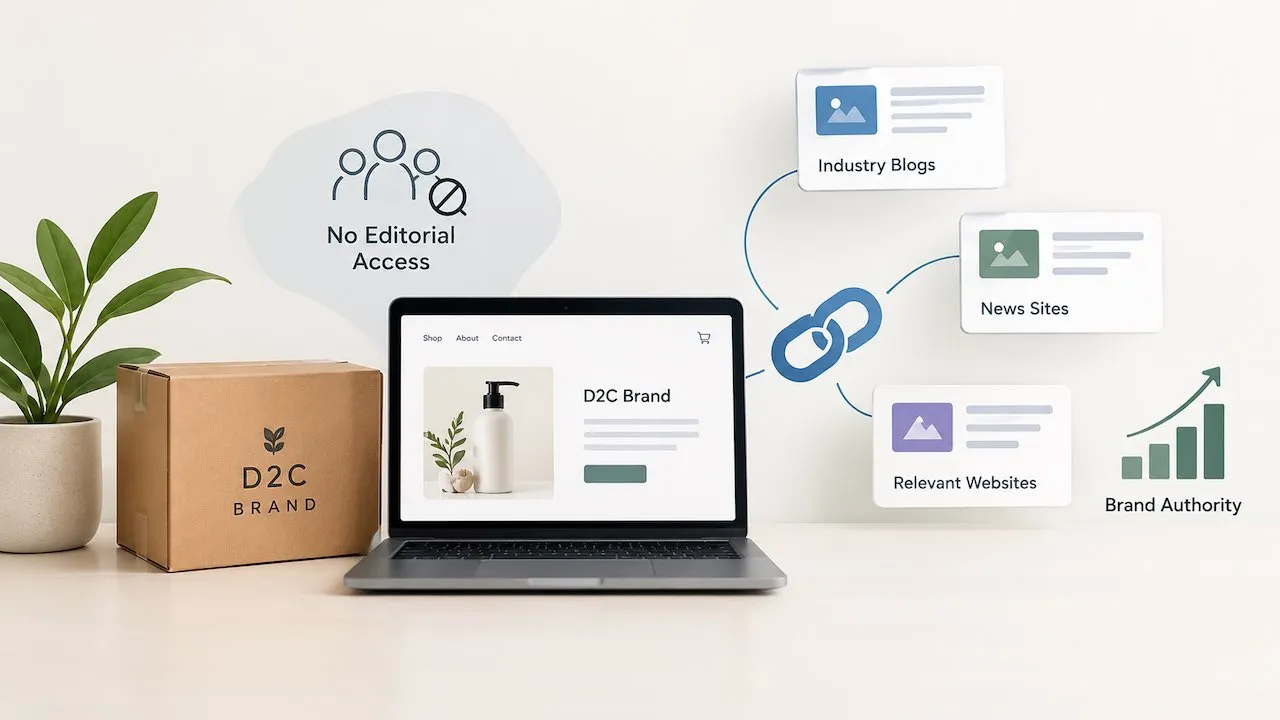
D2C brands face a structural link building disadvantage. Their most commercially valuable pages are product pages. Publishers resist linking to product pages.
Information sites build links naturally. A blog post about personal finance earns links from other sites covering personal finance. A product page for a skincare serum earns almost nothing from organic editorial linking. Publications do not cite product pages as sources. This asymmetry is the core D2C link building problem.
The D2C market reached $162.91 billion globally and is projected to hit $595.19 billion by 2033. As paid acquisition costs rise, organic search becomes the only channel that does not increase in cost. D2C brands that build backlink authority compound their organic revenue over time. Brands relying only on paid social see acquisition costs rise every month while margins get thinner.
The solution is not to fight the product page link problem directly. Build a D2C link building strategy using content pages, digital PR, product reviews, and creator citations. Earn links at scale, then channel that authority to product pages through internal linking.
Product Review Link Building: The Primary D2C Backlink Channel
Product review links are the highest value D2C backlinks. They are contextual, topically relevant, and placed within genuine editorial content by an independent third party. Publications that refuse standard link pitches accept product review requests.
Publications like Wirecutter operate at DR 88. Good Housekeeping sits at DR 87. Niche review sites in beauty, home, fitness, and food cover products at DRs from 45 to 75. Every review these publications publish contains a direct link to the product page. These are editorial dofollow links placed inside genuine product assessment content. No cold outreach campaign can match this link type for product pages.
How to Get Product Review Placements
- Send product samples proactively to review editors: Identify review publications in your category. Email the product review editor directly with a one paragraph product pitch and offer a complimentary sample for testing. Publications that cover your category receive sample requests constantly. Lead with what makes your product measurably different, not what makes it good.
- Build a review outreach list by category: Search Google for “best [your product type]” and “top [your product type] reviews.” Every site ranking for these queries is a target for your review outreach. Note the Domain Rating of each publication. Prioritize publications with DR 40 or above and genuine organic traffic.
- Target “best of” roundup updates: Existing roundup posts are updated regularly. Contact the author of any existing best of list in your category and ask to be considered for the next update. Frame it as a new product that fits their existing editorial coverage, not a link request.
Gift Guide and Seasonal Roundup Link Building
Gift guide placements are the single most scalable D2C link building tactic. Editors at lifestyle, parenting, food, and general interest publications publish gift guides on a predictable annual calendar. This creates a repeatable system for earning product page links from DR 50 plus publications every year.
Most gift guide pitching happens between October and December. This is the wrong time to pitch. Editors finalize their gift guide content in August and September. Pitch in June and July to reach editors before their editorial calendars are locked. A pitch arriving in November competes with hundreds of others. A pitch arriving in July is one of the first the editor sees.
- Build your gift guide pitch template in May: Include a high resolution product image, a one line product description, the retail price, and a direct product page URL. Editors use exactly these four elements to include products in roundups. Make it as easy as possible to include your product without any back and forth.
- Pitch by audience segment, not product category: Search for “gifts for [your target audience]” rather than “gifts for [your product type].” A candle brand pitches “gifts for home decor lovers,” not “gifts for candle lovers.” Audience first pitching matches how editors organize their gift guide content.
- Track and repitch each year: Every gift guide placement this year is a warm pitch for next year. Email editors who featured your product and thank them. Offer an updated product or new variant for the following year’s guide. A product that appeared in last year’s roundup is far easier to include again than a brand new submission.
Digital PR for Direct to Consumer Brands
Digital PR for D2C brands earns editorial backlinks from national and niche publications. It works by pitching original data, founder stories, and trend driven product narratives. Journalists cover these as news stories rather than product placements.
Product placements and product PR are different things. A product placement puts your item in a roundup. Digital PR places your brand in a news story. A journalist wrote it independently after reading your pitch. The news story contains a link to your website. The journalist wrote it because your pitch gave them genuine editorial value. The link is a byproduct, not the request.
- Original consumer survey data: Survey 500 to 1,000 people in your target market on a topic related to your product category. Publish the findings as a data report on your site. Pitch the most surprising finding to journalists as a news story. Data driven stories earn links from business publications, trade media, and lifestyle press at DR 70 to 90. See how digital PR link building and AI citations combine to build D2C brand authority across both Google and AI search simultaneously.
- Founder story pitches: D2C brands have an inherent editorial hook that B2B companies rarely do: a founder who built a consumer product because they had a genuine problem. Entrepreneurship publications, business sections of lifestyle magazines, and brand storytelling podcasts all actively seek founder stories. A successful founder pitch earns a DR 70 plus link and brand authority that product roundup links cannot match.
- Trend commentary pitching: Position your founder as a category expert on trends affecting your product space. A skincare brand founder commenting on the clean beauty regulatory trend earns mentions and links in beauty trade publications far more readily than a product pitch. Expert commentary builds authority and links simultaneously.
Influencer Citation Link Building
Influencer citations generate SEO link value when the influencer publishes a blog post containing a dofollow link. Instagram and TikTok posts carry either no links or nofollow links.
The distinction matters fundamentally. An Instagram post mentioning your product creates a brand signal but passes zero link equity. The same influencer writing a blog post and linking to your product page creates a dofollow backlink. It passes real ranking signal from their domain.
- Prioritize influencers with active blogs over pure social accounts: When evaluating creator partnerships for SEO value, check whether the influencer maintains an active blog with indexed content. A micro influencer with 15,000 Instagram followers and a DR 35 personal blog produces far more link building value than a macro influencer with 500,000 followers and no blog.
- Brief influencers to include product links in their written content: Give influencers a clear product link brief alongside their creative brief. Ask them to include a direct link to the product page in any blog post, newsletter, or YouTube description associated with the campaign. Many influencers do not include links by default. A specific brief changes this.
- 72% of consumers now use AI chatbots to research products before purchase, but only 12% of D2C sites are optimized to appear in those recommendations. Influencer blog posts that name and link to your product feed entity data into AI training datasets. A product mentioned in 50 indexed blog posts across 50 domains creates a far stronger AI recognition signal than a product with one brand owned page.
Affiliate Programs and Their Indirect SEO Value
Affiliate links are typically nofollow or tagged as sponsored. They do not directly pass link equity to your product pages. But a well run affiliate program produces large volumes of content about your products across diverse websites. This creates indirect SEO benefits that compound over time.
When affiliates write about your products, they create indexed web pages. These pages name, describe, and cite your brand. These pages build brand entity signals even without passing direct link equity. Many affiliates include both a sponsored affiliate link and a natural editorial link in the same post. That editorial link is dofollow. Track how many of your affiliate generated pages include both link types in Ahrefs.
Affiliates who generate strong sales also attract editorial coverage from niche deal sites and cashback platforms. These secondary placements often include dofollow editorial links. The D2C link building chain that starts with an affiliate program extends far beyond the affiliate content.
Unlinked Brand Mention Recovery
Unlinked brand mention recovery converts existing editorial coverage into dofollow backlinks. It takes a single outreach email. This makes it the highest conversion link building tactic for any D2C brand with press coverage.
D2C brands in fashion, beauty, food, and home goods earn editorial mentions in lifestyle publications. These mentions name their brand without linking to their site. These mentions already exist as indexed pages. They require no new content creation. They need a single conversion email to become a backlink.
- Find unlinked mentions with Ahrefs or Google: Search Google for “your brand name” with a date filter set to the past 12 months. Review every result that mentions your brand name. Check whether the mention includes a link to your site. Any page that names your brand without linking is an unlinked mention to recover.
- Send a short conversion email: Contact the author or editor of the page. Thank them for the mention. Ask if they would add a link to the specific product page they mentioned to help their readers find it directly. Keep the email under 100 words. Conversion rates for this outreach typically run at 20% to 40% because the editor already likes your brand enough to mention it.
- Track brand mentions proactively: Use Google Alerts, Mention, or Ahrefs brand mentions tracking to catch new unlinked mentions within days of publication. Contacting editors within a week of publication produces far higher conversion rates than outreach sent months after the article was published. See how unlinked brand mentions as an SEO ranking signal apply specifically to D2C brands with fragmented press coverage.
Founder Led PR and Expert Authority Building
Founder led PR earns editorial backlinks at DR 70 to 90 from business, lifestyle, and trade publications. It positions the D2C founder as a named expert in their product category. These are authority links that no product page pitch can earn.
D2C founders have a natural authority signal that most B2B founders lack. They built a product for a consumer need they personally experienced. This personal origin story is a genuine editorial hook. Publications covering entrepreneurship and product innovation actively seek it. A founder who shows up as a named expert in publications builds brand entity signals and high authority editorial backlinks. Both drive long term ranking improvements.
- Respond to journalist requests via HARO or Connectively: Sign up for Help a Reporter Out (HARO) or Connectively. Set up alerts for queries in your product category. Respond to journalist requests with specific, quotable expert insights within the first two hours of receiving the request. Fast, specific responses earn the majority of placements. Vague or slow responses earn almost none.
- Write bylined articles for trade publications: Submit bylined articles to trade publications in your product category. A clean beauty brand founder writing for a beauty industry publication earns a DR 60 plus dofollow link alongside the byline. Trade publication bylines establish expert authority that strengthens E-E-A-T signals for the entire domain. See how E-E-A-T authority signals compound across the domain when founder level expertise is attributed in published external content.
Internal Linking: How to Move Link Equity to Product Pages
D2C brands earn most of their editorial backlinks on content pages, blog posts, and brand story pages. Their SEO value lives or dies by how effectively that equity flows to product pages.
A blog post that earns a DR 70 backlink from a gift guide article passes authority through internal links. A product page internally linked from that blog post receives a share of that authority. Most D2C brands publish content and product pages in silos with no systematic internal linking plan. This is where most of the link equity earned through outreach is wasted.
- Link every piece of content to at least one relevant product page: Every blog post, brand story, and editorial piece on your site should contain at least one contextual internal link to a relevant product or category page. This is how link equity from external backlinks flows to the pages that generate revenue.
- Build a content hub around each product category: Create a pillar content page for each major product category. All related blog posts link to the pillar page. The pillar page links to relevant product pages. External backlinks earned by any page in the cluster flow through this hub to your product pages.
- Audit internal linking quarterly: Run a site crawl in Screaming Frog monthly. Identify product pages with zero or few internal links. Add links from existing high authority content pages to these products. Improving internal linking on existing pages produces ranking improvements without requiring any new backlinks.
AI Search Citation Building for D2C Product Brands
When a shopper asks ChatGPT, Perplexity, or Gemini “what is the best sustainable water bottle for hiking,” your product appears in that answer only if it has been mentioned across enough indexed, authoritative sources to create a recognizable brand entity in the AI engine’s training data.
72% of consumers now use AI chatbots to research products before purchase. Only 12% of D2C sites are optimized to appear in those recommendations. Building AI search visibility for D2C products requires the same foundation as traditional link building. But it must be structured specifically for entity recognition across AI training datasets.
- Aggregate UGC into indexed pages on your site: A product with 100 indexed customer reviews, unboxing write ups, and community mentions outranks a product with only brand written copy in AI search recommendations. Build a dedicated press page that indexes all external media mentions with full citations. Use Organization schema to formalize this coverage as part of your brand entity profile.
- Confirm influencer mentions are indexed and linked: When an influencer or publication mentions your product, confirm the content is indexed by Google before counting it as an AI citation asset. Unindexed content does not enter AI training datasets. Submit any unindexed influencer content URLs to Google Search Console for manual indexing.
- Build schema markup on all product pages: Product schema with aggregated review data, brand entity markup, and breadcrumb structured data signals to AI retrieval systems that your product is a named, verifiable entity. AI engines that read structured product data cite named products at higher rates than unstructured product descriptions. See how brand mentions vs backlinks determine which signal type drives more AI search visibility for D2C product brands.
Measuring D2C Brand Link Building Results
Measure D2C brand link building results through four metrics. These are: new referring domains from DR 40 plus sources in Ahrefs, organic traffic to product and category pages in GA4, branded vs non branded organic traffic split in Search Console, and AI brand recall for product category queries.
- New referring domains from DR 40 plus sources: Filter your Ahrefs referring domains report to show only domains with DR 40 or above. Track how many new qualifying referring domains you add each month. Aim for 5 to 10 new high quality referring domains per month for an early stage D2C brand and 15 to 25 per month for a growth stage brand.
- Organic traffic to product and category pages: In GA4, create a custom report showing organic sessions to product detail pages and category pages separately from blog pages. Rising organic traffic to product pages confirms your internal linking and product review link strategy is working.
- Branded vs non branded traffic split: In Google Search Console, segment impressions by branded queries (your brand name) and non branded queries (product category terms). A growing non branded organic traffic share confirms your domain is earning ranking authority for category level queries beyond just brand searches.
- AI brand recall testing: Monthly, search “best [your product category] for [your target use case]” in Perplexity, ChatGPT, and Gemini. Track whether your product appears. Rising AI brand recall confirms your entity building strategy is working across both Google and AI engines.
Common D2C Link Building Mistakes
These mistakes prevent D2C link building from producing meaningful domain authority growth. They persist even when outreach volume is high.
- Pitching product pages directly in link outreach: Publications resist linking to product pages from editorial content. Pitch content pages, brand story pages, and data assets first. Use internal linking to transfer equity to product pages. Direct product page link pitches have a conversion rate below 2%.
- Treating affiliate links as link building: Affiliate links are nofollow by design. They do not count as backlinks for SEO purposes. Run an affiliate program for sales, not for backlinks. Measure the indirect SEO benefits of affiliate content separately from your link building KPIs.
- Pitching gift guides in November: Gift guide editorial calendars close in August and September. A November pitch competes with hundreds of others and misses most inclusion deadlines. Build your gift guide outreach list in May and pitch in June and July.
- Ignoring influencer blog content: Instagram links are nofollow and carry no link equity. Instagram followers see sponsored posts but the link in the bio passes nothing. Brief influencers to include direct product links in any associated blog post, newsletter, or YouTube description.
- Publishing blog content with no internal links to products: Every blog post earns a share of any backlinks pointing to it. That authority must flow to product pages through internal links. A blog post with no internal links to products is a dead end for any link equity it earns.
Frequently Asked Questions: D2C Brand Link Building Strategy
D2C brands face a structural link building disadvantage because their most valuable pages are product pages. Publishers resist linking to commercial product pages from editorial content. D2C brands must earn links through product reviews, digital PR, founder authority, and content pages. Internal linking moves that authority to product pages.
Affiliate links are typically nofollow and do not directly pass link equity to your product pages. But a well run affiliate program generates large volumes of indexed content about your products across diverse websites. Track the dofollow links separately in Ahrefs to see the real link building value of your affiliate program.
D2C brands should pitch gift guides in June and July, not October to December. Gift guide editorial calendars close in August and September. A pitch arriving in July is one of the first an editor sees. A November pitch competes with hundreds of others and misses most editorial deadlines.
D2C brands build AI search visibility by aggregating indexed customer reviews and media mentions into a press page, implementing Product and Organization schema, and confirming influencer content is indexed and linked so it enters AI training datasets. A product with 100 indexed external mentions earns AI citations at a far higher rate.
D2C brand link building typically shows initial ranking improvements within 6 to 16 weeks. Category level ranking authority builds over 6 to 12 months of consistent outreach. Product review links and gift guide placements produce the fastest ranking signals. AI brand recall typically improves within 30 to 60 days.
Build Your D2C Brand Link Building Strategy with Quick Digital
Quick Digital • Digital Marketing Since 2014
Turn Every Product, Review, and Founder Story into a High Authority Backlink
Quick Digital builds D2C brand link building strategies that earn product review placements, gift guide links, digital PR backlinks, and influencer citations from publications your customers already read. We also recover unlinked brand mentions and build AI search citation authority for your product category queries. 10+ years of digital marketing experience since 2014.
Build Your D2C Link Strategy →
Request a Free Quote
Product Review Outreach • Gift Guide Placements • Digital PR • Influencer Citations • AI Citation Building