

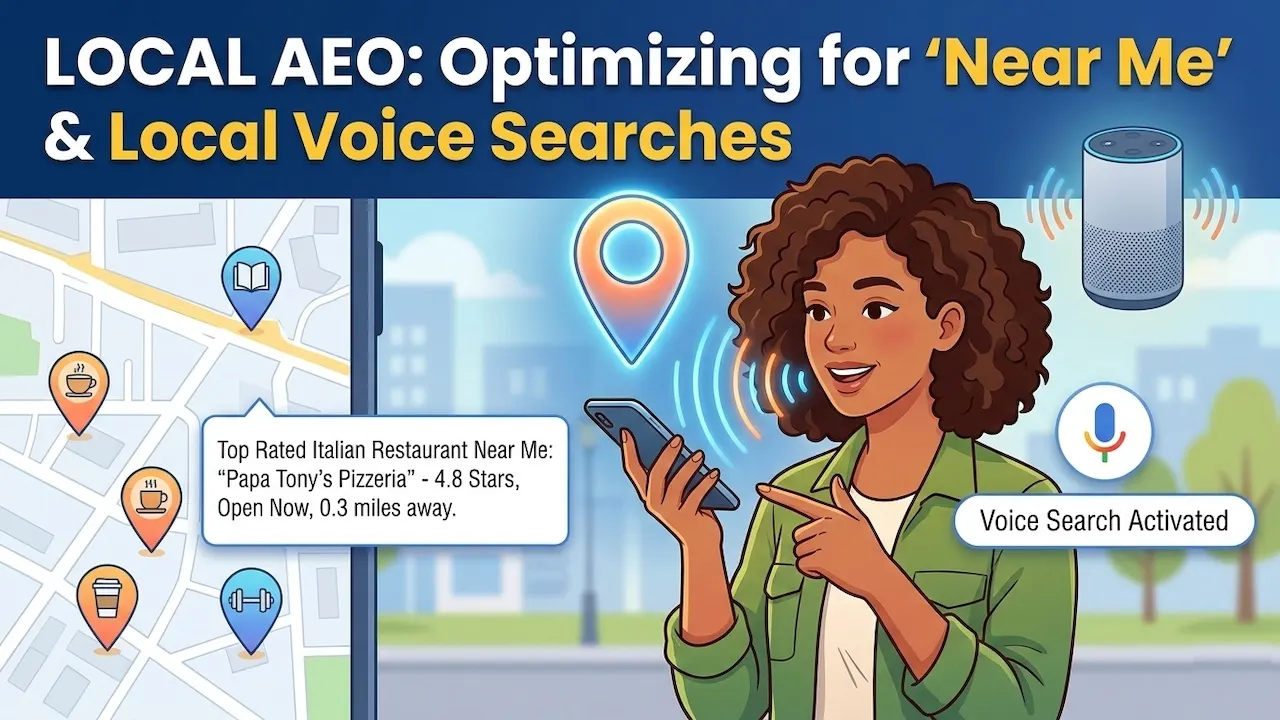
Local AEO (Answer Engine Optimization) is the practice of structuring your business data so AI assistants and voice search engines pick your business as the single spoken answer when someone nearby asks a question. Over 1 billion voice searches happen every month. Local intent drives more than 58% of them. When a user says “Hey Siri, find me an electrician near me open now,” one business wins that call. Every other business gets nothing.
This guide covers the complete local voice search optimization strategy: from Google Business Profile signals and NAP citation accuracy to schema markup, neighborhood-specific content, and multi-platform AI visibility across Google, Bing, ChatGPT, Perplexity, Gemini, Siri, and Alexa.
What This Guide Answers
- What local AEO means vs. traditional local SEO
- How AI assistants pick a local business answer
- Which schema types trigger local voice answers
- How NAP inconsistency kills your AI visibility
- How to build neighborhood-specific content that ranks 40% higher
- How to appear in ChatGPT, Perplexity, Siri, Alexa, and Meta AI local answers
- How to measure local AEO results when traffic analytics miss zero-click wins
Local AEO vs. Local SEO: The Exact Difference
Local SEO wins you a position in a ranked list of links. Local AEO wins you the single spoken or AI-generated answer with no list below it. That shift changes everything about how you structure content, build citations, and measure success.
When someone types “plumber near me,” they see a map pack and 10 blue links. When they speak “What plumber near me is open right now and accepts card payments?” to Google Assistant, one business name gets read aloud. That is local AEO: position zero, voice-first, AI-recommended visibility.
| Factor | Traditional Local SEO | Local AEO for Voice Search |
|---|---|---|
| Primary goal | Rank in the map pack and page 1 | Become the single AI-spoken or AI-cited answer |
| Query format | Short keywords: “dentist Houston” | Full spoken questions: “Which dentist near me takes Cigna and opens on Saturday?” |
| Result type | List of links and map pack | Featured snippet, voice answer, AI overview citation |
| Primary ranking signals | Backlinks, keyword density, on-page SEO | GBP completeness, NAP consistency, schema, review sentiment, page speed |
| Success metric | Ranking position, organic sessions | Phone calls, direction requests, AI citations, featured snippet wins |
| Time to impact | 3 to 12 months | 6 to 8 weeks with schema and GBP optimization |
| Click dependency | High: user must click your link | Low: zero-click voice answers still drive calls and visits |
How Voice Search AI Engines Select a Local Business Answer
Voice assistants like Google Assistant, Siri, and Alexa select a local business answer by cross-referencing 6 data layers: your Google Business Profile, NAP citation accuracy, structured schema markup, review authority, technical page performance, and cross-platform entity consistency. AI does not guess. It picks the business with the most consistent, structured, and trustworthy data across every source it checks.
Google’s Knowledge Graph, Bing’s entity index, Apple Maps, and Yelp all feed into AI answer selection. When your data conflicts between any two of these sources, AI systems lower their confidence score for your entity and pass the answer to a competitor with cleaner data. According to a Moz analysis, over 70% of local ranking signals now come from cross-platform entity verification.
The 6 Core Trust Signals AI Uses to Choose Your Business
- GBP completeness score: Every empty field in your Google Business Profile is a gap in the picture AI builds of your business. Incomplete profiles get passed over.
- NAP consistency: Your business Name, Address, and Phone number must match exactly across 50 or more directories, including abbreviations and phone number formatting style.
- LocalBusiness schema markup: JSON-LD structured data that explicitly communicates your geo-coordinates, service area, opening hours, and accepted payment types to AI crawlers.
- Review volume, rating, and text sentiment: AI reads review text, not just star ratings. Algorithms analyze review context to understand what services you provide and where you operate.
- Page speed under 3 seconds: Voice search results load 52% faster than average web pages (Backlinko). Slow sites lose voice answer eligibility regardless of content quality.
- Profile activity and freshness signals: Businesses that post weekly GBP updates, respond to all reviews, and upload fresh photos signal ongoing trustworthiness to AI systems.
Google Business Profile: The Foundation of Every Local Voice Answer
Your Google Business Profile (GBP) is the structured data source AI assistants query first for every “near me,” “open now,” and “best [service] near me” spoken query. A partially completed or stale GBP makes your business invisible to voice and conversational AI search, even if your website ranks on page one of organic results.
Google now cross-references your GBP service descriptions with your website’s services page to verify consistency. If your site says “HVAC repair” but your GBP lists only “HVAC,” the mismatch weakens your relevance signal for spoken queries like “Who does HVAC repair near me?”
Complete GBP Optimization Checklist for Local Voice Search
- Select the most specific primary category, such as “Emergency Electrician” instead of “Electrician.”
- Add all relevant secondary categories aligned to actual services, like “Electrical Panel Repair Service.”
- Write a 750-character business description using conversational sentences that answer who you are, what you do, where you serve, and when you are available.
- Fill in every service with a unique 2-sentence description using the natural language your customers speak when asking voice queries.
- Upload at least 10 geotagged photos with descriptive file names, such as
electrician-dallas-tx-service-truck.jpg. Google’s Vision AI scans these images to confirm you operate where you claim. - Encourage customers to upload their own photos. User-generated content is a trust signal that AI now factors into recommendation decisions.
- Post weekly GBP updates using question-based titles, like “Need a same-day electrician in Dallas?”
- Populate the Q&A section with 10 to 12 questions that match actual voice query patterns, such as “Do you offer 24-hour emergency service?”
- Keep holiday hours current. AI checks listed hours against the query timestamp for “open now” searches. A mismatch between your website footer and your GBP hours lowers your trust score.
- Respond to every review within 48 hours. Include your service type and city name naturally in the response.
After implementing FAQ schema and conversational question formats on their GBP, one local HVAC company began appearing in Google featured snippets and as the top voice recommendation. Their call volume increased 40% in 3 months without increasing ad spend. — BlakSheep Creative Case Study
NAP Consistency: The Most Damaging Technical Gap in Local AEO
NAP inconsistency is the top reason local businesses get dropped from voice search recommendations and AI citations. When your Name, Address, or Phone number appears differently across directories, AI systems lower their entity confidence score and route the answer to a competitor with cleaner data.
Even minor variations cause problems. “Suite 4” versus “Ste. 4,” “(555) 000-1234” versus “555.000.1234,” or “Smith’s Plumbing LLC” versus “Smith Plumbing” all register as separate entities in citation databases, splitting your authority signal instead of compounding it.
Step-by-Step NAP Audit and Correction Process
- Run a citation audit using Moz Local, BrightLocal, or Yext to identify every platform where your business appears and flag every discrepancy.
- Choose one canonical version of your name, address format, and phone number. Write it down exactly and use it everywhere without exception.
- Correct citations starting with highest-authority platforms: Google, Apple Maps, Bing Places, Yelp, Facebook, and Foursquare.
- Submit to niche directories specific to your industry, such as Healthgrades for healthcare, Houzz for home services, or Avvo for legal professionals.
- Suppress duplicate listings rather than leaving them to coexist. Duplicates split citation authority.
- Re-audit every 90 days. Data aggregators like Data Axle and Foursquare push updates to directories automatically and often overwrite your corrections.
Schema Markup Types That Directly Trigger Local Voice Answers
LocalBusiness schema in JSON-LD format is the structured language AI engines use to confirm who you are, where you operate, and what you offer. Without it, AI must infer your business details from unstructured text, which reduces answer confidence and pushes you down in recommendation priority.
| Schema Type | What It Communicates | Voice Query It Answers |
|---|---|---|
LocalBusiness | Business identity, location, hours, phone | All “near me” and “open now” spoken queries |
FAQPage | Structured Q&A content blocks | Featured snippets, PAA box, and direct voice responses |
GeoCoordinates | Exact latitude and longitude | Precision proximity matching for location-based queries |
AggregateRating | Star rating and total review count | “Best [service] near me” recommendation selection |
OpeningHoursSpecification | Daily hours including holidays | “Open now” and “open on Sunday” queries |
HowTo | Step-by-step instructional content | Procedural and process-based voice answers |
Service | Individual service names, areas, prices | “Do they offer [service] in [city]?” queries |
LocalBusiness JSON-LD Template With All Critical Fields
<script type="application/ld+json">
{
  "@context": "https://schema.org",
  "@type": "LocalBusiness",
  "name": "Your Business Name",
  "description": "160-char description using conversational keywords
                  matching how customers voice-search your services.",
  "address": {
    "@type": "PostalAddress",
    "streetAddress": "123 Main Street",
    "addressLocality": "Houston",
    "addressRegion": "TX",
    "postalCode": "77001",
    "addressCountry": "US"
  },
  "telephone": "+1-555-000-0000",
  "url": "https://yoursite.com",
  "priceRange": "$$",
  "areaServed": [
    { "@type": "City", "name": "Houston" },
    { "@type": "City", "name": "Katy" },
    { "@type": "City", "name": "Sugar Land" }
  ],
  "openingHoursSpecification": [
    {
      "@type": "OpeningHoursSpecification",
      "dayOfWeek": ["Monday","Tuesday","Wednesday","Thursday","Friday"],
      "opens": "08:00",
      "closes": "18:00"
    },
    {
      "@type": "OpeningHoursSpecification",
      "dayOfWeek": "Saturday",
      "opens": "09:00",
      "closes": "14:00"
    }
  ],
  "geo": {
    "@type": "GeoCoordinates",
    "latitude": 29.7604,
    "longitude": -95.3698
  },
  "aggregateRating": {
    "@type": "AggregateRating",
    "ratingValue": "4.9",
    "reviewCount": "218"
  },
  "hasMap": "https://goo.gl/maps/your-map-link"
}
</script>
Validate every schema implementation at search.google.com/test/rich-results before publishing. Also cross-check at validator.schema.org for multi-platform accuracy.
Content Strategy: Every Keyword Type Naturally Integrated
Voice queries average 20 to 30 words longer than typed queries and follow a natural question format that most local business websites completely ignore. Your content must mirror the exact spoken language structure AI extracts answers from. The average voice search answer is 29 words. Pages that win those answers contain 2,312 total words of surrounding depth content.
| Keyword Type | Role in Local AEO | Examples Used in This Content |
|---|---|---|
| Primary (focus) | Signals the exact topic to search engines | local voice search optimization, near me AEO, local answer engine optimization |
| LSI (latent semantic) | Confirms topic relevance through related terms | spoken queries, conversational search, proximity-based search, local intent, voice assistant results |
| Semantic / Entity | Links content to real-world entities AI recognizes | Google Assistant, Siri, Alexa, Bing Copilot, Perplexity AI, Google Knowledge Graph, featured snippet, map pack, NAP consistency, Moz Local, BrightLocal |
| Long-tail / Voice query | Matches exact phrasing of high-intent spoken searches | “what dentist near me is open Saturday and takes insurance,” “best plumber near me with same-day service” |
| NLP / Question-format | Triggers featured snippet and voice answer extraction | who, what, where, when, how, which, can I, do you, is there, find me |
| Emotional / Pain-point | Resonates with businesses feeling real losses from poor local AEO | invisible to AI search, losing customers to competitors, missed calls, getting skipped by voice assistants, never appearing in local recommendations |
| Related / PAA | Captures People Also Ask and related search traffic | how to rank in Google Maps, what is position zero, how to get more Google reviews, does schema help voice search |
Typed vs. Spoken Query: The Content Gap That Costs Local Businesses Daily
- Typed: “dentist near me weekend” vs. Spoken: “What dentist near me is open on Saturday and accepts Blue Cross Blue Shield?”
- Typed: “cheap AC repair” vs. Spoken: “How much does AC repair cost near me and who can come out same day?”
- Typed: “plumber Houston” vs. Spoken: “Which plumber in Houston handles burst pipes at night?”
The Inverted Pyramid Format for Voice Answer Extraction
- Direct answer first: State the complete answer in 1 to 2 sentences under 50 words. Put the most important information in the first sentence.
- Supporting detail: Add 2 to 3 sentences of context covering price range, service area, qualifications, or availability.
- Clear next step: End with a single specific call to action, such as “Call [number] now” or “Book online in 60 seconds.”
High-Intent Long-Tail Voice Query Targets by Intent Type
Purchase-intent queries
- “What is the best [service] near me open right now?”
- “Which [service provider] near me accepts [payment type]?”
- “Find me a [service] in [city] that offers same-day appointments.”
Comparison and evaluation queries
- “What [service] near me has the best reviews?”
- “How much does [service] cost in [neighborhood] on average?”
- “Is [business type] near me better than [competitor type]?”
Logistical and scheduling queries
- “Is [business type] near me open on Sunday?”
- “Who is the nearest [service provider] to [local landmark]?”
- “Can I get [service] at home near me today?”
Neighborhood-Specific Content: The Tactic That Beats Every Generic Competitor
Businesses with neighborhood-specific content rank 40% higher in “near me” searches for those areas than businesses running generic city-level pages. This is the most underused local AEO tactic in competitive markets and the clearest gap in most competitors’ strategies right now.
Instead of one page that says “serving Chicago,” build individual content pages targeting micro-locations like Lincoln Park, Wicker Park, Logan Square, and Pilsen. Each page must contain genuinely unique, locally specific content, not a template with the neighborhood name swapped in.
What Each Neighborhood Content Page Must Contain
- Neighborhood name in the H1, URL slug, title tag, and first 100 characters of the opening paragraph.
- References to at least 2 recognizable local landmarks, cross streets, or districts near where you serve.
- A locally specific FAQ section using
FAQPageschema with 6 to 10 questions phrased as voice queries for that neighborhood. - An embedded Google Map of your service area centered on that neighborhood.
LocalBusinessschema with geo-coordinates centered on that neighborhood’s geography.- At least 3 customer reviews from that neighborhood displayed on-page, with location context mentioned in the review text.
- A service-area-specific photo geotagged to that neighborhood’s coordinates.
Review Authority: Emotional Trust That AI Now Reads Semantically
When a user asks Siri or Alexa for the “best [service] near me,” AI filters by review rating, volume, and text sentiment before selecting any answer. A business with 4.8 stars and 150 reviews consistently beats a business with 5.0 stars and 9 reviews because AI weighs confidence in the data, not just the numeric score.
AI now reads full review text to understand what your business actually does and where it operates. A review saying “The plumber arrived within an hour to our Midtown apartment” tells Google you serve Midtown and handle emergency calls. That semantic context strengthens your voice answer eligibility for Midtown plumbing queries in a way your own content cannot replicate.
Review Generation Strategy for AI-Driven Local Recommendations
- Send a review request SMS within 2 hours of service completion. Response rates drop 35% after 24 hours and 70% after 72 hours.
- Link directly to your Google review form using the short URL:
g.page/[your-business-id]/review. - Ask reviewers to mention the specific service they received and the neighborhood or city. This embeds semantic location keywords into your review corpus.
- Respond to every review within 48 hours. Include your service type and city name naturally in the response, as AI reads these responses as additional local relevance signals.
- Build review volume on Yelp, Facebook, and Apple Maps alongside Google. Alexa draws local answers primarily from Yelp data. Meta AI references Facebook Business Page reviews directly.
Technical Local AEO: Speed, Mobile-First, and AI Crawlability
Technical site performance controls your eligibility for voice search answers at a more fundamental level than most local businesses realize. Voice search results load at an average of 4.6 seconds, which is 52% faster than average web pages (Backlinko). A site loading in 6 or 7 seconds gets classified as a slow-load source and deprioritized for spoken answer delivery.
Technical Requirements for Voice-Eligible Local Pages
- Core Web Vitals pass: Target LCP under 2.5 seconds, INP under 200ms, and CLS under 0.1. Test monthly in Google Search Console.
- Mobile-first responsive design: 70% of local voice searches originate from mobile. Non-responsive layouts fail AI crawlers that simulate mobile agents.
- HTTPS on every page: Non-HTTPS pages are excluded from featured snippet eligibility on Google and ignored by most AI answer extraction systems.
- Question-phrased heading hierarchy: Each H2 and H3 should read as a question your customers would voice-search. This is how AI identifies answer blocks worth extracting.
- FAQ content rendered in plain HTML: Keep FAQPage schema content visible in the HTML source, not loaded via JavaScript. AI crawlers often skip JS-rendered sections entirely.
- XML sitemap with all location pages submitted: Submit to both Google Search Console and Bing Webmaster Tools. ChatGPT-powered search pulls from Bing’s index, making Bing visibility as important as Google.
Local AEO Across 6 AI Platforms: Where Your Business Must Appear
Local businesses now need verified visibility on at least 6 AI answer surfaces to capture the full range of local voice and conversational search traffic. Being strong on Google alone covers less than half the AI answer surface your customers actively use.
| AI Platform | Primary Local Data Source | Key Optimization Action |
|---|---|---|
| Google AI Overviews and Assistant | Google Business Profile, schema, featured snippets | Complete GBP, FAQPage schema, earn featured snippet |
| ChatGPT Search | Bing Places, website content depth | Verify Bing Places listing, build authoritative location pages |
| Perplexity AI | Web citations, domain mentions, review platforms | Earn mentions in local news and niche industry directories |
| Apple Siri | Apple Maps via Apple Business Connect | Claim and complete your Apple Business Connect profile |
| Amazon Alexa | Yelp data and review ratings | Build a high-rating, review-rich Yelp profile |
| Meta AI | Facebook Business Page data | Keep Facebook services, hours, and reviews current |
Apple Business Connect: The Platform Costing Local Businesses the Most Siri Answers
Apple Business Connect controls how Siri answers local queries on every iPhone, iPad, and Mac. Siri pulls from Apple Maps independently of Google for a large percentage of iOS voice searches. A missing or unclaimed Apple Business Connect profile means every Siri user asking “near me” in your service category gets sent to a competitor who claimed their profile.
Claim your profile at businessconnect.apple.com. Fill every field with the same canonical NAP data you use on Google. Upload your logo, select your exact business category, and set accurate hours including public holidays.
Measuring Local AEO: Metrics That Capture What Analytics Misses
Standard organic traffic analytics undercounts Local AEO results because most voice search conversions happen before any click occurs. A user asks Google Assistant for your phone number, Google reads it aloud, the user calls you directly. No impression appears in Analytics. No click gets logged. But your phone rang and you won a customer.
The Right Metrics for Local Voice Search ROI
- GBP calls and direction requests: Track monthly in GBP Insights. These are direct voice-to-action conversions that standard Analytics cannot measure.
- Question-based query impressions: Filter Google Search Console by queries starting with who, what, where, when, why, and how. Rising impressions on these queries signals growing local voice search visibility.
- Featured snippet ownership: Track in SEMrush or Ahrefs under the SERP features filter. Featured snippets source 40.7% of all voice answers.
- Local pack position: Monitor weekly for primary service and city keyword combinations using BrightLocal or Local Falcon.
- Review velocity: Track new reviews per month across Google, Yelp, and Facebook combined. Slowing velocity predicts a coming drop in AI recommendation frequency.
- AI citation tracking: Use Profound, BrightEdge Autopilot, or OmniSEO to track how often your business appears in AI-generated answers across platforms.
- Manual voice search audits: Test your 10 highest-priority query types monthly on Google Assistant, Siri, and Alexa. If a competitor gets named instead of you, identify the gap and close it.
4-Phase Local AEO Implementation Roadmap
Local AEO delivers measurable results in 6 to 8 weeks when executed in the correct sequence. Each phase builds the foundation the next phase depends on. Random tactics without this structure deliver inconsistent results.
Phase 1: Data and Technical Foundation (Weeks 1 to 2)
- Complete a full GBP audit. Fill every empty field and fix every inconsistency between your GBP and website.
- Run a full NAP audit using Moz Local or BrightLocal. Log every citation source and flag every discrepancy.
- Fix NAP in priority order: Google, Apple Business Connect, Bing Places, Yelp, Facebook, Foursquare, then niche directories.
- Implement
LocalBusiness,GeoCoordinates, andOpeningHoursSpecificationschema on all key pages. - Run Google PageSpeed Insights on all location pages and fix every Core Web Vital failure.
Phase 2: Content Optimization for Spoken Queries (Weeks 3 to 4)
- Build or rewrite location-specific pages for each city and neighborhood you serve.
- Add
FAQPageschema to every service and location page with 6 to 10 voice-phrased questions. - Rewrite all service page introductions using the inverted pyramid answer format.
- Populate your GBP Q&A with 10 to 12 conversational questions and direct answers.
Phase 3: Authority and Citation Building (Weeks 5 to 6)
- Launch a post-service review request campaign via SMS and email, targeting 10 or more new Google reviews per month.
- Build local backlinks from chamber of commerce listings, local news coverage, and neighborhood blogs.
- Claim and optimize your Apple Business Connect, Yelp Business, and Facebook Business profiles.
- Submit to 30 or more niche and industry-specific directories with exact canonical NAP data.
Phase 4: Measurement, Auditing, and Iteration (Week 7 onward)
- Pull GBP Insights monthly. Track calls, direction requests, and photo views as primary voice conversion metrics.
- Filter Google Search Console for question-based query impressions weekly.
- Run manual voice search tests on Google Assistant, Siri, and Alexa monthly for your top 10 query types.
- Re-audit NAP consistency every 90 days to catch automated overwrites.
- Post weekly GBP updates and respond to all new reviews within 48 hours.
Are you invisible in local AI and voice search right now?
QuickDigital’s GEO and Local AEO specialists will make your business the answer AI reads aloud when your customers search nearby.
Get Your Free Local AEO Audit →Frequently Asked Questions: Local AEO and Near Me Voice Search
Local AEO makes your business the single recommended answer when AI assistants respond to a spoken local query, while local SEO targets a ranked list position a user still has to choose from. Voice search has one winner. Being second means zero visibility. Local AEO directly targets the position zero outcome that voice assistants read aloud.
Optimize your Google Business Profile completely, maintain exact NAP consistency across all directories, implement LocalBusiness and FAQPage schema, earn keyword-rich reviews, and build neighborhood-specific content pages for every area you serve. Voice assistants retrieve “near me” answers from GBP data first, validate against your website schema, then check review sentiment and platform consistency before recommending any business.
LocalBusiness schema with GeoCoordinates and OpeningHoursSpecification is the most critical for near-me and open-now queries. FAQPage schema on service and location pages is the second most impactful type, directly powering featured snippet capture. Featured snippets source 40.7% of all voice search answers, making FAQPage schema as important as any GBP optimization tactic.
Yes. Service-area businesses without a public address win voice search answers by setting their GBP service radius accurately, hiding their address while defining service areas by city or ZIP code, building neighborhood-specific content pages, and earning strong reviews across Google, Yelp, and Facebook. Strong FAQPage schema for each service area removes the physical presence requirement from AI answer eligibility.
Most businesses see measurable improvements in GBP calls, direction requests, and featured snippet wins within 6 to 8 weeks of executing a complete local AEO strategy. This timeline is significantly faster than traditional link-building SEO because Local AEO relies on citation accuracy and structured data, which AI systems index and act on faster than domain authority changes.