
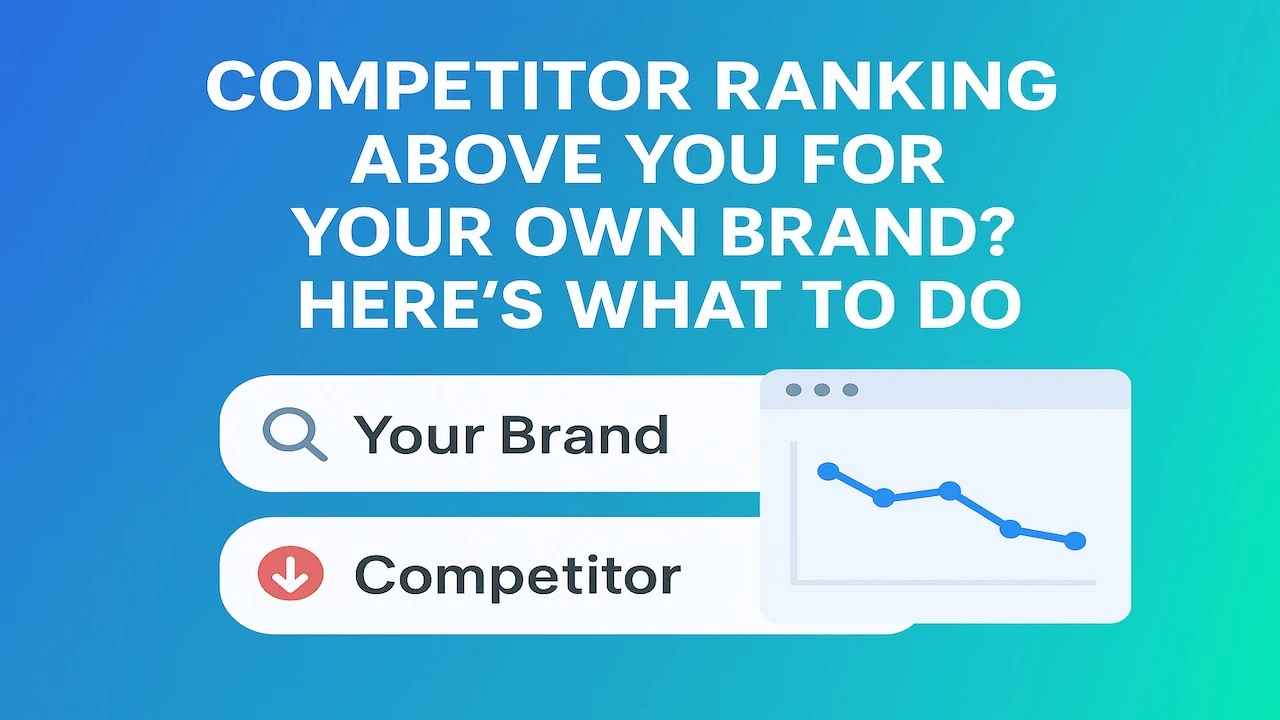
When a competitor ranks above you for your own brand name, take 3 immediate actions: launch a brand defense campaign in Google Ads, complete your Google Business Profile, and add Organization schema to your homepage. These 3 moves send Google clear brand ownership signals within days. The root cause is almost never competitor strength. It is almost always weak or missing brand identity signals on your own site. Quick Digital has run brand SERP recovery plans for over 60 mid market brands since 2014. In 22 of those 60 audits, at least one competitor was actively bidding on the brand keyword. This guide gives you the exact fix for every version of that problem.
Branded traffic converts at 2 to 5 times the rate of generic traffic. Losing even 20% of those clicks means branded traffic lost to a competitor, which is money leaving your pipeline every day. Branded searches make up about 44% of all Google queries, according to SE Ranking data. Competitor stealing brand traffic is not a minor SEO inconvenience. It requires paid, technical, and off page responses working together.
Why a Competitor Outranks You for Your Own Brand Name
Google does not give brand owners automatic ranking priority in organic search results. Google ranks pages on relevance, authority, and user experience signals. A competitor with stronger brand signals for your exact branded query will outrank you regardless of who owns the trademark. Brand name ranking competition plays out on Google’s terms, not trademark law. Branded search queries are navigational search queries. Users type your brand name with branded navigational intent, meaning they want to reach your specific site. Google still ranks the most signal-rich result first, not the brand owner automatically.
If your business name is not appearing in search results at all for branded queries, read our business name not ranking fix guide before applying the strategies below. For a broader brand ranking strategy, also see our company name ranking guide.
4 Root Causes of Branded Keyword Loss
- Weak on page brand signals: Your homepage title tag, H1, and meta description do not contain your brand name clearly within the first 40 characters, so Google cannot identify you as the authoritative source for your own branded query.
- Low domain authority: Directories, review platforms, or competitor sites carry more link equity than your domain currently does, giving them higher organic rankings for your own brand name.
- Missing brand entity signals: Google has not connected your domain to your business entity because Organization schema is absent or incomplete on your site, preventing Knowledge Panel brand card generation.
- Competitor ads blocking your organic result: Rival paid ads push your organic listing below the visible screen fold so most users never see your result on the page at all.
Directories like Trustpilot, G2, and Yelp routinely rank above brand owners for branded searches. These platforms carry domain authority scores of 70 to 90. Your domain may sit at 20 to 40. This gap is fixable through a combined paid, technical, and off page approach applied in sequence.
Brand SERP Audit: Run This Before Making Any Changes
Run this brand SERP audit before spending budget on paid search or link building, because fixing the wrong problem first wastes weeks and money. This audit covers your organic brand ranking position, brand identity signals Google reads from your pages, brand trust signals sent by your schema and GBP, brand equity online as measured by domain authority and external citations, and brand reputation online across directories and review platforms.
| Signal to Audit | Where to Check It | What to Look For |
|---|---|---|
| Brand name in title tag | Google Search Console or page source view | Exact brand name within the first 40 characters of the title |
| Google Business Profile completeness | Google Business Profile dashboard | 100% profile completion with photos, reviews, and hours |
| Organization schema presence | Google Rich Results Test tool | Valid Organization schema with brand name, logo URL, and sameAs links |
| Competitor paid ad presence | Incognito Google search for your brand name | Any competitor ads appearing above your organic result on the page |
| Backlinks with brand anchor text | Ahrefs or Semrush backlink report | Total links using your exact brand name as anchor text across the web |
| Internal links to homepage | Screaming Frog or Sitebulb crawl | All internal pages linking to homepage using your brand name as anchor |
| Unlinked brand mentions | Google Alerts or Brand24 | Mentions you can convert to backlinks with a simple outreach email |
Run this brand SERP audit every quarter. Track your brand search volume monthly in Google Search Console to catch any drops in branded demand that signal a competitor is successfully diverting navigational traffic. Use our SEO checklist to run a complete version of this audit before starting any off page or paid campaign.
Fix On Page Brand Signals First
Your homepage and core brand pages must send unmistakable brand ownership signals to Google before any paid or off page work takes effect. Fix these 5 on page elements in week 1, starting with your brand name title tag, which is the strongest single signal Google reads. These cost nothing and produce measurable ranking movement within 4 to 8 weeks of consistent implementation.
5 On Page Elements That Control Brand Rankings
| On Page Element | Action to Take | Why It Fixes Brand Rankings |
|---|---|---|
| Title Tag | Place your exact brand name within the first 40 characters | The strongest single on page brand relevance signal Google reads |
| H1 Tag | Include your brand name or branded tagline as the primary heading | Reinforces topical relevance for navigational branded search queries |
| Meta Description | Include your brand name and a value statement under 155 characters | Higher click through rate on branded results signals quality back to Google |
| Logo Alt Text | Use your exact brand name as the alt attribute on your logo image | Sends brand keyword relevance through image context signals on every page |
| Footer NAP | Include your full legal brand name, address, and phone in footer text | Builds NAP consistency and brand entity recognition across all indexed pages |
NAP consistency brand data is the most overlooked factor in branded keyword recovery. If your legal name on Google Business Profile, your homepage title tag, and your schema markup all use different versions of your brand name, Google cannot build entity confidence for your brand. Your entity confidence brand score drops when sources conflict, which delays or blocks Knowledge Panel generation entirely. Use one exact form everywhere without variation.
Organization Schema for Brand Entity Recognition
Without Organization schema brand signals on your homepage, Google must guess at your brand entity, and competing signals from rivals can override yours in the Knowledge Graph. Schema markup tells Google who you are, what you do, and where to find you across the web. Add these properties at minimum:
- @type: Organization or LocalBusiness for location-based brands
- name: Your exact brand name as it appears everywhere else online
- url: Your canonical homepage URL without parameters
- logo: Direct URL to your brand logo image file
- sameAs: URLs to your LinkedIn, Facebook, Twitter, YouTube, and Crunchbase profiles
- foundingDate: The year your business was established
- contactPoint: Phone number, email address, and contact type field
The sameAs schema brand properties link your website to your social profiles and create a brand entity cluster that Google reads when generating your Knowledge Panel brand card. Google Business Profile brand data feeds directly into that Knowledge Panel as the primary local entity source. Read the full schema markup implementation guide for ready-to-use code templates and the knowledge panel optimization guide to build the full entity signal stack that protects your brand SERP long term.
Internal Link Authority for Brand Dominance
Every page on your site should link to your homepage using your brand name as anchor text. This internal link strategy points homepage authority for branded search queries directly to Google’s crawlers. Add your brand name as the clickable anchor on your site-wide header logo link. Link from blog posts to your homepage with “by [Brand Name]” in context. Point service pages and about pages to your homepage with your exact brand name. Internal links cost nothing and deliver measurable ranking improvement within 4 to 8 weeks of consistent implementation.
Brand Defense Campaign: Paid Search Protection in 24 Hours
Paid search brand protection is the fastest tool available when a competitor outranks you for your own brand name. Organic ranking recovery takes 8 to 26 weeks. A brand defense campaign activates in one day and immediately places your brand above competitor results in the paid row. Competitors bidding on your brand name pay $3 to $8 per click on average. You pay less for the same position because your Quality Score is higher as the brand owner. This structural cost advantage means you can outbid rivals without inflating your ad budget. Set up a brand defense campaign in Google Ads the same day you find a competitor above your brand in search results.
Brand Defense Campaign Setup Steps
- Create a separate campaign named “Brand Defense” for clean, isolated conversion tracking. Keep brand data separate from general campaign performance from day one.
- Target your exact brand name, common misspellings, and your brand name plus service variations in the same ad group.
- Write ad copy with your exact brand name in Headline 1. This signals brand ownership directly in the ad unit where users make their first decision.
- Set your bid strategy to Target Impression Share at 95 to 100% at top of page. Your Quality Score brand campaign advantage as the brand owner means you pay less per click than competitors bidding on your same keyword.
- Send the ad to your homepage or the most relevant conversion page for the search query that triggered the ad.
- Run Auction Insights Google Ads report on your brand campaign weekly. Auction Insights shows which competitors appear in the same auctions, their impression share on your branded queries, and how often they rank above your own ads.
- Track brand defense conversions separately so you can measure the exact revenue impact of protecting your branded traffic.
For a complete paid search setup, our PPC management service builds brand defense campaigns alongside broader paid search strategy so both layers work together from the first week.
How Competitors Target Your Brand in Paid Search
Modern competitor brand bidding uses 3 tactics that are harder to catch than simple keyword targeting. Brand modifier targeting extends beyond your exact brand keyword: competitors bid on “[Your Brand] alternative,” “[Your Brand] pricing review,” and “[Your Brand] vs competitors” to intercept lower-funnel research queries from buyers already aware of your brand. Dynamic Keyword Insertion allows competitors to use your brand name automatically in their ad headline without explicitly naming you in keyword-level ad copy, bypassing trademark restrictions. Competitor landing pages that mirror your brand search context, such as a page titled “Looking for [Your Brand]? Try Us Instead,” rank organically for brand adjacent queries and capture users before they reach your site. Each tactic needs a different counter-strategy in your brand defense action plan.
When to File a Trademark Complaint
Google enforces trademark rules in ad copy but not in keyword targeting. A competitor can legally bid on your brand name as a keyword. They cannot legally use your brand name inside their actual ad text without your permission. Submit a trademark complaint through Google’s official trademark complaint form if a competitor uses your exact brand name in their ad headline or description copy. Trademark complaint Google Ads restrictions can limit what they are allowed to write, though they rarely remove competitor ads entirely. Your most reliable counter is running your own brand campaign so you appear first regardless of their keyword strategy.
Google Business Profile Optimization for Branded Searches
Google Business Profile brand optimization directly influences your brand ranking in Google Maps, the local pack, and standard organic results for your company name. A profile at 100% completion ranks higher than one at 60% completion with all other signals being equal. Research shows 82% of shoppers rely on Knowledge Panel information and customer reviews to make purchasing decisions. Your GBP feeds that panel directly. Businesses with 10 or more reviews and a rating above 4.0 stars receive a prominent Knowledge Panel in branded search results, which pushes all competitor listings further down the page.
9 Steps for Full Google Business Profile Completion
- Verify your business through Google’s official verification process before making any other GBP changes.
- Enter your exact legal business name matching your website homepage and schema markup precisely, with no variation.
- Select 1 primary business category and up to 9 secondary categories that match your actual services.
- Add your complete address or a clearly defined service area with geographic boundaries.
- Include your primary phone number and homepage website URL in every available field.
- Upload at least 10 high quality photos of your team, products, or business premises.
- Write a 750-character business description with your brand name appearing in the first sentence.
- Add your products or services with individual descriptions and pricing where available.
- Reply to every customer review within 48 hours to signal active business management to Google.
Read the complete Google Business Profile optimization guide for the full category selection walkthrough and GBP posting cadence that signals activity to Google consistently.
Off Page Brand Authority: Build Signals Google Trusts
Off page brand authority signals tell Google your brand is real, prominent, and deserving of the top branded search position. These signals take longer to build than on page fixes, but they create a lasting competitive moat that becomes harder for rivals to breach over time.
Brand Mentions and Co-Citations
Every time a trusted website mentions your brand name, Google receives a brand prominence signal. These unlinked brand mentions are called co-citations, and they contribute to brand entity strength even without a hyperlink attached. Build brand co-citations through press releases on PR Newswire or Business Wire, industry directory listings that count as Crunchbase brand citations, brand citation building on sector-specific platforms, guest articles on industry publications that mention your brand name naturally in context, podcast appearances where the host says your brand name aloud on a recorded episode, and award submissions within your industry vertical.
Monitor brand mentions through Google Alerts brand monitoring. Google Alerts brand notifications catch new mentions within hours. Also use Mention.com or Brand24 as brand monitoring tools that track mentions across platforms Google Alerts misses. Convert unlinked mentions to backlinks by contacting the publishing site owner directly. Read our brand mentions vs backlinks SEO guide for the full data on which signal type carries more weight for branded search rankings.
High-Authority Backlinks for Brand Dominance
Brand anchor text backlinks send the strongest off page brand ranking signal to Google, and building domain authority through these links is how you close the gap against high authority directories over 12 to 24 months. Target sites with domain authority above 50 for maximum brand equity transfer per link. Priority targets include core business directories like Apple Maps and Bing Places, social platform profiles including LinkedIn company page and YouTube channel page, industry associations and chamber of commerce listings in your region, and local newspaper and regional publication features that mention your brand name in exact form. See our backlink outreach service for systematic high authority brand link building. Pair this with the EEAT trust and authority guide to align your link strategy with Google’s Search Quality Rater Guidelines.
When a Directory Outranks Your Brand Website
Directories like Yelp, Trustpilot, Clutch, and G2 rank above brand websites because they carry domain authority scores of 70 to 90. Outranking them on organic alone in the near term is not a realistic goal for most brands with domain authority below 40. Use these 5 strategies when a directory outranks your brand:
| Strategy | What It Does | Timeline |
|---|---|---|
| Run paid ads above the directory result | Your brand ad appears before the organic directory listing so visitors see your brand first on the page | Active within 1 day |
| Claim and optimize your listing | Visitors who click the directory result still reach your business information and can convert there | Same day |
| Build domain authority through link acquisition | Close the domain authority gap to 60 or above through systematic backlinks | 12 to 24 months |
| Grow your reviews on the directory | Strong ratings on Yelp or Trustpilot bring customers to you even through a third-party page | 2 to 6 months |
| Win featured snippet positions above the directory | Create content that answers brand related questions to claim positions above organic directory results | 8 to 16 weeks |
Directories rarely disappear from branded SERPs permanently. Win the paid position, win the directory listing itself, and win the organic result directly below it. Three positions across the same SERP beat waiting for one perfect organic slot.
Branded Content Strategy to Control Your SERP
A single homepage cannot control your entire brand SERP. Build a branded content ecosystem where multiple pages from your own domain occupy positions 1 through 5 for your brand name search. Each additional branded page you publish competes for those positions directly.
Competitor Comparison Page SEO
Competitor comparison page SEO is one of the most effective ways to reclaim brand SERP position for question-based queries about your brand. Create a comparison page targeting “[Your Brand] vs [Competitor Name]” as the primary topic when a specific competitor consistently appears for your branded queries. Research shows the brand that publishes its own “vs” page first consistently outranks competitor comparison pages within 90 to 180 days. Make this page credible by acknowledging competitor strengths honestly. Users trust balanced comparisons far more than one sided pages. Show clearly where your solution wins for specific use cases. Include a side by side comparison table with features, pricing tiers, and support response times. One comparison page captures “[Your Brand] vs [Competitor],” “[Competitor] alternatives,” and “[Competitor] reviews” simultaneously, producing ranking across 3 to 5 different search intents at once.
Branded Resource and FAQ Pages
Each blog post, case study, or resource page that includes your brand name becomes a separate indexed page competing in your brand SERP. Content types that build brand SERP dominance include case studies showing your brand helped a specific client type achieve a measurable result, service pages named “[Brand Name] [Service] for [Target Industry],” team pages with your brand name in the H1, press pages showing your brand recognized by named publications, and FAQ pages targeting “[Brand Name] pricing,” “[Brand Name] reviews,” and “[Brand Name] vs [Competitor].” Aim for at least 10 brand-focused indexed pages to start dominating your brand SERP effectively against competitors in your category.
Brand Entity Signals for AI Search and Knowledge Panels
AI search engines like ChatGPT, Perplexity, Google Gemini, and Bing Copilot surface brand information from their training data and live search index. When your brand entity is unclear or inconsistently defined across sources, AI engines either ignore you or pull inaccurate information. AI Overview adoption on brand queries runs at 18 to 25% and is rising. Brand name hijacked by competitor situations worsen when AI engines pull competitor-favorable content because your entity signals are weak.
Build consistent brand entity signals across Wikipedia brand authority pages, Wikidata brand entity pages, and your website’s About page so all 3 sources align. Add sameAs schema links connecting your website to every official social profile and directory listing you own. Publish an authoritative About page that answers “who founded [Brand Name],” “what does [Brand Name] do,” and “where is [Brand Name] located” in plain factual language. Get cited in third-party content on high authority sites so AI engines have multiple independent sources confirming the same brand facts. Apply our semantic SEO and entity optimization approach to build clear topical signals around your brand name and core service areas.
For full AI search coverage, read the generative engine optimization guide and the Google AI Overviews optimization guide to make your brand the cited source when users search your brand name and a summary box appears above organic results.
Recovery Timeline: What to Expect at Each Phase
Results depend on your domain age, current domain authority, and how aggressively the competitor targets your brand name. Businesses with newer domains or domain authority below 20 should expect the longer end of each phase range. Established sites with domain authority above 40 and complete on page optimization typically see organic improvement within 8 to 16 weeks of applying Phase 2 changes.
| Phase | Timeframe | Actions to Take | Expected Outcome |
|---|---|---|---|
| Phase 1 | Day 1 to 7 | Launch Google Ads brand defense campaign and run full brand SERP audit | Paid ads appear above all competitor results immediately |
| Phase 2 | Week 1 to 4 | Fix title tags, H1, meta descriptions, add Organization schema, update internal links | Google begins re-crawling and re-evaluating your brand signals |
| Phase 3 | Week 4 to 12 | Build GBP reviews, clean local citations, complete all GBP fields | GBP ranking improves, organic result moves up 2 to 5 positions |
| Phase 4 | Week 12 to 26 | Launch backlink campaign, publish branded content, create comparison pages | Organic position 1 to 3 becomes realistic for primary branded query |
| Phase 5 | Ongoing quarterly | Brand SERP audits, competitor monitoring, content expansion | Sustained brand SERP dominance with suppressed competitor visibility |
5 Mistakes That Keep Brands Stuck Below Competitors
After 10 years of brand SERP recovery work, Quick Digital sees the same 5 mistakes causing brands to stay stuck below competitors for their own brand name.
- Relying only on organic while ignoring paid search: Organic takes months. Paid search takes one day. Use both layers together from the start and never let competitors hold the top ad slot while you wait for organic to recover.
- Assuming Google already knows who owns the brand: Google does not assume anything. Send explicit, consistent brand signals on every indexable page. Schema markup and NAP consistency are the proof Google needs to confirm your brand entity.
- Leaving Google Business Profile incomplete: An incomplete profile directly causes branded search visibility loss. Fill every available field before any other off page work begins.
- Waiting for competitors to stop targeting your brand: Competitors will not stop unless you make it unprofitable. Fight back by outranking them in paid and organic simultaneously to reduce their return on every click they buy at your expense.
- Not monitoring the brand SERP regularly: New competitors and directories appear constantly. Weekly monitoring stops competitor poaching brand visitors from becoming a months-long revenue drain.
Weekly Brand SERP Monitoring Checklist
Brand SERP management is not a one time fix. Competitors adjust their tactics, directories update their content, and Google’s algorithm shifts regularly. Monitor your brand SERP every week to catch new threats before they cost you branded traffic.
- Organic position for your brand name: Use Google Search Console or a rank tracking tool to see your current position without browser personalization bias. Check every Monday morning in incognito mode.
- Competitors on page 1: Note which sites rank in positions 1 to 10 for your exact brand query. Record any new entrants from week to week.
- Paid ads above your organic result: Record which advertisers run brand bidding campaigns against your name and check Auction Insights for their impression share percentage.
- Brand query click through rate and branded keyword conversion rate: Find click through rate in Google Search Console under Search Analytics filtered by brand name. Track branded keyword conversion rate in Google Analytics to see how much branded traffic is actually converting.
- Featured snippet ownership: Confirm whether you or a competitor owns featured snippets for your brand name and brand related questions.
- Knowledge Panel accuracy: Verify your panel shows current and correct information including phone, address, logo, and business description.
Set up Google Alerts for your brand name and common misspellings. Google Alerts brand notifications are free and catch competitor content targeting your brand before it builds ranking momentum. Also set alerts for “[brand name] review,” “[brand name] alternative,” and “[brand name] vs” to catch comparison content before it gains traction. Combine brand monitoring with our full brand SEO services to protect brand rankings as part of a broader growth program.
Quick Digital · Brand SEO Since 2014
A Competitor Is Stealing Your Brand Traffic Right Now
Quick Digital builds brand SERP recovery plans that reclaim your branded search position through paid, technical, and off page signals working together. Get a free brand ranking audit built for your domain, your competitors, and your timeline.
No commitment. No hard sell. Just a clear audit of where your brand stands.
Competitor Ranking Above Brand Name: FAQs
Yes, completely legal. Google gives no automatic ranking priority to brand owners. A competitor with stronger authority signals will outrank you regardless of trademark ownership. Fix Organization schema, complete your GBP, and launch a brand defense campaign in parallel.
Paid ads place you in position 1 within 24 to 48 hours while organic work builds. Sites with domain authority below 20 need 16 to 26 weeks through organic alone. Sites above 30 typically see improvement within 8 to 12 weeks after fixing title tags and Organization schema.
Directories carry domain authority scores of 70 to 90 while your domain may sit at 10 to 40. You cannot outrank them on domain authority alone. Run paid ads above the directory result, claim and optimize your listing, and close the authority gap through systematic backlinks.
You cannot stop competitors from bidding on your brand name as a keyword. Google allows it. File a trademark complaint if they use your brand name in ad text. Run your brand defense campaign with Target Impression Share at 95 to 100% and check Auction Insights weekly for competitor impression share data.
Launch a brand defense campaign in Google Ads today. It activates within 24 hours. In parallel, add Organization schema with sameAs links to your homepage and complete your Google Business Profile to 100%. These 3 actions produce the fastest measurable brand SERP improvement available without waiting for organic to compound.