
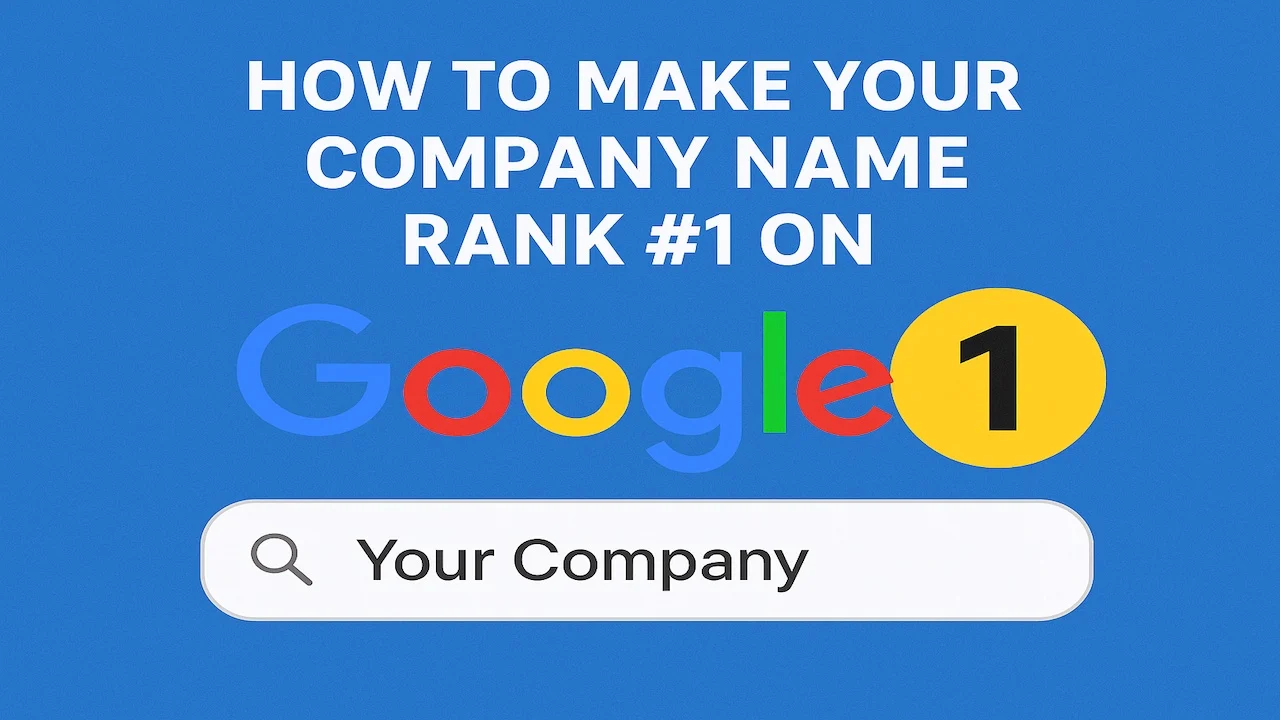
To make your company name rank 1 on Google, send consistent brand entity signals. Match your domain to your brand name. Add Organization schema markup. Complete your Google Business Profile. Build 15 to 25 NAP consistent citations. Earn brand anchor text backlinks. Most businesses reach position 1 for their brand name within 3 to 6 months using this approach. QuickDigital has run this exact process for clients across 15+ industries since 2014.
Your company name is the one keyword you should own by default. Getting your company name to rank 1 on Google is the same as making your brand name rank 1 on Google. The goal and the process are identical. If a competitor or directory ranks above you for your own brand name, one or more signals are missing. This guide tells you exactly which signal is missing in your case. It tells you what to fix first. It gives you the correct order for the fastest result.
Why Your Company Name Is Not Ranking 1 on Google
Every navigational search for your brand name should send the user directly to your website. When your brand name is not ranking on Google, it costs you every potential customer who searches for you by name. A brand name not ranking in position 1 is a direct revenue leak. When your brand name is not ranking on Google in position 1, one specific signal is always missing. Before fixing anything, identify your exact scenario. Each scenario requires a different first action. Applying the wrong fix wastes weeks and sometimes makes the problem worse.
| Scenario | Symptom You See | First Action Required |
|---|---|---|
| No Google indexing | Your site does not appear at all when you search your brand name | Submit your sitemap in Google Search Console and request indexing on your homepage URL |
| Domain does not match brand | Your domain is something generic while your brand name is different | Add brand name in title tag, H1, first paragraph, and logo alt text across all pages |
| No brand entity signals | A directory or social profile ranks above your website | Add Organization schema, complete Google Business Profile, and build 15 citations |
| Competitor targeting your brand | A competitor’s comparison or review page ranks above you for your name | Build your own brand comparison, reviews, and pricing pages immediately |
| Common or shared brand name | A different company with the same name outranks you | Add a geo modifier or industry modifier to your brand name across all touchpoints |
| Google penalty active | Your site ranked before and then dropped suddenly | Run a toxic link audit in Google Search Console and disavow harmful links |
Use our why your business name is not ranking guide for a deeper diagnostic. Run it before moving to the steps below.
The 10-Minute Brand SERP Audit You Need to Run First
Before changing anything on your site, run this audit. It tells you exactly what you are working with right now.
How to Search Your Brand Name Correctly
Open a private or incognito browser window. Sign out of all Google accounts. Search your exact company name. Do not add your city, service, or any other qualifier. The result you see in position 1 is your current baseline.
Signed-in Google accounts show personalized results. Those results hide your true brand ranking from visitors who have never heard of you. The incognito result is what a new potential customer sees.
5 Things to Check in Your Brand SERP
- Your website homepage in position 1 or 2 (the primary goal)
- Your Google Business Profile appearing as a local panel or branded knowledge card on the right side
- Your LinkedIn, Facebook, or YouTube profiles in the top 5 results
- Any directory listing such as Clutch, Justdial, or Yelp above your homepage
- Any competitor page or review site using your brand name in its content or title
Then open Google Search Console. Go to Performance then Queries. Filter by your company name. A reading of 0 impressions means Google is not indexing your site. It may also mean Google is not showing it for that query. Run a site:yourdomain.com search to confirm your pages are indexed. An un-indexed site cannot rank for its own name.
Use the free SEO tools in this guide to run a brand ranking check. See which pages rank for your brand name without paying for a premium tool.
Step 1: Place Brand Signals Across Your Website
Google reads your website to confirm which brand the site represents. Your company name must appear in specific, high-weight locations to pass this confirmation check. This step takes under 2 hours and affects every page on your site instantly.
Brand Signal Placement Checklist
- Your company name in the first paragraph of your homepage, before the 100-word mark
- Your company name in at least 1 H2 heading on your homepage
- Your company name in the page title tag and meta description on all key pages
- Your logo file renamed to companyname-logo.png before uploading
- Your logo alt text set to “CompanyName logo” not just “logo”
- Your company name in the About page headline and opening paragraph
- Your company name in the footer copyright text and footer navigation label
The logo file name matters more than most people realize. Your logo appears on every page of your site. It appears 30 to 50 times in a single crawl. Each instance adds another brand name confirmation without adding visible text to the page. Rename the file before re-uploading it.
Create Brand Specific Supporting Pages
Supporting pages targeting branded search variations fill more top 10 positions with your content. They also push competitor pages and negative results further down your brand SERP.
Build these 5 pages for your brand name:
- About [Company Name]: Company history, founders, mission, and team in 800+ words
- [Company Name] Reviews: Verified client testimonials, star ratings, and case study results
- [Company Name] vs [Competitor Name]: Factual comparison with a clear advantage summary
- [Company Name] Pricing: Transparent pricing tiers or service packages
- [Company Name] Services: One dedicated page per core service mentioning your brand name naturally
Each page should mention your brand name 3 to 5 times organically. These pages rank for branded variation queries like “[brand] reviews” and “[brand] pricing.” Both carry strong commercial and transactional intent.
Step 2: Add Organization Schema Markup
Organization schema is the most direct technical signal you can send to Google’s Knowledge Graph. It confirms your brand identity to Google. Without it, Google must infer your entity from surrounding signals alone. Schema removes that guesswork and accelerates entity recognition by 40 to 60 days on average.
Add this JSON-LD block to your homepage. Replace the placeholder values with your actual company data:
<script type="application/ld+json">
{
  "@context": "https://schema.org",
  "@type": "Organization",
  "name": "Your Company Name",
  "url": "https://yourcompany.com",
  "logo": "https://yourcompany.com/yourcompanyname-logo.png",
  "foundingDate": "2014",
  "@id": "https://yourcompany.com/#organization",
  "description": "A factual description of what your company does.",
  "sameAs": [
    "https://www.linkedin.com/company/yourcompany",
    "https://www.facebook.com/yourcompany",
    "https://www.youtube.com/yourcompany"
  ]
}
</script>
The sameAs array connects your website to your social profiles inside Google’s Knowledge Graph. This cross-link is required for Knowledge Panel eligibility. Validate your schema at Google’s Rich Results Test before publishing. Invalid schema provides zero benefit. It can be worse than no schema at all.
For deeper technical implementation, follow our schema markup implementation guide. It covers both Organization and LocalBusiness schema for your specific business type.
Step 3: Complete Your Google Business Profile
Google Business Profile is the fastest single action to confirm your brand as a real, verified entity. Google adds your business to its database within 2 to 4 weeks of verification. A complete, verified profile with photos and reviews pushes your brand above organic position 1. This appears as a branded knowledge panel on desktop results. This confirmation typically appears within 2 to 4 weeks of verification.
7 Required Fields for Brand Ranking
- Business name matching your website domain and schema exactly with no variations
- Complete address and phone number, or service area for fully remote businesses
- Accurate primary category and up to 9 secondary categories
- Website URL pointing directly to your homepage
- Business description of 200+ characters that includes your company name naturally
- Business hours with holiday updates applied regularly
- Minimum 10 high-resolution photos of your team, office, products, or completed work
Photo File Naming for Brand Signals
Rename every photo before uploading to your Google Business Profile. Use formats like companyname-team.jpg and companyname-office.jpg. Google reads image file names as entity signals. Named files add additional brand mentions across your profile without requiring text edits.
Respond to every Google review within 48 hours. Mention your company name naturally in each response. Businesses with more than 20 reviews and active response patterns rank higher for brand name queries in local results. Active review engagement also signals to Google that your business is operational. This is a secondary ranking factor for brand name searches.
Our detailed Google My Business optimization guide covers the complete GBP audit process with field-by-field setup instructions.
Step 4: Build NAP Consistent Brand Citations
Brand citations are third-party mentions of your company name, address, and phone number. Google uses citation consistency across multiple authoritative sources to verify your brand as a real, confirmed entity. Even 1 name variation reduces entity clarity.
“Quick Digital,” “QuickDigital,” and “Quick Digital LLC” are treated as 3 separate entities by Google’s matching algorithm. Pick 1 exact name format and apply it everywhere before building any new citations. Audit existing listings and correct any variations first.
| Platform | Priority | Brand Signal It Builds |
|---|---|---|
| Google Business Profile | Critical | Direct entity confirmation, branded SERP knowledge panel |
| Facebook Business Page | Critical | Social proof, brand mentions, Knowledge Graph link |
| LinkedIn Company Page | High | B2B authority, brand credibility, entity verification |
| Apple Maps | High | Mobile and Siri search brand visibility |
| Bing Places for Business | High | Bing organic brand ranking and Copilot brand data |
| Yelp | High | Local rankings, review signals, brand trust |
| BBB (Better Business Bureau) | High | Trust signals, verified business status |
| Crunchbase | Medium | Business entity data, Knowledge Graph source |
| Wikidata | Medium | Knowledge Graph entity node, AI engine citation source |
| Clutch or Trustpilot | Medium | Review authority, service brand credibility |
Target 15 to 25 consistent citations before expecting significant brand ranking movement. Complete 100% of each profile’s available fields. Profiles with complete data carry higher authority than partially filled ones on the same platform.
Step 5: Earn Brand Anchor Text Backlinks
Backlinks using your company name as anchor text send direct brand association signals to Google’s algorithm. A single link from a high authority industry publication can move your result from position 3 to position 1. The anchor text must use your brand name specifically. Brand anchor text backlinks are the most powerful single ranking accelerator for brand name queries. Brand anchor text backlinks are the most powerful single ranking accelerator for brand name queries.
3 Proven Sources for Brand Backlinks
Press releases and media coverage. Submit press releases about company milestones, product launches, or original research to PR wire services. Media outlets that cover your story link to your site using your brand name naturally. A mention in a major publication counts as both a citation and a high authority backlink.
Industry directories and association pages. Join relevant trade bodies, chambers of commerce, or industry associations. Member listing pages link to your website using your company name as anchor text. These links come from niche-relevant, trusted domains and carry strong entity confirmation signals.
Guest posts on authority blogs. Write useful, data-driven articles for authoritative sites in your industry. Author bio sections naturally include your brand name linked to your homepage. A portfolio of 10 to 15 guest posts builds brand anchor text diversity and domain authority simultaneously.
Avoid paid link schemes. Google detects unnatural link velocity and issues manual penalties that suppress your brand from position 1. Use our backlink outreach service or guest post outreach service to earn legitimate brand links at scale. This avoids risking a manual penalty.
Step 6: Claim and Optimize Social Media Profiles
Social media profiles appear in the top 5 search results for most brand name queries. Google treats them as high authority secondary verification signals for brand entities. Claim your brand name on every major platform even if you do not plan to post regularly. An unclaimed profile allows another user to register your brand name on that platform. This creates entity confusion and a potential SERP competitor.
- Use your exact brand name without abbreviations or variations as your profile name on every platform
- Link your website URL in the bio or About section of every platform
- Upload your brand logo as the profile picture on all platforms for visual consistency
- Write a detailed About description that includes your company name and core service
- Post at least 2 times per week on your primary platforms to maintain active status signals
- Cross-link your social profiles to each other in the About section where platforms allow
Connect your blog RSS feed to social profiles automatically. This keeps profiles updated with fresh content without manual work each day. Updated profiles send active-business signals to Google. Google prefers ranking active brands over dormant ones in brand name results.
Integrate your social activity with your broader social media marketing strategy. This builds brand recall alongside brand search authority at the same time.
When Your Brand Name Is a Common Word or Shared With Another Business
This is the hardest brand ranking scenario and the one most guides fail to address. If your company is named something like “Apex Consulting” or “Blue Sky Photography,” you compete with many other businesses using the same name. Google defaults to the business with the most seniority and strongest entity signals.
Three specific fixes apply to this scenario:
- Add a geo modifier. Update your title tag to “Apex Consulting Mumbai” or “Blue Sky Photography Chicago.” Apply the same modifier across your Google Business Profile, schema, and all social profiles. This creates a unique entity that Google can resolve without ambiguity.
- Add an industry modifier. If location is not a differentiator, use “[Company Name] | B2B CRM Consulting” in your title and H1 tags. Include the modifier in your Organization schema description and Wikidata entry.
- Build 30+ citations faster than competitors. Citation volume breaks ties between businesses with identical names. The business with more consistent, authoritative citations typically wins the navigational result.
If a competitor with the exact same name outranks you, read our brand competitor outranking guide. It covers the specific strategy for this scenario.
How Long It Takes to Rank Your Company Name on Google
Most businesses reach brand name position 1 within 3 to 6 months. This assumes all steps are implemented consistently. Businesses that launch with a brand-matched domain sometimes see position 1 within 4 to 8 weeks. Building citations immediately is required to hit that timeline. The exact timeline depends on 4 factors. These are domain age, competitor strength for your brand term, implementation speed, and content publishing frequency.
| Your Situation | Expected Timeline to Position 1 |
|---|---|
| New domain with immediate brand signals applied | 4 to 8 weeks |
| Existing domain with no schema or GBP | 2 to 4 months |
| Competitor actively ranking for your brand name | 4 to 9 months |
| Generic brand name competing with an established business | 6 to 12 months with modifier strategy |
| Google penalty suppressing brand results | 3 to 6 months after penalty removal |
Priority order for fastest results: Complete Steps 1 through 3 in week 1. Add Steps 4 and 6 in week 2. Start earning backlinks and publishing brand variation content pages in week 3. This sequence shows ranking movement within 4 to 8 weeks for most sites with no active penalty.
Brand Ranking in AI Search: ChatGPT, Perplexity, and Google Gemini
AI search platforms including ChatGPT, Perplexity, Google Gemini, and Bing Copilot pull brand data from the same entity signals. Making your brand visible in ChatGPT brand search results and Perplexity brand answers uses the same foundation as Google position 1 ranking. These are the same signals that power Google’s Knowledge Graph. Brands with consistent NAP data, Organization schema, and strong citation profiles appear in AI-generated answers when users ask about businesses in a given category. This is now a second brand visibility channel running in parallel to traditional Google position 1.
To make your company name appear in AI-generated brand answers:
- Maintain consistent brand data across all citation sources used by AI training sets, including Wikipedia, Wikidata, Crunchbase, and LinkedIn
- Structure your About page as an entity home with factual, verifiable statements about your company
- Use natural language definitions on your homepage such as “QuickDigital is a digital marketing agency founded in 2014 that helps businesses rank on Google and AI search platforms”
- Build topical authority through content that AI engines can cite as a source
Read our guides on Google AI Overviews optimization and how to rank your brand in ChatGPT. Our answer engine optimization guide covers extending your brand visibility beyond standard Google rankings.
5 Brand Ranking Mistakes That Block Position 1
These mistakes appear consistently across businesses that struggle to rank their own company name. Fix any of these before expecting results from the steps above.
- Inconsistent business name formatting. Using “My Company,” “My Company LLC,” and “MyCompany” interchangeably across directories creates entity confusion. This fragments your entity in Google’s Knowledge Graph. Pick 1 exact format and apply it uniformly to every directory, social profile, schema block, and page. Even a period difference such as “My Co.” vs “My Co” counts as a variation.
- Thin homepage content. Homepages with fewer than 400 words rarely rank first for brand names. Google needs enough content to confirm what your brand represents. Write at least 600 words of substantive, brand-specific homepage copy. Answer who you are, what you do, who you serve, and why customers choose you.
- No brand-specific internal links. Internal links using your brand name as anchor text vote for your homepage. They work inside Google’s internal link authority system. Add brand name anchor text links from your blog posts, service pages, and case study pages to your homepage and About page.
- Duplicate directory listings. Multiple Google Business Profile listings or duplicate Yelp pages for the same business dilute authority and create entity confusion. Audit your existing directory presence before building new citations. Remove or merge duplicate listings on every platform where they exist.
- Duplicate content across pages. Pages that share near-identical content with other sites reduce Google’s confidence in your brand authority. Run a duplicate content audit before publishing new brand variation pages. Make sure each page adds unique, indexable value.
Monitor Your Brand Rankings in Google Search Console
Google Search Console includes a branded query filter in the Performance report. Use it to isolate all searches containing your company name. Track brand performance separately from non-branded organic traffic. Set this up as a regular monthly review, not a one-time check.
4 Metrics to Track Monthly for Your Brand Name
- Impressions: How many times Google showed your site for your brand name search
- Clicks: How many users clicked your result after seeing it in brand queries
- Average CTR: At position 1, branded CTR should exceed 40% for pure navigational queries
- Average Position: Target below 1.5 for full brand name SERP dominance
Set up Google Alerts for your company name to catch new brand mentions across the web. Each new mention using your exact company name is a potential citation and entity signal. Use Ahrefs or SEMrush to track which external pages rank for your brand name. Identify competitor pages you need to outrank with your own brand content.
For a complete monitoring setup, use the tools in our best free SEO tools for small businesses guide. Track brand rankings without a large monthly budget.
Brand SEO Services by QuickDigital
Your Company Name Should Rank 1 on Google Right Now
QuickDigital runs a free brand SERP audit that identifies every signal blocking your position 1. We deliver schema setup, citation building, and brand content strategy in one managed process. Clients see ranking movement within 4 to 8 weeks.
Free brand SERP audit. No obligation. Response within 24 hours.
Frequently Asked Questions
Complete your Google Business Profile, add Organization schema to your homepage, and build 15 consistent NAP citations in week 1. These 3 actions send the strongest entity signals. Most brands see ranking movement within 4 to 6 weeks when no active penalty exists.
The “competitor ranking for my brand” problem occurs when competitors publish “[Company] vs [Competitor]” comparison pages. Running Google Ads targeting your branded keyword also causes this. Build your own comparison and review pages immediately. Use our brand protection guide for the exact outranking strategy.
Build a minimum of 15 to 25 consistent NAP citations before expecting significant brand ranking movement. Prioritize Google Business Profile, Facebook, LinkedIn, Bing Places, and Apple Maps first. Inconsistent name formatting across even 3 to 4 directories delays recognition by 30 to 60 days.
Schema does not directly boost position rankings. It helps Google recognize your business as a verified Knowledge Graph entity, which activates Knowledge Panel eligibility. Brands with active Knowledge Panels hold a permanent branded panel above organic position 1. See our Knowledge Panel optimization guide for the full process.
You can achieve some social profile and directory rankings without a website. However, your website must serve as your primary brand ranking asset for position 1. Even a basic 5-page site with Organization schema and an About page outperforms directories alone. Consistent NAP data across all pages is required. Build the site first, then implement all steps above.