



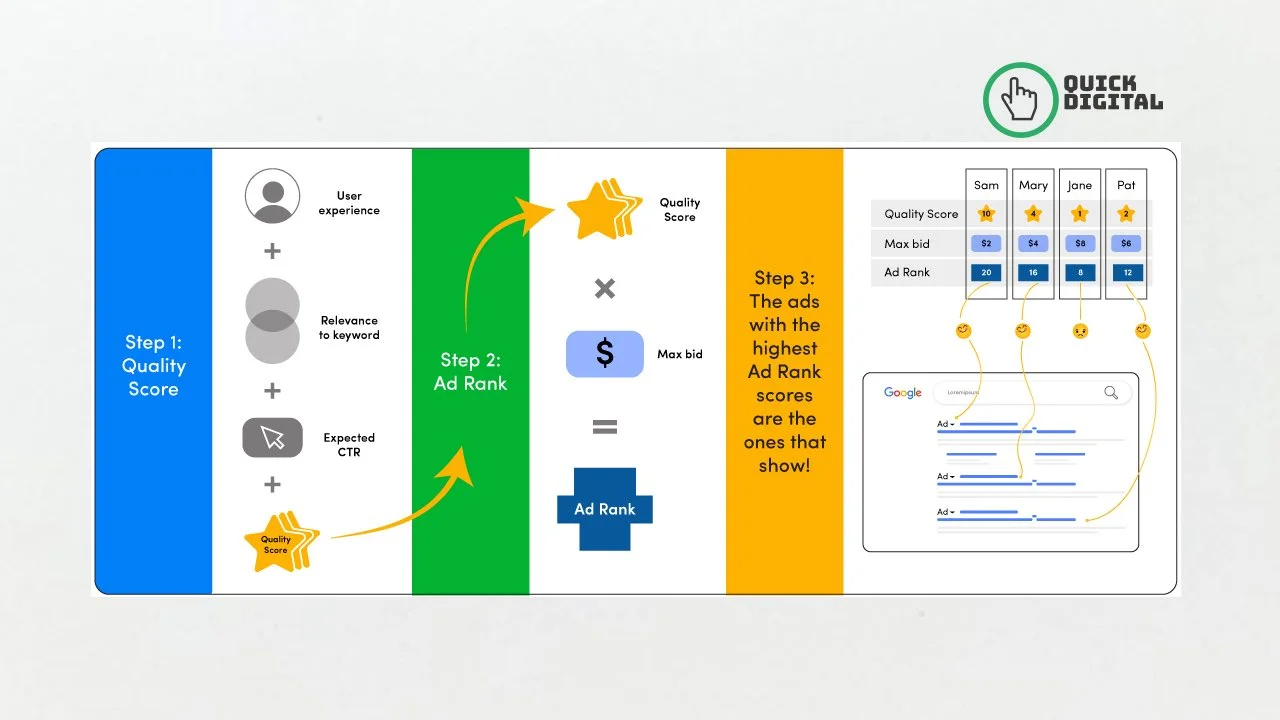
Ad ranking is the real-time scoring system Google runs in every paid search auction to decide two things: whether your ad appears at all, and exactly where it shows on the search results page relative to every competing advertiser. Google recalculates your ad rank score from scratch for every single search query in milliseconds. That score controls your ad position, your click volume, and how much you pay per click.
Most advertisers believe the highest bid always wins the top spot. That belief costs them money every day. A $3 bid with a Quality Score of 9 regularly beats a $7 bid with a Quality Score of 4. Ad ranking rewards relevance and user experience just as heavily as bid amount. Understanding this system is the difference between an ad campaign that generates leads efficiently and one that burns budget for poor results.
At Quick Digital, we have managed PPC campaigns since 2014 across competitive industries. The advertisers who consistently win top ad positions are not the ones with the largest budgets. They are the ones who understand what actually drives ad ranking.
Ad Ranking vs Ad Position: What Each Term Means
Ad rank is the score Google calculates behind the scenes. And Ad position is the visible placement result of that score on the search results page. These two terms describe different things, though most people use them interchangeably.
Ad position 1 places your ad above all other paid results. Ad position 4 places it fourth. Google shows up to 4 ads above organic results and up to 3 ads at the bottom of the page. Your ad rank score determines which slot you receive, if any.
Ad ranking also controls eligibility. When your combined bid and quality signals fall below Google’s minimum threshold for a given position, your ad does not show at all, regardless of your daily budget. This is why some advertisers with large daily budgets still generate zero impressions.
In pay per click (PPC) advertising, your ad rank score gets compared against every other advertiser competing for the same search query at that moment. The advertiser with the highest ad rank wins position 1. The next highest wins position 2, and so on down the page until the threshold minimum cuts off further placements.
The 6 Factors Google Uses to Calculate Ad Ranking
Google officially uses 6 factors to calculate ad rank in every auction. Each factor shifts your score in real time during every single search query that triggers your keyword.
| Ad Rank Factor | What Google Measures | Your Direct Control |
|---|---|---|
| Maximum CPC Bid | The most you will pay per click on this keyword | 100% |
| Quality Score (1 to 10) | Expected CTR, ad relevance, landing page experience | High |
| Ad Rank Threshold | Google’s minimum quality floor per position | 0% (Google sets this) |
| Auction Competitiveness | How many advertisers compete for the same query | 0% (market driven) |
| Search Context | Device, location, time of day, search history | Partial via targeting |
| Expected Asset Impact | Predicted CTR boost from sitelinks, callouts, snippets | 90% |
These 6 factors work together, not independently. Improving only your bid without addressing Quality Score produces expensive, short-lived results. Optimising all 6 simultaneously is what builds sustainable ranking gains at lower costs per click.
Factor 1: Maximum CPC Bid
Your maximum CPC bid tells Google the most you will pay for one click. This sets your ceiling in the auction but does not guarantee top ad placement on its own. Google multiplies your bid with quality signals. A higher bid combined with a low Quality Score still loses to a moderate bid with a strong Quality Score.
Setting the right bid matters far more than setting the highest bid. Start with manual CPC bidding to collect baseline performance data. After accumulating 30 or more conversions, shift to smart bidding strategies like Target CPA or Target ROAS to let Google optimise bids in real time.
Factor 2: Quality Score (1 to 10 Scale)
Quality Score is Google’s visible rating of how relevant and useful your ad is compared to competitors targeting the same keyword. Accounts with Quality Score 8 pay up to 37% less per click than accounts at Quality Score 5 bidding the same amount. Accounts at Quality Score 4 pay a 25% CPC premium. And Accounts at 1 to 3 pay 50 to 100% more per click and still rarely appear in premium positions.
Quality Score combines 3 specific components, each carrying a different weight:
- Expected Click Through Rate (eCTR): Google predicts how likely users are to click your ad based on historical performance. This component carries roughly 39% of the Quality Score formula weight. It compares your CTR against other advertisers showing for the exact same keyword.
- Ad Relevance: This measures how closely your ad copy matches the intent of the search query. It carries roughly 22% of the weight. Google’s AI now evaluates semantic relevance, not just keyword repetition.
- Landing Page Experience: This evaluates how useful, fast, and relevant your page is after the click. It carries roughly 39% of the weight. Page load speed, mobile optimisation, content match, and navigation clarity all factor into this rating.
Each component gets one of 3 ratings: Above Average, Average, or Below Average. A keyword rated Below Average on all 3 components scores 1 to 3. A keyword rated Above Average on all 3 components scores 8 to 10.
Your landing page optimisation strategy directly controls the component that carries the same weight as eCTR. Most advertisers obsess over ad copy while ignoring the page experience that accounts for 39% of their Quality Score.
Factor 3: Ad Rank Thresholds
Ad rank thresholds are minimum quality floors that Google sets dynamically for each position on the page. Google does not publish these thresholds. They shift based on the query, device type, user location, and time of day.
Here is the critical point most advertisers miss: an ad eligible for position 4 can still fall below the threshold required for position 1, even after a significant bid increase. A keyword with very low impression share despite an adequate bid almost always signals a threshold block. The fix is improving quality signals, not raising the bid further. Raising a bid against a threshold block wastes budget without producing better results.
According to Google’s official documentation, ad rank thresholds vary by ad position, with top-of-page positions requiring the highest threshold scores. This protects users from seeing irrelevant ads in the most visible placements.
Factor 4: Auction Competitiveness
Your ad rank score does not exist in isolation. Google calculates it relative to every competing ad in each individual auction. When more advertisers bid on the same keyword, thresholds rise and maintaining your position costs more.
Use Google’s Auction Insights report to track competitor impression share, position above rate, and overlap rate. When a competitor reduces budget or pauses campaigns, you gain ranking opportunities without changing anything in your own account. Spotting these windows lets you capture additional impressions at your existing bids.
Factor 5: Search Context
Context signals shift your ad rank up or down based on who is searching, on what device, from where, and at what time. Google analyses the searcher’s device type, physical location, time of day, prior search history, and the nature of the specific query.
Your ad might rank position 1 on desktop in one city while simultaneously ranking position 4 on mobile in another city for the exact same keyword. These contextual adjustments happen automatically. Use geographic bid adjustments and device-level bid modifiers to concentrate budget where your conversions actually happen.
Factor 6: Expected Asset Impact
Ad assets (previously called ad extensions) include sitelinks, callout text, structured snippets, location information, price assets, and call assets. Google calculates the expected CTR lift that each active asset provides and adds that value directly to your ad rank score. Adding relevant assets improves your rank at zero additional cost per asset. This is the fastest available ad ranking improvement for most accounts.
The Ad Ranking Formula: How the Math Works
Google does not publish its full auction algorithm. The practitioner-standard formula based on Google’s documented mechanism is:
Ad Rank = Maximum CPC Bid x Quality Score x Expected Asset Impact + Ad Rank Threshold Adjustment
Here is how this plays out in a real head-to-head auction between two advertisers targeting the same keyword:
| Advertiser | Max Bid | Quality Score | Asset Boost | Ad Rank Score | Ad Position |
|---|---|---|---|---|---|
| Advertiser A | $3.50 | 9 / 10 | +12% | 35.3 | Position 1 |
| Advertiser B | $7.00 | 4 / 10 | 0% | 28.0 | Position 3 |
| Advertiser C | $5.00 | 6 / 10 | +8% | 32.4 | Position 2 |
Advertiser A wins position 1 while spending significantly less per click than Advertiser B. This happens because of how Google calculates actual CPC.
Your actual CPC equals the ad rank of the competitor directly below you, divided by your Quality Score, plus $0.01. So Advertiser A at Quality Score 9 pays a fraction of what Advertiser B pays at Quality Score 4, even though Advertiser B bids twice as much. Higher Quality Score directly reduces what you pay per click for every auction you win.
How Ad Ranking Affects What You Pay Per Click
Ad ranking and cost per click share a direct relationship that most advertisers underestimate. Google rewards higher quality ads with lower actual CPCs even at identical bid levels.
This table shows the CPC impact of Quality Score changes at the same maximum bid:
| Quality Score | CPC Impact vs QS 5 Baseline | Practical Effect |
|---|---|---|
| 10 / 10 | Up to 50% discount | Pay half as much for the same position |
| 8 / 10 | Up to 37% discount | Strong savings in top positions |
| 5 / 10 | Baseline | Standard market rate |
| 4 / 10 | 25% premium | Pay more for lower positions |
| 1 to 3 / 10 | 50 to 100% premium | Very expensive and rarely visible |
Also note: the CPC impact is not linear. Moving from Quality Score 7 to 8 produces more CPC savings than moving from Quality Score 5 to 6. The upper end of the scale delivers the most return on your optimisation effort.
Poor ad ranking traps accounts in a spending cycle. Low Quality Scores force higher bids to maintain any visibility. Higher bids drain budget faster, leaving less time and money for ad copy testing and landing page improvements. Quality Score stays low, CPCs stay high, and results stay poor. Breaking this cycle requires fixing quality signals first, before adjusting bids.
Managing PPC campaigns without addressing Quality Score is like trying to win a race with flat tyres. The engine (budget) is there, but the traction (quality) is missing.
Why Ad Ranking Matters for Every Click You Buy
Ad position directly controls how many users see and click your ads. Position 1 ads receive 50 to 60% more clicks than position 3 ads for the same keyword. Position 4 and below see major drops in both visibility and click volume.
Ad ranking also determines whether your ad qualifies to show at all. When your rank falls below Google’s dynamic threshold, your ad receives zero impressions regardless of your budget. Advertisers with large daily budgets still generate zero impressions when Quality Scores fall to 1 or 2 on their target keywords.
Higher ad ranks unlock greater asset visibility. Top-positioned ads show more sitelinks, callout text, and structured snippets, which increases CTR further. Better ranking generates more click data, which helps Google calibrate your eCTR prediction more accurately, accelerating Quality Score improvement over time.
Your ad ranking also affects your remarketing results. Ads shown in top positions generate more brand awareness, which improves performance across remarketing campaigns that follow up with previous visitors.
How to Improve Your Ad Ranking Without Raising Bids
Three areas produce the fastest ad ranking gains without requiring higher bids: ad copy relevance, landing page experience, and ad asset coverage. These three levers control the Quality Score components that carry the most formula weight.
Write Ad Copy That Earns a Higher Expected CTR Rating
Expected CTR carries 39% of your Quality Score weight. Ad headlines that include the exact keyword searched consistently earn higher eCTR ratings than generic alternatives. When someone searches “custom wedding invitations,” your headline should say “Custom Wedding Invitations,” not “Beautiful Wedding Stationery.”
Follow these 4 rules when writing search ad headlines:
- Place the target keyword in at least 1 of your 3 headline slots
- Include a specific number or offer, such as “Save 30%” or “24/7 Support”
- Match the headline to the searcher’s goal, not just the keyword
- Test at least 3 headline variations per ad group simultaneously
Responsive Search Ads (RSAs) allow up to 15 headlines and 4 descriptions per ad. Google automatically serves the combinations producing the highest CTR, which improves your eCTR component rating over time. In RSAs, Google’s AI now evaluates semantic relevance, so writing headlines that cover different angles of the same intent performs better than repeating the keyword 15 times.
Build Landing Pages That Win Google’s Above Average Rating
Landing page experience carries 39% of your Quality Score, equal to eCTR. A page that loads in under 2.5 seconds on mobile, matches your ad copy’s promise exactly, and shows a clear call to action above the fold earns an Above Average rating from Google.
Follow these 5 rules to protect your landing page experience rating:
- Load time under 2.5 seconds on a 3G mobile connection (test with Google PageSpeed Insights)
- Match the page headline to the ad headline word for word
- Place your primary call to action above the fold on mobile screens
- Remove unnecessary redirects, heavy third-party scripts, and large uncompressed images
- Build a dedicated page for each major keyword theme rather than one generic page for all ad groups
Dedicated landing pages improve Quality Score by 1.5 to 2.5 points on average versus generic pages. This translates to 25 to 40% lower CPCs and noticeably higher conversion rates for the same traffic.
Slow pages destroy both Quality Score and conversion rate at the same time. Read our guide to improving page load speed, as this single change often lifts Quality Score by a full point in 2 to 4 weeks.
Add Ad Assets to Boost Your Score for Free
Ad assets improve ad rank at zero additional cost because Google adds their expected CTR value directly to your rank score. Most advertisers leave this ranking improvement completely unused.
Here is the ad ranking and CTR impact of each major asset type:
| Asset Type | Ad Rank Benefit | Average CTR Lift | Setup Time |
|---|---|---|---|
| Sitelinks | High | 15 to 25% | 20 minutes |
| Callout Extensions | Medium | 10 to 15% | 10 minutes |
| Structured Snippets | Medium | 8 to 12% | 15 minutes |
| Location Assets | High for local queries | 20 to 30% | 5 minutes |
| Price Assets | Medium | 12 to 18% | 30 minutes |
Add a minimum of 6 sitelinks per campaign. Each sitelink should point to a high-value page such as your pricing page, reviews page, or a specific service page. Keep callout text under 25 characters and focus each callout on one specific selling point like “Free Consultation” or “Licensed and Insured.”
Location assets are particularly powerful for local businesses. When your ads show your address and phone number, users searching near you see a direct trust signal that lifts CTR significantly. Combine this with Google Business Profile optimisation to strengthen your local presence across both paid and organic results.
Tighten Keyword Targeting to Fix Ad Relevance
Ad relevance carries 22% of your Quality Score. Broad match keywords often trigger unrelated searches, which tanks eCTR and pulls your ad relevance rating into Below Average territory.
Use exact match for your highest intent keywords and phrase match for secondary terms. Group keywords into tight ad groups of 5 to 15 terms maximum. Each ad group needs its own specific ad copy and its own dedicated landing page.
Add negative keywords every week by reviewing your Search Terms report. Most PPC accounts waste 30 to 40% of their click budget on searches that never convert. Every irrelevant click lowers your eCTR and signals to Google that your ad does not match the query, reducing your ad rank in future auctions for that search.
Ad Ranking Across Different Google Ads Campaign Types
Ad ranking mechanics work slightly differently across Search, Shopping, Display, and Performance Max campaigns. Understanding these differences prevents misapplied optimisation tactics that work in one campaign type but backfire in another.
Search Campaign Ad Ranking
Search campaigns use the full 6-factor ranking formula with the heaviest emphasis on expected CTR. Users searching on Google arrive with clear intent, so ad copy that precisely matches that intent earns the highest eCTR ratings. Focus your optimisation effort here first. Search campaigns offer the most direct control over ranking outcomes.
Your content marketing strategy informs your ad copy strategy more than most PPC managers realise. The same intent signals that drive organic ranking decisions should guide how you write paid search headlines and descriptions.
Shopping Campaign Ad Ranking
Shopping ad ranking depends on product feed quality, bid amount, and historical CTR. Product titles must include specific details like brand, product type, colour, size, and model to rank competitively in Shopping auctions. A title like “Nike Air Max 270 Running Shoes Blue Size 10” outranks a title like “Blue Shoes” in every auction. Product image quality also affects Shopping ranking. White or neutral backgrounds, multiple angles, and high resolution images all contribute to better positioning and higher CTR.
Display Network Ad Ranking
Display campaigns prioritise image quality, animation clarity, and placement performance history. Placements with strong historical engagement metrics receive preference in subsequent display auctions. Google also evaluates whether your display ads clearly communicate their value and call to action. Our guide to display advertising covers how placement targeting and ad format quality affect your rank in the display network.
Performance Max Ad Ranking
Performance Max campaigns let Google’s machine learning select the ad format, placement, and bid for each impression. Advertisers provide creative assets, audience signals, and conversion goals. Google’s AI then allocates budget and bids to maximise performance against those goals. Visible Quality Score is less predictive in Performance Max because Google evaluates assets across formats simultaneously. Focus on asset variety and quality rather than keyword-level Quality Score in these campaigns.
Monitoring Your Ad Rankings: What to Track Every Week
Ad ranking changes daily based on competitor activity, seasonal demand shifts, and ongoing account performance signals. Weekly monitoring prevents small ranking drops from becoming expensive problems.
5 Metrics That Tell You Your True Ranking Health
- Impression Share: Shows what percentage of available auctions your ad appeared in. Below 70% signals missed ranking opportunities. Identify whether you lost share to budget or to rank.
- Absolute Top Impression Share: Shows how often your ad holds position 1. Below 30% signals a ranking problem that needs Quality Score or bid attention.
- Lost Impression Share (Rank): Shows how often poor ad ranking prevented your ad from showing. Fix this with Quality Score improvements, not budget increases.
- Lost Impression Share (Budget): Shows how often your budget ran out before all auctions completed. Fix this with budget increases or dayparting adjustments.
- Quality Score Trend: Track monthly changes per keyword. Declining scores signal ad copy fatigue or landing page issues that need immediate attention.
Set a weekly review of these 5 metrics. Catching a 10-point drop in absolute top impression share early prevents weeks of lost high-intent traffic.
Responding to Sudden Ranking Drops
When ad rankings drop suddenly, check these 4 causes in order:
- A new competitor entered your auction with a strong Quality Score
- An existing competitor significantly increased bids or budget
- Your landing page developed a technical issue affecting load speed
- A recent account change accidentally lowered bids, paused assets, or changed match types
Review Change History in Google Ads to identify accidental modifications. Run fresh ad copy A/B tests every 30 days. Even high-performing ads eventually see CTR decline as users become accustomed to the same message. Fresh creative keeps eCTR ratings strong, which sustains your Quality Score and ad ranking over time.
Your overall digital marketing SEO checklist and paid ad strategy share the same foundation: relevance signals and user experience always outperform raw spending.
Common Ad Ranking Mistakes That Cost You Money
These 4 mistakes drain ad ranking and budget every single day across thousands of Google Ads accounts.
Sending All Ads to One Generic Landing Page
Using one landing page for multiple ad groups destroys landing page experience scores because each keyword group represents a different user intent. Someone clicking an ad for “emergency roof repair” expects completely different content than someone clicking “roof replacement cost.” Match every major keyword group to its own dedicated landing page. Do not share pages across unrelated intents.
Ignoring Below Average Quality Score Ratings
Google shows each keyword’s Quality Score breakdown inside the Google Ads interface. Keywords rated Below Average on landing page experience or eCTR actively reduce your account-level quality signals and raise your CPCs across the entire account. Pause or delete keywords stuck at Quality Score 3 or below unless they generate high-value conversions that justify the cost premium. They drag down the performance of your healthy keywords while burning budget at inflated CPCs.
Skipping Mobile Optimisation
Mobile searches account for over 60% of paid search volume in most industries. Landing pages that load slowly or display poorly on smartphones receive reduced Quality Score ratings specifically for mobile queries. Test every landing page on real mobile devices monthly. A 1-second delay in mobile load time reduces conversions by up to 20%, according to Google’s own data. This directly harms your landing page experience rating and your ad rank for all mobile searches.
Using Bid Increases to Fix Quality Problems
Raising bids without addressing Quality Score issues produces fast results and faster burnout. You pay more per click but still lose to competitors with better quality at lower bids. Fix Quality Score first. Then use bid increases to scale what already performs efficiently. This order matters. Reversing it wastes budget and trains bad habits that become expensive to unlearn.
Running both paid and organic strategies? Our SEO fundamentals guide explains how organic ranking signals and paid ranking signals reinforce each other when aligned correctly.
Ad Ranking in AI-Powered Campaigns
Google’s AI features change how ad ranking works in Smart Bidding and Performance Max campaigns, but quality signals remain the foundation.
Smart Bidding strategies like Target CPA and Target ROAS analyse thousands of real-time contextual signals per auction, including device, location, browser language, time of day, and query context. These strategies consistently outperform manual bidding once accounts accumulate 30 or more conversions in a 30-day period. Below that data threshold, manual bidding gives you more control.
In Smart Bidding accounts, the visible Quality Score number becomes less predictive as a standalone metric because broad match queries fall outside the exact-match measurement window. Focus on the component ratings (Above Average vs Below Average) as a structural diagnostic rather than optimising the 1 to 10 number in isolation.
The same principles that apply to ad ranking also apply to how AI systems evaluate and cite your content. Understanding Google AI Overviews optimisation shows how relevance and authority signals affect both paid and organic visibility in AI-driven search results.
For businesses wanting full-funnel digital visibility, understanding how Generative Engine Optimisation connects to your paid strategy is the next step in building a search presence that works across all channels.
Quick Digital PPC Audit
Your Ad Budget Is Working Against You Right Now
We audit your Quality Scores, ad rank thresholds, and landing page ratings to show you exactly where you are losing money and what to fix first. Free. No obligation.
Get Your Free PPC AuditQuick Digital has helped businesses improve ad rankings and cut CPCs since 2014
Frequently Asked Questions About Ad Ranking
Ad ranking is the real-time score Google assigns to your paid ad in every search auction to determine whether your ad shows and where it appears on the page. Google calculates your ad rank score using 6 factors: your maximum CPC bid, Quality Score, expected asset impact, ad rank thresholds, auction competitiveness, and search context. Your score gets compared against every other advertiser in that auction. The advertiser with the highest score wins the top position.
Your actual cost per click equals the ad rank of the competitor directly below you divided by your Quality Score plus $0.01. This formula means a higher Quality Score directly reduces what you pay per click even if your bid stays the same. Accounts at Quality Score 8 pay up to 37% less per click than accounts at Quality Score 5 bidding the same maximum CPC.
Yes, consistently. A $3 bid with Quality Score 9 regularly outranks a $7 bid with Quality Score 4 because the Quality Score multiplier more than compensates for the bid difference. Google rewards relevance and landing page quality over raw bid amount. This is the core mechanism that makes Quality Score optimisation more valuable long-term than aggressive bidding alone.
Ad positions fluctuate because Google recalculates your ad rank for every single search query from scratch. Your position changes based on who else is bidding at that exact moment, the searcher’s device, location, time of day, and search history. These contextual factors shift independently of anything you control. This position variation is normal and expected in every Google Ads account.
Bid increases affect ranking immediately in the next auction. Ad asset additions improve ranking within 24 to 48 hours. Quality Score improvements from better ad copy and landing pages take 2 to 4 weeks as Google collects new performance data from your updated ads and pages. Sustainable ranking gains across all 6 factors typically take 60 to 90 days of consistent optimisation.