

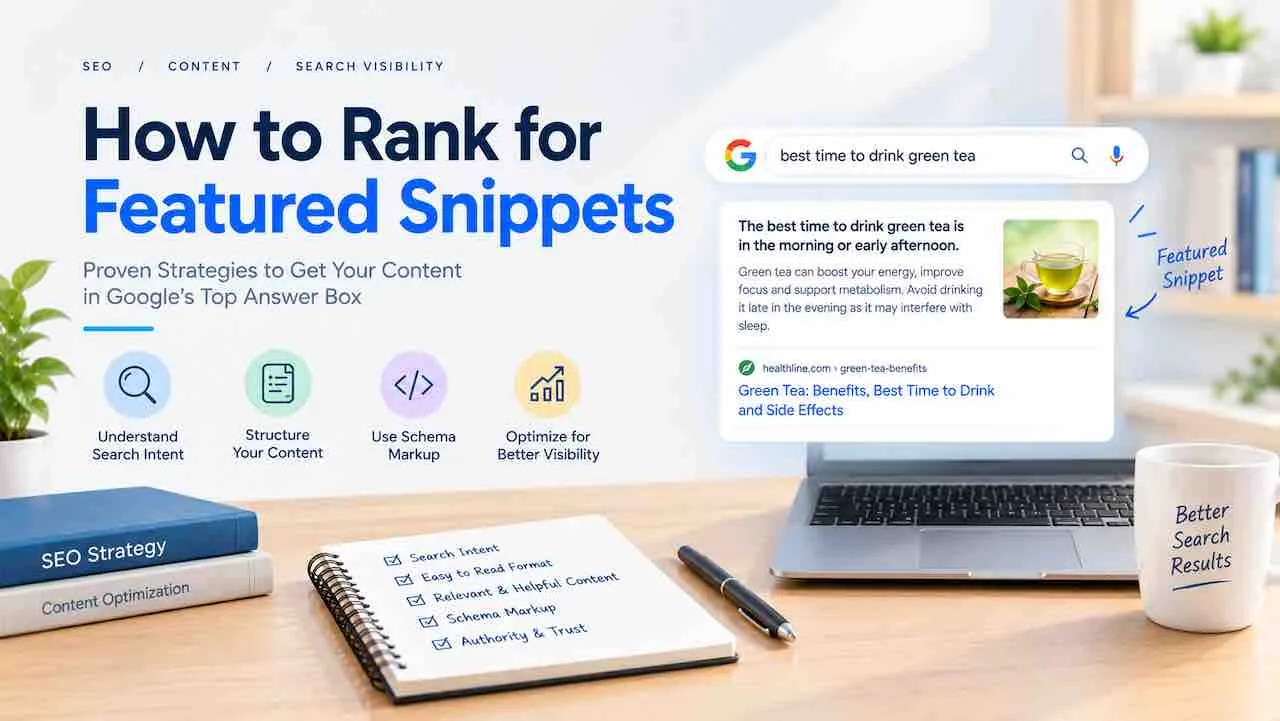
To rank for featured snippets, write the target question as an H2 or H3 heading, then place a direct 40 to 60 word answer in the first paragraph immediately below it, followed by supporting detail. Google pulls featured snippet content from pages already ranking in positions 1 to 10 for the query. The content format, not the domain authority, determines which ranking page wins the snippet. Featured snippets appear on approximately 12% of all Google searches, answer 40.7% of all voice search queries, and cite sources inside Google AI Overviews for 80% of informational queries. A single snippet placement produces more total brand impressions than a standard position one organic result on many informational queries.
If a competitor is sitting in position zero for queries your pages rank 2 to 5 for, they are capturing the zero-click brand exposure and voice search traffic that your ranking earned but your content format failed to claim. This guide gives you the exact content structures for each snippet type, the page qualification requirements, the snippet displacement strategy for taking competitor snippets, and the monitoring system for keeping every snippet you win.
Why Featured Snippets Matter for Your SEO Strategy
Featured Snippet Click-Through Rate Data
Featured snippets produce a combined click-through rate of 28 to 30% when the snippet source page also ranks at organic position 1, compared to 26% for position 1 without a snippet. When a featured snippet answers a query without triggering a click, the snippet source still receives higher brand recall and recognition than a standard organic result because the user reads the answer attributed to the source. Pages that lose their position 1 ranking but retain the featured snippet see much different traffic outcomes than pages that lose both simultaneously, confirming that snippet placement carries independent brand value beyond the click metric. Read our zero-click search optimization guide for the full data on how SERP impressions convert to downstream branded search revenue.
Featured Snippets and Voice Search
Featured snippets answer 40.7% of all voice search queries, according to Backlinko research, making snippet optimization the primary path to voice search visibility. Voice assistants including Google Assistant, Siri, and Amazon Alexa pull their spoken answers from featured snippet content. The same 40 to 60 word direct answer format that wins a text-based featured snippet on desktop is exactly what Google’s text-to-speech systems read aloud for voice search queries. A single piece of content optimized for featured snippet capture effectively optimizes for both text and voice search simultaneously. Read our voice search optimization guide for the full technical specification for voice-first content structure.
Featured Snippets and Google AI Overviews
Pages that hold featured snippet positions are cited in Google AI Overviews at a higher rate than pages ranking in positions 2 to 10 without a snippet, because the same content signals that earn a snippet also satisfy the AI Overview citation quality threshold. Google AI Overviews prioritize content structured as clear, bounded, factual answer units, which is exactly the content format that wins paragraph featured snippets. Optimizing for featured snippets and optimizing for AI Overview citation are not separate strategies. They target the same content quality signals and produce complementary SERP real estate outcomes. Read our Google AI Overviews optimization guide to align featured snippet content with the additional authority signals AI citations require beyond snippet formatting alone.
Three Types of Featured Snippets
| Snippet Type | Triggered By | Content Format Required | Optimal Length | Schema That Helps |
|---|---|---|---|---|
| Paragraph snippet | Definition, explanation, and “what is” queries | Direct answer paragraph immediately below a question heading | 40 to 60 words | FAQ, Article |
| List snippet | “How to,” “steps to,” “types of,” and “best X” queries | Ordered or unordered HTML list directly below a question heading | 5 to 9 items, 1 line each | HowTo, ItemList |
| Table snippet | Comparison, pricing, schedule, and structured data queries | HTML table with clear column headers and a minimum of 3 rows | 3 to 7 rows visible | Table, Dataset |
| Video snippet | “How to” queries where video tutorials dominate the SERP | YouTube video with a clear timestamp or chapter markers | Clip under 3 minutes preferred | VideoObject, Clip |
Paragraph Snippets
Paragraph snippets are the most common featured snippet type and appear for definition, explanation, comparison, and “how does X work” queries. They pull from a bounded answer paragraph of 40 to 60 words placed directly below a question-format heading. Google’s NLP systems identify the paragraph as a bounded answer unit when it starts with a direct declarative statement, contains no preamble or lead-in sentences, and stays within the 40 to 60 word range that Google’s extraction systems are calibrated to pull. Answers over 70 words are frequently truncated, which disrupts the answer’s semantic completeness and reduces the user experience value of the snippet.
List Snippets
List snippets appear for “how to,” “steps to,” “types of,” and “best X” queries and pull from HTML ordered or unordered lists placed directly below a question-format heading. Google displays a maximum of 8 list items before adding a “More items” link. Structure your lists with 5 to 9 items. Each item should be one line. Do not use complete sentences as list items for list snippets. Short 3 to 6 word noun phrases or imperative verb phrases perform better as list items because they are more extractable by Google’s NLP systems than full-sentence items, which the system may truncate inconsistently.
Table Snippets
Table snippets appear for comparison, pricing, schedule, and structured data queries and require proper HTML table markup with thead, th, and tbody elements. Use descriptive column headers in your th elements. Google reads these headers as the labels for every data cell in the column. A table without clear th headers is less likely to win a table snippet because the extraction system cannot assign accurate semantic labels to the data it pulls. Tables comparing 2 or more entities across the same set of attributes trigger table snippets most reliably. Keep your tables between 3 and 7 rows for the best snippet display.
Which Queries Trigger Featured Snippets
Query Types That Win Snippets
Featured snippets appear most reliably for informational, question-format, and comparison queries where a direct factual answer exists and can be bounded within 40 to 70 words. The highest-probability query types for featured snippet wins include definition queries like “what is X,” how-to queries like “how to do X,” comparison queries like “X vs Y,” and process queries like “how does X work.” Question words that correlate most strongly with snippet triggering are “what,” “how,” “why,” and “when.” Queries with strong commercial intent, such as “best agency for X” or “buy X,” are less likely to trigger featured snippets because Google reads commercial intent as requiring transactional results rather than direct informational answers.
Queries That Rarely Win Snippets
Single-word queries, navigational queries, and transactional queries rarely trigger featured snippets because they do not carry an answerable informational intent that a paragraph, list, or table can satisfy. A search for “Ahrefs” is navigational. A search for “buy SEO tools” is transactional. A search for “Python” is too broad for a bounded answer. None of these query types typically produce featured snippets. Before investing content optimization effort in a keyword, filter your keyword list for informational intent and question format. Queries already showing featured snippets in current search results are the highest-probability targets because Google has already determined a snippet is appropriate for that query. You are competing only for the source selection, not for the snippet format decision itself.
How to Write Content That Wins Featured Snippets
The 40 to 60 Word Answer Format
The single most reliable content change that produces featured snippet wins is placing a direct 40 to 60 word answer paragraph immediately below a question-format heading, with the first sentence stating the complete answer before any supporting context. Do not start the answer with “In this article” or “There are several reasons.” Start with the answer. “Link building is the practice of earning hyperlinks from other websites to your own, which passes link equity that raises your domain authority and improves your organic search rankings” is a correctly formatted snippet answer. It is direct, complete in one sentence, and adds supporting context in a second sentence before hitting the word count threshold. Structure every informational heading on your page this way and your snippet capture rate will rise measurably within 6 to 8 weeks of re-indexing.
Question Heading Structure for Snippet Capture
Write the exact search query as your heading whenever possible, because Google’s passage indexing system reads the heading as the question label for the content block immediately below it. “How to rank for featured snippets” as an H2 heading followed immediately by a 40 to 60 word answer paragraph creates a clear question-answer unit that Google’s extraction system can identify without ambiguity. When your heading and the following paragraph form a bounded Q&A unit, Google’s NLP signals classify that passage as an answer candidate for queries matching the heading. Pages that use vague headings like “Content Strategy Tips” without a question format convert to snippets at a much lower rate than pages using exact-question headings even when the answer content below is identical.
How to Format List Snippets
For list snippet optimization, place an H2 or H3 question heading followed immediately by an HTML ordered list with no intervening paragraph between the heading and the list. Ordered lists win snippets for step-based queries. Unordered lists win snippets for type-based and example-based queries. Do not add an introductory paragraph between the heading and the list. Google’s extraction system reads the first content element after a question heading as the answer candidate. An introductory paragraph pushes the list out of the immediate answer position and reduces snippet capture probability much. Keep each list item to one line. Use 6 to 9 items for maximum coverage before the 8-item display cutoff adds a “More items” link.
How to Format Table Snippets
For table snippet optimization, use proper HTML table markup with a thead element containing th column headers, a tbody element containing the data rows, and a question-format heading immediately above the table. Every th element should use a descriptive label that gives context to the entire column below it. A table comparing “Tool,” “Monthly Price,” and “Key Feature” as column headers is extractable. A table with “Option 1,” “Option 2,” and “Option 3” as headers is not. Include your primary entity or comparison subject in the first column and the most user-relevant attributes in columns two through four. Google displays approximately 3 to 5 rows in a table snippet before adding a “More rows” link.
Which Pages Qualify for Featured Snippets
Position Requirements
Google selects featured snippets exclusively from pages ranking in the top 10 organic results for the target query, which means your page must achieve at least a position 10 ranking before any content optimization for snippets produces results. Ahrefs data shows approximately 31% of featured snippets come from position 1 pages, but 70% come from positions 2 through 10, meaning that well-formatted content in positions 2 through 5 frequently beats position 1 pages for snippet selection. Your highest-priority snippet optimization targets are pages already ranking in positions 2 through 8 for question-format informational queries where a competitor currently holds the snippet. These pages have the ranking to qualify and need only the content format change to become snippet candidates.
EEAT and Content Authority Requirements
Google applies a baseline authority threshold for featured snippet selection that filters out pages with insufficient EEAT signals even when their content format is perfect. Pages on new domains with few backlinks, thin link profiles, or absent author credentials earn snippets at much lower rates than pages on established domains with demonstrated topical authority. Build your topical authority through consistent content depth on your target topic cluster before pursuing snippet optimization on individual pages. Our EEAT trust and authority guide covers the full authority signal stack that determines your snippet eligibility threshold on competitive queries.
How to Find Featured Snippet Opportunities
Finding Competitor Snippets to Target
Use Ahrefs’ SERP Features filter or Semrush’s Position Tracking to find every query in your niche where a competitor currently holds the featured snippet but your domain also ranks in the top 10. In Ahrefs, go to Site Explorer, enter a competitor’s domain, open the Organic Keywords report, and filter by “SERP Feature: Featured snippet.” This shows every snippet the competitor currently owns. Cross-reference with your own ranking data using Ahrefs’ Rank Tracker filtered for queries where you rank 2 through 10. Any query where the competitor holds the snippet and you rank 2 through 8 is a high-priority snippet displacement target. These represent snippet opportunities you are already qualified for by ranking position but losing by content format.
Finding Your Near-Miss Snippet Pages
Your near-miss snippet pages are your own pages ranking 2 through 5 for question-format queries where a featured snippet currently appears but your page does not hold it. In Google Search Console, filter your Performance report by queries containing “what,” “how,” “why,” “when,” and “which.” Export queries where your average position is between 2.0 and 8.0. These are your most actionable snippet opportunities because you already have the ranking authority. You need only the content format change. Sort by impression volume to prioritize the highest-traffic snippet opportunities first. Ahrefs Content Gap tool also surfaces question queries your competitors rank for with featured snippets that your domain does not yet hold.
How to Steal Competitor Featured Snippets
The snippet displacement strategy targets specific competitor snippets where your domain already ranks in positions 2 through 8, rewrites the relevant content section in the exact 40 to 60 word bounded answer format, and submits the URL for re-indexing to accelerate Google’s content re-evaluation. Google tests snippet sources dynamically and will displace an existing snippet holder within 2 to 6 weeks of encountering a more precisely formatted answer unit on a page with comparable or better authority. The displacement does not require your page to move above the snippet holder in organic ranking. It requires only that your content format scores higher on Google’s answer extraction quality signals than the current snippet source.
The Step-by-Step Snippet Displacement Process
- Identify a competitor snippet where your domain ranks 2 through 8 for the same query using Ahrefs SERP Features data.
- Open the current snippet page and read the exact answer Google is pulling for the query. Note its word count and format.
- Open your ranking page and find the section that answers the same query.
- Rewrite that section with an exact-question H2 or H3 heading matching the search query, followed immediately by a direct 40 to 60 word answer paragraph starting with a declarative sentence.
- Add FAQ schema markup to the updated Q&A section using the schema type appropriate for the query intent.
- Submit the URL for re-crawling using Google Search Console’s URL Inspection tool to trigger faster indexing of the updated content.
- Monitor the snippet position weekly for 6 weeks using Semrush’s Position Tracking or Ahrefs Rank Tracker to confirm displacement occurred.
Schema Markup for Featured Snippets
Schema markup does not directly cause Google to award a featured snippet, but it provides structured machine-readable signals that reduce content extraction ambiguity and improve the probability that Google selects your page over a competitor with similar content quality.
- FAQ schema: Add to any page containing 2 or more Q&A sections. Each Question and acceptedAnswer pair gives Google a clearly labeled bounded answer unit to evaluate for paragraph snippet extraction. Our schema markup for AEO guide provides ready-to-use FAQ schema code for WordPress and custom HTML implementations.
- HowTo schema: Add to step-by-step instructional content targeting “how to” queries. Each HowToStep element provides a clearly bounded step that Google can extract for list snippet formatting.
- Article schema: Add to all long-form content with author markup and datePublished to establish the content freshness signals that influence snippet selection on time-sensitive informational queries.
- Speakable schema: Mark specific answer paragraphs with speakable CSS selectors to signal to Google that those passages are designed for direct voice search extraction, the same passages that win voice-delivered featured snippets.
The combination of FAQ schema on question-based pages and correct content formatting produces the strongest featured snippet capture results. Schema alone on poorly formatted content does not win snippets. Correct formatting without schema wins snippets but at a lower rate than the same formatting with schema applied. Use both together.
How to Track and Protect Your Featured Snippets
Snippet Monitoring Tools
Track your featured snippet positions using Semrush’s Position Tracking “Featured Snippets” filter, Ahrefs Rank Tracker’s SERP Features column, or SERPWatcher’s snippet tracking module. Set up weekly automated alerts in your chosen tool for every query where you currently hold a featured snippet. Also set alerts for your top 20 snippet opportunities where a competitor currently holds the position and your domain ranks 2 through 8. Competitors optimize continuously, and a snippet you win today can be displaced within 48 to 72 hours if a competitor publishes a more precisely formatted answer. Weekly monitoring catches displacement before it produces a measurable traffic drop in Google Analytics or Search Console.
How to Keep a Featured Snippet Once You Win It
Maintaining a featured snippet requires the same content discipline that won it: regular freshness updates every 60 to 90 days, monitoring for competitor content improvements on the same query, and consistent EEAT signal building that maintains your authority threshold above competitors. Update your snippet answer paragraph quarterly to signal content freshness. Add new supporting data, updated statistics, or current examples. Submit the URL for re-crawling after each update. Watch Google Search Console for impression drops on snippet queries, which typically appear 1 to 2 weeks before the snippet position is lost in rank tracking tools. A proactive freshness update on at-risk snippets prevents displacement in most cases before it fully occurs.
Common Featured Snippet Mistakes
Placing the Answer After an Introductory Paragraph
The most common featured snippet mistake is placing an introductory paragraph between the question heading and the answer, which pushes the answer out of the immediate answer position and prevents Google from identifying it as a bounded answer unit. A section that reads “In this guide, we will cover everything you need to know about featured snippets, including why they matter, how to optimize for them, and how to track your results. Featured snippets are…” forces Google to process additional content before reaching the actual answer. Remove every lead-in sentence from all question-based content sections. The heading is your context. The first sentence of the paragraph is your answer. There is nothing else needed between them.
Optimizing for Snippets on Pages Not in the Top 10
Featured snippet optimization applied to pages ranking at position 11 or below produces zero results regardless of how well the content is formatted, because Google’s snippet selection pool is limited to top 10 results. Before rewriting any section for snippet capture, check the page’s current ranking position for that query in Ahrefs or Semrush. If the page ranks at position 11 or lower, prioritize ranking improvement through link building and topical authority building first. Return to snippet optimization once the page reaches position 8 or above. Applying snippet formatting to unranked pages is a formatting investment with no snippet return until the underlying ranking problem is resolved.
Quick Digital · SEO Strategy Since 2014
Win Position Zero Before Your Competitors Do
Quick Digital identifies your highest-probability featured snippet opportunities, rewrites the relevant content sections in the exact format Google’s extraction systems prefer, and monitors your snippet positions weekly to catch displacement before it costs you traffic.
Stop watching competitors sit in position zero for queries your pages already rank for.
How to Rank for Featured Snippets: FAQs
Featured snippet paragraph answers should be between 40 and 60 words. Answers under 40 words lack context. Answers over 70 words are frequently truncated. Write the answer in 40 to 60 words as a standalone paragraph placed immediately below a question-format heading with no introductory preamble.
No. Approximately 70% of featured snippets come from pages ranking in positions 2 through 10, not position 1. Google selects snippets based on content format and answer quality. Pages at positions 2 through 5 regularly beat position 1 pages when their content uses the direct 40 to 60 word answer format.
Find a competitor snippet where your domain ranks 2 through 8, then rewrite that section with an exact-question heading and a direct 40 to 60 word answer paragraph. Add FAQ schema and submit for re-crawling in Google Search Console. Google typically displaces snippet holders within 2 to 6 weeks of encountering a more precisely formatted answer.
FAQ schema improves paragraph snippet capture. HowTo schema improves list snippet capture for step-by-step content. Speakable schema signals voice search extraction eligibility for specific answer paragraphs. Correct content formatting combined with appropriate schema produces the highest featured snippet win rate. Schema alone on poorly formatted content does not win snippets.
Use Semrush Position Tracking with the Featured Snippets filter, or Ahrefs Rank Tracker with the SERP Features column to monitor all snippet positions your domain holds. Set weekly alerts for snippets you currently own and monitor your top 20 near-miss queries where a competitor holds the snippet and you rank 2 through 8.