

People Also Ask boxes appear on 64.9% of all Google searches, and any page, even one sitting at organic position 14, can win these placements. Google selects PAA answers based on content structure and question intent, not domain authority. Write the exact question as a subheading, place a direct 40 to 60 word answer in the first sentence below it, add FAQ schema, and submit the URL for recrawl in Google Search Console. Pages do not need to rank on page one to win PAA slots.
One home improvement site answered 34 PAA question clusters inside a single pillar page using dedicated H2 headings and direct answer format. The result: 18 PAA placements from one article and 450% organic traffic growth. That is not an outlier. It is what happens when you stop treating People Also Ask boxes as a side effect of ranking and start treating them as their own content strategy with their own rules.
Also critical: PAA boxes appear on 80.92% of all Google AI Overview queries (Concept21 Agency). Winning a PAA placement today means appearing in traditional organic results and AI generated summaries at the same time. This guide gives you the complete PAA keyword research process, the exact answer structure Google extracts, the schema markup that raises your win rate, and the maintenance system that protects your placements after you earn them.
How People Also Ask Boxes Work in Google Search
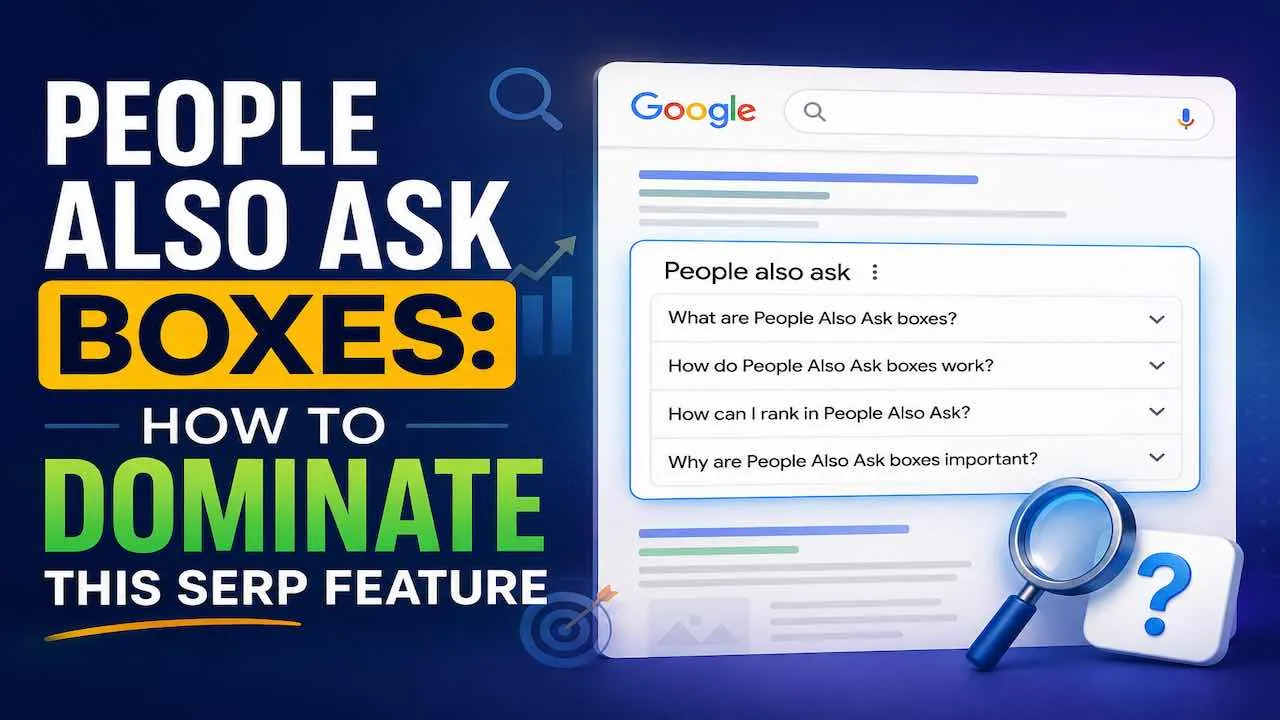
A People Also Ask box is a dynamic SERP feature showing expandable questions with short answers pulled from pages Google identifies as most directly addressing each follow up query. Google launched PAA in April 2015. Each collapsed question opens to reveal a short answer snippet, a source URL, and a direct link to search that question independently. When a user clicks any question, Google runs a query expansion: 2 to 3 new related questions load beneath it automatically. This PAA cascade continues indefinitely, mapping an entire topic cluster around the original search term in real time.
PAA is a citation surface, not a ranking surface. Your URL is attributed with the answer. Users see the answer first and your domain second. The PAA click through rate sits at roughly 5 to 15% per cited answer block, lower than the 42.9% CTR of a featured snippet at position zero but spread across multiple answer slots simultaneously. A single page winning 5 PAA answer boxes on the same query compounds that traffic in a way no single organic ranking position can replicate.
How BERT, RankBrain, and Passage Indexing Select PAA Answers
Google uses BERT, RankBrain, and passage indexing together to select the best PAA answer for each question, prioritizing answer clarity and intent matching over keyword density or domain authority. Each system plays a distinct role in PAA selection.
- BERT reads the full question bidirectionally to understand context before selecting an answer. BERT-driven PAA selection means your answer must match the precise meaning and question intent of the query, not just surface keywords. Write subheadings as natural spoken questions, “How do I get into a People Also Ask box?”, not keyword fragments like “PAA ranking method.”
- RankBrain processes unfamiliar or long-tail queries using machine learning to map question intent to the most relevant answer. Pages written for conversational queries and natural language queries win PAA slots at higher rates. Semantic density, the concentration of semantically related terms around your core subject, signals semantic relevance to Google and raises PAA selection probability. Semantic density and semantic relevance work together: covering every related concept on your pillar page builds the topical authority signal that passage indexing rewards. because RankBrain favors intent matching over exact keyword matching.
- Passage indexing lets Google extract and cite individual paragraphs within longer pages, even when the full page sits at position 15 in organic results. A well-structured 40 to 60 word direct answer paragraph inside a longer guide wins a PAA slot purely on the strength of that passage, regardless of the page’s overall organic position.
One more critical update: Google’s recent core update introduced synthetic content filtering specifically targeting AI-generated PAA responses that hit every semantic variation but lack authentic human insight. Pages winning PAA boxes today demonstrate genuine expertise through first-hand observations and verifiable data that generic AI-only content cannot replicate. Hand-edited answers consistently beat boilerplate responses, even when the boilerplate is structurally correct.
PAA Boxes vs Featured Snippets
PAA boxes appear on 64.9% of all Google SERPs while featured snippets appear on only 12.3%, making PAA the most accessible SERP feature for outranking competitors without page one authority. The differences your PAA SEO strategy must account for:
| Factor | People Also Ask Boxes | Featured Snippets |
|---|---|---|
| SERP frequency | 64.9% of all Google SERPs | 12.3% of all SERPs |
| SERP position | Between organic results 1 and 4 | Position zero, above all organic results |
| Page rank needed | Any page, position 14 can win | Page one typically required |
| Answers per feature | 3 to 4, expands via PAA cascade on click | 1 single answer only |
| Domain authority needed | Low to medium | Medium to high |
| AI Overview connection | Shows on 80.92% of AI Overview queries | Shows alongside AI Overviews 45.39% of the time |
| New site win timeline | 2 to 3 months with correct structure | 6 to 12 months typically |
| Synthetic content filtered | Yes, recent core update removes AI-only answers lacking genuine expertise | Yes, same filtering applies |
Why PAA Boxes Give You an Unfair SERP Advantage
PAA optimization lets you appear multiple times on the same search results page without building new backlinks or fighting for position 1. That is People Also Ask SEO in practice. A single page can hold a traditional organic ranking, a PAA answer slot, and a featured snippet placement simultaneously. That triple SERP visibility was previously achievable only through massive domain authority or paid ad spend. PAA is the one SERP feature that lets you level the playing field against bigger, higher-authority domains. It lets smaller sites compete with and beat much larger domains. Content structure alone wins slots that backlinks and domain age cannot buy.
The long-tail traffic from PAA question clusters consistently surprises even experienced SEOs. A page targeting “People Also Ask boxes” can simultaneously win PAA placements for “how do PAA boxes work,” “can you rank in PAA without being number 1,” and “how long should a PAA answer be.” Each winning placement adds a new entry point to your content. Each click on any PAA question triggers query expansion, loading 2 to 3 additional related questions. That PAA cascade maps your entire topic cluster in real time and sends topically matched visitors to your content without additional work.
The ultimate goal is SERP omnipresence: appearing in a PAA answer box, an organic result, a featured snippet, and a Google AI Overview on the same search results page. That ability to dominate SERP real estate builds brand authority so strong that users actively search your brand name rather than generic keywords. Repeated zero-click searches that expose users to your brand in PAA positions compound into branded search volume over time. For more on how zero-click searches reshape your organic strategy, read the zero-click search optimization guide.
How to Find Your Best PAA Opportunities Right Now
The fastest PAA wins come from pages already ranking organically but missing the PAA slot for the same query. These near-miss targets need only a content update, not a new page or new backlinks. Before spending a minute on new content, sort your existing pages into 3 audit buckets.
The 3-Bucket PAA Content Audit
- Bucket 1: Pages currently appearing in PAA. Protect these placements. Audit every 60 days. Refresh any answer where the underlying data has changed before competitors find the weakness and displace you.
- Bucket 2: Near-miss PAA content. Pages one surgical fix away from winning. Add a direct answer format paragraph, update outdated statistics, add one specific example, and restructure the heading as an exact question matching the user’s natural language query.
- Bucket 3: PAA-absent but high-potential pages. Pages ranking organically for question queries but holding no PAA slot. These need deeper restructuring: direct question-and-answer format plus FAQ schema implementation as the first two actions.
Free PAA Research Sources
People Also Search For (PASF), related searches, and Google autocomplete are 3 free sources that surface PAA question clusters your competitors have not yet targeted. Use all 3 before opening a paid tool.
- People Also Search For (PASF) shows the next query users type after clicking a result and returning to the SERP. PASF terms map the full question sequence users work through before making a decision. Build content that answers every step of that sequence on a single pillar page to multiply PAA question cluster wins from one URL.
- Related searches at the bottom of each Google SERP reveal semantically connected queries that appear before or after your target keyword. These terms frequently surface as PAA questions on adjacent SERPs, making them high-value additions to any content brief built around question intent.
- Google autocomplete surfaces question variants based on real-time search volume and PAA visibility data. Type your core question into Google and record every autocomplete suggestion. Each suggestion is a potential PAA question cluster your page can target with a dedicated subheading and direct answer paragraph.
PAA Keyword Research: Step by Step, How to Rank in PAA and How to Track PAA Gains
- Open Semrush Position Tracking. Go to the Positions tab, click “SERP Features,” and filter for “Domain doesn’t rank” under People Also Ask. This reveals every keyword where you rank organically but miss the PAA slot.
- Cross reference in Google Search Console. Filter queries containing question words: how, what, why, when, which, can, and does. These are your PAA keyword research starting points with real impression data behind them.
- Search each question in incognito mode. Record the exact PAA questions shown, the format of each current answer, the source domain, and the word count. This is your PAA competitive analysis baseline.
- Use AlsoAsked.com to generate a visual question cluster map around your core topic. This tool shows which questions appear together most frequently and reveals the semantic hierarchy within each topic cluster.
- Use AnswerSocrates to see the full scope of related questions around a topic. Build your content briefs around this question data, not just keyword search volume, to target PAA from day one of every new content piece.
- Prioritize questions where the current PAA source is a lower-authority domain or where the existing answer is vague, over 80 words, or poorly formatted. Those are your highest-confidence targets for competitor PAA displacement.
Best PAA Tracking Tools
| Tool | Primary PAA Function | Best For |
|---|---|---|
| Semrush Position Tracking | SERP feature tracking with PAA filters and change alerts | Weekly PAA monitoring |
| Ahrefs Rank Tracker | PAA icons in rank reports plus SERP history | PAA competitive analysis and gap finding |
| AlsoAsked.com | Visual PAA question cluster diagrams | Topic cluster content planning |
| AnswerSocrates | Full scope of questions around any topic | Building PAA-first content briefs |
| AnswerThePublic | Question-based keyword generation | Early-stage PAA keyword research |
| AccuRanker | Real-time PAA tracking with historical trends | Agencies running multiple PAA campaigns |
| Google Search Console | Question query filtering and PAA impression data | Free baseline PAA visibility data |
How to Write Answers That Win PAA Boxes
Every winning PAA answer follows one mechanical rule. Whether your goal is to learn how to get featured in People Also Ask, how to win PAA slots, or how to write PAA answers, the process starts here: place a direct answer in the first 1 to 2 sentences below a subheading that matches the exact question word for word. Google’s BERT model reads the subheading and the opening paragraph together to confirm they address the same question intent. When the heading is the question and the first sentence is the direct answer, passage indexing extracts that block immediately without reading surrounding content. That is how you capture traffic without ranking number one on the full page.
Also important: over-optimization hurts PAA selection. Google’s natural language processing models now detect mechanical keyword insertion that reads unnaturally. A heading like “What is the best way to optimize for People Also Ask boxes for SEO purposes” triggers spam filters. A natural heading like “How do I get my content into PAA boxes?” wins. Write the way a knowledgeable person actually speaks, not the way a keyword spreadsheet dictates.
The Exact PAA Answer Structure That Wins
- The heading is the exact question. Write it exactly as users ask it in conversational search: “How long should a PAA answer be?” not “PAA Answer Length Guidelines.” Subheading optimization for PAA means matching the user’s natural language query exactly, including question words like “how,” “what,” and “why.”
- The first sentence delivers the direct answer. Start with the answer, not background context. “A PAA answer should be 40 to 60 words” beats “There are several things to know about PAA answer length.” Direct answer format wins because BERT extracts the opening sentence first during passage indexing.
- Sentences 2 and 3 add one layer of supporting context. This builds content credibility and separates your answer from shallow responses that synthetic content filtering increasingly rejects. Add a specific number, example, or comparison that a generic AI tool could not generate independently.
- Keep total paragraph answers at 40 to 60 words. For list answers, use 3 to 7 bullet points with 10 to 15 words each. For table answers, use 3 to 5 rows with clear column headers to qualify for rich results. Match the format of the current PAA box for your target question, switching formats reduces your selection probability even when your content is more accurate.
- Build content briefs around PAA questions before writing. Mine PASF data, related searches, and Google autocomplete for every content brief. When your single pillar page answers 8 to 12 questions in the user’s natural research sequence with direct answer format, Google recognizes the page as a topical authority for that full question cluster.
PAA Answer Formats by Question Type
Around 78% of PAA answers display in paragraph format, while the remaining 22% use lists, numbered steps, tables, images, or video results. Before writing your answer, check the current PAA box for your target question in incognito mode and match its format exactly.
| Question Type | Best Answer Format | Word or Item Count |
|---|---|---|
| “What is” questions | Short definition paragraph, defined term in opening words | 40 to 60 words |
| “How to” questions | Numbered list of clear sequential steps, each under 15 words | 4 to 7 steps |
| “Why does” questions | Single direct causal sentence plus 1 supporting sentence with data point | 40 to 55 words |
| “What are the” questions | Bulleted list, each item 10 to 15 words, standalone without surrounding context | 4 to 7 items |
| “How much does” questions | Cost table with price ranges and top 3 variables affecting cost | 3 to 5 table rows |
| “Which is better” questions | Direct recommendation plus 3 to 5 row comparison table with specific criteria | 40 words plus table |
| Tutorial or demo questions | Short video under 3 minutes on YouTube with exact question as video title | Under 3 minutes |
Where to Place PAA Content on Your Pages
The 3 highest-performing locations for PAA content on any page are dedicated FAQ section blocks, in-article question-based headings, and standalone question-and-answer cluster pillar pages. FAQ sections at the bottom of blog posts capture quick transactional question intent. Subheadings within long-form articles capture deeper informational queries mid-page. Only create a dedicated standalone page when a question genuinely needs over 1,000 words to answer properly. Thin single-question pages rarely hold PAA placements beyond 30 days before a more authoritative source displaces them.
Schema Markup That Boosts Your PAA Win Rate
FAQ schema, How To schema, Person schema, and Organization schema are the 4 structured data types most directly linked to PAA eligibility, rich results, and EEAT authority signaling. Structured data does not guarantee a PAA win. But it accelerates Google’s content understanding and raises your PAA inclusion rate. Most sites treat schema as optional for PAA optimization, making schema implementation the fastest structural advantage you can claim over competitors with equivalent on-page SEO quality. Read our full schema markup for AEO implementation guide for the complete structured data setup.
FAQ Schema for PAA Optimization
Add FAQ schema to every page with a visible question and answer section. WordPress users add this through Yoast SEO or Rank Math without writing JSON-LD manually. Each FAQ schema block must contain only questions and answers that appear visibly on the page. Google penalizes hidden or duplicated FAQ schema. Never add schema for content not rendered for users. Validate all structured data through Google’s Rich Results Test after every implementation. Errors silently reduce your PAA eligibility without any visible browser warning.
How To Schema for Step-Based PAA Answers
Use How To schema on process pages where the answer involves 3 or more sequential steps. Each step object needs a name, a text description, and optionally an image qualifying for visual rich results. Pages with valid How To schema appear with rich results in organic search and simultaneously increase eligibility for “how to” PAA placements. Both schema types working together signal complete question-answering authority across informational and procedural query types at the same time.
Person Schema and Organization Schema for EEAT
Add Person schema to every author bio page and Organization schema to your homepage to build verified EEAT signals that directly strengthen PAA selection for YMYL content in health, finance, and legal topics. Google’s Knowledge Graph uses Person schema to confirm who is answering the question and whether that individual has documented expertise in the relevant domain. Organization schema confirms your brand as an established, verified entity rather than an anonymous site. Connect your Organization schema to your Google Business Profile and LinkedIn company page to complete the entity verification chain Google’s NLP models use for entity recognition and Knowledge Graph attribution. Read the full EEAT trust and authority guide to align each EEAT dimension with your PAA content strategy.
PAA Boxes and Google AI Overviews
Content winning PAA boxes now feeds directly into Google AI Overviews, doubling its reach across traditional and generative search results without any extra effort. According to Concept21 Agency, PAA boxes appear on 80.92% of all AI Overview queries. Pages optimized for PAA using direct question-and-answer format, EEAT signals, and FAQ schema consistently appear inside AI generated summaries from Perplexity AI, Gemini, ChatGPT, and Bing Copilot. That is the foundation of Answer Engine Optimization (AEO): structuring content so it answers questions directly for both human readers and large language model engines. Get the complete strategy in our Google AI Overviews optimization guide.
Also, content winning PAA boxes gets cited by AI engines at a disproportionately high rate because those platforms pull from the same question-anchored, well-structured pages Google favors for PAA selection. Building PAA authority on Google builds AI citation authority across all generative search platforms simultaneously. Read the specific guides on Perplexity AI optimization and Generative Engine Optimization (GEO) to align each platform’s requirements with your PAA box targeting strategy.
EEAT Signals and Synthetic Content Filtering for PAA
Google’s Search Quality Rater Guidelines require PAA-eligible content to demonstrate all 4 EEAT signals clearly on the page, and recent updates now apply synthetic content filtering that removes AI-generated answers lacking authentic human expertise. Here are the PAA-specific requirements for each EEAT signal:
- Experience: Reference real-world observations, specific numbers, and hands-on examples only someone with direct practical experience would include. Generic statements any AI tool could produce are caught by synthetic content filtering and removed from PAA answer boxes.
- Expertise: Include author bio markup using Person schema and link to professional credentials, published work, or verified organization profiles. The author’s documented expertise directly influences PAA eligibility for YMYL content.
- Authoritativeness: Cite recognized industry sources such as Semrush, Ahrefs, Google Search Central, or Backlinko when making data claims. Brand authority building through data attribution directly strengthens PAA selection probability for competitive question queries.
- Trustworthiness: Keep all answers factually verifiable, add Organization schema to confirm brand entity status, and update content immediately whenever underlying data changes. Content credibility signals from Organization schema and factual accuracy together form the trustworthiness layer EEAT requires for PAA inclusion.
For the complete semantic SEO and entity optimization framework, see how entity-based PAA authority building works across generative engines. Also read our conversational keywords and question-based queries guide to align your PAA box targeting strategy with how users naturally phrase queries across devices and contexts.
How to Steal Competitor PAA Placements
Competitor PAA displacement produces the highest ROI in PAA box targeting because the opportunity is already validated by Google and the quality bar is visible before you write a single word. Pages at organic position 12 regularly outrank page-one competitors inside PAA answer boxes when their answers are more direct and better formatted. Here is the exact process:
- Use Ahrefs Rank Tracker or Semrush Position Tracking to identify keywords where competitors appear in PAA but your domain does not appear in any PAA question slot.
- Search those keywords in incognito mode. Record the exact PAA question, current answer text, word count, and format. This is your PAA competitive analysis baseline.
- Identify the specific weakness in their answer. Is it over 80 words? Wrong format? Missing a data point users need? Using outdated statistics? Each weakness is a clear opening for displacement.
- Write an answer that corrects every identified weakness. Match the correct format. Cut unnecessary length. Add the missing data point or specific example their answer lacks to establish clear content credibility advantage.
- Add the question as an exact-match heading on your most relevant existing page or create a new FAQ entry targeting that specific question intent.
- Add or update FAQ schema to include the new question and answer pair in your structured data so Google’s crawlers find the question-and-answer relationship immediately on re-indexing.
- Submit the URL for re-crawling in Google Search Console and monitor the PAA slot weekly for 4 weeks using Semrush or AccuRanker to confirm displacement. Catch any counter-displacement immediately and update content freshness signals before the new slot holder builds authority.
Why PAA Answers Disappear and How to Protect Yours
PAA answers disappear when Google finds a more direct answer elsewhere, user behavior signals shift negatively, or a fresher source publishes a better-structured response that passes synthetic content filtering. A publish-and-forget approach consistently results in losing PAA placements to actively managed competitors. Understanding why a PAA answer disappears overnight is the first step to keeping your slots long-term.
5 Reasons PAA Answers Vanish
- A competitor published a more direct answer to the same question with stronger direct answer format, stronger EEAT signals, or more specific verifiable data that Google’s NLP-driven PAA selection scores above yours.
- The question changed phrasing because Google’s NLP detected a shift in how users phrase that query through real-time user behavior signals, and your heading no longer matches the updated conversational query pattern.
- Your page’s technical SEO declined through page speed degradation, crawl errors, or Core Web Vitals failures. Poor LCP or CLS scores reduce PAA eligibility on mobile, where the majority of PAA interactions happen.
- Your answer became factually outdated and users clicking through signaled low satisfaction through high bounce rates and short dwell time. Google reads these negative user behavior signals as quality indicators and removes underperforming PAA answers within 24 to 48 hours of detecting the pattern.
- Google’s NLP model or synthetic content filter updated, reclassifying your answer as insufficiently specific or expert for that question intent. This happens when a page passes the original selection criteria but fails the updated model’s quality threshold.
PAA Maintenance Schedule
- Weekly: Monitor active PAA placements via Semrush Position Tracking or AccuRanker. Check for displacement on your top 10 PAA targets and respond within 48 hours of any lost slot.
- Every 60 to 90 days: Refresh all PAA answers where the underlying statistics or data have changed. Outdated statistics are the fastest path to losing a PAA slot to a fresher source.
- Quarterly: Run the full 3-bucket PAA content audit across your site. Mine PASF, related searches, and Google autocomplete for new question cluster targets in every active topic cluster.
- After every Google core update: Re-check your PAA placements within 2 weeks of any confirmed core update. Synthetic content filtering changes most frequently affect PAA selection immediately after core updates.
Also monitor Core Web Vitals in Google Search Console and fix LCP or CLS failures on PAA-optimized pages within 48 hours of detection. See our full page speed optimization guide for technical fixes that protect PAA eligibility on mobile-first pages. PAA and voice search optimization share the same content pool, our voice search optimization guide shows how PAA-optimized content simultaneously wins voice search results from Google Assistant, Siri, and Amazon Alexa.
Complete PAA Optimization Checklist
| Critical PAA Actions, Do These First | |
|---|---|
| Action | Where to Apply |
| Write subheadings as the exact PAA question in conversational language | Every section targeting a question |
| Place direct answer in the first sentence using direct answer format | All question-based headings |
| Match answer format to the current PAA box format for each question | Each individual PAA target question |
| Keep paragraph answers at 40 to 60 words total | All FAQ section and PAA targeted sections |
| Sort all existing content into 3 PAA content audit buckets | Site-wide, run quarterly |
| High Priority PAA Actions, Do These Next | |
|---|---|
| Action | Where to Apply |
| Build content briefs from PASF, related searches, and PAA question data | Every new content piece targeting PAA |
| Add FAQ schema to every visible Q and A section | All pages with question and answer content blocks |
| Add Person schema to all author bio pages for EEAT signaling | All content author pages |
| Add Organization schema to homepage and connect to Knowledge Graph | Homepage only |
| Add How To schema for step-based PAA answers qualifying for rich results | All process-based question content |
| Validate all structured data via Google Rich Results Test after each change | After every schema implementation |
| Pass Core Web Vitals: LCP under 2.5s, CLS under 0.1 on mobile pages | Site-wide technical SEO audit |
| Medium Priority PAA Actions, Run These Quarterly | |
|---|---|
| Action | Where to Apply |
| Submit updated pages for re-crawl via Google Search Console URL Inspection | After every PAA optimization update |
| Track PAA placements weekly via Semrush or AccuRanker | All active PAA question targets |
| Refresh PAA answers with updated data every 60 to 90 days for content freshness signals | All active PAA content sections |
| Mine PASF, related searches, and Google autocomplete for new PAA question cluster targets | Every active topic cluster quarterly |
PAA and AEO Strategy Since 2014
Win PAA Boxes, AI Overviews, and Generative Search Placements for Your Brand
Quick Digital builds PAA-first content strategies that win placements across Google PAA answer boxes, AI Overviews, ChatGPT citations, Perplexity AI answers, and Gemini results. One strategy. Every answer surface covered.
PAA wins. AI visibility. One unified AEO and GEO strategy.
Get My Free PAA StrategyPeople Also Ask Boxes: FAQs
Write the exact PAA question as a subheading, then place a direct 40 to 60 word answer in the first sentence below it. Match the current PAA answer format. Add FAQ schema and submit for re-crawling in Google Search Console. Position 14 pages regularly beat high-authority competitors on answer structure alone.
Yes. PAA selection is based on content structure, answer clarity, and question intent, not domain authority. New sites see their first PAA placements within 2 to 3 months of publishing well-structured Q and A content with FAQ schema. Pages on page 2 regularly beat high-authority competitors when their answers are more direct.
PAA boxes update within 24 to 48 hours in response to user behavior signals, new content, and NLP model changes. A slot won today can shift to a competitor publishing a better-formatted answer. Monitor weekly using Semrush or AccuRanker and refresh answers every 60 to 90 days.
Yes. PAA boxes appear on 80.92% of all Google AI Overview queries. The same content also appears in ChatGPT, Perplexity AI, Gemini, and Bing Copilot. Voice assistants pull from the same content pool. PAA structured content works across all generative platforms, making it the top investment in Answer Engine Optimization.
Set weekly PAA monitoring alerts in Semrush or AccuRanker and refresh data every 60 to 90 days. Displacement happens when a competitor publishes a more direct answer or your answer fails synthetic content filtering. Run a quarterly 3-bucket PAA content audit to catch near-miss content before competitors target the same slots.