

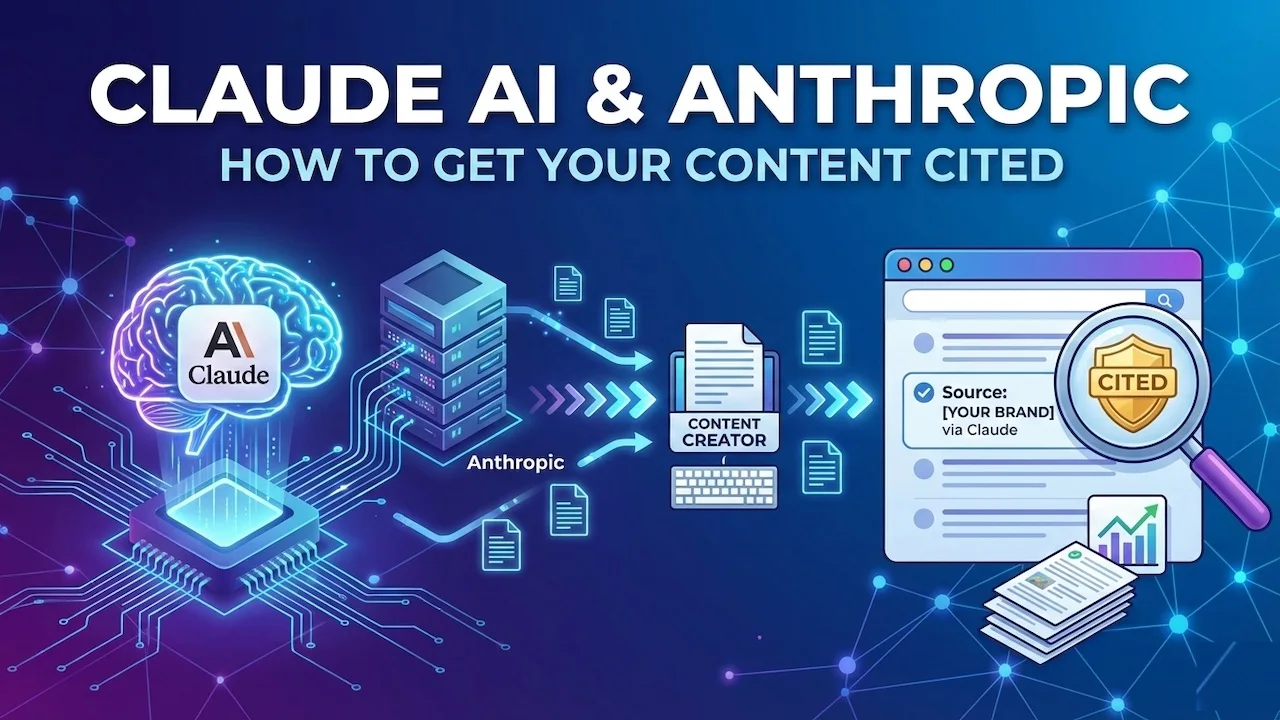
Claude AI optimization is the practice of structuring content so Anthropic’s Claude reads, verifies, and cites it inside synthesized answers. Claude retrieves live web content from Brave Search, not Google. Research by Profound confirms an 86.7% citation overlap between Claude answers and Brave Search organic results. Pages that rank in Brave’s top 10, pass Constitutional AI trust filters, and use self-contained paragraph chunks earn inline citations. Pages that read like marketing copy get filtered out before any citation decision is made.
QuickDigital.org has delivered AI SEO services and generative engine optimization since 2014. This guide covers every layer of Claude AI optimization: Anthropic’s 4 crawlers, Brave Search indexing, Constitutional AI content filters, entity verification signals, and citation tracking tools.
Claude AI Optimization: The Core Concept
Claude AI optimization targets a reasoning model, not a keyword algorithm. Standard SEO places your page in a ranked list of links. Claude optimization places your content as a cited source inside a conversational answer. The success metric shifts from rank position to citation frequency.
Claude evaluates citation eligibility based on 5 aligned factors: Brave Search access, content chunk quality, Constitutional AI trust signals, multi-platform entity verification, and structured data clarity. Fixing 1 factor without addressing the others produces limited results. All 5 must work together for stable Claude citations.
Google Ranking vs Claude Citation: A Real Difference
Google ranks web pages by relevance signals. Claude synthesizes answers from pages it has verified as trustworthy. A brand at Google’s position 1 is not guaranteed a Claude citation. Brands appearing across 10 credible sources get cited consistently. Brands appearing in 1 place, even with top Google rankings, rarely earn stable citations.
Princeton GEO research found keyword stuffing produces a negative effect on AI citation rates as large as -10%. Generative engine optimization requires the opposite of keyword repetition. Claude’s RAG layer reads for atomic facts. Content dense with keyword repetition reads as noise to Claude’s extraction system.
68% of all AI citations come from third-party sources. Only 32% come from brand-owned websites, per Erlin’s research. This confirms that off-page authority building is not optional in any Claude AI citation strategy.
3 Claude Query Types That Trigger Live Web Retrieval
Claude triggers live Brave Search retrieval for 3 query types: current events, specific data points not in training, and topics where live verification adds confidence to the answer. Evergreen factual queries get answered from training data alone with no citations. Knowing this split helps you target Claude AI optimization toward queries that actually produce inline citations.
Claude also runs Research Mode for paid subscribers on Pro, Team, Max, and Enterprise plans. Research Mode runs 5 to 20 sequential searches per query, produces multi-source reports with full citations, and takes 5 to 30 minutes per session. Pages cited in Research Mode reach the highest-intent users on the platform.
Also note: Claude in default chat mode on claude.ai may answer without invoking web search at all. When Claude is invoked with web search tools enabled, or via products that wrap Claude with retrieval, the same query produces live citations. Both modes require separate optimization approaches. Training corpus presence matters more in default mode. Brave Search ranking matters more in web-search mode.
Brave Search: The Foundation of Claude AI Optimization
Claude’s live web search retrieves results exclusively from Brave Search, confirmed by Anthropic’s subprocessor documentation and independent analysis by Profound. If Brave Search has not indexed your page, Claude cannot cite it. Your Google ranking has no direct effect on Claude citation eligibility. This single structural fact reshapes the entire approach to Claude AI SEO.
Brave Search processes over 1.2 billion queries per month, per BrightEdge data. Its index is entirely separate from Google and Bing. When your Brave position for a query improves, your Claude citation eligibility for that same query improves at a measurable rate.
Why Brave Ranking Matters More Than Google for Claude Citations
Brave uses its own crawler with its own index and ranking signals, which operate independently from Google’s algorithm. Clean semantic HTML, strong Core Web Vitals scores, and topical authority content improve Brave rankings independently of Google performance. A page outside Google’s top 10 can earn a Claude citation if it holds a top 10 Brave position.
Nearly 28% of pages most frequently cited by AI systems have little to no traditional Google visibility, per a widely cited analysis of AI citation patterns across platforms. Claude evaluates usefulness and explainability differently from search ranking signals. A page does not need a top Google position to earn a Claude citation. It needs a top Brave position and the right content structure.
Steps to Get Indexed in Brave Search for Claude Citation Eligibility
Submitting your sitemap directly to Brave through search.brave.com speeds indexation to under 24 hours versus weeks for passive crawl detection. Follow these actions to build the Brave Search visibility that feeds Claude citation eligibility:
- Submit your sitemap to search.brave.com manually rather than waiting for passive crawl detection
- Improve page load speed to pass Core Web Vitals thresholds. Slow pages get dropped during AI retrieval before Claude reads them.
- Use semantic HTML with a clean heading hierarchy from H1 to H3. Brave reads page structure to map which sections answer which query types.
- Show visible content update dates in page metadata. Freshness signals predict retrieval rate at the top of the ranking factors across Brave, Google AI Overviews, and Perplexity.
- Build topical depth on a narrower topic set rather than shallow coverage across many loosely related topics
Anthropic’s 4 Crawlers: Configure robots.txt to Protect Claude Citation Access
Anthropic operates 4 separate web crawlers, each with a distinct function, and each can be independently blocked or allowed through your robots.txt file. Blocking the wrong crawler removes your content from Claude’s citation pool without your realizing it. Many publishers blocked ClaudeBot to prevent training data collection and unknowingly cut their Claude citation access at the same time. This is the most common technical mistake in Claude AI optimization campaigns.
| Crawler Name | Function | Effect If Blocked | Recommendation |
|---|---|---|---|
| ClaudeBot | Training data collection for Anthropic’s model training cycle | Removes your site from future training datasets. No direct citation effect. | Block only if you want training opt-out. No impact on live citations. |
| Claude-SearchBot | Indexes content for Claude’s live search results | Removes your content from Claude search responses entirely | Always allow. Blocking this eliminates all Claude citation eligibility. |
| Claude-User | Retrieves pages when a user directs Claude to read a specific URL | Buyers cannot ask Claude to evaluate your page in research sessions | Always allow. Critical for high-intent decision-stage queries. |
| Anthropic-AI | Handles user-requested URL access for entity verification tasks | Limits Claude’s ability to verify claims against your site directly | Always allow. Supports Constitutional AI trust verification. |
The practical robots.txt setup for maximum Claude citation visibility while opting out of training data collection: allow Claude-SearchBot, Claude-User, and Anthropic-AI while blocking only ClaudeBot. Allow all 4 if training data inclusion is acceptable for your business. Read our guide on LLM training data and AI indexing for deeper context on these trade-offs.
llms.txt: The Direct Claude Citation Lever
Adding an llms.txt file to your root directory provides Anthropic with structured context about your site, and independent testing confirms it produces direct citation lift on Claude within 4 to 8 weeks. Anthropic explicitly reads llms.txt files. No other major AI platform has confirmed this level of direct use, making llms.txt a Claude-specific optimization lever not available on ChatGPT or Perplexity.
Your llms.txt file should include:
- A 2 to 3 sentence site summary explaining your organization’s expertise and content focus
- URLs for your most authoritative content pages with short descriptions of what each covers
- Update frequency information to signal content freshness reliability to Anthropic’s AI crawlers
- Author and organizational entity information linking to your verified profiles on Wikidata, LinkedIn, and Crunchbase
Content Structure That Earns Claude Citations
Claude uses Retrieval Augmented Generation to extract and synthesize content at the section level, not the page level. Each section of your page must answer its own heading question without requiring surrounding content for context. Sections that depend on adjacent paragraphs to make sense get skipped during RAG extraction. This is the most common content structure failure in Claude AI optimization.
The Atomic Fact Paragraph Format
Claude’s RAG layer reads for atomic facts: compact, verifiable claims that can be extracted in a 200 to 400 word chunk and used as supporting evidence in a synthesized answer. Paragraphs of 50 to 70 words perform best for chunk extraction across Claude, ChatGPT, and Perplexity, per a Medium case study analyzing citation patterns across all 3 platforms. Short enough for clean extraction. Long enough for full context.
Each citation-ready paragraph follows this 4-part pattern:
- Direct declarative answer in the first sentence, naming the core fact or position clearly
- Supporting evidence from a named primary source: a study, named research organization, or platform documentation
- Concrete example naming a real tool, brand, or real-world scenario
- Acknowledged limitation stating when the approach applies and where it has conditions
Erlin’s research across 500 or more brands found that brands with 8 or more structured attributes per page get cited 4.3 times more often than brands with fewer than 3 structured attributes. Each additional structured fact adds approximately 8.3% median AI coverage. Apply this across every key page in your content marketing strategy.
Question-Based Headings That Match Claude User Prompts
Question-format H2 and H3 headings help Claude match your content sections to specific user prompts during its retrieval phase. A heading like “How does Claude retrieve live web content?” maps directly to conversational queries users type into Claude with web search enabled. Generic headings like “Overview” or “Additional Information” provide no query-matching signal. They cost you retrieval relevance at no visible cost to the page’s appearance.
Use these 3 heading formats to increase retrieval rate for Claude search optimization:
- Direct question headings that mirror user prompts, such as “How does X work?” or “How do you get Y?”
- Comparative headings that match decision queries, such as “Claude vs ChatGPT for enterprise research”
- Process headings that match step-based searches, such as “How to get cited by Claude AI in 5 steps”
Pair question headings with FAQPage schema implementation. FAQPage schema on question sections increases AI answer extraction eligibility across Claude, Perplexity, and Google AI Overviews. It also directly supports answer engine optimization goals across all major AI platforms simultaneously.
Content Freshness as a Claude Trust Signal
Claude compares your stated facts against current web consensus during retrieval. Pages with outdated statistics, deprecated tool references, or stale data get bypassed in favor of more recent sources. Perplexity cites content older than 12 months at only a 37% rate versus an 82% rate for updated content, per Frase’s entity optimization research. Claude shows a similar freshness bias. Treat your highest-priority pages as living documents with visible update dates and version references in metadata, not as published-once assets.
Constitutional AI Filters: 4 Factors That Decide Claude Citation Eligibility
Anthropic trains Claude using Constitutional AI, a two-phase process that teaches the model to evaluate its own responses against ethical principles before finalizing an answer. This training creates documented content preferences that differ from ChatGPT and Perplexity. Content that passes Constitutional AI filters earns citations. Content that fails gets read but not cited. Passing these filters is the defining challenge of Claude AI optimization.
Factor 1: Verifiable Specificity Over Keyword Density
Claude evaluates whether your content contains specific, verifiable facts rather than keyword repetition. Replace “our agency delivers results” with “brands that apply GEO alongside traditional SEO report 60% higher AI citation rates, per Nomadic Advertising research.” The first sentence fails Claude’s factual grounding check. The second passes. Apply this rewrite to every key claim across your most important pages.
Factor 2: Named Primary Source Attribution
A sentence citing “a recent study” earns less Claude citation weight than a sentence citing a named study from a named institution. Vague attribution signals a trust failure in Constitutional AI terms. Claude is trained as a careful, factual reasoner. Content linking directly to original research, named organizations, or official documentation consistently outperforms content summarizing secondary sources. Named attribution is a free upgrade every content writer can apply immediately across existing pages.
Factor 3: Trade-Off Coverage as the 1.7x Citation Multiplier
Content with explicit trade-off or limitation sections receives a 1.7x citation boost compared to content presenting only conclusions, per ConvertMate’s proprietary visibility monitoring data. Claude’s training makes it suspicious of pages presenting only 1 path forward. Add a “this approach works best when X but has conditions when Y” block to every key page to increase citation eligibility at the Constitutional AI trust level.
A page about landing page optimization that explains when CRO works and when it does not earns more Claude citations than a page that only presents the benefits. The same pattern applies to every service, product, or tactic page across any industry.
Factor 4: Balanced Perspective, Not Promotional Tone
Claude’s Constitutional AI training creates a documented bias against promotional language. Content with benefits-first framing, superlatives without evidence, or favorable framing without qualification gets deprioritized even when factually accurate. Write for a technically informed reader who already knows your category. Show the reasoning behind your conclusions rather than asserting authority. Also include author credentials and professional background on every key page, as author expertise is a named Claude citation signal, per Stackmatix’s analysis.
| Content Signal | Citation Effect | Data Source |
|---|---|---|
| Visible update dates and freshness metadata | Top predictor of retrieval rate | Multi-platform citation audit framework |
| Semantic HTML with clean H1 to H3 hierarchy | Second-ranked retrieval predictor | Multi-platform citation audit framework |
| FAQPage and HowTo schema | Third-ranked retrieval predictor | Multi-platform citation audit framework |
| Explicit trade-off or limitation section | 1.7x citation boost | ConvertMate proprietary monitoring |
| 8 or more structured attributes per page | 4.3x citation frequency increase | Erlin research across 500+ brands |
| Keyword stuffing | Negative effect up to -10% on AI citation rate | Princeton GEO research |
| Promotional tone without supporting data | Reduced eligibility through Constitutional AI filter | Anthropic Constitutional AI framework |
| Entity verification across multiple platforms | 30% of citation algorithm weight | ConvertMate proprietary monitoring |
Entity Signals and Off-Page Consensus
Entity verification accounts for 30% of Claude’s citation algorithm weight, per ConvertMate’s research. Claude does not rely on 1 strong page. It looks for cross-platform corroboration before citing a source. 70% of Claude’s most-cited results are verified across multiple authoritative sources before selection. Brands in 1 place rarely get cited. Brands in 10 credible places get cited consistently.
Build this semantic entity presence across platforms to reach the multi-source verification threshold Claude requires:
- Maintain a complete and consistent profile on Wikidata, Crunchbase, LinkedIn, and Google Business Profile with matching name, address, and phone data across all platforms
- Earn editorial mentions on authoritative industry sites like Search Engine Journal, Moz, and HubSpot
- Publish original surveys or proprietary benchmark reports that other sites naturally reference as a primary source
- Get included in comparison and listicle content on sites already ranking in Brave Search for your target queries
- Contribute expert quotes to journalists through press outreach to build third-party attribution across domains
Pair off-page authority building with a complete knowledge panel and structured entity schema. Claude verifies entity consistency through schema-declared sameAs links and consistent NAP data across directories. A topic cluster architecture, with 1 pillar page on the canonical entity and multiple supporting spoke pages on narrower sub-entities, signals to Claude that your site is the authoritative home for a given topic.
Schema Markup That Supports Claude Retrieval
Claude reads prose, not JSON-LD tags directly, but schema markup affects how Brave Search indexes and presents your content during Claude’s retrieval step. Without schema, Claude cannot confidently classify your pages during retrieval. Add these schema types to support Claude AI optimization:
- Organization schema with name, URL, logo, and sameAs links pointing to all authoritative profiles on Wikidata, LinkedIn, and Crunchbase
- Article or BlogPosting schema with author, dateModified, and publisher properties filled in and accurate
- FAQPage schema on every question and answer section across your site
- HowTo schema on step-by-step tactical content sections
- Speakable schema to flag sections for voice and AI answer delivery, which also supports voice search optimization
Also apply E-E-A-T authority signals at the entity level: verified authorship, first-hand experience statements, and external citations pointing back to your research all feed Claude’s trust evaluation before it selects a source.
Claude vs ChatGPT: One Citation Strategy Does Not Cover Both
Claude and ChatGPT share only a 20% citation overlap across tested queries, per Profound’s analysis. A page ChatGPT cites regularly may not appear in Claude answers at all. Optimizing for 1 platform does not automatically optimize for the other. Both require separate strategies targeting separate retrieval backends and different content quality filters.
| Factor | Claude by Anthropic | ChatGPT by OpenAI |
|---|---|---|
| Search backend | Brave Search (86.7% citation overlap) | Bing (26.7% citation overlap) |
| Training method | Constitutional AI, two-phase process | RLHF, human rater scoring |
| Citation placement | Inline hyperlinks next to each supported claim | Inline citations, format varies by mode |
| Tone preference | Evidence-backed, acknowledges limitations | Direct, confident, solution-oriented |
| Trade-off coverage | Required for full citation eligibility | Helpful but not a citation gate |
| Entity verification weight | 30% of citation algorithm | Relies more on referring domain count |
| Citation overlap with the other | Only 20% shared citation overlap across tested queries | |
Read our complete guide on how to rank in ChatGPT for the platform-specific differences that affect your AI citation strategy across both systems. Also compare how Perplexity AI optimization differs in its use of Reddit citations and freshness weighting.
Claude AI Citation Tracking
Claude citations do not appear in Google Search Console, standard analytics, or traditional rank trackers. Tracking AI search visibility requires a separate measurement process built around Claude’s specific retrieval behavior. Use these 4 methods to monitor citation presence and measure progress after implementing Claude AI optimization changes.
Monitored brands detect AI errors in 14 days on average. Unmonitored brands take 67 days, per Erlin’s research. That 53-day gap is the difference between catching a factual error in your AI-generated brand profile and letting it compound across thousands of user queries.
Manual Query Audits in Claude.ai
Testing inside Claude.ai with web search enabled gives the most direct confirmation of citation presence for any given query. Build a list of 10 to 20 queries your target audience types into Claude. Run each one with web search turned on. Record whether your brand appears, in what context, and what competing sources Claude uses instead. Document which pages earn inline hyperlinks versus which get only passing mentions without a link.
Run this audit every 4 weeks. Citation movement from Claude AI optimization typically becomes visible within 4 to 8 weeks after implementing changes across Brave Search indexing, structured chunking, schema markup, and off-page authority building, per practitioner-reported timelines.
Brave Search Position Monitoring
Your Brave Search position for a target query is the leading indicator of your Claude citation probability for that query. Search your target queries directly in Brave Browser. Record your position. When your Brave ranking moves from position 15 to position 8, your citation eligibility increases at a measurable rate. Track this manually or through AI-specific rank tracking platforms like Rankability. Brave ranking is the most controllable input in a Claude AI citation strategy.
AI Citation Tracking Platforms
Platforms including Profound, BrightEdge, Rankability, Mersel AI, and Otterly now provide Claude-specific citation tracking at scale. Profound confirmed Claude’s Brave Search relationship through statistical analysis and monitors how Claude references brands across query clusters. Rankability tracks citation presence and Constitutional AI fit scores, including how citation patterns shift after follow-up queries about risks or alternatives. These platforms are the AI-era equivalent of keyword rank trackers and are standard tools in professional Claude AI optimization campaigns.
Track Claude citations alongside performance data from Google AI Overviews and Google Gemini. Content earning a Claude citation almost always earns citations on other AI platforms too, per Erlin’s cross-platform analysis of 500 or more brands. Optimize for Claude as the highest standard. Apply Perplexity-specific adjustments and Gemini-specific signals as a second layer on top of the Claude foundation.
Also monitor People Also Ask boxes and zero-click search patterns alongside Claude citations. These 3 surfaces reward the same content quality signals: direct answers, structured sections, and named primary source attribution.
Claude AI Optimization Checklist
- Submit your sitemap to Brave Search manually through search.brave.com
- Add an llms.txt file to your root directory with your site summary, key content URLs, and entity information
- Allow Claude-SearchBot, Claude-User, and Anthropic-AI in your robots.txt file
- Block only ClaudeBot if you want to opt out of training data collection
- Structure each page section as self-contained chunks of 50 to 70 words per paragraph
- Write every key claim with named primary source attribution, not vague references
- Add an explicit trade-off or limitations section to every key page
- Add Organization, Article, FAQPage, HowTo, and Speakable schema markup
- Use question-format H2 and H3 headings that mirror Claude user prompts
- Show visible content update dates on all key pages
- Build 8 or more structured, verifiable attributes per page to reach Erlin’s 4.3x citation threshold
- Publish at least 1 piece of original research per quarter to build primary source status
- Build off-page editorial mentions on 10 or more authoritative sites in your niche
- Build a complete entity presence on Wikidata, Crunchbase, LinkedIn, and relevant directories
- Add verified author bios with professional credentials to every key page
- Run a Claude.ai manual query audit every 4 weeks with web search enabled
- Track Brave Search rankings for your 20 highest-priority queries monthly
- Monitor citation share through Profound, Rankability, or Mersel AI
QuickDigital.org • Digital Marketing Since 2014
Get Your Brand Cited by Claude AI
Our GEO specialists build Brave Search visibility, content structure, entity signals, and off-page consensus that earn real Claude citations. Results typically visible within 4 to 8 weeks.
GEO • AEO • Claude Citation Strategy • Anthropic Claude Ranking • AI SEO
Frequently Asked Questions About Claude AI Optimization
Claude AI optimization structures content so Anthropic’s Claude reads, verifies, and cites it in synthesized answers, rather than placing it in a ranked list of links. Traditional SEO targets keyword-matching algorithms. Claude AI SEO targets a reasoning model that reads full pages, checks Constitutional AI trust signals, verifies your brand across multiple sources, and decides whether to include your content in a conversational answer. The goal shifts from rank position to citation frequency. Read our SEO fundamentals guide for the baseline differences before applying Claude-specific layers.
Rank in Brave Search, not Google, to get cited by Claude. Claude pulls results from Brave’s index with an 86.7% citation overlap, per Profound’s research. A page outside Google’s top 10 can earn Claude citations if it holds a top 10 Brave position. Brave uses its own index and ranking signals that operate independently from Google’s algorithm. Read our guide on how to get content cited by Claude for the full Brave Search optimization process.
No. Claude reads the top 10 Brave results for a query, then selects which pages to cite based on relevance, authority, reasoning clarity, and Constitutional AI trust signals. Pages with promotional tone, missing trade-off coverage, weak entity signals, or thin evidence get read but not cited. Reaching Brave’s top 10 for a query is the entry requirement. Passing Claude’s content quality evaluation is the citation requirement. Both conditions must be met.
Technical changes to robots.txt configuration and schema markup produce citation movement within 2 to 4 weeks. Content structure improvements show impact within 4 to 8 weeks. Authority building through off-page editorial coverage and entity establishment operates on a 3 to 6 month timeline, per Erlin’s practitioner data across 500 or more brands. Brands with stronger domain authority and clearer entity verification tend to see citations appear faster.
Yes. Content that earns a Claude citation almost always earns citations on ChatGPT, Perplexity, and Gemini too, per Erlin’s cross-platform analysis of 500 or more brands. The signals Claude rewards, including structured content, named author authority, primary data sources, and clean technical access, are the same signals that drive citations across all major AI platforms. Optimize for Claude as the highest standard. Apply platform-specific adjustments for Reddit presence on Perplexity and structured training data signals for ChatGPT as a second layer. Check our full guide on generative engine optimization for the cross-platform framework.