
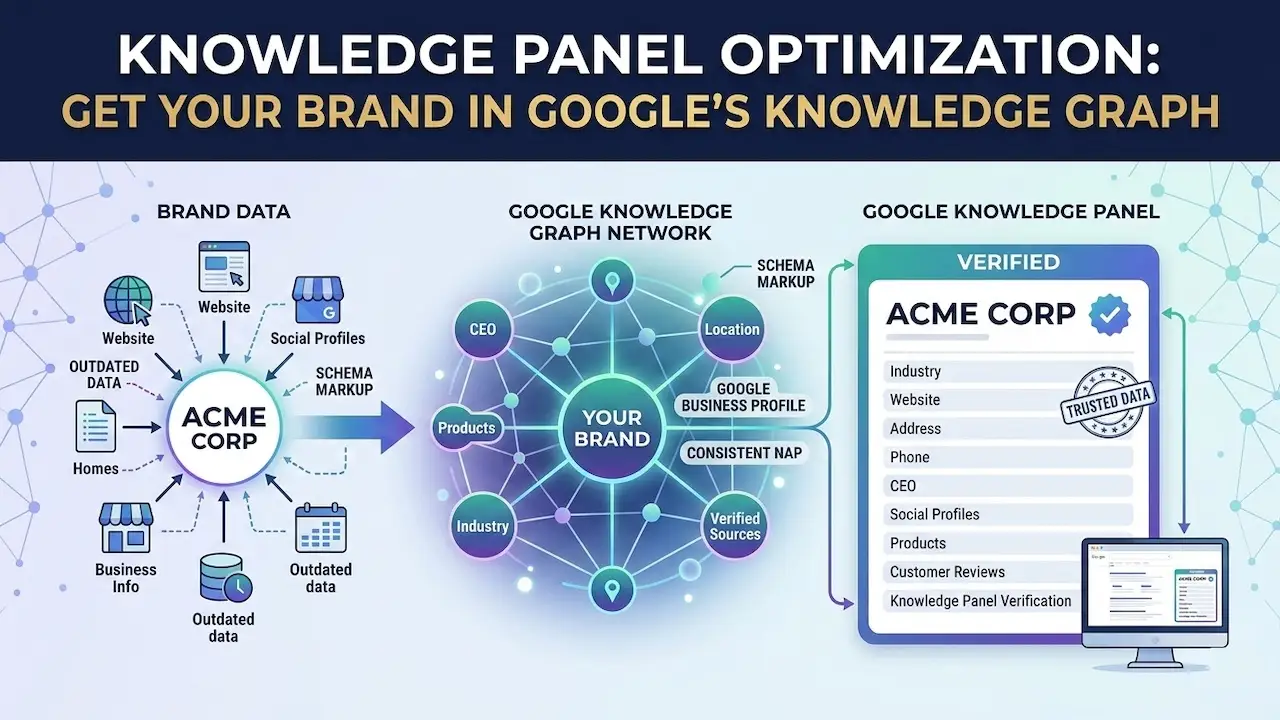
Knowledge panel optimization, and specifically Google knowledge panel optimization, builds structured entity signals so Google recognizes your brand entity in its Knowledge Graph and shows an information card on branded searches. Getting this right lets you dominate branded searches, own branded search results, get found on Google, and become a recognized entity that appears in Perplexity and ChatGPT answers automatically.
Add Organization schema with sameAs links, create a Wikidata entry, and build consistent third-party citations on Crunchbase, LinkedIn, and authoritative directories. Brands with strong entity signals appear in Google AI Overviews, Bing Copilot, and Perplexity answers automatically, without additional keyword targeting. QuickDigital has guided brands through entity based SEO and knowledge panel optimization since 2014, helping brands increase brand trust, improve brand recognition on Google, strengthen brand recognition Google users see on branded searches, and achieve brand visibility in AI search results by using proven entity SEO tools and citation strategies. This guide covers every proven step to get your brand recognized, cited, and displayed across every major AI-powered search engine.
What a Google Knowledge Panel Is and Why It Matters Now
If you are asking how to get a knowledge panel for your business, how to get a knowledge panel at all, or why your Google knowledge panel is not showing, this section answers all three. A brand knowledge panel is the most visible trust signal in any SERP knowledge panel position. It is what most people mean when they talk about knowledge panel for business or how to get a knowledge panel for my business. Knowledge panel SEO, Knowledge Graph optimization, and entity based SEO are now the same discipline because Google resolves entity graph relationships before ranking any branded query. Knowing how to optimize knowledge panel results, how to edit Google knowledge panel data, and how to claim a knowledge panel after it first appears are all sequential steps in the same process.
A Google knowledge panel is the information card on the right side of desktop search results, or at the top of mobile results, for a specific named entity. Google pulls this data from its Knowledge Graph, a semantic database of over 500 billion facts about 5 billion entities and their relationships. Google launched the Knowledge Graph with the concept of “things, not strings,” marking its shift from keyword matching to entity-based search intent resolution.
Why AI Search Makes Knowledge Panel Optimization Urgent
Google AI Overviews, Perplexity, Bing Copilot, and ChatGPT all draw entity information from the Knowledge Graph when building answers that reference specific brands. Brands confirmed in the Knowledge Graph appear in AI generated answers 2 times more frequently than brands with no entity structure, regardless of their organic ranking position. A knowledge panel is visible proof that your entity passed Google’s confidence threshold and belongs in AI generated answers. AI Overviews entity data pulls directly from the Knowledge Graph, making entity optimization the prerequisite for AI search visibility. Getting your brand into the Knowledge Graph is now the foundation of any Generative Engine Optimization (GEO) strategy.
Knowledge Panel vs Knowledge Graph vs Google Business Profile
| Term | What It Is | Primary Signal |
|---|---|---|
| Knowledge Graph | Google’s internal semantic entity database with 500 billion facts | Entity signals, structured data, corroborating sources |
| Knowledge Panel | SERP information card for a recognized named entity | Entity confidence score plus branded search demand |
| KGMID | Unique identifier Google assigns each confirmed entity | Assigned automatically after entity confirmation |
| Entity Home | Primary authoritative URL for your entity, usually your About page | Schema markup, internal linking, on-page entity signals |
| Google Business Profile | Local listing for Maps and local pack searches | NAP consistency, category selection, reviews |
| Brand SERP | All results Google shows for your exact brand name search | Digital footprint, entity attributes, knowledge panel data |
How Google Decides to Show a Knowledge Panel
Google shows a knowledge panel only when two conditions are met: your entity confidence score crosses Google’s threshold, and branded search demand for your entity name exists. Both conditions must be true simultaneously. A brand can have a high confidence score but no panel if nobody searches for it by name. A brand can have high branded search volume but no panel if Google cannot verify its entity attributes consistently across independent sources.
The Entity Confidence Score
The entity confidence score is the numeric value Google’s Knowledge Vault algorithm returns when queried for a specific entity name. The score ranges from 0.0 to 1.0 and measures one core factor: do multiple independent, authoritative sources state the same consistent facts about this entity? When the answer is yes, the score rises. When sources conflict or corroborating sources are absent, the score stagnates and panels never appear. Jason Barnard of Kalicube, whose methodology Google itself adopted to train enterprise clients, identifies this score as the single most important metric in entity SEO. Entity recognition, named entity recognition, and ontology mapping all contribute to how well Google understands and classifies your brand entity. Factual accuracy across sources directly determines where your entity confidence score lands in the entity graph.
What Raises Your Entity Confidence Score
- Consistent entity description across your homepage, Google Business Profile, LinkedIn, and press coverage, all stating the same founding year, location, and category
- High authority corroborating sources such as Wikidata, Crunchbase, Forbes, and industry trade publications that independently confirm your brand attributes
- Organization schema with sameAs links tying your domain to sources Google already recognizes as trusted entities
- Co-occurrence signals where your brand name appears alongside trusted named entities in authoritative indexed content
- Branded search volume showing Google that real users actively search for your entity name
- Entity salience achieved when your brand is the primary subject of articles, not just a passing mention
- Entity disambiguation signals that separate your brand from similarly named entities in Google’s entity graph and semantic database
- Topical authority entity signals built through consistent, expert-attributed content that AI engines associate with your brand entity relationships
- Entity verification achieved when multiple authoritative platforms independently confirm the same brand attributes and entity relationships
4 Types of Knowledge Panels You Can Optimize
Google generates 4 distinct knowledge panel types, each drawing on different data sources and needing a separate optimization path.
Brand Organization Panel
This panel type covers knowledge panel optimization for companies, agencies, SaaS products, and knowledge panel for companies of all sizes. Organization schema on your homepage drives the data, and sameAs links to Wikidata, LinkedIn, and Crunchbase drive the entity confidence score. Brand organization panels appear for corporate entities and dominate brand searches by loading above all organic listings. Brands without these panels miss a bottom-of-funnel trust signal that buyers see before visiting any page on your site. Learning how to optimize brand SERP results for your company starts with getting this panel type right.
Local Business Knowledge Panel
Knowledge panel for local business owners and brick-and-mortar brands requires a different approach than corporate entity optimization. This panel appears for businesses with a physical location. Google Business Profile is the primary data source, and selecting your most accurate primary category is Google’s strongest local entity classification signal. A local knowledge panel differs from a GBP listing: the GBP listing shows in map packs for geographic queries, while the local knowledge panel appears for direct brand name searches without any geographic radius restriction. Understanding knowledge panel vs Google Business Profile as two separate optimization targets is the first step for any location-based brand.
Person Knowledge Panel
This panel appears for public figures, executives, authors, and recognized professionals. Once a person panel is confirmed, Google links the executive’s name as clickable text inside the corporate knowledge panel. This makes personal entity optimization a brand-level priority. Person schema with worksFor, knowsAbout, and alumniOf properties combined with author bylines on high authority publications builds person entity signals fastest. Person panels have quadrupled in a 12-month period, making person knowledge panel optimization the fastest growing area of knowledge panel SEO. A knowledge panel for personal brand visibility and a knowledge panel for personal brand credibility are now inseparable from corporate entity strategy.
Product Knowledge Panel
This panel appears when a user searches for a specific named product, not a broad category. Google pulls data from Google Merchant Center, product schema, and seller profiles. Winning the seller section inside a product panel places your brand directly next to competitors’ pricing and return policies, making it prime transactional real estate for ecommerce brands.
Knowledge Panel Optimization: Step by Step
Knowledge panel optimization follows a specific sequence, and skipping steps is the most common reason brands build dozens of citations but never trigger a panel. Build the entity home first. Add schema second. Build third-party citations third. This order matters because schema markup without a strong entity home points authoritative sources toward a weak foundation.
Step 1: Build a Strong Entity Home Page
Your entity home is the single canonical URL Google designates as the definitive source of truth for your brand. Write one clear, factual brand description and repeat it verbatim across every platform. Include your brand name, what you do, when you were founded, where you operate, and your primary differentiator. Keep each sentence under 17 words. Avoid marketing language. Google reads this as structured factual input for its Knowledge Vault, not advertising copy. Internal link your homepage to your About page, team profiles, and key service pages. This semantic network within your domain signals entity ecosystem depth to Google’s crawlers.
Step 2: Add Organization Schema with sameAs Links
Place Organization schema in a JSON-LD schema block inside your homepage head section, using a script tag with type application/ld+json. The sameAs property is the single most powerful entity signal you directly control. It tells Google that your website, LinkedIn, Crunchbase, and GBP all represent the same real-world entity. Add at minimum: your Wikidata Q-ID URL, LinkedIn company page, Crunchbase profile, and Google Business Profile URL. For the complete schema implementation process, see the schema markup for AEO guide. Also validate your schema through Google’s Rich Results Test, which functions as a schema markup validator for every structured data type. Syntax errors block entity relationships from being mapped correctly. Syntax errors block entity signals entirely without showing any visible browser error.
Step 3: Create or Optimize a Wikidata Entry
Wikidata feeds directly into Google’s Knowledge Graph with the lowest entry barrier of any major authority source. Wikidata-verified brands are 3.2 times more likely to earn a knowledge panel and 2.7 times more likely to appear in Google AI Overview citations, according to Kalicube’s analysis of over 75,000 tracked brands. The process of how to create Wikidata entry for business is simpler than most SEO professionals expect. Go to wikidata.org, register, and add a new item. Include your official name, entity type (Q4830453 for a business), official website, founding date, and links to your social profiles. Map your entry to a Wikidata Q-ID and add that Q-ID URL to your Organization schema sameAs array. An Ahrefs case study confirmed their knowledge panel appeared within 7 days of updating their Organization schema with a Wikidata sameAs link.
Step 4: Build Authoritative Third-Party Citations
Google’s Knowledge Vault needs independent corroboration from multiple sources stating the same consistent facts about your brand. Self-reported data on your own website is one input. Third-party sources that confirm the same facts independently are what raise the entity confidence score. Build corroboration across 30 or more authoritative sources to reach the confidence score needed for a full knowledge panel. The type of sources that matter most depends on your brand category.
| Brand Type | High Impact Citation Sources |
|---|---|
| SaaS and software brands | G2, Capterra, Crunchbase, StackShare, GitHub organization page |
| Agencies and service firms | Clutch, GoodFirms, DesignRush, Semrush Agency Partners |
| B2B companies | LinkedIn company page, Bloomberg, Dun and Bradstreet, Craft.co |
| Ecommerce and product brands | Amazon brand registry, Better Business Bureau, Trustpilot, Google Merchant Center |
| Local businesses | Yelp, TripAdvisor, Apple Maps, Bing Places, Foursquare |
| Personal brands | Author pages on Forbes, Entrepreneur, IMDb, ORCID, podcast directories |
Step 5: Claim Your Knowledge Panel
Once Google generates a panel, claim it immediately. A knowledge panel claim and a knowledge panel edit are the two actions available once Google generates your panel. Knowing how to claim a Google knowledge panel and how to edit Google knowledge panel data correctly are the two most underused tools in brand entity management. Claiming gives you the ability to suggest edits, and Google prioritizes verified suggestions over anonymous feedback, processing them within 3 to 7 business days. Search your brand name on Google, click “Claim this knowledge panel,” and verify ownership through Google Search Console or a verified social account tied to your entity home page URL. After claiming, your suggested corrections carry higher weight with Google’s editorial review team.
Step 6: Optimize Google Business Profile for Local Entities
Google Business Profile is the fastest path to a local knowledge panel. Select the most accurate primary category, since this single field is Google’s strongest local entity classification signal. Add services, hours, photos, and a description that matches your entity home copy exactly. Link your GBP URL in the sameAs property of your LocalBusiness schema. For a full GBP setup walkthrough, the Google Business Profile optimization guide covers every local entity signal in order of impact.
Step 7: Build Person Entity Signals for Executives
Your executives are entity signals for your brand, not separate from it. Google links confirmed executive names as clickable text inside corporate knowledge panels. Each person panel strengthens the parent organization panel directly. Add Person schema to every executive profile page and connect each person entity to your organization via the worksFor property in your JSON-LD. Author bylines on high authority publications like Forbes, Search Engine Land, or industry trade press are the strongest corroborating signal for person entity confidence scores.
Step 8: Monitor Entity Health Monthly
Knowledge panel data changes when Google recrawls corroborating sources or when competitors claim similar entity attributes. Monitor your entity health every 30 days using these specific tools:
- Google Search Console entity signals — Track branded query impressions and click rates. These are direct entity demand signals that Google uses to validate whether your brand entity has sufficient search volume to justify a panel
- Google Knowledge Graph Search API — Query your entity name directly to retrieve your KGMID and resultScore on a monthly basis
- Semrush Organic Rankings — Filter by Knowledge Panel SERP feature to identify which branded keywords trigger a panel
- KalicubePro — The leading entity SEO tool. Tracks knowledge panel changes, confidence score movements, and optimization priorities across 75 million brands
- Google Alerts — Monitor new brand mentions for citation opportunities and incorrect information
- BrightLocal or Moz Local — Audit NAP consistency across directories and identify citation discrepancies that harm entity disambiguation
Knowledge Panel Optimization for AI Search: GEO and AEO
Knowledge panel optimization and Generative Engine Optimization share the same entity foundation: direct facts, consistent structured data, and multi-source corroboration. An Knowledge panel optimization for AI search works because generative engines use entity graph data as a citation filter. When Perplexity processes a query like “best digital marketing agencies in India,” it queries its knowledge base for entities classified as agencies with an India location signal. Brands with Wikidata Q-IDs, Organization schema, and consistent corroborating citations surface because their entity attributes are machine readable.
Brands with only keyword-optimized pages but no entity structure do not surface in AI generated answers. You can get cited by AI engines, rank in AI-powered search, and appear in Perplexity and ChatGPT when your entity is confirmed in the Knowledge Graph. All of this depends on the same entity signal foundation that powers your knowledge panel. This is what GEO entity and AEO entity optimization mean in practice: your entity attributes must be machine-readable before any AI engine will cite you with confidence.
Your Google AI Overviews optimization depends on entity clarity first, content volume second. Understanding Answer Engine Optimization (AEO) alongside knowledge panel optimization gives your brand full coverage across AI search engines. Also read the semantic SEO and entity optimization guide to build topical depth around each entity attribute cluster and the EEAT trust and authority guide to strengthen the trustworthiness signals Google’s quality raters look for when validating entity-attributed content.
GEO Specific Entity Actions for AI Search Visibility
- Add knowsAbout properties to Organization schema listing your core service categories as string values that AI engines can read and reproduce
- Use areaServed to link your entity to specific geographic Wikipedia pages for regional entity association and location-based AI query matching
- Write your brand description as one standalone declarative sentence that any AI can extract, reproduce, and cite accurately without surrounding context
- Publish original research with verifiable data that third-party publications cite, creating entity-attributed co-occurrence in authoritative indexed content
- Add Person schema to executive profiles and link them to your Organization via worksFor to build relational entity signals Google and AI engines both use
- Track your KGMID monthly so any entity drift or incorrect attribute is caught and corrected before it lowers your confidence score and AI citation rate
- Monitor Perplexity citations and Bing Copilot entity mentions monthly by running your brand name through both platforms to verify your entity attributes are displayed correctly
- Build LinkedIn entity signals by keeping your LinkedIn company page description exactly matching your entity home page and Wikidata entry
5 Mistakes That Block Your Knowledge Panel
1. Inconsistent NAP Data Across Citation Sources
When your name, address, and phone number conflict across your website, GBP, Yelp, and directories, the Knowledge Vault lowers your entity confidence score and blocks panel generation. Audit every listing before building new citations. Fix founding year, legal name, and contact detail discrepancies first. One address format variation across 20 listings is enough to block entity confirmation entirely. Run BrightLocal or Semrush Listing Management to find and fix every discrepancy before adding any new citations.
2. Missing or Incomplete sameAs Links
Many brands add Organization schema but leave sameAs empty or include only one link. Google needs at least 5 high authority sameAs targets to build meaningful entity corroboration. Each link tells Google that your website and those external profiles represent the same real-world entity. Without sameAs, the schema tells Google your name but provides no independent verification of your identity. Add Wikidata, LinkedIn, Crunchbase, and GBP at minimum, then expand to Wikipedia and industry-specific authority sources.
3. Building Schema Before the Entity Home Page
Schema markup without a strong entity home page points authoritative sources toward a weak foundation. Google needs one primary URL designated as the canonical source of entity truth before corroborating sources can have their full impact on the confidence score. Build the entity home first. Add schema second. Build third-party citations third. This is the most common reason a brand builds dozens of citations but never gets a panel to appear.
4. Ignoring Person Entity Optimization
Your executives are entity signals for your brand, and ignoring person entity optimization weakens your entire corporate panel. Google links confirmed executive names as clickable text inside corporate knowledge panels. Each person panel directly strengthens the parent organization panel. Brands that treat executive profiles as separate from brand SEO consistently underperform brands that build integrated person and organization entity structures together.
5. Relying on a Single Corroborating Source
Even with a strong Wikipedia article, you still need consistent descriptions on LinkedIn, Crunchbase, GBP, and earned press coverage for maximum entity confidence. Multi-source consistency is the most future-proof strategy. In Google’s largest Knowledge Graph cleanup, 3 billion low-quality entities were removed. Only consistently corroborated entities survived. Brands relying on a single source lost their panels overnight and had no secondary signals to recover from. When a knowledge panel disappeared after Google’s Knowledge Graph cleanup, single-source brands had no corroboration to restore the confidence score. Google knowledge panel not showing for a brand that previously had one almost always traces back to this single-source vulnerability.
How Long Does Knowledge Panel Optimization Take
Building a panel for a new or unrecognized entity takes 3 to 12 months depending on existing brand authority and how quickly third-party corroboration accumulates. A Wikidata entry alone can trigger an initial panel in 7 days, but a rich, fully optimized panel takes sustained entity maturity over a longer period.
| Brand Status | Expected Timeline | Primary Bottleneck |
|---|---|---|
| Established brand with Wikipedia | 2 to 4 weeks | Schema and sameAs implementation |
| Known brand without Wikipedia | 1 to 3 months | Wikidata entry and citation building |
| Growing brand with moderate authority | 3 to 6 months | Third-party corroboration and brand search volume |
| New brand with no entity signals, knowledge panel for new business | 6 to 12 months | Building authority and earned press coverage |
Consistency across schema, citations, and entity home optimization matters more than short bursts of activity. Brands that invest in entity clarity early hold a structural advantage that late movers find difficult to replicate quickly. Also read our Perplexity AI optimization guide to understand how entity signals feed directly into Perplexity’s citation decisions alongside your knowledge panel work.
Entity SEO Since 2014
Get Your Brand Into Google’s Knowledge Graph and Every Major AI Engine
QuickDigital builds your entity home page, Organization schema, Wikidata entry, sameAs citation network, and entity confidence score. Your brand gets recognized and cited across Google, Perplexity, Bing Copilot, and every major AI search engine.
Entity signals. Knowledge panel. AI citations. One complete strategy.
Knowledge Panel Optimization FAQs
Add Organization schema with sameAs links to your homepage, create a Wikidata entry, build 5 or more third-party citations, and claim your Google Business Profile. Google generates a panel once its Knowledge Vault algorithm reaches sufficient entity confidence and detects branded search demand for your entity name.
Schema alone is not enough. Google also requires corroborating third-party sources, branded search demand, and a consistent entity home page. When your sameAs links are missing, the Knowledge Vault cannot confirm your entity. Build a Wikidata entry and align your brand description across at least 5 authoritative platforms.
Yes, directly. AI engines filter brand citations using Knowledge Graph entity data. Wikidata-verified brands appear in AI Overview citations 2.7 times more often than unverified brands. A confirmed entity gets cited at a higher rate regardless of keyword ranking position.
Yes. Person knowledge panels use Person schema with worksFor, knowsAbout, and jobTitle. Author bylines on high authority publications are the strongest corroborating signal for person entities. Google links confirmed executive names as clickable text inside corporate knowledge panels, making this a brand-level priority.
A Wikidata entry can trigger an initial knowledge panel in as few as 7 days. Most established brands see a panel within 1 to 3 months of adding Organization schema, sameAs links, and a Wikidata entry. New brands typically need 6 to 12 months of consistent entity signal building before Google generates a panel.