


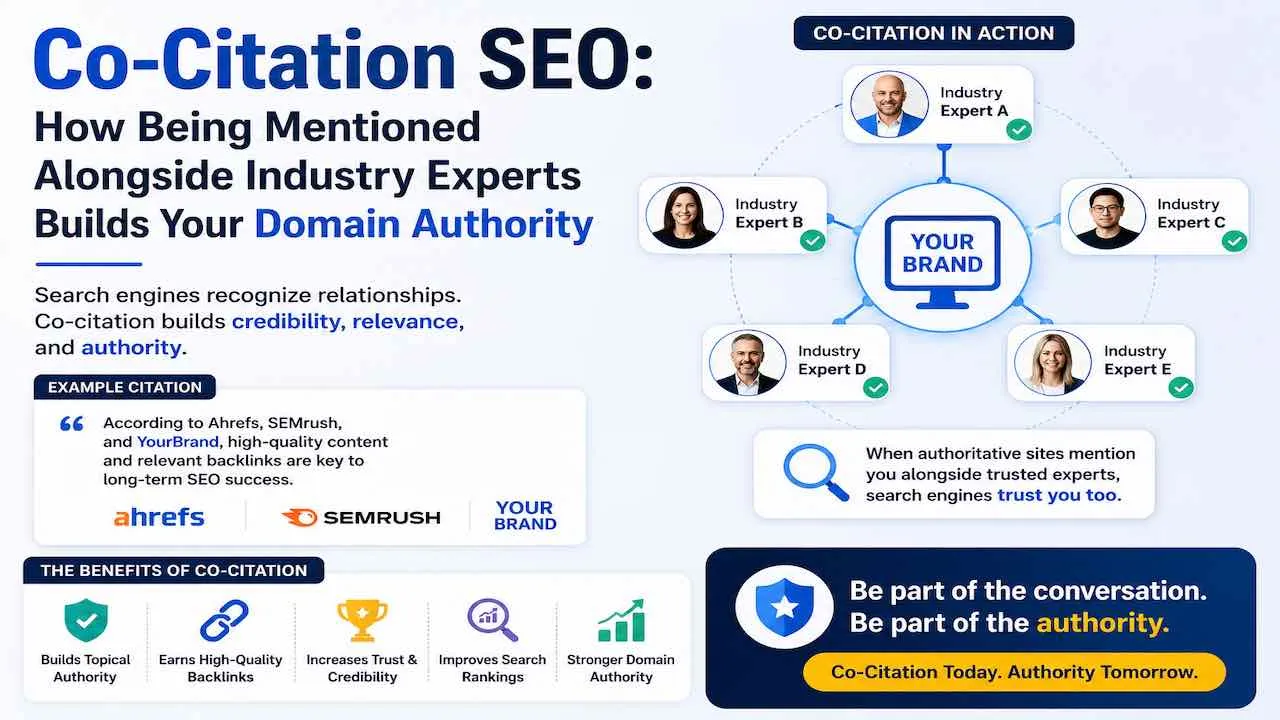
Co-citation SEO is the practice of getting your brand mentioned in the same content as recognized industry authorities, so Google’s NLP systems classify your entity as belonging to the same trusted expert neighborhood in the Knowledge Graph. A co-citation does not require a backlink. It requires your brand name to appear near entities Google already trusts as authoritative in your niche. Each co-citation on a DR70+ publication raises your entity salience score, strengthens topical authority signals, and builds the semantic proximity that places your brand among the experts your buyers search for by name.
Most SEO guides mention co-citation in a single paragraph. This guide explains the full mechanism: the academic origins that shaped how Google reads co-citation today, how BERT processes entity proximity, how the authority halo effect transfers entity trust between co-cited brands, how Koray Tugberk GUBUR’s entity clustering principle makes co-citation placement measurable, how to audit your co-citation profile and analyze competitors, how to avoid negative co-citation risks, and exactly how DR70+ placements now feed AI search citations across ChatGPT, Perplexity, and Google AI Overviews.
Quick Digital places your brand in co-citation contexts on DR70+ publications alongside Ahrefs, Moz, and Semrush, and delivers a co-citation placement report showing every placement, every co-cited authority, and every entity neighborhood edge built. Get your co-citation placement report.
The Academic Origins of Co-Citation SEO
Co-citation analysis was developed by academic bibliometricians in the early 1970s to measure intellectual relationships between scientific papers. Eugene Garfield at the Institute for Scientific Information and Henry Small in a landmark paper established that two documents cited together by a third document share a meaningful intellectual relationship. Papers frequently co-cited together cluster into the same academic discipline in citation maps. This is bibliographic coupling: the more often two sources are cited together, the more strongly related they are in the eyes of the academic community citing them.
Google’s founders Larry Page and Sergey Brin built PageRank on academic citation analysis principles. Google’s Knowledge Graph extended this to named entities: brands, people, organizations, and concepts. The same logic that identifies co-cited academic papers as intellectually related now identifies co-cited brand entities as topically and authoritatively related. When Search Engine Journal lists Quick Digital alongside Ahrefs and Moz in an SEO tools roundup, Google reads that editorial grouping using the same co-citation logic that Eugene Garfield applied to scientific papers. The brand entity that appears in the same editorial context as recognized authorities earns the same semantic association in the Knowledge Graph that co-cited academic papers earn in citation analysis databases.
Co-Citation vs Backlinks: The Fundamental Difference
A backlink passes link equity directly from one domain to another through a hyperlink. A co-citation passes entity association signals through editorial proximity without requiring any hyperlink. The two signals serve different ranking mechanisms. Backlinks raise domain authority and flow PageRank to specific pages. Co-citations raise entity authority by placing your brand in the same semantic context as recognized entities Google already trusts. Co-citation SEO link building targets entity signals in the Knowledge Graph. The strongest editorial placements earn both: a backlink to your site and a co-citation alongside recognized niche authorities in the same sentence. Read our brand mentions vs backlinks SEO guide for a full comparison of how each off-page signal contributes to traditional and AI search rankings.
Co-Citation vs Co-Occurrence: The Critical Distinction
Co-citation requires editorial intent: your brand and a recognized authority are grouped together in a list, comparison, or recommendation in the same indexed content. Co-occurrence simply means two terms appear somewhere on the same page. Appearing on the same 5,000-word page as Ahrefs sends a weak co-occurrence signal. Appearing in the same sentence as Ahrefs in a top-tools roundup sends a strong co-citation signal because Google’s NLP reads editorial intent behind the proximity. Co-citation requires an editorial decision by the publisher. Co-occurrence requires only that two entities appear somewhere on the same indexed page, with no editorial grouping required. The NLP signal strength difference between these two is significant enough to treat them as separate optimization targets entirely.
Does Google Use Co-Citation as a Ranking Signal
Google’s Patent Language on Entity Co-Citation
Google’s patent US 8,682,892 “Ranking Search Results” describes a system that uses both express links and implied links when determining ranking modifications, where an implied link is defined as a reference to a target resource that is not a clickable hyperlink. Related Google patents describe systems that measure “entity co-occurrence” and “contextual entity relationships” as inputs to topical authority scoring. While Google has not officially named “co-citation” as a ranking factor, its patent literature describes the underlying mechanism clearly. BERT’s bidirectional contextual processing reads which named entities appear near which other named entities in indexed text. The entity that consistently appears near recognized authorities builds entity relationship signals that feed the Knowledge Graph entity neighborhood. Whether Google calls it co-citation or contextual entity association, the mechanism produces measurable ranking effects.
What Bing Confirmed About Entity Association Signals
Bing publicly confirmed at SMX West that it uses unlinked brand mentions as a ranking signal, including the context and sentiment surrounding those mentions. Duane Forrester, formerly senior product manager at Bing, stated that Bing figures out authority from mentions without links by reading the editorial context around a brand name. The same editorial context reading that makes unlinked mentions valuable also makes co-citation with trusted entities a stronger signal than a standalone unlinked mention. Being mentioned alone in an article and being mentioned alongside Ahrefs and Moz in the same sentence carry different editorial weight. Bing’s confirmed use of this mechanism demonstrates the technical capability exists in major search engines, and the indirect evidence for Google applying similar logic is consistent across patent literature, Knowledge Graph behavior, and entity ranking patterns.
The Hummingbird and Knowledge Graph Connection
Google’s Hummingbird update shifted Google from keyword matching to entity-based query understanding, making co-citation signals the primary mechanism by which brand entity authority is evaluated relative to topic clusters. Before Hummingbird, authority was measured primarily through backlink quantity and quality. After Hummingbird, authority became increasingly entity-relational: who is your brand associated with, which topics does it cluster within, and which recognized entities does it consistently appear alongside in editorial content. The Knowledge Graph maps these entity relationships. Co-citation placements on authoritative publications add direct edges to that map. Each edge placed through co-citation SEO link building moves your brand entity closer to the center of the expert cluster in your niche, producing broader organic ranking coverage across all queries Google associates with that cluster.
Why Entity Clustering Makes Co-Citation a Powerful Ranking Signal
Koray’s Entity Clustering Principle
Koray Tugberk GUBUR’s semantic SEO methodology identifies entity clustering as the process by which Google groups topically related entities into clusters within the Knowledge Graph, and your brand’s cluster membership directly determines how broadly you rank across topic-related queries. Every time your brand is co-cited alongside Ahrefs, Moz, or Semrush in authoritative indexed content, Google’s entity relationship mapping adds a connection between your brand entity and those recognized entities. Over time, your brand entity migrates into the same Knowledge Graph cluster as the authorities you are consistently co-cited with. That cluster membership raises your entity salience score for every query in the cluster’s topic space. Our semantic SEO and entity optimization guide covers how entity cluster membership translates into ranking breadth across generative and traditional search simultaneously.
How BERT Reads Co-Citation Context
BERT processes text bidirectionally and builds contextual representations of each entity it encounters based on which other entities appear near it in the same passage. When BERT processes a sentence like “leading SEO platforms including Ahrefs, Semrush, Moz, and Quick Digital,” it builds a contextual entity representation of Quick Digital as a peer of the three recognized authorities in that sentence. Named entity recognition identifies each brand as a distinct entity. BERT’s contextual processing places them in semantic proximity. Passage indexing extracts that passage as an independent entity association signal even when the surrounding article ranks at position 15. This is how co-citation produces ranking effects for brands whose pages do not yet rank organically for the same queries their co-cited authorities dominate.
The Authority Halo Effect
The authority halo effect is the entity authority transfer that occurs when a recognized expert entity appears in the same editorial context as your brand, lending a measurable portion of its Knowledge Graph authority to your entity through consistent co-citation proximity. When Ahrefs is co-cited with your brand in ten or more DR70+ publications, some of Ahrefs’ established entity authority halos onto your brand in the Knowledge Graph’s entity relationship model. This authority halo effect is why co-citation placement with the highest-authority entities in your niche produces the largest entity salience gains. Being co-cited once with Ahrefs on a DR85 publication carries more authority halo weight than 50 co-citations with Tier 3 sources. The authority of the co-cited entity directly influences how much entity salience your brand earns from each co-citation placement.
The Knowledge Graph Entity Neighborhood
Google’s Knowledge Graph maintains an entity neighborhood for every confirmed entity: a set of related entities Google associates with yours based on consistent co-citation signals across multiple authoritative indexed sources. A brand consistently co-cited with Ahrefs and Moz across ten or more DR70+ publications builds an entity neighborhood that includes those recognized authorities. When Google processes queries about SEO tools, agencies, or resources, your brand surfaces as a semantically proximate result because your entity neighborhood overlaps with the recognized authorities the query is about. Our knowledge panel optimization guide shows how entity neighborhood membership feeds knowledge panel richness and AI Overview citation frequency directly.
How Co-Citation Builds Domain Authority Without a Link
Topical Authority Through Semantic Proximity
Semantic proximity in co-citation signals directly raises topical authority for the specific topic cluster in which the co-citation occurs. A co-citation alongside Ahrefs and Moz in an SEO tools article places your brand in the SEO tools entity cluster. A co-citation alongside Backlinko and Search Engine Journal in a link building guide places your brand in the link building authority cluster. Each co-citation adds a weighted edge to your entity’s position within that cluster in the Knowledge Graph. As co-citation density increases across multiple authoritative sources, your entity salience score within the cluster rises. Higher entity salience produces broader organic ranking coverage across all queries Google associates with that cluster. Our EEAT trust and authority guide explains how entity salience feeds the Expertise and Authoritativeness dimensions of Google’s quality evaluation directly.
Co-Citation and AI Search Visibility
Large language models learn brand associations from the text they train on, and consistent co-citation of your brand alongside recognized industry authorities builds direct AI citation authority that no amount of backlink building alone can replicate. When Perplexity AI processes a query like “what are the best SEO agencies,” it references indexed content and training data. Brands appearing consistently alongside recognized SEO authorities in that content get cited in AI responses alongside those authorities. About 85% of brand mentions in AI search citations come from sites the brand does not own or control. Co-citation authority earned on DR70+ publications today feeds AI search citations as LLMs continue training on current indexed content. Read our Answer Engine Optimization guide and GEO guide to integrate co-citation building into your full AI search visibility strategy.
Co-Citation vs Co-Occurrence: Full SEO Comparison
| Factor | Co-Citation | Co-Occurrence |
|---|---|---|
| Definition | Brand grouped editorially with a recognized authority in the same content | Two terms appearing anywhere on the same indexed page |
| Editorial intent required | Yes, publisher actively groups your brand with recognized authorities | No, incidental proximity on the same page is sufficient |
| NLP signal strength | Strong, BERT reads entity proximity in the same sentence or paragraph | Weak, entities separated by thousands of words carry minimal association |
| Authority halo effect | Yes, authority transfers from co-cited entity to your brand entity | No, incidental co-occurrence does not trigger authority transfer |
| Knowledge Graph impact | Builds entity neighborhood edges between your brand and co-cited authorities | Minimal, incidental co-occurrence does not reliably build entity edges |
| AI training data signal | Strong, LLMs build statistical associations between co-cited entities | Weak, page-level co-occurrence does not build reliable LLM associations |
| Measurable with tools | Yes, via Ahrefs, Majestic Trust Flow context, Knowledge Graph API | Yes, via Semrush, Moz, and on-page content analysis tools |
| Actionability | High, targetable through digital PR and editorial co-citation placement campaigns | Medium, requires content creation and on-page topic clustering |
Types of Co-Citation and Their SEO Value
Direct Co-Citation
Direct co-citation is when your brand and a recognized authority appear in the same sentence or bulleted list in an indexed editorial piece. This is the strongest co-citation type because BERT’s NLP reads the highest entity proximity signal when two brand entities share a single sentence or a tightly grouped list item. A roundup article that includes “Quick Digital, Ahrefs, and Moz are the top agencies and tools for link building” creates direct co-citation with maximum entity proximity. Target direct co-citation placements on DR70+ publications as the primary metric in any co-citation SEO link building campaign.
Bibliographic Coupling
Bibliographic coupling in SEO occurs when multiple authoritative publications all cite both your brand and a recognized authority, creating a cross-publication co-citation network that reinforces the entity association in the Knowledge Graph. If Forbes, Search Engine Journal, and HubSpot all mention Quick Digital alongside Ahrefs in separate articles on the same topic, the three-source bibliographic coupling creates a much stronger entity neighborhood edge than a single mention in any one of those publications alone. This is the principle behind co-citation link building at scale: the more sources that co-cite your brand with the same authority, the more confidently Google’s Knowledge Graph confirms the entity relationship.
Implicit Co-Citation
Implicit co-citation occurs when an article references your brand’s specific methodology, research, or tool by name without naming the brand itself, while also referencing a recognized authority directly. If a Forbes article discusses “the entity clustering approach” (a method associated with Koray and Quick Digital) in the same piece as a named reference to Ahrefs, the implicit co-citation still builds a weaker entity proximity signal because Google’s NLP associates your methodology with your brand entity through prior indexed content. Implicit co-citation is less reliable than direct co-citation but still contributes to topical entity clustering signals when your brand’s unique methodology or framework is referenced consistently.
Internal Co-Citation and Semantic Clustering
Internal co-citation is the practice of mentioning multiple of your own service pages, tools, or content pieces in the same article, creating semantic clustering signals within your own domain that tell Google your entity covers all aspects of a topic cluster. Mentioning your co-citation guide, your entity link building guide, your brand mentions guide, and your guest post service in the same content piece creates an internal co-citation network. Google reads that network as evidence that your domain is a complete entity on the link building topic cluster, not just a single-page resource. This internal semantic clustering reinforces your entity’s topical authority signals across the full cluster. Our entity link building strategy guide and our unlinked brand mentions ranking signal guide are part of Quick Digital’s internal co-citation network for the link building topic cluster.
How to Audit Your Co-Citation Profile
A co-citation audit identifies which entities Google currently associates your brand with, which tier of authorities you are co-cited alongside, and which publication types generate the strongest entity neighborhood signals for your brand. Run this audit quarterly to track co-citation profile growth and identify new gaps before competitors fill them.
Co-Citation Analysis Tools
| Tool | Co-Citation Function | Best For |
|---|---|---|
| Ahrefs Content Explorer | Search brand name and filter for pages also mentioning target authorities | Finding indexed co-citation placements and mapping co-cited entities |
| Majestic Trust Flow | Topical Trust Flow shows which topic clusters your link and mention profile places you in | Identifying your current topical co-citation cluster membership |
| Semrush Brand Monitoring | Real-time tracking of brand mentions with filtering for co-cited entities | Monitoring new co-citation placements as they are indexed |
| Google Knowledge Graph API | Returns your entity’s associated entities, reflecting current entity neighborhood built from co-citation signals | Measuring co-citation-driven entity neighborhood evolution monthly |
| Google Search Console | Brand query impressions reflect Navboost signals generated by co-citation-driven brand awareness | Tracking branded search growth as a co-citation impact signal |
| Manual Google Search | Search brand name in quotes alongside target authority names to find indexed co-citations | Quick spot-checks for specific co-citation placement verification |
Competitor Co-Citation Analysis
Competitor co-citation analysis reveals which authorities your competitors are consistently co-cited with, identifying the specific entity neighborhood edges they have built that you have not. Run your top three competitors’ brand names through Ahrefs Content Explorer. Filter for pages where each competitor appears alongside recognized niche authorities. Export the results and compare which authorities each competitor is co-cited with most frequently. The authorities appearing in your competitors’ co-citation profiles but absent from yours represent your highest-priority co-citation gap targets. Build co-citation placements alongside those specific entities on the publications where your competitors are already cited to close the entity neighborhood gap that is contributing to their broader topical ranking coverage.
How to Build Co-Citation Signals on DR70+ Publications
The Expert Mention Strategy
The most reliable method for earning co-citation placement alongside recognized authorities is contributing original expert commentary to publications that regularly feature those authorities. Target Search Engine Journal, Search Engine Land, Semrush Blog, Ahrefs Blog, HubSpot, and Forbes where recognized niche authorities appear regularly. When a journalist or editor quotes your expert alongside quotes from recognized authorities in the same piece, that editorial placement creates a direct co-citation signal. All co-cited brand names appear in the same indexed article with clear editorial intent to group them as peers. Google cannot ignore your brand when it repeatedly appears in the same editorial context as the entities it already trusts.
Content Formats That Generate Direct Co-Citation
- Tool and platform roundups: “Best SEO tools” articles group your brand alongside recognized platforms. A single placement in a DR75+ roundup creates co-citation signals with every other entity in the same article, building multiple entity neighborhood edges from one placement.
- Expert opinion roundups: “X experts share their view” articles place your expert quote directly alongside quotes from recognized voices. BERT reads all contributors as peers sharing the same editorial co-citation context.
- Comparative guides: “Agency A vs Agency B vs Quick Digital” articles create the strongest direct co-citation signal because editorial comparison is the clearest form of peer grouping that Google’s NLP systems read.
- Original research citations: Publishing original data that recognized authorities cite in their content creates reverse co-citation, where Ahrefs or Moz appear alongside your brand because they are citing your research as a peer source. Our original research link building strategy guide covers how to build this reverse co-citation mechanism systematically.
- Awards and recognition lists: Industry award articles co-cite all listed winners in the same editorial context, creating co-citation signals with every other recognized brand in the same category.
Avoiding Negative Co-Citation Risks
Negative co-citation occurs when your brand appears alongside low-quality, spammy, or penalized entities in indexed content, sending inverse entity association signals that can lower your co-citation score and topical authority within the affected cluster. A brand listed alongside known spam services, penalized agencies, or low-quality directories in the same content piece builds a negative entity neighborhood edge. Bing’s confirmed sentiment analysis around brand mentions means negative editorial context, such as being named in a “services to avoid” list alongside penalized competitors, can actively signal reduced authority. Audit your existing co-citation profile for any low-quality or negative context placements. Contact publishers to request removal or correction of any co-citation contexts that associate your brand with low-trust entities. Our digital PR and AI citation guide covers how to protect your co-citation profile through proactive editorial relationship building.
Co-Citation in Local SEO
In local SEO, NAP citations are a form of co-citation: your business Name, Address, and Phone number appearing alongside your business category in authoritative local directories creates entity co-citation signals that confirm your local entity type and service area to Google’s local ranking algorithm. A plumber listed alongside other plumbers in Justdial, Sulekha, and Yelp for “plumbers in Ahmedabad” creates local co-citation that signals to Google your business belongs in the plumber entity cluster for that geographic area. Local co-citation audits use the same tools as standard co-citation analysis, filtered for geographic relevance. NAP consistency across all local co-citation sources is the local SEO equivalent of brand name consistency in editorial co-citation: inconsistent data sends entity disambiguation signals that lower your local entity confidence score. Our local SEO services include local co-citation building as a core deliverable alongside Google Business Profile optimization for complete local entity authority building.
Co-Citation Signals by Publication Tier
| Tier | Publication Examples | DR Range | Entity Salience Lift | AI Citation Weight | Authority Halo Strength |
|---|---|---|---|---|---|
| Tier 1 | Forbes, TechCrunch, Search Engine Land, Search Engine Journal | DR 80+ | Highest. Direct Knowledge Graph cluster upgrade | Highest. These sources dominate LLM training corpora | Maximum. Strongest authority halo transfer available |
| Tier 2 | Ahrefs Blog, Semrush Blog, HubSpot, Backlinko, Moz Blog | DR 65 to 80 | High. Builds topical co-citation within the niche cluster | High. Well-represented in AI training data | High. Recognized niche authority halo carries strong signal |
| Tier 3 | Niche industry blogs, regional business publications, newsletters | DR 40 to 65 | Medium. Builds co-citation volume but limited salience gain | Medium. Contributes to co-citation density | Low. Limited authority halo from mid-tier sources |
| Negative risk | Spam blogs, penalized sites, low-quality paid placement networks | Under DR 40 | Harmful. Negative entity association in Knowledge Graph | Filtered from LLM training data | Inverse halo. Lowers brand entity trust score |
How to Measure Co-Citation SEO Impact
Citation Velocity and Co-Citation Score
Citation velocity is the rate at which new co-citations are added to your brand’s profile over a given period, and it functions as a freshness signal in co-citation analysis: steady citation velocity signals active editorial recognition, while sudden spikes followed by silence can signal unnatural patterns. Track your citation velocity monthly using Ahrefs Content Explorer filtered for new brand mentions. A consistent monthly growth in co-citation placements on DR65+ publications signals healthy editorial co-citation building. Your co-citation score is the aggregate measure of the authority of all entities your brand is co-cited with, weighted by the domain authority of the publication where each co-citation appears. Majestic’s Topical Trust Flow provides a proxy metric for measuring which topic clusters your co-citation profile places you in and how strongly your brand entity sits within each cluster.
Four Measurable Co-Citation Impact Signals
- Knowledge Graph entity neighborhood (monthly): Query the Google Knowledge Graph API for your brand. Track which related entities appear in the API response. New Tier 1 authority entities appearing in your neighborhood confirm that co-citation placements are building entity relationship edges in the Knowledge Graph.
- Branded search volume in Google Search Console (monthly): Rising branded impressions confirm that co-citation placements on authoritative publications are generating Navboost-feeding brand queries from new audiences who encountered your brand alongside recognized authorities.
- Topical ranking breadth in Ahrefs (quarterly): Track organic ranking positions for non-branded topical queries you have not specifically optimized for. Rising positions across these queries indicate entity salience gains from co-citation-driven entity cluster membership, not from traditional on-page optimization.
- Unprompted AI citation rate (quarterly): Query ChatGPT, Perplexity AI, and Google AI Overviews with category-level questions in your niche. Track how often your brand appears alongside recognized authorities without being directly asked about. Rising unprompted AI citation rates directly reflect growing co-citation authority across the publications those LLMs train on.
Co-Citation Strategy by Business Stage
| Stage | Co-Citation Priority | Target Tier | Expected Outcome |
|---|---|---|---|
| New brand (0 to 12 months) | 3 to 5 Tier 1 or Tier 2 placements alongside recognized entities | Tier 1 and 2 only | Seeds initial entity neighborhood edges in Knowledge Graph |
| Growing brand (12 to 36 months) | Monthly Tier 2 placements plus quarterly Tier 1 targets | Tier 1 and 2 | Bibliographic coupling across multiple publications builds entity cluster membership |
| Established brand with link profile | Focus shifts to closing entity neighborhood gaps identified in competitor co-citation analysis | Tier 1 | Authority halo from missing Tier 1 co-citations produces largest ranking breadth gains |
| AI search-focused brand | High-volume Tier 1 and Tier 2 co-citations in training-data-rich publications | Tier 1 and 2 | LLM associations between your brand and recognized authorities produce unprompted AI citations |
| Local business | NAP consistency across local directories plus niche local co-citation building | Local Tier 1 directories | Local entity cluster membership for geographic queries in Google Maps and local pack |
For all business stages, the highest-return co-citation placements are editorial pieces that deliver both a direct co-citation alongside recognized authorities and a contextual backlink to your site. Digital PR campaigns targeting Tier 1 and Tier 2 publications achieve both outcomes in one outreach effort. Read our digital PR and AI citations guide and our backlink outreach service page to see how Quick Digital structures campaigns that build co-citation authority and link equity simultaneously.
Quick Digital · Co-Citation SEO Since 2014
We Place Your Brand in Co-Citation Contexts on DR70+ Publications
Every placement is editorial. Every co-cited authority is Tier 1 or Tier 2. You receive a co-citation placement report showing exactly which publications featured your brand alongside which recognized authorities, and which entity neighborhood edges were built.
Get your brand mentioned alongside Ahrefs, Moz, and Semrush on publications Google already trusts.
Co-Citation SEO: FAQs
Co-citation in SEO is when your brand appears in the same indexed content as a recognized authority, creating an entity association signal in Google’s Knowledge Graph. Rooted in academic bibliographic coupling by Eugene Garfield, co-citation needs no hyperlink. Google’s NLP systems build entity neighborhood relationships that raise entity salience scores and topical authority.
Co-citation builds domain authority by placing your brand entity in the same Knowledge Graph neighborhood as recognized authorities. Each DR70+ placement adds a Knowledge Graph edge between your brand and the co-cited authority. As bibliographic coupling grows across multiple publications, Google treats your brand as a peer of established authorities.
Co-citation requires editorial intent: your brand and a recognized authority are grouped in the same list, comparison, or recommendation. Co-occurrence is broader: two terms appear anywhere on the same page without editorial grouping. BERT reads editorial grouping as a peer relationship, making direct co-citation far stronger as an entity signal.
Co-citation directly feeds AI search citation authority because large language models learn brand associations from training text, not hyperlinks. Brands co-cited alongside Ahrefs or Moz get cited with those authorities in AI responses. About 85% of AI search citations come from external sources, making co-citation placement the top lever for AI citation authority.
Koray Tugberk GUBUR’s entity clustering methodology identifies which Knowledge Graph clusters classify topical authorities, then targets co-citation placements that add your brand to those clusters. Audit your entity neighborhood via the Knowledge Graph API. Identify cluster members your brand is not co-cited with. Build DR70+ placements alongside those missing entities.