


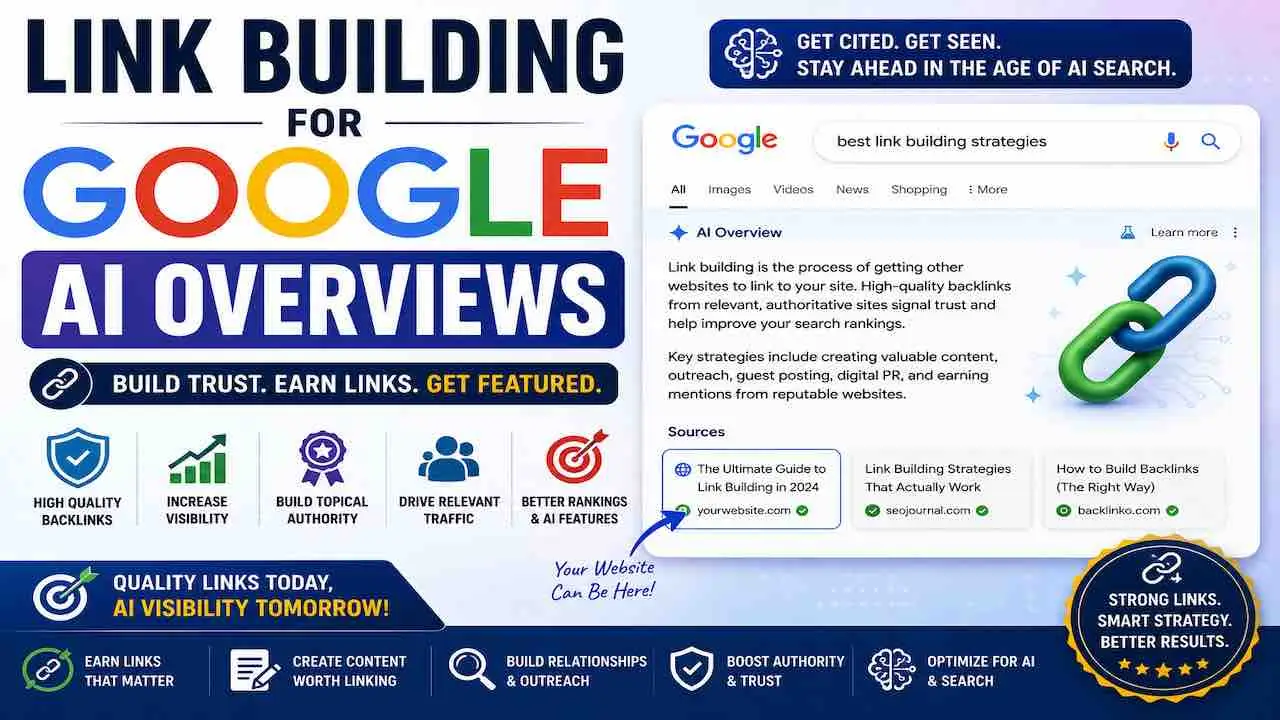
Link building for Google AI Overviews requires editorial citations, topical authority, structured data, and E-E-A-T signals alongside traditional backlinks. As of April 2026, the relationship between organic ranking and AI Overview citation has weakened: only 38% of cited pages now appear in the top 10 for the same query, down from 76% in mid-2025, per Ahrefs’ 863,000-keyword March 2026 study. This shift means structural quality, editorial authority, and E-E-A-T signals now carry more weight relative to raw link volume than at any previous point in AI Overview optimization. Every link building action you take for AI Overviews must target editorial credibility, not just ranking position.
AI Overviews now appear on 48% of all Google queries as of April 2026, reaching 2 billion monthly users. Organic CTR drops 34.5 to 61% when AI Overviews appear above results. Pages cited inside an AI Overview earn 35% more clicks than standard organic positions below. AI Overview traffic converts at 14.2% versus 2.8% for traditional organic, a 5x quality premium. With only the top 1% of domains capturing 47% of all AI Overview citations, citation selectivity is extreme. This guide covers exactly which source types Google AI cites in 2026, what changed since 2025, and the link building strategy that earns consistent AI citation slots.
The 2026 State of Google AI Overviews: Why the Stakes Are Higher Now
Google AI Overviews have moved from experiment to default, appearing on nearly half of all Google searches and shaping buyer decisions before a single organic result is seen. Gartner reports that 82% of consumers have noticed AI Overviews. Pew Research found that users clicked a traditional result in only 8% of visits when an AI summary appeared, versus 15% without one. This behavioral shift makes AI Overview citation the highest-value SERP position available for most informational and commercial queries in 2026.
AI Overviews vs AI Mode vs Search Generative Experience: Key Distinctions
| Feature | Search Generative Experience (SGE) | AI Overviews | AI Mode |
|---|---|---|---|
| Status | Predecessor (discontinued label, 2023-2024) | Default for 48% of Google searches (April 2026) | New dedicated AI search surface launched 2025 |
| Placement | Above organic results in SERP | Above organic results in SERP | Separate full conversational AI search interface |
| Citations | Clickable numbered citations | Clickable numbered citations | Multi-turn citations with follow-up query support |
| Optimization approach | Same as AI Overviews (same underlying signals) | E-E-A-T, schema markup, topical authority, editorial links | Topical authority across related queries matters more than exact-match optimization |
The critical update for 2026: AI Mode and AI Overviews increasingly use fan-out queries, meaning Google reformulates and expands the original query before retrieving sources. A brand ranking for one exact-match query does not automatically get cited for related reformulations. Topical authority across a full cluster of related queries beats exact-match keyword optimization for both AI Overviews and AI Mode citation coverage.
How Google AI Overviews Actually Select Sources
Google AI Overviews use Gemini to synthesize answers from multiple indexed sources, applying E-E-A-T evaluation, semantic relevance scoring, entity recognition, corroboration signals, and fan-out query reformulation on top of traditional ranking signals before selecting which sources to cite. 88% of AI Overviews cite three or more sources. Only 1% cite a single source. Only 274,455 domains have appeared in AI Overviews out of 18.4 million indexed, per MonkeyGoals 2026 research. The multi-source synthesis model means citation is not winner-take-all, but the top 1% of domains still capture 47% of all citations, confirming that editorial authority concentration matters enormously.
The Fan-Out Query System: Why Topic Clusters Beat Exact Match Ranking
Google reformulates every query before retrieval in its fan-out system. A user searching “link building for Google AI Overviews” triggers Google AI to also retrieve sources for related reformulations such as “what source types does Google AI cite,” “editorial citation signals for AI Overviews,” and “how to appear in Google AI search results.” Sources cited in AI Overviews often rank for those reformulated sub-queries rather than the original keyword.
This fan-out behavior explains why 46.5% of cited URLs rank outside the top 50 for the original query. They rank for one of the fan-out reformulations instead. Topic cluster strategy, covering 8 to 12 related subtopic pages around every core topic, outperforms single-keyword optimization for AI Overview citation coverage across every query variation the fan-out system generates.
The Organic Ranking to AI Citation Relationship Has Weakened
The shift from 76% top-10 overlap in mid-2025 to 38% in April 2026 is the most strategically important data point for link building decisions. It means Google AI is increasingly selecting sources based on structural quality, E-E-A-T depth, and topical authority rather than ranking position alone. Traditional link building still builds the organic rankings that give you access to AI citation pools. But editorial quality, content extractability, and cross-platform authority now determine who within the top-10 pool actually gets cited. Both layers are required. Neither alone is sufficient.
Source Types Google AI Overviews Actually Cites in 2026
YouTube is now the number-one most-cited domain in Google AI Overviews at 20.9% citation share, up 34% in six months, followed by Reddit, LinkedIn, Wikipedia, Forbes, and G2 as major citation sources, per the AI Platform Citation Source Index 2026 synthesized from six independent citation-tracking studies. Understanding this source hierarchy tells you exactly where to build authority alongside your on-site content to maximize AI Overview citation probability.
YouTube: The Number-One Most-Cited Source at 20.9% Citation Share
YouTube’s rise to the top-cited position confirms that video content is now the single most cited content format in AI Overviews across every vertical. Google AI Overviews extract content from YouTube video transcripts, not just titles or metadata. Every expert video published without a full text transcript is a direct missed citation opportunity. The transcript is the extractable text artifact. The video engagement signals validate topical authority. Publish expert video content with complete, searchable transcripts on every video, and structure transcript content with BLUF answer-first formatting matching how AI systems extract written content.
Reddit and Community Platforms
Reddit remains the number-one most-cited domain across all AI platforms combined and a top-two source for Google AI Overviews specifically. And Also Reddit accounts for 21% of Google AI Overview citations specifically, per Frase’s 2026 GEO research. Community validation signals carry implicit peer-reviewed credibility that branded content cannot replicate. Authentic contributions in subreddits relevant to your category build the community citation authority that Google AI weights when synthesizing answers to “best” and “alternatives” query types. Promotional posts and brand-owned Reddit content produce no citation benefit. Genuine expert answers to specific community questions produce compounding citation authority over time, with the average cited Reddit post being roughly one year old per Discovered Labs research.
LinkedIn and Professional Networks
LinkedIn rose to number-one for professional queries in Google AI Overviews and doubled its citation frequency between November 2025 and February 2026. Named executives publishing structured long-form thought leadership with dated publication records generate the professional authority signals Google AI weights most heavily for B2B, consulting, and professional service queries. LinkedIn content is indexed and cited by Google AI especially for queries where professional credentials determine source trustworthiness. For brands targeting decision-makers, LinkedIn articles are now a direct input to AI-generated answers about your category, not just a social distribution channel.
Wikipedia and Authoritative Reference Sources
Wikipedia remains a top-5 most-cited source in Google AI Overviews and serves as a primary ground-truth reference for entity definitions, factual claims, and historical context the AI model cross-verifies. A Wikidata entity with a complete sameAs graph connecting your brand to LinkedIn, Crunchbase, and authoritative directory profiles is the fastest practical route to Knowledge Graph entity recognition for brands that do not yet meet Wikipedia’s notability standards. Quora is the most-cited source per Semrush’s June 2025 AI citation study, making Q&A platform contributions a high-priority channel alongside Wikipedia for informational query citation coverage.
G2 and Review Platforms
G2 is the most-cited software review platform on ChatGPT, Perplexity, and Google AI Overviews, per Averi.ai’s cross-platform citation analysis. Review platforms give Google AI independently verifiable proof that your brand exists, operates, and receives third-party evaluation from real users rather than self-published brand claims. Complete profiles on G2, Capterra, Clutch, Trustpilot, and Sitejabber directly increase citation probability for product, software, and service recommendation queries. For B2B brands, G2 in particular is a citation source Google AI already trusts and references, making it a link building and citation-building priority in one action.
Editorial and News Publications
Press coverage in Search Engine Journal, Search Engine Land, Forbes, HubSpot Blog, and vertical trade publications generates the editorial endorsement signals that Google AI uses as corroboration. An editorial citation from a trusted publication confirms your brand is recognized as authoritative by a source Google AI already trusts, which maps directly into citation probability. These editorial links do three things simultaneously: they pass traditional PageRank, they validate your brand through Google’s corroboration scoring system and they create a co-citation signal associating your brand with the topic in a context Google already cites. Building editorial links from publications Google AI cites in your topic area is link building and AI optimization in a single action. See the full framework in our guide to Google AI Overviews optimization.
Brand-Owned Content With Strong EEAT
Brand-owned content qualifies for AI Overview citation when it demonstrates strong E-E-A-T signals: named author credentials, specific outcome data, verifiable statistics from named sources, and schema markup confirming content structure and authorship. Internal linking that establishes topic cluster depth tells Google AI your domain is the category authority, not just a page that mentions a keyword. Read our full guide to semantic SEO and entity optimization for generative engines to apply the full entity signal stack across your priority pages.
EEAT: The Single Most Impactful Google AI Overview Citation Signal
96% of AI Overview citations come from sources with strong E-E-A-T signals, making E-E-A-T the single most impactful citation factor in Google AI Overviews, outweighing any individual link signal. Google AI evaluates E-E-A-T across your entire digital presence, not just your website. Off-site brand mentions, review platform profiles, community contributions, YouTube presence, and the credibility of sources you cite all factor into E-E-A-T scoring before any citation decision is made.
Experience: First Hand Data and Specific Outcomes
AI Overviews deprioritize generic advice any AI could generate without direct subject involvement. Write from actual campaign results and proprietary data. “After adding FAQPage schema to 12 pages and earning 4 editorial citations from Search Engine Land, a B2B SaaS client appeared in AI Overviews for 9 target queries within 45 days” earns AI citations. “Build quality content” does not. Every Experience claim needs a specific measurable number. Back client outcomes with specific before-and-after figures, not general descriptions of success.
Expertise: Author Credentials and Technical Depth
Expertise signals come entirely from specificity and verifiability. Name exact tools used. Reference researchers by name. Use accurate terminology including Retrieval-Augmented Generation, entity-based semantic SEO, fan-out query optimization, topical authority clusters, and corroboration signals. Add named author bios with job titles, credentials, years of experience, and a verifiable LinkedIn profile link on every article. Google AI cross-references author identity against external sources before assigning expertise weight to the associated content.
Authoritativeness: Corroboration Across Trusted Sources
Authoritativeness in AI Overview citation is not self-declared. Google AI builds its understanding of your brand’s authority from what other trusted sources say about you. The corroboration signal, the frequency with which your brand appears alongside your core topics across trusted external platforms, is the primary off-site authority signal that AI citation scoring weights above raw link volume. Brands appearing on YouTube, Reddit, LinkedIn, G2, Quora, and in editorial publications simultaneously build corroboration depth that single-source authority cannot replicate. This is why the top 1% of domains capture 47% of all AI citations: corroboration compounds.
Trustworthiness: Independently Verifiable Claims
Google AI cross-verifies claims against other trusted sources before citing a page. Apply these rules across every priority page:
- Back every statistic with a direct link to the original named source, never a blog summary
- Keep schema markup data consistent with visible page content at all times
- Fix broken outbound links and outdated statistics as soon as you identify them
- Include full author bios with name, title, credentials, and a verifiable professional profile link
- Remove any claim you cannot support with a named, publicly accessible source
Schema Markup and Structured Data for Google AI Overview Citations
Structured data is the machine-readable layer that tells Google AI what type of content sits on your page, who authored it, and which question-and-answer pairs can be extracted directly into a synthesized response. Pages with complete schema markup earn AI citation eligibility that otherwise identical pages without structured data do not reach. Implementing schema is not optional for AI Overview optimization. It is the technical signal the AI synthesis pipeline reads before processing any content on the page.
| Schema Type | Function in Google AI Overview Citation | Fields Required for Full Citation Eligibility |
|---|---|---|
| Article | Confirms content type, authorship, and dates for the AI synthesis pipeline | headline, author, datePublished, dateModified, publisher, all completed |
| FAQPage | Converts Q&A pairs into pre-packaged extractable units for AI generation | Question and acceptedAnswer for every Q&A pair visible on the page |
| HowTo | Structures step-by-step guides for direct extraction into instructional AI Overviews | name, step with tool and supply attributes, numbered with specific actionable language |
| Person (Author) | Links author entity to content entity for E-E-A-T Experience and Expertise signals | name, jobTitle, url (LinkedIn profile), sameAs, all completed per author |
| Organization | Builds entity recognition in Google’s Knowledge Graph for corroboration scoring | name, url, logo, sameAs pointing to LinkedIn, Crunchbase, G2, all completed |
| BreadcrumbList | Signals page position within topic cluster architecture to AI crawlers | item and position, all levels of the site hierarchy mapped correctly |
| SpeakableSpecification | Marks specific sentences appropriate for text-to-speech AI extraction and voice AI Overviews | cssSelector or xpath pointing to the specific answer sentences on the page |
Read the complete guide to schema markup for AEO implementation to confirm every schema type is implemented correctly with all required fields completed. Empty schema fields reduce AI citation eligibility as much as missing the schema type entirely.
How to Track Google AI Overview Citations
Google AI Overview citation data is now available in Google Search Console as of June 2025 under the Web search type, giving every site owner a free baseline tracking method before investing in any paid monitoring tool. Tracking your AI citation performance is not optional. Without a measurement baseline, every optimization action you take produces no feedback loop to confirm which changes produce citations and which produce no measurable result.
Google Search Console AI Overview Data
In Search Console, go to Performance, select the Web search type, and filter by your target queries. AI Overview appearance data appears under impression and click metrics as of June 2025. While Search Console does not separate AI Overview clicks from standard organic clicks in all views, impressions on queries where AI Overviews appear reflect your citation eligibility. Growing impressions on 5-word-plus question queries without proportional click growth signals AI Overview appearance without click-through, an early indicator that your content is being cited but needs CTA or title optimization to capture the available traffic.
Third-Party AI Citation Monitoring Tools
- Otterly.ai: Tracks citation frequency, brand share of voice, and sentiment across Google AI Overviews, ChatGPT, Perplexity, Gemini, and Copilot from one dashboard. Used by over 20,000 marketing professionals for competitor citation benchmarking
- Semrush AI Toolkit: Monitors AI Overview appearances and citation frequency at keyword level, built directly into the Semrush platform alongside traditional rank tracking
- Profound Analytics: Detects content decay before citation frequency drops and shows which pages lose AI citation eligibility as competitors publish fresher content on the same topics
- Peec.ai: Tracks brand citations across multiple AI platforms simultaneously, producing citation frequency and sentiment trend data for share-of-voice comparison against named competitors
- Manual query testing: Run your 15 to 25 highest-priority target queries directly in Google monthly and record whether your domain appears in the cited sources row beneath AI Overview responses. Free, directional, and immediately actionable as a starting measurement
Content Format That Earns Google AI Overview Citations
Google AI Overviews extract content most reliably from pages that lead with a direct answer, use structured comparison tables, numbered lists, and FAQ sections, and maintain semantic depth across a full topic cluster addressing every fan-out query reformulation Google generates from the original search. Content format is the on-page variable that most directly controls whether a page in the citation pool earns a slot or gets passed over in favor of a more extractable competitor.
Answer First Structure: The Core Extraction Requirement
The answer to the primary query must appear in the first paragraph, within the first 100 to 150 words of the page. Pages that open with background context or introductory framing before reaching the direct answer fail the AI extraction test at first contact. Every section heading should be followed immediately by a 40 to 80 word direct answer before any supporting detail. This answer-capsule structure makes your content directly extractable at every heading level, not just the page opening. Apply this to every H2 section, not just your introduction. Read the complete guide to ranking in featured snippets since featured snippet optimization and AI Overview optimization share the same answer-first structural requirements.
Content Types Google AI Overviews Cites Most Often
- How-to guides with numbered steps: Instructional content with specific steps, named tools, and defined outcomes. Mark these up with HowTo schema for maximum extractability
- Comparison articles with structured tables: For “X vs Y” and “best” queries, Google AI specifically searches for structured comparison tables. A well-formatted table nearly guarantees citation inclusion for that query type
- Definition and glossary pages: Pages that define terms directly earn citations for terminology-based searches across every industry vertical
- Original research with named statistics: First-party data makes your page the primary source. Other publishers then cite you, compounding your corroboration signal over time
- Expert opinion pieces with verified author credentials: Content attributed to named professionals with verifiable LinkedIn profiles and published work records earns higher trust scores from Google’s quality evaluation systems
- FAQ pages with FAQPage schema: Built for AI extraction by design. FAQPage schema converts each Q&A pair into a pre-packaged extractable unit the AI synthesis pipeline reads as an explicit question-answer pair, directly supporting answer engine optimization across every AI platform simultaneously
For conversational keyword and question-based query targeting, the fan-out query system means every well-structured FAQ section targeting a related question on your pillar page contributes to AI citation coverage across reformulated query variants Google generates from the original search.
Link Building Strategy for AI Overview Citations: 10-Point Action Checklist
Each action below addresses one or more confirmed AI Overview citation signals documented across Ahrefs 2026, BrightEdge, Peec AI, Conductor, Averi.ai, and the AI Platform Citation Source Index 2026. Work through technical and structural actions first. They produce the fastest measurable citation gains on established domains with existing organic visibility.
Technical and Structural Actions: Items 1 to 5
| Priority | Action | AI Citation Impact |
|---|---|---|
| 1 | Add Article, FAQPage, HowTo, Person, Organization, and SpeakableSpecification schema with all fields completed on every priority page | Direct AI synthesis pipeline signal; empty fields eliminate citation eligibility regardless of content quality |
| 2 | Rewrite every priority page opening to lead with a 40 to 80 word direct answer to the primary query before any background context | Core extraction format for Google AI’s synthesis pipeline; applied at every H2 level, not just the page opening |
| 3 | Build a content cluster of 8 to 12 pages per core topic, internally linked with question-phrased anchor text, targeting every fan-out query reformulation | Topic cluster strategy outperforms single-keyword optimization for AI Overview citation coverage across fan-out query variants |
| 4 | Refresh priority pages every 30 to 60 days with new data, updated statistics, and expanded examples; use IndexNow to push updates to Google immediately | Content freshness directly affects citation probability; stale pages progressively lose citation slots to fresher competitors |
| 5 | Add named author bios with job titles, credentials, years of experience, and verifiable LinkedIn profile links to every article and guide on your site | 96% of AI Overview citations come from sources with strong E-E-A-T; author credentials satisfy the Experience and Expertise filters before citation selection |
Editorial and Offsite Authority Actions: Items 6 to 10
| Priority | Action | AI Citation Impact |
|---|---|---|
| 6 | Earn editorial links from Search Engine Journal, Search Engine Land, Forbes, and vertical trade publications that Google AI already cites for your topic area | Editorial citations from trusted sources serve as corroboration signals amplifying every other citation factor simultaneously |
| 7 | Publish expert video content with full searchable transcripts on YouTube, on every video, every time | YouTube is now #1 most-cited source in Google AI Overviews at 20.9% citation share; transcripts are the extractable citable artifact |
| 8 | Publish authentic, helpful answers in relevant Reddit subreddits and long-form thought leadership articles on LinkedIn without any promotional language | Reddit and LinkedIn together represent the two highest-citation-volume platforms in Google AI Overviews for non-video content |
| 9 | Create or claim complete profiles on G2, Capterra, Clutch, and Trustpilot, and create a Wikidata entity with complete sameAs links | G2 is the most-cited software review platform in AI Overviews; review profiles provide independently verifiable third-party brand validation |
| 10 | Run digital PR campaigns targeting publications that already appear in AI Overview citations for your target queries | Being cited by a source Google AI already trusts creates a co-citation corroboration signal that compounds citation eligibility across related queries |
See how these actions connect to the broader Generative Engine Optimization (GEO) framework that drives AI visibility across Google AI Overviews, ChatGPT, Perplexity, and Bing Copilot simultaneously.
Mistakes That Block AI Overview Citations Despite Strong Backlinks
Brands with strong backlink profiles still miss AI Overview citations when they make these structural, technical, or content mistakes. Each mistake removes citation eligibility at the AI extraction stage, after ranking factors have already qualified the page for consideration in the citation pool.
Mistake 1: Optimizing for Single Keywords Without a Topic Cluster
The fan-out query system means Google AI retrieves sources for reformulated variants of the original search, not just the exact keyword. A single page targeting one keyword earns citation for that query only. A topic cluster of 10 interlinked pages earns citations across every fan-out variant Google generates. Single-page exact-match optimization misses 80% of the AI citation surface area for any given topic.
Mistake 2: Missing or Incomplete Schema Markup
A page with 500 backlinks and no Article or Author schema competes against pages with 50 backlinks and complete structured data. The AI synthesis pipeline reads schema before processing any text content. Empty schema fields reduce AI citation eligibility as much as missing the schema type entirely. Validate every schema implementation using Google’s Rich Results Test before marking pages complete.
Mistake 3: Burying the Answer Past the First Paragraph
Google AI Overviews extract opening content heavily. Pages that begin with background context before reaching the direct answer fail the extraction test regardless of backlink strength. Rewrite every priority page opening to put the core answer in sentences 1 and 2. Then add supporting context in sentences 3 through 5. Apply this at every H2 section heading, not just the page opening.
Mistake 4: No YouTube Presence or Transcripts
YouTube is now the number-one most-cited source in Google AI Overviews at 20.9% citation share. Every brand absent from YouTube forfeits the largest single citation source in the ecosystem. Every brand present on YouTube without searchable transcripts forfeits the citable text artifact that Google AI actually extracts and cites from video content.
Mistake 5: Ignoring G2 and Review Platforms
G2 is the most-cited software review platform in ChatGPT, Perplexity, and Google AI Overviews. Brands without complete G2, Capterra, and Clutch profiles lack the independently verifiable third-party validation that Google AI weights when evaluating brand credibility for product and service recommendation queries. Creating complete profiles on all five major review platforms is a one-time action with permanent compounding citation benefit.
Mistake 6: No Topic Cluster Architecture for Query Coverage
Because Google AI reformulates queries before retrieval, a domain with one strong page on a topic earns fewer total citations than a domain with a full cluster of 8 to 12 interlinked pages covering every related subtopic. Build pillar pages with supporting cluster pages targeting every question a searcher might ask after the primary query. Use People Also Ask data to map every fan-out query variant your cluster needs to cover.
Mistake 7: Letting Priority Pages Go Stale
Content freshness directly affects AI citation probability. Pages earning AI citations and then going without updates for 6 or more months progressively lose those citation slots as competitors publish fresher content on the same topics. Schedule refreshes every 30 to 60 days. Use IndexNow to notify Google immediately after each meaningful update. Monitor decay using Profound Analytics before citation loss becomes a traffic event.
FAQs: Link Building for Google AI Overviews
Yes, but the relationship has weakened. Only 38% of AI Overview cited pages now also rank in the top 10 for the same query, down from 76% in mid-2025, per Ahrefs’ 863,000-keyword March 2026 study. Traditional link building still builds organic rankings that give you access to AI citation pools, but editorial quality, content extractability, E-E-A-T depth, and topical authority now determine who within that pool gets cited. Strong link building and AI-specific optimization are both required. Neither alone is sufficient in 2026.
YouTube is now the number-one most-cited source in Google AI Overviews at 20.9% citation share, up 34% in six months, per the AI Platform Citation Source Index 2026 synthesized from six independent studies. Reddit, LinkedIn, Wikipedia, Forbes, G2, and Quora follow as top-cited source types. G2 is the most-cited software review platform specifically. LinkedIn doubled its citation frequency between November 2025 and February 2026 and is now the number-one source for professional queries. 88% of AI Overviews cite three or more sources, and the top 1% of domains capture 47% of all citations.
Schema markup is the machine-readable signal the AI synthesis pipeline reads before processing any content on your page, making it one of the highest-ROI technical fixes for AI Overview citation eligibility. Article schema confirms authorship and freshness. FAQPage schema converts Q&A pairs into pre-packaged extractable units. Person schema links author identity to content for E-E-A-T validation. Organization schema builds Knowledge Graph entity recognition. The newly added SpeakableSpecification schema marks specific answer sentences for text-to-speech AI extraction. Every schema field left empty reduces citation eligibility as much as missing the schema type. Read the full implementation guide on schema markup for AEO.
Google Search Console now shows AI Overview impression data as of June 2025 under the Web search type, giving you a free baseline tracking method before investing in any paid monitoring tool. In Search Console, go to Performance, select the Web search type, and filter by your target queries to see impression and click data for queries where AI Overviews appear. For automated citation monitoring, Otterly.ai, Semrush AI Toolkit, Profound Analytics, and Peec.ai all track citation frequency and brand share of voice across Google AI Overviews, ChatGPT, Perplexity, and Copilot simultaneously. Run manual query tests on your 15 to 25 highest-priority queries monthly and record citation appearances and positions.
Google reformulates every query into multiple related sub-queries before retrieving sources for AI Overviews, meaning sources are often cited for reformulated variants of the original search rather than the exact keyword the user typed. This fan-out behavior explains why 46.5% of cited URLs rank outside the top 50 for the original query: they rank for one of the fan-out reformulations instead. Topic cluster strategy, covering 8 to 12 interlinked pages per core topic and targeting every related question a searcher might ask, outperforms single-keyword optimization for AI Overview citation coverage across every query variant the fan-out system generates. Map fan-out variants using People Also Ask data and AlsoAsked to build your cluster around every reformulation Google AI generates.