
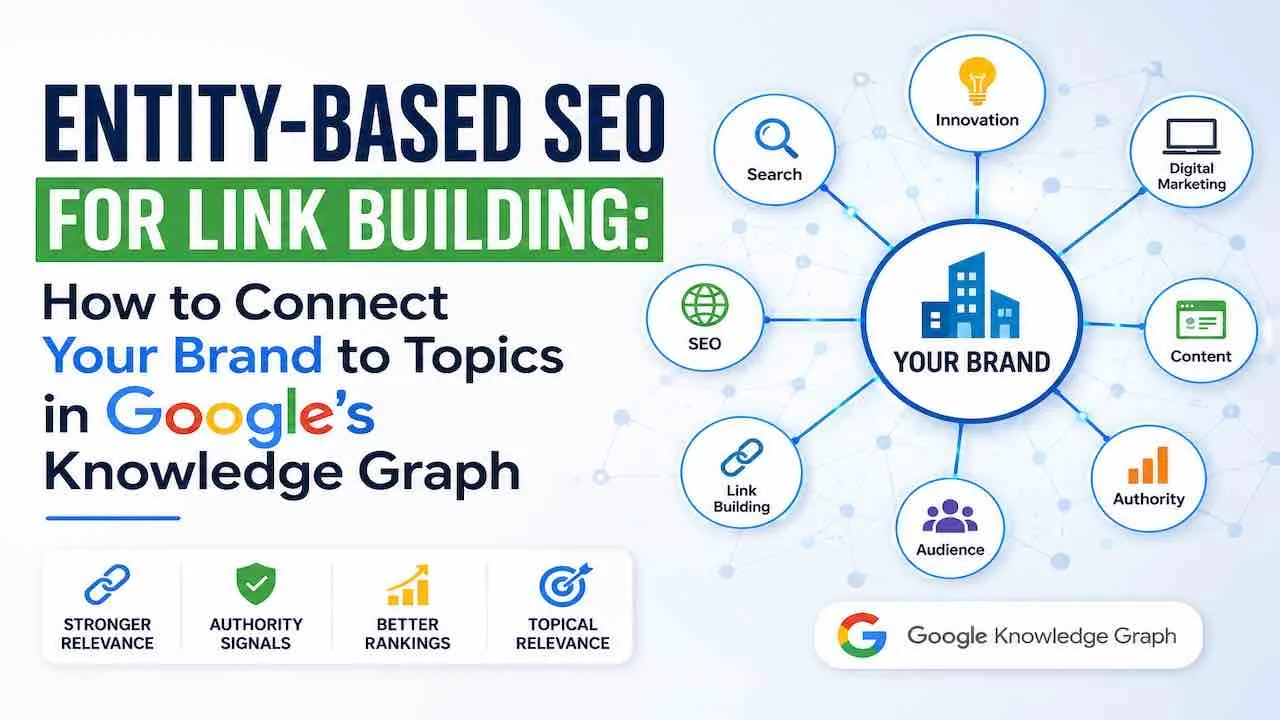
An entity link building strategy connects your brand to verified topics inside Google’s Knowledge Graph by acquiring links from recognized entities such as Wikidata, Wikipedia, and authoritative directories, while building co occurrence signals that confirm your brand’s topical territory. Traditional backlinks transfer PageRank. Entity links transfer topical relevance, entity confidence, and AI citation eligibility at the same time. In a study comparing signals that predict Google AI Overview visibility, brand mentions showed a 0.664 correlation with AI citation frequency, compared to only 0.218 for traditional backlinks.
Entity link building is what builds those brand mention signals at scale. This brand entity link building strategy guide and entity SEO link building approach helps brands outrank competitors with entity links, future proof link building, beat competitors in Knowledge Graph entity associations, and get cited by AI engines. This guide covers every proven tactic with specific implementation steps, the @graph schema architecture that supports them, and the tools that measure their impact.
What Entity Link Building Is and Why It Outperforms Traditional Link Building
Entity link building is the practice of acquiring links from and creating links to confirmed Knowledge Graph entities so Google’s NLP systems can map your brand to specific verified topics, people, and locations inside its semantic database of over 500 billion facts. Google launched the Knowledge Graph in 2012 with the concept of “things, not strings.” Today, BERT, MUM, and Gemini process every query through named entity recognition, not keyword frequency. Google’s February 2026 Find update made this explicit: entity authority is now assessed topic by topic, not domain wide. A site can be an entity authority in digital marketing and not in finance, even if both topics appear on the same domain.
The 0.664 Correlation: Why Brand Mentions Beat Backlinks for AI Citations
Brand co citations, entity co occurrence signals, and sameAs link building produce more AI Overview citation appearances than traditional backlink volume because generative engines filter citations through Knowledge Graph entity data first. Gemini is trained directly on the Knowledge Graph, confirmed by Google and Semrush in 2026. When Gemini processes a query, it resolves entities before it resolves pages. A brand confirmed in the Knowledge Graph with clear topical entity authority gets cited. A brand with only keyword-ranked pages but no entity link structure gets filtered out before the answer is generated. Read the LLM training data and AI indexing guide for how large language models weight entity data during training.
Entity Link Building vs Traditional Link Building: What Each One Transfers
Semantic link building strategy differs from traditional link building strategy in one core way: it builds entity confidence alongside link equity. Understanding entity based link building vs traditional backlinks is the starting point for any entity SEO link building program.
| Factor | Traditional Backlinks | Entity Link Building Strategy |
|---|---|---|
| Primary signal transferred | PageRank and link equity | Topical relevance, entity confidence, AI citation eligibility |
| Target source type | High domain authority sites | Knowledge Graph confirmed entities: Wikidata, Wikipedia, Crunchbase |
| Anchor text goal | Keyword-matched text | Entity anchor text and semantic anchor text matching topic relationships |
| AI search benefit | Indirect through organic rankings | Direct: entity links feed AI Overview citations and Perplexity answers |
| Measurement metric | Domain authority, link count | KGMID, entity confidence score, entity confidence score links, entity salience score, domain authority entity classification |
| Timeline for impact | 2 to 6 months for rankings | 7 days for initial Knowledge Panel, 6 to 12 months for full entity maturity |
The semantic SEO and entity optimization guide covers the full content structure that makes entity links effective. Entity link building amplifies that structure through external source verification.
Build Your Entity Model Before Building Any Links
The most common reason an entity link building strategy fails is that it starts before the entity model is defined. An entity model is a precise list of two things: the entities your brand owns, meaning topics, locations, products, and people directly associated with your organization, and the entities your brand competes on, meaning topics where competitors have stronger Knowledge Graph associations than you do. Building links before this model is defined means acquiring links that point toward a vague, unresolved entity rather than a confirmed one.
How to Build Your Entity Model in 3 Steps
- Write one declarative sentence about your brand that includes what you do, where you operate, when you were founded, and your primary service category. This sentence becomes your entity home page description, repeated verbatim on your About page, Google Business Profile, Wikidata entry, LinkedIn, and Crunchbase profile.
- List 5 to 10 topics your brand genuinely owns as defined by original research, documented expertise, or years of client work. These become the entities you build topical authority entity signals around through entity co occurrence link building.
- List 5 to 10 entities your brand competes on where competitors already have Knowledge Graph entries. These become targets for your entity disambiguation signals and your brand co citations in authoritative third-party content.
Once this model exists, every link acquisition decision maps to either confirming an entity you own or displacing a competitor association on an entity you compete on. See the knowledge panel optimization guide for the full entity confidence score system and how your entity model feeds it.
Entity Disambiguation: The Foundation Every Entity Link Must Build On
Entity disambiguation is Google’s process of separating your brand from every other entity in the Knowledge Graph that shares a similar name, topic, or descriptor. Poor disambiguation is the single most common reason an entity link building strategy fails to raise the entity confidence score. If Google cannot confidently separate your brand from a similarly named competitor, a person sharing your brand name, or an unrelated topic that uses the same words, links from authoritative sources may be attributed to the wrong entity entirely.
Entity Disambiguation Signals That Work
- Unique entity attribute links — Acquire links that consistently associate your brand with specific founding year, location, and service category so Google’s named entity recognition models distinguish your entity from similar ones
- Entity disambiguation content — Publish an entity home page with factual declarative sentences that NLP models can extract, map, and associate cleanly with your specific entity record
- Wikidata disambiguation properties — Create a Wikidata entry that includes your entity type, official website (P856), country (P17), and industry classification (P452) to give Google machine-readable disambiguation data
- Consistent exact-match anchor text — Every external link pointing to your site should use your exact brand name so Google builds a clear anchor text entity signal, not a fragmented one
- Named entity co occurrence — Appear in content alongside specific confirmed Knowledge Graph entities such as locations, executives, and industry organizations that are unique to your brand context
The 7 Core Entity Link Building Tactics
These Knowledge Graph link building tactics address a different layer of the Knowledge Graph confirmation process, from creating your first machine-readable entity signal to amplifying it through authoritative co occurrence corroboration.
1. Wikidata Entity Links: The Fastest Path Into the Knowledge Graph
An Wikidata is the most accessible entry point into Google’s Knowledge Graph for any brand. Wikidata link building for Knowledge Graph entry, how to create Wikidata entry for link building, starts here: create a Wikidata entry, get your Q-ID, and add the Wikidata Q-ID URL to your Organization schema sameAs array. This creates a closed loop that Google’s Knowledge Vault reads as entity verification. Ahrefs documented a Knowledge Panel appearing within 7 days of adding a Wikidata sameAs link to their Organization schema.
Wikidata-verified brands are 3.2 times more likely to earn a Knowledge Panel and 2.7 times more likely to appear in AI Overview citations, according to Kalicube’s analysis of 75,000 tracked brands. Add these properties: official website (P856), founding date (P571), entity type (Q4830453 for a business), country (P17), and industry (P452). Then link the Wikidata Q-ID URL back to your entity home page to complete the entity link building for Knowledge Graph entry.
2. Unified @graph Schema Architecture
The @graph schema architecture links all your entity nodes in a single JSON-LD block: Organization, WebSite, WebPage, Article, and Person. This structure tells Google’s crawlers that your brand, your site, your pages, your authors, and your content are all nodes in the same entity ecosystem. Brands still using isolated schema blocks per page send fragmented entity signals. A unified @graph array using structured data and JSON-LD entity links sends a connected entity relationship map in every crawl.
Each node in the array references the others via @id, so Google can follow the entity relationship from a blog post back through the author to the organization without any ambiguity. How to build entity links for SEO at the schema level and how to connect brand to Google Knowledge Graph through structured data and JSON-LD entity links both start here. This is the architecture top-performing brands in AI Overview citations consistently use, and it directly supports GEO entity link building at the schema level.
3. sameAs Link Network
Knowing how to build sameAs links is the highest-impact technical action in any entity link building strategy. The sameAs property in your Organization schema is the most powerful entity link signal you directly control. Each sameAs URL tells Google that your domain and that external profile represent the same real-world entity. Add at minimum: Wikidata Q-ID URL, LinkedIn company page, Crunchbase profile, Facebook business page, YouTube channel, and Google Business Profile URL. Microsoft confirmed that sameAs schema links directly help Microsoft’s LLMs understand brand entities, making this step critical for Bing Copilot entity citations alongside Google. Validate through Google’s Rich Results Test after every implementation. For the complete schema code template and validation process, see the schema markup for AEO implementation guide.
4. Wikipedia and Authoritative Entity Citations
Wikipedia entity links provide the highest trust signal in Google’s Knowledge Graph corroboration chain, but the notability requirement means most brands need to build press coverage first. Target at least 5 to 7 citations in publications that carry their own Wikipedia pages before attempting a brand article. Conflicts of interest lead to deletion, so earn genuine media coverage instead. Even without a full Wikipedia article, external Wikipedia citations of your brand name count as brand co citationss that build entity mention signals Google reads during entity confirmation. Beyond Wikipedia, build entity citation links across sources matched to your brand type: Crunchbase, G2, Clutch, Bloomberg, or Trustpilot depending on your industry. Entity citation building and entity attribute corroboration through 30 or more independent authoritative sources confirming the same entity attributes before it raises the entity confidence score to panel-generation threshold.
5. Entity co occurrence Links
Entity co occurrence links appear in high-authority content that mentions your brand name alongside confirmed Knowledge Graph entities, even without a direct hyperlink to your domain. These brand co citations build entity salience, the score that measures how central your brand is to a specific topic, not just how relevant. According to Kalicube research, pages with entity salience scores above 0.7 rank 4.2 positions higher on average. Build entity co occurrence link building by appearing in guest articles that mention your brand alongside recognized industry entities, in press coverage that quotes your executives alongside known industry figures, and in research citations where your original data appears alongside named expert sources.
6. Topical Authority Link Clusters
Topical cluster entity links create groups of inter-linked content on your domain that all point to the same Knowledge Graph topic territory, signaling that your brand entity owns a specific subject area with depth. Traditional link building targets individual pages. Knowledge Graph link building targets topic clusters because Google maps entity authority at the topic level, not the page level, as confirmed by the February 2026 Find update. Build a topical cluster by creating 5 to 10 pages on your domain addressing different angles of a single Knowledge Graph topic. Acquire entity links from external sources pointing to different pages in that cluster. Entity salience links and passage level entity signals both strengthen with cluster depth. Pages with 5 or more contextual internal links achieve 62% higher entity salience scores, confirming that internal entity link signals amplify external entity links in the graph.
7. InLinks for NLP Entity Link Gap Analysis
InLinks is a semantic SEO platform by Dixon Jones that uses NLP to identify the exact entity relationships Google sees in your content, then surfaces entity link gaps where your pages lack connections to Knowledge Graph topics that should be present. NLP link building for entity SEO and NLP entity recognition both flow through this analysis. Running an InLinks NLP analysis on your top 10 pages produces an entity salience score for each page, a Topic Wheel showing which Knowledge Graph entities Google currently associates with your content, and a specific list of missing entity relationships your content should reference.
This drives precision entity link building: instead of guessing which Knowledge Graph topics to target with links, InLinks shows you exactly which entities Google expects to see on your pages based on NLP analysis of your existing content. How to use InLinks for entity SEO, how to build topical authority with entity links, and how to build entity authority links all start with the entity gap report, then acquiring links from pages that cover the missing entities and updating your on page content to include direct mentions of those Knowledge Graph topics. For a complete framework that pairs with this workflow, the semantic SEO and entity optimization guide covers entity relationship mapping across a full content cluster.
Entity Anchor Text Strategy for Knowledge Graph Links
Entity link building requires a fundamentally different anchor text approach from traditional link building because the goal is to signal entity relationships rather than keyword rankings.
Semantic Anchor Text vs Keyword Anchor Text
Traditional keyword anchor text like “best digital marketing agency” targets a ranking. Semantic anchor text like “as QuickDigital published” or “QuickDigital’s entity SEO approach” targets an entity relationship. An entity anchor text strategy uses your exact brand name, entity attributed phrases, and named entity co occurrence patterns as the anchor text rather than generic keyword phrases. When your brand name appears as anchor text in a sentence that also mentions a specific Knowledge Graph topic, Google reads an entity co occurrence pattern that maps your brand to that topic area inside the graph. Semantic relevance signals and semantic search link building both improve through semantic anchor text diversity. Vary between exact-match brand name, branded phrase, and entity-attributed phrase anchors across your link profile to signal a natural, multi-source entity confirmation pattern.
4 Entity Anchor Text Patterns That Build Knowledge Graph Connections
- Exact brand name anchor — Your brand name as anchor text in a sentence that mentions a confirmed Knowledge Graph topic your brand owns, creating an entity co occurrence signal
- Entity-attributed phrase — Phrases like “according to [Brand],” “published by [Brand],” or “[Brand] research” signal entity authorship that Knowledge Graph topic mapping reads as topical authority
- Named entity co occurrence anchor — Anchor text that includes your brand name alongside a recognized entity such as a tool name, location, or industry term builds entity relationship links that feed the Knowledge Graph directly
- Branded question anchor — Questions phrased as “[Brand] + service/topic” map your entity to specific Knowledge Graph query types that Google’s NLP models resolve through entity relationship data in AI Mode and standard search
Entity Link Building for GEO and AI Search Visibility
GEO entity link building, entity links for AI Overview citations, and entity link building for AI search use the same entity signal foundation because generative engines draw citations from the same Knowledge Graph data that powers organic rankings. When Google AI Overviews, Perplexity, or Bing Copilot process a query, they query their knowledge base for entities classified as relevant to that topic. Brands with Wikidata Q-IDs, sameAs schema networks, and entity co citation signals in authoritative indexed content surface in generated answers because their entity topic relationships are machine-readable. Brands with only keyword-optimized pages but no entity link structure get filtered out before any answer is generated, regardless of their organic ranking position.
To dominate AI search with entity links, get cited by AI engines, outrank competitors with entity links, build brand authority in the Knowledge Graph, and build brand authority Knowledge Graph associations, add knowsAbout properties to your Organization schema listing your core service categories as string values that AI engines can extract and reproduce. Entity link building for local SEO starts with the areaServed property. Use areaServed to link your entity to specific geographic Wikipedia pages for regional entity association.
Publish original research with verifiable data that third-party publications cite, creating entity-attributed co occurrence in authoritative indexed content that AI engines train on. Beat competitors in Knowledge Graph entity authority by tracking whether you rank in AI search with entity links. Run your brand query through Perplexity, Google AI Mode, and ChatGPT monthly and recording which topics Google associates with your entity in the responses. For the complete picture on how AI engines cite brands in synthesized answers, read the Generative Engine Optimization guide and the Google AI Overviews optimization guide.
GEO-Specific Entity Link Actions
- Entity citation building from sources AI engines specifically pull from: Wikipedia, Wikidata, Crunchbase, Forbes, and domain-specific knowledge bases in your industry
- Create original research content that third-party publications cite, building entity-attributed co occurrence that AI engines train on and cite at higher rates than un-attributed content
- Monitor Perplexity citations and AI Overview appearances monthly to confirm which entity link signals are mapping your brand to specific Knowledge Graph topics in AI-generated answers
- Follow EEAT trust and authority principles to strengthen trustworthiness signals across all entity-attributed sources, since AI engines weight verified, credentialed entities over anonymous sources when selecting citations
Entity Link Building Tools
| Tool | Primary Entity Link Function | Best For |
|---|---|---|
| InLinks | NLP entity gap analysis, entity salience scoring, entity relationship mapping via Topic Wheel | Identifying which Knowledge Graph topics your content lacks entity links to |
| Google Knowledge Graph Search API | Returns your KGMID and entity confidence score (resultScore) directly | Measuring entity confidence score before and after link building campaigns |
| Wikidata Query Service | Create and manage Wikidata entity entries and property relationships | Creating the Wikidata Q-ID entry that is the primary Knowledge Graph entry point |
| KalicubePro | Tracks Knowledge Panel changes, entity confidence score movements across 75 million brands | Enterprise entity link building monitoring and Knowledge Graph priority identification |
| Google Rich Results Test | Validates sameAs schema links and the unified @graph Organization schema | Confirming sameAs entity links and @graph schema are correctly parsed before recrawl |
| Semrush | Identifies Knowledge Panel SERP features and tracks entity-triggered rich results by keyword | Monitoring which branded queries trigger Knowledge Graph features after entity links are added |
| Ahrefs | Backlink entity analysis, anchor text entity distribution, referring domain entity classification | Auditing existing backlink entity signals and identifying entity anchor text gaps |
| Google Search Console | Tracks branded query impressions as entity demand signals | Free entity demand monitoring showing whether branded search volume rises as entity confirmation builds |
How to Measure Entity Link Building Success
Entity link building success is measured through entity-specific metrics that do not appear in standard link building reports, because the goal is entity recognition and AI citation eligibility, not just ranking position.
6 Monthly Metrics to Track
- Entity confidence score (resultScore) — Query the Google Knowledge Graph Search API monthly for your brand name and track your resultScore between 0.0 and 1.0. A rising score confirms entity links are producing the right signal
- KGMID presence — Confirm your Knowledge Graph Machine ID for KGMID entity verification by searching your brand name on Google, clicking the three-dot menu on any Knowledge Panel, selecting Share, and checking the URL for a /g/ character string
- InLinks entity salience scores — Track entity salience score improvements on your top 10 pages monthly after adding entity link signals. Rising salience scores confirm entity topic mapping is strengthening
- Branded query impressions — Monitor Google Search Console for rising branded query impressions, which signal that entity recognition is improving and showing your brand for more navigational queries
- Knowledge Panel changes — Track whether your Knowledge Panel appears, disappears, or enriches with new topic attributes as entity links accumulate over time
- AI citation rate and factual accuracy signals — Track monthly how often your brand appears in Perplexity, ChatGPT, and Google AI Overview answers for queries in your entity’s topic territory
Entity Link Building Timeline
Phase Overview and Timeline Expectations
Entity link building follows a predictable phase progression, though the exact timeline depends on your domain’s existing authority, content depth, and how many corroborating entity sources are already in place.
5-Phase Entity Link Building Roadmap
| Phase | Timeframe | Actions | Expected Outcome |
|---|---|---|---|
| 1. Entity Foundation | Week 1 to 4 | Build entity model, add unified @graph schema, create entity home page, build Wikidata Q-ID entry | Google begins associating your domain with your entity name in crawl data. Initial entity confidence score appears in Knowledge Graph API |
| 2. Primary Entity Links | Week 4 to 8 | Add sameAs network (Crunchbase, LinkedIn, G2, GBP). Submit sitemap after each addition | Entity confidence score begins rising. InLinks entity salience scores improve on key pages. LinkedIn entity links and Crunchbase entity citation indexed |
| 3. co occurrence Amplification | Week 8 to 16 | Publish original research. Build guest article co citations. Target entity co occurrence links in press coverage | Knowledge Panel appears for most established brands. Branded query impressions rise measurably in Search Console |
| 4. Topical Entity Depth | Month 4 to 6 | Build topical cluster entity links. Use InLinks to close entity link gaps. Expand sameAs network to Wikipedia if notability is met | Knowledge Panel enriches with topic attributes. AI Overview and Perplexity citations begin appearing for entity-owned topics |
| 5. Entity Maturity | Month 6 to 12 | Quarterly entity confidence score audits, ongoing press coverage, compounding co citation links | Full entity maturity. Consistent AI citation across Google AI Mode, Perplexity, and Bing Copilot for all owned entity topics |
Entity authority links, ontology link building, and knowledge representation entity signals all compound through systematic link acquisition that builds both domain authority and entity signal simultaneously, the backlink outreach service targets entity-verified sources that transfer both link equity and Knowledge Graph corroboration in each acquired link. For the complete brand SERP picture that entity link building creates, read the knowledge panel optimization guide.
Entity SEO and GEO Services Since 2014
Connect Your Brand to Google’s Knowledge Graph and Every Major AI Engine
QuickDigital builds entity link building strategies that confirm your brand in the Knowledge Graph, raise your entity confidence score, and get your brand cited in Google AI Overviews, Perplexity, and Bing Copilot. Entity model. @graph schema. Wikidata. sameAs network. One complete strategy.
Entity links. Knowledge Graph confirmation. AI citation eligibility.
FAQs
An entity link building strategy builds brand entity links from and to confirmed Knowledge Graph entities so Google’s NLP systems map your brand to verified topics. Unlike traditional link building, entity links transfer topical relevance and AI citation eligibility alongside link equity.
Entity links directly raise AI citation frequency. Brand mentions show a 0.664 correlation with AI Overview visibility versus only 0.218 for traditional backlinks. Wikidata-verified brands appear in AI Overview citations 2.7 times more often. Gemini trains on the Knowledge Graph, so brands without entity confirmation get filtered before any AI answer.
Traditional backlinks transfer PageRank and domain authority. Entity links transfer topical relevance, entity confidence score, and AI citation eligibility alongside link equity. Entity links use semantic anchor text and entity co occurrence signals. Traditional backlinks do not feed Knowledge Graph entity confirmation or AI citation eligibility directly.
Run an InLinks NLP analysis on your top 10 pages to get an entity salience score and a Topic Wheel showing which Knowledge Graph entities Google associates with your content. The entity gap report shows which topics are missing. Acquire links from pages covering those topics and add direct mentions of those Knowledge Graph entities to your content.
A Wikidata entry can trigger a Knowledge Panel within 7 days. Full Knowledge Graph entity confirmation with consistent AI citation eligibility typically takes 6 to 12 months. Entity confidence score improvements appear within weeks of adding sameAs links and Wikidata citations. AI Overview and Perplexity citations follow as entity maturity builds.