


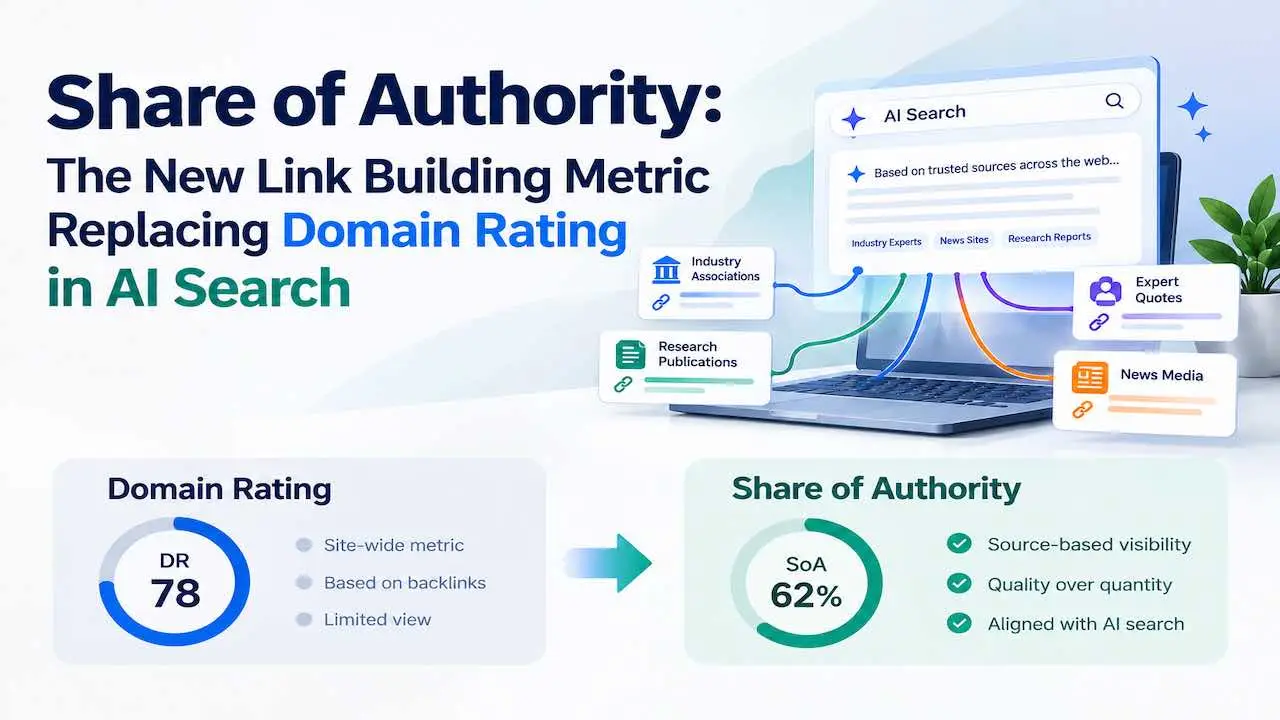
Share of authority is a competitive SEO metric that measures your brand’s authority relative to all competing domains within your specific niche, expressed as a percentage of the total available authority in that topic cluster. Unlike Domain Rating, which measures absolute backlink strength, share of authority measures whether you are stronger than the specific competitors you actually face. A DR 35 site with a 40% share of authority in its niche outranks a DR 70 generalist with a 3% share of that same niche’s authority in Google AI Overviews, ChatGPT, and Perplexity, because AI search engines cite within topic clusters, not across the entire web.
Search Engine Land has confirmed that share of authority or voice will become the primary SEO metric as the shift from a numbers game to a confidence game takes hold across the industry. For brands still measuring success by chasing higher DR backlinks while their actual niche authority share shrinks, this represents a fundamental strategy error that no amount of generic high-DR link building can correct.
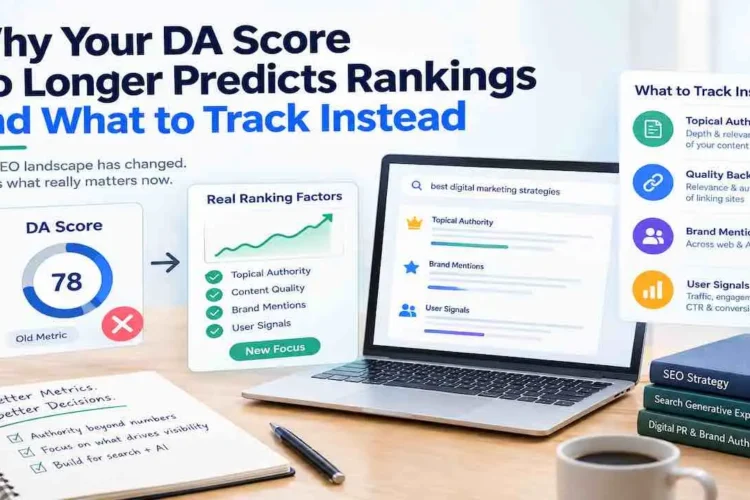
Why Domain Rating Is No Longer Enough as a Predictive SEO Metric
What DR Measures and What It Misses
Domain Rating, developed by Ahrefs, measures the strength of your domain’s backlink profile on a logarithmic 0-to-100 scale, calculated from the number of unique referring domains linking to your site and their own DR scores. Domain Authority by Moz and Authority Score by Semrush measure similar absolute backlink strength values. All three metrics answer the same question: how strong is your backlink profile compared to every other site on the web? They do not answer the question that matters most for competitive rankings: how strong is your backlink profile compared to the specific domains competing against you for your exact target queries? This is the measurement gap that share of authority closes.
DR also fails to account for topical relevance of the backlink profile. A DR 60 domain with 90% of its backlinks from unrelated industries carries less topical authority for SEO-related queries than a DR 30 domain whose backlink profile is concentrated in marketing, SEO, and digital PR publications. Topical authority share, the concentration of your niche-relevant links relative to competitors, is the dimension DR ignores entirely.
The DR Paradox: Smaller Sites Outranking Bigger Domains
The clearest evidence that DR is a vanity metric in AI-era search is the consistent pattern of lower-DR niche sites outranking higher-DR generalist sites in both Google AI Overviews and traditional organic results for specific topical queries. Sites with DA 50+ are 3.7 times more likely to rank in top 10 for competitive keywords than sites with DA 20 to 30 as an average. But within a specific niche, a DR 35 site that owns 45% of all niche-relevant referring domains consistently outranks DR 70 generalist sites that hold only 2% to 3% of that niche’s authority share. Domain rating never explains this pattern. Share of authority does. Our domain authority failing link building results guide documents specific cases where DR growth produced zero ranking improvement because authority share within the target niche was not growing alongside it.
AI Search Makes DR Even Less Reliable
Google AI Overviews, Perplexity, ChatGPT, and Bing Copilot cite sources based on topical authority share within a query’s topic cluster, not based on the absolute DR of the citing domain. AI Overviews will cite a DR 28 niche publication as a primary source over a DR 80 news site when the niche publication holds the dominant authority share for that specific topic. Semrush analysis of 1,000 domains confirms that websites with stronger contextual backlink authority within their niche are cited more frequently in AI-generated answers than sites with higher absolute DR but weaker niche authority concentration. This is why chasing DR for its own sake is increasingly disconnected from the AI search visibility outcomes brands actually need.
Share of Authority Defined
Share of authority is your brand’s proportional ownership of total backlink authority, topical relevance signals, and entity recognition within the specific competitive set you rank against for your target queries. It is not a single-tool metric. It is calculated from a combination of referring domain share, organic share of voice, topical authority concentration, and entity authority signals within your defined niche. A strong share of authority means Google and AI engines classify your entity as the most authoritative source within your topic cluster, regardless of how your absolute DR compares to high-DR generalist sites outside that cluster.
The Core Formula for Share of Authority
The practical share of authority calculation uses three inputs: your referring domain count in niche-relevant publications, your organic share of voice for target keywords, and your entity authority concentration within the topic cluster.
Step 1: Define your competitive set. Identify the 5 to 10 domains that consistently rank for your primary target keywords. These are your authority share competitors, not every site on the web.
Step 2: Extract niche-relevant referring domains. Use Ahrefs or Semrush to filter each competitor’s backlink profile for referring domains within your specific niche category. Count only topically relevant referring domains, not total referring domains.
Step 3: Calculate authority share. Divide your niche-relevant referring domain count by the total niche-relevant referring domain count across your entire competitive set. Multiply by 100. The result is your baseline share of authority percentage.
Step 4: Layer in organic share of voice. Use Ahrefs Organic Share of Voice or Semrush Share of Voice in Position Tracking to calculate your percentage of total available organic visibility for your target keyword set. Weight your authority share calculation by this organic share of voice figure to produce a composite share of authority score.
Share of Authority vs Share of Voice vs Domain Rating
| Metric | What It Measures | Scale | Predicts AI Citation? | Niche-Specific? |
|---|---|---|---|---|
| Domain Rating (Ahrefs DR) | Absolute backlink profile strength vs all sites on the web | 0 to 100 logarithmic | Weakly, no niche context | No, web-wide metric |
| Domain Authority (Moz DA) | Predicted ranking likelihood vs all sites on the web | 0 to 100 | Weakly, no niche context | No, web-wide metric |
| Authority Score (Semrush) | Combined backlink, traffic, and spam factor authority score | 0 to 100 | Moderate, includes traffic signals | No, absolute metric |
| Share of Voice (Semrush/Ahrefs) | Your percentage of total organic visibility for a keyword set | 0 to 100% | Moderately, measures organic coverage | Yes, keyword-set specific |
| Share of Authority | Your percentage of total niche authority within your competitive set | 0 to 100% | Strongly, measures niche entity authority | Yes, niche and competitor-specific |
Why Share of Authority Predicts AI Search Citations Better Than DR
AI search engines query their knowledge base for entities classified as authoritative within the specific topic cluster a query relates to, which is exactly what share of authority measures and what absolute DR ignores. When Perplexity processes “best link building agencies,” it identifies entities in its training data and real-time index that hold the highest topical authority share for the link building topic cluster. A brand with 35% share of authority in the link building niche gets cited even when its DR is 40. A brand with 1% share of authority in the same niche does not get cited even when its DR is 75. Share of authority is the metric that explains AI citation patterns that DR cannot.
New metrics emerging from this AI shift include Share of AI Conversation, AI Presence Rate, and Citation Authority, all of which are downstream expressions of your underlying share of authority in a specific niche.
How AI Search Engines Evaluate Competitive Authority
Entity Authority in Topic Clusters
Google’s Knowledge Graph and AI Overviews evaluate brand authority at the topic cluster level, not the domain level, which means entity authority in topic clusters is the mechanism that converts share of authority into AI search visibility. A brand entity that consistently appears as the authoritative source for all major subtopics in the link building cluster, such as outreach strategies, anchor text optimization, and niche edits, earns higher entity authority concentration than a brand that covers only one subtopic well. This entity authority in topic clusters is built through a combination of content depth, backlink topical relevance, co-citation alongside recognized authorities, and entity recognition in Google’s Knowledge Graph. Our semantic SEO and entity optimization guide covers how entity authority in topic clusters is built and measured alongside traditional link authority signals.
The Niche Authority Threshold
The niche authority threshold is the minimum share of authority required within a specific competitive set before Google and AI engines begin citing your brand as a primary source for that topic cluster. This threshold varies by niche competitiveness. In a low-competition niche, 15% to 20% share of authority may be sufficient to trigger primary source citations in AI Overviews. In high-competition niches like SEO tools or legal services, the threshold rises to 30% to 40% before consistent primary AI citations begin. Brands below the niche authority threshold in their competitive set appear as secondary or supporting sources in AI answers, or do not appear at all, regardless of how high their absolute DR score is. Identifying and exceeding the niche authority threshold for your competitive set is the most actionable target that share of authority provides.
Share of AI Conversation as a Related Metric
Share of AI Conversation is an emerging tracking metric that measures your brand’s semantic real estate in AI-generated answers for your target query set, expressed as a percentage of total AI answer content about your topic that references your brand. It is a downstream output of your share of authority: as your niche authority share grows, your share of AI conversation grows proportionally. Tracking share of AI conversation monthly alongside share of authority provides a leading indicator (authority share) and a lagging output (AI conversation share) in the same dashboard. Tools like Profound, Brandwatch, and manual query testing across ChatGPT, Perplexity, and Google AI Overviews can track share of AI conversation for any defined query set. Read our link building measurement for AI search guide for the complete dashboard setup that tracks both authority share and AI conversation share simultaneously.
How to Calculate Your Share of Authority
Step-by-Step Calculation Using Ahrefs and Semrush
- Step 1: Define your competitive set. Run your primary target keyword in Ahrefs or Semrush. Export the top 10 organic results. These are your authority share competitors for this keyword cluster. Repeat for your top 5 keyword clusters and identify the domains that appear consistently across all clusters. These recurring domains form your core competitive set.
- Step 2: Filter referring domains by topical relevance. In Ahrefs Site Explorer, go to each competitor’s Backlinks report. Filter by “Dofollow” and export referring domains. Manually tag domains as “niche-relevant” (publishing content in your industry) or “non-relevant.” Count only niche-relevant referring domains for each competitor.
- Step 3: Calculate your niche-relevant referring domain share. Sum all niche-relevant referring domains across your competitive set including your own domain. Divide your count by the total sum. Multiply by 100. This is your baseline share of authority percentage.
- Step 4: Layer in Semrush Share of Voice. Set up Position Tracking in Semrush for your target keyword set. Add all competitors from your competitive set. Semrush calculates Share of Voice automatically. Cross-reference your referring domain share with your organic share of voice to produce a weighted composite share of authority score.
- Step 5: Track monthly. Record both numbers at the same time each month. Rising authority share with flat share of voice indicates link building is working but content coverage needs expanding. Rising share of voice with flat authority share indicates content is working but link building needs to target more niche-relevant publications.
Share of Authority Benchmarks by Industry
| Industry | Competitive Set Size | Threshold for AI Citations | Target for Primary Source Status |
|---|---|---|---|
| SEO and Digital Marketing | High (50+ active competitors) | 20% share of authority | 35%+ share of authority |
| SaaS and B2B Tech | Medium-high (20 to 40 competitors) | 15% share of authority | 30%+ share of authority |
| Healthcare and Legal | Medium (10 to 25 competitors) | 25% share of authority | 40%+ share of authority (EEAT requirements) |
| Ecommerce and Retail | High (30 to 60+ competitors) | 10% share of authority | 20%+ share of authority |
| Local Services | Low (5 to 15 local competitors) | 25% local authority share | 45%+ local authority share |
| Finance and Insurance | Medium-high (15 to 30 competitors) | 20% share of authority | 35%+ share of authority |
How to Build Share of Authority Through Link Building
Niche-Specific Link Acquisition Over Generic High-DR Links
The fastest path to growing your share of authority is acquiring backlinks from niche-relevant publications that your direct competitors are not yet cited in, rather than chasing the same high-DR generic publications every site in every industry targets. A link from a DR 45 publication that exclusively covers your niche adds more to your niche authority share than a link from a DR 80 news site that covers every industry. Niche-specific link acquisition builds topical authority concentration: the density of niche-relevant referring domains relative to your competitive set. This is the backlink strategy dimension that directly raises share of authority rather than just raising absolute DR. Our link building service prioritizes niche-relevant publication targeting specifically to build competitive authority share, not just domain-wide DR improvement that fails to translate into niche ranking gains.
Authority Gap Analysis
Authority gap analysis identifies the specific niche-relevant publications your competitors have backlinks from that your domain does not yet have, giving you a prioritized target list of link acquisition opportunities that directly close the authority share gap. Run each competitor’s backlink profile through Ahrefs. Filter for niche-relevant referring domains. Export and deduplicate. Any publication that links to two or more of your competitors but not to you is an authority gap target. Closing these gaps through editorial outreach, guest posting, or digital PR produces the highest share of authority gains per link earned because each closed gap reduces a competitor’s relative authority advantage and increases yours simultaneously. Our backlink outreach service runs systematic authority gap analysis before every campaign to target the specific publications that move your share of authority score fastest.
Brand Authority Score Through Digital PR
Digital PR builds brand authority score alongside link authority by placing your brand in the same editorial context as recognized industry authorities, compounding link equity gains with entity authority gains in the Knowledge Graph simultaneously. A single placement in a DR80+ industry publication that co-cites your brand alongside Ahrefs or Semrush does three things at once: adds to your niche-relevant referring domain count, raises your topical authority share through co-citation, and strengthens your entity authority in the Knowledge Graph entity neighborhood. This triple-signal approach to brand authority score building is why digital PR campaigns deliver stronger share of authority growth per placement than standard link building campaigns targeting only DR improvements. Read our digital PR and AI citation guide to understand how editorial placements build brand authority score and niche authority share simultaneously.
Entity Authority Signals Through Co-Citation
Co-citation alongside recognized niche authorities on DR70+ publications builds entity authority signals in the Knowledge Graph that raise your entity authority share without requiring a direct backlink from every placement. When Forbes or Search Engine Journal mentions your brand alongside Ahrefs and Moz in the same sentence, your entity moves into the same Knowledge Graph cluster as those recognized authorities. That entity authority clustering raises your share of authority within the niche as Google’s NLP systems strengthen the entity relationships between your brand and established niche leaders. Our co-citation SEO guide covers the exact mechanism and how to build co-citation placements that raise authority share faster than standalone backlink acquisition. Also see our brand mentions vs backlinks SEO guide for a data-backed comparison of which off-page signals contribute most to niche authority share in traditional and AI search.
How to Track Share of Authority Monthly
Tools for Share of Authority Tracking
| Tool | Share of Authority Function | Best For |
|---|---|---|
| Ahrefs Organic Share of Voice | Measures your percentage of total organic clicks for a keyword set vs competitors | Organic authority share tracking for defined keyword clusters |
| Semrush Share of Voice | Calculates your estimated traffic share vs competitors for tracked keywords | Competitor-benchmarked authority share visibility |
| Ahrefs Site Explorer | Backlink profile filtering by topical relevance for niche referring domain count | Calculating your baseline niche-relevant referring domain share |
| Semrush Authority Score | Combined domain authority score used as one input in composite share calculation | Benchmarking absolute authority growth alongside relative share gains |
| Profound or Brandwatch | AI search brand mention monitoring for Share of AI Conversation tracking | Measuring downstream AI citation share as an output of authority share growth |
| Manual AI Query Testing | Direct querying of ChatGPT, Perplexity, and Google AI Overviews for brand citation presence | Monthly spot-check of AI visibility share for high-priority queries |
Building Your Authority Share Dashboard
A monthly share of authority dashboard needs four columns: niche-relevant referring domain share, organic share of voice percentage, AI citation presence rate for priority queries, and absolute DR or Authority Score as a secondary reference point only. Track each column for every competitor in your defined competitive set. Month-over-month changes in niche-relevant referring domain share tell you whether your link building is building authority share or just domain-wide DR. Track share of authority for your EEAT trust and authority signals separately for any YMYL content in health, legal, or finance categories. Our EEAT trust and authority guide covers how authority share integrates with EEAT signal tracking for a complete authority measurement system.
Share of Authority for AI Search Visibility
How LLMs Use Competitive Authority Signals
Large language models learn which brands are authoritative within which topic clusters from the training data they ingest, and your share of authority within a topic cluster in that training data directly determines how frequently you appear in AI-generated responses for queries in that cluster. Brands that appear most consistently across trusted, high-authority, niche-relevant publications in training data build the strongest LLM authority signals within their topic cluster. Share of authority in training-data-rich publications is for that reason the mechanism that converts link building activity today into AI search citation authority in the next training cycle. Read our Answer Engine Optimization guide and our Generative Engine Optimization guide to align your share of authority building with the full AI search citation strategy.
AI Visibility Share as a Target Metric
AI visibility share is the proportion of total AI-generated answer content for your target query set that includes a reference to your brand, and it is the most direct output metric of your share of authority building efforts. As your niche authority share grows through niche-specific link acquisition, co-citation with recognized authorities, and digital PR placements on high-authority publications, your AI visibility share grows proportionally. Set a quarterly AI visibility share target for your top five query clusters and track it through monthly manual testing across Google AI Overviews, Perplexity, and ChatGPT. When AI visibility share grows without a corresponding growth in share of authority, your content depth is outpacing your link authority. When share of authority grows without AI visibility share growth, your entity recognition in AI training data needs more editorial placement volume on tier-one publications to close the gap.
Common Share of Authority Mistakes
Optimizing for Absolute DR Instead of Relative Authority Share
The most common share of authority mistake is running a link building campaign targeting the highest available DR publications regardless of their topical relevance to your niche, producing DR growth that never translates into niche authority share gains. A link from a DR 85 lifestyle magazine adds nothing to your share of authority in the B2B SaaS niche. A link from a DR 45 SaaS-focused industry publication adds directly to your niche-relevant referring domain count and raises your authority share within your actual competitive set. The metric your competitors do not know yet is that niche-relevant link concentration beats raw DR accumulation at every level of the AI search citation algorithm. Redirect your link building campaign brief to target publications within your industry category first, then evaluate DR as a secondary filter within that niche-relevant publication set.
Tracking DR Growth While Authority Share Shrinks
Many brands track rising DR as a success metric while their authority share within their target niche quietly drops because competitors are acquiring more niche-relevant links faster. A brand that grows from DR 30 to DR 45 while each of its five competitors grows from DR 25 to DR 55 has a falling share of authority despite impressive absolute DR growth. Rising DR with falling authority share produces declining AI search visibility and declining organic rankings for competitive niche queries simultaneously. Chasing DR without tracking niche authority share is optimizing for a metric that fails to predict the outcomes that matter. Tired of chasing high DR backlinks is a rational response to years of DR growth that produces no ranking improvement within the actual competitive set. Track share of authority monthly alongside DR to catch this pattern before it produces six months of wasted link building budget.
Share of Authority Benchmarks by Business Stage
| Business Stage | Current Authority Share Range | Priority Action | Target Share |
|---|---|---|---|
| New brand (under 12 months) | 0% to 5% niche authority share | Close top 3 authority gaps vs each competitor in niche-relevant publications | 10% to 15% within 12 months |
| Growing brand (12 to 36 months) | 5% to 20% niche authority share | Systematic authority gap closure plus digital PR for co-citation on DR70+ publications | 25% to 30% to cross niche authority threshold for most niches |
| Established brand with link profile | 20% to 35% niche authority share | Target the specific Tier 1 publications where top competitors have links you do not | 40%+ to reach primary AI source citation status in most niches |
| Niche leader | 35%+ niche authority share | Defend share against rising competitors and expand authority into adjacent topic clusters | Maintain and grow across adjacent cluster subtopics |
Quick Digital · Authority Share Link Building Since 2014
Build Share of Authority in Your Niche, Not Just Domain Rating
Quick Digital runs authority gap analysis, niche-relevant link acquisition, and digital PR campaigns that raise your share of authority within your specific competitive set. Every campaign includes monthly authority share tracking alongside traditional DR metrics.
Stop optimizing for DR. Start building the authority share that predicts AI search citations.
Share of Authority SEO: FAQs
Share of authority measures your brand’s percentage of total niche authority within your competitive set, not your absolute Domain Rating across the entire web. A DR 35 site with 40% niche authority share outranks a DR 70 generalist with 3% share in both organic results and AI search citations.
Domain Rating measures absolute backlink strength against every site on the web, not relative authority against your actual niche competitors. A brand can grow DR by 20 points while niche authority share falls if competitors acquire niche-relevant backlinks faster. AI search engines cite within topic clusters where niche authority share predicts visibility.
Filter each competitor’s backlink profile in Ahrefs for niche-relevant referring domains, count your own, then divide your count by the total across your competitive set. Multiply by 100 to get your baseline share of authority percentage. Cross-reference with Semrush Share of Voice for a weighted composite score. Track monthly.
AI engines including Google AI Overviews, Perplexity, and ChatGPT cite sources based on topical authority share within a query’s topic cluster, not based on absolute DR. Brands holding dominant niche authority share get cited as primary sources. Growing niche authority share through relevant link acquisition directly raises your AI visibility share.
The minimum share of authority for consistent AI citation visibility varies by niche: 15% to 20% in low-competition niches, 25% to 35% in high-competition categories like SEO, legal, or healthcare. For most B2B niches, crossing 25% niche authority share produces consistent AI Overview citations. Set quarterly targets per topic cluster.