


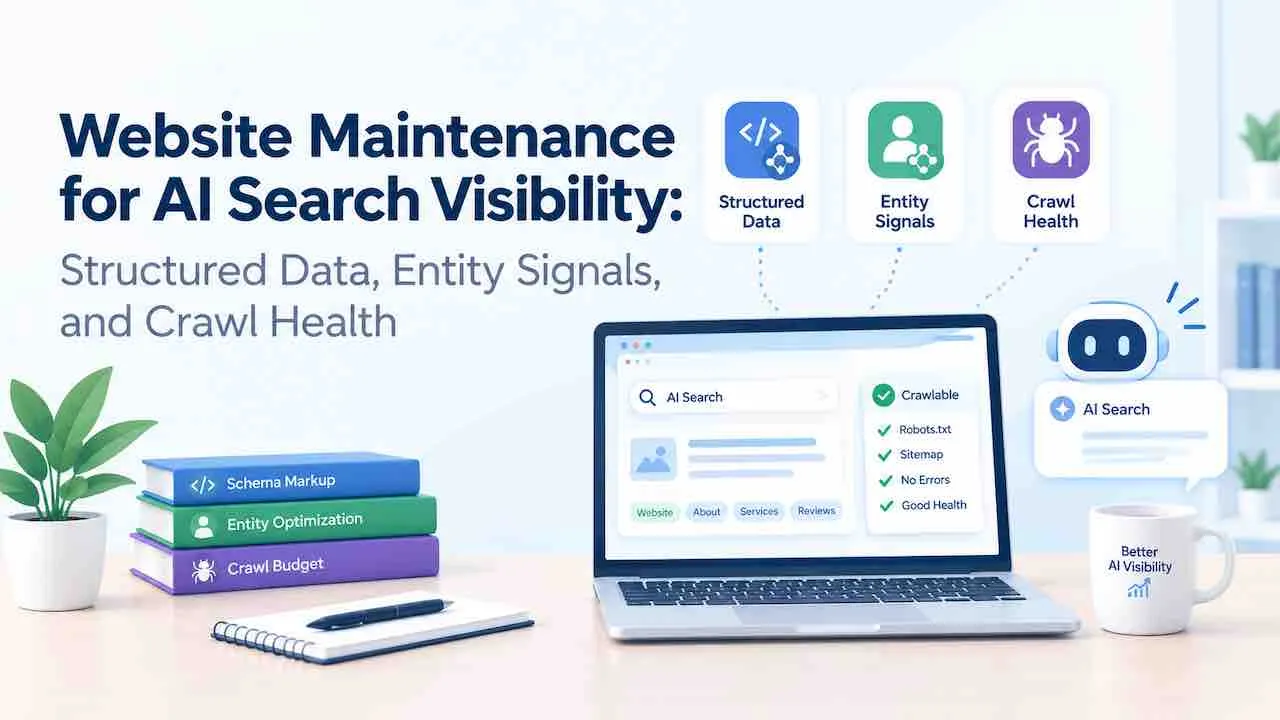
Website maintenance for AI search means keeping the technical signals AI systems need. These signals help AI find, read, and cite your content. Google AI Overviews, ChatGPT, Perplexity AI, and Bing Copilot generate answers from sites they can crawl cleanly. 3 maintenance areas directly control AI search appearance: structured data, entity signals, and crawl health.
Sites that skip this maintenance stay invisible to AI engines. This happens even when they rank well in organic results. Sites that maintain these signals get cited as sources in AI-generated answers. Quick Digital’s website maintenance services cover structured data audits, crawl health, and entity signal upkeep. WAF access verification is included in every plan.
Why AI Search Reads Websites Differently
AI search engines retrieve content from a crawl index and generate answers from it. A page ranking well in organic results may still miss Google AI Overviews. 3 things determine whether your site appears in AI answers. These are crawler access, structured data clarity, and clean passage extraction.
AI search also separates two distinct crawl types. Training crawls build the model’s knowledge base. Retrieval crawls power real-time answers. You can block GPTBot (OpenAI training) without affecting ChatGPT answers. OAI-SearchBot handles ChatGPT real-time retrieval. Blocking the wrong crawler removes you from AI-generated answers while leaving training access open. LLM indexing for website maintenance explains how to manage both crawl types correctly.
AI crawlers also have no manual re-index option. Google Search Console lets you request re-indexing for Googlebot. No equivalent tool exists for GPTBot, ClaudeBot, or PerplexityBot. The first crawl an AI bot makes on your page shapes its index entry. Website maintenance for AI search must get the signals right before that first crawl. Answer engine optimization and Google AI Overviews optimization both depend on this foundation.
Crawler Access, WAF Blocking, and robots.txt
Website maintenance for AI search starts by confirming each AI crawler reaches your public content. Many sites block AI crawlers without knowing it. A permissive robots.txt does not guarantee access. Web Application Firewalls (WAF) and CDN bot protection can reject AI crawlers at the network layer. They operate before robots.txt is read.
AI Crawler User-Agents to Allow
Allow these 7 AI crawlers on all public content pages:
- GPTBot: OpenAI training crawler
- OAI-SearchBot: OpenAI real-time ChatGPT retrieval
- ClaudeBot: Anthropic Claude AI crawler
- PerplexityBot: Perplexity AI crawler
- Googlebot-Extended: Google AI Overviews crawler
- Applebot-Extended: Apple AI features crawler
- BingBot: Microsoft Bing Copilot
WAF and CDN Bot Protection Settings
Check your WAF and CDN settings separately from robots.txt. Cloudflare, Fastly, and AWS CloudFront categorize AI crawlers as generic bots and block them by default. Review bot management rules quarterly. Add each AI user-agent to the allowlist explicitly. A 403 response served to an AI crawler is a silent crawl failure. It does not appear in Google Search Console. Only server log analysis reveals it.
JavaScript Rendering and Initial HTML
AI crawlers cannot execute JavaScript. Content loading after page render is invisible to GPTBot, ClaudeBot, and PerplexityBot. Every page must deliver its full text in the initial HTML response. Run a fetch-as-bot test in Google Search Console. Switch JavaScript-dependent content to server-side rendering or static generation.
Structured Data Maintenance for AI Search Visibility
Structured data gives AI search engines machine-readable facts about your pages, entities, and relationships. Without it, AI systems must infer meaning from plain text. Regular schema markup audits lead to more AI citations. Service schema and Article schema are the two most commonly missed types. Review schema markup implementation for full technical requirements.
JSON-LD Schema Types That Matter Most for AI Search
| Schema Type | What AI Search Uses It For | Maintenance Frequency |
|---|---|---|
| Organization | Entity identification, brand facts, sameAs links | Quarterly |
| Article / BlogPosting | Author attribution, dateModified, topic | Every content update |
| Person (author) | Author credibility, knowsAbout, E-E-A-T signals | When credentials change |
| FAQPage | Direct answer extraction for AI responses | When FAQ content changes |
| BreadcrumbList | Site architecture and topic context | On URL or navigation change |
| Service | Service-entity relationship to organization | Quarterly |
Every schema type must include a stable @id property. Without it, AI systems see each mention as a different entity. This breaks entity recognition and reduces knowledge graph confidence. A complete Organization schema also builds knowledge panel eligibility over time. Add sameAs links to Google Business Profile, LinkedIn, Wikipedia, and Wikidata. Check all sameAs URLs quarterly. A broken sameAs URL weakens entity authority without any crawl error.
Schema Drift: The Silent AI Search Killer
Schema drift is the most common reason AI systems skip a page. It happens when markup no longer matches visible content. AI systems compare markup to visible content. A mismatch lowers trust in the page’s facts. Run a schema validation pass monthly using Google’s Rich Results Test. Flag any page where schema properties differ from visible content.
Entity Signals: How AI Search Identifies Your Brand
Entity signals tell AI search engines who your organization is and whether external sources agree. AI systems pull entity facts from structured data, About pages, author profiles, and third-party mentions. Inconsistency across these sources reduces AI confidence. Strong entity signals support entity optimization for generative engines.
Organization Entity Maintenance
5 facts must match across your Organization schema, About page, and off-site profiles:
- Legal or trading name (exact spelling, no variation between platforms)
- Website URL (canonical, consistent trailing slash usage)
- Business address and phone number for local entities
- Year the organization was founded
- Primary service or product category
A name spelled two ways across LinkedIn, Crunchbase, and your About page creates entity ambiguity. Ambiguous entities get cited less often in AI-generated answers.
Author Entity and E-E-A-T Signals
AI search weights content from identifiable, credible authors more heavily. Each author needs a Person schema with name, url, sameAs, and knowsAbout properties. The knowsAbout property lists 3 to 5 topic areas matching their actual content. E-E-A-T trust and authority signals show how author credibility directly affects AI citation rates. Audit author pages quarterly. Orphaned author pages with no internal links do not transfer entity signals.
NAP Consistency Across the Web
NAP consistency across directories, review platforms, and social profiles is a measurable entity signal. Audit 5 platforms each quarter: Google Business Profile, LinkedIn, Crunchbase, Trustpilot, and relevant trade directories. Entity recognition in AI search depends on consistent facts appearing across multiple independent sources.
Crawl Health Maintenance for AI Search
A technically unhealthy site loses AI search visibility even when structured data and entity signals are correct. Website maintenance for AI search must address crawl health as a baseline. The full website maintenance checklist covers crawl health alongside content and security tasks.
XML Sitemap, lastmod, and IndexNow
Submit an XML sitemap to Google Search Console and Bing Webmaster Tools. Every new page should appear within 24 hours of publication. Include accurate lastmod dates in sitemap entries. A lastmod date that never changes signals stale content to AI crawlers. Use IndexNow to push real-time URL updates to Bing after every publication.
Broken Links, Soft 404s, and Redirect Chains
Broken internal links stop AI crawlers from reaching connected pages. Run a broken link audit monthly. Fix hard 404 errors with a direct redirect. Also audit soft 404s: pages that return a 200 status code but show thin or near-empty content. AI crawlers index soft 404s as low-value pages. Reduce redirect chains to a single hop. A chain of 3 or more redirects loses crawler signal at each step.
Canonical Tags and llms.txt
Duplicate content forces AI crawlers to guess the authoritative version. They may index neither. Audit canonical tags each quarter. 3 common errors: canonical to a redirect, canonical to a noindex page, and missing self-canonical. Technical SEO maintenance covers canonical health in full detail.
llms.txt is an experimental Markdown index file placed at your domain root. It tells AI systems which pages to prioritize and which to skip. Keep it aligned with your live sitemap. Remove discontinued URLs from it immediately after any page deletion or redirect.
Content Freshness and AI Search Re-indexing
AI search systems weigh content freshness when selecting passages for generated answers. Pages without a visible update date receive lower confidence scores for time-sensitive queries. Website maintenance for AI search includes a content decay review every quarter.
When to Update Pages for AI Search
Update a page when any of these 4 conditions are true:
- Its facts are outdated or contradict current public information
- Its internal links point to 404 pages or redirect destinations
- Its structured data no longer matches visible content (schema drift)
- Competing pages rank above it in AI-generated answers for its topic
Prioritize updating high-traffic pages before publishing new ones. One updated page often recovers more AI visibility than three new pages combined.
dateModified Schema Property Maintenance
Add dateModified to Article schema every time content changes. Also set datePublished once at original publication. AI crawlers use both to assess content recency and crawl recency signals. Do not update dateModified without making a meaningful content change. AI systems cross-check the date against actual content. A false dateModified update signals low trustworthiness and reduces citation likelihood. Page load speed improvements keep newly updated pages re-indexed quickly.
Content Structure for AI Passage Extraction
AI search engines extract individual passages from pages, not entire articles. Page structure determines whether AI systems pull a clean answer or skip the page entirely.
Answer-First Structure and Heading Maintenance
Each section must follow one pattern. State the answer in the first sentence. Then support with specifics. Audit heading structure after every major content update. Vague or clever headings reduce AI extraction accuracy. Replace them with descriptive headings matching likely AI search queries exactly.
Internal Linking Architecture for Entity Mapping
Internal links help AI search engines map entity relationships across your site. A service page with 8 internal links sends stronger entity signals than one with 0. Audit internal links monthly. Identify pages with fewer than 3 links pointing to them. These link depth and crawl path standards come from SEO best practices for website architecture. They define the crawl depth AI indexing depends on.
Monitoring AI Search Visibility
Effective website maintenance for AI search requires monitoring beyond standard organic traffic reports. AI-generated answers do not always produce clicks. Active monitoring finds AI visibility gaps before they affect revenue.
Tracking AI Crawler Activity in Server Logs
Server logs show exactly which pages each AI crawler visited and what response code they received. Check server logs monthly for 4 signals:
- AI crawler visits on key pages (crawl recency confirms active indexing)
- 403 or 500 responses served to AI crawlers (silent crawl failure)
- Pages with zero AI crawler visits (possible WAF or robots.txt block)
- Crawl frequency drops (signals lower content quality score)
AI-powered website monitoring automates this log analysis across all major AI bots. Website performance monitoring tracks TTFB and uptime alongside crawler signals.
UTM and Referral Traffic Tracking for AI Sources
ChatGPT referral traffic appears as chatgpt.com referrals in Google Analytics 4. Perplexity AI shows as perplexity.ai. Some ChatGPT referrals carry utm_source=chatgpt.com parameters. Set up GA4 segments for both referral hostname and UTM source. This captures all AI-referred sessions. Review these segments monthly alongside organic traffic data.
Manual Citation Checks and AI Visibility Audits
Search manually in ChatGPT, Perplexity, and Google AI Overviews for your brand name and top service queries. Record whether your site is cited. How to rank in ChatGPT covers the full citation workflow. For deeper strategy, generative engine optimization builds on the same clean crawl signals maintained here.
Website Maintenance for AI Search: Monthly and Quarterly Schedule
AI search maintenance tasks fall into 3 cadences: monthly checks, quarterly audits, and event-triggered updates.
| Task | Cadence | Tool |
|---|---|---|
| Broken link scan and 404 / soft 404 fix | Monthly | Screaming Frog, Search Console |
| Server log review for AI crawler activity | Monthly | Server log analyser or hosting panel |
| Schema drift validation | Monthly | Rich Results Test, Schema.org validator |
| AI citation manual check | Monthly | ChatGPT, Perplexity AI, Google AI Overviews |
| XML sitemap and lastmod check | Monthly | Google Search Console, Bing Webmaster Tools |
| robots.txt and WAF allowlist audit | Quarterly | Search Console, WAF admin panel |
| Organization and author schema review | Quarterly | Rich Results Test |
| sameAs URL validity check | Quarterly | Manual or redirect checker |
| NAP consistency audit | Quarterly | Manual check across 5 platforms |
| Content decay and dateModified update | Quarterly | Analytics + Screaming Frog |
| llms.txt alignment with live sitemap | Quarterly | Manual review |
| Content-schema match audit | On any content change | Rich Results Test |
Core Web Vitals website maintenance runs alongside this schedule. LCP, INP, and CLS scores affect AI search and traditional page experience signals the same way.
Frequently Asked Questions
No, blocking GPTBot does not affect Google search rankings. GPTBot is OpenAI’s training crawler, separate from Googlebot. Blocking it only prevents content from appearing in ChatGPT training data. OAI-SearchBot powers live ChatGPT search answers.
Run schema validation monthly and after any content update. Schema drift is the most common reason AI systems skip a page. Monthly checks catch drift before it affects AI citation rates. Any content change that affects facts, prices, or author details needs an immediate schema check.
Yes, in 4 areas: WAF/CDN allowlist management, per-bot robots.txt rules, stable @id properties, and initial-HTML delivery. Standard technical SEO does not cover these. Both share crawl health, site speed, and canonical tag requirements.
A WAF blocks AI crawlers at the network layer, before robots.txt is read. Crawlers receive a 403 error and cannot access the page. This does not appear in Google Search Console. Only server log analysis reveals it. Review WAF bot management rules quarterly and add AI user-agents to the allowlist.
Yes. A slow TTFB causes AI crawlers to time out or deprioritize a site. A time-to-first-byte above 600ms reduces AI crawl depth. Fix server response time before any other website maintenance for AI search work. AI crawlers often visit more frequently than Googlebot, making performance critical.
Website Maintenance for AI Search Visibility
Quick Digital maintains structured data, entity signals, crawl health, and WAF access for AI search visibility. Monthly audits, schema drift detection, and AI crawler verification are included in every plan.
View Maintenance Plans Get a Quote