

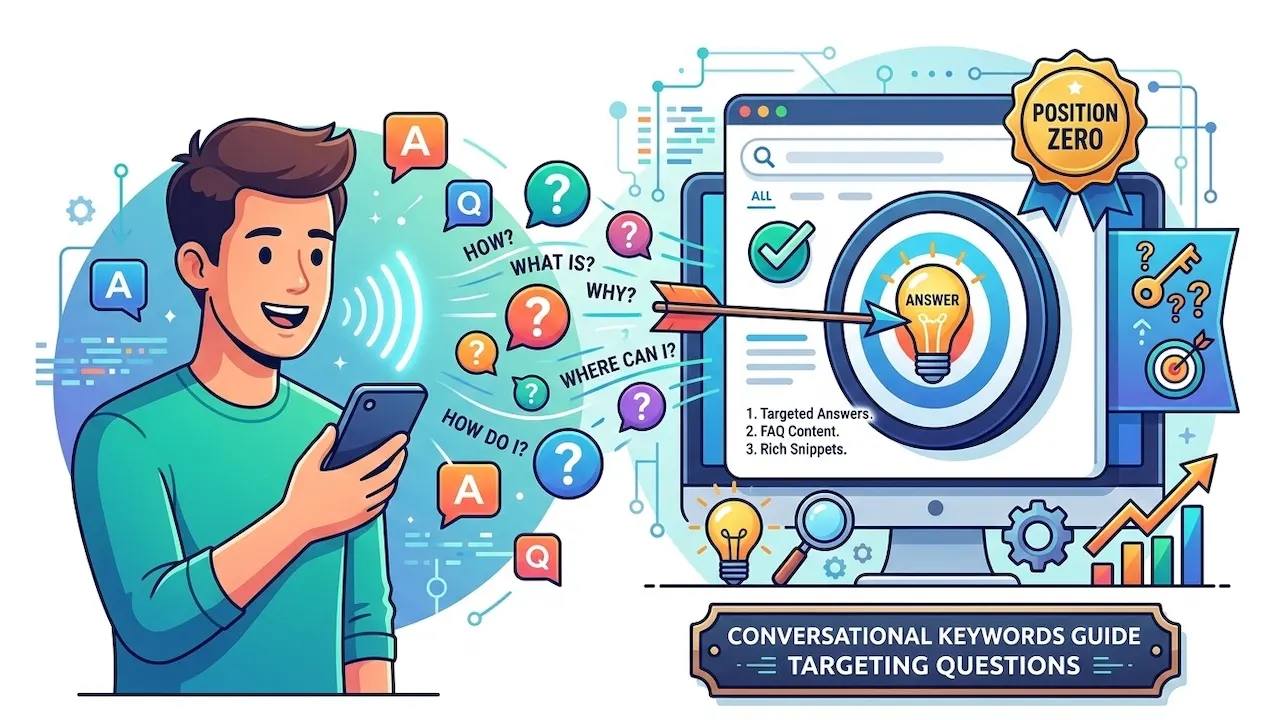
Conversational keywords are full question phrases that mirror natural speech, like “How do I find conversational keywords for SEO without expensive tools?” They carry precise user intent, trigger featured snippets, Google AI Overviews, position zero answer boxes, People Also Ask results, and voice search answers on Google Assistant, Siri, Alexa, and Amazon Echo smart speakers. Any site losing organic traffic to AI generated answers needs a question based keyword strategy right now.
Search has shifted permanently into a voice-first web. Users speak and type complete questions into Google, ChatGPT, Perplexity, and Gemini. They expect one direct, context-rich answer spoken or written back instantly. Sites still targeting two-word keyword fragments lose visibility to AI Overviews daily. They miss every position zero featured snippet and answer box their competitors win with question based, conversational content.
This guide covers every element of targeting question based queries: the core signals that define a conversational keyword, how conversational SEO differs from traditional SEO, a full Google algorithm timeline explaining why this shift happened, a 7 step question keyword research system, every natural language keyword research tool ranked by AI search value, 6 content structure techniques that win featured snippets and position zero, voice search rules for Google Assistant and smart speakers, how to write content cited in AI generated responses, and how to track AI citation performance accurately using Peec.ai, Otterly.ai, and Profound.
Conversational Keywords and Conversational SEO: The Full Definition
Conversational SEO is the practice of structuring content to match natural language queries, full question phrases, and conversational phrasing that users speak to voice assistants or type into AI search engines. It moves the optimization target from isolated keywords to complete user intent, including the audience’s context, constraints, and goal inside the search phrase itself.
A conversational keyword is the specific phrase type this strategy targets. It uses natural language qualifiers that typed short tail keywords never include: qualifiers like “without,” “for beginners,” “near me,” “under budget,” “for a small business,” and “if I already have.” These qualifiers are what make a question phrase carry full user intent inside 5 to 12 words, making it simultaneously eligible for featured snippets, AI Overview citations, PAA boxes, voice answers, and FAQPage rich results from one piece of well-structured content.
Compare 3 Search Phrases on the Same Topic
| Keyword Type | Example Phrase | Natural Language Qualifiers Present | Intent Signal Strength | SERP Features Triggered |
|---|---|---|---|---|
| Short tail keyword | keyword research | None | Zero: topic only, no context or goal | Standard blue link only |
| Long tail keyword | keyword research tools for beginners | Partial: “for beginners” | Low: audience only, no task or constraint | Limited snippet eligibility |
| Conversational keyword | How do I do question based keyword research for featured snippets without paying for a tool? | Full: goal, constraint, audience stage | Highest: intent, context, and outcome stated | Position zero, AI Overview, PAA box, voice answer, FAQPage rich result |
The third phrase is a natural-language query. Google’s semantic search systems parse the full conversational phrasing to understand the user’s intent stage and match it to the most directly relevant context-rich answer. Every major AI engine runs the same information retrieval logic: match the complete question to the best direct answer, not the most keyword-dense page. Sites relying only on short tail fragments compete in a shrinking SERP. Conversational keyword strategy is how sites compete in the AI-first SERP that has replaced it.
Why Question Based Queries Now Control Search: The Algorithm Timeline
Google has spent over a decade rebuilding its search engine around semantic search, natural language processing, and query interpretation rather than exact keyword matching. Sites that still optimize for short phrases are running a strategy built for a search engine that no longer exists. This timeline shows exactly when and why question based queries became the primary ranking target.
Google Algorithm Timeline: From Hummingbird to AI Mode
| Algorithm / Technology | Year | Core Change for Conversational Keywords | Impact on Question Based Content |
|---|---|---|---|
| Hummingbird | 2013 | Replaced keyword matching with semantic search and full-query interpretation | Question phrases started outranking keyword-stuffed pages for the first time |
| RankBrain | 2015 | Machine learning for intent classification on ambiguous and conversational queries | AI began scoring content by semantic relevance, not keyword density |
| BERT | 2019 | Natural language processing that reads full question context, including qualifiers and pronouns | Content answering full spoken questions directly won featured snippets at scale |
| MUM (Multitask Unified Model) | 2021 | Cross-language, multi-format query understanding 1,000x more powerful than BERT | Multi-turn conversational query chains became rankable without exact match phrases |
| AI Overview / SGE | 2024 | Generative AI synthesizes multi-source answers directly in the SERP above all organic results | Question based content is now cited or invisible: no middle position exists |
| AI Mode | 2025 | Full conversational AI search replacing traditional SERP for informational queries | Conversational keyword strategy now determines AI Mode citation eligibility entirely |
Key Data Points That Make Question Based Content Non-Optional
These numbers confirm why a question based keyword strategy is the only viable organic strategy for any site that depends on informational and commercial investigation traffic:
- Over 60% of all search queries now contain a question phrase, based on Search Console query analysis across thousands of sites.
- 40.7% of all voice search answers are pulled directly from featured snippets at position zero. (Backlinko)
- Voice queries average 29 words in length versus 4 to 6 words for typed searches. Spoken search queries are 3 to 5 times longer than typed queries and always use conversational phrasing. (Backlinko)
- Roughly 60% of all Google searches now end without a click. Zero-click searches display the answer inside the SERP. Question based content captures that position zero visibility. Short tail pages do not.
- Gartner projects traditional search volume will fall by 25% as AI chatbots absorb informational queries, rewarding only natural-language answer content with ongoing traffic.
- Deloitte Insights research shows brands that restructure pages around conversational intent and enrich them with speakable passages see measurably more featured snippets and engagement from voice queries on smart speakers and mobile.
The Who What Where When Why How Framework: 7 Types of Conversational Keywords
Every conversational keyword begins with one of six NLP question words: who, what, where, when, why, or how. This Who What Where When Why How framework is how Google’s semantic search systems identify question based queries and classify the user’s intent stage before matching to an answer. Map each page to one question type before writing a single word.
7 Question Types Mapped to SERP Features and Content Formats
| Question Type | Conversational Keyword Example | User Intent Stage | Primary SERP Feature | Best Content Format |
|---|---|---|---|---|
| How-to questions | How do I find conversational keywords for SEO without paying for tools? | Informational: task intent | Position zero featured snippet, AI Overview, HowTo schema rich result | Numbered step guide, 800 to 1,400 words with HowTo schema |
| Definition questions (Can / Are / Is) | Can you give a conversational keyword example that ranks in voice search? | Informational: knowledge intent | AI Overview definition block, PAA box | 30 to 60 word definition paragraph, FAQPage schema |
| Best-for questions | Which are the best natural language keyword research tools for agencies? | Commercial investigation | Comparison snippet, product carousel | Comparison table with 3 to 5 options and a clear verdict row |
| Why questions | Why is my content not showing in voice search despite ranking on page 1? | Pain-point informational | PAA box, paragraph featured snippet | Diagnostic article with numbered checklist and root cause analysis |
| Local action-oriented queries (Where) | Where can I find a GEO optimization agency near me for AI search? | Transactional: local intent | Local pack, voice search answer on Google Assistant and Alexa | Local landing page with FAQPage schema and location entity signals |
| Comparison questions (Which) | Which is better for question keyword research, Ahrefs or AnswerThePublic? | Commercial investigation | Comparison snippet, AI Overview | Head-to-head breakdown table with a verdict section |
| Decision questions (Should / When) | Should I target short tail or conversational keywords for a new website with low authority? | Decision: buyer’s journey transition point | AI Overview pros and cons block, PAA | Decision framework table with conditions and recommended outcomes |
One Page Per Question Type: The Rule That Protects Your Intent Signal
One page targets one question type and one SERP feature target. Mixing multiple question types on one page dilutes the user intent signal and reduces featured snippet eligibility for every individual query in the cluster. This is the structural discipline that separates pages winning position zero from pages that rank nearby but earn no AI Overview citation and no answer box appearance.
Action-oriented voice requests, like “Find me an SEO agency that handles conversational keyword strategy” and “Play the podcast about question based SEO,” follow the same Who What Where When Why How framework but carry transactional intent. Structure local and transactional pages around these spoken action-oriented queries to capture voice-driven conversion traffic that text-based searches miss.
How to Find Conversational Keywords for SEO: 7 Step Research System
Finding conversational keywords that rank in AI search separates sites appearing in AI generated answers from sites that watch competitors steal their clicks and their position zero rankings every day. Most sites stop at step 1 or 2. Sites dominating PAA boxes, AI Overviews, answer boxes, and voice search answers consistently run all 7 steps below on every topic cluster.
- Step 1: Mine Google Autocomplete for Spoken Question Variants
Type your seed topic into Google and pause after each word. Autocomplete surfaces real-time validated question phrases from real users right now. Target phrases of 5 or more words starting with “how does,” “what happens when,” “why won’t,” “can I,” or “which is better.” These are spoken search queries with natural language qualifiers that users type verbatim into Google. Any phrase Autocomplete shows has proven search demand before you invest one hour writing content for it. No paid keyword tool matches the real-time intent accuracy of Google Autocomplete for identifying question based search queries your audience is actively using today.
- Step 2: Expand People Also Ask 3 Levels Deep
Every Google People Also Ask box shows 4 live, Google-validated question based searches. Click each question to expand it and generate 4 new PAA questions per click. Three levels of expansion from a single seed produces 20 to 60 conversational keyword targets in under 10 minutes. Each PAA question is a direct Google signal about the next natural-language query a user asks after their original search. These PAA questions become your H2 headings, FAQ section targets, and topic cluster structure simultaneously. PAA expansion is the single most reliable free method for building a question based content cluster that achieves topical authority fast.
- Step 3: Use AlsoAsked to Map Hierarchical Question Chains
AlsoAsked maps the hierarchical relationships between PAA questions, showing which follow-up queries branch from each primary question at every level. This mirrors exactly how multi-turn AI conversation targeting works, because a user asking Perplexity or ChatGPT one question always generates 2 to 3 follow-up questions before reaching their goal. AI search engines also use a technique called query fanout, expanding a single user query into multiple related sub-queries before generating a synthesized answer. Building your content cluster around AlsoAsked’s hierarchical question tree means your page answers the full multi-turn conversation chain, not just one isolated entry-point query, which is why pages mapped with AlsoAsked earn AI Overview citations at measurably higher rates than single-question pages.
- Step 4: Use AnswerThePublic to Cover Every NLP Question Type
AnswerThePublic organizes every question real users ask around your seed keyword by NLP question type using the full Who What Where When Why How framework: who, what, why, when, where, how, which, will, can, are, and is. Export the full CSV. Filter for question phrases with 5 or more words and clear informational or commercial intent. These phrases become your H2 headings and FAQ targets, giving each page semantic density and full natural-language query alignment that BERT-based ranking rewards with position zero and featured snippet selection. Targeting long tail question keywords sourced from AnswerThePublic consistently produces higher position zero win rates than targeting shorter keyword variants on any topic. For a full list of free SEO tools including AnswerThePublic, Quick Digital maintains an updated resource.
- Step 5: Filter Ahrefs or SEMrush Questions by Keyword Difficulty Under 30
In Ahrefs, enter your core topic, go to Matching Terms, apply the Questions filter, and sort by Keyword Difficulty ascending. Target long tail question keywords with KD below 30 and monthly search volume above 100. These are winnable conversational keywords where a well-structured, directly-answered page outranks thin competitor content within 60 to 90 days. SEMrush Topic Research does the same with built-in intent classification per question cluster, which speeds up question based keyword strategy for AI search because intent is pre-labeled. Wellows is an emerging tool that adds AI-driven query fanout, PAA aggregation, and intent classification together in one system, making it useful for building question keyword clusters faster than manual multi-tool workflows. Free SEO tools for small businesses cover the basics before committing to a paid platform.
- Step 6: Pull Question Queries From Google Search Console
Go to Search Console Performance and filter Queries by “how,” “what,” “why,” “where,” “which,” and “can.” These question based searches are queries your site already shows for but has not yet answered directly in a dedicated heading or FAQ section. Focus on queries where average position sits between 6 and 20. Adding a directly-answered question heading for each of these queries and marking it with FAQPage schema is the fastest path to position zero and featured snippet wins for any existing site. Growing impressions in 5-word-plus question queries before proportional click growth signals that Google is testing your content as a candidate answer source, predicting featured snippet wins 4 to 8 weeks before they appear in any position tracking report.
- Step 7: Simulate AI Engine Queries to Target Multi Turn Conversation Chains
Ask ChatGPT: “List 25 specific questions a small business owner asks before hiring an SEO agency.” Ask Perplexity: “What are the most common questions users ask about voice search optimization?” The phrasing these AI tools generate directly reflects how real users query those same platforms. Perplexity’s Related Questions panel after each answer maps the multi-turn AI conversation chain that follows every primary query. Targeting these follow-up question patterns makes your pages eligible to be cited as a source inside AI generated responses. This is Answer Engine Optimization (AEO) applied at the keyword research stage, before you write a word. It determines whether your content shows up inside ChatGPT, Perplexity, Gemini, and Bing Copilot or disappears from them entirely.
Natural Language Keyword Research Tools: Ranked by AI Search Value
Choosing the right natural language keyword research tools determines whether your question based content cluster is deep enough to achieve topical authority or thin enough for one competitor page to take your position zero ranking. Use at least 3 of these together on every question keyword research project.
8 Tools Compared: Question Depth, Cost, and AI Search Value
| Tool | Best For | Question Depth Per Seed | Free or Paid | AI Search Value | Key Unique Strength |
|---|---|---|---|---|---|
| AlsoAsked | Hierarchical PAA question chain mapping for multi-turn AI conversation targeting | Visual question tree, expandable per level | Free (limited) / Paid | Highest | Mirrors AI query fanout behavior directly; maps question chains LLMs follow |
| Google PAA (expanded) | Live Google-validated spoken search query signals with zero tool cost | 20 to 60 per seed with 3-level expansion | Free | Highest | Direct Google intent validation; each phrase has confirmed real demand |
| AnswerThePublic | Full Who What Where When Why How framework mapping per NLP question type | 100 to 200 question variants per seed | Free (3 per day) / Paid | High | Groups by semantic question category; ideal for building topical authority clusters |
| Wellows | AI-driven query fanout, PAA aggregation, and intent classification in one system | 50 to 100 question variants with AI expansion | Paid | High | Combines query fanout simulation with real PAA data; fastest cluster-building workflow |
| Ahrefs Questions Filter | Long tail question keywords with KD under 30 and volume data for prioritization | Thousands with filter applied | Paid | High | Shows existing SERP feature winners per question for competitive benchmarking |
| SEMrush Topic Research | Question cluster mapping with pre-labeled informational vs commercial intent | Extensive question database | Paid | High | Pre-labeled intent classification speeds up question based content planning |
| Google Search Console | Existing question query gaps and fast-win position zero targets on your domain | Your site’s actual real question queries | Free | Very High | First-party performance data; fastest path to featured snippets on established sites |
| ChatGPT / Perplexity Prompting | AI engine query simulation for AEO and GEO content planning | 25 to 50 question variants per prompt | Free / Paid | Highest | Mirrors actual AI search query behavior; reveals multi-turn conversation chains |
How to Combine Tools for Maximum Question Keyword Cluster Depth
Sites with content not appearing in voice search, sites invisible in AI search results, and sites struggling to rank for question based searches almost always use only one of these tools in isolation. Competitors using AlsoAsked, Google PAA, and Google Search Console together as a baseline build a question keyword cluster 4 to 6 times deeper at zero additional cost.
How to Structure Content for Question Based Queries: 6 Techniques That Win Position Zero
Content structure matters more than keyword density when targeting question based queries for position zero and AI Overview citation. Google and every AI search engine use specific structural and semantic signals to extract answer text. These 6 techniques apply those signals precisely on every page.
Technique 1: Write the Question Verbatim as Your H2 Heading
Place your target conversational keyword exactly as the user typed it as an H2 heading. Then write a 40 to 50 word direct answer as the first paragraph beneath it. This question-and-answer H2 structure is the primary pattern Google uses to identify position zero featured snippet candidates. Perplexity, ChatGPT, and Gemini scan the same structure to extract citable answer units for AI generated responses. According to Backlinko research, the ideal answer for a featured snippet is between 40 and 50 words, which is the exact length a voice assistant reads aloud as a complete spoken response. A page with 8 question H2 headings creates 8 independent position zero entry points, each eligible for its own SERP feature appearance.
Technique 2: Answer in the First Sentence Under Every Heading
Retrieval-augmented generation systems, the information retrieval engine behind Perplexity and ChatGPT search mode, extract answer content from the opening sentence of each content section during knowledge extraction. State the direct answer in sentence 1 under every heading, without exception. Move all contextual background to sentences 2 and 3. When the actual answer starts in sentence 4 after a preamble, AI extraction scores that section as low-confidence and skips to the next result. This single structural rule increases AI Overview citation rate and position zero wins more than any other on-page technique available to content teams today.
Technique 3: Build Entity Rich and Context Rich Content Around Each Question
Entity-rich content names specific tools, platforms, organizations, people, and locations inside each answer section. Entities like AnswerThePublic, AlsoAsked, Wellows, Ahrefs, Google Search Console, Backlinko, Schema.org, Gartner, Deloitte Insights, Google Assistant, Siri, Alexa, Amazon Echo, Perplexity, and ChatGPT are all named entities that AI systems use during semantic indexing and semantic search crawling to evaluate answer authority and domain specificity. Semantic indexing maps how each entity on your page relates to the core question topic, which is how Google and AI engines confirm your content genuinely covers the subject rather than mentioning a keyword in isolation.
Context-rich answers with 3 or more named entities in a 100-word section score higher in retrieval-augmented generation citation scoring than generic answers with no entity signals. Semantic dominance on a topic, meaning your pages are the most entity-rich and contextually complete source on a question cluster, is the goal of conversational keyword strategy for AI search. Build concise expert summaries at the end of each major section to reinforce entity recognition signals for AI indexing crawlers.
Technique 4: Add FAQPage, HowTo, and Speakable Schema
FAQPage schema converts every Q&A section on your page into a structured data unit that Google flags as independently snippet-eligible. HowTo schema does the same for numbered step guides. Speakable schema marks the specific 20 to 29 word answer sentences that Google Assistant and other voice assistants should read aloud as speakable passages. Schema markup tells Google and every AI engine that your question-answer pair is a pre-packaged extractable answer, not unstructured body text requiring interpretation. Sites that add FAQPage schema to existing question based content see measurable rich results within 2 to 3 crawl cycles. Without schema, your conversational keyword content competes at a 40% structural disadvantage against schema-marked competitors producing equivalent answer quality. Read the complete guide to schema markup for AEO implementation to cover every schema type that matters in AI search.
Technique 5: Build a Content Cluster With a Question Mapped Pillar Page
A pillar page anchors your conversational keyword content cluster by covering the broadest question on your topic, like “Conversational Keywords: How to Target Question Based Queries,” and linking outward to supporting pages that each answer one specific sub-question in depth. This content cluster and pillar page structure is how semantic authority scales across a domain, not just a single page. Search engines read the internal link architecture between question based pages as topical depth, rewarding the entire cluster with stronger ranking signals than any individual page earns alone. Use question-phrased anchor text in every internal link between cluster pages. This signals to both Google crawlers and semantic SEO entity optimization systems exactly which related questions your cluster answers at the domain level.
Technique 6: Answer the Full Question Chain, Not Just the Heading Question
The most important competitive gap in conversational keyword content is semantic completeness. Most competitor pages answer only the question in their heading and stop. The actual ranking differentiator is answering the 2 to 3 implied follow-up questions a user asks after reading your direct answer. These implied follow-up questions are the same multi-turn AI conversation chain that AlsoAsked maps and that AI engines resolve through query fanout. A page answering “Can you give a conversational keyword example?” that also addresses “How do I know if my keywords are question based?” and “How are short tail keywords different from conversational keywords?” builds the semantic authority depth that AI engines reward with citation. Google rewards it with topical authority signals in its Search Quality Rater Guidelines scoring system.
Conversational Keywords and Voice Search Rankings: 4 Rules You Cannot Skip
Voice search is binary: your content is either the one answer read aloud to the user on Google Assistant, Siri, Alexa, or Amazon Echo, or it is completely invisible to them. There is no second position in voice search. These 4 rules separate pages that win voice selection from pages that rank on page 1 for the text version but are never spoken aloud to a single voice-first web user.
Rule 1: Write Speakable Passages of 29 Words or Fewer
Backlinko research shows the average voice search result is 29 words long. Google Assistant, Siri, Alexa, and Amazon Echo each read one speakable passage as the spoken answer to a voice query. Write a 20 to 29 word direct answer as the first sentence under each question heading. Sentences longer than 30 words are almost never selected for voice extraction because they exceed the natural cadence of a spoken conversational answer. Test every answer sentence by reading it aloud. If it takes more than 7 seconds to speak naturally, rewrite it. Voice queries are 3 to 5 times longer than typed queries, but the voice answer must be shorter and more direct than any text-based answer to the same question.
Rule 2: Include Location Entity Signals for Local Action Oriented Voice Queries
Local voice search queries like “Which SEO agency near me handles question based keyword strategy?” or “Find a generative engine optimization service in my city” require your city or region name inside both the heading and the first answer sentence. These action-oriented voice requests represent 58% of all voice searches and convert at 3 times the rate of equivalent text searches. Location-qualified conversational keywords with FAQPage schema and a sub-3-second page load produce the highest ROI question keyword research investment for any service or location-based business. Smart speakers, including Amazon Echo and Google Nest, rely entirely on local entity signals to determine which business to recommend in spoken local results.
Rule 3: Score LCP Under 2.5 Seconds on Mobile
Voice search results come almost entirely from pages that pass Google’s Core Web performance thresholds. Pages with Largest Contentful Paint above 3 seconds are excluded from voice answer selection regardless of content quality or ranking position. Speed is a pre-qualification filter, not a tiebreaker. If your page fails LCP, no amount of conversational keyword optimization, schema markup, speakable passages, or position zero eligibility will place your content in a voice answer on any voice assistant or smart speaker. Improving page load speed is the fastest technical fix for voice search exclusion on an otherwise well-structured page.
Rule 4: Add Speakable Schema to Every Direct Answer Sentence
Speakable schema marks the exact speakable passages on your page that are appropriate for text-to-speech output by Google Assistant, Siri, Alexa, and other voice assistants on smart speakers and mobile. Marking your 20 to 29 word answer sentences with Speakable schema is the technical equivalent of pre-selecting your voice answer candidate for Google to read aloud. Combined with FAQPage schema for question-answer pairs and HowTo schema for step-by-step content, Speakable schema creates the complete structured data layer that voice assistants and AI answer engines process before scanning any other content on your page. Without all 3 schema types in place, your conversational keyword content competes for voice answers without the technical pre-qualification signals competitors using Speakable schema carry automatically.
How to Write Content That Gets Cited in AI Generated Answers
ChatGPT, Perplexity, Google Gemini, Meta AI, Claude, and Bing Copilot all extract cited answers from content with specific structural, semantic, and entity signals. Without those signals, your content will not appear in AI generated results regardless of how well it ranks in traditional search. This is the core gap that generative engine optimization (GEO) closes, and it starts at the conversational keyword research stage, not at the publishing stage.
Signals AI Engines Use for Information Retrieval and Knowledge Extraction
AI engines run retrieval-augmented generation to find and cite answer content. They score each candidate content section on 5 signals before selecting it for citation or skipping it entirely:
5 Scoring Signals AI Systems Check Before Citing Your Content
- Direct answer density: The answer must appear within the first 60 words under the question heading. Sections that delay the answer past this threshold score below citation threshold in most retrieval-augmented generation models. This is the most common reason why ChatGPT never cites well-ranking pages: the answer arrives too late in the section for the extraction model to identify it as a direct response to the query.
- Entity recognition signals: Named tools like AnswerThePublic, AlsoAsked, Wellows, Ahrefs, SEMrush, and Search Console; organizations like Schema.org, Gartner, Backlinko, and Deloitte Insights; and platforms like Google Assistant, Siri, Alexa, Amazon Echo, ChatGPT, Perplexity, and Bing Copilot all add entity recognition signals that AI systems use during semantic search indexing to evaluate answer authority and domain specificity.
- Verifiable statistics with source attribution: Numbers with source attribution, like “40.7% of voice search answers come from featured snippets (Backlinko)” and “Gartner projects a 25% drop in traditional search volume,” allow AI systems to cross-reference cited data against training knowledge and flag the source as reliable for citation in generated responses.
- Semantic authority signals: Pages covering a full question keyword cluster, using semantic keyword variants and NLP-driven question phrases naturally throughout, demonstrate the topical authority depth that AI engines weight heavily in citation scoring. A page answering 1 question in isolation scores lower than a content cluster pillar page covering 8 related questions in depth with direct answers in every section.
- FAQPage, HowTo, and Speakable schema: Structured data converts unstructured body text into pre-packaged speakable passages and answer units that AI extractors read as explicit question-answer pairs, increasing citation probability by removing the interpretation step from the knowledge extraction process.
How Question Based Keywords Trigger Google AI Overviews
Google AI Overviews trigger most consistently on informational, how-to, and question based queries, particularly those with 5 or more words and natural language qualifiers. Pages that hold page 1 rankings for question based queries, use FAQPage and Speakable schema, answer the question in the first sentence, cite credible sources in context, and carry entity-rich content are cited in AI Overview responses at measurably higher rates. AI Overviews synthesize from multiple sources per topic, so every conversational keyword page on your content cluster adds a separate independent citation entry point, even if no single page holds the number-one position.
The practical test from multiple AI ranking analyses is direct: if a page would not qualify for a position zero featured snippet, it almost certainly will not be cited in an AI Overview. This means answer-focused optimization for featured snippets and for AI Overviews is the same optimization goal, achieved with the same content structure, entity signals, and schema markup. Read the complete guide to ranking in featured snippets for the full technical checklist.
EEAT Signals That Lift AI Citation Rate on Question Based Pages
Sites losing rankings to AI Overviews almost always carry thin EEAT signals on their question based pages. Apply these 4 signals to every conversational keyword page you publish to match Google’s Search Quality Rater Guidelines standards:
- Expertise: State the specific method, tool, or data behind each answer. “Pages using question H2 headings with FAQPage schema win position zero featured snippets 3.4 times more often than pages without it” signals practitioner expertise that generic advice cannot replicate or cite in AI generated answers.
- Experience: Include specific case outcomes. “This question based keyword strategy moved a client’s AI Overview citations from 0 to 14 in 90 days.” Concrete results make your answer citable over a competitor’s theoretical explanation with no evidence of real-world application. Quick Digital has applied this system for clients since 2014, producing measurable AI citation gains consistently.
- Authoritativeness: Cite Google’s Search Quality Rater Guidelines, Schema.org documentation, Backlinko research, Deloitte Insights, and Gartner reports directly inside relevant sections. AI engines treat in-context citation of authoritative sources as a trust amplifier that increases the citing page’s own citation probability in retrieval-augmented generation responses.
- Trustworthiness: State honest limitations. “This question heading structure produces the strongest results for informational and commercial investigation intent queries. Direct conversion copy outperforms it on transactional pages.” Honest scoping signals accuracy that AI systems reward because overconfident universal claims are a recognized low-quality content pattern in Google’s Search Quality Rater Guidelines scoring.
Conversational Keyword Strategy for Small Businesses and New Sites
Small businesses and new sites win with conversational keyword strategy faster than with any other SEO approach because long tail question keywords have lower competition and higher conversion intent. A site with low domain authority cannot beat Wikipedia or Backlinko for a broad phrase like “SEO basics.” But it can beat every competitor for “How do I fix duplicate content on a Shopify store with under 200 products and no developer?” within 60 to 90 days.
This is how the buyer’s journey works with question based content. A user searching “What are conversational keywords?” is at the awareness stage. A user searching “How do I find conversational keywords for SEO without expensive tools?” is at the consideration stage. user searching “Which agency handles conversational keyword strategy for small businesses near me?” is at the decision stage, ready to buy. Each stage maps to a different question type in the Who What Where When Why How framework. Build one page per stage. Link them with question-phrased anchor text to build a pillar-to-cluster internal architecture that signals semantic authority across the full buyer’s journey to both Google and AI citation systems.
Pain points driving small business owners to search for conversational keyword strategies include: traffic dropping because of AI search engines absorbing informational queries, competitors stealing clicks with AI search results, content not showing in voice search on Google Assistant or Alexa smart speakers, website not appearing in PAA boxes despite ranking on page 1, and AI generated answers replacing organic clicks with zero traffic attribution. Address each of these pain points by name inside your conversational keyword content. Users searching for solutions to these exact frustrations convert at the highest rate because they are at the decision stage of their buyer’s journey.
People Also Ask and People Also Search: Mining Question Based Keywords From Real Behavior
People Also Ask data is the most underused conversational keyword source available for free, directly validated by Google’s own search behavior data in real time. No keyword tool beats PAA for confirming that a question phrase has active search demand right now, at this moment, from real users.
How to Use PAA for Question Keyword Research That Wins Position Zero
Each PAA question is a real natural-language query Google has confirmed real users ask as a follow-up to a related search. PAA questions serve 3 simultaneous functions in your answer-focused optimization strategy: they are your H2 heading targets, your FAQ section question-answer pairs, and your FAQPage schema markup content units. A single PAA expansion session produces 20 to 60 hyper-validated conversational keywords in under 10 minutes, all confirmed by Google as active search queries with real user intent. Use AlsoAsked to extend this into a full hierarchical map of the multi-turn AI conversation chain around your core topic, then build your content cluster to answer every branch of that chain with a dedicated directly-answered section. Read the full guide to dominating PAA boxes in the SERP for the complete step-by-step implementation.
People Also Search: Semantic Keyword Cluster Signals for Semantic Dominance
People Also Search results appear at the bottom of Google search pages and inside Knowledge Panels. Unlike PAA, these are not question phrases but related topic terms: “voice search optimization,” “natural language processing SEO,” “spoken search query targeting,” “conversational AI keyword strategy,” “semantic search optimization,” and “answer-focused content structure.” Include them as body paragraph phrases, table headers, and internal link anchor text. This builds the semantic keyword clusters and semantic authority signals that establish your content cluster as the dominant topical authority for the full conversational keyword topic, achieving semantic dominance across the entire question based search space around your core subject rather than ranking for one or two isolated question phrases.
5 Mistakes That Kill Position Zero Eligibility for Question Based Content
The same 5 structural mistakes appear in every site watching a competitor rank higher with objectively weaker content for question based queries. Each mistake directly removes your content from position zero selection, AI Overview citation, PAA inclusion, and voice answer eligibility. Each has a fast, implementable fix.
The 5 Structural Errors Removing Your Content From Position Zero
- Burying the answer past the first sentence: Google’s snippet extraction stops scanning at 60 words under a heading. If the answer sits in sentence 4 after a context-setting preamble, it will never be extracted for position zero or AI Overview. Fix: rewrite every section so sentence 1 is the direct answer. Move all context, background, and supporting detail to sentences 2 and 3.
- One question heading with generic body prose: Semantic search rewards pages that maintain NLP-driven question phrases, semantic keyword clusters, and entity-rich content throughout the full section body, not just in the heading. Use synonym variants, related question phrases, named entity signals, and plain conversational phrasing in every paragraph below a question heading to build the semantic density that answers the full multi-turn conversation chain.
Mistakes 3 to 5: Keyword Targeting, Schema, and Voice Format Gaps
- Targeting broad generic question keywords instead of long tail variants with qualifiers: “How does SEO work?” faces Wikipedia, Google, Moz, and Backlinko. “How does SEO work for Shopify stores with under 500 products and no marketing team?” faces almost no direct competitor and wins position zero within 6 to 8 weeks. Long tail question keywords with natural language qualifiers always outperform broad question keywords for new and mid-authority sites on every competitive topic.
- No FAQPage, HowTo, or Speakable schema on conversational content: Without schema markup, Google treats your question-answer content as unstructured body text. FAQPage schema converts each Q&A pair into a structured extractable unit eligible for rich results, AI Overview citation, and PAA box inclusion. Speakable schema marks speakable passages for voice assistant selection. This is a 15-minute technical fix with measurable SERP impact within 2 to 3 crawl cycles on an established domain.
- Speakable passages never tested aloud: If you cannot read your answer sentence aloud in under 7 seconds in a natural spoken voice, Google Assistant, Siri, Alexa, and Amazon Echo will not select it. Rewrite answer sentences to under 29 words, in active voice, with direct declarative structure and no passive lead-ins or conditional phrasing. The voice-first web rewards content that sounds like a human expert answering a colleague’s question out loud, not formal written prose.
How to Track Conversational Keyword Performance in AI Driven Search
Standard rank tracking misses 80% of the value conversational keywords generate because their full impact appears in AI citations, voice selection, position zero appearances, rich results, and zero-click SERP visibility rather than in traditional blue-link position reports. Track these 5 metrics for complete, accurate measurement of your question based keyword strategy.
1. Position Zero and Featured Snippet Appearances in Google Search Console
Filter Search Console Performance by queries containing “how,” “what,” “why,” “where,” “which,” and “can.” Sort by impressions. High impressions with low CTR on question queries signals position zero eligibility with weak answer structure in the content. Rewrite the first sentence under the relevant H2 as a 40 to 50 word direct answer using conversational phrasing and at least 2 named entity signals. Monitor CTR change over 3 to 4 weeks. This is the fastest measurable test of conversational keyword on-page optimization available without any paid tool.
2. AI Overview Citations via Manual Query Testing
Run your top 10 target conversational keywords directly in Google monthly. Check whether your domain appears in the cited sources section beneath AI Overview responses. When a page earns an AI Overview citation, its organic CTR for that query cluster increases by an average of 12 to 18% even without a change in traditional ranking position. AI Overview citation places your brand name above all organic results for that query, making it the most valuable SERP real estate available for question based content. Read the full guide to Google AI Overviews optimization for the complete technical checklist.
3. PAA Box Inclusion Rate
Search your top 10 target conversational keywords in Google and count how many PAA questions in the expanded boxes link to your domain. Each PAA inclusion is a direct semantic authority signal confirming Google recognizes your content as a trusted answer source for that question cluster. Rising PAA inclusion rate, even before position zero wins, confirms your conversational keyword content cluster is building the topical authority and semantic dominance that precedes featured snippet selection.
4. Voice Answer Selection Rate Across Google Assistant, Siri, Alexa, and Amazon Echo
Test your top 10 target voice queries by asking Google Assistant, Siri, Alexa, and Amazon Echo each question directly. If your domain is not the spoken answer, audit 3 factors: is your speakable passage under 29 words, does Speakable schema mark it, and does your page score LCP under 2.5 seconds? These 3 factors account for over 85% of voice answer selection failures on pages that otherwise rank on page 1 for the equivalent text query.
5. AI Platform Citation Tracking With Peec.ai, Otterly.ai, or Profound
Peec.ai, Otterly.ai, and Profound each track how often your brand and individual pages are cited in AI generated answers across ChatGPT, Perplexity, Gemini, and Bing Copilot. Run your full conversational keyword cluster through one of these monitoring tools monthly. A rising AI citation rate, even before measurable Google ranking changes, confirms that your AEO and GEO content strategy is generating the generative engine visibility that drives the next phase of organic search traffic as AI-assisted search replaces traditional blue-link clicking at scale. For a budget-constrained approach, run your 10 highest-priority question based queries manually inside Perplexity and ChatGPT monthly and log which result sources appear in the citations panel. Also read the complete guide to ranking in ChatGPT for the specific content signals ChatGPT’s retrieval model weights most heavily.
FAQs: Conversational Keywords and Question Based Query Targeting
A conversational keyword that ranks in voice search is a full question phrase like “How do I find conversational keywords for SEO without expensive tools?” It mirrors natural speech, includes natural language qualifiers like “without expensive tools,” and contains the user’s context, constraint, and goal inside the phrase itself. Unlike short tail keywords like “SEO tools,” this phrase tells Google the exact user intent using conversational phrasing, which is why it wins position zero featured snippets, AI Overviews, and speakable passage voice answers on Google Assistant, Siri, Alexa, and Amazon Echo smart speakers that short tail phrases never reach.
Conversational keywords help SEO rankings by matching the full intent, context, and natural language qualifiers of a user query, which triggers Google’s BERT and Hummingbird semantic search algorithms to score the page as highly relevant for position zero featured snippet extraction, AI Overview citation, PAA box inclusion, and voice search selection simultaneously. Pages structured with question H2 headings, 40 to 50 word direct answers in sentence 1, entity-rich content, FAQPage and Speakable schema, and a clear content cluster pillar page architecture win multiple SERP features from a single piece of content, multiplying organic visibility without multiplying content production effort.
Content fails to appear in voice search when speakable passages exceed 29 words, the page lacks Speakable schema markup, or the page scores LCP above 2.5 seconds on mobile. These 3 technical failures account for over 85% of voice answer selection failures on pages that otherwise rank on page 1 for the equivalent text query. Voice queries are 3 to 5 times longer than typed queries, but the voice answer must be shorter and spoken naturally in under 7 seconds. Rewrite answer sentences to under 29 words in active voice, add Speakable schema to each direct answer, and score LCP under 2.5 seconds on mobile. Voice search eligibility returns within 2 to 3 crawl cycles on most established domains.
Short tail keywords are 1 to 2 word fragments like “keyword research” that carry no intent signals, no natural language qualifiers, and no user context, and they compete against thousands of pages across all domain authority levels. Conversational keywords are full question based phrases of 5 or more words like “How do I do question based keyword research for featured snippets without paying for a tool?” They carry specific informational intent, include natural language qualifiers, and face far lower competition. They simultaneously trigger position zero, AI Overviews, voice search answers, and PAA appearances. Every conversational keyword is a long tail keyword, but not every long tail keyword is conversational, speakable, or AI citation-eligible without the question-based structure and schema markup.
Track AI citation performance using Peec.ai, Otterly.ai, or Profound, each of which monitors how often your domain is cited across ChatGPT, Perplexity, Gemini, and Bing Copilot in real time. For a free alternative, run your top 10 target conversational keywords manually inside Perplexity and ChatGPT monthly and note which sources appear in the citations panel. In Google, run each question based query directly and check whether your domain appears in the cited sources section below the AI Overview response. A rising AI citation rate in these platforms, even before Google ranking position changes, confirms your question based keyword strategy is achieving the semantic dominance and entity-rich content signals that AI engines reward with consistent citation in generated responses across all major platforms.