


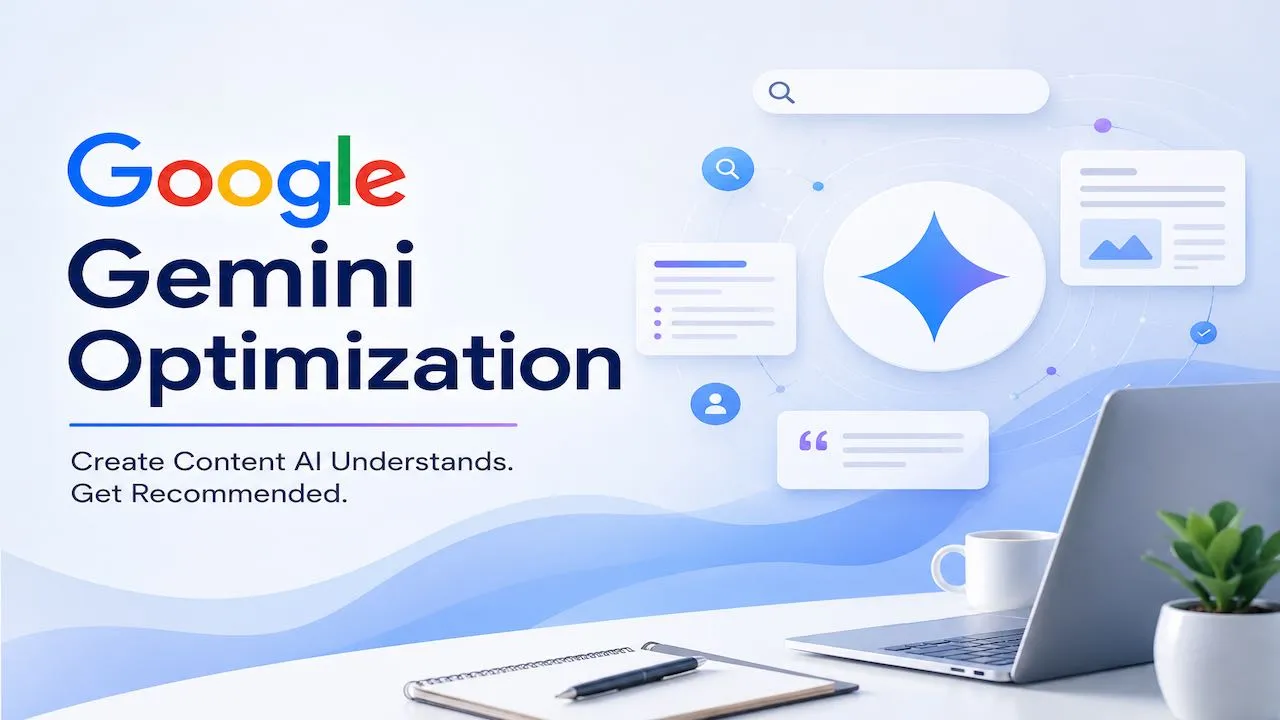
AI Overviews cite multiple sources. Passage optimization, schema markup, and EEAT signals determine citation selection. AI Overviews appear on 48% of all Google searches. That figure comes from BrightEdge tracking data. It marks a 58% year-over-year increase. Google’s LLM-based system retrieves 100 to 300 word passages from indexed pages. It uses NLP to synthesise direct answers. It cites contributing sources with prominent links.
Your goal is not only to rank on page one. Your goal is to become a source Google cannot answer the query without citing. QuickDigital has managed AI Overviews programs for clients across B2B, SaaS, healthcare, and professional services since 2014.
If your top-10 content earns no AI Overview citations, this guide explains why. If competitors are cited while your pages are ignored, the 7 ranking factors below explain why.
How Google AI Overviews Work: The 2-Stage Retrieval System
Google AI Overviews use a 2-stage pipeline. Each stage has different ranking signals. Each stage has different optimisation levers. Understanding both stages is the foundation of Google AI Overviews optimization strategy.
Google AI Overviews launched as Search Generative Experience (SGE), tracked as SGEi by monitoring tools. It now runs on Gemini generative AI models with semantic search and NLP capabilities. Google Bard was the earlier LLM architecture that preceded today’s AI Overview synthesis system.
Stage 1: Retrieval from the Organic Index
Stage 1 is gated by organic ranking signals. Google selects candidate pages from the existing organic index. Pages with weak organic rankings rarely reach Stage 2 evaluation. 76.1% of AI Overview citations come from pages ranking in the top 10 according to Ahrefs research. If your page is not on page one, AI Overviews optimization has no effect on that page. Fix organic rankings first.
AI Overviews and traditional SEO are not competing strategies. Organic SEO is the prerequisite. AI Overview citation is the next step for pages that already rank well.
This is also the key distinction between AI Overviews and AI Mode. AI Mode operates with a separate retrieval layer. AI Overviews pull primarily from pages already in organic results. The optimisation overlap between both systems is around 70%.
Stage 2: Passage Extraction and Synthesis
Stage 2 changes the competitive target entirely. Once Google retrieves candidate pages, it moves to passage extraction. The system does not rank whole pages against the query. It extracts individual passages of 100 to 300 words. Each passage must answer a specific sub-question clearly.
A page can contribute one passage to one sub-question. It can do this without ranking position one for the entire query. 47% of AI Overview citations come from pages ranking below position 5 per BrightEdge data. Position matters less than passage quality at Stage 2.
Each query generates multiple sub-questions. These are called fan-out queries. The system runs a separate retrieval pass for each sub-question. A page answering one fan-out query earns a citation for that passage. Passage-level competition is where most AI Overview optimisation wins live.
| Optimisation Target | Traditional SERP Ranking | Google AI Overview Citation |
|---|---|---|
| Unit of relevance | Whole page vs query | Individual passage vs sub-question |
| Primary ranking signal | Backlinks and domain authority | Passage clarity and EEAT authority |
| Content structure | Helps readability and rankings | Critical; drives passage extraction |
| Schema markup | Enables rich results | Correlates with +73% citation rate |
| EEAT signals | Domain-level trust signal | 2.3x citation multiplier vs weak EEAT |
| Win condition | Rank above competitors | Provide the clearest extractable passage |
The 7 AI Overview Ranking Factors That Drive Citations
AI Overview ranking factors fall into two categories. Threshold requirements must be met before any citation is possible. Passage-level signals determine which eligible pages get cited. The factors below are ordered by evidence strength.
Factor 1: Traditional Organic Ranking
Pages outside the top 10 never reach Stage 2 evaluation. Google’s retrieval system selects from the existing organic index. A page at position 15 never reaches Stage 2 evaluation. Fix organic rankings before attempting passage-level work. Organic SEO is the threshold requirement. Review our SEO best practices for site architecture to support both organic ranking and AI Overview eligibility.
Factor 2: Passage-Level Answer Quality
Target 134 to 167 words per AI Overview passage. Passages under 100 words often lack specificity for AI synthesis. Passages over 300 words reduce extraction clarity. Each passage must answer one specific sub-question completely. The answer must appear in the first sentence.
Write every section as a standalone answer. The heading states the sub-question. The first sentence states the answer. Remaining sentences provide supporting evidence. This structure creates clear passage boundaries. Google’s extraction system isolates and cites these boundaries reliably.
Factor 3: Schema Markup
Schema markup correlates with a 73% higher selection rate for AI Overview citations. This finding comes from Wellows analysis. Schema does not force a citation. It makes content unambiguous to machine reading systems. Google’s passage extraction layer reads schema as a machine-readable answer map.
4 schema types have the strongest documented AI Overview impact. These are FAQ schema, HowTo schema, Article schema, and Person schema. Pages combining text, images, video, and schema see 317% more AI citations per Ahrefs research. Schema amplifies the citation probability of already-strong passages. For the complete technical implementation, see our schema markup implementation guide for AEO.
Factor 4: EEAT Authority Signals
Strong EEAT earns 2.3x more AI Overview citations than high position alone. This comes from Wellows and ZipTie.dev research. Position is a threshold. EEAT is the differentiator after that threshold is met.
Key EEAT Signals for AI Overview Citations
- Author entity verification through Person schema linked to credentials.
- Organisation schema with verified business identity.
- External citations and brand mentions across authoritative third-party sources.
- Visible author bios with verifiable professional credentials on the content page.
See our EEAT trust and authority guide for the full implementation framework.
Factor 5: Fan-Out Query Coverage
Fan-out queries are the sub-questions Google generates from any main query. A study of 173,902 URLs found a clear result. Ranking for fan-out queries made a page 49% more likely to earn an AI Overview citation. The Spearman correlation between fan-out query breadth and citation likelihood is 0.77.
Build fan-out query coverage by mapping every sub-question a user might ask about your topic. Add a dedicated H3 section for each sub-question. Answer each sub-question directly in the first sentence of its section. Use People Also Ask data and Google autosuggest to identify sub-questions. See our People Also Ask domination guide for the PAA coverage approach.
Factor 6: Multiformat Content
Multiformat pages achieve 317% more AI Overview citations per Ahrefs. This comes from Ahrefs research. Multiple content formats signal authoritative topic treatment to Google’s verification systems. It is not about aesthetics.
Add ImageObject schema to every image on target pages. Add VideoObject schema to embedded videos. Each additional schema-tagged format increases citation selection probability. It compounds alongside your passage quality and EEAT signals to produce a stronger citation profile.
Factor 7: Content Freshness Signals
AI Overview systems favour content with visible, accurate freshness signals. A visible publication date helps. A visible last-updated date matters equally when content has been revised. Statistics should include their source and collection period. Outdated statistics with no citation date reduce AI Overview citation probability.
Update the statistics in your top-10-ranking content regularly. Add the update date visibly to the page. Add it through Article schema dateModified markup as well. Both signals together confirm freshness for the AI retrieval system.
Content Structure for Google AI Overview Citations
Content structure drives passage extraction quality. The structural patterns that win AI Overview citations share 3 characteristics. They answer the sub-question in the first sentence of each section. They keep each passage between 134 and 167 words. They use hierarchical headings that signal topic relationships to machine parsing systems.
Answer-First Formatting for Passage Optimization
Answer-first formatting leads each section with a direct answer. Every subsequent sentence provides supporting evidence, examples, or statistics. Google’s passage extraction system retrieves the first strong answer it encounters. Answers buried after 3 sentences of context are extracted less reliably.
Apply answer-first formatting at every heading level. Your H2 section introduction answers the H2 question immediately. Your H3 sections answer their specific sub-questions immediately. Pages with answer-first formatting at every section generate more citations per page. See our conversational keywords guide for the query optimisation approach that feeds AI Overview answer formats.
Passage Length Targeting: 134 to 167 Words
134 to 167 words per section is the target. Passages below 100 words often lack specificity for the AI synthesis layer. Passages above 300 words create extraction ambiguity. The system may extract a different passage boundary than intended.
Check your content section by section. Count the words between each heading and the next. Splitting one 800-word section into 5 sections of 160 words each creates 5 passage candidates. This multiplies your citation surface area from a single page. It requires no additional content production. It is the structural change with the highest citation yield per unit of effort.
FAQ Section Strategy for AI Overviews
Add a FAQ section to every content page. FAQ sections create clean, clearly bounded question-answer pairs. These align exactly with how Google’s passage extraction system retrieves sub-question answers. Add FAQ schema markup to every question-answer pair in the section.
FAQ questions must match actual sub-questions users ask. Use Google Search Console performance data to identify queries your page receives impressions for. Add those exact questions as FAQ entries with direct answers. This converts evaluation signals into citation signals directly.
Schema Markup for AI Overview Optimisation
Schema markup defines passage answers for machine reading. It does not replace strong content. It makes strong content machine-readable with certainty. These are the schema types with documented impact on AI Overview citation rates.
FAQ Schema: The Highest-Impact Schema for AI Citations
FAQ schema marks up question-answer pairs. Google’s passage extraction system treats FAQ schema entries as pre-identified citation candidates. Each question-answer pair becomes an explicit passage candidate with a clear boundary. Implement FAQ schema on every page containing a FAQ section.
Use the FAQPage schema type with Question and acceptedAnswer child types for each pair. Match the FAQ schema questions exactly to the heading text of each FAQ question on the page. This creates the clearest possible boundary signal for the extraction system.
Article and Person Schema for EEAT Verification
Article schema feeds author signals into EEAT verification. Include the author field in your Article schema pointing to a Person schema entity. The Person schema must include the author’s name, job title, and professional credentials. Add a sameAs property linking to their verified professional profiles such as LinkedIn.
Organization schema provides the business entity context that supports domain-level EEAT credibility. Include your organisation’s name, URL, logo, and contact information in Organization schema on every page. For the complete entity-schema strategy, see our semantic SEO and entity optimisation guide.
HowTo Schema for Procedural Content
HowTo schema marks up procedural content as a series of clearly bounded steps. Google’s AI Overview system frequently cites step-by-step content for procedural queries. Each step provides a clean, self-contained passage candidate. Implement HowTo schema on any content covering processes, tutorials, or setup guides.
Each HowToStep element creates an explicit passage boundary with a name and description. The extraction system can retrieve each step independently. This makes procedural content one of the most citation-ready formats for AI Overviews.
EEAT Signals That Earn AI Overview Citations
EEAT signals for AI Overview citations differ from standard SEO EEAT in one important way. Standard SEO EEAT primarily affects domain-level trust. AI Overview EEAT functions as a citation multiplier at the passage level. A passage from a verified expert author is cited over a stronger-ranking passage from an unverified author.
Author Entity Optimisation for AI Search
Every page targeting AI Overview citations needs a named, credentialled author. The author bio must appear directly on the page. It must include the author’s name and their specific expertise. It must include verifiable credentials such as professional certifications. It must include links to their external professional profiles.
Build an author profile page on your domain for every subject matter expert. Link every piece of content to its author profile page. Link the author profile page to the author’s external professional profiles. A credentialled author with a complete entity chain produces measurably higher citation rates. For how Knowledge Panel entity signals amplify author authority, see our Knowledge Panel optimisation guide.
External Authority and Brand Mention Signals
External authority signals come from brand mentions across authoritative third-party sources. Coverage in industry publications helps. Consistent entity references across multiple high-trust platforms matter equally. Google’s verification protocol confirms expertise through external sources. Internal claims of authority have no measurable effect on citation rates.
Build external authority through original research publication and expert commentary in industry media. Use systematic brand mention acquisition across the platforms that feed Google’s knowledge graph. See our unlinked brand mentions and AI search ranking guide for how brand mentions function as citation signals. See our link building for Google AI Overviews guide for the authority-building strategies AI Overviews require.
Fan-Out Query Strategy: The Highest-Evidence Optimisation Action
Fan-out query coverage is the core AI Overview content strategy. Every primary query generates a cluster of sub-questions. Google runs a separate passage retrieval pass for each one. A page covering more sub-questions generates more citation opportunities per page.
Building Your Fan-Out Query Map
Build your fan-out query map before writing or revising content. Enter your primary keyword into Google Search and collect the People Also Ask questions. Collect the related searches at the bottom of the results page. Enter the keyword into Google autosuggest and record every suggested variation.
Each suggestion represents a sub-question Google expects authoritative content to answer. Structure your content with a dedicated H3 section for each sub-question. Answer each one directly in the first sentence of its section. Target the 134 to 167 word passage length for each sub-question section.
Fan-out coverage also increases topical authority signals for traditional organic ranking. A page covering 12 related sub-questions signals deeper expertise than a page covering only the head term. Fan-out query optimisation improves both your Stage 1 eligibility and Stage 2 citation rate. For the generative engine optimisation strategy incorporating fan-out query coverage, see our generative engine optimisation guide.
Voice Search and AI Overview Citation Overlap
Voice search optimization and AI Overviews share a strong structural overlap. Both systems favour direct, conversational answers in the first sentence of each passage. Both favour FAQ-formatted content with clear question-answer structure. Both favour structured data markup that confirms passage intent.
Voice search queries are almost exclusively question-based. They match the sub-question format that AI Overviews extract passages for. Pages built with voice search optimization tend to score higher on passage clarity metrics. Voice search optimization is a complementary strategy for improving AI Overview citation rates. For the full voice search strategy, see our voice search optimisation guide.
Measuring Google AI Overview Citation Performance
Google Search Console does not yet provide a dedicated AI Overview citation report. Measure AI Overview citation performance using these proxy metrics and third-party tools.
- Google Search Console impression-to-click ratio: A page receiving high impressions for a query with near-zero clicks may be contributing to an AI Overview. That AI Overview is satisfying user intent before a click. Track impression-to-click ratios for each top-ranking page. A ratio well below your site average signals potential AI Overview coverage on that query.
- SE Ranking AI Overview Tracker: SE Ranking’s tool tracks which queries trigger AI Overviews and which pages are cited. Use it to identify which of your pages earn citations and which target queries cite competitors instead.
- Manual SERP monitoring: Run weekly manual searches for your 20 most important target queries. Record which queries trigger AI Overviews and which sources are cited. Check whether your pages appear in the citations. This takes 20 minutes per week and provides direct citation data.
- Branded query impressions: AI Overview citations send branded search signals even without clicks. Track your branded query impression volume in Search Console alongside citation monitoring. Growth in branded impressions following citation gains confirms AI Overview visibility is building brand recognition.
For the full AI search visibility measurement framework, see our link building measurement for AI search guide.
Common Google AI Overview Optimisation Mistakes
These mistakes consistently prevent eligible pages from earning AI Overview citations despite ranking in the top 10.
- Attempting AI Overview optimisation without page-one organic rankings. The retrieval stage is gated by the organic index. Pages not ranking in the top 10 are simply not evaluated at Stage 2. For the zero-click search strategy working alongside AI Overviews optimisation, see our zero-click search optimisation guide.
- Burying the direct answer after context paragraphs. Google’s passage extraction system retrieves the first clear answer in a passage. Three sentences of context before the answer reduces extraction reliability. Lead with the answer. Follow with the evidence.
- Writing passages over 400 words without sub-headings. Long sections without structural boundaries create extraction ambiguity. Split long sections into sub-questions. Each sub-question needs a heading and a passage under 300 words.
Schema, Author, and System Mistakes
- Adding schema markup without improving content quality first. Schema helps the extraction system read strong content. It does not convert weak content into a citation candidate. Strong passage quality comes first. Schema markup amplifies it.
- Ignoring author entity signals on high-ranking pages. Pages with anonymous authorship lose citation probability at Stage 2 to pages with weaker rankings but verified expert authors. Add author bios and Person schema to every page targeting AI Overview citations.
- Treating AI Overviews and AI Mode as identical systems. AI Overviews primarily retrieve from the existing organic index. AI Mode operates with a separate retrieval layer. Strategies written for AI Mode do not transfer directly to AI Overviews.
For the answer engine optimisation approach covering all AI search surfaces, see our AEO guide. Our specialist AI SEO services and GEO services cover the full implementation program. See platform-specific guides for ChatGPT, Perplexity AI, Google Gemini, and Claude AI.
Google AI Overviews Optimisation by QuickDigital
Get Your Content Cited in Google AI-Generated Answers
QuickDigital audits your top-ranking pages against the AI Overview citation factors. We implement passage-level restructuring, schema markup, and EEAT signal optimisation. We track citation rates across your target queries and report measurable improvements. Since 2014, we have optimised content for every major shift in Google’s ranking systems.
Get My AI Overviews AuditFree audit. No obligation. Response within 24 hours.
Frequently Asked Questions
First, reach the top 10 for your target query. Then optimise individual passages of 134 to 167 words to answer specific sub-questions. Add FAQ schema, Article schema, and Person schema markup. Build author entity signals with verifiable credentials. Pages with strong EEAT signals are cited 2.3x more than position-one pages with weak EEAT.
Yes. Featured snippets optimisation targets the single best answer for a head query. AI Overview optimisation targets being cited as one of multiple sources across sub-questions. AI Overviews retrieve passages from multiple pages at once. You need to be the clearest source for at least one sub-question.
FAQ schema, HowTo schema, Article schema, and Person schema have the strongest documented impact. Schema markup correlates with a 73% higher AI Overview selection rate per Wellows analysis. Pages combining text, images, video, and schema achieve 317% more AI citations than single-format text content.
No. Being in the top 10 is the threshold. Position one is not required. Pages at positions 6 to 10 with strong EEAT are cited 2.3x more than position-one pages with weak EEAT. Also, 47% of AI Overview citations come from pages below position 5. Passage clarity matters more than exact rank position.
Use Google Search Console impression-to-click analysis, SE Ranking’s AI Overview tracker, and weekly manual SERP monitoring. A page with high impressions and near-zero clicks may be contributing to an AI Overview. That AI Overview is satisfying user intent before a click. Track branded query impression growth as a confirmation signal.